Tag: Facebook Messenger

  • Meru Cabs now available on Facebook Messenger

    Meru Cabs now available on Facebook Messenger

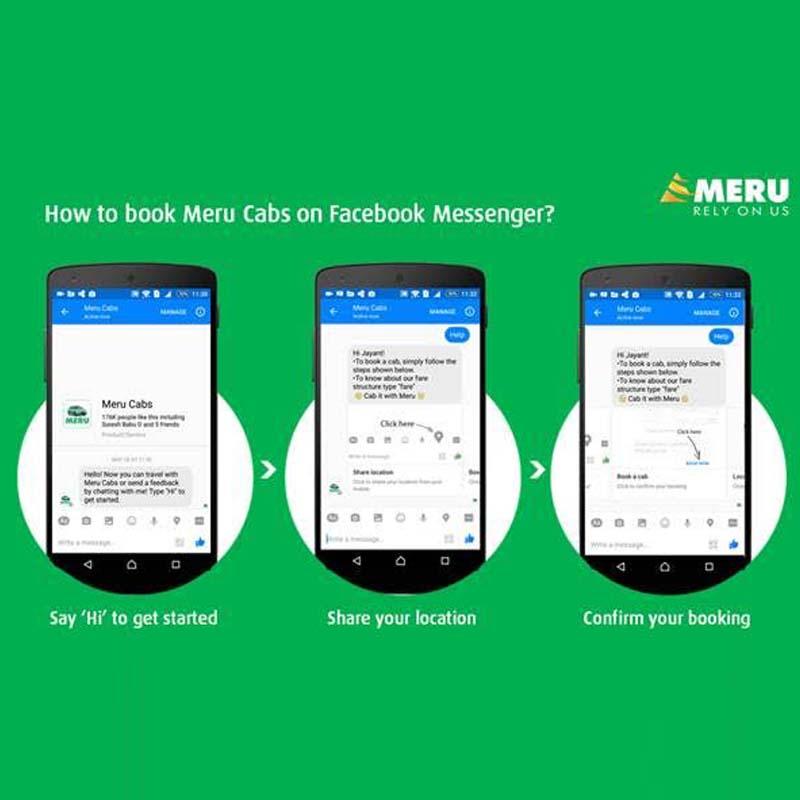
    MUMBAI: Meru Cabs announced the integration of their cab booking system with Facebook Messenger to provide automated cab booking facility. Meru’s entire range of taxi services will now be accessible to Facebook users via Facebook Messenger and will allow them book cabs through key words, intelligent chat bot and conversational question- answers through the service called Meru Messenger Bot. With this new development Meru Cabs becomes the first cab services provider in the world to go live with implementing Facebook’s Bot services.

    Adopting the latest technology, Meru aims to widen their customer base by providing convenient and seamless cab booking access to its users. Facebook messenger users can simply search “Meru Cabs” on Facebook Messenger under ‘Bots and Business’ section and begin interaction. After the initial mobile number verification (one time), the user starts a normal chat with Meru Messenger Bot to book a cab. Once the location is shared on the chat box, the user is then directed to choosing sedan (Meru) or hatchback (MeruGenie) cab available for the trip with the ETA (Estimated Time of Arrival). Once confirmed, the Meru Messenger Bot responds on real time basis with the cab details along with the chuffer’s mobile number. The bot enables the user locate his/her cab & check the fare details.

    Commenting on the technology implementation, Mr. Siddhartha Pahwa, Group CEO, Meru Cabs said, “Simplifying our customer’s lives and addressing all their requirements is our priority at Meru. With this new feature, the process of booking a cab has become as convenient as chatting with a friend on Facebook messenger. Now, Meru Cabs is available to 150 million Facebook messenger users to book cabs in India.”

    Commenting on the technology implementation, Mr. Nilesh Sangoi, CTO, Meru Cabs said, “We are very happy that our system was accepted by the Facebook Developer platform and instantly integrated in the Messenger. We will continue to adopt unique technology products to de-clutter our user’s lives, ensuring convenience & accessibility of our services to them.”

  • Gupshup announces launch of bot builder platform gupshup.io in India

    Gupshup announces launch of bot builder platform gupshup.io in India

    MUMBAI: Gupshup, the world’s leading messaging platform trusted by developers in more than 30,000 businesses, has announced the launch of its new bot builder platform, gupshup.io, poised to lead a new wave of bot revolution in India. The Gupshup.io platform consists of omni-channel messaging APIs and bot builder tools. The omni-channel APIs enable connectivity to almost every messaging channel including SMS, Facebook Messenger, Slack, Telegram, Teamchat etc, with more to be added soon. The bot builder tools support the entire bot lifecycle including development, testing, deployment, hosting, publishing, monitoring, tracking, search and discovery of bots.

    With messaging apps recently opening up APIs for businesses to build bots, we’re now on the verge of a once-in-a-decade paradigm shift in the tech industry. After desktop and clients in the mid-80s, browsers and websites in the mid-90s, and mobile OS and apps in the mid-00s, messaging platforms and bots are emerging as the next wave of tech revolution. Virtually everything that we do today on websites or apps will soon be done through bots. Bots will enable shopping, ordering food, banking, trading and most other activities through your favourite messaging app.

    “Bots are the new apps. Bots will transform virtually every aspect of our lives, making it simpler and easier to engage with businesses and brands just by chatting with them”, said Gupshup founder and CEO Beerud Sheth. He further added, “Every business and brand will have to develop a bot strategy quickly. Gupshup.io offers the most advanced tools globally for developers preparing to meet the explosive demand for messaging bots and services.”

    Gupshup used its extensive experience with the bot building process to automate common tasks performed by every bot developer. The Gupshup platform enables a developer to build, test and deploy a bot across multiple channels in minutes. The bot is automatically hosted with a one-click deploy process.  Post-launch monitoring and tracking of bots has also been automated. An omni-channel bot store enables the search and discovery of bots, helping developers to promote their bots. Instead of using a patchwork of tools, the Gupshup platform offers an end-to-end integrated platform for developers that frees them up to focus on their specific workflows.

    Gupshup continues to operate its smart-messaging app Teamchat, which pioneered the concept of smart messages i.e. structured fields within chat messages. Teamchat was the earliest and most bot-friendly messaging app, currently being used by over 2,000 businesses, including companies like HDFC, ICICI, Biostadt, Meru Cabs, PNB Metlife and others. Bots built on Teamchat continue to support enterprise use-cases such as CRM, HR and ERP.

  • Gupshup announces launch of bot builder platform gupshup.io in India

    Gupshup announces launch of bot builder platform gupshup.io in India

    MUMBAI: Gupshup, the world’s leading messaging platform trusted by developers in more than 30,000 businesses, has announced the launch of its new bot builder platform, gupshup.io, poised to lead a new wave of bot revolution in India. The Gupshup.io platform consists of omni-channel messaging APIs and bot builder tools. The omni-channel APIs enable connectivity to almost every messaging channel including SMS, Facebook Messenger, Slack, Telegram, Teamchat etc, with more to be added soon. The bot builder tools support the entire bot lifecycle including development, testing, deployment, hosting, publishing, monitoring, tracking, search and discovery of bots.

    With messaging apps recently opening up APIs for businesses to build bots, we’re now on the verge of a once-in-a-decade paradigm shift in the tech industry. After desktop and clients in the mid-80s, browsers and websites in the mid-90s, and mobile OS and apps in the mid-00s, messaging platforms and bots are emerging as the next wave of tech revolution. Virtually everything that we do today on websites or apps will soon be done through bots. Bots will enable shopping, ordering food, banking, trading and most other activities through your favourite messaging app.

    “Bots are the new apps. Bots will transform virtually every aspect of our lives, making it simpler and easier to engage with businesses and brands just by chatting with them”, said Gupshup founder and CEO Beerud Sheth. He further added, “Every business and brand will have to develop a bot strategy quickly. Gupshup.io offers the most advanced tools globally for developers preparing to meet the explosive demand for messaging bots and services.”

    Gupshup used its extensive experience with the bot building process to automate common tasks performed by every bot developer. The Gupshup platform enables a developer to build, test and deploy a bot across multiple channels in minutes. The bot is automatically hosted with a one-click deploy process.  Post-launch monitoring and tracking of bots has also been automated. An omni-channel bot store enables the search and discovery of bots, helping developers to promote their bots. Instead of using a patchwork of tools, the Gupshup platform offers an end-to-end integrated platform for developers that frees them up to focus on their specific workflows.

    Gupshup continues to operate its smart-messaging app Teamchat, which pioneered the concept of smart messages i.e. structured fields within chat messages. Teamchat was the earliest and most bot-friendly messaging app, currently being used by over 2,000 businesses, including companies like HDFC, ICICI, Biostadt, Meru Cabs, PNB Metlife and others. Bots built on Teamchat continue to support enterprise use-cases such as CRM, HR and ERP.

  • Time spent online doubles in a decade fuelled by smartphones, tablets: Ofcom

    Time spent online doubles in a decade fuelled by smartphones, tablets: Ofcom

    MUMBAI: Ofcom’s Media Use and Attitudes 2015 report, now in its tenth year, shows that Internet users aged 16 and above claimed to spend nearly 10 hours (9 hours and 54 minutes) online each week in 2005. By 2014 it had climbed to over 20 hours and 30 minutes.


    The biggest increase in Internet use is cited among 16-24 year olds, almost tripling from 10 hours and 24 minutes each week in 2005 to 27 hours and 36 minutes by the end of 2014.


    2014 saw the biggest increase in time spent online in a decade, with Internet users spending over three and a half hours longer online each week than they did in 2013 (20 hours and 30 minutes in 2014, compared to 16 hours and 54 minutes in 2013).


    Five years of tablet computing


    Increasing take-up of tablets and smartphones is boosting time spent online. Apple’s iPad launched in the UK five years ago this month, alongside Android and other devices, helped to take tablets into the mainstream.


    While just five per cent of adults reported using a tablet to go online in 2010, this increased to 39 per cent in 2014. Using a smartphone has more than doubled in five years, from 30 per cent of adults in 2010 to 66 per cent in 2014.


    As a result, the amount of time people are online while ‘out and about’ – away from home, work or their place of study – has increased five-fold over the past ten years, from 30 minutes in 2005 to nearly two and a half hours (2 hours and 18 minutes) in 2014.


    Overall, the proportion of adults using the Internet has risen by half – from six in ten in 2005 to almost nine in ten today.


    Increased mobile and online entertainment


    More people are watching TV and video on the Internet. Over a quarter (27 per cent) of Internet users regularly watch TV or films online, compared to one in ten in 2007. This rises to 39 per cent of 16-24 year olds, up from 21 per cent in 2007.


    Watching video clips online has almost doubled over the past eight years, from 21 per cent to 39 per cent of Internet users.


    The mobile phone is now the primary device used for gaming with over a quarter (26 per cent) of mobile users playing games at least once a week, compared to 17 per cent playing on games consoles. Fifteen per cent of adults now use a tablet for gaming.


    The proportion of Internet users saying they regularly play games online has doubled from 10 per cent in 2005 to 22 per cent in 2014.


    Surge in instant messaging on mobiles


    Instant messaging has become a popular way of keeping in touch, driven by services including WhatsApp, Facebook Messenger and BBM.


    Regular instant messaging on a mobile phone has leapt from 29 per cent of mobile phone users in 2013 to 42 per cent in 2014. Instant messaging across all devices has seen the biggest growth among 25-34 year olds, 80 per cent of Internet users in this age group are instant messaging at least once a week, up from 38 per cent in 2005.


    Nearly all mobile phone users are sending text messages (90 per cent in 2014, compared to 70 per cent in 2005). People are also increasingly using their mobile phone to email (52 per cent regularly using their phone to email, compared to five per cent in 2005) or make a phone call over the Internet (VoIP) – 43 per cent in 2014, compared to 27 per cent in 2013.


    Social media fans


    The use of social media has tripled since 2007, when Ofcom first asked people about their social media habits. Nearly three quarters (72 per cent) of Internet users aged 16 and above say they have a social media profile, compared to 22 per cent in 2007.


    Some 81 per cent of social media users log into these websites or apps – including Facebook, Twitter, LinkedIn, Instagram or Tumblr – at least once a day, up from 30 per cent in 2007.


    Social media has seen the biggest growth among 35-44 year olds, with 80 per cent of Internet users in this age group now on social media, up from just 12 per cent in 2007.


    2014 saw a dramatic surge in older people using social media, with nearly half (49 per cent) of 55-64 year olds who go online having a social media profile, up from one third (33 per cent) in 2013.


    People still love their TV but mobiles are a must for young people


    People are spending more time online but, when asked which device they would miss the most, 37 per cent of adults said they would miss their TV more than any other device.


    The mobile phone came a close second with nearly one in three adults (32 per cent) saying it would be the device they would miss the most.


    But for 16-24 year olds, the TV came a distant second to their mobile phone. Some 59 per cent of this age group said they would miss their mobile the most, compared to 17 per cent saying TV.


    Less concern about being online


    The proportion of Internet users aged 16 and above saying they are concerned about the Internet has fallen over the past 10 years, from around 70 per cent in 2005 to 51 per cent in 2014 – stable on 2013.


    But Internet users are increasingly likely to agree they should be protected from inappropriate or offensive online content (60 per cent strongly agreed in 2014, compared to 51 per cent in 2013).


    There was an increase in concerns about mobile ‘apps’ in 2014, with 28 per cent of app users reporting concerns compared with 20 per cent in 2013. This has been largely driven by issues around security, fraud or privacy, with 20 per cent of users saying they were concerned about these areas, up from 14 per cent in 2013.


    The majority of Internet users (68 per cent) are happy to provide personal information online in the belief they will benefit in some way. But more people say they would never provide their credit or debit card details (21 per cent in 2014, compared to 13 per cent in 2013) or their mobile number (26 per cent in 2014, 17 per cent in 2013).


    Public and civic activities


    People are much more likely to go online for public or civic activities now than they were in 2005.


    For example, in 2014 nearly eight in 10 Internet users (78 per cent) said they had gone online to find out about a public service, up from half (49 per cent) in 2005.


    More Internet users say they have visited political or campaigning websites, up from 19 per cent in 2005 to 44 per cent in 2014.


    Ofcom’s Adults Media Use and Attitudes Report 2015 covers the use and attitudes of UK adults (aged 16 and above) across the Internet, TV, radio, games and mobile phones.