Tag: Experiential Marketing

  • Godrej L’Affaire combines experiential, influencer and digital marketing

    Godrej L’Affaire combines experiential, influencer and digital marketing

    MUMBAI: Experiential marketing as a tool of brand activation has become extremely prevalent in the past few years. It is a powerful way to engage the customers better with a brand through first-hand experiences offering not just the look, but the touch and feel of any product on display.

    Another interesting aspect that has been added to this whole paradigm of bringing brands and consumers closer is the effective use of influencer marketing. While earlier influencer and experiential marketing were two mutually exclusive trends, in the recent past, both have intertwined rather seamlessly to offer an exponential reach to the brands. One thing that has definitely contributed to its growth is the digital boom.

    Anexample of the tactical use of experiential, influencer and digital marketing together is L’Affaire, a luxury lifestyle platform by the Godrej Group.

    L’Affaire recently concluded its third edition at Vikhroli, Mumbai, presenting a wholesome experience to its patrons themed around ‘5 Senses’. The unique platform offered rich experiences spanning across fashion, lifestyle, music and dance performances, workshops, food, and engaging conversations. The event saw a huge footfall of influencers from across the genres experiencing the magic of Godrej and other associated brands like Myntra through a stellar show augmented by fashion displays and musical presentations.

    Speaking about the concept behind this exclusive soiree with Indiantelevision.com, Godrej Group vice president and head corporate brand Sujit Patil noted, “The key idea behind creating our very own media platform was to build a Mecca of content creation. We had various brands within Godrej, which were interacting with the influencers and people who recommend products individually. So, we thought why we can’t combine these distinct products, which are anyway a part of the same genre and create something bigger. We planned to make to it so compelling that it eventually becomes brand-agnostic and comes out as a kind of property where experiential engagement happens and we get more number of influencers on board.”

    He further added, “Most importantly, we wanted to show our products in the real light. We wanted the influencers to experience the look, the feel, the touch, and get to them the factors that really mean the credo of a particular brand.”

    On being quizzed why is it important to involve influencers and bloggers in this whole paradigm of experiential marketing, Patil mentioned that today we live in a world that follows authenticity. “If you ask someone to write about something without experiencing it, it is unauthentic, and people will be able to read through that. But when people come here, experience the products and then write about it, they write it from the heart. That helps in getting more traction,” he said.

    Sujit also contended that influencer marketing is only bound to grow. He said, “Micro-influencers, even if they have a lesser number of followers, can write authentically and bring out the essence in an honest manner and it’s going to work [for the brands.”

  • India’s AdEx revised to Rs 62,483 cr. by EEMA; includes ‘experiential’ with 13.6 per cent share

    India’s AdEx revised to Rs 62,483 cr. by EEMA; includes ‘experiential’ with 13.6 per cent share

    MUMBAI: ‘Experiential Marketing’ or the concept of creating a bond between the consumer and the brand beyond ‘buying and selling’ by immersing them in an experience, is an underrated and underrepresented form of marketing, several marketers guiltily admit.

    Historically they have shied away from accepting experiential as a separate media to spend on, due to the dearth of representative figures, measurement challenges  and studies done on the subject.

    Off-late things have changed and experts observe that experiential marketing is increasingly becoming part of the popular marketing conversation, thanks to the acceptance of digital and the advent of several new technologies.

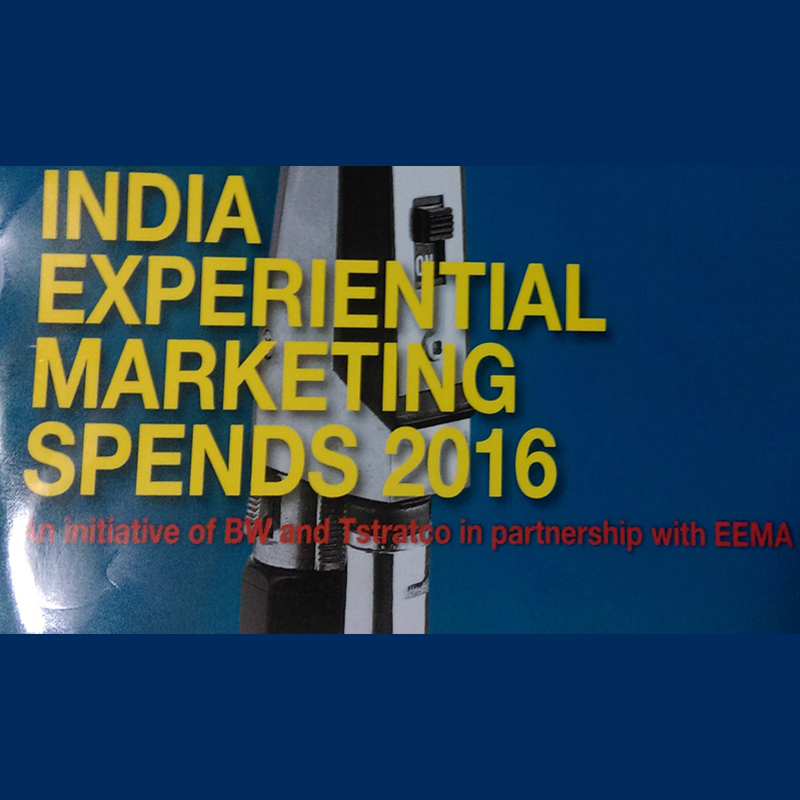
    This has led to several industry bodies to sit up and take notice, and do a quantitative evaluation of the sector.  In fact a recent report on the sector released at the EEMAX Conclave 2016 has raised India’s estimated total adex for 2016-2017 to Rs 62,483 cr by including an additional ad ex of Rs 8,483 cr represented by experiential marketing.  

    As per a report compiled by Business World and Tstratoo, in partnership with Event and Entertainment Management Association (EEMA),  between 2014 and 2016 the experiential marketing industry has seen an estimated 16 to 17 per cent growth.

    The EY-EEMA report for 2014-2015 assessed the experiential marketing industry size to be worth Rs 6250 cr in terms of revenue out of which Rs 3750 cr represented the organised sector and Rs 2500, the unorganised sector. Estimates for its 2015-2016 report pegs the industry at Rs 7281 cr, showing a growing increase in the representation of the organised sector. It amounted to Rs 4,369 of the total worth in 15-16 financial year.

    EY-EEMA predicts sector’s growth

    Identifying ‘experiential’ as a whole new media segment in which marketers are investing their media budget, the study further provides an advertisement expenditure break-up.

    FICCI-KPMG report predicts India’s total AdEx to reach Rs 54000 cr in the year 2016.  Citing that advertising spend in the experiential marketing sector doesn’t feature in the major industry reports like FICCI-KPMG, GroupM’s TYNY and Pitch Madison, the report takes the liberty to include the estimated Rs 8,483 in the total adex, increasing it to Rs 62,483.

    public://chart.jpg

    Upon consulting the report with marketing expert and Maxus experiential marketing national direct Vidur Patney, he said, “It is a disorganised and fragmented sector. Not many firms have a process or are part of larger groups to ensure that the quoted figures are spot on to be used in such researches. While I trust EY, the numbers are what companies say, and are seldom validated.”


  • India’s AdEx revised to Rs 62,483 cr. by EEMA; includes ‘experiential’ with 13.6 per cent share

    India’s AdEx revised to Rs 62,483 cr. by EEMA; includes ‘experiential’ with 13.6 per cent share

    MUMBAI: ‘Experiential Marketing’ or the concept of creating a bond between the consumer and the brand beyond ‘buying and selling’ by immersing them in an experience, is an underrated and underrepresented form of marketing, several marketers guiltily admit.

    Historically they have shied away from accepting experiential as a separate media to spend on, due to the dearth of representative figures, measurement challenges  and studies done on the subject.

    Off-late things have changed and experts observe that experiential marketing is increasingly becoming part of the popular marketing conversation, thanks to the acceptance of digital and the advent of several new technologies.

    This has led to several industry bodies to sit up and take notice, and do a quantitative evaluation of the sector.  In fact a recent report on the sector released at the EEMAX Conclave 2016 has raised India’s estimated total adex for 2016-2017 to Rs 62,483 cr by including an additional ad ex of Rs 8,483 cr represented by experiential marketing.  

    As per a report compiled by Business World and Tstratoo, in partnership with Event and Entertainment Management Association (EEMA),  between 2014 and 2016 the experiential marketing industry has seen an estimated 16 to 17 per cent growth.

    The EY-EEMA report for 2014-2015 assessed the experiential marketing industry size to be worth Rs 6250 cr in terms of revenue out of which Rs 3750 cr represented the organised sector and Rs 2500, the unorganised sector. Estimates for its 2015-2016 report pegs the industry at Rs 7281 cr, showing a growing increase in the representation of the organised sector. It amounted to Rs 4,369 of the total worth in 15-16 financial year.

    EY-EEMA predicts sector’s growth

    Identifying ‘experiential’ as a whole new media segment in which marketers are investing their media budget, the study further provides an advertisement expenditure break-up.

    FICCI-KPMG report predicts India’s total AdEx to reach Rs 54000 cr in the year 2016.  Citing that advertising spend in the experiential marketing sector doesn’t feature in the major industry reports like FICCI-KPMG, GroupM’s TYNY and Pitch Madison, the report takes the liberty to include the estimated Rs 8,483 in the total adex, increasing it to Rs 62,483.

    public://chart.jpg

    Upon consulting the report with marketing expert and Maxus experiential marketing national direct Vidur Patney, he said, “It is a disorganised and fragmented sector. Not many firms have a process or are part of larger groups to ensure that the quoted figures are spot on to be used in such researches. While I trust EY, the numbers are what companies say, and are seldom validated.”


  • Tata Motors bets big on experiential marketing; rolls out ZICA ‘7 Senses’

    Tata Motors bets big on experiential marketing; rolls out ZICA ‘7 Senses’

    MUMBAI: Tata Motors has unveiled a unique immersive marketing campaign titled ‘7 Senses’ for it’d recently launched ZICA. 7 Senses is designed to give a complete experience of the car, making all the senses work together to create an emotion that is greater than the sum of its parts. The campaign will unfold in a phased manner and will cover all seven senses namely sight, smell, sound, taste, touch, intuition and equilibrium.


    According to Tata Motors passenger vehicles business unit president Mayank Pareek, with #madeofgreat campaign the company has charted a new course in its brand building and transformation journey. “We continue to roll-out compelling campaigns with an aim to bring our consumers closer to the brand. We are gearing up for the ZICA launch and as a build-up to the launch, it is imperative we provide our customers with an immersive experience of the car and further help build a brand recall. Through the ZICA ‘7 Senses’ campaign we will not only ensure that our customers experience the car, but also cherish the experience.”


    ZICA 7 Senses: The campaign has been derived out of the insight to make one feel livelier and young at heart rather than mundane like daily chores of automated choices.


    Sight: ZICA truly embodies the company’s Impact Design language, a philosophy which forms the over-arching design brand and stands for ‘Immediate Impact at first sight. Lasting Impact over time. To truly experience the youthful, energetic and bold character of the car even before it is launched, Tata Motors will be rolling out a Virtual Test Drive App that elevates the simplicity of 2D Video into an immersive 3D experience.


    Smell: ZICA is a fresh product that will connect with the youth as well as anyone who is young at heart. It will make a person feel great while also making him/her look aspirational to their peer group. Distilling these attributes into a bottle, Tata Motors will be introducing the ZICA signature fragrance that captures the spirit of youth.


    Sound: Recognising the dynamic consumer world where connectivity is an increasing need for all, ZICA comes equipped with an audio acoustics system designed exclusively by HARMAN. With an eight speaker audio system and speed dependent volume control, ZICA will deliver a new level of driving and ownership experience.To further enrich this surround sound – like experience, Tata Motors will introduce the ZICA anthem, a soundtrack of a new generation, that can be played on the HARMAN infotainment system. The superior quality of the infotainment system and the peppy beats of the anthem is sure to pump you up.


    Taste: Tata Motors truly understands that life isn’t just about the big achievements, but about the little victories in life. To celebrate these little joys of life, the company will introduce ‘The Zica Chocolate,’ which will allow an individual to reward themselves for the goals achieved in life.


    Touch: The ConnectNext Infotainment System delivers the entire world at your fingertips. ZICA introduces new segment-first applications like the Smart NAVI and the Juke-Car app. The first-of-its-kind NAVI app displays TBT (Turn By Turn) Navigation when connected to a smartphone via Bluetooth. The NAVI app also provides guidance on Estimated Time of Arrival (ETA) and Next Maneuver, which helps in simplifying navigation while driving. Along with Bluetooth pairing, it also supports speed volume control, steering wheel mounted information controls and phonebook on-the-fly.


    The Juke-Car application, a first-in-segment feature, utilises mobile hotspot to create a virtual network and host a service for sharing list of available songs in the device. All connected devices can view the song list on the hotspot device. Users can place their requested song queuing. The Juke-Car app then plays the songs one after the other. All this and more is just a touch away in the ZICA.


    Intuition: With the intelligently designed 22 utility spaces, ZICA comes with more storage spaces than its competitors, which gives a new dimension in intelligent design, making traveling in a ZICA more intuitive than ever before.


    The car comes loaded with multiple storage spaces such as a smart driver side pocket, cup-holders on front console, tab holder in glove box, smart recessed storage on dashboard, which make the drive experience very comfortable.


    Equilibrium: The ZICA has been designed and programmed to deliver best-in-class fuel economy and a peppy driving experience with segment-first features. Turning the key puts all the senses into overdrive and when the car is in motion, it helps one leave all worries miles behind without her/him even knowing it, that is when one attains complete balance in life and this is true Equilibrium.

  • ‘Technology is the future of experiential marketing:’ Vidur Patney

    ‘Technology is the future of experiential marketing:’ Vidur Patney

    MUMBAI: When talking of marketing campaigns we often come across the term ‘on ground activation.’ While at a rudimentary scale, it’s how a brand markets itself through direct engagement with consumers, its utility and purview is infinitely evolving. The idea is to create a bond between the consumer and the brand beyond ‘buying and selling’ by immersing them in a fun and memorable experience, which evokes emotions within the consumers that they thereafter associate with the brand instead.


    From a simple handing out of Red Bull cans at a music concert to Multi Screen Media’s open air bus ‘Bulaava Express,’ which toured the country across 13 cities creating euphoria for the 2014 IPL — the beauty of experiential marketing lies in its flexibility of mode and scale to target the consumers.


    While the concept isn’t new to marketers, its rapid evolution over the years armed by technology and digitisation has made it increasingly important to understand experiential marketing from an insider’s perspective.


    With that in mind, Indiantelevision.com approached recently appointed Maxus national director – experiential marketing Vidur Patney to shed light on the changing landscape of experiential marketing, and the role it is going to play in the near future.


    Purview:


    From on ground and van activations through major cities to team building activities from brands at corporate level, experiential marketing plays on a wide range, and the possibilities are endless.


    How you use the formula to connect with your consumer, what chord you strike with them in the process is what puts you at an advantage when it comes to this form of marketing. The idea is to wow the consumers with unique interactions and engagements that leave impressions in their minds. Creating vanilla experiences that the consumers can then start associating with the brand is also part of the process.


    Though the possibilities are endless, it is getting increasingly challenging to come up with new ways to give consumers that vanilla experience. The only way forward is to use the available digital and technological tools at our disposal. By identifying how the consumers engage with such tools, we come up with concepts that allow us to make the most of it.


    Evolution:


    The evolution of experiential marketing has happened in three phases. Often considered an old school marketing art, the first hurdle was to get brands and marketers to realise its potential in the current ecosystem. To make them look beyond the generic TVC marketing and acknowledge that today consumers are not content with just knowing a brand through their television sets.


    Once that was established, phase two was to explore the various ways in which experiential marketing can be used, and integrated with the headlining campaigns. This was the period we saw an increase in on-ground activities, contests, product launches where consumers could interact with brand ambassadors, etc.


    Once that was achieved, we had to think how to expand the reach of experiential marketing, take it from being a space restricted solution, to a trigger that leads to conversations and interactions about a brand on a larger scale. That’s why currently we are concentrating on making way for more and more shareable experiences using the digital platforms.


    Role of technology:


    There’s no denying the fact that technology is the way forward when it comes to marketing, be it at the concept level or while executing. It has become an integral part of our consumers’ lifestyle. We can not only target consumers better with analytical tools made available to us through technology, but also engage consumers to give them the best of experiential.


    Technology is also the differentiator when a brand wants to stand out and grab eyeballs. It is no longer something people are averse to. People are willing to accept technology into their lives and know more. As a result, to customise for them, to garner more participation and deliver a powerful brand message, technology plays a very important role.


    The tools could be one on one engagement through technology, giving consumers a virtual experience. Use of technology is important because it is something today’s generation is excited about. If used right, it helps give that wow factor and conveys a much stronger message for the brand. Also, it goes a long way into consumers accepting what you are saying and giving them something memorable.


    For example, the recent use of virtual reality (VR) and augmented reality technology can and has opened up new avenues when it comes to experiential marketing. People can now get a first hand interaction with how a brand functions. These are extremely useful tools for automobile and technology related brands where a consumer can see the inner workings of a car or a phone. It has a much bigger impact than simply sharing the specs with a consumer. But its use is endless when it comes to other sectors as well. One may argue that applying virtual and augmented reality in marketing may rack up the cost of marketing for brands but that’s just the initial phase. Just like any other technology, it’s the first investment that costs more, after which one can cash in on them while enjoying more innovations.


    Going beyond metros:


    Experiential marketing can be a very important marketing tool when it comes to tier II and tier II cities. We have noticed that while on ground activations work in metros, its reach is becoming limited. It only draws in a niche crowd. The urban consumer isn’t easily wowed by simple events, you need to spend more and innovate your engagement concepts to keep their interest. They get easily bored. Consumers in tier II and tier III cities, on the other hand, can still be catered with vanilla experiences by creating simple engaging moments. With brands now looking their way to expand consumer base, use of experiential marketing becomes crucial in those areas.


    We recently did an on-ground activation for a movie screening in Indore where hundreds of kids and their parents turned up by simply allowing them to play games on an app we developed for the event. In a metro that would have only interested a niche group, way below hundred.


    Experiential marketing in sports:


    If there is one section where experiential marketing dominates, it is sports. We all interact with sporting events for a personal connection, be it our passion for the sport, our loyalty to a team or love for a favourite player. That is why brands love to associate with sporting events. It is easier to create those memorable moments, which brands would to be credited for. They want consumers to associate their favourite on ground memories with the brands.


    There are numerous possibilities for experiential marketing for any sporting event, be it Indian Premiere League, Indian Super League, Pro Kabaddi League, etc.


    A holistic marketing solution:


    Experiential marketing and digital marketing forms two important pillars of the core media solution that we provide our clients. Having an experiential marketing arm gives Maxus an added advantage of providing a holistic marketing solution.


    It’s a three way communication within Maxus that helps us achieve that. When it comes to digital technology and bringing it on ground, we have Metalworks. Figuring out how that technology can be used to wow and create a memorable experience for the consumer is what we at Experiential Marketing do. When these come together with Maxus’s core media vertical, we are able to give brands the best possible solution to engage with the consumer.


    Going only experiential:


    So far experiential has worked in collaboration with core media and other arms of marketing. While there are certain brands that can go only experiential as their marketing strategy, it highly depends on the brand’s target audience and the type of campaign. There are some products for which experiential gets the lion’s share of the marketing budget.


    While there is no set rule, more and more brands are keeping budgets aside for experiential marketing because it’s the last mile of communication between the brand and a consumer.


    Experiential works best when it’s area specific. If a brand launches a product aimed at consumers of a certain area, having a localised approach makes more sense rather than a TVC.
  • Carat Fresh integrated to become psLIVE

    Carat Fresh integrated to become psLIVE

    MUMBAI: To be the first in the region, Dentsu Aegis Network’s experiential marketing agency, psLive, which was recently launched in APAC, will be rolled out in India.


    Carat Fresh Integrated, which has built itself to a strong 95 experiential professionals, across eight offices, over the last five years, will transform to psLIVE in India, giving it a great platform to build upon.


    Dentsu Aegis Network South Asia chairman & CEO Ashish Bhasin will take on the additional role of chairman APAC, Posterscope and psLIVE – Asia Pacific.


    In India psLIVE will be focusing on experiential marketing, PR, rural marketing, branded entertainment, sports marketing, creative and consultancy as the key areas of operation in the initial phase. psLIVE India will be the first truly global experiential marketing agency, offering the entire gamut of services, which is built for the digital age.


    Commenting on the development, Bhasin said “We are very happy to transform Carat Fresh Integrated to psLIVE because this puts us in a unique place of having a strong ground based operation, backed by all the global knowledge and tools. All aspects of experiential marketing, particularly activation and rural, are becoming extremely important in India. Having a world class operation like psLIVE as part our offering, will give the Dentsu Aegis Network clients a unique opportunity to tap these areas, through a professional set-up.”


    psLIVE India will commence its operations with 95 employees, in eight offices. These offices are located in Mumbai, Delhi, Bangalore, Chennai, Ahmedabad, Kolkata, Chandigarh and Guwahati.  psLIVE has a ground network of over 3500 people. It is expected that by end 2015 the ground network will touch 10,000 and over 1,00,000 villages would have been covered by then.


    R Ravi Shankar will head psLIVE India while Sidharth Ghosh, vice president, Keshav Chandorkar, rural markets national head and Ajay Rao, vice president, will form the core management team of psLIVE.

  • Effie Awards: It’s a honey-bunny win for Lowe Lintas

    Effie Awards: It’s a honey-bunny win for Lowe Lintas

    MUMBAI: It was a night of many firsts for the Effie Awards, 2013. The Awards, organised by the Ad Club, that honours the advertising agencies and the clients just didn’t get the highest number of entries this time – which rose up to 415 from last year’s 315, it was also webcast live on the Advertising Club website while the award ceremony was in progress on Friday night.


    Moreover, the year also witnessed the highest number of attendees at the event with more than 12,000 passes sold. Plus, two new categories – Effie for Good and Effie for Experiential Marketing – were added this year.


    Lowe Lintas & Partners and Ogilvy & Mather that were leading the list of the shortlisted case studies with 51 and 31 shortlisted entries respectively, were in for a close competition at the award ceremony. While the former took home the Agency of the Year Award for the second time (earlier one being in 2006), the men in black – Ogilvy & Mather – bagged the Grand Effie to stand at the second position.


    Lowe Lintas bagged 16 awards in total including six Gold to lead the chart with 160 points for clients including Idea (Honey Bunny, Telephone Exchange), Lifebuoy (Help a child reach five), Tanishq (Tanishq and Sridevi – Coming Back Home), Hindustan Unilever (Kissan 100 per cent natural seeded).


    O&M also managed 130 points and three Gold Effies for clients including Vodafone (Made for you, Earmuffs) and Bournvita (Aadat).


    Lowe Lintas’ chairman and chief creative officer R Balki along with his team couldn’t stop smiling after the grand victory. The agency that is not really known for participating in award shows looked delighted with its performance. “My team is happy and they are here to party,” says Balki as he remarks that he personally doesn’t believe in awards and it is his teams’ happiness and hard work that matters to him the most.


    And though the men in black lagged behind with few points, their enthusiasm at the ceremony was infectious. The close competition with the rivals and the hunger to do better is what keeps the industry motivated year after year, thinks O&M’s executive chairman and creative director Piyush Pandey. “For a long time now, there hasn’t been a close fight and I wish Lowe Lintas the very best. It is their night tonight,” he says.


    However, the third spot in the list of winners was taken by McCann Erikson that bagged one gold and 60 points. The Gold came in for Coca Cola (how Coca Cola won the battle for Indian teens).


    And it was Hindustan Unilever (HUL) that was credited with the Client of the Year award. HUL executive editor, home and personal care was happy to have won the award, he says, “These awards are about industry recognition and effectiveness.”


    The nip in the air didn’t bother the ad world much as they all came in to become a witness to the grand ceremony that was opened by MC Brian Tellis. Pratap Bose took the stage for the first time after official taking the charge of the Ad Club as the president and proclaimed that the country has some of the best advertisements/campaigns in the Asia Pacific. “The quality of our work is only improving with every coming year and we have only bettered our standards set last year,” Bose remarked in his opening speech.


    However, this year, few categories didn’t see a Silver or Gold Effie being handed over. All India Bakchod’s Rohan Joshi didn’t take much time to take a pot shot at the situation by sharing a joke on Hussain Bolt coming third even when nobody claimed the second or first position!


    But still the event ended on a “high” note with lots of fireworks to celebrate the victory as the attendees whispered that the Lintas’ win was well-deserved.

  • GroupM India adds another feather to its cap with Porter Prize

    GroupM India adds another feather to its cap with Porter Prize

    MUMBAI: GroupM India has won the award for ‘leveraging unique activities’ at the prestigious Porter Prize 2013 event.


    GroupM is the first company from the media and advertising field to win this award. Elaborating the reasons why GroupM was chosen, Institute for Competitiveness India honorary chairman Dr Amit Kapoor said: “GroupM reflects effective rendering of activities across the value chain, how activities reinforce and synergies are created across its range of activities through a interlocking system that becomes basis for competitive advantage and sustainability. GroupM reflects an understanding that clearly states that good strategies depend on the connection among many things, on making interdependent choices and making a tailored value chain that competitors cannot easily imitate.”


    Porter Prize is one of the coveted awards in the field of strategy and competitiveness and is supported by the Institute for Competitiveness India.


    Speaking on the occasion, GroupM South Asia CEO CVL Srinivas said: “We are delighted to win the prestigious Porter Prize. This award is testament to GroupM India’s strategic approach to building the business that has resulted in a strong leadership position in this market. The diversified offerings of GroupM have scaled up over the years to become the new core of our agency. Our integrated product helps us provide unique value to clients to build their competitive advantage. All this wouldn’t have been possible without the support we get from our clients and business partners, the dedication and hard work put in by our talented team over the years, and the encouragement we get from GroupM regional, global offices and WPP to keep innovating and shaping the market.”


    GroupM India has continued its great run in 2013. Its agencies have dominated all industry awards, won over 60 new businesses and it has launched several initiatives in digital, content, experiential marketing and analytics.