Tag: Eutelsat Communications

  • Eutelsat 9B satellite soars into space

    Eutelsat 9B satellite soars into space

    MUMBAI: Eutelsat Communications’ Eutelsat 9B satellite was successfully launched into geosynchronous transfer orbit by ILS using a Proton rocket that lift off from the Baikonur Cosmodrome.


    Separation of Eutelsat’s new satellite occurred after a 9 hour 12 minute Proton flight. Partial deployment of the satellite’s solar panels, that represents the first critical post-launch operation, took place two hours later. Following further manoeuvres and in-orbit tests, Eutelsat 9B will be positioned at 9 degrees East in March to assume broadcasting of over 350 TV channels currently served at this position by Eutelsat 9A and provide expansion capacity for new services.


    Eutelsat 9B also marks an industry first as the host satellite for the inaugural data relay payload for the European Data Relay System (EDRS) being implemented through a Public Private Partnership (PPP) between ESA and Airbus Defence and Space.


    Commenting on the launch, Eutelsat chairman and CEO Michel de Rosen said, “Our congratulations to ILS and Krunichev for a flawless launch that sees a new Eutelsat satellite propelled on its way to geostationary orbit. This sophisticated satellite programme reflects outstanding collaboration between Eutelsat, ESA, Airbus Defence and Space, ILS and Krunichev. We look forward to putting Eutelsat 9B to work for the benefit of our broadcaster clients and to the inauguration of the ground-breaking European Data Relay System that is a powerful illustration of the complementarity of geostationary and low earth satellites for fast transmission of data flows back to earth.”

  • Eutelsat 9B satellite soars into space

    Eutelsat 9B satellite soars into space

    MUMBAI: Eutelsat Communications’ Eutelsat 9B satellite was successfully launched into geosynchronous transfer orbit by ILS using a Proton rocket that lift off from the Baikonur Cosmodrome.


    Separation of Eutelsat’s new satellite occurred after a 9 hour 12 minute Proton flight. Partial deployment of the satellite’s solar panels, that represents the first critical post-launch operation, took place two hours later. Following further manoeuvres and in-orbit tests, Eutelsat 9B will be positioned at 9 degrees East in March to assume broadcasting of over 350 TV channels currently served at this position by Eutelsat 9A and provide expansion capacity for new services.


    Eutelsat 9B also marks an industry first as the host satellite for the inaugural data relay payload for the European Data Relay System (EDRS) being implemented through a Public Private Partnership (PPP) between ESA and Airbus Defence and Space.


    Commenting on the launch, Eutelsat chairman and CEO Michel de Rosen said, “Our congratulations to ILS and Krunichev for a flawless launch that sees a new Eutelsat satellite propelled on its way to geostationary orbit. This sophisticated satellite programme reflects outstanding collaboration between Eutelsat, ESA, Airbus Defence and Space, ILS and Krunichev. We look forward to putting Eutelsat 9B to work for the benefit of our broadcaster clients and to the inauguration of the ground-breaking European Data Relay System that is a powerful illustration of the complementarity of geostationary and low earth satellites for fast transmission of data flows back to earth.”

  • Eutelsat 9B satellite to address high-growth broadcast markets; to launch on 28 Jan

    Eutelsat 9B satellite to address high-growth broadcast markets; to launch on 28 Jan

    MUMBAI: Eutelsat Communications’ 9B satellite is on track for launch by an ILS Proton rocket on 28 January. Lift-off of the five-ton satellite built by Airbus Defence and Space is scheduled at 04:19 am Baikonour time (January 27 – 22.19 GMT, 23.19 CET).


    Eutelsat 9B will address high-growth broadcast markets through one pan-European footprint delivering wide coverage and four regional footprints serving Germany, Greece, Italy, and the Nordics with the Baltics and Ukraine.


    The first of three Eutelsat satellites to launch in 2016, Eutelsat 9B will be followed into space by Eutelsat 65 West A and Eutelsat 117 West B.


    High-capacity video satellite


    Eutelsat 9B is a high-capacity Ku-band satellite for the 9° East position that sits at the crossroads of Europe’s leading video neighbourhoods. Overall Eutelsat capacity will increase to 50 physical transponders (47 equivalent 36Mz transponders) to take this neighbourhood to a new level of performance.


    The satellite will replace Eutelsat 9A that has built a diverse line-up of over 350 channels, of which 100 in High Definition (HD), broadcasting to cable, DTH and DTT homes across Europe and serving clients that include M7 for the KabelKiosk and AustriaSat Magyarország platforms as well as OTE, AFN, Arqiva, Globecast, Media Broadcast and RR Media.


    Opening a SpaceDataHighway


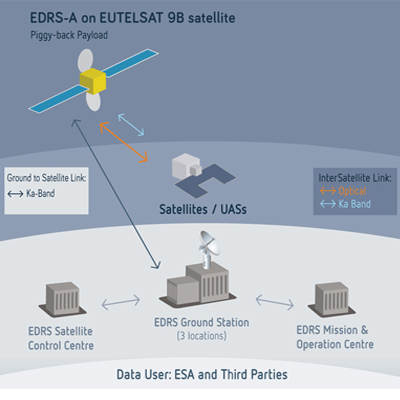
    Eutelsat 9B also hosts EDRS-A, the first node of the European Data Relay System (EDRS) for ESA and Airbus Defence and Space. This new SpaceDataHighway will significantly speed up the flow of information between low-orbit satellites and their ground stations, improving reaction time for a wide range of operations such as disaster monitoring, emergency operations and coastal and maritime surveillance.


    The EDRS-A payload hosted on Eutelsat 9B comprises a laser communications terminal and a Ka-band inter-satellite link that will retrieve high volumes of data sent from low orbit satellites as well as airborne platforms and a Ka-band antenna to transmit the data from geostationary orbit to EDRS ground stations.

  • Eutelsat partners Facebook on satellite initiative for Africa

    Eutelsat partners Facebook on satellite initiative for Africa

    MUMBAI: Eutelsat Communications and Facebook are partnering on a new initiative that will leverage satellite technologies to get more Africans online. 


    Under a multi-year agreement with Spacecom, the two companies will utilise the entire broadband payload on the future AMOS-6 satellite and will build a dedicated system comprising satellite capacity, gateways and terminals. In providing reach to large parts of Sub-Saharan Africa, Eutelsat and Facebook will each be equipped to pursue their ambition to accelerate data connectivity for the many users deprived of the economic and social benefits of the Internet.


    Spot beams for community and Direct-to-User access


    Scheduled for start of service in the second half of 2016, the Ka-band payload on the AMOS-6 geostationary satellite is configured with high gain spot beams covering large parts of West, East and Southern Africa. The capacity is optimised for community and Direct-to-User Internet access using affordable, off-the-shelf customer equipment. According to the terms of the agreement, the capacity will be shared between Eutelsat and Facebook.


    State of the art satellite technology to meet pent-up demand


    Using state of the art satellite technology, Eutelsat and Facebook will each deploy Internet services designed to relieve pent-up demand for connectivity from the many users in Africa beyond range of fixed and mobile terrestrial networks. Satellite networks are well suited to economically connecting people in low to medium density population areas and the high throughput satellite architecture of AMOS-6 is expected to contribute to additional gains in cost efficiency.


    Eutelsat steps up Internet activity in Africa


    The capacity will enable Eutelsat to step up its broadband activity in Sub-Saharan Africa that was initiated using Ku-band satellites to serve professional users. Eutelsat is establishing a new company based in London that will steer its African broadband vision and business. The company will be led by Laurent Grimaldi, founder and former CEO of Tiscali International Network, and will focus on serving premium consumer and professional segments.


    Facebook continues Internet.org initiative


    Two years ago, Facebook announced Internet.org, an effort to accelerate the rate of connectivity by addressing the physical, economic and social barriers that are keeping people from getting online. For Facebook, this satellite system represents one of many technology investments to enable cost-effective broadband access to unconnected populations. Facebook plans to work with local partners across Africa to utilise satellite and terrestrial capacity to deliver services to rural areas.


    Internet.org vice president Chris Daniels said, “Facebook’s mission is to connect the world and we believe that satellites will play an important role in addressing the significant barriers that exist in connecting the people of Africa. We are looking forward to partnering with Eutelsat on this project and investigating new ways to use satellites to connect people in the most remote areas of the world more efficiently.”


    Eutelsat chairman and CEO Michel de Rosen added, “We are excited by this opportunity to accelerate the deployment of our broadband strategy and to partner with Facebook on a new initiative to provide Internet access services in Africa. Eutelsat’s strong track record in operating High Throughput Satellite systems will ensure that we can deliver accessible and robust Internet solutions that get more users online and part of the Information Society.”

  • Eutelsat to present key UHD trends at MIPCOM

    Eutelsat to present key UHD trends at MIPCOM

    MUMBAI: The television business is dramatically transforming as broadcasters scale up production of premium content and delivery of an enhanced viewing experience. As the industry lines up to adopt Ultra HD (UHD) TV, the new quality benchmark in broadcasting, Eutelsat Communications will share research at MIPCOM on consumer appetite in key European TV markets for this latest evolution.


    The pulse of UHD will be presented by Eutelsat today at the MIPCOM show in a ‘4k focus welcome address.’ It will include key findings of new qualitative consumer research conducted for Eutelsat by market research firm TNS, and fresh data from GfK on Ultra HD screen sales.


    Eutelsat head of market research and customer experience Claudia Vaccarone and Eutelsat director of marketing innovation and digital cinema Michel Chabrol will share insight on how to anticipate UHD mass-market deployment. 


    They will be joined by Sony Corporation senior producer, visual entertainment Joe Nakata and well-known journalist and broadcast industry expert Chris Forrester.


    Since its first broadcasts of Ultra HD in January 2013, Eutelsat has amassed industry-leading expertise on the conditions for successful transition to this new format. Two Eutelsat satellites are broadcasting permanent channels in Ultra HD, showing Eutelsat co-productions and content produced by independent programme-makers who have sought out Eutelsat’s satellite platforms to promote their work.

  • Eutelsat enhances Tooway satellite service

    Eutelsat enhances Tooway satellite service

    MUMBAI: Eutelsat Communications has announced major improvements to its Tooway satellite service with the aim to enhance the speed and affordability of consumer satellite broadband across Europe and the Mediterranean Basin.


    Offering higher bitrates, increased consumption profiles and lower entry costs, the latest generation of Tooway broadband services is now available and is being commercialised by distributors integrating the new offers into their service portfolio.


    The Tooway portfolio of services delivered via Eutelsat’s KA-SAT High Throughput Satellite now offers download speeds of up to 18 Mbps and upload speeds of up to 6Mbps, with consumption profiles of up to 50 Gigabytes per month, the company stated.

    This move towards a faster, higher volume service has been facilitated by an upgrade of the digital modulation scheme of the KA-SAT infrastructure, from 8PSK2 to 16APSK, generating a significant increase in the system’s total throughput.


    In order to lower entry costs, Eutelsat’s broadband affiliate, Skylogic, is also rolling out an attractive hardware rental programme in certain countries to enable distributors to opt to rent user equipment to new customers.


    “Today’s announcement shows our commitment to further enhancing the performance of the Tooway service which is fundamentally about connecting people – both those in areas unserved and underserved by ADSL,” said Eutelsat CEO Michel de Rosen.

    The update last month of the EU’s Digital Scorecard shows that as many as 10 million homes in the EU27 are still not broadband-equipped. This means there is still work to be done to meet the objectives of the Digital Agenda in Europe and at a broader level across the full KA-SAT footprint.


    “We believe that the enhanced Tooway service and the improved user equipment programme will forward the move to satellite broadband for those still struggling with mediocre Internet access, depriving them of the social and economic benefits of broadband,” added Rosen.

  • Hot Bird 8 Satellite begins commercial service

    Hot Bird 8 Satellite begins commercial service

    MUMBAI: The Hot Bird 8 broadcast satellite of Eutelsat Communications has gone into commercial service at 13 degrees East. The satellite has 64 Ku-band transponders which span the entire range of frequencies used at Eutelsat’s Hot Bird 8 neighbourhood for broadcasting more than 950 television channels and 550 radio stations to over 113 million homes.

    The size and configuration of Hot Bird 8 enables Eutelsat to increase in-orbit redundancy at its premium video neighbourhood and releases Hot Bird 3 for its new mission at 10 degrees East, informs an official release.

    Built by EADS Astrium and launched on 5 August from the Baikonour Cosmodrome, Hot Bird 8’s scheduled in-orbit life is expected to exceed 15 years. Following launch and manoeuvres to bring the satellite into geostationary orbit, HOT BIRD(TM) 8 completed an exhaustive round of in-orbit tests at 1.7 degrees East.

    These were followed by a series of digital video and data transmissions at 4 degrees East, which is a future operational position for the Group.

    Now released from its mission at 13 degrees East, Hot Bird 3 will begin transfer operations for its relocation to its new position at 10 degrees East where it is scheduled to begin service later in October under the name of Eurobird 10, the release adds.