Tag: Eurozone

  • India will be the fastest-growing economy in 2016: GroupM

    India will be the fastest-growing economy in 2016: GroupM

    MUMBAI: Even as WPP’s GroupM has revised down its global ad investment growth predictions to 4.5 per cent in 2016 ($22 billion incremental) from the earlier 4.8 per cent in its bi-annual global advertising expenditure forecast, the agency has said that India will be the fastest-growing economy in 2016. The agency has raised the 2016 forecast for India by two points to 15 per cent. India is a beneficiary of cheaper oil, as is its Next 11 neighbour Pakistan, which GroupM also upgraded in the forecast.

    For 2015, GroupM predicts ad investment growth of 3.4 per cent ($17 billion incremental) in 2015, which is also below its predictions at midyear for 2015 that stood at four per cent.

    Moreover, Brazil, Russia China and India (BRIC) will represent 23 per cent of measured global ad investment in 2016, a proportion which has grown every year since they began measuring it in 2000, and GroupM continues adding a point a year for the BRICs in its modelled forecast through to 2020.

    The forecast is published in GroupM’s biannual worldwide media and marketing forecast report, This Year, Next Year. The intelligence is drawn from data supplied by WPP’s worldwide resources in advertising, public relations, market research and specialist communications by GroupM’s Futures director Adam Smith.

    “The outlook remains tough. Marketers’ constrained pricing power in a deflationary world, a macro trend, prompts ongoing focus on cost control versus investment and this colors our outlook. Continued strength across the majority of the BRIC and Next 11 countries, notably mainland China, is a highlight of the forecast, but the Eurozone is still struggling to find traction. While our outlook is overall positive, we recognise the downside risks of financial pressures in faster growth markets and the changing profile of China’s external demand,” Smith said.

    Mainland China remains the largest contributor to global advertising growth, but GroupM has revised downward its 2015 forecast from 8.7 per cent to 7.8 per cent, and the 2016 forecast is also slightly reduced from 9.6 per cent to 9.1 per cent. GroupM observes that Chinese consumer demand remains strong, supported by wage growth, urbanisation, property wealth and supportive governmental policy. However, on the external side, less demand for primary resources, less foreign direct investment (FDI), less local tourism, and the impact of domestic goods and services replacing imports are among the top reasons for ad market slowdowns in Taiwan and Hong Kong.  

    Russia is at risk of another step down in the oil price, but absent another shock, a soft Ruble and room to ease rates could assist quick recovery. GroupM expects a short, sharp ad recession of 13 per cent in 2015 followed by two per cent growth in 2016. And despite the Olympic summer, GroupM revises Brazil’s 2016 down from nine per cent to seven per cent. There, household spending continues to shrink as unemployment potentially reaches a ten-year high. 

    The Eurozone now accounts for only 11 per cent of global advertising, and Eurozone consumer price inflation remains near-zero; monetary policy is set to ease just as that of the USA may tighten. Zero ad growth is forecast in France in 2016, and German and Italian annual ad growth for 2016 is anticipated to fall only between one and two per cent. Spain shows the Eurozone’s strongest recovery, but advertising investment in Spain will still be 55 per cent smaller in real terms relative to its 2007 peak. In Europe, outside the Eurozone, high employment and other very positive trends make the United Kingdom the fastest-growing mature ad market in the world and the number three contributor to global ad growth in 2016 behind China and the US.

    In terms of investments across media types, the shift of advertiser investment to digital, of course, remains the biggest trend. GroupM maintains its midyear forecast and anticipates digital growth of 14 per cent in 2016, commanding 31 per cent of global ad budgets. This is a deceleration from the 17 per cent growth predicted for 2015. The slower but ongoing strength of digital springs from many sources including organic take-up, technical innovation, advances in value, viewability and validation, automation and efficiency, better creative work, and the mastery of data.

    “Facebook is addressable and targeted at scale with requisite tools and automation that make it easy for advertisers to understand and use; so it is reaping advertising growth of 50 per cent globally, including Instagram. Organic Google website revenue is growing remarkably fast too at 25.5 per cent, and they have streamlined YouTube into a complement to broadcaster VOD, even if it is not yet a real challenger on price or quality,” said GroupM global president Dominic Proctor. 

    “We see that digital’s data and automation capabilities are inspiring the evolution of all media — in all markets across the globe — but digital will continue its powerful growth and market share gains. This is despite the challenges in the digital space such as viewability, fraud, measurement and currency, all of which we expect to be solved by market forces,” Proctor added.

    GroupM believes 2015 will be the first year that absolute spend in traditional media went backwards in the ‘new world’ (Latin America, Central & Eastern Europe, and Southeast Asia). Only a half-point fall is predicted, but this marks rapid deceleration from the 17 per cent growth recorded as recently as 2010. New world newspaper advertising first went negative for growth in 2012, followed by magazines in 2013. China’s advertiser exodus from TV to digital gave the extra push required to make 2015 a negative for traditional media in the new world. These trends are anticipated to ease slightly in 2016.

    Globally, print media’s share of advertising will stand at 18 per cent in 2016, according to GroupM. Print’s long-standing run-rate of annual loss is slowing from two points of share to one, but GroupM notes it is too soon to call it a stabilization. The medium is embracing digital distribution, but only the strongest franchises are replicating their eminence in the digital domain. Common obstacles include fragmentation, chronic loss of reach, and lack of common standards in audience measurement and trading.

    Traditional TV continues to stand up well. TV accounted for nearly 44 per cent of global ad investment at its peak in 2012; since then it has shed about a point a year. China is responsible for most of this loss because TV advertising became more rationed and regulated while the digital ecosystem grew by leaps and bounds. The USA by contrast is perhaps the least-regulated and most competitive TV ad market, and its TV ad revenue share loss is less than the global average. It would look even healthier if its digital gains were properly consolidated with its traditional linear top line.

    “TV’s share is rising in almost as many countries as it is falling and contributors to the forecast identified three themes of untapped potential: relaxing regulation, improving the quantity and quality of VOD ad inventory, and format innovation. But every medium is in the midst of transformation; some to accelerate growth, others to decelerate share losses; and GroupM, as ever, plays a central role with the voice of the advertising customer to help shape the market to the advantage of our clients,” added Proctor.

  • GroupM forecasts ad spends to reach $560 billion by 2015

    GroupM forecasts ad spends to reach $560 billion by 2015

    MUMBAI: WPP’s GrpupM is out with its biannual ‘This Year, Next Year’ report forecasting the global advertising investments.

    As per the report the ad spends will reach $534 billion in 2014, a 4.5 per cent increase over 2013. The company predicts investments in 2015 rising an additional 5 per cent to $560 billion.

    In further says that globally, ad recovery is localised, with 17 markets accounting for 93 per cent of expected ad growth in 2014. Even at its moderate 3.4 per cent rate of ad investment growth this year to $162 billion, the US contributes fully one-quarter of incremental ad dollars. China ranks second as it climbs a predicted 9.8 per cent to $76 billion. Other countries making the cut include Nigeria, Kenya and Vietnam.

    “Many companies are still operating with very strong balance sheets,” said GroupM Global president Dominic Proctor. “Coupled with a rising general confidence and a specific comfort around digital marketing, though notwithstanding some geo-political uncertainty, we are seeing an uplift in some of the ‘older economies’ as well as the new.”

    Of marketplace performance, ‘This Year, Next Year’ report editor Adam Smith stated, “Despite the slowdown in China’s general economy from 2012, its consumer economy continues to expand. This, plus intensive digitisation of advertising, keeps China ad investment rising at or near double-digits, with no large print legacy to correct.”

    It is a different story in Western Europe, where 73 per cent of the regional economy is in the Eurozone, where demand remains suppressed by debt, internal imbalances and deflationary politics. In real terms, the Eurozone remains 20 per cent below its 2007 advertising peak, and the hardest-hit ‘periphery’ of Greece, Ireland, Spain, Italy and Portugal, 47 per cent below the peak.1

    Smith added, “Western Europe, however, is the most-digitised ad region in the world; though this may finally be maturing to judge by digital ad investment growth slowing from double- to high-single digits in 2014 and 2015.”

    Western Europe also has the world’s most print-heavy advertising, though here too, the downward adjustments to annual advertising investment are moderating from double- to mid-single-digits in 2014 and 2015.    

    Elsewhere, GroupM notes that some members of its south-east Asia group (Indonesia, Malaysia, Thailand, Philippines, Singapore and Vietnam) face political and economic challenges, and this year will collectively slip from double- to mid-single digit ad growth.

    “This group will still contribute to the global ad recovery, but we are on alert for central banks ‘tightening into the downturn’ if inflation becomes a problem,” said Smith.

    India, Brazil and Russia remain among the faster-growing ad markets, though GroupM warns that its reduced Russia forecast – from an annual run-rate of 10 per cent to 6 per cent — depends on no worsening in domestic affairs. 

  • ZenithOptimedia predicts global ad spend to grow by 5.3 per cent in 2014

    ZenithOptimedia predicts global ad spend to grow by 5.3 per cent in 2014

    MUMBAI: Global advertising expenditure is expected to grow by 5.3 per cent to $ 532bn, according to a report from media agency ZenithOptimedia.

    The agency has increased its forecast for 2014 by 0.2 percentage points since September, after recent signs of stronger growth from markets like the US, the UK, Germany, Hungary, Poland, Australia and Mexico, together with evidence that Spain’s steep downturn is finally bottoming out.

    Interestingly, this is the second time that the agency upgraded its expectations for 2014 this year, the first was in June (from 5.0 per cent to 5.1 per cent). In fact, for the year 2015, it expects the global ad market to accelerate to 5.8 per cent, followed by another year of 5.8 per cent growth in 2016.

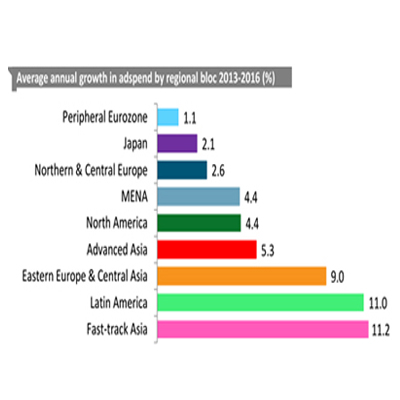
    As part of its global analysis, the agency has also included Ireland in the so-called Peripheral Eurozone category. It assumes that the growth for these countries will be somewhat more muted.

    The agency says that in Europe, it has separated the ‘PIIGS’ markets (Portugal, Ireland, Italy, Greece and Spain), which have faced the full brunt of the Eurozone crisis, into the Peripheral Eurozone. “Their ad  markets have fallen even more sharply than their economies, as local advertisers cut back to reduce losses and preserve cash, and multinationals withdraw budgets to redeploy in more economically healthy regions. We estimate that ad expenditure in Peripheral Eurozone fell by 11.1% in 2013. 2014 looks a lot better, with ad expenditure forecast to shrink by just 0.9%, followed by a slow recovery of 1.8% growth in 2015 and 2.5% growth in 2016. This assumes that the Eurozone avoids disaster over our forecast period, and in particular assumes that no country crashes out of the euro, or falls into disorderly default on its debts,” says the report.

    The report also reveals that the rest of Western Europe, as well as Central European countries like the Czech Republic, Hungary and Poland, which are currently performing more like countries such as France, Germany or the UK than the much-faster growing markets of Eastern Europe, such as Russia and Ukraine. “This is partly because many of these Central European markets are in the Eurozone, and because they have strong trading links with Zenith Optimedia Group Limited,” it says.

    As far as the Asian market is concerned, the agency has divided it in to four parts – Japan, Eastern Europe and Central Asia, Advanced Asia and Fast-track Asia.

    The report says that the Eastern European advertising markets, such as Russia and Ukraine, recovered quickly after the 2009 downturn and have since continued their healthy pace of growth, largely (though not entirely) unaffected by the problems in the Eurozone. “Their near neighbours in Central Asia, such as Azerbaijan and Kazakhstan, have behaved very similarly, so we have gathered them together under the Eastern Europe & Central Asia bloc. We expect this bloc to have grown 11.7% by the end of 2013, followed by 8%-10% growth for the rest of our forecast period,” it says.

    The agency has kept Japan separate as the market behaves differently from the other markets in Asia. Even after the recent economic stimulus, Japan remains stuck in its rut of persistent low growth and grew 2.1 per cent in 2013. The agency estimates the growth rate of the country to remain at 2 per cent per year through to 2016.

    Apart from Japan, there are five countries in Asia with developed economies and advanced ad markets and thus they are categorised as “Advanced Asia”. It includes Australia, New Zealand, Hong Kong, Singapore and South Korea. The report reveals that growth here has been a disappointing 1.3 per cent in 2013, after a period of heightened tension between North Korea and its neighbours caused advertisers in South Korea to cancel or postpone several campaigns. “We forecast a much healthier 4.5 per cent growth in 2014, followed by 6.6 per cent growth in 2015 and 4.8 per cent growth in 2016,” says the agency in the report.

    Fast-track Asia includes countries like China, India, Indonesia, Malaysia, Pakistan, Philippines, Taiwan, Thailand and Vietnam as these economies are growing extremely rapidly as they adopt Western technology and practices. This group barely noticed the 2009 downturn (ad expenditure grew by 7.2 per cent that year) and since then has grown comfortably at double-digit rates. We estimate that ad expenditure in Fast-track Asia has grown 10.7 per cent in 2013, followed by 10 per cent to 12 per cent annual growth in 2014 to 2016.