Tag: ETV

  • Four new channels receive MIB permission to launch in 2015

    Four new channels receive MIB permission to launch in 2015

    NEW DELHI: While the year 2014 saw the clearance of more than 30 television channels, the first four months of 2015 have so far only seen four new channels receiving permission to launch. They are: ETV Plus, ETV Life, ETV Abhiruchi and Vedas Om TV. The largest gainer is here Eenadu Entertainment Television of Hyderabad, which owns the ETV brand of channels.


    To expedite the process, which had remained stagnant after March-end, the Ministry now holds the Open House meetings with stakeholders two time every month instead of once.


    With the four new channels being added this year, the number of permitted satellite television channels has gone up marginally to 830 by April 2015 from 826 in December-end 2014.


    The cleared channels are all general entertainment channels (GECs), which now total to 425 and all of them have been given uplinking permission.


    Statistics show that 697 channels (including 382 news channels) are permitted to uplink and downlink from within the country, and 40 (including seven news channels) are uplinked from India for beaming overseas and not in the country. There is no change in channels uplinked from overseas and downlinked into India with the number remaining static at 93 (including 16 news channels). 


    Additionally, the MIB has permitted 9X Bangla channel to assume a new name – 9X Bannao.

  • DataVideo eyes 50% revenue from Indian market in 5-10 years

    DataVideo eyes 50% revenue from Indian market in 5-10 years

    MUMBAI: With the proliferation of digital devices and today’s ever changing market of always–on connectivity, broadcasters are looking beyond TV to stream and monetise their content.


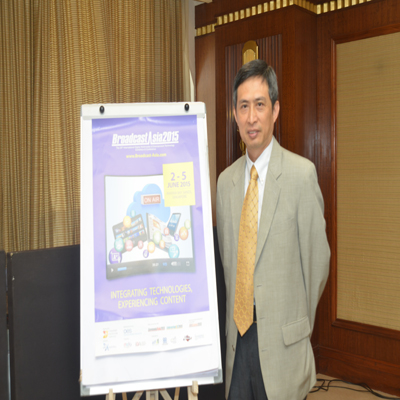
    Keeping this in mind Broadcast Asia 2015 will unveil its new TV Everywhere! zone presenting the latest solutions to address increasing consumer expectations. One of these solutions is being offered will be from DataVideo, which has been participating in the summit for the last 17 years. With its slogan “Live in Seconds” it offers mobile video solutions.


    While currently India contributes to less then 10 per cent of the company’s overall revenues, DataVideo Singapore managing director Frank Lin is bullish on the Indian market and expects it to jump up to 50 per cent over the next five to ten years.


    Lin, who is optimistic about the various sports leagues coming up in India, tells Indiantelevision.com, “A lot of equipments, which are state of the art are required in sports broadcasting. How does one set up a studio? We offer a studio in a box. Through our integrated solutions, we can set up sports broadcasting equipments in 10-30 minutes of a day.”


    The target industries for DataVideo are broadcasting, audio video and weddings sectors along with educational and religious sectors. “Presently north, east and west regions of India are served by our Noida office and south India is served by our Cochin office,” informs Lin.


    Established in Taiwan in January 1985, the company has more than 200 employees worldwide. It also has close to 90 distributors in various countries.


    In India, Data Video works with channels like Doordarshan, ESPN, ACT TV, TV9, ETV, Zee TV etc. In the education sector, the company works with the Indian Institute of Technology (IIT), Calicut Medical College and Manipal University.


    Some of their new line of products includes OBV-2800CCU, HRS 30 Field Recorder, NVS 25 Streaming Server and a SE 700 4-CH HD Switcher for the wedding video market.


    Broadcast Asia 2015 will be held from 2-5 June, 2015 at Marina Bay Sands, Singapore.


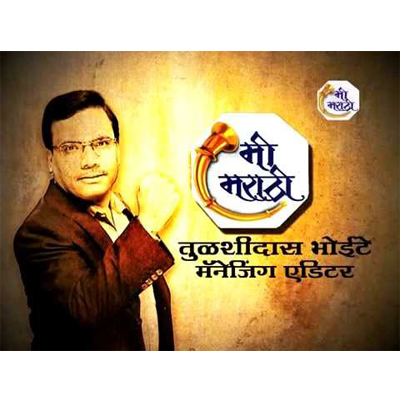
  • “Media today is suffering from ideological corruption”: Tulsidas Bhoite

    “Media today is suffering from ideological corruption”: Tulsidas Bhoite

    Mi Marathi, a Marathi news channel has been working hard to gain cognizance since its revamp from an entertainment channel to a news channel in March 2014. The channel, after a year of constant endeavour to connect with the viewers, has become the chart topper in the Marathi news space.

    At the forefront of Mi Marathi is a team of veteran journalists and among them is the channel’s managing editor Tulsidas Bhoite.  

    Bhoite started his career in 1992 in print media. It was in 2000 that he moved to electronic media with his debut stint at ETV. He has worked with leading channels like Zee Marathi, IBN7, Star Majha, Zee 24 Taas, TV 9 and Jai Maharashtra.

    Indiantelevision.com’s Seema Singh spoke to Bhoite about the transition of Mi Marathi from an entertainment channel to a news channel, the challenges and much more.

    Excerpts:

    What was the reason behind converting the entertainment channel Mi Marathi to a news channel?

    I think it was a wise decision by the management. I travel a lot with all segments of people, be it with commoners or professionals from different field. As per my analysis, there is space for more than 10 news channels in Maharashtra. The market here is quite weak in terms of both revenue and TRP, and so far, not a single channel has tapped the market fully. Currently with seven players in the region, we have only just managed to tap 50 per cent of the market.

    How did the transition take place? What happened to the GEC employees?

    We haven’t removed a single employee from any department because we didn’t want to write-off any people. Everyone has their own talent, and it was our duty to cultivate that talent for the betterment of the channel. We decided to use GEC talent for news and fortunately the management allowed us to do that. As the pace of work in a news channel differs from that of a GEC, we do face the problem of speed but our employees are coping and trying to change their functioning style.

    When the management decided to relaunch the channel as a news channel, they started hiring best professionals from the industry. The hiring process is still on and we have on board the three best faces from the industry in Kumar Ketkar, Nikhil Wagle and Bharatkumar Raut.

    We are hiring more talent from the news industry now. Even today, we do not have any technical backup like the other news channels, because of the space crunch. Plans are also afoot to shift to a new office and buy more technical equipments. With no technical support and just 60 per cent workforce as compared to the other news channels, I think we have been doing a fairly good job.

    How is the management-employee relationship in the company? Are employees involved while taking decisions?

    We ask our employees to give ideas. We may or may not accept the ideas, but we always ask people to participate in the ideation process. In fact, Jhingroo, the icon created by the channel during elections, was the idea of our creative team, which is still being appreciated by many.

    Being the seventh player in the market, what was the strategy to attract viewers? 

    Yes, we entered the market as the seventh player in the regional news space in March 2014. In order to remain relevant in the space, we had to create a new market for ourselves. As I mentioned, there is a large part of Maharashtra, which is still uncovered by news channels. So our strategy was to create a new segment for ourselves in the news market and also grab existing viewers of other news channels.

    We decided to cover news differently. For example in Mumbai, channels generally cover Mantralaya when it comes to politics, stock market for financial and a select two or three theatres or multiplexes when it comes to entertainment news. We changed this. We sent our cameras to that part of the society, where others hesitated. The news industry generally works on a myth of the up market and down market. But if you see, only 10 per cent of the news channel viewer comes from the so called up market strata.

    Even in the rural parts of Maharashtra, channels focus on the sugar belt of Pune or Nasik. We completely changed that. We always cover every news right from rural to urban, from upper to middle to lower middle class. And I’m not saying this because I’m a journalist, but this is the most practical approach. Even advertisers want to cater to the rural markets these days.

    What were the challenges you faced when you entered the market?

    The first challenge that came our way was that no one wanted to accept us as we weren’t big faces, when we launched. Traditional leaders thought we could not carry on the channel. But when we applied our strategies to run the channel, after four months they started taking cognizance of the channel.

    What did you do right to get to the number one position?

    Firstly, the selection of issues and subjects to cover. Secondly, we consider the opinion of each person in the team as important. Thirdly, when others are trying to think on an issue, we have already acted on it. We connect our channel directly to viewers, from all segments. We are always trying to give them a say in each and every programme. To understand the pulse of the audience, we never forcefully apply our views on the audience. We give the audience a chance to express their opinion.

    What’s your Target Group?

    While we don’t focus on one TG, we look at targeting the 15-45 year olds. For example, our character Jhigroo, resonates not just with politicians, but also the younger generation, who while are not too interested in politics or the news, but like the animated character. We want to catch the young audiences.

    How did you ensure that you did not lose out on your viewers from the entertainment channel, while making new ones in the transition?

    Most channels apply the ‘Hot Cut’ policy. But during the relaunch, we did not make the mistake of ‘Hot Cut.’ So while a show was on air, we did not cut the programme to go on air on something that was happening now because that could have harmed us. So we used the phase out process. We kept 50 per cent programming and 50 per cent news from September 2013 to March 2014. And from March, we relaunched fully as a news channel and we continue treating news in a different way. A lot of emphasis is being given to the presentation of the news, despite lacking on the technical front.

    How do you plan to maintain the number one position?

    When we announced the relaunch in the newsroom, I had said ‘our struggle is man vs machine.’ While content is the king, distribution plays a crucial role and we are hoping to expand our reach.

    My aim is to not just get good numbers. My ultimate goal is that the channel should be cognizable, right from the top person to someone sitting in the rural area. People should know the channel and the content. Number one, two doesn’t really matter.

    We would like to capture 50 per cent of the market to be able to do more experiments with the content.

    What are the challenges in the Marathi news space?

    In Maharashtra, people are open to other languages, and so we have to compete with Hindi news channels as well. Our strategy is to go to people, pick up their issues and give them a voice.

    Do you think advertisers should put in more money in regional channels? Is there scope?

    There is an untapped market in Maharashtra. However, when it comes to news genre, I don’t think any sales team in any of the channels has the potential to tap that huge market, and this includes my channel. There is a need to set up that team. We need to look at people with good ideas, who can tap that market.

    The logo has remained the same even after the relaunch. Any plans to change that?

    We thought on that. The creative team has created a different logo as well, but for now we will stick to the current logo. Our communication from class to mass shows that they like our current logo.

    Are you looking at revamping the channel?

    My team is currently struggling with the limited resource. But we need to move to a new space and as soon as we find that space, we will have two studios and better equipment and lighting. The revamp will be in the next six months.

    We are also working towards bringing in more graphics in the next 15 days. We will not stick to a single rule of programming. Adding more content to the channel is an unending process. We are making rules, only to break them.

    How has Nikhil Wagle’s presence helped the channel?

    If you study our viewership pattern, we are equally distributed throughout the day, from 3 pm to 11 pm. We wanted to strengthen our 9 – 10 pm time band and so when Nikhil Wagle agreed to join our channel, we offered him that time band. He has his own followers in Maharashtra, and that cannot be denied. Our mood and his is the same and that helps the channel a lot.

    How many journalists and bureaus do you currently have?

    In all over Maharashtra, we have nine bureaus and we will increase that to 12 in the next three months.

    Of the nine, seven are connected by lease lines. We will also start our studios in the next three months. We want to give our correspondents in these studios an opportunity to handle their own small shows on regional basis.

    In Mumbai, we have a team of 12 reporters and 20 camerapersons and out of Mumbai we have 60 reporters and 30 camerapersons.

    What’s your take on prime time debate?

    When deciding the strategy for the channel, I think like a viewer and not like a journalist. People are fed up of debates and that’s a fact. Fortunately, we only have one debate showPoint Blank hosted by Wagle, who is a man of content.

    We take only four people on the panel in order to give proper time to each one to represent their point of view. Media is suffering from ideological corruption. We are media, we are supposed to give equal opportunity for people to give their opinion. There should be discussion and not debate.

    Vir Sanghvi had once said, “We don’t have news channels, we have low cost entertainment channels.” But I think people are fed up of such low cost entertainment and so we are trying to deliver hard core news.

    If you check our ratings, we aren’t getting good ratings for any of our entertainment shows.

    Have you subscribed to BARC? Will you be discontinuing your TAM subscription? 

    We haven’t yet subscribed to BARC, but we will. We haven’t taken a decision on whether we will continue with TAM or not. We may continue with both TAM and BARC.
  • Post revamp, Colors Bangla looks at expanding footprint in West Bengal

    Post revamp, Colors Bangla looks at expanding footprint in West Bengal

    KOLKATA: Viacom18, which recently rebranded the ETV’s five regional channels under the Colors brand name, has now unveiled the new logo of the Bengali entertainment channel – Colors Bangla (erstwhile ETV Bangla).


    Post the revamp, Colors Bangla is looking at drawing broader synergies under the Colors brand name in order to expand its footprints in West Bengal. 


    As part of the revamp, not only did ETV Bangla shed the ETV brand name and take on Colors’ identity, it will also be looking at inducting new programming, going forward.


    When queried as to whether the Bengali channel will see Hindi serials from its sister channel Colors in the future, Colors Bangla and Colors Odiya channel head Sujay Kutty said, “While we debate on borrowing content internally, I believe broader synergies will definitely be drawn in order to grow the channel’s footprint.”


    The transformation of the identity of the Bangla regional channel ETV Bangla into Colors Bangla coincided with the Bengali New Year. “We had planned a grand gala themed, “Tomar Sapner Rong” on 12 April, where superstar Jeet unveiled the Colors Bangla logo,” he said.


    When asked if the Colors brand name will help increase the channel’s viewership, Kutty said, “Colors is an established mass general entertainment brand, synonymous with unparalleled entertainment. The ETV general entertainment channels that have undergone the brand transition have been pioneers in regional entertainment, reflecting the rich cultural heritage of the region, with differentiated and innovative content. The rebranding of the Bangla regional GEC will augment the Colors franchise while also holding higher relevance for Colors Bangla in terms of competition,” he said.


    Speaking about branding and marketing activities the channel has undertaken, Kutty said, “To generate awareness amongst the people in Bengal, the marketing and communication initiatives for the launch of Colors Bangla have been designed to extend its interactivity with viewers across various platforms. The rebranding is supported by a 360 degree marketing and communication campaign that includes TV, cable, on-ground, radio, outdoor as well as the digital platform. Various marketing initiatives such as name plate engagement at high populated slums of Kolkata and ROB – a prefabricated tram with the Colors Bangla branding can be seen.”


    The channel will also air the world television premiere of popular movies like ChatuskoneOpen Tee Bioscope and Buno Haas. “The three week long marketing campaign will run across West Bengal and Kolkata creating buzz around the launch. The Bengali New Year spells new beginnings – and what better than this auspicious occasion to reveal the fresh new identity of Colors Bangla? It is our way of celebrating the festival of the people of West Bengal with them, for them, and of them,” he concluded.

  • “I am a firm believer of strengthening what we have already started”: Sudhanshu Vats

    “I am a firm believer of strengthening what we have already started”: Sudhanshu Vats

    Over the past seven years, Viacom18 has grown to be one of the bigger conglomerates in India. The JV which started off as a partnership between Viacom International and Network18’s subsidiary TV18 and is now a JV between Viacom and Reliance Industries which has taken over Network18 has grown out of just a broadcasting business into a film and live events business.


    At the helm of it is Viacom18 group CEO Sudhanshu Vats who joined the company nearly three years ago after a double decade long stint at Hindustan Unilever Limited (HUL). Energetic and dynamic, Vats has a belief of uniting the entire Viacom18 channels and departments into ‘one Viacom18’.


    Spending much of his career at HUL, Vats still thinks from a consumer perspective. Speak to him now of content and he will first think of what the consumer is doing. On the occasion of the completion of seven years of the company, he speaks to indiantelevision.com’s Meghna Sharma and Vishaka Chakrapani about the growth of the company and where it is headed.


    Tell us about the seven year journey.


    When Viacom18 was formed seven years ago, there were only three channels MTV, Vh1 and Nick, and now we have 10 channels. That is an expansion in our broadcast business. We have also entered the film entertainment business through Viacom18 Motion Pictures in 2011. About a year and half ago, we got into experiential/live entertainment business. So now we have broadcast, films and live entertainment under our wings. We began our journey at about Rs 100 crore. In the last seven years we have grown 20 times. 


    A significant milestone is that we have turned PAT profitable in FY-14. That was our first year of PAT profitability at Viacom18. It’s important to not only grow exponentially but also profitably. Profitable growth is sustainable and gives you fuel for investment.


    What’s your growth strategy?


    I am a strong advocate of sharper segmentation. The more I think about it, the more I am convinced. Let us start from a consumer point of view. What is happening in India is that the country is urbanising at a very fast pace, income levels are growing, people are becoming more aware. Urbanisation is happening more rapidly than we see because it goes beyond the tangible phenomenon of growth in cities / urban habitats, attitudinally India is urbanising at a rapid pace. 


    Prime Minister Shri Narendra Modiji’s campaign is all about tapping in to the mindset of urban Indian youth who may not stay in urban India but has a mindset of aspiration, opportunity, development, fair play, which is universal. From the point of view of content, we see that when we move from rural to urban we move from a “We to I” mindset and develop a stronger individual identity. So we want to customise content for every Indian. In the utopian sense 1.2 billion people want 1.2 billion packages. Are there screens available to consume content? Yes 900 million. Is there capacity to carry content? Yes, with the digitisation of cable network and planned growth in broadband and 3G/4G we are building sufficient capacity in the content pipes. With consumer desiring more and more content it can’t be the same/similar content being churned out. So sharper segmentation is needed.


    In each of the genres we exist, we will segment further and deepen our presence. We will continue to look at adjacent genres. We have Colors and Rishtey in Hindi GEC. Post legal and regulatory clearances, we will have a strong presence of Viacom18 in regional GEC genre as well.


    Within Colors, a few years ago we didn’t have comedy sub-genre and we now have Comedy Nights with Kapil – and that’s a hit. We are also looking at other sub-genres. It’s about providing a spectrum of options to viewers within the channel.


    Was moving into movies an alternative to launching a movie channel?


    When we look at movies, we look at whether there is a consumer case, and also a commercial case. Movies have about a 13-14 per cent viewership according to TAM. So there is a consumer case. However a movie channel isn’t differentiated enough. We aren’t so sure if there is a commercial case for us, given the rising acquisition rights for films.


    What about a sports channel?


    Sports is a genre that we aren’t looking at in the short- to medium-term. If you look at the consumer case again people are watching a lot of cricket. But even in that, it’s a 0-1 situation. When India is playing international cricket or it is a short form game, viewership is huge but the moment India isn’t playing, or it is test cricket, viewership drops. At the same time viewership for domestic cricket is very poor. For other games, viewership will take time to develop. 


    It is a genre which has promise in the future. But it is a long gestation game. It needs deep investment and commitment.


    Leagues are increasing in number. Where do you see them going?


    Leagues are an interesting development where players are finding a sweet spot between sports and entertainment. Is it a promising place in the future? Perhaps yes. All this depends on the journey of the company. For Viacom18, I think there is enough and more to be done in deepening our current genres or entering identified adjacent genres. Our focus should be to strengthen the same. Having said that, we will continue to evaluate all opportunities from time to time. 


    How is the business of Live Viacom18 doing? A few months ago it was bringing in 2 per cent of your revenue. What is it now?


    This year we should be at about 4 per cent of our total revenue.  Live entertainment is the place where we start getting straight into the wallet of the consumer. It broadens our revenue streams – first is advertising, second is subscription and third is direct share of the wallet. In urban India, this phenomenon will grow rapidly. Particularly in certain genres like music, there is nothing to beat live entertainment. Other forms of entertainment are passive. So if you see in EDM or Bollywood dance music, we have two properties – Vh1Supersonic and MTV Bollyland. I am equally keen on the kids genre. The entire piece on experiential entertainment is a good space. We want to surely reach 10 per cent in future.


    Are you expanding the number of events that you have?


    Last year Vh1Supersonic was a standalone property. This year we are doing arcades and mini events in big towns- Bengaluru, Mumbai, Delhi with three artists. We have taken Vh1 Supersonic gigs to 50+ clubs and hundreds of colleges. With MTV Bollyland, we went deeper to mini-metros and towns with 1 million + populations – in fact it’s going to be 12 towns this year. We are also taking the IP outside India with the first event soon to be held in Dubai.


    Will there be any more additions to the list?


    I am a firm believer of deepening and strengthening what we have already started. For Colors, we will evaluate as we move forward, because we do a lot of non-fiction shows and the genre lends itself very well to live events.


    How has your ad inventory grown due to the 12 minute ad cap rule?


    A 12-minute ad cap for pay TV is a step in the right direction – it improves viewer experience. The viewer wants quality content and while he or she may want to watch some advertising, the problem lies in the fact, that there are cases when advertising outweighs the content duration. In future good content will command a premium on the 12-minute ad inventory. In India ad rates are under-indexed, possibly amongst the cheapest in the world, so there is a lot of room for growth. Colors, MTV, Nick, Vh1 and Comedy Central have successfully improved ERs. Across our genres our attempt will be to get good content that leads to higher viewership and better rates.


    What is the network’s take on geo targeting?


    The pilot has been conducted in the kids’ cluster. It’s a clear win-win situation for both broadcaster and advertiser, therefore it gives us confidence to scale it up across genres. While the FMCG sector will derive a lot of value, other sectors also stand to benefit from this. In addition geo-targeting will help us tap newer clients and local advertisers in future.


    What is the state of carriage fees? Has it come down or is it still on an upward swing?


    Overall carriage has come down in the past two years. The broad understanding was that with digitisation there would be no carriage at all. So it hasn’t come down as much as we would have liked it to. This is due to the lack of addressability of the consumer/viewer. No wonder then, that carriage, rather than continually coming down, has begun to rise again in recent months. As we move forward, MSOs would need to drive revenues and collections from the subscribers, thereby reducing /eliminating dependence on carriage.


    What about the unequal advertising/subscription skew in India?


    Worldwide ad subscription revenue tends to be almost equal. Like many things in India, change for the better is slow but gaining momentum.


     What best practices does Viacom18 need to grow?


    The next growth phase requires that we build capacity in talent, systems and processes and invest behind key strategic opportunities. Capacity building especially in processes and systems is an ongoing journey. We have begun to lay greater emphasis on analytics, automation and processes such as ERP. They are being implemented at Viacom18. We have focused leading brands in each genre and this is unique to us. Finding the right balance between independence and interdependence is important, hence we are driving synergy as we grow. We are building greater interdependence – in our processes and in our culture.


    We are hiring from colleges, as well as carrying out lateral hires. We constantly evaluate how best do we provide our people with new and exciting opportunities within the organisation. Finally, we also have a structured end-to-end approach to offer to our clients through our Viacom18 Integrated Network Solutions team. We offer a full bouquet of services to advertisers, who can partner with us on live events, broadcast, film integration – the entire spectrum of consumer connect.

  • ETV aims to create a market with Gujaratis’ desire for comedy content

    ETV aims to create a market with Gujaratis’ desire for comedy content

    MUMBAI: Comedy is intrinsic to a Gujarati household. What they have till now been eating from the Hindi general entertainment channels (GECs) will now be served to them with a new revamped ETV Gujarati with six new shows, starting 3 November.


    With the tagline ‘Dilthi Gujarati’, the regional channel is now rising from the ashes. Tapping into the Gujarati euphoria that is surrounding the new Gujarati Prime Minister Narendra Modi, the family focused, female driven channel is gearing up to be Gujarati’s ‘real entertainment channel’ in a market which doesn’t have another entertainment channel.

    Viacom18 EVP and business head- ETV Gujarati and ETV Marathi Anuj Poddar says that the channel had been weakly positioned till now. “Our research showed us that the people there are not interested in high drama but about fun and comedy.” The channel has put in nearly six months of hard work to come up with the brand slate of programmes.

    The new shows include Pati thayo Pati Gayo (We Workshop Entertainment), 1760 Sasumaa (Meena Gheewala Telefilms), Aa Family Comedy Che (Sango Telefilms), Kanho Banyo Common Man (Entity Productions), Hirjini Marji (Click Digital Studios India and Vrajesh Hirjee) and Daily Bonus (a game show by Interscope Communications) from 7 pm to 10 pm. Popular names such as Ketaki Dave, Vrajesh Hirjee, Krishna Gokani and Sanjay Goradia will be seen on ETV Gujarati.

    Talking about this fresh line-up, ETV Gujarati programming head Sanjay Upadhyay says, “We have partnered with industry heavyweights to showcase a lineup that is contemporary, fresh and appeal to all who are ‘dilthi Gujarati’.”

    The fiction team in Mumbai and non- fiction team in Ahmedabad has conceptualised the new look. The two cookery shows have been retained, one in the afternoon and one early primetime due to their popularity. Although Poddar is sure that the high production quality of the shows will bring in audiences. He is aware that it isn’t easy to break their attachment to Hindi GECs anytime soon. “People will sample it at various times. It isn’t about us being one more player in the market but about creating the market itself,” he says.

    From an advertiser perspective, he says that the channel can be positioned relatively well because of its 8-10 per cent contribution to the Hindi speaking market (HSM). Currently the market size of Gujarati television is about Rs 40 crore to Rs 50 crore with 1 per cent viewership of the regional market which itself is about 16 per cent of entire TV market in the country. But Poddar puts the entire advertising market across platforms in Gujarat at over Rs 1000 crore, which he is eying.

    “In terms of opportunity size, the market is big; though a lot of it goes to Hindi GECs. Today advertising there happens mainly through print, radio and national TV but now they will have a platform to talk to the audience. Once we get the channel running, we will approach advertisers to reallocate to our channel,” he says confidently. Currently, the channel has Aimil Amyron as its strategic sponsor for several months.

    The channel has also hiked up ad rates by 100 per cent and is now selling primetime slot at Rs 3500. Advertisers currently prefer a Hindi GEC over a Gujarati channel, but he expects that to change in time. The national to regional advertiser skew is about 80:20.

    A huge marketing plan began since Navarati with sources pegging the expenditure at about Rs 3 crore, which for a Gujarati market is heavy. An in-house team along with agency The CO, has come up with the creative. The first leg of the campaign began in Navrati when the channel launched its anthem by getting the stars at various on ground events in Rajkot, Surat and Baroda. This was followed by the outdoor campaign executed by Milestone Brandcom consisting of hoardings and rickshaws followed by movie theaters along with the launch of Happy New Year and branding partnership with fast food joints across the state. The launch day will see full page newspaper ads in Gujarat Samachar, Sandesh and Divya Bhaskar and will be followed by radio activity on station My FM.

    A canter activity will commence from next week as well and is being executed by Marketmen Activations. Show promos are being shown on Gujarati channels TV9, VTV, GSTV, Sandesh News and its own ETV News Gujarati and CNBC Bajar along with UTV Movies and UTV Stars, the national channels. Digital advertising will include YouTube pre rolls and Facebook targeted spots for all Gujarati content. The entire campaign will go on for three weeks post launch.

    Media planning has been executed by both the in-house ad sales team as well as Vizeum. A special promo has been created just for the channel with big personalities endorsing the channel such as Yusuf Pathan, Irrfan Pathan, Murari Bapu etc. The channel promo packaging has been done by Supra Films by Rajul Mishra.

    A 30 member office is situated in Ahmedabad while the heads are in Mumbai. Poddar says that the production cost of the shows are close to what is spent in Marathi shows. However, the channel hasn’t launched any big ticket show for now to keep the costs low without compromising on quality. “We want to create a space that is different and unique from advertiser value proposition with targeted environment. So we aren’t taking a high burn strategy,” he says adding that he looks for a breakeven to happen by two years.

    While the shows will run from Monday to Saturday, Sunday will see Gujarati movies as well as Hindi movies from the Viacom18 library. “Though Hindi movies will spike up our ratings, but the aim is to strengthen the Gujarati primetime band,” states Poddar.

    Currently the channel is present on all DTH and digital platforms in the state while its analogue penetration is about 90-92 per cent. GTPL, Den, InCable, Dewshree,Tata  Sky, Airtel, Dish TV, Videocon d2h, Reliance Digital, Sun Direct are its list of distribution platforms. “The legacy that we have inherited from the old owner is its excellent distribution,” informs Poddar .


  • Network18 Q2-2015 results a little better q-o-q and y-o-y

    Network18 Q2-2015 results a little better q-o-q and y-o-y

    BENGALURU: Bringing Network18 Media and Investments Limited (Network 18) to the black is still work in progress for its new board, but it should get there soon, considering the company’s Q2-2015 numbers and TAM data for its bouquet of news and GEC channels led by Colors, CNBC, CNN-IBN and ETV among others.


    Please refer to the attached financial performance statement and press release for the various figures and TAM data reported by Network18.
     
    Network18 reported 11.2 per cent y-o-y and 5.1 per cent q-o-q growth in consolidated Total Income from Operations (TIO) in Q2-2015. The company’s consolidated TIO in Q2-2015 was Rs 744.84 crore versus Rs 669.85 crore in Q2-2014 and Rs 708.39 crore in Q1-2015. Corresponding HY-2015 and HY-2014 TIO numbers were Rs 1226.48 crore and Rs 1023.98 crore respectively, indicating a decent 18.1 per cent growth in the current half year.
     
    Note:  100,00,000 = 100 Lakhs = 10 million = 1 crore
     
    Let us look at the other Q2-2015 and HY-2015 numbers reported by Network18
     
    Consolidated loss for Q2-2015 was lower at Rs 36.47 crore versus the one time adjusted massive loss of Rs 1021.88 crore in the last quarter and the Rs 36.28 crore in Q2-2014. Loss in HY-2015 has widened to a huge Rs 1058.35 crore because of the Q1-2015 adjustments, versus the Rs 20.93 crore loss in HY-2014.
     
    Correspondingly, consolidated profit before depreciation, interest and taxes (PBDIT) numbers for the current quarter has improved to Rs 33.6 crore which was 36.2 per cent higher than Rs 24.7 crore in the immediate trailing quarter and 14.9 per cent more than the Rs 29.3 crore in the year ago quarter. In H1-2015, consolidated PBDIT at Rs. 58.3 crore was 6 times (up 514 per cent) more than the Rs. 9.5 crore in H1-2014.
     
    The company’s consolidated total expenditure at Rs 746.90 crore (100.3 per cent of TIO) was 1.8 per cent more than the Rs 733.45 crore (103.5 per cent of TIO) in Q1-2015 and 11.5 per cent more than the Rs 670.1 crore (fractionally more than 100 per cent of TIO) in Q2-2014. HY-2015 total expenditure at Rs 1480.36 crore (101.9 per cent of TIO) was 15.5 per cent more than the Rs 1281.92 crore (104.5 per cent of TIO) in HY-2014.
     
    Consolidated Programming cost at Rs 172.39 crore (23.1 per cent of TIO) was 1.7 per cent more than the Rs 169.54 crore (26.7 per cent of TIO) in Q1-2015 and 10.5 per cent more than the Rs 143.84 crore (21.5 per cent of TIO)in Q2-2014. HY-2015 programming cost at Rs 341.93 crore (23.5 per cent of TIO) was 46.9 per cent more than the Rs 232.71 crore (19 per cent of TIO) in the corresponding half year -period of last year.
     
    Finance costs in Q2-2015 was 6 per cent lower at Rs 29.01 crore (3.9 per cent of TIO) versus the Rs 30.88 crore (4.4 per cent of TIO) in Q1-2015 and 4.3 per cent more than the Rs 27.83 crore (4.2 per cent of TIO) in Q2-2014. Finance costs in HY-2015 at Rs 59.89 crore (4.1 per cent of TIO) was 0.6 per cent more than the Rs 59.53 crore (4.9 per cent of TIO) in HY-2014.
     
    On a consolidated basis, two segments contribute to the company’s numbers – Media Operations (MO) and Film production and distribution (Film).
     

    Consolidated Segment figures
     
    MO revenue in Q2-2015 was 4.5 per cent more at Rs 727.94 crore versus the Rs 694.08 crore in Q1-2015 and 19.3 per cent more than the Rs 607.8 crore in Q2-2014. In HY-2015, MO reported revenue of Rs 1419.05 crore which was 23.8 per cent more than the Rs 1146.61 crore in HY-2014.
     
    MO reported operating profit of Rs 3.88 crore in Q2-2015 versus an operating loss of Rs 83.88 crore in Q1-2015 and an operating profit of Rs 9.46 crore in Q2-2014. For HY-2015, operating loss from MO widened to Rs 79.90 crore from Rs 30.39 crore in HY-2014.
     
    Film segment reported 38.7 per cent higher revenue at Rs 19.85 crore in Q2-2015 versus the Rs 14.32 crore in Q1-2015, but was 68 per cent lower than the Rs 62.05 crore in Q2-2014. For HY-2015, Film segment revenue fell by 57.7 per cent to Rs 34.17 crore from Rs 80.85 crore in HY-2014.
     
    Film segment reported operating loss of Rs 4.38 crore in Q2-2015, operating loss of Rs 0.95 crore in Q1-2015 against an operating profit of Rs 3.13 crore. For HY-2015, this segment’s operating loss for both HY-2015 and HY-2014 was Rs 5.33 crore .
     

    Network18 Standalone Q2-2015 and HY-2015 numbers
     
    On a standalone basis, Network18 reported lower TIO in Q2-2015 at Rs 16.80 crore versus the Rs 17.77 crore in Q1-2015 and the Rs 29.23 crore in Q2-2014. HY-2015 TIO at Rs 57.95 crore was better than the Rs 34.58 crore in HY-2014. Standalone loss for Q2-2015 at Rs 18.52 crore was lower than the Rs 637.96 crore in Q1-2015 (one-time adjustment) and the Rs 32.59 crore in Q2-2014.
     

    Standalone segment figures
     
    Three segments contributed to Network18 standalone numbers – Event Management (EM), Web operations (WO) and Publishing business (publishing).
     
    Event management had no revenue in Q2-2015 and Q1-2015, and Rs 8.95 crore revenue in Q2-2014. Operating losses from this segment in Q2-2015, Q1-2015 and Q2-2014 were Rs 0.11 crore, Rs 0.06 crore and Rs 0.76 crore respectively.
     
    WO reported revenue of Rs 12.98 crore in Q2-2015, Rs 12.68 crore in Q1-2015 and Rs 9.22 crore in Q2-2014. Operating losses from this segment were Rs 2.75 crore in Q2-2015, Rs 3.99 crore in Q1-2015 and Rs 9.99 crore in Q2-2014.
     
    Publishing segment reported revenue of Rs 3.82 crore in Q2-2015, Rs 5.09 crore in Q1-2015 and Rs 10.59 crore in Q2-2015. Operating losses from this segment were Rs 1.66 crore in Q2-2015, Rs 2.29 crore in Q1-2015 and Rs 3.91 crore in Q2-2014.
     
    Additional Notes
     
    1.       Pursuant to the enactment of the Companies Act, 2013 (the Act), the Group has, effective from 1st April, 2014, reassessed the useful life of its fixed assets and has computed depreciation with reference to the useful life of assets as recommended in Schedule II to the Act. . Consequently Depreciation for the quarter and half year ended 30th September is higher by Rs.1.16 crore and Rs.9.78 crore respectively and net loss is higher by Rs. 1.16 crore nd Rs.9.78 crore respectively. Further, based on the transitional provision provided in Schedule II, an amount of Rs. 7.13  crore has been adjusted with the opening reserves during the half year ended 30th September 2014.
     
    2.        During the quarter ended 30th June, 2014, based on a review of the (i) investments, and (ii) other current and non-current assets, the Group has accounted for (a) diminution in the value of certain investments to the extent of Rs. 142.83 crore and goodwill Rs. 234.78 crore; (b) obsolescence/impairment in the value of certain tangible and intangible assets to the extent of Rs. 127.43 crore and (b) write-off and provisions of non-recoverable and doubtful loans/advances /receivables to the extent of Rs. 519.41 crore and the same has been disclosed as Exceptional Items. Further, Exceptional Items for the said quarter ended 30th June 2014 also includes Rs. 20.94 crore towards severance pay and consultancy charges. However, these adjustments will have no impact on the future operating profit and cash flows of the businesses of the Group.
     
     
    3.       Equator Trading Enterprises Private Limited (“Equator”) including its subsidiaries Panorama Television Private Limited and Prism TV Private Limited had become wholly owned subsidiary of the Company with effect from 22nd January, 2014. Hence, the consolidated results of the current period also include the results of these subsidiary companies. Eenadu Television Private Limited had also become an associate with effect from 22nd January 2014 and its results have been accounted as “Associate” under accounting standard 23 on Accounting for Investments in Associates in Consolidated Financial Statements. To this extent, the results of this period are not comparable with the corresponding previous period.


    Click here for the financial statement

  • Gunjan Varshney joins Doodarshan as Regional sales head

    Gunjan Varshney joins Doodarshan as Regional sales head

    MUMBAI: Gunjan Varshney has joined pubcaster, Doordarshan, to boost its sales revenue. She has joined as the  regional sales head for north India.


    As head, she will be responsible for revenue generation for the network from north India, based in New Delhi.


    Speaking on her new role, Varshney said, “I am delighted and honoured to be given this opportunity to be a part of India’s own biggest media network, and look forward for an exciting carrier ahead.”


    Prior to this, she was with Focus News Network as deputy vice president. She has over 12 years of experience in TV channels and ad agencies including Grey Advertising, ETV, Star, Hungama and Zee News.

  • YuppTV launches ETV Telegu for US viewers

    YuppTV launches ETV Telegu for US viewers

    MUMBAI:  The popular and prestigious Telegu channel ETV will now be available on YuppTV again. With ETV in the bouquet, YuppTV becomes the most dominant provider of Telugu content to the US region.


    As a favorite channel of the Telugu diaspora in the US, ETV is one of the most sought after paid channels included in the Telugu package offered to US customers by YuppTV.


    Talking about the launch, YuppTV CEO Uday Reddy said, “By offering ETV, we have become the dominant provider of Telugu content in the US Region. It is for the benefit and pleasure of thousands of Telugu viewers in the US that we have gone this extra mile to bring ETV back on YuppTV.”


    “Our aim is to give viewers a 360-degree experience and we will not compromise on any front, to deliver on our promise. We are sure that TV viewers in the US will welcome this new launch with enthusiasm. We are happy to give them the channels of their choice and trust that they enjoy every viewing moment,” he added.


    The Telugu package offered by YuppTV will cover all the important Telugu channels being aired in India. Viewers in US can stay completely updated of any key coverage, news bulletins or entertainment.


    Also, Yupp TV recently launched its own streaming player. Viewers will now be able to access more than 180 channels worldwide using any compact or portable wi-fi enabled player. Content will be made available as live V, catch-up TV, TV shows and movies in 1080p high definition (HD) quality to subscribers, turning normal TVs to smart TVs.


    YuppTV delivers more than 180 Indian television channels worldwide in 11 languages that comprise Hindi, Tamil, Bengali, Punjabi, Marathi, Telugu, Malayalam, Kannada, Bhojpuri, Oriya and Assamese to its viewers.

  • ICRA rerates Network18 and TV18

    ICRA rerates Network18 and TV18

    MUMBAI: Barely a week after independent and professional investment and credit rating agency ICRA revised ratings for Network 18 media and investments (N18) and TV 18 Broadcast (TV18), it has once again upgraded the two companies ratings for enhanced amounts.


    Note: Short Term Instruments (All instruments with original maturity within one year) with ICRA A1 rating are considered to have very strong degree of safety regarding timely payment of financial obligations. Such instruments carry lowest credit risk. Modifiers {“+” (plus) / “-“(minus)} can be used with the rating symbols for the categories [ICRA]AA(SO) to [ICRA]C(SO). The modifiers reflect the comparative standing within the category.


    N18


    The short- term rating for Rs 230 crore of ICRA A1+ and long-term rating for Rs 10 crore of ICRA A on enhanced banking facilities of Rs 240 crore (up from Rs 140 crore) has been assigned to N18. The outlook on the long-term rating is ‘positive’.


    Additionally, N18’s commercial paper of Rs 100 crore has been assigned as ICRA A1+. The assigned ratings take into account the strong growth in operating profits of N18 (consolidated) in 2013-14 over the previous year, significant reduction in net losses by virtue of favourable impact of cable digitisation, internal cost compression measures and more than halving of interest costs.


    The rating agency says “ICRA draws comfort from the diversified offerings of the broadcasting business across genres and expects that the addition of ETV regional channels, post the recent acquisition, will further strengthen the overall operational profile of the company on a consolidated basis. ICRA notes that the Network18’s non-broadcasting businesses continue to experience weak profitability/ losses while some of its existing bouquet of channels may also continue to face profitability pressures arising from rising competitive intensity. Also, in the broadcasting business, there is likely to be recurring need to fund gestation losses in select new channels as also additional investments that may have to be put in for the ETV bouquet of channels.”


    TV18


    The Rs 200 crore commercial paper programme of TV18 Broadcast has been assigned short-term rating of ICRA A1+. 


    The assigned ratings take into account the strong growth in operating profits of TV18 (consolidated) in 2013-14 over the previous year, increase in net profits to Rs 85.6 crore in 2013-14 from a net loss of Rs 42.2 crore in 2012-13 by virtue of favourable impact of cable digitisation, internal cost compression measures and more than halving of interest costs. The ratings continue to draw support from the diversified offerings of the company’s content bouquet across genres and strong market position of the key news and entertainment channels.


    Says the rating agency, “ICRA expects that the recent addition of ETVs regional channels into TV18’s content bouquet will further strengthen the overall operational profile of the company. TV18 (consolidated) currently derives a large proportion of its revenues through advertisement income, a revenue stream that tends to be volatile and is a function of economic environment and corporate advertisement budgets. However, the enactment of regulatory framework for digitisation of cable TV Systems in India is expected to increase the quantum and proportion of the relatively more stable subscription income for TV18, going forward. Already, TV18 (consolidated) has seen a strong positive traction in net distribution income having increased to Rs 178 crore in 2013-14 (excluding ETV channels) from minus (-) Rs 102 crore in 2011-12.”


    It also states that while TV18’s (consolidated) cash generation is likely to be supported by higher subscription revenues and lower carriage costs by virtue of cable digitisation, it expects continued profitability pressures arising from rising competitive intensity in key business segments, the need to fund gestation losses in select new channels as also additional investments that may have to be put in for the ETV bouquet of channels.