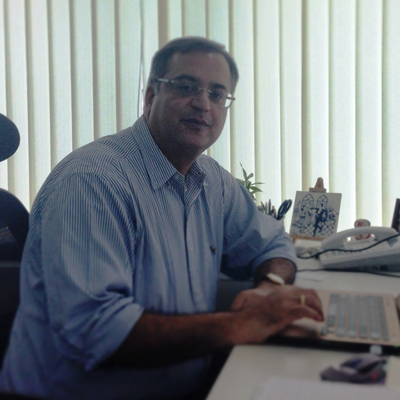
Certainly not his maiden stint at handling regional, Ravish Kumar was earlier with Star, managing Star Pravah and Star Jalsha for two years. While he originally got on-board Viacom 18 to head the network’s proposed movie channel which did not materialise for some reason, he quickly rose to the challenge of reviving three regional territories.
Today, as Viacom 18 executive vice president and business head – regional channels, ETV Kannada, ETV Bangla and ETV Odiya, Kumar is close to completing three years with the network even as the regional market continues to grow from strength to strength.
On any given day, Kumar is running from pillar to post, what with three different portfolios to handle. However, on a rare day that he was able to find some time, indiantelevision.com’s Vishaka Chakrapani sat him down to understand the business of regional channels. Excerpts…
How has your experience been with working on regional channels?
To take up these channels and turn them around is a huge task. Regional channels involve a lot of experimenting and risk-taking. These are vibrant channels in vibrant markets and are full of ideas. We have started seeing results on some of the channels and on others we have built a solid foundation.
What makes each market different from the other?
All states are unique and have a varied cultural background, literature, heritage, theatre etc. This gives a tremendous canvas to paint from. There is a strong sense of expectation and a strong sense of progressiveness from the people, which means there is a lot of place for us to introduce discontinuities in content.
After the acquisition by Network 18, one of the first things you did was to get Bigg Boss on the Kannada and Bangla channels. How has it worked and how are the formats working for regional?
In all three markets, we changed the primetime slot within one year and have reinvented the entire portfolio of fiction and non-fiction. We’ve experimented with established formats like Bigg Boss and Jhalak Dikhlaja and also created our own IP with a show called Indian. The base of the show is that while you are a Kannadiga, do you understand the nuances of being an Indian. We took a team of 18 to 22 people and took them across the country, where they had to adapt to the local way of life. This is our own format, which gave us more or less the same ratings as Bigg Boss.
We did Indian in Kannada last year and we intend to renew it but we are looking at reinventing as well. Season one is done and it is of no use to do it a second time. The IP is the fundamental guts of the show which takes you out of your comfort zone and gives you experiences that you haven’t had before to make you a more confident person. We go for the emotional hook that makes you stronger and exposes you to a life as never seen before.
So last year, we experimented with big-ticket formats and right now, we are doing a hybrid of Jhalak Dikhlaja called Takadhimitha– Dancing Stars in which we have licensed the version from BBC Productions and are producing it on our own. We have worked successfully in all three models. International formats, our own IPs, and a hybrid model.
Adaptation is a misused word. You have to look at whether a show is relevant for the market. Whether the practice or the theme of the show is prevalent in that region.
If you are doing a huge international format show like Bigg Boss or India’s Got Talent, the scale of production is huge. You have to pay format fee, licence fee that takes the cost to a different level. So there is a certain expectation with what you can do and what you cannot and there is an expectation that people also have which is hard to meet.
But reinventing for a show every year is a difficult task. It is a challenge because it’s not easy to reinvent. But in a regional market, there is so much more to do. I can be as creative as I want. We don’t care about ratings; what we care about is making sure people like what we put there. We have upped the quality and variety of content in the three channels. So deliver a product and keep your faith in it.
But big formats have not yet entered Odisha yet? What kind of a market is it?
Odisha is a smaller market for us and not as well developed or monetised as the others. There is a limit on the amount we can spend in this market. But what works here is dubbed shows. And we also have six to seven of our own shows. The weekend property is song and dance-based as opposed to big shows due to budget restrictions.
In Odisha, we are in the process of adapting shows from Tamil and Telugu and from our sister channel, Colors, too. In terms of content, people want soaps, drama, aspirational and progressive shows. In the regional market, you also have the responsibility to educate people. For viewers such as housewives, television is their window to the world. Their ecosystem is very limited. When they watch a serial like Balika Vadhu, which is followed by a learning section, that is what they are really interested in.
Colors manages to make money out of Bigg Boss by balancing its PnL and not by money earned through the show. Do you also work in a similar manner for regional adaptations of Bigg Boss?
We are far more sensitive to PnL. There is a limit to the amount of money I can put, even though I want to do a big-ticket show. So that confines or prevents me from taking on more than I can chew. You need to be sensitive to costs in these markets because the cost Hindi can afford is not necessarily the cost we can work with in the regional space and we don’t want to compromise on quality.
What are the kind of fiction shows that you have on your Kannada channel?
We have done adaptations of Balika Vadhu and Madhubala called Puttagowri Maduve and Ashwini Nakshatra, respectively. We also have three of our own original shows: Agnisakshi, which is recently launched; Lakshmi Baramma and Charanadasi. Everything has worked for us. So we seek to provide quality and outstanding stories. Madhubala and Ashwini Nakshatra may have started out similarly but now, their stories are extremely divergent.
How has the market evolved in these three states?
I think regional continues to grow faster than Hindi. Earlier in Bangla and Kannada, you would pull in GRPs by pulling in people to watch. The market now has stabilised at a level and now you are taking share from each other. The TV penetration and coverage continues to grow. We are going to have a new method of looking at data, which might lead to some redefinition of universe. TV hasn’t reached saturation. We are now seeing increasing penetration of second TV households.
ETV has a slightly older audience due to its long existence. How do you ensure your fiction shows reach out to the right TG, especially the youth?
In fiction, our stories are very mainstream and we are giving newer talent a chance. We are supplementing it a lot with our non-fiction shows. Non-fiction is what draws the youth to the channel. But we ensure that whatever we put out is not excluding any particular group. We are realising that great content works across the board. The definition that we have to tailor content to fit an age group is a myth.
Would it have been possible for the ETV group to make such investments prior to acquisition by Network 18?
These channels, according to my understanding, had been on the selling block for quite some time. So, they were managing bottom lines carefully and not looking at growth. They were actually managing for profit. Would they have actually turned around and put this kind of money in the shows? Probably not, but it is hard to answer.
How do you manage competition with the Hindi market?
Anyone who wants to watch Hindi is welcome to do that. We don’t fight Hindi. We continue with our strategy, irrespective of what Hindi is doing. Let me put it this way – we are not threatened by them but we don’t even ignore them and if there is any learning to be had, we are constantly monitoring Hindi to see what we could be doing bigger and better. I have a canvas that is beautiful. It allows me to pick and choose from Hindi and international as well.
What is your viewership share in each state?
TAM data for the four-week average ending week 12, shows that in Kannada, we are 25 per cent; Udaya is 31 per cent; Suvarna is 22 per cent; and Zee Kannada is 12 per cent. We used to be number four or five in this market and now we are a strong number two. In Odisha, Tarang has 40 per cent, Sarthak has 30 per cent and we are at 14 per cent. In Bangla, Star Jalsha is 49 per cent, Zee Bangla is 37 per cent, and we have 10 per cent.