Tag: entertainment tax

  • Four MSOs levied penalty for non-payment of entertainment tax

    Four MSOs levied penalty for non-payment of entertainment tax

    NEW DELHI: Even as Siti Cable ‘vehemently’ denied any allegation of tax evasion as alleged by the Delhi Government, similar notices were issued to three other major multi-system operators (MSOs) for paying Rs 243.77 crore as dues, due to a default in payment of entertainment tax.


    While there was no official word from either IndusInd Media and Communications or Hathway Cable and Datacom, a source from Den Networks informed Indiantelevision.com that the action by the Delhi Government was a violation of a commitment given by it to the Delhi High Court that no coercive action would be taken during the pendency of a case challenging the levy of entertainment tax and vires of the Delhi Entertainment and Betting Tax Act 1996.


    The source also added that an appropriate reply would be given both to the Delhi Government and in the High Court, but said no notice had been received so far and the MSO had learnt about it only from a newspaper report.


    Siti Cable, which had received a similar notice for Rs 33.12 crore, had said in an official statement, that it had been depositing the entertainment tax regularly on the basis of collections. The MSO had “vehemently’ denied the allegation of tax evasion.


    The matter is pending vide its Writ Petition of 2014, Siti Cable had earlier said.


    According to reports, the charges levied on the four MSOs include a 100 per cent penalty and an interest on dues.


    The levy is for 2013-14 and 2014-15. Den Networks has to pay just over Rs 88.81 crore, while Hathway Cable and Datacom need to pay around Rs 59 crore, IndusInd Media and Communications has been asked to pay just under Rs 52 crore for two years.


    While noting that these MSOs need to file their tax every month, a Delhi Government source said that Den, Hathway and IndudsInd had between them around 2.6 million subscribers in the capital. 

  • 2014: A year of improved subscriber numbers

    2014: A year of improved subscriber numbers

    The year 2014 has been better than the previous year, in terms of the share of numbers for all direct to home (DTH) players. Subscriber additions were higher and there was more stability in the overall industry. In terms of price discounting, people were more rational through the year. Overall, it has been a much better year than 2013.

    Increased subscriber numbers and ARPU

    Overall additions in subscribers, for all the DTH players, were higher in the magnitude of 25-30 per cent than the previous year.

    That apart, the churn came down substantially, not only for Dish TV, but for all the other DTH players as well.

    2014 also saw a rise in the Average Revenue Per User (ARPU). But there are still problems, since the whole cable TV system hasn’t stabilised and gross billing hasn’t been fully implemented. Though, we do see some encouraging signs, in terms of people getting down to doing that now.

    DTH has been able to take price increases through the year. There was a price increase which took place in April, at the magnitude of 8-9 per cent. But the big collection from the ground will happen only once cable TV gets its act together.

    Different people calculate ARPU differently. For example, Dish TV calculates it on subscriber revenue, whereas Airtel Digital TV, as per its published figures, looks at gross numbers, and so do others. So there is no common matrix being used across the industry for definition of ARPU. But having said that, at the consumer level, the consumer prices are in the average price range of Rs 250-275.

    Challenges in 2014

    One of the major challenges that we continue to present to both the state and central government is on the high level of taxation on DTH. Apart from the taxation element which we have been presenting, we are the only industry which is subject to service tax and entertainment tax. While we were hoping for some relief in the last budget, we didn’t get that, we hope we will get some relief in the coming year.

    Secondly, there is no clarity on the licence fee issue, even though the Telecom Regulatory Authority of India (TRAI) issued a recommendation, there has been no action on that front.

    So while we lived in continued uncertainty in 2014, we hope that the government will take some steps in 2015. People have invested more than Rs 25000 crore in the industry, so at least we have the right to know what the law of the land will be going forward.

    The new launch Zing

    It has been an extremely successful product in all the geographies we launched. The specific proposition that we had, which was regional first and targeting the entire product mix around consumption has clicked very well with the customers. So we are very pleased with the way things have come.

    Highs and lows of 2014

     For Dish TV, it has been a fairly stable year. We regained our share leadership for about last three to four quarters. We launched a significant and tactical product in Zing which has helped us capitalize on the phase III and IV areas. The high point has been that we have been able to, post the balance sheet adjustment that we did last year, been able to get back on the growth path, which is what we have always said and we achieved that in 2014.

    The low point is at two levels: At one level, the whole issue of taxation and licence fee kept dragging for the whole year. Secondly, we expected the cable TV and broadcaster system to stabilize the whole regime. The whole issue of getting proper addressability and customers to actually choose and compare products has still not happened.

    Delayed Digitisation

    First and foremost, the manner of digitisation needs to be addressed. What has happened in the first two phases is simply the change of pipe. This has not been supported by addressability and that is the reason there has been no or marginal change in the revenue flow.

     Until and unless these issues are addressed, a non-addressable digitisation is of no help to anybody, neither to the government nor the stakeholders. We hope that by the time they get down to it, we will have some better roadmap of how to achieve that.


    (These are purely personal views of Dish TV CEO R C Venkateish and indiantelevision.com does not necessarily subscribe to these views)

  • Bollywood pins hope on the new Maharashtra government

    Bollywood pins hope on the new Maharashtra government

    MUMBAI: As the new Maharashtra Chief Minister took oath to serve the state, the Film and Television Producers Guild of India has come up with a list of issues and challenges the industry currently faces. 


    The entertainment capital of India – Mumbai has been the centre of the Indian entertainment industry since its inception and this industry provides employment directly or indirectly to almost 5 million people in the country. However, serious implications caused by the various archaic laws and heavy burden of taxation on the Hindi film sector has stunted the growth of this industry and made several stalwarts displeased with the system, said the statement issued by the organisation.


    According to the Film and Television Guild of India, the high taxes imposed on the Hindi film industry in the state, like the Entertainment Tax on films, applicability of VAT on television production business and stamp duty to keep local bodies taxes out of the proposed GST, have cast a dark spell for the ‘Film Guild’.


    The absence of single window mechanism has resulted in systematic harassment and malpractices over the years, and has increased costs for the producers thereby significantly discouraging producers from shooting in the state. In addition to this, the lack of adequate cinema halls in the state (much lower than southern states) has hampered the growth of the film industry and directly resulted in increase in piracy and loss of revenues to the government, as well as the industry, states the guild.


    These issues are not only detrimental to the growth of the industry but will result in an inevitable breakdown of the entire film industry, it added.


    Speaking about the various concerns weighing down the sector, Film and Television Producers Guild of India president Mukesh Bhatt said, “Maharashtra has always been the home for the Hindi film industry. Sadly, we have been made to feel like an orphan in our own home state. Leave aside any support; we are penalized for making films in a language which does not belong to any other state in the country including Maharashtra. The impartial treatment given to Hindi film industry in our own state in the past is obvious when it comes to the high tax structure, archaic laws and multiple complications restricting growth of the film industry in the state.”


    However, showcasing hope in the new chapter of Maharashtra politics, he added, “We are confident that the new BJP government in Maharashtra will address these pending issues and help the film industry achieve newer heights.”


    Mumbai has been the dream city for a lot of Bollywood actors, who have carved their space in the history of cinema and in the hearts of their fans over the years. It’s time that the entertainment industry is rewarded for all these years of service to the people and required changes be made in the system, as they hinge their hope on the newly elected BJP government.

  • Axe the tax, say DTH ops & MSOs

    Axe the tax, say DTH ops & MSOs

    MUMBAI: In the run up to Budget 2014, the DTH Operators Association and the MSO Alliance have joined hands with broadcasters to embark on an aggressive campaign (in the shape of a television promo or commercials)  to fight the heavy entertainment taxes levied on them by the various state governments.


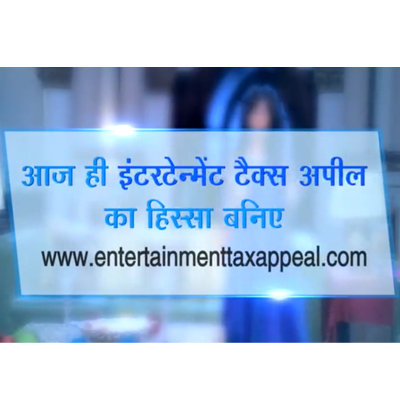
    The TV commercial which stars Roopal Tyagi (Sapne Suhane Ladakpan Ke) and Surbhi Jyoti (Qubool Hai) has been running across all channels.  It makes an appeal to TV viewers to log on to http://entertainmenttaxappeal.com to pledge against rising entertainment taxes. It says that on an average a viewer spends approximately Rs 3000 on cable TV and DTH recharges annually. Almost half of this goes directly into the government’s kitty by way of taxes. Therefore, there is a need to put an end to it.


    “We will present the appeals from the people to the government and hope that they take note of it,” says newly-appointed DTH Operators Association of India president RC Venkateish. He added that the advertisement was timed to coincide with the upcoming budget session. 


    Entertainment tax is a state subject and hence, varies from state to state. In some, it is a fixed amount while in others the state exchequer carves it out as a percentage of the bill. 


     “The state of Maharashtra charges Rs 45 as entrainment tax. This is ridiculously high,” says an industry professional and adds, “High entertainment tax is one of the reasons why local operators don’t declare the number of viewers they have.”


    The campaign is expected to run for a month in order to build a ground swell of public opinion against the entertainment tax levies.  It seems to have got the Information & Broadcasting Minister Prakash Javadekar’s attention already. Speaking to PTI recently he assured industry that “the government is looking into the demands of the DTH operators and that the issue is with the Ministry of Finance.”


    “Industry has high hopes in the new Modi-led government. For several years, it has been appealing to the previous government to reduce the burden but to no avail.  High and multiple taxes have been crippling. Hopefully, the government will find a solution to this problems,” says a media observer. 


    It’s now over to Mr Arun Jaitley. 


    Click here to watch the commercial

  • Dish TV’s appeal to the Finance Minister

    Dish TV’s appeal to the Finance Minister

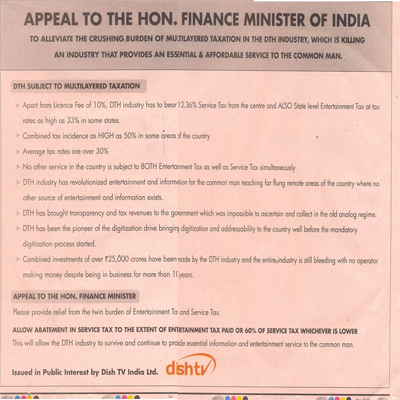
    MUMBAI: The Direct to Home (DTH) industry has been vehemently opposing the heavy taxation being levied on the various operators in the country. In view of the same, the country’s oldest DTH operator Dish TV has appealed to the new Finance Minister Arun Jaitley.


    The DTH operator in its appeal has requested the Minister to alleviate the crushing burden of multilayered taxation in the DTH industry which is in turn killing the industry. The operators are subject to several taxes such as 10 per cent licence fee, 12.36 per cent service tax from the centre and the state level entertainment tax which is as high as 33 per cent in some states. While the average tax rates in most states is 30 per cent, in some it is as high as 50 per cent.


    The appeal states that no other service in the country is subject to both service as well as entertainment tax at the same time. “DTH industry has revolutionised entertainment and information for the common man reaching far flung remote areas of the country where no other source of entertainment and information exists. It has brought transparency and tax revenues to the government which was impossible to ascertain and collect in the old analogue regime,” states the appeal.


    Dish TV says that the entire industry has made investments of over Rs 25,000 crore but is still bleeding with no operator making money despite being in business for more than 10 years.


    The request by the operator on behalf of the entire industry is to provide relief from the twin burden of entertainment tax and service tax. It requests to allow abatement of service tax to the extent of entertainment tax paid or 60 per cent of service tax whichever is lower.   

  • TRAI to hold MSO-MCOF meet in Mumbai

    TRAI to hold MSO-MCOF meet in Mumbai

    MUMBAI: Maharashtra Cable Operators Federation (MCOF) that had recently approached the Bombay High Court challenging the payment of entertainment tax, billing and the carriage fee has now approached the Telecom Regulatory Authority of India (TRAI) to seek answers on the constitution of revenue share.


    “While the TRAI says that there should be a revenue share between the multi system operators (MSOs) and last mile owners (LMOs) on the subscription fee the LMO collects from the consumer, is that the only revenue in this cable TV universe?” questions MCOF president Arvind Prabhoo.


    According to Prabhoo, there should be clear definition of constitutes revenue. “Apart from subscription revenue, there is carriage fee revenue, advertising revenue and even activation revenue. So why it that these revenues are not shared amongst all the stakeholders of the cable TV system?” he asks.


    “Who decides what revenue is?” questions Prabhoo.


    With regards to this, a meeting has been called between the MSOs and MCOF by TRAI. “I had met N Parameswaran earlier this month and had discussed these issues with him. With regards to this, TRAI has decided to hold a meeting in Mumbai between MCOF and MSOs,” informs Prabhoo.


    When Indiantelevision.com contacted TRAI principal advisor N Parameswaran he confirmed the meeting, but said that no particular date was yet decided. “We will be holding a meeting between the two in order to address issues of billing,” concludes Parameswaran.  

  • Case by MSOs challenging Entertainment Tax to be heard on 27 May by DHC

    Case by MSOs challenging Entertainment Tax to be heard on 27 May by DHC

    NEW DELHI: Three multi-system operators were given interim relief in January in the entertainment case issue. In January, the case was adjourned to 13 March and today has further been adjourned to 27 May by the Delhi High Court. However, the HC said that the stay order issued earlier in January to multi-system operators in entertainment tax issue will continue.


    DEN Networks, Hathway Cable & Datacom, and Siticable had moved the court seeking protection against the Entertainment Tax Officer’s order to pay entertainment tax.


    Acting Chief Justice B D Ahmed and Mr Justice Siddharth Mridul gave the order on a plea by counsel for the petitioners.


    DEN Networks, Hathway Cable & Datacom, Siti Cable and InCable were ordered to pay entertainment tax due since April 2013.


    Orders were issued directing the four MSOs to file returns and deposit the pending tax amount with interest under the Delhi Entertainment and Betting Tax Act and Rules, 1996.


    The MSOs argued that it was the local cable operator who should pay the entertainment tax. They had moved the Court to prevent any coercive action.


    DEN and Hathway argued in the last hearing that they are not liable to pay entertainment tax from April since they have started consumer billing only from November. DEN also argued that the entertainment tax must be collected only on actual collections. The MSO also sought clarity from the tax department whether entertainment tax is paid on per subscriber or per set-top box (STB) basis. While Siti Cable adhered to pay entertainment tax, it challenged the quantum of the tax. IMCL 

  • DEN, Hathway and InCable get interim relief  on ent tax

    DEN, Hathway and InCable get interim relief on ent tax

    MUMBAI: The big four  of Indian cable TV – DEN Networks, Hathway Cable and Datacom, InCable and Siti Cable – heaved a sigh of relief as 21 January ended. The reason: the Delhi High Court – which was hearing their appeal seeking to restrain the state government’s entertainment tax authorities from taking any coercive action against them for not paying entertainment tax – gave them relief, if at least for some time. The  HC passed an interim order, forbidding the tax folks  from taking any steps  against  three of the MSOs – Den, Hathway and InCable.


    The cases that were heard in one day saw the appeals of  DEN and Hathway being joined  together while InCable and Siti Cable presented its case separately.  With the order coming into effect, MSOs have been relieved of the duty of collecting entertainment tax from the LCOs and submitting it to the government till the judgment on the case is passed. The next hearing will be on 13 March.


    The respondent (the entertainment tax collection authorities) have been given four weeks to file its reply to the case. In the meanwhile, its hands are tied. However, what was not clear at the time of writing whether  the onus is back on the LCOs to pay the tax to the government.


    Although the MSOs are receiving the tax from LCOs, they claim they aren’t getting the full amount. Hence, the balance amount normally has to be coughed up by the MSO whether it is paid the same or not by the LCO. This is pretty unfair, they have stated.


    The  MSOs approached the Delhi HC as  the inexplicable  pressure was being thrust on them to cough up taxes.

  • Now, MSOs to collect entertainment tax in Maharashtra

    Now, MSOs to collect entertainment tax in Maharashtra

    MUMBAI: Cable operators in Maharashtra have been fighting tooth and nail to reduce the Rs 45 entertainment tax (ET) levied on them by the state government but nothing seems to be working. Now, in a fresh move, the state cabinet has approved an amendment which makes the multi-system operators (MSOs) responsible for the collection of ET from the Last Mile Owners (LMOs).


    Earlier, the onus was on the LMOs, who were supposed to collect the ET along with the service tax and give it to the state. In December, the Maharashtra Cable Operators Federation (MCOF) moved the Court challenging the Maharashtra state government’s amended gazette resolution (GR) regarding entertainment tax. According to the amended GR, it was mandatory for the LMOs to file a joint affidavit with the MSOs while paying entertainment tax. However, last month the Bombay High Court ordered an interim stay on the amended gazette resolution (GR) of ET.


    MSOs and LMOs are all wondering whether this amendment will come into effect or  will it be regarded as as contempt of court, since the High Court’s stay order is in place. As of now, no notification or communication has been issued to the parties involved. “We can only comment after the notification is passed. But we wonder what will happen since the matter is sub judice and the LMOs are stating that it is their business to deposit the tax,” says Hathway president Milind Karnik.
     

    Indusind Media (InCable) managing director  Ravi Mansukhani is puzzled about  the government’s move.  “”How can they pass this?,” he asks. “The case is pending in several courts.” But he adds that he is  “absolutely fine if the LMOs want to do it. It will be difficult for us to reach out to subscribers the way they do. The reason why the government has taken this step is  because it is easier to collect it from a few MSOs rather than so many LMOs”


    MCOF is looking at approaching either the High Court or the Supreme Court depending on the circumstances. “We will definitely not comply and will continue giving the tax to the High Court only,” says MCOF task manager Bobby Shah.


    The Maharashtra government expects MSOs in the state to give their customers bills that will include an additional Rs 45 as entertainment tax besides the service tax of 12.36 per cent following the notification. “Majority of people will have to shed more money for the cable TV service while a few will have to give marginally more than what they are currently paying,” says Shah.


    However, the operators are still protesting against the high ET rate and want it to be reduced. “The amendment is not bothering us much, but what is important is the high rate of entertainment tax that needs to be brought down,” says Cable Operators and Distributors Association (CODA) president Anil Parab.


    MOS ABS Seven Star CMD Atul Saraf says that he is fine with collecting ET from the LMOs. “But the amount needs to be reduced to just Rs 10 to Rs 15 so that the customer isn’t burdened with the extra cost,” he opines.


    Now, it’s a wait and watch situation if the Maharashtra cabinet’s decision is regarded  as contempt of court, or if it will come into effect from the date of notification! Whatever happens, it’s surely going to bring clarity on the revenue that the government earns. 

  • Chennai Corp cracks the whip on cable TV ops

    Chennai Corp cracks the whip on cable TV ops

    MUMBAI: A major crackdown on cable TV operators is taking place in Chennai. 


    The Chennai civic body, The Chennai Corporation has gone on a drive to collect infrastructure usage and registration charges from local cable TV operators in the city.


    Sources in Chennai revealed that around 16 companies were given legal status after they coughed up Rs 1 crore to the corporation. Currently, the civic body charges Rs 9,400 per km as infrastructure use rent to cable TV and telecom operators, though a proposal to hike it to Rs 32,000 is pending with the government. 


    The Chennai Corporation has been trying to clean up the city and had issued orders to its employees and staff to snap cables of the operators who did not pay up. It expects to collect another Rs 1 crore in the coming week. 

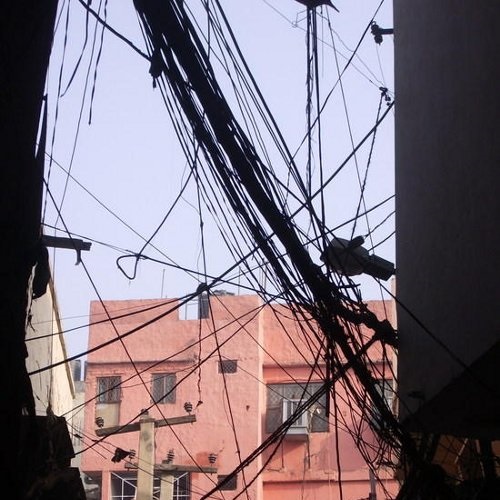
    The civic body is expected to next streamline the way the cables have been strung over head all over Chennai, say officials.