Tag: energy

  • Anker sets bold new course with AI, robotics and solar at IFA Berlin

    Anker sets bold new course with AI, robotics and solar at IFA Berlin

    BERLIN: Anker Innovations, the Chinese consumer-tech firm best known for power banks and chargers, is no longer content with cables and batteries. At IFA 2025 in Berlin, chief executive Steven Yang unveiled a sweeping new brand direction, positioning the group as a global leader in “smart hardware” and pledging to “ignite new possibilities through ultimate innovation.”

    The company will now operate under three unified marques: Anker for charging and energy, Eufy for home and security, and Soundcore for audio and entertainment. Yang told the audience that the pivot is rooted in three principles: break problems down to fundamentals, pursue higher standards rather than easy wins, and grow together with partners and users. The rhetoric, he said, would drive a “maker spirit” across the group — more workshop than corporate HQ.

    IFA saw the debut of the EufyMake UV Printer E1, marketed as the world’s first personal 3D-texture UV printer. Already the most funded Kickstarter hardware project ever — raising $46m from 17,000 backers — it ships to early adopters now and will reach retail in December at $2,499 / €2,499. Bundled with upgraded AI design tools, it promises to turn sketches or photos into textured prints on wood, leather or metal.

    Eufy’s Omni S2 robot vacuum introduced HydroJet 2.0 scrubbing and a 30kPa AeroTurbo cleaning system capable of deep-cleaning carpets and crossing five-centimetre obstacles. More eye-catching was Marswalker, a robotic carrier that lugs the S2 up and down stairs — a long-standing Achilles’ heel of robot vacuums. Marswalker will ship in the first half of 2026.

    In security, Eufy announced AI Core, a large-model agent running locally in the home to detect over 100 scenarios, from package deliveries to trespassers, while keeping data off the cloud. Its companion, the eufyCam S4, is a hybrid 4K/2K PTZ camera promising panoramic views and facial detail up to 15 metres.
    Soundcore meanwhile stretched from earbuds into wellness and theatre. The Sleep A30, a pair of ANC sleep buds already selling in the US, has reached Europe. They adaptively cancel noise and play AI-generated brainwave audio to tackle snoring and other disruptions.

    The brand also introduced a coin-sized wearable voice recorder with real-time transcription and 97 per cent accuracy across more than 100 languages, aimed at students, professionals and journalists.

    Perhaps the boldest move was absorbing Anker’s Nebula projector business, reborn as Soundcore Nebula. The flagship X1 Pro projector, launching on Kickstarter on 23 September, combines a 4K triple-laser engine with Dolby Vision video and Dolby Atmos multi-channel audio. Its detachable wireless speakers and powered subwoofers turn it into what Soundcore dubs the world’s first “mobile theatre station.”

    Anker’s own division doubled down on power. Its new Prime line adds AnkerSense View smart displays to show charging speeds and temperatures. The Prime 160W charger, Prime 300W power bank, Qi2 wireless charging station and triple-display docking station all pitch efficiency and compact design as their edge.

    The group’s energy arm, Anker Solix, launched the Solarbank Multisystem, a modular kit linking up to four Solarbank units with 14kW solar input and 4.8kW output. Targeted squarely at Europe’s high-tariff households, it promises up to 80 per cent savings on energy bills and a four-year payback period. Its semi-DIY installation is marketed as 85 per cent cheaper than conventional solar. Complementing it is the V1 Smart EV Charger with gesture-based control and tariff-synchronised charging. The starter kit begins at €1,898, with the EV charger priced at €499. Germany gets it first, with France and the Netherlands following on 11 September.

    The showcase in Berlin marked more than another tech fair launch. Anker is re-casting itself as a systems company, fusing AI, robotics and renewable energy into everyday hardware. If successful, Yang’s bet could move the firm up from niche accessories into the ranks of household consumer-tech giants. The risk is execution: a vacuum that climbs stairs and a solar charger that pays for itself in four years are promises the market will hold him to.

  • Reliance hits record Q1 FY26  EBITDA as Jio and retail fire on all cylinders

    Reliance hits record Q1 FY26 EBITDA as Jio and retail fire on all cylinders

    MUMBAI: Reliance Industries has kicked off FY26 with a blockbuster first quarter, posting its highest-ever consolidated quarterly EBITDA of Rs 58,024 crore ($ $6.8 billion), a sharp 35.7 per cent leap over last year, fuelled by robust performances across digital, retail and energy verticals.

    Group net profit soared 76.5 per cent year-on-year to Rs 30,783 crore ($3.6 billion), aided by operational gains and a Rs 8,924 crore windfall from its stake sale in Asian Paints. Total revenue rose 6 per cent to Rs 2.73 lakh crore ($31.9 billion), with EBITDA margins improving by a stellar 460 basis points to 21.2 per cent.

    Reliance Jio continued to dominate the digital landscape, crossing a jaw-dropping 200 million 5G subscriber milestone and 20 million home broadband connections. Jio Platforms’ revenue jumped 19 per cent to Rs 35,032 crore, while EBITDA climbed 24 per cent to Rs 18,135 crore, with margins expanding 210 basis points to a best-in-class 51.8 per cent.

    ARPU rose to Rs 208.8, driven by premium subscriber additions and deepening data consumption, which reached 54.7 billion GB this quarter. Jio also unveiled its next-gen tech stack—JioGames Cloud, JioPC, and the proprietary UBR fixed wireless platform—taking a firm aim at India’s AI and home computing future.

    Reliance Retail cemented its pole position, clocking Rs 84,171 crore in revenue (up 11.3 per cent), and EBITDA of Rs 6,381 crore (up 12.7 per cent), marking an industry-leading margin of 8.7 per cent. The business added 388 new stores, taking the total footprint to 19,592 outlets spanning 77.6 million sq ft.

    JioMart’s hyper-local push paid off with daily order volumes exploding 175 per cent year-on-year. AJIO continued to thrive in the online fashion segment with its new 4-hour delivery service and strong traction for Shein, while the FMCG arm doubled revenue to Rs 4,400 crore.

    Reliance’s Oil-to-Chemicals (O2C) segment, despite a 1.5 per cent drop in revenue due to crude price softness and planned shutdowns, posted a solid 10.8 per cent EBITDA gain at Rs 14,511 crore. Jio-bp’s aggressive retail fuel push contributed significantly, with volumes of petrol and diesel up 38.6 per cent and 34.2 per cent respectively.

    With net debt remaining flat at Rs 1.17 lakh crore and capital expenditure of Rs 29,875 crore this quarter, the group is doubling down on its “golden decade” growth strategy across tech, consumption, and energy. Chairman Mukesh Ambani said, *“Reliance will continue its stellar track record of doubling value every four to five years.”

    From superfast data to doorstep delivery and clean fuels, Reliance is firing on all fronts—and showing no signs of slowing down.

  • CS Tech AI: The right way to rebrand a technology solutions provider

    CS Tech AI: The right way to rebrand a technology solutions provider

    MUMBAI: You are a technology solutions provider. Your company and the solutions  you provide are well known to those involved in the automotive, architecture/engineering, transportation, telecom, water management, energy and geospatial engineering spaces.  And to top it all your company name is Ceinsys Tech. And most people find the name strange and difficult to pronounce. Especially in the domestic sector; internationally, things are good as the name looks fancy enough for a tech firm.

    So what you do?

    Do you run a campaign telling customers the right way to pronounce the company’s name?  Or do you  totally change your moniker? Or  do you take the tack that  Rs 250 crore plus turnover Ceinsys Tech India operations managing director  Kaushik Khona did?

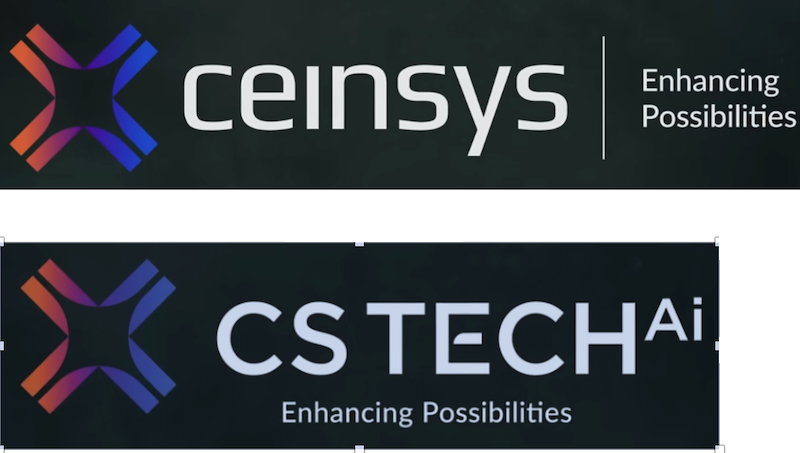
    What Kaushik and team did is they took the C and the S from the name and removed the redundant “einsy.”  So they were left with CS Tech. Well, to everyone that looked like a great change , but they also wanted to make the  brand look edgy and very design-driven  like many a tech company  takes the effort to look (remember Apple and its classy designer look in everything it does).

    In line with its  strategy to grow globally and be seen as a cutting edge global technology company which is adding dollops of artificial intelligence into its solutions and processes, a decision was taken to add the words AI next to the logo as a suffix.  This change, for the company,  marked a strategic shift to underscore its  focus on artificial intelligence (AI) and its role in driving technological innovation.

    “The move comes as Ceinsys positions itself for a future shaped by AI-driven solutions. The addition of “.ai” to the new rebranding reflects the company’s roadmap to integrate newer technologies including AI into the geospatial and technology solutions that enable smart infrastructure and utility development,” said the company.

    Hence the name of the company was changed to CS Tech AI.  

    Said Khona: “The rebranding of Ceinsys into CS Tech with inclusion of suffix ‘.ai’ is more than just a rebranding exercise—it represents our focus on the adoption of advanced technology into providing of solutions to our esteemed clients. AI is becoming the backbone of smart solutions, and this rebranding reinforces our commitment to innovation and relevance in a rapidly evolving landscape. It also allows us to communicate our vision more clearly and differentiate ourselves in the market.”

    A decision was taken to maintain the icon next to the logo as well as the tagline “Enhancing possibilities” as both only reinforced the high-tech look for the branding.  

    The corporate name Ceinsys Tech Ltd was maintained with  only the URL being changed to www. cstech.ai from www.ceinsys.com

  • Telcos may offer multi-play OTT for security, energy & appliance control: Report

    MUMBAI: The Smart Home is a growing fifth-play opportunity for operators. The global smart home market is growing exponentially, attracting an array of service providers, including technology giants and startups to major media players, device makers, big-box retailers, home improvement companies, utilities and telecom network operator.

    Government mandates and initiatives in addition to the ongoing technology innovations coupled with increased attention paid to conservation- are the major factors contributing in making smart home a place with a bright future. Focus on sustainability, increasing awareness amongst the consumers with regards to energy consumption and regulatory mandates on energy conservation continue to drive smart home adoption trend globally. While adoption is increasing in countries where governments actively support faster broadband services, especially fiber to the home, the costs associated with new equipment, installation and ongoing maintenance are significant deterrents to home automation.

    Government mandates and initiatives, ongoing technology innovation and the intense attention paid to conservation all contribute to giving the smart home a bright future. The smart home is an attractive opportunity for network operators, thanks to their unique billing relationships and network connections into the home.

    Telcos can improve the value proposition of home automation by implementing a multi-play OTT strategy that offers a range of capabilities, such as security, energy and appliance control.

    Partnerships with companies from different industries are key to ensuring the role of operators in smart home functionality. The market is at a fork in the road, going either toward an open ecosystem with heterogeneous devices or toward proprietary platforms that control all device access.

    The Smart Home, a research report by Pyramid Research, analyses the smart home strategies of leading network operators in a number of markets across the globe, focusing on their roles in the value chain. It discusses the elements of smart home services, the participants in the ecosystem and a number of smart home strategies available to operators. Attention is paid throughout to the key challenges operators face, including the need for device standardization and interoperability.

    Introduction in the report: Providing a thorough overview of the smart home market, this section looks at the long-term evolution of the market, the types of services available as well as the main adoption drivers and barriers.

    The smart home ecosystem (in the report): This section examines the value chain and the roles of the various types of participants, from broadband providers to device manufacturers, utilities and home security platform providers.

    Telco positioning strategies and marketing opportunities: This section analyzes a number of approaches operators can take to gain competitive advantage in the connected home, including white-labeling, support services, bundling and OTT services.

    Key takeaways in the report whittles down into a number of actionable bullet points.

    Case studies: This section analyzes four smart home programs by operators: AT&Ts Digital Life platform in the US, Oranges Homelive in France, HKTs Smart Living in Hong Kong and Rogers Communications Smart Home Monitoring in Canada.

    One could identify the broad barriers to adoption as well as challenges specific to telecom operators in the smart home market. Assess the role and opportunity of operators in the smart home market and how they can gain competitive advantage over the markets many powerful players.

    One could gain information on some of the most valuable experiences by operators in the home automation market, placing them in the context of ongoing market developments and the main technological and competitive challenges.

    The Case studies could be leveraged upon by the operators and cable companies to make informed decisions pertaining to partnering, go-to-market strategies and investments in technologies.

    Also read:

    MatrixCloud OTT enables IPTV operators roll out OTT services in 60 days

    Content & channel management vital as Asian production enters new growth cycle

    Processing video from linear to live, OTT & VR: Verizon launches Exponent for global carriers

  • ET NOW in association with DuPont presents The Power of Shunya: Challenge for Zero

    ET NOW in association with DuPont presents The Power of Shunya: Challenge for Zero

    ET NOW, India’s No.1 business news channel in association with DuPont India, a leader in market driven science & innovation is launching an inspiring television competition series ‘The Power of Shunya™: Challenge for Zero’. This unique show will give university students the opportunity to present their best ideas and innovations that will help India achieve progress against the goal of Shunya or zero – a country of zero hunger, zero malnutrition, zero accidents, zero lives lost, zero carbon footprint. The 10-part series will be hosted by popular television anchor Gaurav Kapur and will premiere on Saturday, October 12, at 6:30 pm only on ET NOW.


    ‘The Power of Shunya™: Challenge for Zero’ is an invitation to the best minds from science, technology and business schools to come together to showcase ground-breaking innovations and their go-to-market strategies across key sectors like food, agriculture, nutrition, health, energy, mobility, infrastructure, safety and sustainability.