Tag: Emerging India

  • Digital is the key to unlocking Emerging India

    Digital is the key to unlocking Emerging India

    NEW DELHI: The next big market is beyond metros’.

    Non-metros, rural, tier 1, 2, & 3 are driving the next wave of consumption in the country. There is no product category on the shelf that does not sell well in this region. However, the consumer and the consumption pattern is also much different from what we see in the metros.

    Better known as Emerging India or Real Bharat, the audiences in the region are aspirational and keen to spend on newer experiences. Brands and marketers are very excited about this opportunity and working towards chalking out a strategy to increase its footprint, strengthen the distribution, and create tailor-made range of products for the audiences region. All of them are leveraging digital medium to crack this billion dollar puzzle – ‘Real Bharat’. 

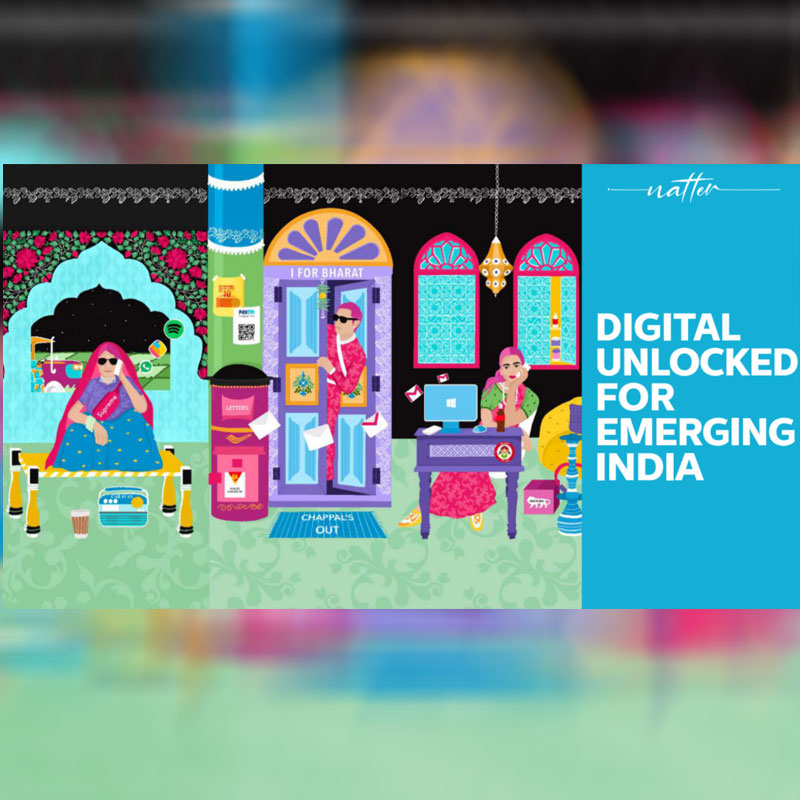
    Natter, a leading Delhi-based digital marketing agency that has placed itself comfortably between the consumer insights and marketing requirements, is accompanying brands in this journey to crack the Real Bharat code. It undertook a study with 11000 respondents across 10 states to get an indepth analysis on the digital consumption patterns of this new consumer. The new-age agency that aims to position itself as the one-stop solution to all the brand requirements has come up with a report ‘Digital Unlocked for Emerging India’. The report clearly elucidates the role of 'Digital' in Emerging India is not just restricted to advertisements, but it will be the medium to engage, reach and sell. 

    It further enables the marketers and brands to deep-dive into the consumption & spending patterns, digital penetration, entertainment choices and mediums, language preferences of ‘Emerging India’ across socio-economic groups and geographies.

    Some of the key points highlighted in the report are:- 
    •    43% respondents are taking farming as primary occupation; 21.5% use WhatsApp groups for gathering farming related information; 9.9% farmers watch farming related videos on YouTube
    •    37% women access internet for songs, movies; 18% watch funny videos; 16% educational videos; 
    •    Samsung leads in the smartphone & feature phone category 
    •    50% respondents use Jio followed by Airtel
    •    Order from E-commerce: Flipkart (46%), Amazon (33%), other local online stores (16%), Snapdeal (5%) 
    •    YouTube: 63% go for entertainment & songs, 12% education related videos, 25% business & farming related videos 
    •    WhatApp: 68.3% use it for connecting with friends, 21.5% use it for farming related information, and 7.5% for buying and selling information.
    •    Facebook: 65% respondents had profile on Facebook
    •    Gaming: Time spent on gaming has increased, and increasingly females are also playing more.

    Jankana Kaul, Founder & CEO, Natter says, “The focus of report has been to capture the variations in digital consumption patterns & insights on different needs of Digital citizens in Bharat. At Natter we will continue to de-code these differences & capture nuances to help marketers to opt, devise & craft solutions relevant for rural consumers. With more than a decade long brush with Bharat, I have seen a steady pace of digital evolution & now giants entering this space to woo this consumer class. Here we are in next phase of Digitisation – an imperative shift from WHY DIGITAL TO HOW DIGITAL. And at Natter we provide you with the HOW STRATEGY.”

    Avinash Joshi, COO Natter says, “We at Natter strongly believe and aim to initiate and catalyze discussions around the significant advancements in adoption of digital across emerging India. In its first edition, the Digital Unlocked report reveals the most significant shift in digital that will be driving marketing strategies, company investment and consumer behaviour. Brands leading the way in engaging and providing the needed value are more likely to significantly exceed their business goals. Digital Unlocked will prove to be a valuable tool for our teams at Natter and marketers across the globe.”

    You can download the report here.

  • ‘Emerging India’ series to air on NatGeo on 14 August

    ‘Emerging India’ series to air on NatGeo on 14 August

    MUMBAI: Starting 14 August, National Geographic Channel will present the changing face of India through its series ‘Emerging India’.

    The five-part series will premiere on the eve of Independence Day at 10 pm and looks at today’s India coming to terms with its newfound place in the world – a confident and bold nation, a power to be reckoned with.

    The series will cover topics as diverse as the new call centre generation to computer literacy amongst children to the development of the world’s largest planned city on the outskirts of Mumbai.

    Speaking on the series, National Geographic Channel India Sr VP-Programming, Joy Bhattacharjya said, “Emerging India looks at India in a very realistic and objective manner, bringing forward the normal yet less explored aspects of modern India in a unique manner. We are particularly excited about an episode titled ‘Bombay Calling’ that showcases the undocumented lives of the youngsters working in the BPO sector. The series successfully manages to present the fast track life of an Indian today, a life which sees a complete eradication of earlier conceptions of India by those in the developed world.”

    The week-long series will feature the following five episodes from Monday, 14 August will continue till Friday, 18 August at 10 pm:

    The Hole in the Wall: ‘The Hole in the Wall’ explores Indian researcher Sugata Mitra’s experiments and attempts to answer the question “Can children really teach themselves the rudiments of computer literacy with no instruction?”

    Bombay Calling: Life at the other end of the line profiles the lifestyles of young Indians who swipe their identity cards and enter a world where they leave their real names at the door and negotiate uncharted territory and live an unfamiliar life. Bombay Calling is a snapshot of their world in transition, a Nat Geo window into the growing BPO sector. This critically acclaimed film directed by Samir Mallal has won the Grand Jury Prize – Indian Film Festival of Los Angeles and the Colin Low Award for Most Innovative Documentary – DOXA Documentary Film and Video Festival, Canada. The film has also been shown at the Melbourne International Film Festival and will be a part of the Indo-American Arts Council Film Festival, New York this November. The filmmakers Ben Addelman and Samir Mallal dive into this bustling world of late nights, long hours and hard partying. The result is a compelling insider’s look at the growing number of young people who choose to follow the American dream…but in Indian ishtyle.

    Stuntmen of Bollywood: This episode provides a gripping and in-depth account of the dangerous lives Indian stuntmen lead to make the leading actors appear as ‘heroes’ on the silver screen. This episode brings superstars, action directors and technicians on the same platform to reveal the heroic and often tragic tales behind well-known action sequences that have until now remained a well-kept secret.

    Mumbai: Public transport is Mumbai’s lifeline. Trains were built for 1700 passengers, but in this mega-city they carry three times that number. Mumbai’s trains and buses keep this city in the fast lane, but by 2020 this city of 13 million could swell to an astounding 28 million people. This film takes a look at the futuristic transport arrangements being planned for the city along with the development of a new Mumbai-Navi Mumbai-the world’s largest planned city.

    Hot Science – From India: This episode documents India’s attempts to establish itself as a fast developing nation with a unique brand of hot science and how the country is at the forefront of plans to push the developing world across the digital divide, with a hand-held, inexpensive alternative to the PC. Indian meteorologists are developing sophisticated computer models that harness the past to probe the monsoons of the future. Indian engineers have tapped the sun for an eco-friendly rite of passage – with a solar crematorium.

  • NGC looks at an ‘Emerging India’ next month

    NGC looks at an ‘Emerging India’ next month

    MUMBAI: National Geographic Channel (NGC) will celebrate India next month with an Emerging India Week.

    This will look at different topics from call centres in Mumbai to Delhi’s firefighters.

    Speaking to Indiantelevision.com on the localisation plans NGC India VP marketing Rajesh Sheshadri says, “We have a two-fold plan for localisation. One is in terms of look and feel of the channel, packaging as we call it. We are in the process of creating packaging that will connect at a local level.

    “The other is from creating local programmes. We already have India based programming, like Megacities: Mumbai, Sunset Bollywood, Delhi in Flames and we are in the process of increasing this bank of content. We don’t localise for localisation sake. Even the India based programming reflects our overall positioning of Think Again. Therefore, even if a Mumbaikar sees the Megacities episode on Mumbai he will learn 10 things about it that he did not know earlier.”

    The Emerging India Week takes place on the week of 15 August. One key episode that will air here is Bombay Calling at 10 pm on 15 August. This looks at what life is like in a call centre in the country’s financial capital and the call centre in question is Epircentre. It gives viewers an insiders view of how a call centre operates and what it takes to achieve success.

    It looks at the behavioural attitudes of the young employees who make good money early in their career. It will also examine at how their parents view the profession. For instance, a girl who works in the call centre comes from the sugar belt. Her father expresses pride at what she has achieved. That is because in her home town there are not many opportunities for growth. Those opportunities are to be found in the city.

    Another episode is called Delhi In Flames. This looks at Delhi’s firefighters and how they cope with the challenges of working in the country’s capital. Then there is the technology based episode Hole in the Wall. What is interesting is the manner in which it shows how technology cuts through India’s social and cultural barriers.

    A researcher Dr. Sugata Mitra conducted a series of experiments. It involved putting up a high speed computer on the walls of different places like slums. The children, irrespective of where they lived, were able to teach themselves how to surf the internet and how to download content from the web.

    It shows that children because of their curious nature have more scope to be self taught compared to adults. While on the subject of children as had been reported by Indiantelevisuion.com NGC has kicked off a Junior Hunt. This is a quest to find India’s superkid who is curious, adventurous, articulate, energetic and smart, in short, an all rounder.

    Sheshadri points out that NGC has so far contacted 180 schools all of whom have expressed interest. Some of them are letting a brand inside for the first time, which he finds encouraging. The hunt should come to an end by the end of September. The channel says that the endeavour aims to extend its children’s block Nat Geo Junior on-ground to provide an intelligent platform for kids to showcase their talent through a fun-filled, learning experience.

    Asked about how the idea for the Junior Hunt came about Sheshadri says, “Last year, we had launched the Nat Geo Junior block for kids on the channel. Its performance made us think again about what we are doing for kids. We realised that children are a very important set of audience whom we need to cater to and we had to make it a 360-degree experience for them too.

    “Then came an idea of encouraging kids to realise their potential but not based on the traditional parameters of grades in school. We are looking for a kid who likes his/her books as much as sports, likes to learn and discover new things, is adventurous, out-going and ready to take on challenges, in short an all-rounder.

    He points out that when NGC launched its Junior on air, block experts were consulted for their feedback on provide edutainment for the young audience. The aim is to have content through which children learn while having fun. “For the Nat Geo Junior block we try to select programmes that kids can relate to and are also superlative. Therefore, the segment is well appreciated by kids as well as their teachers and parents” adds Sheshadri.

    One local property that has done well for NGC has been Mission. There are plans in the pipeline to do another one but so far nothing has concretised.

    Sheshadri adds that the programing template on NGC going forward is two fold. One will be to have a different genre of infotainment every night. So on Monday, there is Nat Geo Investigates, on Wednesday technology takes the spotlight etc. The other strand is to have theme weeks. As had been reported earlier by Indiantelevision.com NGC will have a Terror Week in September.

    “We have created two hour special stacks from Monday – Friday to show case particular genres of content. This runs between 8-10 pm. Following that at 10 pm, we have Nat Geo Presents which will showcase our theme weeks, global tentpoles, etc. All of these bands have been packaged in a manner that is attractive to the advertiser.”

    In terms of how viewers perception of the channel have changed since the Think Again rebranding is concerned Sheshadri says, “Earlier NGC was associated mainly with wildlife and the adventure of exploration. Now, though we are seen as being a channel that specialises in different subjects like those of technological interest. A lot of this has to do with shows like Megacities.

    “We are seen as airing quality shows that are tech driven. Technology is something that our viewers can relate to more directly compared to wildlife. That is because they might use things that are technically complex though they might not always be aawre of it. In whatever we do, we ensure that uniqueness in terms of presentation, concepts and ideas is maintained and there is a take back value for our viewers from our programming. This approach is starting to pay dividends.”

    On the advertising front, Sheshadri agrees with the industry view that a Tam Elite Panel will increase ad revenue for the English entertainment and infotainment genre. He says, “An elite panel in Tam will help advertisers to identify what their target viewer is watching and will help them to direct their advertising spends at relevant places. English entertainment and the infotainment segment should definitely see a rise in ad revenue. A lot of this would depend on both – the acceptance of this metric among the agencies and clients and the measurement system adopted by this panel.

    “The ad sales strategy has been fine tuned to reflect the content that we have and hence the target group that comes on the channel to consume this content. Our content is evolved and hence the customer that comes to watch us is also evolved and sophisticated. All our specials have rated extremely well with the advertising fraternity even though they are based on varied topics from It Happens Only In India to Megacities to Most Amazing Moments.”