Tag: Elephants

  • Animation film stresses need for elephant corridors

    Animation film stresses need for elephant corridors

    NEW DELHI: A timely message during a social event. To coincide with the ongoing Ganesh Chaturthi festival, an animated film has been made to draw attention to the sad state of elephants in the country. The number of elephants has dwindled by almost half over the past few decades.

    Culture Machine’s digital channel ‘Being Indian’ has released the new video titled ‘Our Elephants’ to shed light on the plight of elephants and the grave state of elephant corridors. The film says the total population of elephants has fallen and is between 27,000 and 29,000 now.

    ‘Being Indian’ takes the opportunity to edify people about the conditions of the real giant wanderers.

    Elephant corridors are nature’s highways that allow elephants to move from one habitat patch to another. India houses 50 percent of the entire elephant population across the globe. The country is making efforts to promote elephant corridors and help preserve the friendly giant’s habitat.

    Although possessing an overpowering exterior, elephants are one of the most social and intelligent creatures. They are responsible for sustaining the forest and keeping the ecosystem together.

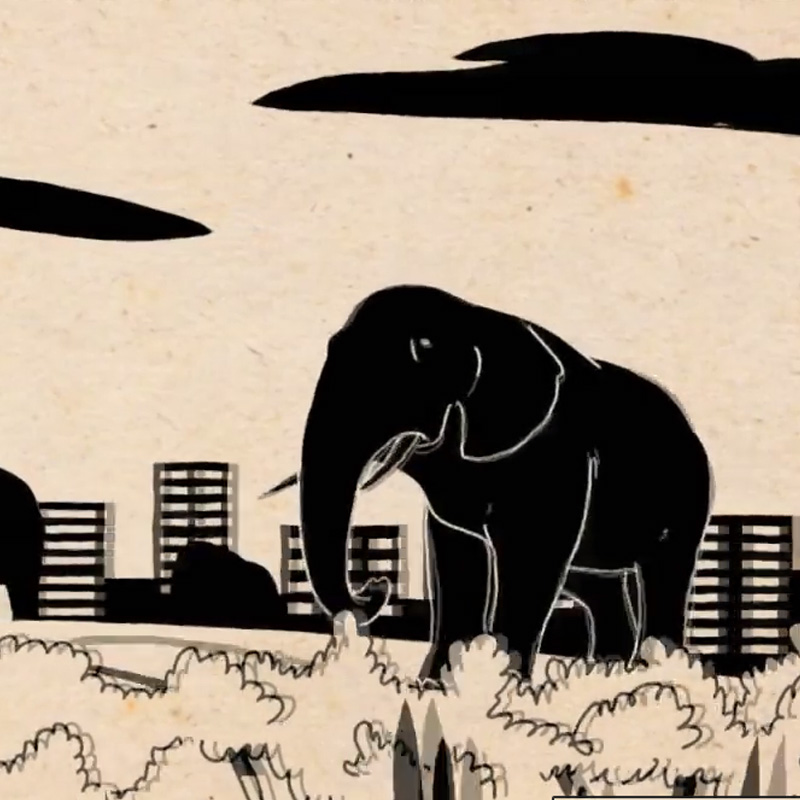
    ‘Our Elephants’ by ‘Being Indian’ narrates the man versus the giant story through dialogue. Man survives by destroying and creating what has been given to him by nature. An elephant is similar, as he creates rivers and trails that lead to the evolution of newer species.

    But, humans are disrupting this cycle of evolution and creation, but the poor elephants end up paying the price as they get run over by trains while making their great expedition through the forests.

    Culture Machine’s digital channel ‘Being Indian’ stated, “It’s very crucial for us to realise the importance of the deteriorating conditions of our forests and dimensioning population of elephants. We have curated this content to raise awareness about the situation at hand, and help make a difference through our platform.”

    The film gives the message: One can either choose to be impacted by the world or choose to impact world.

    Watch the video on-

  • Animation film stresses need for elephant corridors

    Animation film stresses need for elephant corridors

    NEW DELHI: A timely message during a social event. To coincide with the ongoing Ganesh Chaturthi festival, an animated film has been made to draw attention to the sad state of elephants in the country. The number of elephants has dwindled by almost half over the past few decades.

    Culture Machine’s digital channel ‘Being Indian’ has released the new video titled ‘Our Elephants’ to shed light on the plight of elephants and the grave state of elephant corridors. The film says the total population of elephants has fallen and is between 27,000 and 29,000 now.

    ‘Being Indian’ takes the opportunity to edify people about the conditions of the real giant wanderers.

    Elephant corridors are nature’s highways that allow elephants to move from one habitat patch to another. India houses 50 percent of the entire elephant population across the globe. The country is making efforts to promote elephant corridors and help preserve the friendly giant’s habitat.

    Although possessing an overpowering exterior, elephants are one of the most social and intelligent creatures. They are responsible for sustaining the forest and keeping the ecosystem together.

    ‘Our Elephants’ by ‘Being Indian’ narrates the man versus the giant story through dialogue. Man survives by destroying and creating what has been given to him by nature. An elephant is similar, as he creates rivers and trails that lead to the evolution of newer species.

    But, humans are disrupting this cycle of evolution and creation, but the poor elephants end up paying the price as they get run over by trains while making their great expedition through the forests.

    Culture Machine’s digital channel ‘Being Indian’ stated, “It’s very crucial for us to realise the importance of the deteriorating conditions of our forests and dimensioning population of elephants. We have curated this content to raise awareness about the situation at hand, and help make a difference through our platform.”

    The film gives the message: One can either choose to be impacted by the world or choose to impact world.

    Watch the video on-

  • Wherever they go, Spy cams follow

    Wherever they go, Spy cams follow

    MUMBAI: Taking natural-world filmmaking to an unparalleled scale, Animal Planet’s new series SPY IN THE WILDbrings most engaging and secret stories of some of the most intriguing and charismatic animals present on this Earth. Award winning teams of directors and cameramen employ remote-controlled buggy-cameras, buried periscopes and state-of-the-art technologies to bring forth the lives of world’s famous animals.

    Starting May 1st, every night at 10 pm on Animal Planet, SPY IN THE WILDgives a new perspective on the behaviour, emotions, intelligence and extreme survival tactics used by animals. Specially designed cameras and the latest technology allow the viewers to really get to know the species that include lions, elephants, polar bears, tigers and penguins.  

    For the first time, state of the art ‘SpyCreatures’ infiltrate the dolphins’ underwater world, often interacting and engaging the curiosity of the dolphins themselves, offering a unique glimpse of their intelligence and personalities.   The sensational ‘Bouldercam’ takes viewers to within a whisker of the lion. The programme also introduces ‘Dungcam’ and applies the revolutionary brand of photography to perhaps the most popular of all animals – the African Elephant.  Using the‘Tuskcams’ and ‘Trunkcams’, the crew uses intelligence and sensitivity of elephants and seeks support to carry the cameras on their tusks and trunks to film the tigers wherever they go, even on the move.With bouldercam’s revolutionary sound system, the television vibrates to the purrs, roars, yelps and barks of these highly vocal animals.The team also uses mini-cranes, buried cameras and tracking vehicles to grab the action.

    Production Facts

    1. For the three-part special Penguins – Spy in the Huddle, 1,000 hours of intimate behaviour were recorded – almost nothing that happened on the colony was missed. With emperor penguins, this proved to be the longest continuous shoot of emperors ever made – more than 330 consecutive days. The overwintering crew was totally  isolated for 8 months, with no contact with the outside world beyond a satellite uplink, in temperatures as low as -60?C. There were only 10 days when they didn’t film.

    2. Humboldt penguins are shy birds and have hardly ever been filmed. Spycams played a key role in the 165 days of filming.

    3. For Dolphins – Spy in the Pod, 900 hours of intimate behaviour were recorded over the course of 1 year, in countries as diverse as Mozambique, Canada, Florida, South Carolina, Honduras, Costa Rica, Australia, South Africa and Argentina.

    4. In the course of the filming period, they dived over 1500 times and spent nearly 3000 hours at sea filming with the Spy Creatures and dolphins in all weathers. Over half of the filming took place via free diving (as opposed to using scuba gear), in depths ranging from shallow coral reefs to nearly 70 feet deep!

    Episode Details:

    Tiger – Spy in the Jungle:   The elephant camera crew reveals the incredible story of four cubs growing up in this previously unseen world.  By following the tiger, the camera-carrying elephants uncover a wildlife world every bit as rich as that of Africa, encountering sloth bears – a rarely filmed bear with a unique character, famous for carrying its comical babies on its back – and leopards, the tiger’s major competitor. The episode also brings to light the extraordinary red dogs. These fearsome creatures race through the jungle in huge packs, striking fear into anything in their path.

    Polar Bear – Spy on the Ice: Shot mainly using spy cameras, this episode gets closer than ever before to the world’s greatest land predator.Icebergcam, Blizzardcam and Snowballcam are a new generation of covert devices on a mission to explore the Arctic islands of Svalbard in Norway. Backed up by Snowcam and Driftcam, these state-of-the-art camouflaged cameras reveal the extraordinary curiosity and intelligence of the polar bear.  The cameras also follow the bears as they hunt seals, raid bird colonies, dive for kelp and indulge in entertaining courtship rituals. Icebergcam even discovers their little-known social nature as seven bears share a washed-up whale carcass.

    Elephants – Spy in the Herd: Elephants show many human similarities – life span, social structure, wisdom of age and emotional bonds – which allows this series to connect even more strongly with the audience.  The cameras are disguised as elephant dung.  These come in different versions and use different lenses.  Shots are captured as the cameras are carried by the elephants or even kicked like a football. The intimacy of the ‘dungcams’ images reveal the subtleties of elephant life in a way that has never been seen before.

    Dolphins – Spy in the Pod is a magical underwater adventure. Dolphins are one of the most social and playful animals on the planet. Using the trademark blend of extraordinary imagery,analysis of behaviour and moments of humour, the episode looks at thesecret lives of one of the world’s most popular and charismatic animals.

    Lion – Spy in the Den makes us imagine sitting just a whisker away, watching lion cubs growing up learning to be lions themselves, and getting into all kinds of trouble. Out on the African plains, right under the lion’s nose, ‘bouldercam’ – a state-of-the-art mini camera and buggy with surround sound, all hidden in a ‘boulder’ – trundles along.

    Penguins – Spy in the Huddle: The amazing technical wizardry of the penguincams allows them to blend into these penguin colonies, allowing a closer view of the creatures than ever before as they immerse themselves in the penguin world, both on land and at sea.Penguins – Spy in the Huddle spends nearly a year in their close company, deploying 50 spycams to capture as never before the true character of three very different, yet equally charismatic, birds

  • BBC.com and BBC World News launch second series of Power of Nature

    BBC.com and BBC World News launch second series of Power of Nature

    MUMBAI: Starting 14th January, Power of Nature, sponsored by Nikon, returns to bbc.com and BBC World News for a new 10 part series revealing there’s more to the Earth’s great wild places than just their natural beauty.


    Using extraordinary HD imagery,the individualfour minute filmsfocus on a diverse range ofthe Earth’s most spectacular places and uncover the profound impact some of our planet’s animalshave on their habitats. From the gardener elephants of the tropical rainforests to the sea otters of the North Pacific, the series will include stunning natural imagery and will feature interviews with world renowned scientists and biologists who explain the importance of these complex ecosystems that allow our planet to thrive.


    Dr M Sanjayan, Lead Scientist with The Nature Conservancy and contributor for the Power of Nature series, said:“Viewers will see these animals and the worlds they inhabit in an entirely different way. They will learn how animals are critical actors, shaping the health and well-being of the human race.Putting these stories on bbc.com and BBC World News, underscores the importance of understanding these new, surprising facts about our world.”


    The Power of Nature series will be available as short films on 14th January at 3.30pm BBC World News and online at www.bbc.com/powerofnature.


    Further details about each short film include:


    ELEPHANTS: Mega-gardeners of the Forest
    The tropical rainforests of Africa and Asia play a crucial role in keeping our planet healthy.  In this film Lead Scientist with The Nature Conservancy, Dr M Sanjayan, Dr Valerie Kapos of the UN Environment Programme, and tropical field biologist and conservationist Dr Ian Redmond uncover the crucial role that forest elephants play in keeping these forests strong and resilient. 


    WOLVES: Forest Stewards
    After a seventy year absence, wolves were reintroduced to Yellowstone National Park in 1995. It was hoped they would protect the rising elk population – but they did much more than that. In this film Lead Scientist with The Nature Conservancy, Dr M Sanjayan, Dr Valerie Kapos of the UN Environment Programme and animal behaviourist Kirsty Peake describe the surprising effect the returning wolves have had – not just on their prey, but on the rivers, forests and even the landscape.


    WHALES: Gardeners of the Ocean
    Whales are among the biggest animals that have ever lived.  In this film Conservation Biologist Dr Joe Roman and Marine Scientist Stephanie Wear describe how whales restore valuable nutrients to surface waters, starting a chain reaction that stretches into the atmosphere and our lives.


    SEA OTTERS: Guardians of the Kelp
    The kelp forests fringing the North Pacific coast are one of the most bountiful marine ecosystems on Earth. One of the kelp’s most endearing denizens, the Sea Otter, is key to its success.  In this film, marine ecologist Professor James A Estes, cameraman Doug Allan, ecological economist PavanSukhdev, and lead scientist with the Nature Conservancy, Dr M Sanjayan reveal how sea otters eat sea urchins which would otherwise devour the kelp and disrupt the web of life that relies on it.


    SALMON:  Heart of the Forest
    The Great Bear Rainforest on Canada’s Pacific Coast is the largest temperate rainforest left on Earth. This forest owes its existence to an ocean-dweller – the Pacific Salmon. In this film ecological economist PavanSukhdev and Lead Scientist with The Nature Conservancy reveal the unlikely hero at the core of the success of these ancient woodlands.


    VULTURES: Earth’s Clean-up Crew
    Vultures soar above some of our planet’s most spectacular scenery – from the vast plains of Africa to the stunning Andes mountain range in South America. In this film Ecological Economist PavanSukhdev, Lead Scientist with The Nature Conservancy Dr M Sanjayan, Jemima Parry-Jones Director of the International Centre for Birds of Prey and Dr Ananya Mukherjee, Vulture Safe Zone Coordinator explain what happened when India’s vultures almost went extinct at the turn of the century.


    HIMALAYAS:  Water Tower of Asia
    The Himalayas are the greatest mountain range on Earth. In this film Environmental Economist, PavanSukhdev, wildlife cameraman, Doug Allan, and Ecological Economist, Dr Trista Patterson reveal not only the natural beauty and diversity of the Himalayas but also the hidden and essential contribution they make to life on the planet. 


    SAHARA: Life Giving Sands
    The Sahara is hot, barren and dusty. But hidden within the dust are minerals left from an earlier more fertile time. In this film Professor of Sedimentology at Birkbeck College, Charlie Bristow, Lead Scientist at The Nature Conservancy, Dr M Sanjayan and Environmental Economist, PavanSukhdev reveal the Saraha’s hidden ability to nourish ecosystems round the planet.


    SUNDARBANS: Nature’s Bioshield
    TheSundarbans is the largest mangrove forest in the world. Stretching along the coastline of India and Bangladesh, this delicately balanced ecosystem is the haunt of tigers. In this film Sustainability Advisor and Author, Tony Juniper, Environmental Economist, PavanSukhdev, and Lead Scientist with The Nature Conservancy, Dr M Sanjayan, reveal the wildlife this strange and magical forest supports. 


    CORAL REEFS: Underwater Pharmacy
    Coral reefs are one of the most bio-diverse habitats on the planet – a kaleidoscope of colour and life – a quarter of all marine species are found here. In this film Ecological Economist, Dr Trista Patterson, Lead Scientist with The Nature Conservancy, Dr M Sanjayan and Professor Callum Roberts, Marine Conservation Biologist, reveal the richness of life supported by Coral Reefs but also the contribution these colourful ecosystems are making to medical science. 

    The sponsorship arrangement was facilitated by BBC Advertising, which sells advertising and sponsorship solutions on behalf of BBC World News and bbc.com.

  • DiCaprio named global ambassador of IFAW

    DiCaprio named global ambassador of IFAW

    MUMBAI: The actor plans to support various animal conservation issues, but will begin his new role with the “Elephants, Never Forget” campaign.

    Leonardo DiCaprio has been appointed the global ambassador for the International Fund for Animal Welfare‘s (IFAW) Animal Action campaign ‘Elephants, Never Forget‘.

    The campaign has been designed to shut down the slaughter to near extinction of these animals caused by the black market international ivory trade, despite the ivory ban established 1989.

    “Authorities in 85 countries have seized almost 400 tons of ivory on the black market since the 1989 ivory trade ban,” DiCaprio has ben quoted to have said.

    “In the last century, the number of elephants in the wild has declined by 50 percent. Their disappearance could devastate ecosystems and have a lasting impact on the biodiversity of our planet,” he added.

    The ivory trade also fuels ongoing conflict and strife around the world.

    “Elephants are killed by poachers so their tusks can be traded for weapons and drugs by international criminal organizations before becoming trinkets and jewelry for consumers,” DiCaprio explained.

    The IFAW action is part of the organization‘s annual international education program that strives to reach seven million teachers, students and their families in over 15 countries.