Tag: elections

  • 4 out of 10 manifestoes talk about child rights, says CRY

    4 out of 10 manifestoes talk about child rights, says CRY

    KOLKATA: After launching its nation-wide campaign ‘Vote for Child Rights’ election advocacy campaign in November last year, the Child Rights and You (CRY) has again attempted to look at the political parties’ manifestos from child rights perspective.


    CRY which had launched the campaign in all major metro cities now aims to see whether political parties have given enough importance to issues related to children in promises made for the next five year.


    Manifestos of 10 parties viz INC, BJP, NCP, BSP, CPI, CPI(M), SP, AIADMK, DMK and JDS were looked at from the framework of children’s Right to Survival, Development, Protection and Participation.


    Some of the key quantitative findings say that only four parties out of 10 – BJP, CPI, DMK and CPI(M) have mentioned children/child rights issues in a separate section. While for rest of the parties it is mentioned in a scattered way mostly under headers like ‘Education’ and ‘Health’.


    Average representation of content on children’s issues in 2014 party manifesto is around 11 per cent while in 2009 it was 9.75 per cent. “There is a marginal increase seen as far as quantitative representation is concerned,” the official added.


    It further reveals that none of the party talks about the societal role and steps that need to be taken to ensure that children have their right to live, develop, and build their capabilities and interests. Also, none of the parties has looked at all/ different perspectives of child rights/ children’s lives.


    CRY would love to ensure that political parties and people in power take heed to ‘Putting Children First’ always among other agendas and give top priority to children’s issues and commit to changing the situation of children in our country.


    The manifesto was based on CRY’s in-depth analytical report ‘Status and Trends in Child Rights in India-An overview of the Past Decade’, and covers the aspirations of children across the country. The report comprised of views of development thinkers and practitioners in the Child Rights arena and provides a detailed analysis of child rights indicators.


    Speaking about the campaign, CRY (East) regional director Atindra Nath Das, said, “Vote for Child Rights campaign is our way of ensuring that there is political will behind our justified demand to protect Child Rights. It is imperative that the best interest of the child be put at the centre of all policies, legislations and practices, and the Vote for Child Rights campaign focuses on that solely.”


     “This is our attempt to remind politicians and governments in power that it is their obligation to undertake all measures in protecting and promoting child rights,” Das concluded.

  • An ‘Infectious’ association

    An ‘Infectious’ association

    MUMBAI: For colleagues at the then Saatchi & Saatchi who saw them fighting with each other, it came as a surprise when Ramanuj Shastry and Nisha Singhania quit within days of each other, to start an enterprise of their own.

    Singhania makes no bones about it. “We still have a lot of fights. Of course, it’s all related to work, but we aren’t the kinds who will just nod our heads to what the other person has to say,” she admits. How do they resolve these conflicts? “We try and convince the other. At the end of the day, it is all about logic and creativity,” she answers.

    What began as an association when the duo first met in Rediffusion Y&R blossomed into an up-and-coming agency christened ‘Infectious’. Ask them why such a title and Singhania says it has to do with their belief that their work should be infectious. “We wanted to solve clients’ business problems, rather than focus only on creating communication like large agencies. Our work is to engage people and for that to happen, the work had to be communicable. We wanted to start an epidemic of good with ideas that spread,” she adds.

    The freedom to do the kind of work the two of them wanted to was the mainstay of this self-funded agency. “We wanted to ‘do’ as well as ‘say’. For instance, when Camlin asked us to create a print ad for Children’s Day, we ‘did’ an activity instead. We created a ‘join the dots’ ad, which kids had to colour and parents were urged to upload on their Facebook page. It was a very successful engagement and within 24 hours, took the likes on the Kokuyo Camlin FB page from 150 to 15,000,” says Shastry.  The activity went on to be nominated by Facebook Studio for best use of the social networking website by any brand.

    According to Singhania and Shastry, what sets their agency apart is the quality of ideas, lesser turnaround time, and personal involvement in every business. The client list is a mixed bag of biggies like HCL, DNA and Camlin and start-ups like Pied Piper and Braces & Smiles. For some clients, the agency handles all their marketing requirements while for others, it looks after specific projects.

    For an organic set up, Infectious was lucky to have bagged two clients even before it launched. However, Singhania and Shastry are candid about the fact that clients are usually more comfortable giving business to larger agencies. Besides, it did take them a while before winning the confidence of heavyweights like HCL and DNA.

    Infectious is headquartered out of Mumbai with a presence in Chennai, Delhi and Kolkata and has a young, energetic, hand-picked team of 15 running it. “We have worked in various agencies, so when people heard that we were starting something of our own; we got a lot of calls, especially from the youngsters. And since we have worked with them, so we knew what we could expect from them. We are blessed to have hand-picked talent,” says Singhania.

    In addition to having a young team, the agency saw no harm in advertising itself. “Very few advertising agencies ever advertise about themselves. What is the harm in doing so? The logo adaption is our way of having fun. Digitally, one can do so much to engage with people, let alone clients,” says Shastry. Though he quickly adds that at its core, the business is still about ideas and digital is only a medium. Speaking of elections, he says that most political parties engaged and optimized their reach via the digital medium. Even Infectious created a special campaign along with DNA to urge people to go out and vote.

    What do the next five years look like for Infectious? “Five years is a very long time. We are a ‘work in progress’ agency, with plans for the next 100 days,” say Shastry and Singhania at once.

    What about network agencies snapping up independent agencies? The duo feels that in most cases, it is a win-win situation where network agencies bring in resources and scale while independent agencies bring in local expertise.

    And with Goafest coming up, the agency which is all for awards as long as they are for real work, the future holds only great promises.

    One wouldn’t be wrong in saying that like Monday mornings and coffee (chai, in some cases), Singhania and Shastry are a perfect combo.

  • DDB MudraMax throws India’s first ever voters party

    DDB MudraMax throws India’s first ever voters party

    MUMBAI: While Mumbai voted on 24 April, DDB MudraMax and Thincquisitive Foundation celebrated democracy, by hosting India’s first ever Voters Party at Hard Rock Cafe, Andheri, Mumbai.


    Being a Voters party, only people who had voted, by showing proof of the Black Dot, could enter. The hosts screened the IPL match and this was followed by live performances by Anushka Manchanda, Spud in the Box and Vasuda Sharma.


    Operation Black Dots objective was to bring a shift in the way politics is looked at in India and by making it more engaging and inclusive. Open hangout sessions were held, at regular intervals with eminent political leaders, journalists and economists such as Priya Dutt, Ajit Ranade, Aarthi Saathe, Mahrukh Inayet, Sanjay Jha, Milind Deora, Laxmi Narayan Tripathi, where a various number of topics were discussed such as Section 377, Political Ideologies, Money spent on political campaigns etc.


    The team also got the youth interested and tuned in, by visiting most colleges across Mumbai, and helping students get their voters id and also answer all queries they had regarding any subject. Apart from this, Vishal Dadlani, Purab Kohli, VJ Jose and Anushka Manchanda were roped in to spread the word and get as many youngsters to vote by tweeting and posting messages about #OBDIndia on their Twitter and Facebook pages.


    On 23 April, Tata Nano Twist helped promote the initiative by supplying six cars and four bikes that went all around the city, encouraging people to vote, the next day. The team also took to outdoor for the final leg, by asking Sachin Tendulkar and Shah Rukh Khan where they’re going to be on voting day.


    Commenting on the success of the campaign,  Operation Black Dot  founder and DDB Mudra Group chief youth marketer Samyak Chakrabarty said, “Thorough this campaign, not only is this an incentive for the disinterested voters to go out and vote, but is an excellent way for them to celebrate their vote and consequently democracy. From getting MPs on bean bags to breaking down complex political concepts into quick fun videos, we did it all to ensure our TG finds such discourse interesting and engaging. Our team of 100+ volunteers who were mainly students themselves did a great job in engaging their peer groups for this cause.”

  • IPL and Twitter partner for real-time interactive IPL experience

    IPL and Twitter partner for real-time interactive IPL experience

    MUMBAI: Twitter is buzzing and while one thought it was only for the ongoing elections, the social networking site has now partnered with the Indian Premier League (IPL), taking its 2013 partnership one step ahead. Through this association the duo will unveil a new gold standard of live, interactive and conversational experiences for cricket fans globally. The partnership will be seamlessly integrated on-air, on-ground and online.


    A few initiatives include:


    Twitter IPL Calendar


    Through this fans can set reminders for their favourite matches, by simply tweeting @IPL with the hashtag #Calendar; they will then receive calendar entries for each IPL match on their mobile phone, which will remind the fan of the match’s starting time, 10 minutes before the start of each game.


    IPL Pulse


    Audiences will also hear the story of IPL-7, as told through Twitter Data, with “IPL Pulse” data visualizations depicted in broadcast highlighting the most buzzing players, conversations, and trends. IPL Pulse will also be available to view on the IPL website during the season. Fans at the stadium can tweet with #PepsiIPL as well and experience the visualization growing larger-than-life on the giant screens.


    Best Tweets and Hashtag Battles


    As they could last season, fans will continue to have the opportunity to see the best tweets on screen, and vote for their favourite teams and players in the team and player hashtag battles, whose results will be showcased in real-time, throughout the match.


    #IPLSelfie


    In keeping with the phenomenon of the selfie that has spread from Twitter throughout popular culture, fans tweeting with #IPLselfie this season will have their photos featured on the IPL website.


    #IPLMagic


    At the end of every match, fans will be able to receive a personalised photo message with an iconic image from every match of IPL-7 when they tweet to @IPL with #Magic. This will be personalised for every user, with a message by the captain of the team featured in the photo. This will be a global first interactive experience for a sports league at this scale.


    @IPLSpiderCam


    Exclusive behind-the-scenes content from the IPL will get a new twist this year, with the SpiderCam turning into a first-person tweeting object, bringing never-before-seen images from the cricket field into the timeline of cricket fans in real-time, through the @IPLSpiderCam Twitter account.


    #TwitterMirror


    This season will also see the debut of the autographed #TwitterMirror, where players and the members of the winning team will have the ability to share candid messages with fans through customized photos, which will be tweeted out from @IPL. The story of the IPL will also be told through six-second Vine videos through the 2014 season.


    Twitter Q&As


    Between matches, the @IPL Twitter handle will be regularly taken over by players and commentators to interact 1-on-1 with fans.


    “IPL has always set the bar high for fan engagement. This next phase of our partnership with Twitter will ensure that fans can not only take in the action this summer but participate in the fun in real-time with unique interactive experiences,” IPL Governing Council chairman Ranjib Biswal.


    Twitter India market director Rishi Jaitly said, “Twitter is the world’s leading mobile information network where users follow, share and experience content that is live, public and conversational. This partnership represents yet another watershed moment at the intersection of Twitter and sports. By bringing together Twitter best practices and innovation at such scale to a global audience, IPL is again truly connecting to the pulse of today’s cricket fans. We congratulate them for giving fans around the world meaningful opportunities to discover content, converse and self-express as part of the live, public conversation that is IPL.”

  • ETV 3 launched for Telangana

    ETV 3 launched for Telangana

    MUMBAI: At the back of the government deciding to split the state of Andhra Pradesh into two states- Telangana and Andhra Pradesh, one of the country’s oldest broadcasters run by Ramoji Rao, the Eenadu group has decided to venture in the newly formed state with a dedicated news channel christened ETV3.


    The channel that went on air on Wednesday at 9:00 am will cater to the people of Telangana by focusing on issues relating to the development and progress of the state. While the channel will initially be called ETV3, very soon it will be renamed to ETV Telangana. The channel is being headed by Rajendra Prasad, who has been with the Eenadu group for over 15 years.


    For now, the channel will be available on all multi system operators (MSOs) platforms in the Telangana region such as Hathway, Digicable etc. The decision to distribute it in Andhra Pradesh has not been taken as yet. Riding on the back of the Lok Sabha elections, the decision to launch the channel was taken by the Ramoji Rao group.


    ETV3 is a pay channel broadcasting from Insat 4A, the licence for which was acquired in 2012.


    Some of the shows on the channel are Assembly Election Special that speaks about the upcoming elections for the legislatures of Andhra Pradesh and Telangana, Jai Kisan on agriculture, Idi Sangathi a magazine programme that deals with contemporary issues, Sakhi– a show for housewives, ETV 360 degrees – a news bulletin, Pratidhvani and National Election Specials.


    The Telugu channels of Ramoji Rao are under his ownership and not with TV18.  According to sources, post 2015 the name ETV News will be rechristened to News 18 for the channels acquired by TV 18 while the name ETV will be retained by the Eenadu group. TV18 had in its offer document requested for permission to use the Eenadu brand name till February 2015.


    Currently ETV Telugu and ETV2 are the other two channels with Ramoji Rao.

  • Campaigning with a purpose

    Campaigning with a purpose

    MUMBAI: The countdown to the ‘who will claim the kursi’ has started and finally after spending enough and more moolah on advertising and campaigning, the world’s largest democracy will vote for its 16th Lok Sabha.

    Indiantelevision.com brings to you a roundup of all the television commercials launched by Congress and Bharatiya Janata Party (BJP) to woo the voters – young or old, man or woman – and what was the message the parties wanted to convey through these.

    Campaigns by Congress

    India’s transformation

    Storyboard: The ad focuses on one man who is taken aback with no ATMs, no flyovers or no mobile phones. Only to be woken up to the reality which is quite different. He is relieved to see that the amenities, which have become an integral part of our lives today, are back. He laughs off the dream and is happy about how our lives have changed in the past 10 years, thanks to all the development.

    Purpose of the ad: The adverts show the progress the country has made in the last 10 years i.e. under the UPA regime. Be it telecom, infrastructure or other facilities, everything has become a part of our lives.

    Click here to watch the video

    The video highlights the inclusive growth, economic development and social equity achieved through the various welfare schemes of the Central Government. It underscores the impact of policy decisions at the ground level for participatory governance within the right framework.

    Bharat Nirman

    Click here to watch the video

    Storyboard: A police jeep enters a busy street where street vendors are galore. The police hawaldar screams on top of his voice from the jeep telling the vendors to shut their shops as it is not allowed. However, one vendor (selling golguppas) refuses to bow down to the halwaldar’s dhamkis of shifting his cart to some other place. He proudly tells the policeman that he has a government approved licence to work and that it is his right.

    Purpose of the ad: Through this campaign, Congress wants to highlight the scheme which helps street vendors. The Street Vendors (Protection of Livelihood and Regulation of Street Vending) Bill, 2014 which was passed by the Lok Sabha on 6 September 2013, provides for protection of livelihood rights and social security of street vendors.

    Kattar Soch Nahi, Yuva Josh

    Click here to watch the video

    Storyboard: The TVC revolves around a youngster (Hasiba Amin, a youth congress representative) who says that since India is a young country where 50 per cent of the population is under 30 years, only a party which can understand their beliefs, expectations, mindset, problems and dreams needs to come to power. And the party which does so is none other than Congress. So, under the leadership of young Rahul Gandhi, the youngsters can grow. The mantra is ‘not extremist thinking, but youthful energy’.

    Purpose: To bring forward Rahul Gandhi’s ideology of approaching the youngsters to come together and work for the betterment of the country. RaGa’s vision suggests that we are young minds and should not believe in fanaticism but youthfulness.

    Har Haath Shakti, Har Haath Tarakki

    Click here to watch the video

    Storyboard: Again in this TVC, a youngster (Shabbir Ahmad, a youth congress supporter) is shown talking about his credence in Rahul Gandhi’s vision that we need to bring a change in our country with RTI, Food Security Bill, Lokpal Bill and Employment guarantee. He supports the vision for future which is to have ‘more equal, more caring society.’

    Purpose:  The ad highlights the need for the society to stand together. It also says that it is under Congress’ guidance/ hand that the whole nation will develop. The ad also highlights how the party has given a common man the power through its various schemes and bills. And this will empower them.

    Congress Ke Mazboot Haath

    Click here to watch the video

    Storyboard: Congress leaders like Sachin Pilot, Nirupam Roy, Jyotiraditya Scindia and many more can be seen sitting and discussing matters which concerns the nation and what can be done to address them. In the background, a song plays which symbolizes these politicians as Congress’ strong hands and it is they who will ensure that India moves forward.

    Purpose: Moving towards a stronger India, Congress soldiers will always ensure people’s betterment and it will continue its efforts to provide a happy and prosperous life for all.

    Bharatiya Janta Party (BJP): campaigns at a glance

    Ab Ki Baar, Modi Sarkar

    Click here to watch the video

    Storyboard: The black and white advert highlights how even though the country has progressed and people have sent there girls for higher education and work in other cities, they are not at ease. The woman/mother in the ad, stresses on the fact that the country isn’t safe in current government’s hands as women aren’t safe.

    Purpose: After the Delhi gang rape case and many more that followed it, the campaign highlights the fact that the government has failed to provide safety to the women of the country and worse, hasn’t been able to punish the culprits.

    I will Choose BJP, My Vote for Modi

    Click here to watch the video

    Storyboard: A cobbler is shown reciting how a party headed by a dynasty has ruled the country for years and has filled its own pockets, while the poor has remained stagnant. He goes on to say that this time he for his self-respect, will choose BJP and vote for Modi.

    Purpose: To showcase how poor have remained poor in the country while the politicians and others have filled their pockets.

    Vote for BJP

    Click here to watch the video

    Storyboard: The animated ad shows an umpire and a cricketer being disturbed by people who want their wishes to be fulfilled. People are shown screaming ‘humari maange poori karo’ while demanding petty things.

    Purpose: These ads were launched during the T20 World Cup, and hence revolves around cricket (umpire and cricketers). The ads take a dig at Congress and Aam Aadmi Party (AAP).

    BJP Anthem

    Click here to watch the video

    Storyboard: The anthem shows BJP prime ministerial candidate Narendra Modi swearing by the motherland that he will not let her get destroyed and everyone will get his/her due. People from different socio-economic backgrounds are shown highlighting their concerns – no jobs, no safety, no economic growth etc.

    Purpose: To bring to focus the scams and other issues concerning the common man to foreground. Through the anthem, the BJP is trying to give out a strong message to the voters, that if Modi comes to power, he will take the country to an upward growth.  

  • Zee 24 Taas gets election ready

    Zee 24 Taas gets election ready

    MUMBAI: With election fever having gripped the nation, television channels, even the regional ones, are jumping into the fray.

    One such is Zee Media Corporation’s Marathi news channel, Zee 24 Taas, which has launched a slew of election-related programmes ahead of the polls.

    Of these, Election Express, airs at 10:30 pm, and is an on-ground show with a three-camera set-up, where journalists talk to candidates and voters in various constituencies. Whatsup India is a youth show with a two-camera set-up whereas Hava Maharashtrachi has one OB van accompanying it and evaluates the mood of voters in various parliamentary constituencies of the state. Ran Sangram, Audit Matadarsanghache, Agenda Maharashtracha and Gennext are some of the other new shows.

    Zee 24 Taas business head Bhushan Khot says, “Right now, we have 50 per cent of election news and the rest is general news. On the days of polling in Maharashtra (10, 17 and 24 March) and on counting day (16 May), we will have all-day election news.”

    Experts have been roped in on the four crucial days. Ad rates too have been hiked to double the amount, and sources say it could be near Rs 2000 for a 10 second slot on the counting day. Among the sponsors on-board are Gujarat Ambuja, V Guard and Shakti Pump.

    Forty to fifty stringers and videographers will cover all 48 constituencies of Maharashtra, including Vidharba, Amravati, Nagpur, Marathwada, Latur, Aurangabad, Pune, Solapur, Nashik, Kolhapur, Satara, Thane and Mumbai. In some cases, stringers will take on the job of reporting as well as shooting videos.

    Zee 24 Taas says being a regional channel, its focus on elections will not be as sharp as say a national channel, at least this time. However, when the state goes to polls in September later this year, the channel will have full-fledged election programming.

  • Election tracker: Battling it, out-of-home

    Election tracker: Battling it, out-of-home

    MUMBAI: This general election may be the first among many, where media has been so extensively (and blatantly) used by political parties and their prime ministerial hopefuls.


    Far from fighting shy of marketing themselves, the main players – Congress and BJP – have spent nearly Rs 400 to Rs 500 crore each on publicity campaigns. An additional Rs 500 to Rs 1,000 crore will be spent on related activities such as banners, hoardings, organization of public meetings and transportation of key campaigners, among others. Not surprisingly, media agencies estimate around 2 to 2.5 per cent of overall advertisement spends this year to come from elections.


    One can switch a channel, turn a page or surf away, but hoardings are hard to ignore or even miss. And this is the reason why of the whole advertising budget, parties are spending approximately 10-15 per cent of the total budget i.e. close to Rs300-400 crore on OOH, if not less, as per industry sources.


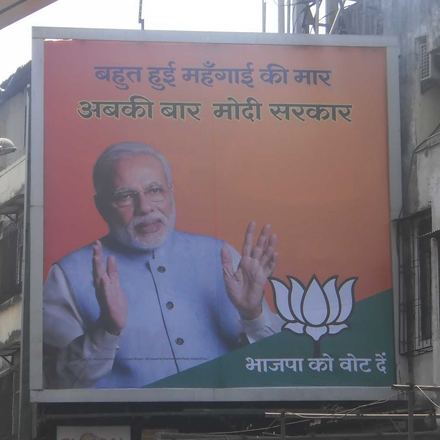
    Possibly, with advertising rates on general entertainment channels (GECs) on television being prohibitive and posters having been banned in several cities of the country, outdoor remains the only viable option for election propaganda as it is cost-effective and has high reach as well. So you have hoardings of calling for a ‘Modi Sarkar’ or boating of ‘Bharat Nirman’ with NamO and RaGa staring down at you from the most non-descript locations in the country. What’s more, they have illumination for better visibility at night.


    With elections just round the corner, outdoor advertising has picked up significantly, mostly fuelled by political parties, which is quite unlike the usual scenario where outdoor advertising is more prominent during the second half of the year.


    Speaking of the growing appeal of OOH, Madison OOH Media Group CEO Arminio Ribeiro, says: “Given the flexibility of this medium in terms of narrow- and broad- casting and its localization and rapid awareness build-up benefits, outdoor has appealed to political parties to get their message across to the electorate through its multiple formats.”


    In order to get the best quality hoarding, tapping the most crowded route through buses or railway has certainly increased the competition. Everyone is trying to avail the benefit of this golden opportunity and those who have the diverse range of inventories are the main gainers.


    Sanjeev Gupta, managing director of Global Advertisers, which has been roped in for outdoor by both Congress and BJP, says, “With changing trends, political parties have also changed their approach and have become more professional. Therefore, our media plan included a mix of outdoor inventories to expand the reach of these campaigns and we expect to see more demand for outdoor in the coming months.”


    While Postercope Asia Pacific regional director, Haresh Nayak, says: “Tier II and Tier III markets have been the focus for the last year, continuing to grow this year as well, showing deep penetration in rural areas to create brand awareness.”


     Indeed, the FICCI-KPMG 2014 report finds that the OOH industry has grown by 5.5 per cent from CAGR (2007 to 2013), what with clients from real estate, telecom, media, auto, and now politics, driving it forward.

  • Now BBC trains its lens on Indian elections

    Now BBC trains its lens on Indian elections

    MUMBAI: Not only political parties but news channels of every hue are gearing up for what is being billed as the mother of all general elections witnessed by this country.


    The latest to hit the 2014 election trail is BBC World News, a broadcasting network that needs no prior introduction. For the first time, BBC will be broadcasting live from India with three of its best-known anchors flown into the country to present their shows from the subcontinent – Jon Sopel with Global, Mishal Hussain with Impact, and Babita Sharma with Newsday.


    A week of special programming will lead into the main programming starting on the first day of polling on 7 April. This will continue for a week with the three anchors, along with special editions of India Business Report and Talking Business with Linda Yueh. Thereafter, it will rely on the expertise and knowledge of BBC teams in Delhi and Mumbai and the BBC Hindi service.


    Alongside the television programming, an Indian version of the bbc.com mobile site will be created for users to land directly on the India page upon clicking the main url. The online content will be trilingual, with predominantly English content along with some in Hindi and Tamil. Among others, the shows will explore angles such as what the election means for India’s neighbours like Pakistan and China and what it means for the rupee.


    “India is a massive market. The mobile penetration here is close to 200 million users. Our mobile traffic is up by 350 per cent in three years and there are profound changes going on here. The new India mobile edition will provide a tailored experience, including top India news stories along with global news headlines, video, business, sport and the best from our features content,” says BBC Global News CEO Jim Egan. “It’s a very big editorial undertaking for us. We haven’t taken the channel on the road like this. Topics that interest world audiences such as politics, economy, defence and culture, will be covered. We won’t do it superficially or trivially but bearing in mind that a majority of our viewers are outside India, we won’t do in-depth analysis like local channels.”


    BBC correspondent-anchor Sopel is excited to be covering elections live in India. “Election in India is important because India is important. We have a polling day and you have a polling month! That’s because your total electorate is 840 million and the UK just has 48 million,” he says.


    While adding a local flavour to its programming, the global broadcaster will ensure it serves BBC values such as impartiality, fairness and balance. “No other international channel has the network of specialist language correspondents that we have,” says Sopel.


    On the cards is a marketing campaign in major metros like Delhi, Mumbai, Bangalore and Chennai to let audiences know about BBC’s election coverage both on- and off- air. As of now though, BBC is busy figuring out whether to place the satellite dish in Mumbai or the national capital, depending on costs and feasibility.

  • Marketing lessons a la AAP

    Marketing lessons a la AAP

    MUMBAI: The recent-concluded Delhi elections, took everyone by surprise when Aam Admi Party won 28 seats. We take a look at what one can learn from the new entrant.

    When it was formed less than a year ago on 26 November, 2012, little did the Aam Aadmi Party imagine it would make such a big splash at the polls.   

    Winning 28 out of 70 seats in the Delhi Assembly elections on 8 December, the AAP came a close second to the BJP which won 31 seats, pushing the ruling Congress to an irrelevant third position. What’s more, three-time Congress CM Sheila Dixit suffered defeat at the hands of AAP chief Arvind Kejriwal. Before the elections, the now ex-CM of the national capital, didn’t think before making statements like, “Arvind isn’t even on our radar.” Dixit probably forgot the legend of David Vs Goliath.

    For a fledgling party which emerged as an offshoot of the larger ‘India against Corruption’ movement launched by activist Anna Hazare -where people took to the streets to protest the many ills plaguing the current administration – this is no mean feat.

    And neither is the fact that AAP – registered as a political party with the Election Commission (EC) only in March this year – has successfully met the EC’s criteria to become a state party.

    So what did the AAP do right to banish all the scepticism its broom-wielding members met with from seasoned politicians who dismissed the party, at least initially, as ‘chillar’ or worse, a group that made a lot of noise but had no real impact.

    Looking at the AAP’s historic win from a marketing perspective, we at indiantelevision.com believe brands may do well to take a few lessons from the party’s promotional strategy:

    * Strong USP
    Each brand need to have a very strong USP which helps position it in the minds of the target audience. AAP’s USP is that it gives the common man a belief, a hope, that there is going to be a better tomorrow, and that it has been created by the common man who is fed up of the politics of politics, and will hence deliver on its promise.

    *Be consistent
    At the heart of the AAP’s party manifesto is its stand against corruption – which cuts through classes. And it has not deviated from that. It has refused to ally with either the Congress (I) or the BJP, despite there being a possibility of it occupying the seats of power in Delhi.

    Brands need to stick to their core premise and promise and not try to ride fads.
     
    * Marry your brand USP with the brand mnemonics
    The AAP has always had one agenda – the aam aadmi, and it has stayed true to it ever since inception. Party members are common people who have volunteered and are unpaid. They come across as common people; they dress up like common people; they move around like common people. Even though many of them are well educated.
    And during this election campaign there was none of the largesse distribution or ostentation that the general political parties generally resort.

    The choice of name and the symbol in the case of the AAP was also crucial. The name says it all -Aam  Aadmi Party. Then the symbol was the killer: what is the one thing that is still common across all homes in India, even in middle-class and upper class homes and hutments – it is the broom. Using the broom as the mnemonic meant many things: it will be used to sweep clean all the dirt in the political system, while it helped identify the common man with a tool that is used in his/her home every day.

    * Know your customer; make him your network and your ambassador
    The AAP needed to connect with its customer: the electorate of New Delhi. Almost 130,000 volunteers all over the world, some of whom descended on Delhi before the election campaign became both the best focus group and research agency anyone could ask for.

    Some executives even took leave from their high paying jobs in India and overseas, housewives found time from their day to day chores, young college students, technicians, labourers, cable TV operators – everyone pitched to connect with the consumer and pass on what troubled the common Delhi-ite – crucial information to the central headquarters of the AAP. And they then propagated that further themselves to the electorate.

    With millions of products overflowing on shop shelves and online, brands need to know what their customers really want, when they want it and how they want it, and in the process make them your ambassadors and messengers.

    * Choose the correct medium at the correct time
    AAP had little financial resources at its disposal; some say less than Rs 20 crore. That’s probably what’s spent by politicians on a couple of constituencies. Once again volunteers stepped in to build the buzz.

    Twitter, facebook, online, print, and television. AAP went the whole hog on all the mediums. But not to splurge; just to have its message heard. The media were relatively complying: did not the common man also work in media? It hooked the middle class and the upper middle class through social media.

    And what about the man on the street?  Well it used direct selling: volunteers went door to door to the electorate in Delhi, connected with the common man. In trains, in buses, on auto rickshaws, in jhuggis, in bastis – there was the huge poster campaign, and it was the educated folks who went where they normally would not.

    Brands have to be careful about the medium they choose and utilise it to maximise impact. Brands too have to keep themselves in people’s mind through various activations/campaigns especially in today’s market where the sharks are ready to rip apart any competition.