Tag: elections 2014

  • A sunshine year for outdoor industry

    A sunshine year for outdoor industry

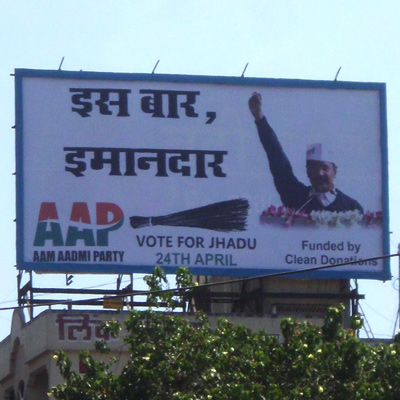
    MUMBAI: Got distracted while driving through the highway? Then blame it on the rise of the hoardings.


    What was not an essential part of any advertisers’ marketing plan when the television was on rise has now once again caught everyone’s attention as numerous channels quote premium rates.


    “It is an in-your-face advertising. While one can skip and miss an ad on TV, it is very rare that one will miss out a life-size hoarding,” say media observers while adding that it is also the cheapest form.


    Metros continue to garner the largest share (in excess of 50 per cent) of the outdoor pie. However, in line with the trend witnessed in the last couple of years, the Tier II and III cities continue to outperform the larger metros. The reason for this is the fact that a large number of campaigns are being projected for Tier II and Tier III audiences. Nonetheless, since the cost of media is lower, the percentage contribution is almost negligible. Regionally, north and west contribute up to 60 per cent of the total advertisement spend in OOH.


    Interestingly, billboards are cherry-picked by brands and planners alike as it makes for approximately 55 per cent of the format used by outdoor advertisers 2013. Thirty-four per cent of revenue came from transit mediums.  


    However, thanks to economic uncertainties and who will come to power, the year 2013 saw muted growth of the Indian outdoor advertising industry. The current story is quite different.


    According to the Ficci report of 2014, brand owners spent approximately Rs 19.3 billion in 2013 on OOH which was only five per cent of their total advertisement spends. The projected spends this year is close to Rs 21.2 billion. 


    The general election gave many advertising agencies reasons to rejoice, especially the ones in the outdoor business. According to a senior media planner from Maxus, political parties on an average had spent 20 per cent of their marketing budget on outdoors.


    “Election campaigns came as an additional benefit to us beside our regular business. From the starting of the year, we started receiving bookings for our sites by various national parties. For three months, March, April and May, all our sites were booked. Anticipating this demand, we had expanded our portfolio, much earlier, which included big size hoardings at prominent areas, extensive reach in tier II and tier III cities, unbeatable pricing points and transparent policies,” says Global Advertisers managing director Sanjeev Gupta.


    The first half was in favour of political advertising; the other categories which also spent and continue to do so on outdoors are real estate and e-commerce companies that are leaving no stone unturned to woo customers. While there are many low spenders, the categories which slashed their spends drastically are telecom, automobile, consumer electronics and banking, financial services and insurance (BFSI).


    According to media experts, though inventories appeared to be completely occupied during election seasons, they are not sure about the revenue numbers. The pricing during a political advertising campaign roll was highly influential and negotiated on the basis of personal relations. Having said, many outdoor players are happy with the start of the business.


    The forward trend


    Innovation is the key to survive in the competitive business and this is the reason today advertisers want more than just plain vanilla hoardings. They prefer them with illumination, advance public utility structures especially for short duration campaigns. “Flip billboards (flip hoardings) is now becoming a new trend in the advertising industry,” mentions Gupta.


    Laqshya Media chief operating officer Atul Srivastav highlights that the two trends, which have recently sprung in the outdoor space, are emergence of vendor based agencies and consolidation of media ownership business.  


    “Outdoor is moving to become Out-of-Home in true sense of it. The lines are blurring, no longer do we have compartments of 20x40s to qualifying as an outdoor. With mobile, tabs etc seeping in rapidly and with the consumer constantly being on the go, the trend is to create campaigns that engage consumers when they are out of home. Thus, while our age old hoardings remain essential, we approach the medium with an open mind and give integration a lot of importance,” believes  Posterscope Group India managing director Haresh Nayak.


    Monsoon, a worry?    

    If one goes by what the MET has to say about the monsoon this year then OOH players have little to worry.


    Though weak monsoon will affect the economic sentiments, experts believe that the new government will able to handle the situation. Hence, resulting in better spends even in the coming months which will be more than last years.

                                                                                                                                                                                                                                                                     “We are expecting good sale in monsoon season. Presently, it has brought us clients of resorts, hotels, holiday destinations, tourism, education sector, amusement parks and many more. In our attempt to have full occupancy during the monsoon season, we have introduced various selling concepts in our business such as hoardings on rotation basis, barter plans, mix-media plan, tier I & tier II cities plan and many more,” reveals Gupta.


    The industry, overall, now waits for a better festive season which will be followed after the unpredictable monsoons. Currently, many show launches are lined up by the entertainment sector which the outdoor industry is betting high on.  


    The future is bright like our streets for the OOH sector.

  • Rajdeep Sardesai and Arnab Goswami poles apart on future of journalism

    Rajdeep Sardesai and Arnab Goswami poles apart on future of journalism

    MUMBAI: The venue: the National Centre of Performing Arts auditorium in south Mumbai. The occasion: a panel discussion that preceded the Press Club of India’s Red Ink Awards. On stage were IBN18 editor-in-chief  Rajdeep Sardesai, Times Now editor-in-chief Arnab Goswami, and Dainik Divya Marathi chief editor Kumar Ketkar, O&M national creative director and chairman Piyush Pandey. And for a change it was they who were grilled by Star India CEO Uday Shankar, a former journalist himself. The topic: Elections 2014: were we fair or did we stoke the NaMo wave?’

    Shankar set the pace for the panel when he spoke first, stating that it is he who would be asking the questions and no one would be allowed to answer – in all probability taking a jab at Arnab. As the audience burst into laughter,  he then told Rajdeep to open the debate by speaking his mind.

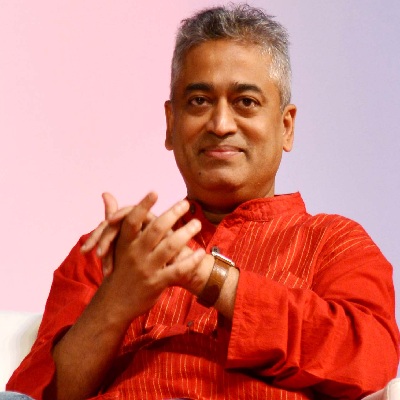
    Dressed as casually as one can get, in a red kurta, simple trousers and chappals, Sardesai delivered a hard hitting monologue on Modi and the kind of journalism that exists in India now.

    “Modi had the most  innovative and sustained campaign that we have ever seen in an Indian election,” he said, while pointing out that Congress president Rahul Gandhi was like a kid in kindergarten in front of Modi. But he also said that it was unfair to blame the media for creating the NaMo wave.

    “Some channels have abandoned the basic role of media. They are now doing cheerleading or supari journalism to get more viewers and ratings. Modi was not subject to the intense scrutiny in the last two years that the others were subject to. While he was brilliant with his social media strategy and communication he was spared the ignominy that others were subject to. Some channels elevated Narendra Modi to God. He is a good politician and communicator but not a messiah. Some journalists need to ask themselves if they want to do journalism or hagiography,” he added.

    On the other hand, Arnab instantly put himself and his channel in the spotlight by stating that one of the positives of being located in Mumbai, far away from the hub of channels (Noida) was that it keeps him disassociated with politicians.

    “I am not romantically involved with any political party so I don’t end up having a bitter break up with them. My distance with politicians is both physical and psychological. We in India are overawed by them. Modi was the focus because there was no competition. We are not dependent on politicians for ratings. There is no scientific evidence that Modi gets ratings,” he said while also stating that he wasn’t aware of this supari journalism that Rajdeep referred to.

    “The next 10 years of journalism to me are very bright,” said Arnab. A view that Shankar totally endorsed. Said he: “The future of journalism is bright because we do something that is essential to the society. We should not be cynical about the media, without them the country would not have been what it is.”

    However, Arnab’s view seemed to have irked Rajdeep who in the latter part of the discussion said, “We can state that in 10 years things will be great and things are going to change, but arrogance is the downfall of every journalist! At our time, it was never that what the anchor said would matter more than what the guests said.”

    Ketkar who comes from the print side of the media and was the senior most scribe on the panel let loose his spleen as he lambasted the electronic media for sidetracking and sideswiping print publications.

    “It is the electronic media that sets the tone for the next day’s morning headlines in the paper by these discussions. The people don’t set the agenda, the media does. The media has covered how miserable Bihar is but no mention of the Gujarat floods when Modi was campaigning at the height of his campaign trail. So, it is not just that you have to speak more about something, but by also not showing something you can stoke the fire,” he said.

    While the three editors did not refrain from taking digs and potshots at each other for the kind of journalism that is being resorted to, it was Piyush Pandey – the man behind the Narendra Modi election campaign –  who gave his insights on what led to NaMo wave. He pointed out that no matter what Modi did, he never gave the media a chance to ignore him; he made sure he was in the public eye, consistently giving out the right message that the public wanted to hear. “The media rode the Modi wave. It did not create it,” he said.

    While the very topic was sidelined, the editors were deeply engaged in pontificating on the state of journalism in the country with Goswami being the most optimistic about it.

    Having recently taken a month long break from his editorial duties, Rajdeep was the most vocal about the fact that news television needs to find its bearings quickly.

    “The idea that the television makes or breaks will not hold anymore. I really think that we have lost the capacity to go beyond the dramatic headline. We have lost our nerve. We need to introspect and ask ourselves : are we willing to do a serious interrogation of the Gujarat model, positive and negative?” he questioned. The fact that the BJP did well in places where cable TV did not reach efficiently was also brought out by Shankar and Sardesai.

    While the discussion didn’t see any real conclusion, it did end with a valuable point to ponder: whether journalists were getting too emotionally involved with politicians?

    Shankar had the last word on this. Said he:  “I think there is too much reverence even now in Indian media and on the other hand, there is too much emotional attachment. Either we are just cynical or when we go there we get sucked in. There has to be a balance in between. Overall, I think we shouldn’t be cynical about media. We have lots to capture and improve but without the media, this place, this country would be much worse.”

  • 7 things that could blow your mind on 16 May

    7 things that could blow your mind on 16 May

    MUMBAI: Come Friday, every news channel has promised hours of the latest and extensive election result updates by their anchors and arm chair experts. Almost all channels in their excitement to grab eyeballs will begin their coverage from 6 am as the world waits with baited breath to know the mandate of the nation.


    As almost everyone is glued to their sets and expecting a common possibility to pour out, we from the team of indiantelevision.com bring you seven such wacky yet possible outcomes that could be contrary to what is expected in the biggest election of all times.


    What if…


    Rahul Gandhi loses Amethi and Kejriwal wins Varanasi

    This will be a fortune teller’s delight and an astrologer’s worst nightmare come true. Narendra Modi won’t have much to worry as he still has another safe seat- Vadodra in Gujarat.  Mr Muffler winning from Varanasi in his enthusiasm could well be seen then, taking a dip in the holy Ganga- not advisable for a man with cold eh?


    There is a power cut for hours

    Families sitting in front of a TV set. Popcorn and cola being passed around and midway through the coverage as anchors are about to tell you which party is seen gaining the maximum seats… click goes the electricity. One may recall, in June 2012, 20 of India’s 28 states were left without power when a grid had collapsed. So, the situation is a possibility. But on an election result day, people will have much more to complain other than just the sweltering heat.


    Exit poll prediction goes wrong

    A repeat of 2009, when exit polls had signaled the green light for the NDA cannot be rubbished.  This could also be the death kneel for research agencies already under a cloud for rigging opinion polls. Congress’s spokespersons will be the ones having the last laugh as anchors try to put on some saving grace.


    Markets crash…

    When exit poll results were shown recently, the markets reacted very strongly to a pro-Modi sentiment. But what if in the overzealous quest of share market, investors and holders, the sensex crashes. Again a possibility that cannot be ruled out.


    Jashodaben escorting Modi on his victory rally!

    A perfect ending to a troubled marriage as seen in Bollywood movies, Jashodaben escorting her star husband could silence many of his critics. It would also bring tears to many Indian voters except Rahul baba who now would face pressure of finding a bride as if the electoral drubbing wasn’t enough. Rahul Ka Swayamwar -maybe?


    NDA unable to get 272

    What if the NDA is unable to get to the magic figure? Yes it could reach out to form alliances with regional players. What could make this situation scarier is regional players offering their support on the condition that Modi is not the PM. Rajnath Singh could then be tipped to be the PM, in this Game of Thrones.


    EC declares 16 May as ‘Dry day’

    Celebrations will be cut short if this comes true! All that one would be left to celebrate with are the kilos of ladoos that the BJP has ordered for. With no booze to celebrate, India would be instantly wrapped by the “Gujarat model” and be a dry country. Amul milk and cookies may be?


    All celebrities winning the elections, Rakhi Sawant too!

    With many celebrities trying their luck at the ballot, they winning the same would add the much need glamour to our non-glitzy parliament. Whether they provide deep insight or pure entertainment is one’s wild guess. And, Rakhi Sawant in parliament? Oh jeejus!

  • News channels building ammo for D-day

    News channels building ammo for D-day

    MUMBAI: As the mother of all elections draws to a close, news channels are working themselves to a frenzy to feed the hungry electorate byte-by-byte updates of the poll results.


    Speaking of Times Now, the channel has stretched itself to the limit, promising 250 hours of non-stop election coverage, starting with the poll of polls and culminating in a grand finale.


    News Nation, on the other hand, will showcase poll results using innovative graphics between 6am and 3pm on 16 May, followed by expert analyses and later, special shows around formation of the new government.


    CNN-IBN and IBN7, with their shows A Billion Votes – Post Poll Survey and Mera Vote Meri Sarkar – Post-Poll Survey, respectively, have promised 100 hours of poll coverage, beginning 12 May and ending 16 May. The last phase will be complete with insights into the world’s largest electoral exercise.


    CNN-IBN, IBN7 and IBN-Lokmat editor-in-chief Rajdeep Sardesai said in a statement, “With the results of the biggest elections of our times round the corner, the entire nation is keeping a close eye on the outcome. The IBN Network has been a front runner in election programming. Through our 100 hours of extensive coverage, we look forward to continuing our leadership and delivering on the expectations of our viewers of being the most accurate and most trusted network for elections.”


    Sardesai along with his formidable team will lead the network’s election coverage, with help from political experts including Swapan Dasgupta, Ramachandra Guha, Surjit Bhalla, Manini Chatterjee, Sandeep Shastri, Kumar Ketkar, Dipankar Gupta and Paranjoy Guha Thakurta.


    For ABP News, counting day will start at the crack of dawn at 6am with live interviews of the key faces of this election and a summary of the trends and results using state-of-the-art election software and graphics that the channel has come to be synonymous with. Helping viewers understand the poll results and their implications will be ABP News’ experienced anchors including Kishore Ajwani, Abhisar Sharma, Sumaira Khan as also Neha Pant from the National News Centre, Noida.


    Prannoy Roy will once again step into the role he started off with all those years ago. The ace journalist will anchor NDTV’s show-stopper, India Decides – The Final Countdown. The channel is hoping to ensure the fastest national projection, based on early numbers and Roy’s expertise. Counting day will see Roy and Dorab Sopariwala joined by some of the country’s finest anchors, including Barkha Dutt, Vikram Chandra and Srinivasan Jain among others.


    Similarly, prominent faces associated with various news channels will lead the channel coverage for the day. For instance, Ajay Kumar, Ramesh Bhatt and Pinaj Tyagi will be the main anchors on News Nation on 16 May.


    As for ET Now, election coverage will commence at 7:00 am. The channel will have a panel of experts comprising Swaminathan Aiyar, Bibek Debroy, Sadanand Dhume and Sanjeev Aga who will decode the election results and give comprehensive analysis of how the economy and markets will shape up post elections. ET Now also has a lineup of industry captains like Godrej Group chairman Adi Godrej, Hero MotoCorp joint MD Sunil Munjal, Ashok Leyland vice chairman R.Seshasayee, HDFC vice chairman & CEO Keki Mistry, CII president Ajay Shriram, and FICCI president Siddharth Birla to represent the industry’s viewpoint on the election results and the likely agenda for the new government.


    Realizing the kind of viewership these channels are all set to garner on the counting day, a multitude of brands have latched onto the exercise. For example, IBN network has roped in ebay.in, ACC Cement, Renault, Asian Paints and Principal Mutual Funds while Microsoft is its technology partner. News Nation has got onboard Ghadi Detergent, Pepsi, LG, SBI, Hitachi, Airtel, Spice Mobile, TVS Motors and J.K. Cement while ABP News has tied up with Hero, Luminous, Snapdeal.com and Kent Water Purifiers.


    Consequently, news channels have hiked their ad rates for a 10 second spot. According to News Nation CEO Shailesh Kumar, the channel has hiked ad rates 15 times the normal rates for prime time for a 10 second spot. However, media planners and buyers beg to differ.


    A prominent media planner on condition of anonymity revealed that many such figures are floating around. Like it is being said that Times Now, which used to charge Rs 3,000 for a 10 second spot, has now hiked ad rates to Rs 7,500 or even Rs 9,000. Or for that matter, Hindi news channel Aaj Tak has doubled its ad rate from the previous Rs 4,500 to Rs 9000 approx.


    The media planner went on to say that news channels are in fact still trying to get advertisers on board. And though the ad rate may be the same on paper for any single news channel, new brands may have to pay a steep price as compared to old timers who might even be offered a discount.


    Not to be left behind in the online space, immediate trends and results from all counting centres will be relayed to NDTV in Delhi, which will reach viewers with state-of-the-art graphics almost as soon as they are released. ABP News has deployed personnel at various counting centres across the country to digitally deliver real-time data to the servers so that viewers get the results at a fast pace. Separate teams will also work right through the day for delivering results on Twitter, Facebook, Whatsapp, BBM or SMS, wherever a viewer is, on the device of his choice. Times Now has already launched an app called Election HQ app, which is also available on i-tunes to provide information to its viewers on the go. To make the incoming information simpler for the audience to understand, IBN has created the Microsoft Election Analytics Centre. The CNN-IBN – Microsoft Election Analytics Centre uses a range of Microsoft devices and services, and leverages analysis of current and historical data to provide people with intelligent election insights.


    With almost all news channels ready to bombard viewers with wide-ranging news and analyses related to the poll results, it remains to be seen which one manages to grab the highest number of eyeballs, along with of course, the new government.

  • #RaceTo272 with Twitter and NDTV’s Graphity

    #RaceTo272 with Twitter and NDTV’s Graphity

    MUMBAI: When it first created Graphity on the occasion of Republic Day, little did NDTV know that its service of sending personalized photographs and messages would create such a flutter on social media, especially Twitter.  


    On the counting day, 16 May, NDTV has decided to engage its propriety service Graphity on Twitter to tweet real-time results to people who use the hashtag #RaceTo272 from @NDTVElections. The tweet will have an info-graphic representing the latest party/alliance position at that moment.


    How does it work?


    A little over three months since its launch and NDTV’s platform already boasts a client list that reads: Rajinikanth, Jai Ho, the BJP, Hero and Star Vijay among others. Indeed, when Rajini finally decided to be a part of Twitter, his first few followers received autographed photographs of the southern legend, courtesy Graphity.


    While the popular trend has been for people and companies to turn to Graphity to attract users, more prominently on Twitter, the service is not restricted only to Twitter, and can operate for web and SMS as well. According to NDTV Convergence CTO Kawaljit Singh Bedi, “The technology is such that we can monitor any social media. But Twitter is the best medium to do it.”


    On Twitter, Graphity works on keywords and hash tags; it listens to them and sends out the desired outcome, as requested by the client or NDTV itself. A case in point is Star Vijay, which utilized the service for its show Super Singer where hash tags were tracked and personalized messages from finalists were sent for a week before the finale. “We wanted to be a brand that people follow. Super Singer is synonymous with Star Vijay so the conversation would revolve round us. This helped us deepen the bond and make it stronger,” says Star Vijay digital media strategist Paul Samji.


    NDTV first used Graphity for one of its own activities in January, post which, Twitter sat up and took notice and started routing people who required similar services to NDTV. It took four months to come up with the service and if anything, all that hard work is now bearing fruit. It takes one or at the most two days to form an idea of what the client wants. Using the content management system (CMS), users give controls to the software. Firstly, the ‘listener’ service listens to hash tags by connecting to Twitter and secondly, the listener application connects to the ‘pusher’ application. The response page then sends out the desired outcome that is modified to fit a web page as well as various operating systems.


    According to sources, rates for Graphity have ranged from Rs 3 lakh to Rs 18 lakh.


    The inspiration for Graphity came from BCCI’s photographs of Sachin Tendulkar bidding farewell to the cricketing world and his fans. After speaking to various companies, including some in the US, NDTV decided to do it alone. A team of four engineers helped set up Graphity. “We have built it like a platform. It suggests an inpoint and outpoint for sending commands to execute outcome. These can be text, image, video, information or a combination of any of these,” says Bedi. “There are two more brands we are working with. The requests are only increasing because brands see the value in Graphity.”


    Given Graphity’s growing popularity, it’s quite possible that in the near future, the service may evolve into more than just a branding exercise used by brands to get maximum exposure.

  • Why NDTV chose to re-subscribe to TAM

    Why NDTV chose to re-subscribe to TAM

    MUMBAI: The warring couple NDTV and TAM Media are back in bed and under the sheets together with the news network organisation re-subscribing to the TV ratings service in early April.  If readers will recollect, both NDTV and TAM have been having several rounds of fisticuffs – in court and in industry forums – about how its services are flawed and how it incorrectly depicts its viewership.


    Industry professionals are raising their eyebrows questioning how this rancour was resolved? 


    It may be recalled that several broadcast networks had rallied against TAM’s TV ratings service in mid-2013, and some had even chosen to unsubscribe. Many of them, however, backtracked and re-subscribed, following TAM’s assurance that they would heed broadcasters’ requests.


    NDTV, for its part, had chosen to unsubscribe to TAM data beginning 21 September 2013, holding on to its stand about the flawed nature of the TV viewership ratings.


    TAM continued monitoring NDTV on a weekly and monthly basis and providing its data to subscribers – broadcasters, agencies and marketers. But a little while later the rating agency chose to stop providing detailed programming and TV commercial level data to its subscribers. So advertisers, agencies could not fathom how viewers where consuming the NDTV network’s programmes or the commercials it was airing on a second by second basis, say observers close to the situation. This led them to start giving the network a go-by from media plans. And this is what hurt NDTV as advertisers and agencies started questioning if they were getting a bang for their buck for ad dollars spent on the channel. The NDTV senior management was also fearful that its ad revenues which were showing signs of weakening could be impacted further because of the lack of detailed viewing data.


    Simultaneously, it was investing in relaunches, revamps of its existing channels, and in its retail ecommerce venture. Additionally, the nationwide elections were coming up in the world’s largest democracy which are expected to be a revenue bonanza for most news channels.


    In order to feature in media planners’ plans it needed to have its detailed numbers being provided in the TAM data sent out to  subscribers. Hence, it had to per force subscribe once again to TAM’s viewership ratings service.


    Senior NDTV sources say that TAM manipulated and compelled it to re-subscribe by stopping doling out the detailed programming and commercial data, even as they continue to hold the view that TAM ‘s viewership data monitoring is flawed – along with the industry, the MIB and TRAI.


    “We need TAM’s ad data. TAM, in its present form has to end in due course, and BARC, the new industry standard is coming soon,” says a senior NDTV executive. “In the case of NDTV the flawed TRP data is not matched by any other data which has shown us to be leaders.” 


    TAM representatives however say that its hand was forced as NDTV had unsubscribed and failed to renew its contract which allows it to monitor a broadcasters’ content.


    Clearly, a truce seems to have been called, but it appears to be one which was forced and is probably only for the short-term.


    (Updated on 12 May 2014 at 3:33 pm)

  • Frankly Speaking with Modi

    Frankly Speaking with Modi

    MUMBAI: The channel which claims to be the headquarter for 2014 elections and the man who gets personalities to speak frankly has finally got BJP’s prime ministerial candidate, Narendra Modi, on the channel.

    Times Now has added another feather to its cap by becoming the first English News channel to get an interview with Narendra Modi. The man has already given a lot of interviews since the elections started to various Hindi channels, to name a few: ETV Gujarati, India News, Aaj Tak, CNBC Awaaz, Zee News etc.

    ETV Gujarati opened the score for Modi and his string of interviews. However, English News channels have tried their level best to get the man on to their channel; and since then failed.

    CNN IBN’s deputy editor Sagarika Ghose even tweeted asking the man to give an interview to “best” journalists. To which India TV’s chairman and editor-in chief Rajat Sharma replied, “Well, I already got one. You should watch good news channels too.”

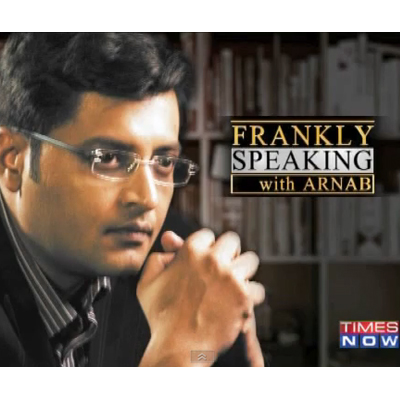
    The channels editor-in-chief Arnab Goswami who got Rahul Gandhi first on his ‘Frankly Speaking’ show can now finally breathe a sigh of relief to get Modi before any of his rivals did. The Rahul Gandhi interview became a trend and also a butt of jokes. The hashtag #RahulSpeaksToArnab trended for days after the interview as jokes, parodies, cartoons and even remixes of the interview flooded the internet space.

    With Varansi going to polls on 12 May from where Modi fights against AAP’s Arvind Kejriwal, BJPs prime ministerial candidate is already in news. The time seems perfect for the channel to speak to the man.

    In the interview to Goswami, Modi will speak about issues ranging from his campaign to the recent controversy over his ‘caste’ comments and also Priyanka Gandhi’s ‘Neech Rajniti’ jibe.

    With Times Now and Twitter getting into a partnership for the 2014 general elections, hashtags have become common for the channel. The hashtag this time around is #ModiSpeaksToArnab. One will have to wait and watch to see what will trend after the interview airs on 8 May at 9pm.

  • Mr Goswami, please come out of the studio

    Mr Goswami, please come out of the studio

    For the elections of the century, news channels are doing all they can to not only outdo each other but also cover the elections, accurately.


    And with half the country already inked, the fight is going to get only tougher. The primetime anchors who are used to the air-conditioned studios have left their comfort zones and are now roaming every length and breadth of the country in the scorching Indian summer.


    After the countless exit and voters’ polls and panel discussions, it is now the editors, who have taken upon themselves the task to gauge the mood of the nation. With over 80 lakh polling stations across the country, expenditure nearing Rs 110 crore and 40 lakh polling staff ready for more than 60 crore voters set to exercise their mandate this time, the anchors are venturing out to the villages and city by-lanes to gather ground information from the common man and find out who will they like to see as their new Prime Minister.


    In the drive to get the most accurate election coverage, Headlines Today has even got a special bus made. The Dilip Chabaria designer-made Election Express claims to cover over 8,000 kilometers, informing the nation on everything and anything that has to do with elections.


    The journo couple, Rajdeep Sardesai and Sagarika Sardesai, of CNN IBN too have covered the various cities to know which candidate will be opted for and why, locally.


    The Hindi and regional news channels too have boarded the outdoor express. The debates are taking place out in the open, now.


    However, one man (read Arnab Goswami) who knows all the questions which the nation wants to know hasn’t left the four-walled studio. Wonder why?


    Is it that he is too used to shouting down at people in the studio or is he is afraid that someone might just yell back at him if he tries to do the same what he does in the studio, out in the open?


    Maybe Mr Nation-wants-to-know, who suffers from OCD of not being able to see others talk, feels it to be a waste of time and money to go out to the streets where the real political debates are held.


    Imagine even if he did go out to the streets what will happen? Many might just fall on the feet of the ‘Rajnikanth of news.’ That’s quite a possibility.


    Hate him or love them, but you cannot ignore him. One has to give him that much credit. And yes, he is that one reason, which makes many switch on Times Now.


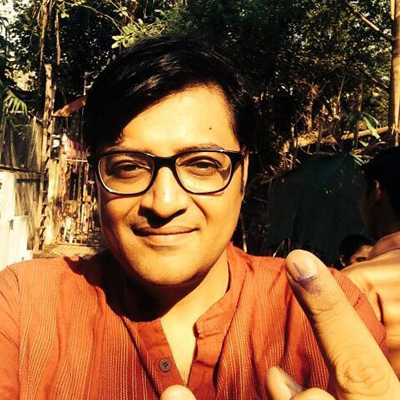
    So while he did go out to vote (his selfie caught everyone’s attention); it will be a sight, when he actually steps out on the streets, to cover elections.


    Wish Mr Goswami listens and comes out of the “shell” to cover the real deal in the Indian summers!

  • BJP’s manifesto most-talked on social media

    BJP’s manifesto most-talked on social media

    MUMBAI: The 2014 elections have been very different from the previous ones; never before have elections created so much buzz especially among the youngsters.


    Media has played a major role in creating elections the hot topic for months now with social media playing a vital role in it. With the Lok Sabha elections already underway, voters have been closely evaluating the manifestos of AAP, BJP and Congress. Conversations on social networks have been buzzing with netizens discussing the various developmental programmes promised by the political parties.


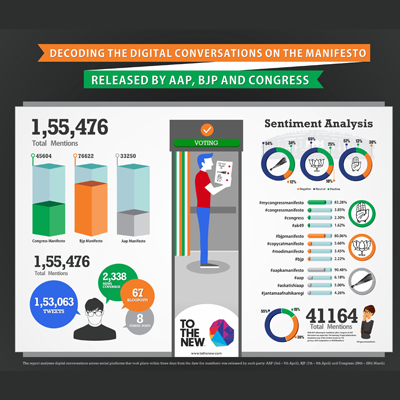
    To The New, an integrated digital services network, has released a report that analyses digital conversations across various social platforms such as Twitter, forums and news sites that took place within three days from the date the manifesto was released for that party. The report, powered by ThoughtBuzz, the social media analytics’ arm of the company, also tracks the sentiment around the manifesto and shares “word clouds” that highlights the key sentiments that are dominating the social platforms.


    To The New marketing head Irfan Khan said, “The 2014 General Elections has seen immense interest and vocal participation of the youth. The release of the manifestos by the political parties has given the young and the “first-time voters” the opportunity to evaluate and make an informed decision. The report on the buzz around manifesto enables us to understand the psyche of these voters.”


    The report reveals that mentions of BJP’s manifesto far outnumbered that of political rivals AAP and Congress with a whopping 76,662 mentions on the social platforms in the span of three days of the release of the party manifesto. In contrast, Congress had 45,604 mentions followed by AAP with 33,250 mentions.


    The report findings further revealed that the discussion on AAP manifesto had the most positive outcome amongst the three parties, 34 per cent had a positive tone, 54 per cent had a neutral tone and 12 per cent of the tonality was negative. 57 per cent of the discussion on Congress manifesto had a neutral tone, 30 per cent was negative while only a mere 13 per cent of the tonality was positive. On the other hand, 65 per cent of the discussion on BJP manifesto had a neutral tone, 25 per cent was positive while only 10 per cent of the tonality was negative. In the duration of three days of the release of BJP manifesto, the hashtag #copycatmanifesto, created a lot of buzz on the digital space receiving a total of 41,164 mentions.

  • Elections 2014 through the eyes of Bengali TV channels

    Elections 2014 through the eyes of Bengali TV channels

    KOLKATA: Most television channels in West Bengal have started election coverage about a month ago and with the state going to polls from Thursday, it will only intensify in the coming weeks.


    With elections in five phases between 17 April and 12 May, both news and infotainment channels are pulling out all stops to ramp up their reportage of poll-related news and analyses.


    Not only 24×7 Bengali news channels such as ABP Ananda, 24 Ghanta, ETV News Bangla, Focus TV, Kolkata TV and Tara Newz but also infotainment channels like Aakash Bangla that has three news slots, are beginning to resemble a battlefield before the onset of war.


    Even networks that were hitherto fighting shy of election coverage are now taking to it like a fish to water, with crowd shots of the constituencies going to polls including Darjeeling, Jalpaiguri, Cooch Behar and Alipurduar, among others. Television channels have gone so far as keeping their websites up-to-speed with the latest election updates.


    Focus Bangla (earlier Ne Bangla) editor-in-chief Biswa Majumdar said that the channel had interviewed most of the big shots in these elections. “For elections, we have 14 special programs. Celebrities will go to places and interact with people,” he said. Focus Bangla has dedicated five to six hours every day for election coverage and earmarked anywhere between Rs 30 lakh and Rs 40 lakh for it.


    For ETV News Bangla, elections are an important occasion for making a mark in the regional news space. “This year, the election is colourful and especially in Bengal with many celebrities contesting either from TMC or BJP. For Thursday, we have deployed the team and OB vans for Darjeeling. From 8am till 12 noon and then again from 4 pm to 9 pm, we will telecast live news, latest developments and talk shows to stay ahead of the others in terms of content,” said ETV News Bangla editorial advisor Prabir Ghosal. He added that the channel would be spending a huge amount on election coverage.


    TARA (Television Aimed at Regional Audiences) Newz, one of the survivors of the now defunct media arm of the Saradha Group has formed three teams to cover elections in the state and will deploy one more team for election coverage in the national capital.


    Tara Newz chief reporter cum input editor Dipankar Nag said that the channel had saved the money collected from advertisements and donations to buy a back pack, so that it could telecast on-ground happenings to viewers within seconds.


    While elections seem to be top priority for most of the TV channels, one of the news analysts opined, “The reporters are sweating but hardly anything new is coming out. All the channels are doing the same sort of stories and even special programs are very similar with no sense of innovation.”


    While another rued, “It seems most of the channels have forgotten that this is a national election and not a Panchayat poll where they can have an overdose of local politics.”


    A third expressed the view that while some news channels are carefully passing on information to viewers, others are manipulating facts to up the news quotient.