Tag: Elbert D’silva

  • BARC’s Elbert D’Silva on kids’ viewership trends, NTO impact & category growth prospects

    BARC’s Elbert D’Silva on kids’ viewership trends, NTO impact & category growth prospects

    MUMBAI: According to BARC India data, Kids’ segment is only three per cent of the overall advertising space on television, with GEC and News channels accounting for the larger pies. However, with Kids’ segment contributing 20 per cent of total viewership on television, there is a great opportunity for creators to produce localised content and advertisers to explore this category.

    BARC India head product leadership and excellence Elbert D’Silva gave a presentation at KAM Summit organised by Animation Xpress on 30th August. D’Silva spoke on the market trends, Kids viewership trends and data, NTO impact on genre, and industry growth.

    “There is a myth that viewers are moving towards digital but according to data viewership on television is still holding strong. 20 per cent of total viewership is contributed from Kids viewership. The time spend on television by kids from 2 years to 14 years is around 3 hours 32 minutes. Kids in urban Indi spend more time watching TV than rural. In Urban area the time spend on TV is around 3 hours 58 minutes and in rural is 3 hours 15 minutes. 2 to 14 years old kids in urban India contributes 59 per cent of kids viewership,” said BARC India head product leadership and excellence Elbert D’Silva at the recently concluded Kids Animation and more (KAM) Summit KAM organised by Animation Xpress.

    According to a FICCI report, he pointed out, animation, VFX and post production industry grew by 18 per cent in 2018 and is expected to reach Rs 127.6 billion by 2021. Currently the industry is growing at 30 per cent. There is huge demand for kids content not only on OTT but also on TV. Domestic demand over digital and other platforms for animation is also growing.

    “90 per cent of viewership is on animated content be it movie, serial or any other form. Animation is dominant player in the kids segment on television. Within that movies tend to have higher affinity towards viewership while serial falls in second bucket,” said D’Silva.

    When it comes to gender, BARC data also states that boys show greater affinity towards kids channels. In the viewership of kids genre, boys contribute 59 per cent and girls 41 per cent of total viewership.

    Delhi, Maharashtra, Gujarat and Assam are states clocking high consumption of kids content, with a large share of viewership being accounted for by central India. In the south language market, Tamil Nadu spends a lot of time on TV and that holds for kids viewership as well. As a genre, kids is the third most dominant after GEC and movies.

    In terms of the new tariff order’s impact, D’Silva said, “During the NTO, there was some amount of disruption in terms of consumption in kids genre. But the genre redesigned with the increasing trends lead by summer vacation. Post NTO we are seeing upward moment in kids viewership.”

    BARC data also offered an understanding in terms of age group and time spent. 2 to 8 years olds spend more 25 to 30 minutes more on kids channels as compared to 9 to 14 years olds on a daily basis. 9 to 14 year olds have a more diverse taste in terms of TV viewership. The ‘prime time’ in a sense for kids viewership is between 8 AM to 12 PM and before GECs’ primetime i.e. 6 PM to 8 PM.

    “Kids is an important segment and in India we have large population operating in that space. But unfortunately the segment is only three per cent of the overall advertising market. Most of the ads that are telecasted are on GECs and News channels on television,” D’Silva stated.

    He further opined that there is there is scope for more advertisement on kids channels, with a great opportunity for content creators to cater to both young and older kids’ audience.
  • Kids prefer home-grown content, feature films on TV

    Kids prefer home-grown content, feature films on TV

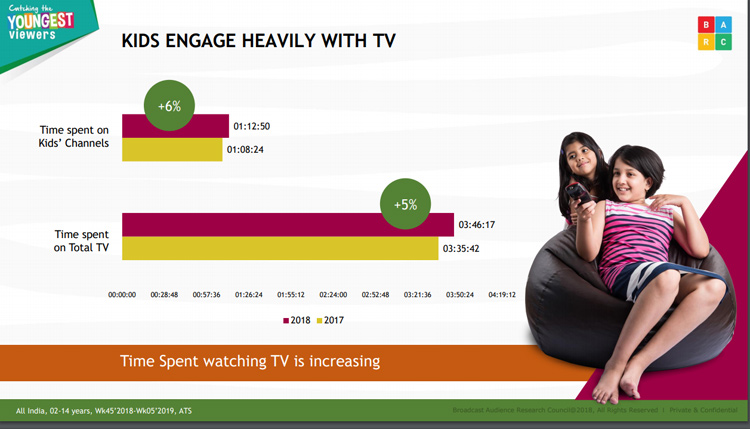
    MUMBAI: The TV industry is growing and so is kids’ viewership. Since 98 per cent of India is still single TV homes, co-viewing is extensive and leads to better targeting options while demand for localised content and regional content are a boon to creators. Broadcast Audience Research Council (BARC) India unravelled its findings on ‘Catching the youngest viewers’ at FICCI Frames 2019 held on the third day of the event. BARC India senior VP business development partnerships Elbert D’silva shared that 21 per cent of total viewership on linear TV sets comes from kids. With one in every four viewers being a kid, there is a high engagement level and time spent is also increasing.

    Just 12 per cent watch kids’ content, a whopping 49 per cent of kids watch general entertainment channels (GECs), followed by 24 per cent of them watching movies. Likewise, a large chunk of viewership doesn’t only come from kids’ category; in fact, it comes from age-groups as well. 38 per cent of the viewership comes from 2-14 years of age group, followed by 10 per cent from 15-21 years of age group, 14 per cent and 18 per cent fall under the 22-30 years and 31-40 years of age group respectively. This is due to co-viewing. But kids from NCCS households watch more of kids’ genre because premium homes are multiple TV households. Here kids’ genre gets about 16 per cent of viewership.

    He highlighted that females aged 31-40 years spend 30 per cent of their co-viewing time with kids and this offers significant targeting options to the advertisers. Bifurcating the female audiences across different age groups that spend the highest time in co-viewing, the report revealed that 15-21-year-olds spend 12 per cent, 22-30-year-olds spend 22 per cent, age group from 31-40 spends 30 per cent while 9 per cent and 7 per cent time are spent by the females that fall under 41-50 years and 51-60 years respectively.

    D’silva further shared that feature films give better ROI with higher per minute impressions. It stated that 76 per cent of the avg imp/min comes from the game, talk or quiz shows, followed by 155 avg imp/min from cartoons and animations and 508 avg imp/min from feature films.

    Talking about home-grown content, he said that there has been a rapid increase of localised content on the kids’ genre and duration of it on national kids channels has gone up by 18 per cent. Comparing the growth in 2018 to 2016, the jump has been from 33 per cent to 39 per cent of overall content. Preference of content amongst kids changes as they grow older and so the preference for Indian content is higher among younger age groups.

    Apart from this, kids channels that broadcast in multiple languages enjoy a clear lead in the viewership. The report disclosed that 84 per cent of kids viewership accrues to the 11 channels that have multi-language feeds, 7 per cent from Hindi, 3 per cent from Tamil, whereas Telugu, Malayalam and Kannada gain 2 per cent viewership for each language respectively.

    Regional kids channels also have a high growth potential. The Sun Network’s Chutti TV in Tamil Nadu commands 17 per cent share with the rest going to national kids’ channels, Chintu TV in Karnataka gets 23 per cent, Kushi TV in Andhra Pradesh/Telangana gets 16 per cent while Kochu TV in Kerala gets the highest share of 40 per cent viewership.

    Top advertised products are those which are consumed by the children, but mothers are also the target audience since they are the decision makers. Boost and Fisher Price are brands targeting kids while Colgate, Harpic and Vicks are focused on the mothers watching TV.