Tag: Ekta Kapoor

  • Great Grand Masti….Greater disappointment!

    Great Grand Masti….Greater disappointment!

    MUMBAI: Indra Kumar acted in and made a few Gujarati films in the era of tax exemption and subsidy offered by the Gujarat government to promote Gujarati films. Indra’s forte in those days was to thrive on vulgar gestures and double meaning dialogue. It worked because Gujarati films catered mainly to a certain level of audience. He also came to be called the Dada Kondke (the legendary Marathi filmmaker) of Gujarati films. Indra directed some notable films in Hindi with top stars.

    With corporate studios calling shots and stakes gone sky-high, survival for independent filmmakers became impossible. Indra decided to go back to his Kondke style of film making starting with Masti (2004), followed by Grand Masti (2013) to now come up with the third part of his Masti series with Great Grand Masti.

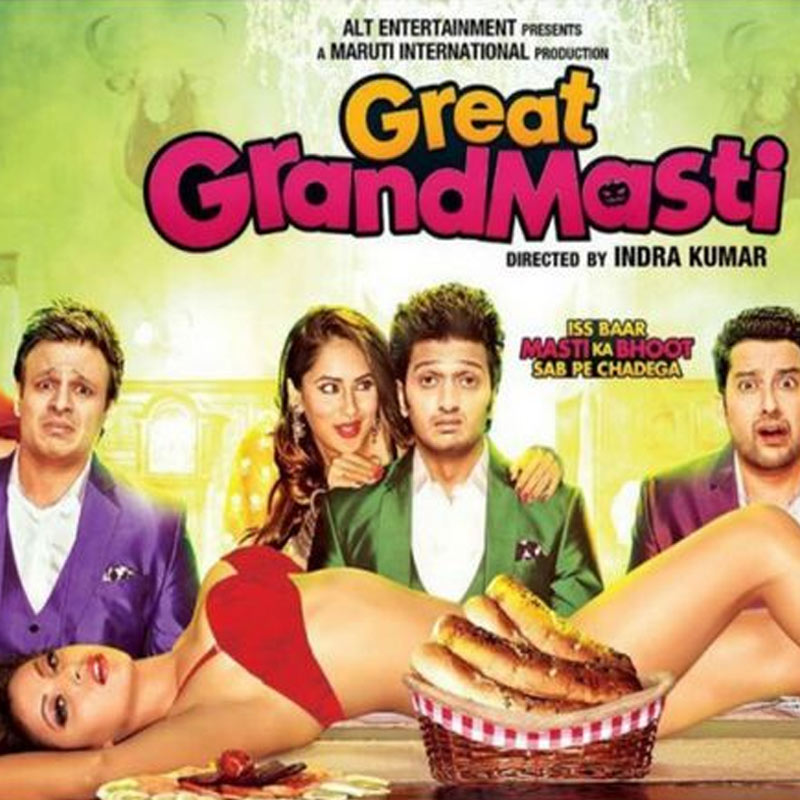
    The Great Grand Masti has the same agenda as its earlier versions which is to weave a comedy around vulgarity. The male and female anatomy is the theme around which the makers plan to play. To this end, Indra lets loose his three generally out of work male characters from his earlier films, Riteish Deshmukh, Aftab Shivdasani and Vivek Oberoi. All that these three have in mind is sex 24×7. It oozes from all their actions.

    All three are married to very revealing and willing girls but all three girls carry excess baggage which keeps the trio from getting anywhere close to their spouses. Since the lads are desperate for sex and their own women are not available to them, they need to look elsewhere. They decide to embark on a village where Riteish has a palatial property to sell.

    The makers think it is time to make this film hattke from the earlier two. So the angle of paranormal is added to consolidate the comedy. This is rare because paranormal on its own has few takers in Hindi films, let alone with a blend of comedy. Last one in memory is late producer-actor Deven Verma’s Bhaago Boot Aaya, inspired from a James Hadley Chase novel, Miss Shumway Waves A Wand. But, to a disastrous results.

    In absence of a script or good gags, Indra lets his three non-actors loose on the screen as they start with trying to seduce the sexy maid, Urvashi Rautela, at the palatial house and, later, to save their lives when they realize that the maid is a ghost waiting to be seduced for the last 50 years! The hide n seek between the guys and ghost is meant to be funny but it is not and falls flat. In its 127 minute duration, the only funny scene the film has is of Viagra aftereffect which, again, has been lifted from Mel Brook’s comedy, History Of The World (1981). And, that too has been killed by stretching it too far.

    The film is a poor specimen of comedy, entertainment or whatever it may be called. Nothing works here. The performers keep to their reputation and don’t act; over two hours of buffoonery is what they resort to.

    The film is poor on all counts and has no hopes at the box office.

    Producers: Shobha Kapoor, Ekta Kapoor, Sameer Nair, Aman Gill, Ashok Thakeria, Sri Adhikari Brothers, Anand Pandit.

    Director: Indra Kumar.

    Cast: Ritesh Deshmukh, Vivek Oberoi, Aftab Shivdasani, Urvashi Rautela, Pooja Bose, Amar Saxena, Sanjay Mishra, Shreyas Talpade.

  • Balaji Telefilms hires new creative director, Chloe Ferns

    Balaji Telefilms hires new creative director, Chloe Ferns

    MUMBAI: Today, folks at Balaji Telefilms are popping champagne as they welcome back senior resource and old friend Chloe Ferns as the new creative director of the company. This top change in Balaji Telefilms comes after the news that Creative director Tanusri Dasgupta has stepped down after being at the company for nearly 12 years.

    It’s her first day at the job and Chloe already feels at home. “Balaji has always been home to me, and my first day at work gives me that feeling of homecoming. I am excited to work with some of the greatest creative minds in the business, and churn out compelling content,” says Ferns.

    Ferns has had 13 years experience in television working with Balaji Telefilms in an earlier stint initially, followed by Chasing Ganesha Films, Nautanki Films, KeyLight, Seventy, among others.

    Ferns will be reporting to joint managing director Ekta Kapoor and will be responsible for all the content being created under the production house.
    Amongst the shows that are doing well for Balaji Telefilms are Ye Hai Mohabattein, Kavach, Kalash, KumKum Bhagya, Pavitra Bandhan and Yeh Kahaan Aa Gaye Hum. This apart, the production house is also churning out regional TV productions.

    Meanwhile, if sources at Balaji Telefilms are to be believed, Dasgupta is leaving Balaji Telefilms to study in the US. Over the years, she has worked very closely with Ekta Kapoor.

  • Balaji Telefilms hires new creative director, Chloe Ferns

    Balaji Telefilms hires new creative director, Chloe Ferns

    MUMBAI: Today, folks at Balaji Telefilms are popping champagne as they welcome back senior resource and old friend Chloe Ferns as the new creative director of the company. This top change in Balaji Telefilms comes after the news that Creative director Tanusri Dasgupta has stepped down after being at the company for nearly 12 years.

    It’s her first day at the job and Chloe already feels at home. “Balaji has always been home to me, and my first day at work gives me that feeling of homecoming. I am excited to work with some of the greatest creative minds in the business, and churn out compelling content,” says Ferns.

    Ferns has had 13 years experience in television working with Balaji Telefilms in an earlier stint initially, followed by Chasing Ganesha Films, Nautanki Films, KeyLight, Seventy, among others.

    Ferns will be reporting to joint managing director Ekta Kapoor and will be responsible for all the content being created under the production house.
    Amongst the shows that are doing well for Balaji Telefilms are Ye Hai Mohabattein, Kavach, Kalash, KumKum Bhagya, Pavitra Bandhan and Yeh Kahaan Aa Gaye Hum. This apart, the production house is also churning out regional TV productions.

    Meanwhile, if sources at Balaji Telefilms are to be believed, Dasgupta is leaving Balaji Telefilms to study in the US. Over the years, she has worked very closely with Ekta Kapoor.

  • Colors to air ‘Kawach…Kaali Shaktiyon’ se from 11 June

    Colors to air ‘Kawach…Kaali Shaktiyon’ se from 11 June

    MUMBAI: Uneasy rests the soul that loves and loses. Its obsession with love challenges the realms of life and death. But, what happens when the soul turns rogue? Colors’ upcoming drama, a finite paranormal thriller series titled Kawach…Kaali Shaktiyon Se is a story of love, passion and obsession. Drawing evil from its grave to possess a pure soul in an epic battle against good, the show delves into the lives of a loving couple Paridhi and Rajbir, and his fanatical lover Manjulika’s unfulfilled soul. Supported by a dramatic narrative and backed by Balaji Telefilms’ prowess in celebrating Indian folklore and myths, the show dwells deep into the elements of supernatural occurrences and exorcism.

    Set to take over the baton from Naagin, the show will go on-air starting 11 June 2016, and will air every Saturday and Sunday at 8:00 pm.

    Commenting on the launch of the show, Colors CEO Raj Nayak said, “The numero uno show of Indian television is going to be replaced by a new entrant which has the potential to become another trendsetter in the industry. The success of Naagin has led us to believe that the Indian viewers have a huge appetite for stories which dangle on the realms of the unknown. Going by the efficacy of this research, we bring to the viewers, Kawach – a show that talks about love, demonic possession and exorcism. Colors has set a benchmark of sorts in the finite fiction series space and we hope to continue the same trend now with Kawach. The show will definitely create ripples, is our belief.”

    Adding further, Colors programming head Manisha Sharma said, “Rooted in possession and exorcism driven by fanatical love, the show will create supernatural experiences that will engage viewers across the country. The show is essentially a love story; on one side is a devoted wife who vows to protect her husband against all evils and on the other side is an insatiated spirit whose unrequited love for the same man makes her wreak havoc in his blissfully married life. Everyone who has struggled to secure his/her love or has loved and lost will identify with the emotions displayed in this drama. As Kawach charts its own course, we are confident in its ability to grip audience attention.”

    Speaking about the show, the reigning Czarina of Indian television, producer Ekta Kapoor of Balaji Telefilms said, “Supernatural themes in recent times have tasted much success across the entertainment industry. Be it in films or on television, audiences enjoy watching stories based on myths and folklore. Kawach…Kaali Shaktiyon Se will witness evil energies taking center stage as the goodness of love will be tested in all its glory. The show will evoke a multitude of emotions amongst viewers – be it empathy for Rajbir, hatred for Manjulika or reverence for Paridhi. With a strong VFX team in place, Kawach will be our next visually spectacular proposition on Colors and we look forward to strengthening our association with the channel further.”

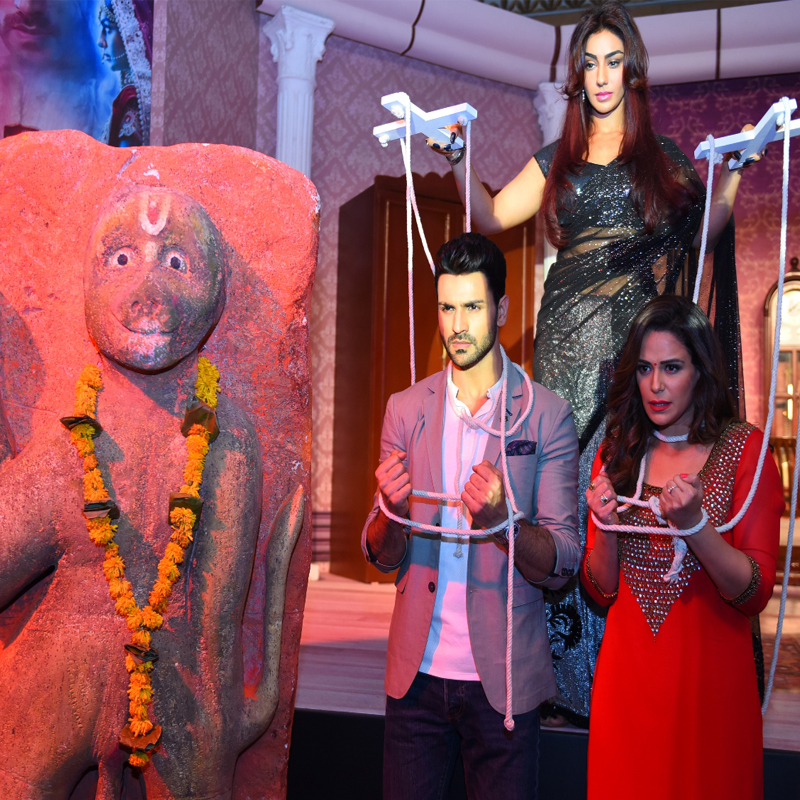
    When love turns into an evil obsession, it holds the power and ability to completely take over a person’s existence. The show will see two types of love – an all-consuming obsessive love that draws Manjulika (Maheck Chahal) to Rajbir (Vivek Dahiya) even after her death, and a selfless strong-willed love that empowers Paridhi (Mona Singh) to protect Rajbir from dark elements. Paridhi’s determination and devotion, Rajbir’s conundrum and inability to ward off harm from his wife’s life, and Manjulika’s malevolence as she recuperates from having failed at being a temptress while she was still alive, will play a major role in shaping their personalities. As a fierce tussle juxtaposes good and evil, Manjulika’s soul possesses Paridhi’s body, and uses her dreams and ambitions to manipulate her presence in Rajbir’s life and future. And with Manjulika’s evil ploys and hell-fire for her fixation with Rajbir in the offing, it will be Paridhi’s efforts that will battle the realms of bone-chilling incidents.

    Speaking about her character, Mona Singh, who essays the role of Paridhi said, “Paridhi is a modern women who is well educated, is an archaeologist by profession and doesn’t believe in supernatural occurrences. But, she is willing to go to any length to protect her husband from the clutches of evil. She will get possessed by Manjulika’s spirit, but even this will not deter her from her goals. Paridhi considers love supreme and will chart her course to her destiny with that one goal in mind.” Commenting on Rajbir’s character, actor Vivek Dahiya said, “As a story of love and obsession, Kawach will take viewers on a spine-tingling ride. Rajbir doesn’t believe in supernatural powers, but is a strong believer in the power of love and uses it to fight evil spirits when his wife Paridhi is possessed by Manjulika’s soul. His misfortune and failure at protecting his wife causes him to take many decisions that shape their future and existence. But how Rajbir and Paridhi’s love fights through all odds forms the crux of this story.”

    Upon being casted in her first ever fiction role as Manjulika,Maheck Chahal said, “Manjulika is a dark and sexy seductress. She tries to win Rajbir’s heart but fails. Her return from the dead is a mark of power and passion, and she will do all it takes – including inhabiting Paridhi’s untainted and loving soul – to own the man who she believes is rightfully hers.”

    Along with the above cast, the show brings together a power-packed cast comprising of Ashwini Kalsekar as Indrani, Aham Mehta as Jagat Singh, Shiva Rindani as Bharat Singh, and Ritu Vij as Janki Devi amongst others.

    To engage with viewers at a grass-root level, Colors has devised a robust marketing and digital strategy including different touch points including outdoor and radio. Further, the channel has planned a series of on-ground activations at more than 130 Hanuman temples across HSMs (Hindi Speaking Markets) wherein a Kawach kit comprising of a Hunaman Chalisa and a Hanuman Kawach will be distributed amongst devotees. On the digital front, an extensive outreach has been planned utilizing multiple social media platforms including Facebook, Twitter and Instagram amongst others.

  • Colors to air ‘Kawach…Kaali Shaktiyon’ se from 11 June

    Colors to air ‘Kawach…Kaali Shaktiyon’ se from 11 June

    MUMBAI: Uneasy rests the soul that loves and loses. Its obsession with love challenges the realms of life and death. But, what happens when the soul turns rogue? Colors’ upcoming drama, a finite paranormal thriller series titled Kawach…Kaali Shaktiyon Se is a story of love, passion and obsession. Drawing evil from its grave to possess a pure soul in an epic battle against good, the show delves into the lives of a loving couple Paridhi and Rajbir, and his fanatical lover Manjulika’s unfulfilled soul. Supported by a dramatic narrative and backed by Balaji Telefilms’ prowess in celebrating Indian folklore and myths, the show dwells deep into the elements of supernatural occurrences and exorcism.

    Set to take over the baton from Naagin, the show will go on-air starting 11 June 2016, and will air every Saturday and Sunday at 8:00 pm.

    Commenting on the launch of the show, Colors CEO Raj Nayak said, “The numero uno show of Indian television is going to be replaced by a new entrant which has the potential to become another trendsetter in the industry. The success of Naagin has led us to believe that the Indian viewers have a huge appetite for stories which dangle on the realms of the unknown. Going by the efficacy of this research, we bring to the viewers, Kawach – a show that talks about love, demonic possession and exorcism. Colors has set a benchmark of sorts in the finite fiction series space and we hope to continue the same trend now with Kawach. The show will definitely create ripples, is our belief.”

    Adding further, Colors programming head Manisha Sharma said, “Rooted in possession and exorcism driven by fanatical love, the show will create supernatural experiences that will engage viewers across the country. The show is essentially a love story; on one side is a devoted wife who vows to protect her husband against all evils and on the other side is an insatiated spirit whose unrequited love for the same man makes her wreak havoc in his blissfully married life. Everyone who has struggled to secure his/her love or has loved and lost will identify with the emotions displayed in this drama. As Kawach charts its own course, we are confident in its ability to grip audience attention.”

    Speaking about the show, the reigning Czarina of Indian television, producer Ekta Kapoor of Balaji Telefilms said, “Supernatural themes in recent times have tasted much success across the entertainment industry. Be it in films or on television, audiences enjoy watching stories based on myths and folklore. Kawach…Kaali Shaktiyon Se will witness evil energies taking center stage as the goodness of love will be tested in all its glory. The show will evoke a multitude of emotions amongst viewers – be it empathy for Rajbir, hatred for Manjulika or reverence for Paridhi. With a strong VFX team in place, Kawach will be our next visually spectacular proposition on Colors and we look forward to strengthening our association with the channel further.”

    When love turns into an evil obsession, it holds the power and ability to completely take over a person’s existence. The show will see two types of love – an all-consuming obsessive love that draws Manjulika (Maheck Chahal) to Rajbir (Vivek Dahiya) even after her death, and a selfless strong-willed love that empowers Paridhi (Mona Singh) to protect Rajbir from dark elements. Paridhi’s determination and devotion, Rajbir’s conundrum and inability to ward off harm from his wife’s life, and Manjulika’s malevolence as she recuperates from having failed at being a temptress while she was still alive, will play a major role in shaping their personalities. As a fierce tussle juxtaposes good and evil, Manjulika’s soul possesses Paridhi’s body, and uses her dreams and ambitions to manipulate her presence in Rajbir’s life and future. And with Manjulika’s evil ploys and hell-fire for her fixation with Rajbir in the offing, it will be Paridhi’s efforts that will battle the realms of bone-chilling incidents.

    Speaking about her character, Mona Singh, who essays the role of Paridhi said, “Paridhi is a modern women who is well educated, is an archaeologist by profession and doesn’t believe in supernatural occurrences. But, she is willing to go to any length to protect her husband from the clutches of evil. She will get possessed by Manjulika’s spirit, but even this will not deter her from her goals. Paridhi considers love supreme and will chart her course to her destiny with that one goal in mind.” Commenting on Rajbir’s character, actor Vivek Dahiya said, “As a story of love and obsession, Kawach will take viewers on a spine-tingling ride. Rajbir doesn’t believe in supernatural powers, but is a strong believer in the power of love and uses it to fight evil spirits when his wife Paridhi is possessed by Manjulika’s soul. His misfortune and failure at protecting his wife causes him to take many decisions that shape their future and existence. But how Rajbir and Paridhi’s love fights through all odds forms the crux of this story.”

    Upon being casted in her first ever fiction role as Manjulika,Maheck Chahal said, “Manjulika is a dark and sexy seductress. She tries to win Rajbir’s heart but fails. Her return from the dead is a mark of power and passion, and she will do all it takes – including inhabiting Paridhi’s untainted and loving soul – to own the man who she believes is rightfully hers.”

    Along with the above cast, the show brings together a power-packed cast comprising of Ashwini Kalsekar as Indrani, Aham Mehta as Jagat Singh, Shiva Rindani as Bharat Singh, and Ritu Vij as Janki Devi amongst others.

    To engage with viewers at a grass-root level, Colors has devised a robust marketing and digital strategy including different touch points including outdoor and radio. Further, the channel has planned a series of on-ground activations at more than 130 Hanuman temples across HSMs (Hindi Speaking Markets) wherein a Kawach kit comprising of a Hunaman Chalisa and a Hanuman Kawach will be distributed amongst devotees. On the digital front, an extensive outreach has been planned utilizing multiple social media platforms including Facebook, Twitter and Instagram amongst others.

  • FY-16: Higher tax, lesser films release lowers Balaji Telefims revenue, profit

    FY-16: Higher tax, lesser films release lowers Balaji Telefims revenue, profit

    BENGALURU: Balaji Telefilms Limited (Balaji) reported 15.5 percent decline in consolidated total revenue from operations (TIO) for the year ended 31 March 2016 (FY-16, current year). The company’s consolidated profit after tax (PAT) in the current year declined to less than half as compared to the previous year. Balaji attributes the decline in consolidated TIO to release of just one film in the current fiscal as compared to five in the FY-15. Further, the company had to pay more than a five-fold (5.6 times) increase in income tax in the current year as compared to FY-15.

    Balaji’s reported consolidated TIO in FY-16 at Rs 292.76 crore as compared to Rs 342.65 crore in the previous year. PAT in FY-16 was Rs 2.74 crore (1 percent PAT margin) as compared to Rs 5.63 crore (1.6 percent PAT margin) in FY-15. 

    Note: The unit of currency in this report is the Indian rupee – Rs (also conventionally represented by INR). The Indian numbering system or the Vedic numbering system has been used to denote money values. The basic conversion to the international norm would be:
    (a) 100,00,000 = 100 lakh = 10,000,000 = 10 million = 1 crore.
    (b) 10,000 lakh = 100 crore = 1 arab = 1 billion.

    EBIDTA in the current year declined 2 percent to Rs 5.95 crore (2 percent EBIDTA margin) as compared to 6.06 crore (1.7 percent EBIDTA)

    For the quarter ended 31 March 2016 (Q4-16, current quarter), Balaji reported 6 percent year-over-year (y-o-y) growth in consolidated TIO at Rs 83.23 crore as compared to Rs 77.81 crore in Q4-15, and a 12 percent quarter-over-quarter (q-o-q) growth from Rs 73.15 crore in Q3-16.

    Revenue for the quarter from commissioned programs (including Nach Baliye) declined to Rs 55.64 crore as compared to Rs 59.51 crore in Q1-15 and Rs 71.27 crore in the immediate trailing quarter. The company says that the decline in revenues for Q4-16 was due to Meri Aashiqui Tum Se Hi, Itna Karo Na Mujhe Pyaar and Pyar Ko Ho Jane Do going off air during the quarter.

    The company created lesser hours of programming in Q4-16 as compared to during the corresponding year ago quarter and during the immediate trailing quarter. Total programming hours in Q1-16 were 247 as compared to 258 in Q1-15 and 294.5 hours in Q3-16. Net realisation per hour in Q4-16 increased to Rs 22.5 lakh as compared to Rs 22 lakh in Q1-15, but declined when compared to Rs 24.2 lakh in Q3-16.

    Balaji reported a net loss of Rs 13.28 crore in the current quarter as compared to PAT of Rs 9.61 crore in Q1-15 and  PAT of Rs 6.64 crore in Q3-16.


  • FY-16: Higher tax, lesser films release lowers Balaji Telefims revenue, profit

    FY-16: Higher tax, lesser films release lowers Balaji Telefims revenue, profit

    BENGALURU: Balaji Telefilms Limited (Balaji) reported 15.5 percent decline in consolidated total revenue from operations (TIO) for the year ended 31 March 2016 (FY-16, current year). The company’s consolidated profit after tax (PAT) in the current year declined to less than half as compared to the previous year. Balaji attributes the decline in consolidated TIO to release of just one film in the current fiscal as compared to five in the FY-15. Further, the company had to pay more than a five-fold (5.6 times) increase in income tax in the current year as compared to FY-15.

    Balaji’s reported consolidated TIO in FY-16 at Rs 292.76 crore as compared to Rs 342.65 crore in the previous year. PAT in FY-16 was Rs 2.74 crore (1 percent PAT margin) as compared to Rs 5.63 crore (1.6 percent PAT margin) in FY-15. 

    Note: The unit of currency in this report is the Indian rupee – Rs (also conventionally represented by INR). The Indian numbering system or the Vedic numbering system has been used to denote money values. The basic conversion to the international norm would be:
    (a) 100,00,000 = 100 lakh = 10,000,000 = 10 million = 1 crore.
    (b) 10,000 lakh = 100 crore = 1 arab = 1 billion.

    EBIDTA in the current year declined 2 percent to Rs 5.95 crore (2 percent EBIDTA margin) as compared to 6.06 crore (1.7 percent EBIDTA)

    For the quarter ended 31 March 2016 (Q4-16, current quarter), Balaji reported 6 percent year-over-year (y-o-y) growth in consolidated TIO at Rs 83.23 crore as compared to Rs 77.81 crore in Q4-15, and a 12 percent quarter-over-quarter (q-o-q) growth from Rs 73.15 crore in Q3-16.

    Revenue for the quarter from commissioned programs (including Nach Baliye) declined to Rs 55.64 crore as compared to Rs 59.51 crore in Q1-15 and Rs 71.27 crore in the immediate trailing quarter. The company says that the decline in revenues for Q4-16 was due to Meri Aashiqui Tum Se Hi, Itna Karo Na Mujhe Pyaar and Pyar Ko Ho Jane Do going off air during the quarter.

    The company created lesser hours of programming in Q4-16 as compared to during the corresponding year ago quarter and during the immediate trailing quarter. Total programming hours in Q1-16 were 247 as compared to 258 in Q1-15 and 294.5 hours in Q3-16. Net realisation per hour in Q4-16 increased to Rs 22.5 lakh as compared to Rs 22 lakh in Q1-15, but declined when compared to Rs 24.2 lakh in Q3-16.

    Balaji reported a net loss of Rs 13.28 crore in the current quarter as compared to PAT of Rs 9.61 crore in Q1-15 and  PAT of Rs 6.64 crore in Q3-16.


  • Uday Shankar@FICCI Frames 2016: The real digital challenge

    Uday Shankar@FICCI Frames 2016: The real digital challenge

    Good morning.

    Honorable Minister of Communications and Information Technology, Ravi Shankar Prasad Ji, Chairman TRAI R.S. Sharma, Mr. Mukesh Ambani, Ramesh Ji, friends from the world of media and entertainment.

    As co-chair of FICCI’s M&E committee, I have had the opportunity to address you for a few years now. I take this as a rare privilege and hence spend some time thinking through what I should say. A few weeks ago, as I was discussing the theme with some of my colleagues, a young assistant of mine – cocky on youth and his recent admission to Harvard Business School stated rather dismissively that there wasn’t anything new to be said as there wasn’t anything new happening in the M&E sector. While it sounded like a cynical assessment at that time it did set me thinking if there was indeed a grain of truth in what he said. On the surface, it does seem that not much has changed in the last several years except for some incremental growth or decline depending on which vertical you are talking about. Cable TV continues to struggle – struggling to improve its business case, struggling to improve its talent & technology quotient and above all to stay relevant in a rapidly changing world.  DTH, that set out to revolutionize distribution, increasingly seems to be intent on locking its destiny inside an isolated box in a networked world. Even the story of digitalization that started 6 years ago remains incomplete. The advertising revolution of the 90’s when a large number of international and Indian brands were built on television screens, doesn’t seem to be breaking new ground in terms of what I call brand revolution 2.0. Content creators, a community that I belong to, generally seem to be caught in a time warp with the same themes playing in a loop again and again –cursed destinies, rebirth and revenge and deference to elders in public while bickering in private, pretty much sums up what rules national entertainment. The quality of news of course, seems to cause only national consternation, with now even our friendly neighbor taking a pot-shot at our news channels!Over all, it seems the more things change the more they remain the same.  So maybe my colleague was right after all.  

    But then is the picture really as gloomy as this? Because beneath the surface ofentrenched stagnation, quietly – almost stealthily -there is a gigantic disruption playing out. A disruption that’s shifting the ground from beneath our feet.  

    My friends, allow me to recap the year for you.  The creative group to make the most waves last year were 4 youngsters, irreverent enough to take on our entire film industry and then build on that success by putting the entire country under a scanner.  This is a group who has the audacity to have a name so offensive that our news media calls them by their acronym AIB.  Yes, I am talking about All India Bakchod, who are perceived as comedians although this is not a group of people who make imbecile jokes while dressed in a funny manner.  More than once they have set the news agenda for the nation.  They have the gall to take on the combined might of big telcos and Mark Zuckerberg’sFacebook when they felt that the freedom of the internet was being parceled away.  They have used humour to put a spotlight on the state of fire stations in India or for that matter the behavior of the police force. As a group, these four youngsters made more headlines last year than probably all of the creative community put together.

    Very recently one of the pioneers of television entertainment told me that she was so frustrated by the frozen state of traditional media that she was going to create a digital enterprise to tell the stories that traditional media has been too scared to tell.  Of course, I am talking about the totally adorable – Ekta Kapoor.  Think about that for a moment – the person who created the archetype of saas and bahu feels the need to break away from these stifling constraints of the medium that she herself created.  Why?  When that happens, we all need to think hard.

    Friends, the most talked about launch in Indian M&E last year was not a new channel, or a new newspaper or a new production house – actually it was a mobile app that had the gall to ask consumers to go solo.  A call fundamentally at odds with the concept of content consumption in this country, that believes that the entire family watches TV together in the living room. Well, I am talking about the launch of our very own hotstar.  In just about a year, hotstar has been downloaded over 50 million or 5 crore times.  What is the implication of this?  Consider this – more people have watched the English Premier league on hotstar last year than on television.  Yes, EPL was watched by more people on hotstar than on television.  Even for a mass sport like cricket, in the larger cities, hotstar’s watch time is now starting to reach 50% of television.  I urge you to reflect on the potential of that statistic.   This infant service is already becoming a product of habit in India and now this year, my friends, we have set our sight on creating the first global Media & Entertainment product born out of India, when we take hotstar to the rest of the world in a few months.  The numerous and affluent south Asian diaspora which for the longest time has been frustrated by the lack of access to its favourite content will be able to watch cricket, movies and drama through hotstar.  While I am indeed happy for hotstar to be the pioneer, we are very aware that this is a trend that will get replicated again and again, very quickly.

    This colossal shift by no means is limited to television.  At the risk of earning her disapproval, let me share the story of my daughter – she is a serious academic whose job is to analyze the social sector and legislation for a living.  She is always on top of news and opinion articles and yet I have never seen her hold a physical newspaper in her hand.  Her daily dose comes exclusively from the digital universe. Her intake ranges from headlines under 140 characters to ebooks over 14 million characters long. She is a voracious consumer of movies and drama; yet goes to theatres morefor fun than for creative consumption.  Fixed schedule programming sounds as bizarre to her as silent movies to us.  She is obsessed with music but doesn’t own a single CD.  Her near infinite library rests entirely on her iPhone – the same goes for her friends and colleagues who use android devices.

    The world has changed.  There is a tectonic shift happening in our industry right in front of us.And yet, what we see in the world of traditional television is just stagnation. And this stagnation has been made worse by the funny denial that all of us seem to be living in. Even though this change is happening faster than anything we have ever seen, our approach towards it seems to be one of incrementalism.

    I see an even more obsessive desire to protect the antiquated business models that we have painstakingly built over the years and that technology and the youth are decimating like a bull-dozer rolling over glass bottles.  It reminds me of the story of a Japanese soldier who was left stranded and forgotten on a small island in the Pacific. Many years after Japan had lost the war and the world had returned to normal that lone soldier kept guarding that isolated island thinking he was still protecting the Japanese empire.  Herein probably lies the explanation why print companies found it difficult to make the transition to TV and why almost all the digital successes generally come from companies that did not exist even a decade ago.  This is because these are companies and people who are not chained by their legacy businesses.  Just imagine where businesses like Netflix, Twitter and Facebook were a decade ago and what global empires they have created in this short span of time.

    It is pretty clear to me that we are in a battle.  In this battle there are only two options that we have – we can either continue living in denial, hide back in our artificial walled gardens, watching as the bricks crumble down one by one or we can arm ourselves with the sameweapons that our challengers possess, and venture forth into battle, sometimes even against the same businesses that we have created. Change or Perish.

    There is one thing however that will continue to be the same: the power of stories. For those of us who had imagined a world where the so called user generated stories would unseat high quality creativity, the answer comes from the Netflix strategy.  Netflix – the most successful content provider in the US, the challenger to the media behemoths of the west has done so on the back of extremely high quality content, so much so that Netflix’s catalogue today represents the absolute best of American television.

    However there is a twist in the tale here.  No longer is the story enough, within the commoditized consistency of experience.  Technology and creativity are coming together to enhance the experience literally, almost daily.  Indians long used to a life of having to start all over again if the power went for a minute are rapidly getting used to being asked if we want to resume where we left off?

    The new screens have once again highlighted the importance of the story but they have introduced the centrality of the experience at the same time.  Design and engineering can no longer be divorced from the story – this is a radical departure from everything that we were taught all these years.  We learnt this the hard way through hotstar – how small changes even in the browsing experience could lead to dramatic shifts in consumption.  Today I am happy to remark that we at Star probably have more engineers in our team than any other media and entertainment company.  Equally we have more designers and more story tellers than anyone else because those are the three pillars on which we see future M&E companies getting built.  

    Clearly, we need to change the lens with which we look at talent.  In this new world neither technology nor talent will be limited by geographical boundaries.  The best engineers are as likely to be in Berlin as in Bangalore.  We already know that best designers and animators for Hollywood no longer need to be there – because they are already in Goregaon and let’s not forget our very own Priyanka Chopra who is the first home grown star of a truly global show.  We are looking at a truly global world.  But this global world has no patience for traditional forms of reverence.  At Star, we are grappling with this everyday – when we inducted culturally diverse talent we had to create space for that cultural diversity to exist. But that’s easier said than done.  Technology going global, talent going global also means adoption of a new tradition.

    Recently, I just saw amazon.in selling cow dung cakes online.  This humblest of the humble, the most traditional of fuels, being sold at 350 bucks for a small packet.  To me, that is the real power of the world that we are going into.  Power of the idea that someone actually thought that there is a market out there for cow dung cakes and the fact that that market is willing to a pay huge premium for it.  And the fact that the internet has created a market place where ideas and creativity are the only constraints.

    In this context let me draw your attention to the illustrious gathering on this podium today because if India has to make that leap into the new world where everybody can create value for himself or herself by sheer innovation then this group here must deliver.  Minister Ravi Shankar Prasad is not just a senior minister of the Union Cabinet – he holds the key to India’s transition into this digital world.  Chairman R.S.Sharma will have to decide how much can he accelerate that leap, and finally the whole country is looking at Mr. Ambani’s initiative called Reliance Jio to unshackle that truly global, truly democratic dream of 125 crore Indians.  Let’s all hope that they do the right thing, for it is in the best interest of this country they all must succeed.

     

  • Uday Shankar@FICCI Frames 2016: The real digital challenge

    Uday Shankar@FICCI Frames 2016: The real digital challenge

    Good morning.

    Honorable Minister of Communications and Information Technology, Ravi Shankar Prasad Ji, Chairman TRAI R.S. Sharma, Mr. Mukesh Ambani, Ramesh Ji, friends from the world of media and entertainment.

    As co-chair of FICCI’s M&E committee, I have had the opportunity to address you for a few years now. I take this as a rare privilege and hence spend some time thinking through what I should say. A few weeks ago, as I was discussing the theme with some of my colleagues, a young assistant of mine – cocky on youth and his recent admission to Harvard Business School stated rather dismissively that there wasn’t anything new to be said as there wasn’t anything new happening in the M&E sector. While it sounded like a cynical assessment at that time it did set me thinking if there was indeed a grain of truth in what he said. On the surface, it does seem that not much has changed in the last several years except for some incremental growth or decline depending on which vertical you are talking about. Cable TV continues to struggle – struggling to improve its business case, struggling to improve its talent & technology quotient and above all to stay relevant in a rapidly changing world.  DTH, that set out to revolutionize distribution, increasingly seems to be intent on locking its destiny inside an isolated box in a networked world. Even the story of digitalization that started 6 years ago remains incomplete. The advertising revolution of the 90’s when a large number of international and Indian brands were built on television screens, doesn’t seem to be breaking new ground in terms of what I call brand revolution 2.0. Content creators, a community that I belong to, generally seem to be caught in a time warp with the same themes playing in a loop again and again –cursed destinies, rebirth and revenge and deference to elders in public while bickering in private, pretty much sums up what rules national entertainment. The quality of news of course, seems to cause only national consternation, with now even our friendly neighbor taking a pot-shot at our news channels!Over all, it seems the more things change the more they remain the same.  So maybe my colleague was right after all.  

    But then is the picture really as gloomy as this? Because beneath the surface ofentrenched stagnation, quietly – almost stealthily -there is a gigantic disruption playing out. A disruption that’s shifting the ground from beneath our feet.  

    My friends, allow me to recap the year for you.  The creative group to make the most waves last year were 4 youngsters, irreverent enough to take on our entire film industry and then build on that success by putting the entire country under a scanner.  This is a group who has the audacity to have a name so offensive that our news media calls them by their acronym AIB.  Yes, I am talking about All India Bakchod, who are perceived as comedians although this is not a group of people who make imbecile jokes while dressed in a funny manner.  More than once they have set the news agenda for the nation.  They have the gall to take on the combined might of big telcos and Mark Zuckerberg’sFacebook when they felt that the freedom of the internet was being parceled away.  They have used humour to put a spotlight on the state of fire stations in India or for that matter the behavior of the police force. As a group, these four youngsters made more headlines last year than probably all of the creative community put together.

    Very recently one of the pioneers of television entertainment told me that she was so frustrated by the frozen state of traditional media that she was going to create a digital enterprise to tell the stories that traditional media has been too scared to tell.  Of course, I am talking about the totally adorable – Ekta Kapoor.  Think about that for a moment – the person who created the archetype of saas and bahu feels the need to break away from these stifling constraints of the medium that she herself created.  Why?  When that happens, we all need to think hard.

    Friends, the most talked about launch in Indian M&E last year was not a new channel, or a new newspaper or a new production house – actually it was a mobile app that had the gall to ask consumers to go solo.  A call fundamentally at odds with the concept of content consumption in this country, that believes that the entire family watches TV together in the living room. Well, I am talking about the launch of our very own hotstar.  In just about a year, hotstar has been downloaded over 50 million or 5 crore times.  What is the implication of this?  Consider this – more people have watched the English Premier league on hotstar last year than on television.  Yes, EPL was watched by more people on hotstar than on television.  Even for a mass sport like cricket, in the larger cities, hotstar’s watch time is now starting to reach 50% of television.  I urge you to reflect on the potential of that statistic.   This infant service is already becoming a product of habit in India and now this year, my friends, we have set our sight on creating the first global Media & Entertainment product born out of India, when we take hotstar to the rest of the world in a few months.  The numerous and affluent south Asian diaspora which for the longest time has been frustrated by the lack of access to its favourite content will be able to watch cricket, movies and drama through hotstar.  While I am indeed happy for hotstar to be the pioneer, we are very aware that this is a trend that will get replicated again and again, very quickly.

    This colossal shift by no means is limited to television.  At the risk of earning her disapproval, let me share the story of my daughter – she is a serious academic whose job is to analyze the social sector and legislation for a living.  She is always on top of news and opinion articles and yet I have never seen her hold a physical newspaper in her hand.  Her daily dose comes exclusively from the digital universe. Her intake ranges from headlines under 140 characters to ebooks over 14 million characters long. She is a voracious consumer of movies and drama; yet goes to theatres morefor fun than for creative consumption.  Fixed schedule programming sounds as bizarre to her as silent movies to us.  She is obsessed with music but doesn’t own a single CD.  Her near infinite library rests entirely on her iPhone – the same goes for her friends and colleagues who use android devices.

    The world has changed.  There is a tectonic shift happening in our industry right in front of us.And yet, what we see in the world of traditional television is just stagnation. And this stagnation has been made worse by the funny denial that all of us seem to be living in. Even though this change is happening faster than anything we have ever seen, our approach towards it seems to be one of incrementalism.

    I see an even more obsessive desire to protect the antiquated business models that we have painstakingly built over the years and that technology and the youth are decimating like a bull-dozer rolling over glass bottles.  It reminds me of the story of a Japanese soldier who was left stranded and forgotten on a small island in the Pacific. Many years after Japan had lost the war and the world had returned to normal that lone soldier kept guarding that isolated island thinking he was still protecting the Japanese empire.  Herein probably lies the explanation why print companies found it difficult to make the transition to TV and why almost all the digital successes generally come from companies that did not exist even a decade ago.  This is because these are companies and people who are not chained by their legacy businesses.  Just imagine where businesses like Netflix, Twitter and Facebook were a decade ago and what global empires they have created in this short span of time.

    It is pretty clear to me that we are in a battle.  In this battle there are only two options that we have – we can either continue living in denial, hide back in our artificial walled gardens, watching as the bricks crumble down one by one or we can arm ourselves with the sameweapons that our challengers possess, and venture forth into battle, sometimes even against the same businesses that we have created. Change or Perish.

    There is one thing however that will continue to be the same: the power of stories. For those of us who had imagined a world where the so called user generated stories would unseat high quality creativity, the answer comes from the Netflix strategy.  Netflix – the most successful content provider in the US, the challenger to the media behemoths of the west has done so on the back of extremely high quality content, so much so that Netflix’s catalogue today represents the absolute best of American television.

    However there is a twist in the tale here.  No longer is the story enough, within the commoditized consistency of experience.  Technology and creativity are coming together to enhance the experience literally, almost daily.  Indians long used to a life of having to start all over again if the power went for a minute are rapidly getting used to being asked if we want to resume where we left off?

    The new screens have once again highlighted the importance of the story but they have introduced the centrality of the experience at the same time.  Design and engineering can no longer be divorced from the story – this is a radical departure from everything that we were taught all these years.  We learnt this the hard way through hotstar – how small changes even in the browsing experience could lead to dramatic shifts in consumption.  Today I am happy to remark that we at Star probably have more engineers in our team than any other media and entertainment company.  Equally we have more designers and more story tellers than anyone else because those are the three pillars on which we see future M&E companies getting built.  

    Clearly, we need to change the lens with which we look at talent.  In this new world neither technology nor talent will be limited by geographical boundaries.  The best engineers are as likely to be in Berlin as in Bangalore.  We already know that best designers and animators for Hollywood no longer need to be there – because they are already in Goregaon and let’s not forget our very own Priyanka Chopra who is the first home grown star of a truly global show.  We are looking at a truly global world.  But this global world has no patience for traditional forms of reverence.  At Star, we are grappling with this everyday – when we inducted culturally diverse talent we had to create space for that cultural diversity to exist. But that’s easier said than done.  Technology going global, talent going global also means adoption of a new tradition.

    Recently, I just saw amazon.in selling cow dung cakes online.  This humblest of the humble, the most traditional of fuels, being sold at 350 bucks for a small packet.  To me, that is the real power of the world that we are going into.  Power of the idea that someone actually thought that there is a market out there for cow dung cakes and the fact that that market is willing to a pay huge premium for it.  And the fact that the internet has created a market place where ideas and creativity are the only constraints.

    In this context let me draw your attention to the illustrious gathering on this podium today because if India has to make that leap into the new world where everybody can create value for himself or herself by sheer innovation then this group here must deliver.  Minister Ravi Shankar Prasad is not just a senior minister of the Union Cabinet – he holds the key to India’s transition into this digital world.  Chairman R.S.Sharma will have to decide how much can he accelerate that leap, and finally the whole country is looking at Mr. Ambani’s initiative called Reliance Jio to unshackle that truly global, truly democratic dream of 125 crore Indians.  Let’s all hope that they do the right thing, for it is in the best interest of this country they all must succeed.
     

  • Balaji Telefilms ‘Kasam..Tere Pyar Ki’ on Colors starting March 7

    Balaji Telefilms ‘Kasam..Tere Pyar Ki’ on Colors starting March 7

    MUMBAI: Leaving no stone unturned, Viacom 18’s Hindi general entertainment channel, Colors is all prepped up for Balaji Telefilms’ new show Kasam…Tere Pyaar Ki. Starting from 7 March, the show will be aired at 10pm from Monday to Friday. The channel has roped in Indiagate Basmati Rice as the powered by sponsors for the soap

    Kasam…Tere Pyaar Ki, a tale of star-crossed lovers Rishi played by Ssharad Malhotra and Tanushree played by Kratika Sengar, highlights the connection between their souls since childhood, but the vagaries of destiny pulls them apart.

    Talking with Indiantelevision.com, Colors programming head Manisha Sharma said, “This is an older man and younger girl reincarnation love story. I am hoping it will be as romantic as Ekta’s other shows. I am sure the new offering from Balaji will have all the flavours. The show further marks the strengthening of our relationship with Balaji Telefilms, with which we have delivered path-breaking content time and again. Balaji’s Telefilms proficiency at depicting the various shades of love has made it a master storyteller with a strong hold on the pulse of the audience’s hearts”.

    As reported earlier by Indiantelevision.com, the new show Kasam will replace one of the most popular show on Colors,  Meri Aashiqui Tum Se Hi  which is yet another Balaji production. Talking about the same, Sharma added, “Its time to bid goodbye to Meri Aashiqui Tumse Hi because it has lived its life. It used to do well for us and was loved by our audience but it has to end, because you can’t keep stretching love stories for long.“

    Speaking about the show, Balaji Telefilms producer Ekta Kapoor said, “Kasam…Tere Pyaar Ki redefines every known shade of love. It explores a deep-rooted connection between souls, binding Rishi and Tanushree’s hearts from childhood and continuing, across lifetimes, long after destiny separates them. The show instils freshness through its intensity of emotions, which combined with a distinctive backdrop, will find appeal amongst romantics and convert non-believers. The show’s scale and production quality further adds to the authenticity of the concept thereby creating a belief system around the perpetuity of love”.

    Colors has devised a 360-degree integrated marketing campaign for the show that includes print, broadcast, OOH, and radio among others. Kasam…Tere Pyaar Ki will also be promoted via a robust digital strategy engaging viewers across social media platforms like Facebook, Twitter and Instagram.