Tag: editors

  • OTT series’ directors, editors share experiences, learning at Vidnet 2019’s Masterclasses

    OTT series’ directors, editors share experiences, learning at Vidnet 2019’s Masterclasses

    MUMBAI: Indiantelevision.com’s Vidnet 2019, for the first time, conducted Masterclasses for aspiring directors and editors of the OTT space. Masterclasses brought directors and editors of successful series like Ghoul, Gullak, Rangbaaz, Kota Factory, It’s Not That Simple, Criminal Justice and Delhi Crime to share their experiences and learning as creators.

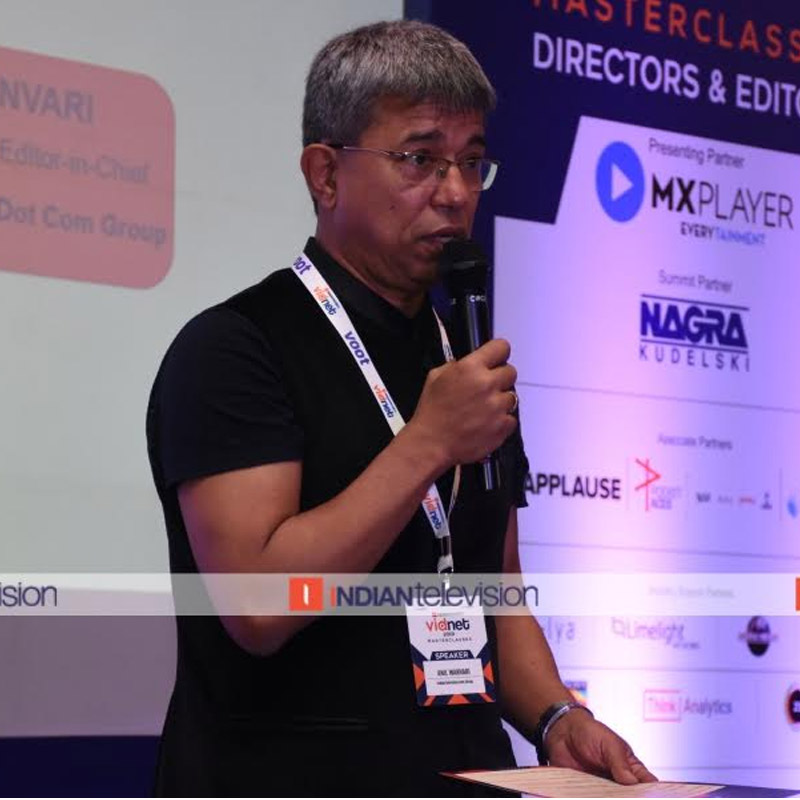
    The initiative is an attempt to help the audience learn from the OTT industry’s best creators on creating successful web series. In the opening remark, Indiatelevision.com founder and CEO Anil Wanvari said, “This is the first time that we have organised Masterclasses and our vision is to create a platform and to build a community for aspiring creators."

    The first Masterclass was held by the makers of Netflix’s Ghoul. Creator, writer and director Patrick Graham shared insights on the process of making Ghoul which was initially written as a film and later converted to three-episode original premium content for Netflix. Graham also revealed that he took six months to write and research on the script of Ghoul and the post-production took three to four months. He said that horror is the most untapped genre in India and the concept of military horror was never attempted. Ghoul editor Nitin Baid briefed the audience on how he started working on the psychological horror-thriller and his experience while working with Graham on the project.

    The next Masterclass was conducted by Sachin Pathak, director of Rangbaaz S-2 who shared his experience on how he started his journey in the industry and how he got the opportunity to direct Rangbaaz S-2 for ZEE5. Pathak said that experience is the best teacher on shooting-related challenges.

    Another interesting Masterclass was on SonyLIV’s Gullak. Amrit Raj Gupta who directed Gullak began his journey in 2013 as an intern in TVF. He also directed TVF Bachelors season one and two. Amit Kulkarni editor of Gullak, Tripling S-2 and TVF Bachelors shared his two pence with the audiences. The duo said that the major challenge while creating content for OTT is to deliver satisfactory shots within a limited time span.

    Kota Factory director Raghav Subbu and editor Gourav Gopal Jha enlightened the audience on their recent success. TVF's Kota Factory premiered on YouTube this year and the show grabbed attention for being the first black and white web series. Subbu revealed that the idea of doing black and white web series hit him two weeks before the shoot and the team was slightly sceptical about it. They shot the show with two cameras- one for black and white series and another for colour series so that they have a backup if the concept didn’t work. They also explained motives behind having excessive aerial shots in the show and creating characters which resonate with the viewers. Subbu said that it is the responsibility of the director to turn the script into live characters on the screen. He said, “I follow the thought which says there is no good or bad film, there is a good or bad director and I come from that school. It’s important that the association with the script and directors works well.”

    At the Masterclass, Danish Aslam who directed It’s Not That Simple for VOOT touched the practical aspect of directing a show for an OTT platform. He explained the differences between shooting a film and a web series. He said, “The storytelling format is a crucial differentiating factor – episodic versus long-form storytelling. India has more daily soaps which stretch beyond 100 episodes. The concept of seasons is completely new in our country.”

    Aslam also explained how to keep the spark alive between episodes. He also gave some examples from his experience in addressing the challenges one faces while working on the limited budget and time constraints on OTT platforms.

    Vishal Furia, director of Criminal Justice and Lapachhapi, a Marathi Film, threw light on the concept and making of Criminal Justice and the research he conducted to bring the actual story from paper to screen. He too commented that the horror genre is not so evolved in India.

    The last and the most interesting Masterclass was taken by Delhi Crime’s writer, director and creator Richie Mehta who informed that he took four years to research on the subject and connected with most of the characters to understand their views. Mehta answered the audience's questions like how much fiction was added to the show, realism of the scene, deciding the point to start and stop the story, and psychological impact while researching and writing for Delhi Crime.

  • TV18 & CNN extend partnership on CNN IBN

    TV18 & CNN extend partnership on CNN IBN

    MUMBAI: TV18 and CNN International have extended their collaboration on CNN-IBN.


    In this second term, the two will strive to take the partnership to next level, enabling CNN-IBN viewers to stay ahead on news from around the world and across multi-platforms.


    Talking about the extension, Network18 chairman Adil Zainulbhai said, “We are delighted to announce the renewal of this extremely cherished partnership between two most respected brands in journalism. In this second term, we aim to present a brand new CNN-IBN that will bring news with even greater speed, accuracy, clarity and credibility and keep the viewers tuned to global developments much ahead of others. With this renewed partnership, we will enhance the process of news gathering and delivering it to our viewers by informing and enlightening.”


    The renewed addendum aims to cut through the noise and clutter that is currently prevailing on the television news space. It will also provide the channel an opportunity to access live reports and discussions in real time from CNN studios around the world. CNN will also provide the technical knowhow and training to CNN-IBN anchors and editors.

  • 220 journalists in jail around the world: CPJ

    220 journalists in jail around the world: CPJ

    MUMBAI: The Committee to Protect Journalists (CPJ) has identified that 220 journalists are in jail around the world in 2014. This is an increase of nine from last year’s tally.

    The committee mentioned that the tally marks the second-highest number of journalists in jail since CPJ began taking an annual census of imprisoned journalists in 1990, and highlights a resurgence of authoritarian governments in countries such as China, Ethiopia, Burma, and Egypt.

    “China’s use of anti-state charges and Iran’s revolving door policy in imprisoning reporters, bloggers, editors, and photographers earned the two countries the dubious distinction of being the world’s worst and second worst jailers of journalists, respectively,” says the report.

    The list of the top 10 worst jailers of journalists was rounded out by Eritrea, Ethiopia, Vietnam, Syria, Egypt, Burma, Azerbaijan, and Turkey.

    In recent years, journalist jailings in the Americas have become increasingly rare, with one documented in each 2012 and 2013. This year, the region has two: a Cuban blogger was sentenced to five years in prison in retaliation for his critical blog, and in Mexico, an independent journalist and activist for Mayan causes has been charged with sedition.

    The report goes on the point out that 20 per cent, or 45, of the journalists imprisoned globally are being held with no charge disclosed. Also, online journalists accounted for more than half, or 119, of the imprisoned journalists.

    CPJ believes that journalists should not be imprisoned for doing their jobs. The organisation has sent letters expressing its serious concerns to each country that has imprisoned a journalist. In the past year, CPJ advocacy led to the early release of at least 41 imprisoned journalists worldwide.


  • Is blaming the watchdog politicos’ new defence matra?

    Is blaming the watchdog politicos’ new defence matra?

    MUMBAI: The countdown to the general elections has well and truly begun, what with political parties and their prime ministerial hopefuls engaging in an unending game of one-upmanship.


    What is surprising though is that this time round, the fourth estate, otherwise hailed as ‘the watchdog of democracy’, is at the receiving end of this mud-slinging match.


    For starters, two years after an Indian Express report about the controversial movement of two army units towards the national capital, General VK Singh, who was the then army chief, opted to call the reporters ‘presstitudes’ while dismissing the article as ‘the fable of a sick mind’.  


    Then, Arvind ‘Aam Aadmi’ Kejriwal, during his recent speech at Rohtak in Haryana, alleged that Mukesh Ambani had bought some TV channels and newspapers and asked them to give extensive coverage to Rahul Gandhi and Narendra Modi.


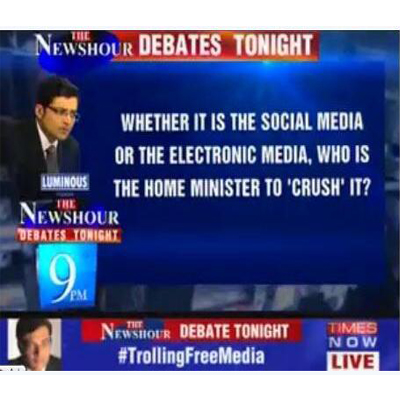
    Just the other day, at a Congress function in Solapur, Union Home Minister Sushil Kumar Shinde threatened “to crush elements in the electronic media spreading false propaganda” although he clarified the very next morning that he was targeting “social media, not journalism”.


    And while on the subject of social media, readers will recall how West Bengal Chief Minister Mamata Banerjee, known for her stiff stance on most issues, got a Jadavpur University Chemistry Professor arrested for allegedly circulating ‘anti-Mamata’ cartoons on the Internet in 2012.


    The same year, a similar fate befell a small scale industrialist who was arrested for allegedly posting ‘offensive’ messages on social media targeting Union Finance Minister P Chidambaram’s son Karti.


    Yes, social media can often be a double-edged sword but what is equally important is that it has given the aam aadmi a voice.


    Times Now Editor-in-Chief Arnab Goswami puts it correctly when he says that the media is variously termed as good or bad depending on whether it praises or bashes politicians. Indeed, politicos trolling media to suit their purpose was the subject of a News Hour debate not so long ago while #Trollingfreemedia had the Twitterati debating the issue endlessly.


    So much so, the Editors Guild came out in protest with a statement that read: “Ironically, leaders who built up reputations and support by engaging the public through the media are now turning on the very media when they come under critical scrutiny.”


    The News Broadcasters Association (NBA) too issued a press statement saying: “A news channel’s endeavour is to cover news-worthy events across all segments of national and international life and to present news to viewers, which is current and relevant. The media provides a service that is essential for any democratic society. This is particularly important when the most fundamental aspect of a democracy, the elections are round the corner. At such a time, the media plays an indispensable role in enabling citizens to stay well informed and make important choices. There can be no acceptable reason for attacking the media on frivolous, unsubstantiated grounds. Intimidation and preventing the media from performing its duties amounts to interfering with the freedoms enshrined in and guaranteed by the Constitution.”


    The NBA specifically appealed to political leaders across parties and public figures not to level baseless charges against the media and keep the discourse civil and sane.


    Somehow, now media has become everyone’s punching bag. Nonetheless, journalistic maturity is needed without losing the enthusiasm, energy and insightfulness.