Tag: economic

  • CNBC-TV18 business leader big bash kicks off 7 December 2025 in Mumbai

    CNBC-TV18 business leader big bash kicks off 7 December 2025 in Mumbai

    MUMBAI: Who are the corporate executives and individuals who helped shape the business landscape in India in 2024?

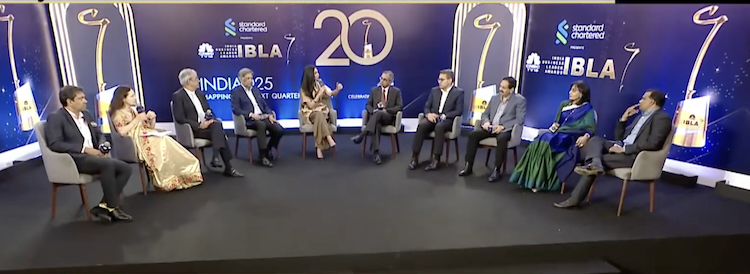
    Many a media outlet has its own list that they felicitate and recognise with a nice little ceremony.  English business news leader CNBC-TV18 is all set to present and celebrate its  crop  of  leaders that its  crack editorial teams and jury consider as shining  stars through the CNBC-TV18 India Business Leader Awards (IBLA). 

    Presented by Standard Chartered Bank, the awards are returning for the twentieth edition on 7 December 2024 in Mumbai. The theme ‘Leadership in Action, means that executives who embody conviction, innovation, and purposeful disruption will be felicitated. The IBLA , needless to say, brings together such visionary leaders, honouring their resilience, foresight, and ability to inspire transformative impact.

    The awards evening will be an exceptional gathering of influential figures from the business, economic, policy, and cultural spheres, such as minister of road transport & highways Nitin Gadkari,  minister of commerce and industry Piyush Goyal;  DLF chairman emeritus KP Singh; Serum Institute of India founder Cyrus Poonawalla ; Bharat Forge CMD Babasaheb N. Kalyani;  Aditya Birla group chairman Kumar Mangalam Birla; Tube Investments of India (TII) executive vice-chairman and Cholamandalam (Chola) Investment & Finance chairman Vellayan Subbiah; ; Blinkit founder Albinder Dhindsa; Bajaj Auto managing director Rajiv Bajaj; SBI chairman Challa Sreenivasulu Setty;  Standard Chartered Bank CEO, India & south Asia Zarin Daruwala,; Indian actor Rajkummar Rao; Kotak Mahindra Bank MD & CEO Ashok Vaswani; Federal Bank managing director & CEO  KVS Manian; JSW Steel jt MD & CEO Jayant Acharya;  Piramal group chairman Ajay Piramal and Akasa Air  founder  & CEO Vinay Dube. 

    CNBC-TV18 managing editor Shereen Bhan said, “IBLA is more than just an awards ceremony – it is a tribute to those who have not only envisioned change but have taken bold steps to turn it into reality. As we celebrate CNBC-TV18’s 25-year legacy in business news journalism, the twentieth edition of IBLA marks a significant milestone in our journey of honouring leadership that drives transformation. The theme ‘Leadership in Action,’ reflects our enduring commitment to celebrating individuals who inspire generations and shape the future of our economy.”

    Network18 CEO – English & business news, Smriti Mehra added, “Over the past two decades, IBLA has established itself as the definitive platform for recognising the visionary leaders who have been instrumental in shaping India’s economic growth. We deeply value our longstanding partnership with Standard Chartered Bank. Their continued support has been crucial in elevating the scale and prestige of this iconic event year after year.”

    Know more about the 20th edition of CNBC-TV18 India Business Leader Awards: https://www.cnbctv18.com/ibla

  • On Earth Day, L’Oréal Paris pledges to reduce its carbon footprint by 50%

    On Earth Day, L’Oréal Paris pledges to reduce its carbon footprint by 50%

    Mumbai: Amid increasing urgency to combat climate change, brands around the world have begun reevaluating their production practices. Now, beauty brand L’Oréal Paris has announced its sustainability program, ‘L’Oréal for the Future, because our Planet is Worth it’, on the occasion of World Earth Day.

    The brand has pledged to embrace the ambitious mission of reducing its carbon footprint by 50 per cent on every finished product. It has also announced its decision to contribute €10 million to environmental projects whose beneficiaries are communities of women around the world.

    “Now is the time to accelerate sustainable innovation, to make the shift to a circular economy and to reduce the impact of our products,” said L’Oréal Paris global brand president Delphine Viguier-Hovasse, adding that between 2005 and 2020, the brand’s factories and distribution centres had already reduced CO2 emissions by 82 per cent, water consumption by 44 per cent, and waste generation by 35 per cent.

    “There is still much work to be done but we will remain strong in our resolve to make a difference and play our part in this race against climate change. We have a duty to change the codes of beauty to adopt a more sustainable approach and to empower our consumers to achieve responsible consumption,” she added.

    Among the key pledges made by the brand include its aim to use 100 per cent recycled plastic, 100 per cent sustainable cardboard and operate100 per cent carbon neutral factories by 2030. Along with financial support, it will also develop specific programs that empower women in leadership positions.

  • Nothing misses Amul’s target

    Nothing misses Amul’s target

    MUMBAI: Indeed, the pony-tailed and polka-dotted li’l girl of Amul fame has come to be an iconic part of the country’s socio-political and economic landscape, courtesy her cheeky yet responsible comments on issues ranging from IPL spot fixing to the more recent prosecution of Indian diplomat Devyani Khobragade in USA.


    When Amul approached Sylvester Da Cunha in 1966 to design a campaign for Amul Butter, little did the company imagine the ads would go on to become somewhat of a national tradition.


    With Sylvester’s son Rahul now in charge of all Amul ads, we ask him to reveal the secret behind such brilliant, pun-intended ideas week after week?


    “If I tell you, then I have to kill you,” laughs Rahul, attributing all the enthusiasm and creativity to the ‘raw material’ available in the country currently.


    “From Bollywood to politics to issues, there is so much happening in this country. I don’t think we would have been able to do what we are doing here in any other country. It is all because of the colorful characters we have,” he says.


    Rahul is part of a three-strong core team that works on the witty, topical ads. And while the trio is unafraid to take a stance on anything under the sun, there’s one topic it steers clear of – religion.


    “It’s dicey and too sensitive a topic to indulge in and we try to avoid it unless and until it has got to do with someone like Asaram Bapu,” says Rahul.


    At a time when most brands do not believe in commenting on ‘sensitive’ issues, Rahul prides himself on being part of a company that has never shied away from taking a stance. “It is our USP and others doing it is a rare case,” he adds.


    Not that all their ads have met with bouquets; there have been the occasional brickbats too, for example, Amul’s recent commentary on the Tehelka scandal, which didn’t go down well with a majority of the people. But that doesn’t deter the team from keeping up the good work. As Rahul puts it, “We don’t look back as we feel it is all part and parcel of the industry and we cannot make everyone happy.”


    As the year comes to a close, indiantelevision.com brings you some of its pioneering ads of 2013:


    The year began with Kashmir’s top clergyman issuing a fatwa against an all-girls rock band, reasoning music is banned in Islam and girls should imbibe ‘better values’ instead of vices.


    The IOC’s decision to drop wrestling from the Olympics came as a huge setback for fans and practitioners of the game. The only saving grace being it would be included in the 2016 Olympics.


    Around mid-year, the Madras High Court passed a judgment saying that an unmarried couple of the right legal age “indulging in sexual gratification” would be considered married and could be called “husband and wife”. An entire nation was shell-shocked by the forward-thinking pronouncement.


    Escalating prices and economic slowdown notwithstanding, some politicians were brazen enough to say food is cheap in this country. Congress spokesperson Raj Babbar went to the extent of saying it is possible to have a full meal for just Rs 12 in Mumbai even today. And the junta didn’t know whether to laugh or cry at this cruel joke…


    In a body blow to the LGBT (Lesbian, Gay, Bisexual and Transgender) community, the Supreme Court recently turned back the clock on Section 377 of the Indian Penal Code, which criminalizes any kind of sexual activity “against the order of nature” including homosexual acts. In a 2009 judgment, the Delhi High Court had decriminalized all such activity, leading many such people to live together.


    Meanwhile, at least one other Supreme Court judgment did not disappoint. The apex court ruled that persons in lawful custody – whether convicted in a criminal case or otherwise – cannot contest elections. The common man rejoiced even though the ruling does not apply to those on bail.


    When a colleague claimed founder-editor of Tehelka Magazine Tarun Tejpal had sexually assaulted her in an elevator during a fest organized by the publication in Goa, it went on to become the mother of all scandals. However Amul’s take on the matter attracted a lot of criticism, possibly because rape doesn’t lend itself to humor.


    The Aam Aadmi Party (AAP) was just that… till the unlikely hero of the Delhi Assembly Elections decided to take Congress support to form the government in the national capital.

  • HDFC Life’s ‘Birthday’ gift

    HDFC Life’s ‘Birthday’ gift

    MUMBAI: “Not today but surely tomorrow,” is something we all say even though tomorrow never comes. And if it does, it’s usually because someone or something triggers us into action.

    Similarly, HDFC Life’s new campaign ‘Birthday’ to promote its long-term financial plan to secure the future of a child tries to inculcate among young parents the habit of disciplined and systematic investment planning by using their kid’s birthday as trigger.

    HDFC Life didn’t want its campaign to be labelled as something that simply lures people but as an informative ‘trigger’ that would help them secure their child’s future.
    Watch the video: YoungStar Plans from HDFC Life

    Drawing a parallel with the Cadbury ad which uses the tagline ‘Shubh Aarambh’ telling people to eat something sweet before starting something new, HDFC marketing, product, and direct channels senior executive vice president Sanjay Tripathy says: “Previously too, brands, especially FMCG brands, have used trigger-based communication successfully. Hence, we thought of using the same thought.”

    “Birthday seemed the best option because as parents, one can plan a long-term and every b’day will act as a reminder for the payment of the premium. Timing and the context plays a very important part. We did this by showing in our film a younger kid and young parents and one of our contextual ads also shows age for buying the product, which is between 3-9 years so that parents can have a long investment horizon of 10-15 years for a bigger corpus available when the child turns 16, 18 or 21, ready to take up under or post graduation.”

    Won’t the economic slowdown impact the plan and in such a scenario, will the trigger work?
    Child plans are some of our major plans and close to 15% of our business comes from this, says Sanjay Tripathy

     “Child plans are some of our major plans and close to 15% of our business comes from this. And when we did research, we found out that the parents are very involved in the planning of birthday celebrations, the other part that came out was that the mother is very involved in the planning of the financial future of the child. And lastly, people are not very clear about when to take the step? So we thought this a nice way to convey the message of when is the right time for the parent to start investing,” replies Tripathy.

    The 360-degree campaign covers TV, print, radio, OOH and digital and will run for six weeks. Asked about the spend break-up, he says: “Television and print by nature are costly, and the amount I’m spending on digital might be less compared to them but it might be sufficient for that medium so I won’t be fair to break it down.”

    With Leo Burnett having done the ATL (print, TV and radio), NCD KV Sridhar talks about campaign execution as: “Most of the times, the important parenting decisions are overshadowed by urgent ones. Through our campaign, we’ve tried to communicate to parents that investing in a child plan at the right time is equally important. And we thought what better day than a child’s birthday to remind parents to start investing for their future. After all, only when they invest on time will their children get the support they need to fulfil their dreams when they grow up”.

    Digital agency Propaganda has handled the campaign’s digital side.

  • Prasar Bharati and Radio-Television Slovenia sign a deal

    Prasar Bharati and Radio-Television Slovenia sign a deal

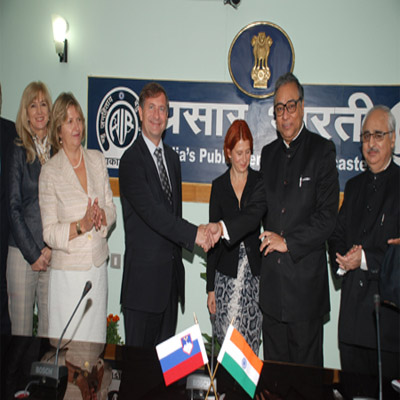
    NEW DELHI: India’s largest broadcasting network, Prasar Bharti has found a potential business partner in Radio-Television Slovenia (RTV SLO). The two got together recently and have agreed to explore further opportunities in potential projects of co-production of programmes along with significant cultural, economic, political, social and festive events in the respective countries.


    A Memorandum of Understanding (MOU) for cooperation in the field of broadcasting was signed between Prasar Bharati and RTV SLO. It aims at trading expertise of each of the broadcasters and entails exchange programmes in the fields of culture, education, science, entertainment, sports, and news on their respective networks, besides provision for personnel exchange and training of staff.


    To sign the deal, a high level delegation that included Slovenia led by Deputy Prime Minister and Minister of Foreign Affairs Karl Viktor Erjavec, along with his team of ministers and officials – Mrs. Darja Bavdaz Kuret, Vlasta Vivod, International Department (RTV SLO) Head Suzana Vidas Karoli, and Boris Jelovsek visited Prasar Bharti.  


    The agreement was signed between Karoli and Prasar Bharati Member (Personnel) Brig (Retd.) V.A.M. Hussain.


    In his speech, Erjavec emphasised the importance of the MoU and said: “In today’s world, TV is the medium with the most significant impact in the life of culture, education, science, entertainment, sports, and news. And I am sure this agreement will bring additional opportunities to strengthen so important people-to-people contacts and bring better understanding of our nations. Your contribution to these strengthened people-to-people contacts and better understanding of our nations will also lead to deepening of cooperation in economic, political, scientific, educational and cultural fields. And we thank you for that.”


    The RTV SLO director GM Marko Filli could not attend the meeting, but he sent across a message that was read out by Karoli. He remarked: “Cooperation between media organisations is crucial for their quality work and development of programmes for the public they serve. New technologies are diminishing the distances that used to be a barrier for cooperation. The world is changing in such a way that not only small media organisations can learn and benefit from bigger ones, but also big media organisations are able to discover new ways of working and possibilities of cooperation with the small ones. At the same time the public is interested in the quality and contemporary content of the programmes and not so much of where the content is coming from.”


    In his message, he also emphasised that the exchange of programmes in the fields of culture, education, science, entertainment, sports and news will help us to broaden content offer and make both parties stronger and more influential in their home lands. “I must point out this cooperation is of great importance especially for Slovenian public service and therefore we look forward for this first operational exchange. As the production of programme is depending more and more on technical knowledge, exchange of programme content can be and will be upgraded with exchange of expertise between personnel and providing the training with technical staff. We can learn from each other and certainly we will benefit from each other. The ultimate goal must always be satisfaction of our public,” he said in the message.


    Prasar Bharati CEO Jawhar Sircar pointed out that India has always given importance to friendship with Slovenia. He stressed that cooperation in exchange of programmes, participation in each other’s cultural events are far more effective tools that enrich the knowledge and perception about nations and that Prasar Bharati would strive to reach the heart of Slovenian people through heightened co-operation as envisaged in the MoU.

    This MoU is directed towards developing and strengthening friendly relations between the two countries through an increased co-operation in the field of broadcasting thus enabling the two countries to share their rich cultural heritage that includes a gamut of events and festivals.

  • Subscribers blame operators for channel packages

    Subscribers blame operators for channel packages

        
    KOLKATA: This year, not only has the economic recession dampened Kolkata’s festive fervour, customers are now complaining about the inability to view their favourite television channels despite opting for them.

    However, before jumping to any conclusions about multi system operators (MSOs) having missed their deadline for offering channel packages, the MSOs maintain they’ve already done the needful. So why then are subscribers cribbing?

    Apparently, a majority of them have filled out customer request forms (CRFs) opting for a fresh bouquet of channels and yet, nothing has changed for them.

    Says Shyamal Sen, a resident of south Kolkata: “I do have a cable connection with a package of Rs 280+Rs 50 (tax), which amounts to Rs 330 per month … but all these packages are only fooling people. I assume my neighbour has taken the Rs 180 package and still enjoys all the channels.”

    Rupa Das from Behala is happy that a couple of channels she had struck off from the list last month have gone off air but is yet to receive her new package.

    On their part, MSOs refuse to take the blame for the plight of subscribers.

    Kolkata has 30 lakh cable homes and nine MSOs, of which, SitiCable controls a substantial share of cable users. The company claims it has introduced packages on time. “We have offered the package and achieved 100 per cent CRF. Around 50,000 subscribers did not submit their forms. It seems those households which have more than one set-top box have not opted for a package for their second one or they are not residing in Kolkata,” says Siticable Kolkata director Suresh Sethia.

    A Hathway Cable and Datacom official too maintains the company has offered channel packages to all its customers and hasn’t received any such complaints so far.

    While Cable Operators Digitalisation Committee Kolkata Association of Cable Operators convener Swapan Chowdhury, reasons that the process could have been delayed with the onset of Durga Puja. According to him, MSOs and operators might take another month to start beaming channel packages. “A lot of back-end technical work still remains before new packages can be beamed,” he argues.

    Similarly, an official from another MSO says since the MSO hasn’t yet collected CRFs from its customers, it plans to beam packages in phases after Durga Puja. “The LCOs will not work this week. Even if I want to offer packages, nothing can be done. Customers have to understand this,” he says.

    Manthan director Sudip Ghosh says customers are going in for need-based packages currently.

    Meanwhile, Namit Dave, a media analyst, is rather candid about the whole thing. He reasons that with the delay in the DAS process, it was apparent that channel packages would not be in place starting 1 October. “Even now in Kolkata, 100 per cent DAS has not been achieved in reality. So there is no question of channel offer,” he shoots.

    If sources are to be believed, nearly 60 per cent of CRFs have been collected in Kolkata. However, festivities have put a spanner in the works and it is likely that MSOs and operators will take some more weeks before they start beaming the channel packages.

  • BBC to boost business coverage with new programmes

    BBC to boost business coverage with new programmes

    MUMBAI: BBC World News and BBC.com plan to boost their business coverage in the upcoming months with new coverage and analysis to give audiences the story behind the headlines at a time of vast economic change.

    Starting this month the BBC will premiere a fresh line up of programmes and online features from London, Johannesburg, Singapore and around the world. From Talking Business with Linda Yueh to Escape from the Boardroom, Africa Business Report to Young and Jobless, BBC World News and BBC.com will deliver the latest on today’s business world to audiences around the globe.

    A world-renowned economist, each week Linda will sit down with big thinkers and news makers to talk about the latest business stories and economic trends; and what they mean not just for companies, but for consumers around the world. Linda will draw on her skill at cutting through the figures and get behind the headlines to make sense of a complex world. Clever discussions, distinctive news packages, and Linda’s analysis will make this show a must-watch for viewers around the globe.

    On the new line-up, Linda Yueh said: “With the vast changes in the global economy, understanding what lies behind the headlines matters more than ever. As part of a wider push to increase coverage of global business and the world economy on the BBC, I am delighted to host a new global business programme that will highlight the key trends that are re-shaping our world. Talking Business with Linda Yueh will focus on what these changes mean for our everyday lives through insightful discussions and interviews with key personalities.”

    Based in Singapore, Linda will travel extensively to cover the main global economics and business news stories. Prior to joining the BBC she was the Economics Editor for Bloomberg Television.

    Also on 5 October, BBC World News will launch Africa Business Report, a new weekly business TV programme, fronted by well-known presenter Lerato Mbele, covering key business stories and trends from across Africa. Africa Business Report will be produced by the BBC‘s new Africa Business unit from its production centre in Johannesburg and will report from across Africa showcasing the latest business trends across the continent, through a mixture of on the ground reports and high profile interviews.

    BBC Global News controller of English Richard Porter said: “Our role as a global broadcaster is to help the audience understand the constantly evolving economic landscape around them. Through in-depth analysis and background explanations, our new business programming on BBC World News and BBC.com takes our audience behind the headlines to get to the root of the stories that shape today’s economy both at home and around the world.”

  • ABP’s Punjabi foray on hold, for now

    ABP’s Punjabi foray on hold, for now

    MUMBAI: Everyone is feeling the pinch of the bad economic conditions in the country and news channels seem to be hit hard by it.

    According to sources, the Punjabi news channel that MCCS was planning to launch has been postponed to sometime in end-2013, due to the difficult phase that the industry is going through Although no date was fixed, sources had told indiantelevision.com, that it would be sometime in September or October.

    “News media is going through difficult and painful times and we are waiting for things to settle down,” says a source from the organisation. ABP already has a foothold in Hindi (ABP News), Marathi (ABP Majha) and Bengali (ABP Ananda).

    The news network had decided to expand into regional languages or Tier II cities as it felt it had saturated the potential in the metros. It had identified Punjabi as the first of the languages that it would launch. Sources in MCCS say that the company is reaping good profits and the delay is due to the overall financial conditions of the genre and the fact that it was still waiting to be granted an uplink license from the ministry of information and broadcasting.

    Recently, Network 18 laid off more than 350 employees and Bloomberg slashed its rolls by 30 as well. Tough times are peeling off the skin from the news sector.

  • The opportunity and challenges of taking Indian TV content overseas: Viacom18 head – distribution & International Business and Sun18 COO- North Gaurav Gandhi

    The opportunity and challenges of taking Indian TV content overseas: Viacom18 head – distribution & International Business and Sun18 COO- North Gaurav Gandhi

    Indian broadcasters earn over Rs 10 billion every year from subscription and advertisement revenues and content sales from the International markets. This number has been steadily increasing over the last decade and should continue to grow.

    Since this revenue source has started making substantial contributions to the bottom line of broadcasters, it is important for all to understand this opportunity and its related challenges in greater details.

    The opportunity of taking Indian television content abroad can be simply explained with the 3 ‘E’s – Enormity of audiences, Emotional link and Economic value.

    Enormity of audiences: The estimates for the NRI and PIO populations range between 25-30 million spread over 100 countries. There are more than 25 countries where the Indian overseas population crosses the hundred thousand (100,000) mark, and close to 60 countries where the population is above ten thousand (10,000) individuals. These numbers make for an attractive business opportunity for broadcasters to tap into this audience base. This becomes even more compelling since the Pareto principle applies here perfectly with the top 20 markets (of the 100+countries where Indians reside) accounting for over 80 per cent of the overseas Indian population, making it relatively easier to reach out to the larger audience pools.

    Even regional content finds dedicated audiences with large linguistic pockets in countries like Malaysia and Singapore (Tamil), the Middle East (Malayalam), Canada and UK (Punjabi) for example.

    Emotional links: Indian content is a very important tool for these communities to connect with their cultural roots. Thus the emotional involvement with Indian content is very high and Indian channels become a ‘must have’ for most of these families, thanks to shared cultural backgrounds.

    Economic Value: The economic opportunity for broadcasters becomes significant as many of these large Diaspora markets have a fairly attractive ARPU (average revenue per user) – especially in the context of what the Indian broadcasters are used to back home. Given such high ARPUs, the license fee per channel (at least for the mainline GECs) in UK, US, Middle East etc can range from $1 per sub to as high as $ 7 per sub (especially on some a-la-carte options). This is a very different scenario from the domestic market (in India) where the consumer currently pays less than $4 for 80-100 channels to the cable operator and only a fraction of that gets passed back to the broadcasters.

    The economics become even more attractive as the incremental costs to expand into overseas territories are largely limited to transport and marketing costs with content costs being minimal – largely because most Indian broadcasters own the content IP around the world for perpetuity (or at least multiple years in case of movies and events, etc)

    However, this opportunity to get incremental revenues is not without its share of challenges. The big challenges impacting this business today are several.

    Competition, clutter and bandwidth constraint: Given the attractiveness of the overseas market, most broadcasters after reaching some level of size, scale or maturity in the domestic market look at expanding operations. However, the platforms (DTH or cable) in most markets cannot dedicate enough bandwidth to distribute all of these services. In many cases the platforms don’t see the need to go beyond offering a few channels and covering only the most critical genres like GECs and Movies. Thus for several channels and especially the late entrants, this reticence is a major entry barrier. And in many markets, very often when platforms add more services to existing packages/bouquets, they are doing so at the same retail price forcing the channels to further divide the revenue pie to accommodate the new players

    Advertising opportunity remains limited: For most Indian broadcasters operating in the international arena, subscription revenues tend to form the larger part of the revenues with the advertising sales revenues playing more of the support role. The key reason for this is the fact that the ‘desi’ channels target only the Diaspora audiences and not the mainstream viewers, thereby limiting the audience base. Given the small base, to keep cost per contact at manageable and affordable levels, the advertising-sales rates are extremely low.

    Secondly as competition grows (and fragmentation increases), the same advertising dollar gets divided. And with the considerable slowdown in the global economy in the last few years and the recessionary trends in many of the large markets for Indian channels, that has also impacted the advertising revenues for the Indian broadcasters.

    Piracy: This remains a huge and ever increasing threat to revenues for both the broadcasters as well as platforms. Internet streaming as well as the proliferation of many illegitimate OTT services poses a huge danger for pay TV revenues.

    The above challenges, along with the growing cost of local operations in many overseas territories, make it a tough task for many broadcasters looking to expand their international operations.

    At Viacom18, in the short span of two years, Colors content has reached audiences in approximately 120 countries using a combination of channel distribution and content sales. For the key markets like the US/Canada, UK, Middle East, South East Asia and Australia/New Zealand/Fiji with their sizeable Indian audiences, we have set up three international feeds and local ad sales operations.

    Colors, as a channel, is now distributed in close to 50 countries. This is complimented by our content sales in those markets where our audiences are the local mainstream audiences and not necessarily the Indian Diaspora. With the popularity of Bollywood transcending language and cultural barriers, more audiences are sampling Indian content which is amply demonstrated by the fact that our content is syndicated in 20 foreign languages in over 100 countries and where one of our leading daily soaps will now be produced locally in one of the African countries for the local audiences there – a first for an Indian show. In addition we are also subtitling our feeds in English and other local languages to cater to these mainstream audiences and bolster our subscription and ad-sales revenues.

    In the final analysis, the challenges notwithstanding, it is essential for mainline Indian broadcasters to have an international strategy in place, the careful execution of which will result in substantial revenues to compliment their domestic businesses.

  • Economic uncertainty will continue to impact consumer mindset: JWT

    Economic uncertainty will continue to impact consumer mindset: JWT

    MUMBAI: JWT‘s center for provocative thinking JWTIntelligence, has released its seventh annual yearend forecast of key trends that will “drive” or “significantly impact” consumer mindset and behaviour in the year ahead.

    Continued economic uncertainty, new technologies and the idea of shared responsibility are driving or at the center of several trends in 2012, the report reveals.

    “With our annual trends forecast, we aim to bring the outside in – to help inspire ideas beyond brand, category and consumer conventions – and to identify emerging opportunities so they can be leveraged for business gain,” JWT director of trend spotting Ann Mack said. “Trends, like any complex and dynamic human phenomenon, are not preordained – once they are spotted, they can be shaped.” 
     
    The 10 key trends are:

    Navigating the new normal: the economy will push brands into opening up more entry points for cost-sensitive consumers as the ‘new normal‘ becomes a prolonged normal in the developed world. Marketers will find new opportunity in creating stripped down offerings, smaller size and otherwise more accessible products and services.

    Live a Little: Faced with constant reminders about what to do (exercise more, eat better) and what not to do (smoke, over spend), and fatigued from several years of austerity, consumers will look for ways to live a little without giving up a lot. People have been exercising more self control, and increasingly they‘re looking to let loose once in a while; indulging in sinful things, splurging on treats and escaping from today‘s many worries.

    Generation go: While twenty something in the developed world feel they‘ve been dealt an unfair deck, there are many who are finding opportunity in economic adversity. Out of continued joblessness or discontent with the status quo will spring an unprecedented entrepreneurial mindset, enabled by technologies that obliterate traditional barriers to entry. A so-called lost generation will transform itself into uniquely resourceful cohort.

    The rise of shared value: Rather than simply doling out checks to good causes, some corporations are starting to shift their business models, integrating social issues into their core strategies. The aim is to create shared value, a concept that reflects the growing belief that generating a profit and achieving social progress are not mutually exclusive goals.

    Food, as the new Eco-issue: The environmental impact of our food choices will become a more prominent concern as stakeholders-brands, governments and activist organizations-drive awareness around the issue and rethink what food is sold and how it‘s made. As more regions battle with food shortages and/or spiking costs, smarter practices around food will join the stable of green ‘best practices‘. 
     
    Marriage optional: A growing gang of women is taking an alternate life route, one that doesn‘t include marriage as an essential checkpoint. Both in the West, where this trend is building, and in the East, where it‘s gaining momentum, ‘happily ever after‘ is being redefined as a household of one, cohabiting or single motherhood.

    Reengineering Randomness: As our individual worlds become more personalised and niche and the types of content, experiences and people we are exposed to become narrower, greater emphasis will be placed on reintroducing randomness, discovery, inspiration and different points of view into our worlds.

    Screened interactions: More flat surfaces are becoming screens, and more screens are becoming interactive. Increasingly we‘ll be touching them, gesturing at them and talking to them-and becoming accustomed to doing so as part of our everyday behaviors. This is opening up novel opportunities to inform, engage and motivate consumers.

    Celebrating Aging: Popular perceptions of aging are changing. People of all ages are taking a more positive view of growing older. And as demographic and cultural changes, along with medical advances, help to shift attitudes, we‘ll redefine when ‘old age‘ occurs and what the term means.

    Objectifying Objects: As objects get replaced by digital/virtual counterparts, people are fetishizing the physical and the tactile. As a result we‘ll see more ‘motivational objects‘, items that accompany digital property to increase perceived value, and digital tools that enable creation of physical things.

    The report predicts that on tech side, more flat surfaces will become screens, and more screens will be interactive-touching them, gesturing at them and talking to them will become part of our everyday behaviors. And as technology makes our individual worlds more personalized and niche-and narrows the types of content, experiences and people we‘re exposed to-greater emphasis will be placed on reintroducing randomness, discovery, inspiration and different points of view into our worlds.

    JWT‘s 10 Trends for 2012 report is the result of quantitative, qualitative and desk research conducted by JWTIntelligence throughout the year. For this report, they conducted quantitative surveys in the US and the UK using Sonar, JWT‘s proprietary online tool. (They surveyed 531 Americans and 524 Britons age 18+ from 31 October to 8 November. Data is weighted by age, gender and income.) They also received inputs from nearly 70 JWT planners across more than two dozen markets, and interviewed experts and influencers across sectors including technology, luxury, social responsibility and academia.