|
India is one of Discovery‘s key priority markets along with Latin America where there is tremendous scope for pay-TV growth.
Bullish about digitisation in India, Discovery has plans to expand its portfolio of channels. The latest addition in the menu: Discovery Kids from the second quarter of this calendar year.
In an interview with Indiantelevision.com‘s Ashwin Pinto, Discovery Networks International president, CEO Mark Hollinger talks about the company‘s growth markets and its expansion plans in India.
Excerpts: |
|
|
How important is India as a growth market for Discovery? |
|
|
Discovery has launched in many genres. When are you launching the children’s channel? |
|
|
Is the timing right given that the kids genre is struggling?
So whether a market is up or down at any point of time doesn‘t matter; there is space for a more education-focussed network like ours. And India, moreover, highly values education. The digitisation process is beginning and is a good opportunity for us. We are not worried about the kids genre business at all. |
|
|
Will the education component be your differentiating element?
The channel will have a healthy dose of entertainment and also satisfy the curiosity of viewers in an entertaining way. The good news is that India is a young country. There are millions of kids below the age of 14 and so the market is big. |
|
|
|
|
The challenge here is that niche channels have to rely excessively on ad revenue. By when do you see subscription starting to contribute in a serious manner?
When we start in a market, there is a 100 per cent affiliate revenue and then we move towards advertising. India obviously is an ad sales market. But it is hard to sit here and say what the affiliate revenue stream is going to be. We can hope that digitisation will affect carriage fees and other things. |
|
|
For the digitisation process to succeed in terms of cut off dates being achieved, what needs to happen?
Forget about fancy things like DVRs. Just to get the infrastructure in place is an enormous challenge. Luckily for us, we can watch it from afar. But once it is in place, then there is an opportunity and sort of a challenge for programmers to take advantage of digitisation. We have done it successfully in other markets. |
|
|
Do you think that the 30 June deadline will be met for the metros? |
|
|
How will digitisation change OneAlliance’s relationship with MSOs?
We have a great team on the ground and great brands. When The OneAlliance was started, there was no digitalisation in India, no DTH. Now that there is DTH, the OneAlliance has only become stronger. |
|
|
Will you now make a concerted effort at marketing yourself to Indian consumers so that they choose you? |
|
|
Discovery is in several languages in India. Could you talk about the importance of localisation? |
|
|
More players are entering the infotainment and lifestyle space in India. Will this cause fragmentation? |
|
|
Discovery spends $1 billion towards programming. Are content investments going to be affected by the global downturn? |
|
|
Which are the main focus areas for Discovery? |
|
|
What is the big challenge you face this year?
I would say that the big challenges are the impact generally of broadband or free platforms like DTT on pay television. Can pay TV penetration continue to grow? In some countries, there are regulatory issues. Some markets like Brazil have become more protectionist as of late in terms of local Brazilian content and local channels being required on packages. The availability of alternative platforms is both a big challenge and a big opportunity. |
|
|
There has been a certain amount of operational restructuring within Discovery like the removal of the COO position. Is the basic aim to be more cost effective? |
|
|
Last year you split Europe into two business units. What prompted this move?
Then you have Central, Eastern Europe and the Middle East and Africa which are much more growth markets. There is still expansion to be done. These are more entrepreneurial markets. So we split along the lines of Western Europe as one unit and then Central, Eastern Europe, Middle East and Africa as another unit. We did not add a region. The international business still has four regions. We just restructured Europe to grow Western Europe and put common markets together. |
|
|
Could you talk about Discovery‘s strategy to penetrate new markets like Colombia?
There is an opportunity in Colombia and it is our fourth biggest market in Latin America. We earlier only used a local representative for ad sales. We opened an office there for the primary purpose of ad sales while offices in Europe were opened for affiliate purposes. |
|
|
In Spain you are free to air. Are you expanding your free to air portfolio?
So now in Germany, Spain and in the UK, we have launched free to air channels. They complement the pay business and are not intended to replace it. They have allowed us to grow at a time when the overall Western Europe pay TV business is not growing. This is harder to do in other markets as there is not a big enough digital terrestrial platform or there are ownership restrictions. |
|
|
In Korea you did a partnership with CMB. Why? |
|
|
How did the JV with Oprah Winfrey for a channel come about?
That is how it happened. We have ambitions for the channel in terms of finding markets internationally for it. Tom is a proponent for markets in the Asia Pacific where he feels that the channel will fare well. Oprah created a lot of buzz when she came down to India. This has also been the case in Australia and in other markets around the region. But we first want it to be well established in the US. |
|
|
Discovery bought Betty in the UK, its first such acquisition of a production company. Are you looking at more such acquisitions? |
Tag: DVR
-

‘India is among our top 10 markets’ : Discovery Networks International president, CEO Mark Hollinger
-
Tivo selects The Kaplan Thaler Group to lead ad efforts
MUMBAI: Tivo which creates television services for digital video recorders (DVRs) in the US has selected The Kaplan Thaler Group to serve as the creative resource for its advertising efforts.
Tivo VP consumer marketing, Katie Ho says, “Our desire to invest in marketing to educate consumers about the clearly differentiated feature set of the Tivo service requires us to develop a broader, more sustained national consumer advertising presence in the coming year. We’re excited to partner with The Kaplan Thaler Group, given their strong strategic thinking, fresh ideas and their exceptional ability to capture the essence of our brand.”
The Kaplan Thaler Group CEO and chief creative officer Linda Kaplan Thaler says, “Tivo is a cultural icon and an incredibly strong brand among American consumers. This is a great, strategic win for us. We have the opportunity to not only work with a group of progressive and creative thinkers, but to apply our unique philosophy to get people to sit up and take notice of Tivo.”
-

Youtube is affecting TV viewing in the US
MUMBAI: Few vehicles are as effective at reaching large segments of the population as television, a fact that has established it as the favored medium for advertisers in many product categories. For as long as that has been the case, however, TV networks and advertisers have been fearful of emerging competitors and technologies that threaten their route into consumers’ minds.
From the remote control to the Digital Video Recorder (DVR), there have long been predictions that live TV and its embedded advertisements were going to be adversely affected by consumers’ ability to bypass commercials. More recently, a different kind of threat has emerged from social networking video site YouTube.
Recent research by Harris Interactive uggests that this fear may indeed be warranted. Over four in 10 (42 per cent) online US adults say they have watched a video at YouTube, and 14 per cent say they visit the site frequently. Almost one in three (32 per cent) of these frequent YouTube users say that they are watching less TV as a result of the time they spend there.
However, YouTube has its own set of challenges as it tries to monetise the viewer traffic it has amassed. If YouTube is considering airing ads before its videos, they may be advised to halt that thinking. 73 per cent of frequent YouTube users say that they would visit the site less if it started including short video ads before every clip.
These are just some of the results of a recent Harris Poll of 2,309 US adults (ages 18 and older), of whom 363 are frequent YouTube viewers, conducted online by Harris Interactive from 12-18 December 2006.
Of all frequent YouTube users, two-thirds (66 per cent) claim that they are sacrificing other activities when on YouTube. Although their visits to the site are most likely to have been at the expense of visiting other websites (36 per cent), time spent watching TV is next most likely to have taken a hit (32 per cent).
YouTube also cuts into email and other online social networking (20 per cent), work/homework (19 per cent), playing video games (15 per cent), watching DVDs (12 per cent) and even spending time with friends and family in person (12 per cent).
Further compounding the problem for the TV and advertising, YouTube usage is greatest among the group already hardest to reach through television advertising: young males. Over three-quarters (76 per cent) of 18 to 24 year old males say they have watched a video at YouTube, and 41 per cent visit YouTube frequently.
Harris Interactive’s Media & Entertainment Practice senior research manager Aongus Burke says, “We know from some of our other data on teens that YouTube is just as popular with them as it is with young adults. It has really emerged as a major force in, and problem for, the traditional entertainment industry. Not only is YouTube using a lot of their own content to steal the eyeballs they want the most, the site has provided a launching pad to wholly new forms of user-generated video entertainment that are gaining popularity quickly.”
However, YouTube faces challenges of its own as it tries to cash in on the house that it has built. When asked if the inclusion of short commercials before every clip would change how often they will visit YouTube, nearly three-quarters of adults who frequently visit the site say they would visit it a lot (31 per cent) or a little (42 per cent) less often as a result.
Burke adds, “To be fair as far as we know, YouTube has never publicly said that they are considering including short commercials before the clips on their site. However, we wanted to see how much resistance there would be at that extreme. Apparently, there is a lot.”
Indeed, in the last year, TV networks have successfully experimented with airing of TV episodes with commercials on their websites. Nearly as many online adults (41 per cent) say they have watched a video at a TV network website as they have at YouTube (42 per cent). It seems like TV networks can get away with advertising more easily.
Burke further says, “Indeed, we have seen in previous data that consumers as a rule are not averse to watching commercials online in order to catch an episode of a TV show they would otherwise miss. Yet those who are accustomed to finding and watching everything for free at YouTube may have developed a very different set of expectations for the site.”
-

NDS, CyberLink to deliver TV entertainment to PCs
MUMBAI: NDS, the leading provider of technology solutions for digital pay-TV, and CyberLink, a world leader in digital home software solutions, have partnered to integrate NDS VideoGuard PC technology with CyberLink’s PowerCinema home entertainment solution for PCs.
PowerCinema supports full TV services including live broadcast channels, digital video recording (DVR) functions, Electronic Program Guides (EPGs), secure content downloads, on-demand services, and Video-on Demand (VOD). By integrating the NDS VideoGuard® technology, PowerCinema enables operators to expand their services to PC owners, and extend their market reach.
The VideoGuard PC solution uses hardware-based security and a USB VideoGuard Key™ to provide a secure way of extending content usage rights beyond the set-top box. The VideoGuard PC solution ensures that you can extend your existing services such as broadcast TV and VOD to PCs. It also maintains secure storage for the ultimate solution of content protection convergence.
“Our partnership with such a ubiquitous PC technology as CyberLink PowerCinema presents a win-win situation for our pay-TV operator customers, PC vendors, and consumers”, said Joseph Deutsch, Vice President of Product Marketing, NDS. “Because VideoGuard combines CA and DRM to protect TV services as well as the licensing and content rights, operators can rely on secure content transfer between DVRs, PCs, and Portable Media Players (PMPs). Users can therefore enjoy their high-definition content on their PCs along with the flexibility to move it to PMP devices or CDs without compromising the content owner’s rights.”
Alice H. Chang, CEO of CyberLink added: “CyberLink PowerCinema offers a complete TV solution for enjoying high-definition digital TV from satellite, cable and IPTV service providers. By working with NDS to integrate VideoGuard PC, we now support the world’s leading conditional access technology for premium pay-TV content. This collaboration delivers an extremely valuable solution for PC companies and pay-TV operators who can now expand TV’s reach onto a new PC platform within the digital home.”
“We are delighted to integrate VideoGuard PC into PowerCinema” continued Chang. “We have decided to partner with NDS, a company that has the industry’s best track record for conditional access and digital rights management. This ensures that pay-TV operators will see our “Cyberlink inside” PCs as a natural extension to their network and provide subscribers the freedom to enjoy the best services and content beyond the living room”.
This solution for the PC market follows NDS’s earlier integration of VideoGuard Mobile and Electronic Service Guide (ESG) with CyberLink’s Mobile DTV player, enabling any pay-TV operator to provide a true end-to-end secure multi-platform, multi-network service.
-

‘Fall in STB prices make digitisation affordable in low ARPU countries.’ : Dr. Abe Peled – NDS chairman & CEO
With conditional access system (Cas) coming in next year and DTH already in, the time is right for television technology firms to take a serious look at India. One such firm is NDS, which provides technology solutions for digital pay-TV. It has opened a dedicated sales and support operation in Mumbai. Indiantelevision.com’s Ashwin Pinto caught up with NDS chairman and CEO Dr. Abe Peled for a lowdown on the company’s plans and the emerging digital age.
Excerpts:
For NDS, DTH is a high revenue earner. How is the company gearing up to new delivery technologies, particularly at a time when investments are coming into IPTV and growth in DTH subscribers is slowing?
The market for satellite is getting competitive and complex because of triple play. We have 70 per cent of our revenues coming from DTH. We expect our growth in this area to stay strong as DTH service providers are going in for advanced technologies. We will benefit not primarily from subscriber growth but because of penetration of new technologies. We, for instance, have shipped 4.2 million digital video recorders (DVRs) and there is a scope for explosion in this segment as prices drop. But we realise that IPTV is also offering opportunity and have 14 different contracts including Yahoo in Japan which has 200,000 subscribers.
You have just acquired for $107.5 million Jungo Ltd. which is a leading provider of software for residential gateways. Will this help you penetrate the broadband television market?
It will definitely help us better serve the telecom network operators to offer reliable video over broadband services. We are looking at acquisitions in the IPTV and mobile space even as pay-TV operators are looking at different delivery platforms.
With Cas coming in next year and DTH already present, how is NDS tapping the growing opportunity in India?
We actually started selling our products in India three years back with Hathway Cable & Datacom. The reason why DTH and Cas are coming in now is that the technology is sufficiently inexpensive to be able to be used even in countries where subscriber revenue is a few dollars each month. The first set-top box (STB) launched by DirecTV in the US cost $700. But now the cost of the STB is below $50. Also, the cost of digital compression has fallen. All this makes digitisation affordable in countries which have low ARPUs (average revenue per user). China and India are key growth markets for us.
NDS is seen as a high-cost encryption system. Do you have a pricing strategy for the low ARPU countries like India?
We have a product called VideoGuard which addresses this issue. There is a myth spread by our competitors that we are not affordable. We are very competitive and cable operators will have to take a long term view. It is not the Cas mandate that they have to service but also look at interactive features. Besides, we see a consolidation take place in the cable TV industry here.
DTH has grown wherever there has been premium content. How do you see the Indian DTH market evolve?
I have a word of caution. While we would like to supply technology to lots of people, the experience is that in satellite very few places have room for more than one player; it is just not cost effective. In France, the two operators merged this year. The US has two operators as it is a large country. So maybe India will follow the US. But surely there can’t be space for so many players who have expressed their intent to join the fray. Exclusive content is also not allowed and the sectoral cap on DTH of 20 per cent stake by broadcasters can seriously hamper big capital coming into the business. But Tata Sky is off to a good start. And with DVR prices falling, we see it as an incentive to push digitisation.
Are you in talks with the major telcos like Reliance Infocomm for IPTV?
We are looking at expanding business in India and are in talks with several companies. But I can’t give any specific details. We have opened office in Mumbai specifically for this purpose.
Are you also ramping up the research and development facility in Bangalore?
We have almost 600 people in our Bangalore lab and are still hiring. We have just moved into our new office premises which can house double the capacity we are operating in now. Bangalore is a key part of our research and development operations. The EPG (electronic programme guide) was developed out of here and the middleware was adapted for our two clients, Tata Sky and Hathway, in India.
What are the challenges that lie ahead for NDS?
As the media landscape changes, pay TV operators are facing more competition. There are new modes of delivering and distributing content that perhaps bypass traditional avenues. Our challenge is firstly to help our pay TV customers embrace new technologies and broaden the entertainment experience that they offer. At the same time, we want to work with telecom firms or people who want to distribute content directly to the PC or are keen to get into triple services play. We will be an enabler in this changing, fluid media landscape.
How has NDS been able to quickly identify consumer tastes and preferences with evolving technology?
While consumers are not our direct customers, our success critically depends on them enjoying the entertainment experience. For example, in the early days of interactive television the first instinct was to say that we will allow consumers the technology to access the web to view television. We did not do that, as we understood that is not the case. We, instead, moved towards enhancing the television experience, which means interactive sports and other programmes. Companies came to us wanting to sell stuff through interactive TV. MTV wanted to sell music CDs. But we learned quickly that there isn’t a good enough business model to do that. The margins are not enough after you account for all the costs. We focussed on things that allowed channels to increase their viewership share like interactive quizzing. This way they could hike their ad rates. One of the key lessons was that T-commerce does not really work. We are working with Nickelodeon in the UK for games that you can overlay onto the programme.
There is something called Pie in the face. So if you score enough points you can throw pie on an actors face. These things enhance the television experience.
Is there a resistance from consumers for digital TV?
The only resistance from the consumer is the price. They appreciate what the DVR and EPG have done. Price is determined by two factors. One is the absolute cost of the technology, which is coming down. Second is the business model of the operator. Will they bundle the cost into subscription and spread it out over several years or expect consumers to pay upfront? That is what dictates the rate of adoption. If the payment asked for upfront is modest, the adoption is quite quick. If the upfront is higher, the adoption is slower.
What are the key markets for NDS in terms of revenue?
The US accounts for 35 per cent of our revenues while 20 per cent comes from the UK. Asia is about 11 per cent. Our hope is that in five years time Asia will contribute at least 20 per cent. Last year in China, one million STBs with our technology were deployed in Shenzhen. This year we expect three million deployments.
‘Market for DTH service providers is getting competitive & complex because of triple play‘Has China been a more difficult market to penetrate vis-a-vis the rest of Asia as you need to show demonstrable commitment and the fact that the Chinese government takes a personal interest in how TV technology develops?
The Chinese government takes an active interest in content. I don’t think that it takes a greater interest in technology than governments in other countries. We have a small development lab in Beijing as we are committed to it. The challenge is that there is no premium content that an operator can offer. So digitilisation is a result of government initiatives rather than a demand from consumers for getting more premium content. NDS has contracts with the larger Chinese provinces.
How is NDS coping in the face of competitors like Kudelski and Irdeto?
In terms of scale, NDS has 66.6 million STBs deployed worldwide. Irdeto has two to three million. Kudelski, a Swiss firm, is our main rival but we are ahead. The fact that we have so many deployments gives us the scale to invest in research and development. That enables our technologies to be more sophisticated and secure.
Secondly NDS has a much broader offering for pay TV operators. While conditional access is necessary, you have other technologies like interactivity and games. None of our competitors have this broad range of technological capabilities. It is not just about providing Cas but also about providing an enhanced experience. We are at much better place to do that vis-avis our competitors. Our competitors can offer price but we are competitive there as well.
NDS recently was ranked as the top research and development investor among all UK-based software companies. Could you talk about your R&D centers and their importance?
We believe in being a leader in television technology. We spend over 30 per cent of our revenues on research and development. We have centres in Israel, UK, Bangalore, France, Korea, US etc.
Is NDS also working in the mobile sphere which allows for content viewing anytime, place?
We have a DVB H system that we are doing trials with. Korea is the most advanced country in terms of mobile deployment. We are doing a trial there with WiFi Hotspots. If you go into that Wi Fi it will pick up different channels that you can watch by streaming.
Finally what are the major changes you see in the digital television landscape five years from now in India and Asia?
A large percentage of homes will have a box. It will offer interactive TV. A percentage of that will be DVR I would hope at least eight per cent. A similar percentage will have broadband capabilities. I am not sure about the potential of High Definition. It will be a small percentage.
-

Most DVR homes in the US play recorded primetime content within two days
MUMBAI: Among television households with digital video recorders (DVRs) in the US, more than 78 per cent of all viewers who watch recorded broadcast primetime shows within a week play them back within two days. 84 per cent of them play them back within three days.
That is one of the findings from recent analysis of DVR playback viewing by Nielsen Media Research, for the week of 25 September.
TAmong viewers age 18-49, 76% played back broadcast network primetime programs within 48-hours. During the same time period, 84% watched primetime shows they recorded off advertiser-supported cable networks; and 85% viewed time-shifted syndicated shows within two days. By the third day, those percentages rose to 84% for primetime broadcast, 90% for primetime cable and 91% for total syndication.
Nielsen Media Research senior VP planning and analysis Pat McDonough says, “The TV landscape is changing rapidly, and as consumers increasingly decide for themselves when to watch their favorite shows, Nielsen will establish new means to track their behaviour.
“This latest analysis allows clients to better understand how DVR playback affects viewing over seven days. It will enable us to work with clients to determine the most appropriate way to incorporate this data into our measurements.”
Nielsen says that viewers age 18-49 constitute the largest targeted buying group within the television industry. Other key findings with respect to DVR playback of primetime programming among persons 18-49 reveal that:
Among all households age 18-49, 2.6 per cent of viewing time is DVR playback, but among households with DVRs, 22.9 per cent of all primetime minutes viewed are via DVR playback.
Among total minutes of primetime programming viewed by households with DVRs within seven days, the percentage that is played back from DVR is:
Broadcast Networks: 41.1 per cent
Ad-Supported cable: 17.9 per cent
Syndication: 14.1 per cent -
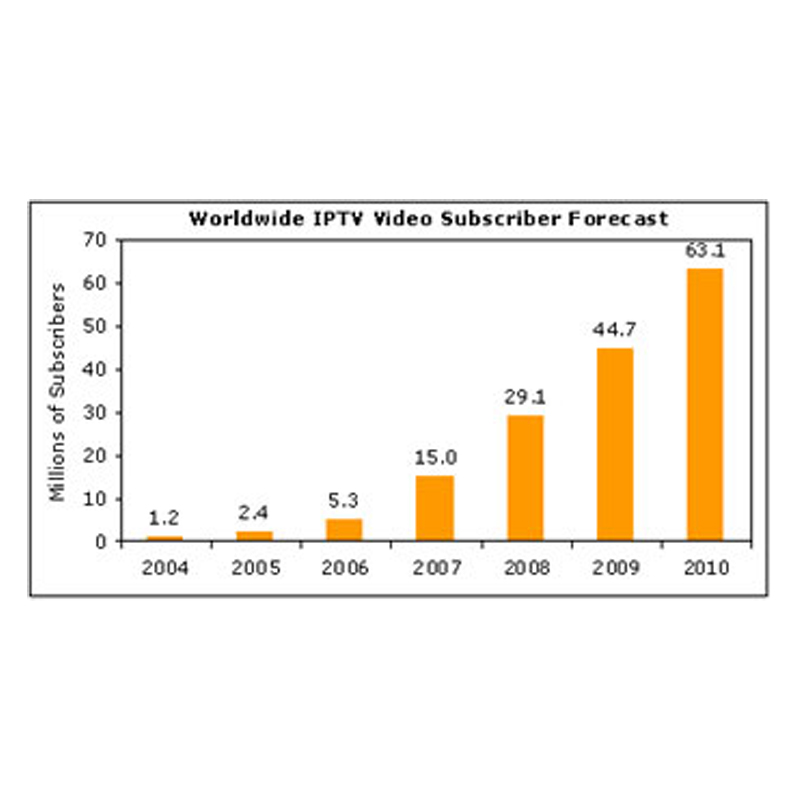
IPTV subscriber base set for explosive growth: iSuppli
MUMBAI: The worldwide subscriber base for Internet Protocol Television (IPTV) services is expected to expand by a factor of more than 26 from 2005 to 2010, spurring a competitive battle between video providers both old and new, iSuppli Corp. predicts.
Global IPTV subscribers will grow to slightly more than 63 million in 2010, rising at a stunning Compound Annual Growth Rate (CAGR) of 92.1 per cent from 2.4 million in 2005, as presented in the figure below.
The IPTV subscriber base will generate more than $27 billion in overall IPTV services revenue in 2010. While video services will account for the largest portion of these dollars, value-added media services and IPTV operator advertising will combine to represent more than 14 per cent of IPTV services revenue in 2010. Furthermore, across all IPTV services, the corresponding content licensing revenue will reach $11 billion in 2010.
“The fight to capture the expanding base of IPTV subscribers will put telecom operators on a collision course with existing pay-TV market competitors and with a new class of broadband video portals as they roll-out progressively more sophisticated offerings,” said iSuppli vice president multimedia content and services Mark Kirstein.
iSuppli categorises market deployment of IPTV services in three phases. The current global IPTV market is early in its first phase: basic service deployment. The second phase will add an array of value-added and interactive services. Phase three will bring dramatic improvements in integration and interactivity.
Thus, in this pending battle for subscribers, providing a competitive video offering is merely the cost of entry for IPTV operators. Differentiation of IPTV services will be essential to bringing new capabilities to TV-based entertainment and attracting subscribers.
Areas of differentiation will include:
Interactivity, such as communication, community, voting, interactive advertising and television commerce (t-commerce).
Integration across multiple platforms, across voice and data services and across content types, i.e. video, voice, music, gaming, data services and user content.
Personalisation, including intelligent TV recommendations, individualised advertising and non-linear video programming, such as Video on Demand (VoD) and Digital Video Recording (DVR).Value-added services, including on-demand gaming, music, media applications, home networking management, security and data.
Beyond the video service providers themselves, an array of companies will benefit from new opportunities arising from their roles as the “arms suppliers” for the battle over the next generation of television distribution. These companies include infrastructure gear manufacturers, set-top box makers, software vendors and semiconductor suppliers, iSuppli predicts.
On a geographic basis, the European market has taken the early lead in the global IPTV market, both for subscribers and for revenue. However, Asia will generate faster growth than the other regions and will achieve the largest subscriber base by the end of this year. The Americas region will lead the world in terms of IPTV dollars starting this year because it will yield the highest Average Revenue Per User (ARPU).
-

US adults with DVR’s belong to upscale and print-oriented group: Study
MUMBAI: US adults whose households have a digital video recorder (DVR) are more upscale than those that do not and are more likely to be heavy readers of magazines and newspapers and are also heavy users of the Internet.according to the latest data from Mediamark Research Inc.,(MRI).
According to the Fall 2005 MRI data release, 8.6 per cent of US adults reported having a DVR in their household. That percentage rose to 11.2 per cent of adult households in the Spring 2006 release. The survey period for this release was March 2005 to early May 2006.
The spring 2006 data show that 36.8 per cent of adults with DVR’s have a college education and 17.1 per cent have average household income exceeding $150,000. Within the entire adult population, 25.2 per cent graduated college and 8% have an average income exceeding $150,000, states an official release issued by the research firm.
Of adults with DVR’s in the household, 15.7 per cent have home values exceeding $500,000 compared with 9 per cent of the entire adult population.
In terms of media usage, adults in DVR households are 43 per cent more likely to be heavy readers of magazines (defined as the top quintile of users, based on number of magazines read) than the general adult population. They are 40% more likely to be heavy readers of newspapers (defined as the top quintile of readers, based on number of newspapers read) than the general population.
Adults in DVR households also tend to use the Internet more than households without DVR’s, as they are 81 per cent more likely to be heavy Internet users (the top quintile of users based on number of times used in a month) than the general population, the release adds.
On the other hand, adults in DVR households tend to watch less TV than households without DVR’s; they are 23 per cent less likely to be heavy TV viewers (the top quintile of users based on number of one-half hours viewed per week) than is the general adult population.
-
TiVo and DirecTV extend relationship for three years
MUMBAI: The creator and a leader in television services for digital video recorders (DVR) TiVo Inc., and digital television service provider DirecTV, Inc. announced a three-year extension to the TiVo-DirecTV commercial agreement.
Existing DirecTV TiVo subscribers will be able to continue to receive the TiVo service, with TiVo providing ongoing maintenance and support. In addition, TiVo and DirecTV agreed not to assert patent rights against the other. The agreement also extends the advertising relationship between the two companies. DirecTV will continue to service existing DirecTV receivers with TiVo service. While specific financial terms of the agreement were not disclosed, the recurring monthly economics of the agreement are similar to the economics for DirecTV receivers with TiVo service activated since 2003.
“We are pleased to have reached an agreement with DirecTV that will allow us to continue to provide our service to the more than 2 million DirecTV TiVo households. As the pioneer in the DVR market, we have created a service that is highly valued by consumers because of our technology, the wide range of our unique features and the unparalleled ease of our user experience. This agreement reflects TiVo’s popularity among DirecTV subscribers and importantly respects the value of our intellectual property as well,” said TiVo CEO Tom Rogers.
“By extending our agreement with TiVo, we are ensuring quality support for DirecTV customers who already own a DirecTV TiVo unit. We are pleased to cooperate with TiVo in a way that will best serve DirecTV and our DirecTV TiVo customers,” said DirecTV chief technology officer Romulo Pontual.
-

Motorola makes TV shows available from DVR to mobile phone
MUMBAI: Expanding on the Follow Me TV experience of room-to-room media sharing, Motorola, Inc. will demonstrate a new technology that can move recorded shows from a Motorola digital video recorder (DVR) set-top directly to a Motorola mobile device like the next-generation RAZR V3x.
This new ability to move content can expand Motorola’s existing whole-home video platform to meet the video needs of consumers anywhere and everywhere.
A live demonstration of this new feature will be on display at both the CTIA Wireless 2006 and the 2006 National Show. The explosion of digital video technologies in recent years is leading the demand for ever-greater control over TV at home and on the go.
Starting with a Motorola set-top, consumers can now create a multimedia network that sends content not only to other rooms in the home, but to mobile devices with storage-card capacity. In addition, Motorola mobile devices can be used to program a Motorola DVR remotely. No more worries about forgetting to record your favorite show – control your television wherever you are.
“By combining the reliability and clarity of Motorola video products with the style of Motorola cell phones, we can deliver a truly personalized television experience. Consumers get the chance to enjoy seamless, mobile entertainment, and service providers get the opportunity to extend their reach beyond the home,” said Motorola corporate vice president and general manager of digital video solutions John Burke.
The full Follow Me TV experience is enabled by Motorola DVR set-tops and the company’s OCAP software solution. This software solution includes powerful tools designed to offer home media networking using the Multimedia over Cable Alliance (MoCA) standard.