Tag: DVB

  • DVB to showcase future of media delivery at DEMOS 2020

    DVB to showcase future of media delivery at DEMOS 2020

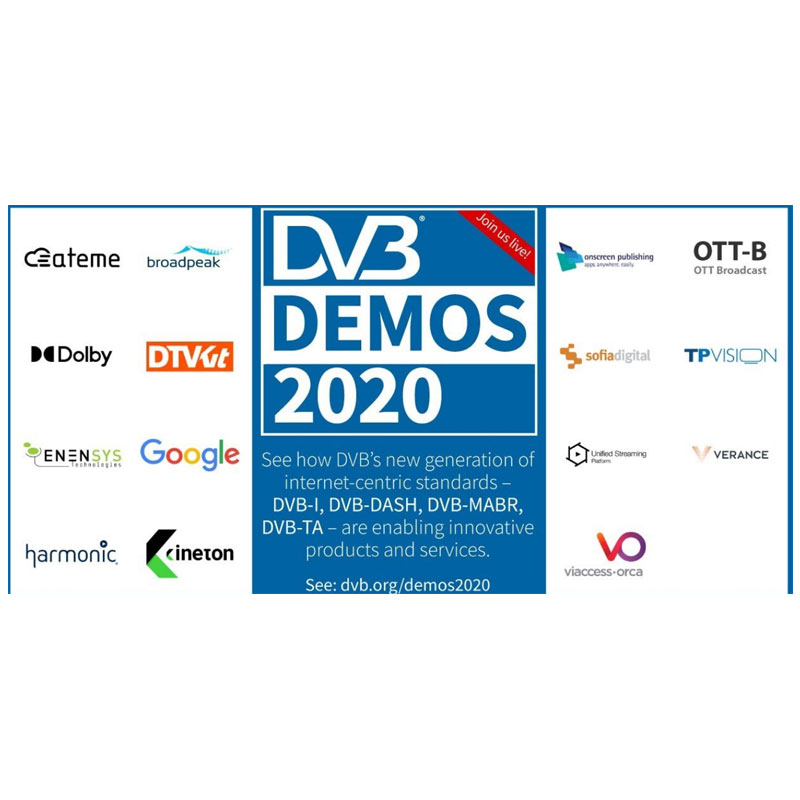
    GENEVA: DVB, a consortium of the world’s leading media and technology companies working together to design open technical specifications for digital media delivery, will host DVB DEMOS 2020, an all-day online event on Thursday, 26 November. The event will bring the industry together to witness the future of media delivery. Fifteen different exhibitors will participate in DEMOS 2020, showcasing products and services based on the latest generation of internet-centric specifications from DVB, comprising DVB-I (including DVB-DASH), DVB-MABR and DVB-TA.

    "In recent years, DVB's focus has shifted to addressing the challenge of fragmentation in IP-based media delivery technologies," said Emily Dubs, head of technology at DVB. "DVB DEMOS is the first time we'll bring together such a broad cross-section of vendors, all using our next-gen specifications. The aim is to showcase how hybrid and broadband delivery can benefit from the reliability and robustness that defined the success of digital television while opening up new possibilities for innovative services."

    Technology demos followed by one-on-one meetings with vendors

    DVB DEMOS will kick off with a live stream featuring a series of short technology demonstrations, viewable on the DVB DEMOS 2020 web page and on DVB's YouTube channel. Attendees also have the opportunity to book appointments for more in-depth demos and discussions in private online meeting rooms. Exhibitors will include ATEME, Broadpeak, Dolby, DTVKit, ENENSYS Technologies, Google, Harmonic, Kineton, OnScreen Publishing, OTT Broadcast, Sofia Digital, TPV Technology, Unified Streaming, Verance and Viaccess-Orca.

    DVB DEMOS will show how DVB-I serves as a common media layer across a variety of delivery channels, providing end users with a seamless experience. Another key highlight will be how DVB-DASH and DVB-MABR enable scalable low-latency streaming on par with broadcast services. The first solutions based on DVB-TA will also be exhibited, showing how targeted advertising opens the door to new revenue streams for broadcasters. Additionally, attendees will get a first-hand look at how broadcast services can be easily integrated within IP-based platforms.

    Many of the demos will bring into play collaboration between the exhibitors, illustrating the interoperability that is a cornerstone of DVB's approach. Different combinations of streams, service lists, clients and players will be highlighted to show how a standards-based ecosystem increases the possibilities for innovation.

    DVB DEMOS 2020 is free to attend. Registration is required to join the afternoon session and to book appointments with exhibitors.

    DVB DEMOS will start at 10:00 CET on 26 November. To see the full DVB DEMOS schedule, visit https://dvb.org/demos2020. For more information about DVB, visit www.dvb.org.

  • Content piracy making b’casters invest in good tech for security: Tata Communications VP Brian Morris

    Content piracy making b’casters invest in good tech for security: Tata Communications VP Brian Morris

    Somebody had aptly said that a new development brings along with it not only benefits, but also various downsides. If technology is opening up new frontiers of content delivery to consumers, the menace of content piracy too is rising globally. So, it’s almost always a race against time to find neutralizers to a menace like piracy for content owners and technology & security companies. 

    And, Tata Communications is one such company that not only helps its customers deliver content, but also does continuous research in safety methods. That’s just one of the many reasons why the company continually makes major investments in building and improving state-of-the-art global communications network. One such example of investments is the $1.19 billion spent on the company’s global subsea fibre network — the company claims it is one of the world’s largest and most advanced —- that covers 700,000 km or more than 17 times around the world; the only Ethernet ring serving the Middle East; more than 400 points of presence on five continents, apart from ownership and operation of over 1 million sq. ft. of data centre space in 44 locations worldwide.

    In an interaction with Indiantelevision.com, Tata Communications VP and GM – Global Media and Entertainment Services Brian Morris holds forth on various aspects of content delivery, tackling content piracy and the need to have a good technology partner for broadcasters.

    Excerpts:

    As broadcasters deliver content on multi-platform like social media and OTT, how can they ensure that they have the highest levels of content security integrated within the core of their business operations and across various delivery platforms?

    Today, content owners, enabled by technology providers, are taking control in a world where the viewing patterns of consumers are dramatically changing due to advances in mobile and flexible content provisioning. The broadcasting counter-revolution is about staying ahead of the game and providing viewers with the platforms and services that give them more control when it comes to dictating their own viewing experiences.

    For broadcasters and Over the Top (OTT) and streaming network providers, this means enabling content to be delivered via non-traditional distribution channels, to support on-demand and catch-up services that allow viewers to watch whatever content they want, whenever they want, on any device.  It is also enabling the disruption of regionalization and rights management as content owners seek to extend reach and distribute their content on a global basis.

    Hence, emergence of OTT and streaming players and growing adoption of various smart devices, in an increasingly growing connected world, has forced pay-TV operators to offer their content on multiple networks and multiple devices. This gradual transformation has led to roll out of parallel systems requiring adoption of multiple service delivery and content security platforms resulting into management complexities.

    To manage the multi-service / multi-platform environment, media service providers need to adopt unified security approach to meet security requirement on any device and any type of content (live or on-demand). Below are the key trends in unified content security space:

    # Single security client combining CAS (conditional access systems) and DRM (digital rights management) functionalities to support DVB, IPTV STB and OTT based media distribution

    # Adaptive security solutions compatible with any devices (including device with HWRoT, Open STBs like Android STB, Legacy STBs without HWRoT and Open CE devices)

    # Security solutions to meet requirements for enhanced content (UHD, HD HDR, early release content) – MovieLabs , an R&D JV of six major motion picture studios, has come with new content security ECP guidelines

    # Security solutions to support open consumer devices – software based security solutions compatible with customer owned devices.

    Is forensic watermarking a step in the right direction when it comes to content security?

    It is the prerogative of content owners to do any kind of watermarking. We, at Tata Communications, are fully supportive and capable of carrying any watermarking through our infrastructure. Forensic watermark is a great help when it comes to content security. It offers a range of benefits to broadcasters and content providers and some of them are the following:

    # Single solution to fight against content redistribution across the value chain– For the content owner, the source of leak can be found out; while for the licensee, session-based watermarking enables them to identify which OTT account or smart card the pirate stream is originating from.

    # Lower total cost of ownership with easy deployment and scalability – all consumers (irrespective of the device they use) receive watermarked content, and not just those users who own watermarked enabled devices.

    # Fast time to market on deployed devices and existing workflows – there is no need for specific client side hardware, which makes it easier to deploy to existing devices.

    # Renewable, robust security based on a centralized design – central architecture is more secure, in order to make it impossible for pirates to exploit the client device and easy to renew if a breach occurs.

    The main limitation of forensic watermarking technology is the occasional occurrence of false positives in which legal copies of a document, image, video or program are tagged as unauthorized. Forensic watermarks have gained acceptance in the software and digital video industries. Other applications in which the technology holds promise include digital music and electronic books (e-books).

    With the rise of number of OTT platforms in India, are the players taking security breach or its possibility seriously as Indian security systems generally tend to be lax?

    A mega-trend noticed in the broadcasting industry in India is the rise in non-traditional content viewing and distribution. With the growing adoption of smart devices and the millennial audience of the country, with 50 per cent of the population under the age of 25, looking to consume videos on-the-go, the video-on-demand is on an exponential growth. This growth has raised a number of concerns around public safety and privacy issues, both at an organizational and a national level.

    OTT players are, therefore, looking to adopt a unified security approach that can meet the security requirement on any platform and any region. An important change noticed amongst the Indian broadcasters is the investment made in technology partners who can keep up with the demand of maximum uptime, reach and security. A strong network player can carry the content applications securely and smoothly. 

    Do you feel that the level of piracy of Indian content within and outside India is growing?

    Piracy has become a major issue for broadcasters globally. One example of this would be the final episode of Game of Thrones’ season five in 2015; it was illegally downloaded 1.5 million times before it had even aired. This shows that there is a complete breakdown of geographical boundaries and India is seeing a boom in online piracy too. The recent addition of Netflix and other big OTT players in the country is an additional reason of worry for the industry. 

    According to a study conducted by Evisional and America’s Motion Pictures Association (MPA), Indians form the largest group to download Indian copyright content from torrent sites. So, broadcasters are not only looking to harness the power of non-traditional distribution methods to get their content to the consumer, they also face a battle to decrease illegal broadcasting.

    If piracy is a growing phenomenon, are Indian broadcasters and content owners really alive to the problem and taking safety measures or these are just ad hoc moves? 

    The biggest challenge for broadcasters is: how do they make content available to global audiences in real-time and in different file formats ranging from HD TV, to tablets and smartphones to protect their content and minimize piracy? Cases like the Game of Thrones are a wake-up call. While there is no foolproof way to completely block content piracy, but iinnovative broadcasting organizations are increasingly looking to fibre to run their content on. The readily available bandwidth of fibre enables the transport of live video in higher resolutions, with more security and more potential for customization than other methods. Fibre is also ideal for moving large video files.

    Content transcoding and delivery technology in the cloud is also making headway. It enables broadcasters to move content files to the cloud and transcode them into broadcast quality formats ready for immediate transmission and secure delivery to selected destinations. This means that it is possible to make authorized content available for simulcast in HD format. with the aim of helping broadcasters and content creators transcode media files into broadcast quality formats ready for immediate delivery and transmission globally. This drastically reduces the delivery time compared with traditional solutions that rely on the physical transport of media, meaning the time to view can be reduced across all regions.

    Considering that Tata Communications also operates in APAC region, how seriously piracy is taken by players in that region?

    According to a recent report by digital TV research, OTT TV and video revenues for 17 countries in the Asia Pacific region will reach $18,396 million in 2021. Another finding shows that Game of Thrones has been crowned as the most pirated television show for a few years with data collected from the first 12 hours during season six’s premiere episode showing that India stood as the second country in top downloads. Content piracy clearly ignores geographical boundaries and the unauthorized distribution of premium content is here to stay. 

    However, with the entry of global players like Netflix, RedBull Media House, OTT players are realizing that content offering and content security are two important factors that will help them differentiate from each other. A technology partner that can help with their global distribution requirements over a secure network is becoming a need. Tata Communications’ partnership with Red Bull Media House or distribution of live Formula1 races over Sky television are some of the recent partnerships we have seen as a result of these requirements.

  • Content piracy making b’casters invest in good tech for security: Tata Communications VP Brian Morris

    Content piracy making b’casters invest in good tech for security: Tata Communications VP Brian Morris

    Somebody had aptly said that a new development brings along with it not only benefits, but also various downsides. If technology is opening up new frontiers of content delivery to consumers, the menace of content piracy too is rising globally. So, it’s almost always a race against time to find neutralizers to a menace like piracy for content owners and technology & security companies. 

    And, Tata Communications is one such company that not only helps its customers deliver content, but also does continuous research in safety methods. That’s just one of the many reasons why the company continually makes major investments in building and improving state-of-the-art global communications network. One such example of investments is the $1.19 billion spent on the company’s global subsea fibre network — the company claims it is one of the world’s largest and most advanced —- that covers 700,000 km or more than 17 times around the world; the only Ethernet ring serving the Middle East; more than 400 points of presence on five continents, apart from ownership and operation of over 1 million sq. ft. of data centre space in 44 locations worldwide.

    In an interaction with Indiantelevision.com, Tata Communications VP and GM – Global Media and Entertainment Services Brian Morris holds forth on various aspects of content delivery, tackling content piracy and the need to have a good technology partner for broadcasters.

    Excerpts:

    As broadcasters deliver content on multi-platform like social media and OTT, how can they ensure that they have the highest levels of content security integrated within the core of their business operations and across various delivery platforms?

    Today, content owners, enabled by technology providers, are taking control in a world where the viewing patterns of consumers are dramatically changing due to advances in mobile and flexible content provisioning. The broadcasting counter-revolution is about staying ahead of the game and providing viewers with the platforms and services that give them more control when it comes to dictating their own viewing experiences.

    For broadcasters and Over the Top (OTT) and streaming network providers, this means enabling content to be delivered via non-traditional distribution channels, to support on-demand and catch-up services that allow viewers to watch whatever content they want, whenever they want, on any device.  It is also enabling the disruption of regionalization and rights management as content owners seek to extend reach and distribute their content on a global basis.

    Hence, emergence of OTT and streaming players and growing adoption of various smart devices, in an increasingly growing connected world, has forced pay-TV operators to offer their content on multiple networks and multiple devices. This gradual transformation has led to roll out of parallel systems requiring adoption of multiple service delivery and content security platforms resulting into management complexities.

    To manage the multi-service / multi-platform environment, media service providers need to adopt unified security approach to meet security requirement on any device and any type of content (live or on-demand). Below are the key trends in unified content security space:

    # Single security client combining CAS (conditional access systems) and DRM (digital rights management) functionalities to support DVB, IPTV STB and OTT based media distribution

    # Adaptive security solutions compatible with any devices (including device with HWRoT, Open STBs like Android STB, Legacy STBs without HWRoT and Open CE devices)

    # Security solutions to meet requirements for enhanced content (UHD, HD HDR, early release content) – MovieLabs , an R&D JV of six major motion picture studios, has come with new content security ECP guidelines

    # Security solutions to support open consumer devices – software based security solutions compatible with customer owned devices.

    Is forensic watermarking a step in the right direction when it comes to content security?

    It is the prerogative of content owners to do any kind of watermarking. We, at Tata Communications, are fully supportive and capable of carrying any watermarking through our infrastructure. Forensic watermark is a great help when it comes to content security. It offers a range of benefits to broadcasters and content providers and some of them are the following:

    # Single solution to fight against content redistribution across the value chain– For the content owner, the source of leak can be found out; while for the licensee, session-based watermarking enables them to identify which OTT account or smart card the pirate stream is originating from.

    # Lower total cost of ownership with easy deployment and scalability – all consumers (irrespective of the device they use) receive watermarked content, and not just those users who own watermarked enabled devices.

    # Fast time to market on deployed devices and existing workflows – there is no need for specific client side hardware, which makes it easier to deploy to existing devices.

    # Renewable, robust security based on a centralized design – central architecture is more secure, in order to make it impossible for pirates to exploit the client device and easy to renew if a breach occurs.

    The main limitation of forensic watermarking technology is the occasional occurrence of false positives in which legal copies of a document, image, video or program are tagged as unauthorized. Forensic watermarks have gained acceptance in the software and digital video industries. Other applications in which the technology holds promise include digital music and electronic books (e-books).

    With the rise of number of OTT platforms in India, are the players taking security breach or its possibility seriously as Indian security systems generally tend to be lax?

    A mega-trend noticed in the broadcasting industry in India is the rise in non-traditional content viewing and distribution. With the growing adoption of smart devices and the millennial audience of the country, with 50 per cent of the population under the age of 25, looking to consume videos on-the-go, the video-on-demand is on an exponential growth. This growth has raised a number of concerns around public safety and privacy issues, both at an organizational and a national level.

    OTT players are, therefore, looking to adopt a unified security approach that can meet the security requirement on any platform and any region. An important change noticed amongst the Indian broadcasters is the investment made in technology partners who can keep up with the demand of maximum uptime, reach and security. A strong network player can carry the content applications securely and smoothly. 

    Do you feel that the level of piracy of Indian content within and outside India is growing?

    Piracy has become a major issue for broadcasters globally. One example of this would be the final episode of Game of Thrones’ season five in 2015; it was illegally downloaded 1.5 million times before it had even aired. This shows that there is a complete breakdown of geographical boundaries and India is seeing a boom in online piracy too. The recent addition of Netflix and other big OTT players in the country is an additional reason of worry for the industry. 

    According to a study conducted by Evisional and America’s Motion Pictures Association (MPA), Indians form the largest group to download Indian copyright content from torrent sites. So, broadcasters are not only looking to harness the power of non-traditional distribution methods to get their content to the consumer, they also face a battle to decrease illegal broadcasting.

    If piracy is a growing phenomenon, are Indian broadcasters and content owners really alive to the problem and taking safety measures or these are just ad hoc moves? 

    The biggest challenge for broadcasters is: how do they make content available to global audiences in real-time and in different file formats ranging from HD TV, to tablets and smartphones to protect their content and minimize piracy? Cases like the Game of Thrones are a wake-up call. While there is no foolproof way to completely block content piracy, but iinnovative broadcasting organizations are increasingly looking to fibre to run their content on. The readily available bandwidth of fibre enables the transport of live video in higher resolutions, with more security and more potential for customization than other methods. Fibre is also ideal for moving large video files.

    Content transcoding and delivery technology in the cloud is also making headway. It enables broadcasters to move content files to the cloud and transcode them into broadcast quality formats ready for immediate transmission and secure delivery to selected destinations. This means that it is possible to make authorized content available for simulcast in HD format. with the aim of helping broadcasters and content creators transcode media files into broadcast quality formats ready for immediate delivery and transmission globally. This drastically reduces the delivery time compared with traditional solutions that rely on the physical transport of media, meaning the time to view can be reduced across all regions.

    Considering that Tata Communications also operates in APAC region, how seriously piracy is taken by players in that region?

    According to a recent report by digital TV research, OTT TV and video revenues for 17 countries in the Asia Pacific region will reach $18,396 million in 2021. Another finding shows that Game of Thrones has been crowned as the most pirated television show for a few years with data collected from the first 12 hours during season six’s premiere episode showing that India stood as the second country in top downloads. Content piracy clearly ignores geographical boundaries and the unauthorized distribution of premium content is here to stay. 

    However, with the entry of global players like Netflix, RedBull Media House, OTT players are realizing that content offering and content security are two important factors that will help them differentiate from each other. A technology partner that can help with their global distribution requirements over a secure network is becoming a need. Tata Communications’ partnership with Red Bull Media House or distribution of live Formula1 races over Sky television are some of the recent partnerships we have seen as a result of these requirements.

  • Companies deploy security for cable network to help set new digitalisation standard

    Companies deploy security for cable network to help set new digitalisation standard

    MUMBAI: Verimatrix, the specialist in securing and enhancing revenue for multi-network, multi-screen digital TV services around the globe, today announced that Sunny Digital Home Entertainment, Pvt, Ltd, a joint venture company of Teleecare Networks India Private Limited and a leading cable MSO for the southern region of India, has selected the Verimatrix Video Content Authority System (VCAS) for DVB solution to provide revenue security for its digital cable service expansion in the Telangana state. Sunny Digital chose the proven cardless security solution to enable its analog-to-digital transition and create a foundation for future hybrid network and multi-screen services.

    Sunny Digital is a digital cable MSO based in Hyderabad, India providing more than 650 international, national and regional satellite channels. The company’s cable-based solution enables it to reach all parts of Telangana State and provides a wealth of content, commerce and e-services. VCAS for DVB provides Sunny Digital with a cost-effective revenue security solution that offers robust, chip-level security without having to manage the logistics of smartcards.

    “Our approach to the transition from analog to digital is revolutionizing the services we can provide to our customers in Telangana,” said Mr. Y.S. Krishna, Director, Sunny Digital Home Entertainment Pvt Ltd. “We chose Verimatrix as our revenue security partner because of their expertise and tremendous success the company has had in deployments globally, and in India. We are confident Verimatrix is the best partner to provide robust revenue security solutions that will help ensure our competitive stance and future growth.”

    Sunny Digital is delivering “triple play” technology that provides a multi-screen, multi-service and app-based access to a world of content and services. The cardless VCAS for DVB solution offers a more secure approach than smartcards as it incorporates embedded security features in the set-top box at the chipset level ensuring that the descrambling keys or control words cannot be intercepted in the clear and shared over the Internet. This system also offers renewability of security subsystems with flexible options that enable operators to stay a step ahead of potential pirates. VCAS for DVB has been integrated with set-top boxes from MICO Panodic and LGCNS for the Telangana deployment.

    “We are thrilled to be part of the Sunny Digital technology ecosystem that is bringing advanced digital TV to Southern India,” said Steve Oetegenn, president, Verimatrix. “Over the last several years, Verimatrix has been a part of many digitalisation efforts in India, laying a solid foundation for the variety of services that will transform the way entertainment is consumed in the country.”

    Verimatrix will illustrate how security solutions are at the core of all key monetization strategies for the pay-TV and Internet video service at IBC 2016 (booth #5.A59). For additional information or to book an appointment with the team please visit www.verimatrix.com/ibc2016.

  • Companies deploy security for cable network to help set new digitalisation standard

    Companies deploy security for cable network to help set new digitalisation standard

    MUMBAI: Verimatrix, the specialist in securing and enhancing revenue for multi-network, multi-screen digital TV services around the globe, today announced that Sunny Digital Home Entertainment, Pvt, Ltd, a joint venture company of Teleecare Networks India Private Limited and a leading cable MSO for the southern region of India, has selected the Verimatrix Video Content Authority System (VCAS) for DVB solution to provide revenue security for its digital cable service expansion in the Telangana state. Sunny Digital chose the proven cardless security solution to enable its analog-to-digital transition and create a foundation for future hybrid network and multi-screen services.

    Sunny Digital is a digital cable MSO based in Hyderabad, India providing more than 650 international, national and regional satellite channels. The company’s cable-based solution enables it to reach all parts of Telangana State and provides a wealth of content, commerce and e-services. VCAS for DVB provides Sunny Digital with a cost-effective revenue security solution that offers robust, chip-level security without having to manage the logistics of smartcards.

    “Our approach to the transition from analog to digital is revolutionizing the services we can provide to our customers in Telangana,” said Mr. Y.S. Krishna, Director, Sunny Digital Home Entertainment Pvt Ltd. “We chose Verimatrix as our revenue security partner because of their expertise and tremendous success the company has had in deployments globally, and in India. We are confident Verimatrix is the best partner to provide robust revenue security solutions that will help ensure our competitive stance and future growth.”

    Sunny Digital is delivering “triple play” technology that provides a multi-screen, multi-service and app-based access to a world of content and services. The cardless VCAS for DVB solution offers a more secure approach than smartcards as it incorporates embedded security features in the set-top box at the chipset level ensuring that the descrambling keys or control words cannot be intercepted in the clear and shared over the Internet. This system also offers renewability of security subsystems with flexible options that enable operators to stay a step ahead of potential pirates. VCAS for DVB has been integrated with set-top boxes from MICO Panodic and LGCNS for the Telangana deployment.

    “We are thrilled to be part of the Sunny Digital technology ecosystem that is bringing advanced digital TV to Southern India,” said Steve Oetegenn, president, Verimatrix. “Over the last several years, Verimatrix has been a part of many digitalisation efforts in India, laying a solid foundation for the variety of services that will transform the way entertainment is consumed in the country.”

    Verimatrix will illustrate how security solutions are at the core of all key monetization strategies for the pay-TV and Internet video service at IBC 2016 (booth #5.A59). For additional information or to book an appointment with the team please visit www.verimatrix.com/ibc2016.

  • TRAI extends time for views on opening up DTT to private players

    TRAI extends time for views on opening up DTT to private players

    NEW DELHI: With sharing of Prasar Bharati infrastructure remaining a ticklish issue, the Telecom Regulatory Authority has decided to give more time to stakeholdes to respond to its consultation paper on the issue of Digital Terrestrial Transmission (DTT), which has until now remained a monopoly of the public broadcaster Doordarshan.

    Sakeholders can now respond with comments by 5 August and counter-comments on12 August, and Trai has said no further time would be given.

    The paper issued on 24 June 2016 was aimed at examining opening up DTT to private players in an effort to reach the largest audiences in the country.

    indiantelevision.com had earlier reported that the government was in the final stages of this exercise. Later, the website quoted Prasar Bharati Chief Executive Officer Jawhar Sircar has saying that the pubcaster had itself cleared this more than a year earlier, even while pointing out that this would necessitate use of the Prasar Bharati infrastructure.

    DD, which presently has exclusive domain over terrestrial broadcasting, ranks amongst the world’s largest terrestrial television networks. It has a network of 1412 analog transmitters that provide TV services through two national channels namely, DD National and DD News. In addition to this, the network also broadcast several regional TV channels over the terrestrial network in a time sharing mode to meet the local and regional needs of people in different parts of the country. All TV channels provided by DD are free-to-air.

    DTT for broadcasting TV programme services was first introduced in the UK in 1998 by deploying the first generation DVB-T standard developed by the European Digital Video Broadcasting (DVB) group. Since then, Trai says many new standards have evolved and at this juncture implementation of the second generation standards are underway. The DTT broadcasting spectrum has been harmonized with earlier analog spectrum allocation and therefore DTT makes use of similar analog channel allocations. Latest DTT technologies provide a number of advantages over analog terrestrial broadcasting technology, of which some include better quality TV reception – with enhanced picture and sound performance; eEfficient use of frequency – one DTT transmitter can broadcast multiple TV channels; frequency reuse possible – a single frequency network (SFN) can be implemented to cover a large geographical area; efficient reception of TV channels in portable environment such as on moving vehicles; TV channels can also be received on mobile phones and handheld devices; and the 7 or 8 MHz TV frequency band can accommodate 10-12 Standard Definition (SD) TV channels or it can be employed as a data pipe to deliver different type of services including radio services.

    The DTT platform is flexible and content format agnostic – newer formats of TV channels such as HD TV, 3D TV, UHD TV, data and radio services etc. can thus be delivered with reduced transmission power requirements. Digitization also allows for government bodies to reclaim spectrum and repurpose it.

    With standardized DTT transmission and clear advantages in terms of effective frequency utilization as well as enhanced TV quality, many countries the world over have laid down clear roadmaps to switch-off analog terrestrial TV transmission with a transition to DTT. In India, though work for changeover from Analog terrestrial transmission to digital terrestrial transmission by DD has already commenced, a clear roadmap is however unavailable.

  • TRAI extends time for views on opening up DTT to private players

    TRAI extends time for views on opening up DTT to private players

    NEW DELHI: With sharing of Prasar Bharati infrastructure remaining a ticklish issue, the Telecom Regulatory Authority has decided to give more time to stakeholdes to respond to its consultation paper on the issue of Digital Terrestrial Transmission (DTT), which has until now remained a monopoly of the public broadcaster Doordarshan.

    Sakeholders can now respond with comments by 5 August and counter-comments on12 August, and Trai has said no further time would be given.

    The paper issued on 24 June 2016 was aimed at examining opening up DTT to private players in an effort to reach the largest audiences in the country.

    indiantelevision.com had earlier reported that the government was in the final stages of this exercise. Later, the website quoted Prasar Bharati Chief Executive Officer Jawhar Sircar has saying that the pubcaster had itself cleared this more than a year earlier, even while pointing out that this would necessitate use of the Prasar Bharati infrastructure.

    DD, which presently has exclusive domain over terrestrial broadcasting, ranks amongst the world’s largest terrestrial television networks. It has a network of 1412 analog transmitters that provide TV services through two national channels namely, DD National and DD News. In addition to this, the network also broadcast several regional TV channels over the terrestrial network in a time sharing mode to meet the local and regional needs of people in different parts of the country. All TV channels provided by DD are free-to-air.

    DTT for broadcasting TV programme services was first introduced in the UK in 1998 by deploying the first generation DVB-T standard developed by the European Digital Video Broadcasting (DVB) group. Since then, Trai says many new standards have evolved and at this juncture implementation of the second generation standards are underway. The DTT broadcasting spectrum has been harmonized with earlier analog spectrum allocation and therefore DTT makes use of similar analog channel allocations. Latest DTT technologies provide a number of advantages over analog terrestrial broadcasting technology, of which some include better quality TV reception – with enhanced picture and sound performance; eEfficient use of frequency – one DTT transmitter can broadcast multiple TV channels; frequency reuse possible – a single frequency network (SFN) can be implemented to cover a large geographical area; efficient reception of TV channels in portable environment such as on moving vehicles; TV channels can also be received on mobile phones and handheld devices; and the 7 or 8 MHz TV frequency band can accommodate 10-12 Standard Definition (SD) TV channels or it can be employed as a data pipe to deliver different type of services including radio services.

    The DTT platform is flexible and content format agnostic – newer formats of TV channels such as HD TV, 3D TV, UHD TV, data and radio services etc. can thus be delivered with reduced transmission power requirements. Digitization also allows for government bodies to reclaim spectrum and repurpose it.

    With standardized DTT transmission and clear advantages in terms of effective frequency utilization as well as enhanced TV quality, many countries the world over have laid down clear roadmaps to switch-off analog terrestrial TV transmission with a transition to DTT. In India, though work for changeover from Analog terrestrial transmission to digital terrestrial transmission by DD has already commenced, a clear roadmap is however unavailable.

  • Telefónica, Alcatel – Lucent conducting a pilot project for mobile interactive multimedia services in Spain

    Telefónica, Alcatel – Lucent conducting a pilot project for mobile interactive multimedia services in Spain

     MUMBAI: Alcatel-Lucent and Telefónica are conducting a pilot project for mobile interactive multimedia services in Spain. The pilot project will encompass an offer of interactive TV, radio and music services for mobile handsets.

    The tests started in early October 2006 and are scheduled to run for six months.

    Telefónica Móviles España general director of technology Cayetano Lluch says, “We want to offer our customers the most complete personalised best-in class multimedia experience, that brings the full benefit of interactivity and excitement into their everyday lives. In the framework of this multi-faceted trial, we are eager to cooperate with Alcatel-Lucent and we will test its end-to-end solutions portfolio covering mobile TV, radio and music service delivery.”

    Alcatel-Lucent’s convergence activities president Marc Rouanne says, “With more than 80 mobile TV and video services in operation worldwide, Alcatel-Lucent enjoys a leadership position in the booming mobile TV and radio market. We are proud to have been chosen by Telefónica to conduct these comprehensive mobile TV, radio and music trials, as this will allow us to demonstrate our capability to enable interactivity.”

    The framework of this agreement Alcatel-Lucent is providing Telefónica with a trial platform of Alcatel-Lucent’s mobile interactive services. Additionally, Telefónica will test a set of complementary Alcatel-Lucent’s applications to bring full interactivity and enjoyment to the subscribers, all of them using the same platform and some elements already provided.

    With Alcatel-Lucent’s Mobile Interactive TV solution, Telefónica will be able to create new, high-quality, interactive television services, allowing mobile end-users to watch high-quality TV channels, consult an electronic program guide (EPG) in a preferred format, rapidly change channels or content, and use contextual interactive services, such as ordering content associated with a TV programme, with one or two key strokes in their handsets.

    Alcatel-Lucent’s mobile interactive solution will provide Telefónica’s end-users with a new way to hear radio on a mobile phone, allowing them to select different FM radio channels and to browse the Electronic Program Guide of these channels. In addition, interactive services will be linked to the content selected by the operator, that spans voting, alerts and interactive advertising services.

    Alcatel-Lucent’s mobile interactive Music solution includes new music discovery services, music and video catalogues, as well as cross selling of several artist’s related content (ring tones, video clips, full tracks and wallpaper).

    Alcatel-Lucent’s “Unlimited Mobile TV” solution uses a 3G-friendly hybrid satellite and terrestrial infrastructure based on the forthcoming DVB-SH broadcast mobile TV standard in the S-Band (2.2 GHz). It enables the delivery of an unlimited number of TV channels to an unlimited mobile audience with unlimited coverage.

    In addition, to complement this ongoing technical evaluation, Telefónica and Alcatel-Lucent will perform market tests. Creating an ecosystem of key players, Alcatel-Lucent ensures the delivery of mobile interactive services on the right network, suited to the most appropriate content and advertiser sponsorship to the subscribers.

  • BBC World Service using Wegener to make the transition to a DVB based distribution platform

    BBC World Service using Wegener to make the transition to a DVB based distribution platform

    MUMBAI: Wegener which provides television, audio and data distribution networks worldwide has announced BBC World Service has completed the first phase of a multi-year, multi-phase project for the global distribution of radio and TV broadcasts using its equipment.

    The project involves BBC World Service transitioning to a DVB based distribution platform and the first phase of the transition is live transmissions to affiliates in Europe and the Middle East.

    BBC World Service head of transmission and distribution Nigel Fry says, “We have successfully integrated Wegener’s Compel Network Control system with our existing traffic system to manage distribution schedules and satellite receiver groupings. Operations here at the uplink and at our affiliate stations have been working well and we are very pleased with the first phase of our rollout and Wegener’s involvement. We look forward to continuing to work closely with Wegener throughout the remaining phases of the project.”

    Wegener president and COO Ned Mountain says, “Our job as a dedicated technology partner is to enable the BBC World
    Service to visualize and capitalize on additional opportunities inherent in a deployed Wegener network solution. With each phase of this global rollout Wegener is committed to providing exceptional integration and customer support.”
     

  • Alcatel, Samsung to develop mobile TV handsets in the S-Band

    Alcatel, Samsung to develop mobile TV handsets in the S-Band

    MUMBAI: France based comunications services provider Alcatel and Samsung Electronics have signed an agreement to develop mobile handsets compatible with the evolution of the DVB-H standard in the S-Band. This is part of Alcatel’s Unlimited Mobile TV solution.

    The two parties will collaborate on interoperability testing in order to deliver a seamless end-to-end solution to operators and a high quality Mobile TV service to end-users. Both companies will support the standardization process of this solution in the DVB Forum undertaken in the DVB-SSP (Satellite Services for Portable devices) Ad-Hoc Group, and join forces to market their combined solution. In a first step, this agreement covers Europe, where the S-band spectrum is available today.

    The solution in the S-Band allows complete territory coverage for Mobile TV at the scale of a country or even a continent, including inside buildings. Besides, this solution is compatible with DVB-H in UHF, which also enables the development of dual-mode UHF/ S-Band Mobile TV terminals.

    Samsung senior VP Kwang Suk Hyun says, “Samsung values its new cooperation with Alcatel for handsets in the S-Band, as it opens the door to a significant new business opportunity for Samsung in Europe. S-Band is a solution of choice in Europe for Mobile TV deployment and Samsung intends to be a major player in this business.”

    Alcatel’s mobile broadcast activities president Olivier Coste says, “We welcome Samsung as a new key stakeholder in the S-Band ecosystem for broadcast Mobile TV, as they enjoy a track record in fast Mobile TV handset development and go-to-market capability. Samsung’s endorsement of our hybrid mobile TV solution in the S-Band also demonstrates the attractiveness of this option for the Mobile TV industry at large.”

    The goal of Alcatel’s “Unlimited Mobile TV” solution is to make television available on mobile phones throughout rural and urban areas, including indoors, with a wide range of programming options and excellent image quality, regardless of the number of viewers simultaneously watching the same programme.

    This universal broadcast coverage is possible thanks to the unique combination of a high-power geo-stationary satellite for cost-effective nationwide coverage and a network of low power repeaters, co-located with mobile base stations, to provide urban and indoor coverage. This innovative solution uses an evolution of the DVB-H standard in the 2 GHz band (S-Band), a telecom frequency band between 2.17 and 2.2 GHz associated with satellite usage, which is adjacent to the 3G/UMTS band. This 30MHz band is currently available all across Europe.