Tag: Durex

  • #ForgetCondoms as Durex launches India’s thinnest condoms ‘Invisible’

    #ForgetCondoms as Durex launches India’s thinnest condoms ‘Invisible’

    NEW DELHI: Durex has launched India’s thinnest condom ‘Invisible’. Through this product, Durex aims to encourage usage of condoms by addressing the number one reason people avoid putting them on: that it hinders intimacy between the couples.

    With the launch of the Durex Invisible condoms, a new TVC also went live that showcases and highlights that nothing comes between ‘you and unforgettable sex.’ Towards the end, it closes with the message that all obstacles to great and pleasurable sex would be removed with this new line of condoms – it’s so thin, it’s like it’s not even there. On the social media front, the brand started promotions with #ForgetCondoms, and the hashtag quickly went viral.

    Read more news on Durex

    According to Durex’s Global Sex Survey conducted in 2017, only 6.3 per cent people use condoms in India. In spite of having high awareness, some people choose not to use condoms because they inhibit pleasure during sex. 

    RB South Asia Health CMO Pankaj Duhan said: “We truly believe that this condom will transform the market by addressing the biggest barrier to condom use – reduced pleasure with the partner.  Through this campaign, we aim to encourage more and more people to feel pleasurable sex with Durex Invisible while we continue to deliver on the high-quality standards that Durex is known for with no compromises on reliability.”  

    Unprotected sex is full of risks: partners who do not use condoms leave themselves vulnerable to sexually transmitted diseases and unplanned pregnancies. With this caution in mind, Havas Group India chairman and CCO Bobby Pawar said: “Having unprotected sex has been one of the major concerns in Indian society, to come with a TVC which addresses the issue was not easy. We have conceptualised the TVC keeping in mind the consumers' need and preference, by using indirect metaphor showing one can get maximum sexual pleasure, with Durex Invisible because it's so thin that it's almost invisible.”

    Durex Invisible condoms will be available in packs of 3s and 10s. Additionally, these will also be available on all major e-commerce platforms across India, both traditional and modern trade pharmacies and in top convenience stores in major metropolitan cities.

  • Brands and their digital-first avatars

    Brands and their digital-first avatars

    NEW DELHI: We are the natives of a digital world. Most of the resources that were earlier physical for us have turned into pouches of kilobytes and megabytes; be it our photographs, watches, or music systems. Wrapped in a screen of five inches, a big part of our hobbies, our jobs, and our social communications are now soldered onto motherboards.

    Quick to react, the marketing industry shifted a big chunk of their annual spends to digital platforms. In India alone, the digital marketing industry is growing by more than 30 per cent annually. Not just advertising, a lot of brands have been investing in revamping their identities for a digital world.

    Last year, the industry noticed a lot of brands, including big names like Mastercard and Doritos, doing away with names in their logos and sticking to just their symbols. The brands argued that simpler logos appeal better to GenZ, who do not prefer over-the-top marketing and a loud brand presence.

    This year, brands like Volkswagen, Durex, and Cadbury started another trend, called flattening of their logos. They are getting rid of any 3D elements in their logo design and shifting to bolder, simpler typefaces. Again, the wish is to connect better with a younger audience.

    Madison BMB CEO and chief creative officer Raj Nair says: “There has been, particularly in the last five odd years, a multitude of companies going in for a revamp of their logo/identity. These include companies that owe their origins to the online world as well as traditional companies, which primarily conduct their business in the offline world.  So you have online natives like Google, Pinterest, Airbnb, Spotify and GoDaddy that have conducted this exercise as well as traditional giants like Cadbury, Durex and Volkswagen that have also undergone a change.”

    However, more than appealing to a younger audience, reshaping of logos make a great sense for the mobile-dominated world of today.

    DDB Mudra Group NCD Rahul Mathew explains: “Brands have to adapt to the world their consumers live in, and logos are a big part of every brand’s identity. As more and more of brand engagement, research and even purchase are moving from the physical world to the digital one, brands are also evaluating what they can or should carry with them. Their 3D logos are like massive four-poster beds that have looked beautiful where they have been living but are a pain to move.”

    He adds: “2D logos are much more flexible. The absence of shadows and gradients makes it easy to use them across platforms and formats. The minimalism also makes digital assets easier on the eye and more recognisable.”

    Google was, probably, one of the first brands to react to this need. It came with a revamped identity in the year 2015, bringing down the size of its digital logo from 14,000 bytes to only 305 bytes. Back then, in a blog post, the technology giant had revealed that the move was made to make the logo look good on small screens. According to experts, it also made easy to load on the devices of those living in remote locations, possibly with slow internet speeds.

    And, additionally, this restructuring of logos for a digital world can open up a plethora of opportunities for the martech companies.

    According to a machine learning engineer, it is easier for machines to identify 2D logos from a low-resolution image as compared to a 3D image, as the number of vectors is lesser in the former, not taking into account other external factors. This might allow martech companies to scan user images from online sources and create a better database for better-targeted marketing.

    Havas Group India chairman and chief creative officer Bobby Pawar elaborates: “Flat logos are simpler and generally more easily identifiable. They are easier to reproduce without losing anything across all touchpoints, platforms, and user interfaces. It, therefore, will (help in creating richer databases for marketing).”

    Brands and marketers are thinking digital-first these days, thus, creating a vast playfield for martech companies to innovate and come with solutions that can utilise these opportunities. On the other hand, it is equally important for platforms and governments to safeguard user data as the technology is making it easier to access by alien parties. However, whatever may be the individual discourse from here, the world is surely entering into an exciting data-dominated phase of unusual marketing opportunities, which will be a delight to observe. 

  • Durex unveils #ComeTogether campaign to create awareness about orgasm inequality

    Durex unveils #ComeTogether campaign to create awareness about orgasm inequality

    MUMBAI: Research reveals that men get aroused quickly while women tend to take time. Durex India has launched a new brand campaign which aims to create awareness about orgasm inequality, the film highlights the fact that sex is great when you #ComeTogether. The campaign has been conceptualised and executed by Havas Creative.

    As per the Global Sex Survey conducted by Durex in 2017, nearly 70 per cent of women in India don’t orgasm every time they have sex. The campaign takes on the issue of orgasm inequality by normalising conservations and providing product solution for both men and women so that they #ComeTogether, thereby helping reduce the orgasm gap.

    The brand has launched a revolutionary product called – Durex Mutual Climax Condoms which speeds her up and slows him down so that they both peak together.

    Using statistical and cultural truths, the campaign intends to rally public opinion towards having a healthy, positive and important conversation about the awareness, culture and science around the issue of orgasm equality.

    RB South Asia Health chief marketing officer Pankaj Duhan said, “We are very excited about launching our latest innovation Mutual Climax condoms. Our ongoing campaign #ComeTogether along with this new solution aims to create awareness on the issue of orgasm inequality, thereby encouraging couples to have a discussion on the issue. With Mutual Climax, we want to empower couples and make equal pleasure and sexual equality a reality in India.”

    The film uses subtle metaphor to show the stages that men and women go through during the act of sex and how often the end can be a bit anticlimactic and then breaking the metaphor to show how powerfully pleasurable it can be when you #ComeTogether. The film highlights that the only way to reach at the level of mutual pleasure is to get there together.

    Commenting on the creative strategy, Havas Group chairman and chief creative officer Bobby Pawar said, “Orgasm is still considered as a tabooed topic in Indian society, to come up with a film talking contextually and visually of orgasms was no easy task and needed to walk a fine line. We have conceptualised the film keeping in mind the sensitivity around the topic, by creating a film in a fun and engaging style by using indirect metaphor. The idea behind the film was to create awareness and to build conversation around the topic. The driving force behind the campaign is the philosophy that sex & pleasure are great when equal, fair & mutual.”

  • Redmi Note 6 Pro most advertised in BARC week 47

    Redmi Note 6 Pro most advertised in BARC week 47

    MUMBAI: The Broadcast Audience Research Council (BARC) India has released its data for top advertisers and brands between 17 November 2018 – 23 November 2018.

    The data is a reflection of top 10 advertiser and brands across genre on Indian television (U+R): 2+ Individuals.

    The data demonstrates ads that were inserted the most in week 47 of 2018.

    Top Advertisers:

    For week 47, Hindustan Unilever Ltd stays on first position as the top advertiser and led with 126482 ad insertions on television. HUL's products include foods, beverages, cleaning agents, personal care products and water purifiers.

    Reckitt Benckiser Ltd, maker of Dettol, Veet, Durex condoms, Strepsils, Air Wick, Harpic came in second with 69309 ad insertions followed by ITC Limited with 37322 insertions.

    Godrej Consumer Products Ltd stood fourth followed by Procter & Gamble India with 33192 and 30981 insertions respectively.

    Top Brands:

    Surprisingly, Redmi Note 6 Pro took the first spot with 16020 insertions. Trivago stood second followed by Flipkart.com with 12504 and 11319 insertions respectively.

    Axis Bank Credit/ Debit Card took the fourth position with 11270 insertions followed by Santoor Sandal and Turmeric with mere 10590 insertions.

  • Need for condom brands to target the rural audience

    Need for condom brands to target the rural audience

    MUMBAI: Sex is perhaps the most rampant taboo in India. Despite the economic and technological advancements, sexual discourse in the country is yet to witness a significant evolution. From sex education in school to conversations at home, the country in a sense continues to avoid addressing the elephant in the room. The cultural conditioning, especially in a country as large and diverse as ours, tends to have major implications on industry and market economics. Marketers and advertisers tend to feel handicapped when operating around no-go-zones. That's the space India's condom companies find themselves in.

    In India, Condoms advertising continues to be a tug of war between advertisers and the regulatory authorities. Companies create an advertisement, spend millions on marketing, only to find out that ASCI and MIB have slapped them with charges to withdraw or modify the ad. There is no running away from the fact that Indians have a conservative approach to sex. And When condom brands try to titillate and opt for sleazy advertising, they compound the problem.

    This rather 'controversial' category has always had its challenges and limitations when it comes to product marketing. The ‘Sanskaari’ Indians don't want to see condom ads on television, hoardings or radio. Maybe, that’s the reason we tend to notice fewer condom brands around us. 

    While the situation is still better in urban and metro cities, one wonders what the scenario is like in rural pockets of the nation where topics like condom and sex are considered 'impure' and 'grubby'. 

    The overall condom penetration in India is only six per cent. According to several studies and surveys, the Indian condom market is projected to reach $180 million by 2022. This is on account of rising consumer awareness about HIV, STI and other sexually transmitted diseases. The booming e-commerce business, rising young population and an increase in the average marriageable age are other contributing factors that have played a role in effecting this change.

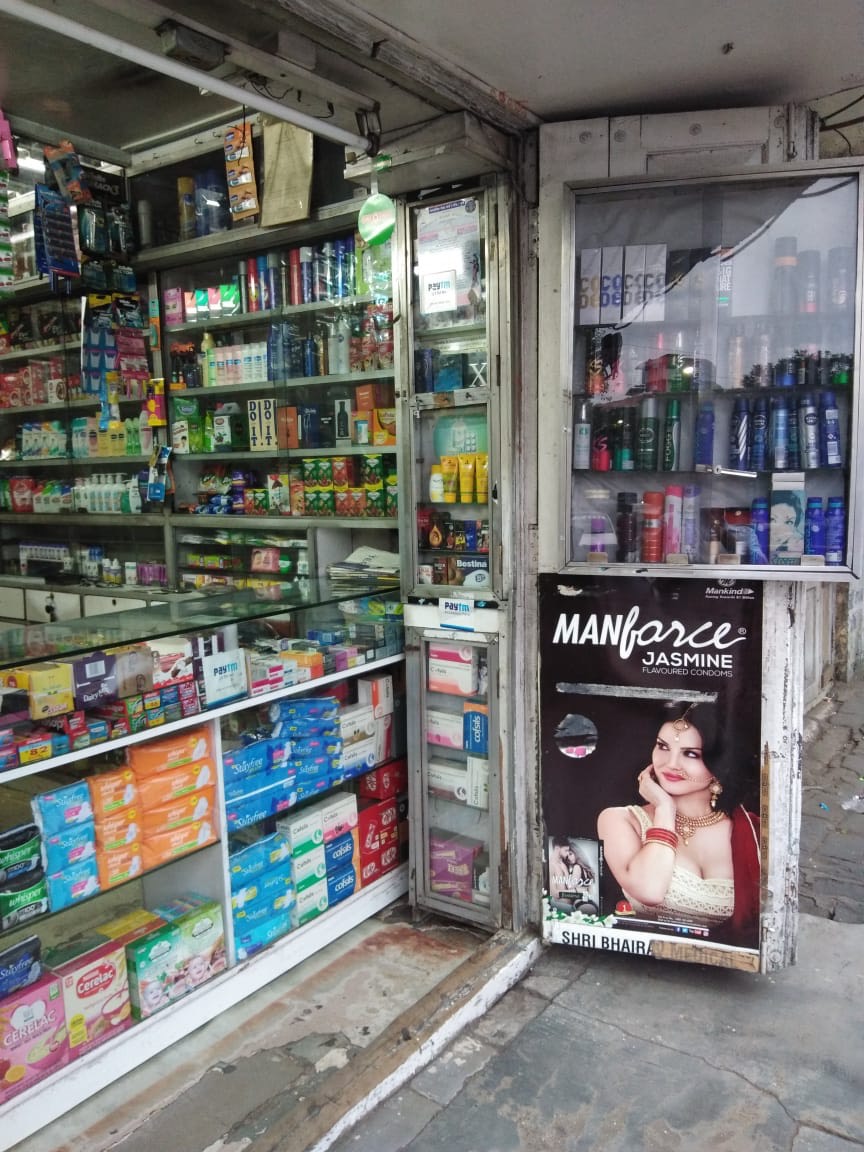
    The market is primarily dominated by Manforce with a 32 per cent share, followed by Moods at 12 per cent, Skore at 10 per cent, Kamasutra at eight per cent, Kohinoor at eight per cent and Durex at around three per cent along with local brands. 

    The National Family Health Survey in its 2015-16 survey revealed that the knowledge of contraceptive methods is almost 100 per cent in India and 99 per cent of married women and men aged between 15-49 know of at least one such method. Sounds like a good number, right? However, the condom penetration (usage) in India is extremely low, with the urban sector clocking around six per cent and the rural a mere four per cent.
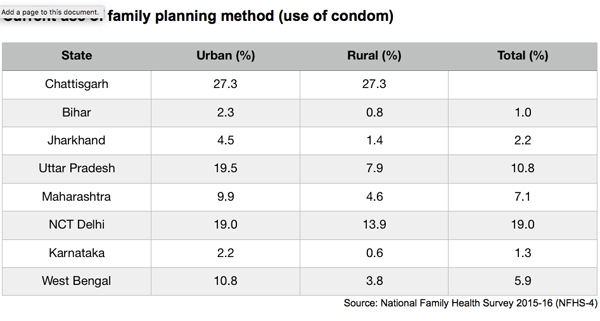
    GRAPH.jpg

    The rural market is still small in India and contributes to about 27 per cent of the 1073 crore condom market in India as per a Nielsen report. But the good news is, it has grown by 16 per cent in terms of value in 2017. Usage of condom in smaller pockets has increased in the last five years due to modernisation, digital penetration and availability of low cost smartphones and data.

    The segment is still unorganised with major private players taking the lead in developed regions. They spend millions on advertising and marketing themselves in the eyes of modern consumers. Case in point: Manforce signed pornstar-tuned-Bollywood actor Sunny Leone, Durex snapped up Bollywood actor Ranveer Singh after he admitted that he was ‘addicted to sex’, SKORE condoms went international and signed cricketers Chris Gayle and Dwayne Bravo. The result? These brands are now at the top of brand recall in the eyes of consumers.

    But the rural scene is majorly dominated by local players. Retailers often take advantage of the consumer discomfort and display brands that allow them good margins, which in most cases are local companies.

    At such a point, it is crucial for national brands to create brand visibility for the audience that isn't really big on television or digital. In order to increase the penetration in smaller segments of India, JK Ansell has launched low value products under the portfolio of KamaSutra brand. Interestingly, Kamasutra currently does not advertise or market its product in rural regions, as 95 per cent its sale comes from the developed cities.

    Brands such as Durex, KamaSutra, Moods and SKORE prefer staying away from rural marketing and undertaking any awareness campaigns. But maybe its time they look into these markets as the next phase of growth is bound to stem from tier two and three towns.
    c20204cb-952a-4b9a-94c7-3eaaf22b798f.jpg

    Most condom brands look at targeting the younger generation in rural areas aged between 20-24 in the hinterland, where condom usage is greater. JK Ansell GM for marketing Ajay Rawal said, “Condom consumption is generally in the age group of 18-30 years. Beyond this, owing to sterilisation and IUD post marriage, the condom usage generally dips. So, the younger generation is where the future lies and hence we want to effectively tap into this segment.”

    Durex's pack of three condoms costs around Rs 55 whereas Skore, Manforce and KamaSutra are priced at Rs 25. Among local brands, Cobra condoms are sold at Rs 14, KIK at Rs 15 and Invigra's pack of 4 at Rs 30. 

    All said and done, distribution and social awareness still remains a challenge in the rural segment for major players as it is still serviced by low price condoms and free condoms (NIRODH) distributed by the Government of India. 

    Sales through modern trade outlets and the digital media are further driving the off take in the category, giving consumers more time during the transactions.The good news is that the rural consumers have taken a step towards accepting quality products rather than settling down with basic low value cheap condoms. 

    But that's not enough. The need of the hour, for condom companies and India as a country, remains the challenge of permeating social awareness down to the last mile.

    Also Read :

    I&B tightens up on condom ads on TV

    Time for condom brands to review their storytelling

    'Sanskari' India wants condom ads off primetime

    MIB recants, says only explicit condom ads banned during the day

  • Durex debuts flavoured condoms with Kohinoor

    Durex debuts flavoured condoms with Kohinoor

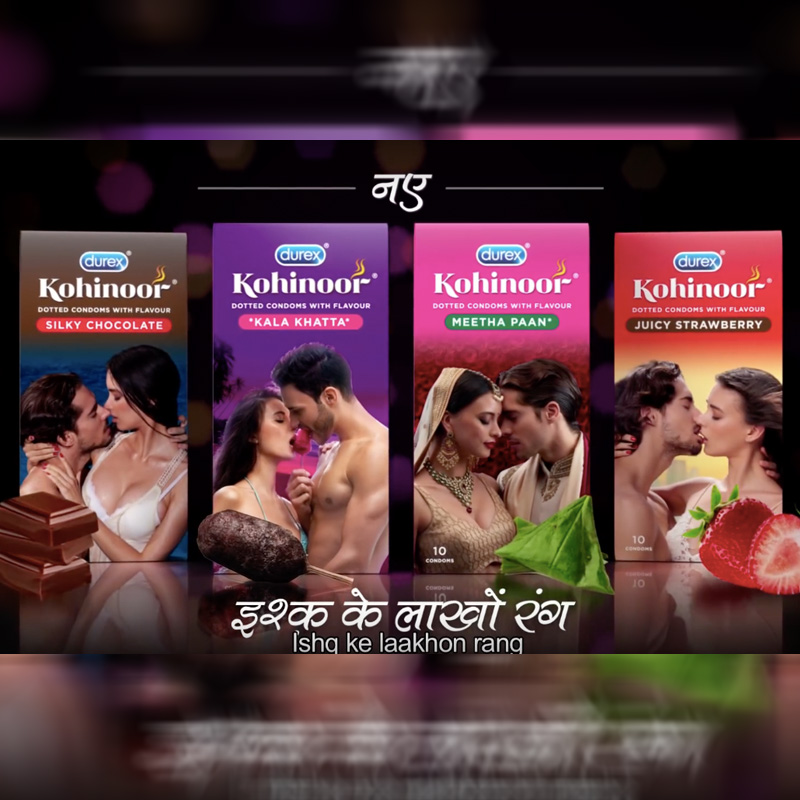
    MUMBAI: Durex, the world’s top sexual wellbeing brand, has announced its entry into the flavoured condoms segment under the flagship of Durex Kohinoor.

    Continuing with the assurance of Durex quality and the legacy of Kohinoor, Durex Kohinoor is available in a variety of exotic flavours like “Meetha Pan”, “Kaala Khatta”, “Silky Chocolate” and “Juicy Strawberry.”

    Meetha paan and kaala khatta have been added to bring the local Indian flavours to consumers and also add fun and adventure to the lives of our consumers while strawberry and chocolate have been legendary and all-time favourites of the masses. The new pack will be priced at Rs 90 for a pack of 10 condoms, available online as well as at physical stores across India.

    Considering that flavoured condoms contribute to nearly 80 per cent of the category, bringing this segment under the fold of Durex marks another key milestone for the brand. With the right product, price and positioning in place, Durex Kohinoor new flavours are targeted to catch the eye of consumers who are seeking to add a degree of pleasure and excitement to their sex life by helping them explore the world of role play and bringing their fantasies alive through the variety that the brand can offer now.

    Excited to introduce the new range of flavoured condoms, RB Health South Asia marketing director Pankaj Duhan mentions that this range enables consumers to have enriching sexual experiences with their existing partner. “With Durex Kohinoor we aim to expand our audience base and reach out to all consumers who are seeking to add a degree of fun and adventure in their sex life,” he said.

    Durex Kohinoor aims to bridge the gap and break the transparent wall that prohibits people from talking about their problems during physical intimacy and their expectations from their partners.

  • Ranveer Singh continues Durex association with denims

    MUNBAI: Bollywood superstar Ranveer Singh reinforced his association with Reckitt Benckiser’s condom brand Durex. The actor has now decided to endorse the rubber maker’s new denim product line – denims. Singh tweeted about the announcement today along with a teaser video from his official handle @RanveerOfficial.

    Durex will soon enter the denim market and is all set to make its way into the jeans which is first of its kind and this new association with the Bajirao Mastani male lead has already set the stage says the brand. In the teaser video released yesterday, Ranveer is seen in a trial room telling his fans saying “Guys Durex is launching Jeans and I am the first one to try it”… Then he goes into the trial room and shouts, “Guys this fits really well…”

    About three years ago the Bollywood actor had featured in a Durex condom ad having sex and then rapping and dancing as a part of the campaign – ‘When You Have Great Sex, You #DoTheRex’. That ad had concentrated on the ‘feel good’ factor that one generally gets after sex. That was probably a first – the first time that a male actor had associated himself with a condom brand.

  • Tech in Durex Love ad

    NEW DELHI: February may be the shortest month of the year, but for love it is an important month as Valentine’s Day falls on 14 February.

    In a bold move to ignite the passion among lovers in this month of love, sexual wellbeing brand Durex has launched a new campaign, ‘Look Up For Love’.

    The new campaign aims to demonstrate that when utilized properly, technology can rekindle the romance.

    The campaign has been designed in view of the era where technology has become an addiction and where lovers are too immersed in their virtual world on mobiles and miss their real love.

    A recent study on one-upmanship in relationships has shown that when a person begins to play with a mobile phone, the partner tends to spend even more time on his or hers. The survey showed that 71.4% admitted using mobile phone very often and 61% agreed that their partner uses a mobile phone frequently.

    Consequently, relationships are affected because of the technology and importance of creating a ‘technology-free’ zone with one’s loved one.

    The campaign aims to bring together couples who are estranged because of the frequent usage of technology and encourage them to have a more real conversation with each other. For enhancing the relationship and build true connection, Durex has launched the Love Bug – A reminder to the partner that one wants to be #TrulyConnected.

    Speaking about the new campaign, RB India Marketing Director Rohit Jindal said: “The campaign is an attemptto inspire couples to ditch the technology, have a more real conversation and connect with each other this Valentine’s Day. We believe that key to a healthy relationship is staying engaged and appreciating every moment with each other.”