Tag: DTH

  • Pearl Broadcasting invests Rs 400 million in P7 News, Mumbai launch on 23 September

    Pearl Broadcasting invests Rs 400 million in P7 News, Mumbai launch on 23 September

    MUMBAI: Pearl Broadcasting Corporation has invested close to Rs 400 million in P7 News and is set to formally launch the Hindi news channel in Mumbai on 23 September.

    P7 has already signed up major cable networks including Incablenet, Hathway Cable & Datacom, Scod18 and Wire & Wireless India Ltd (WWIL).

    “Our investment so far has been close to Rs 400 million (barring distribution). For Mumbai, we are spending around Rs 50 million for distributing the channel on cable networks. We have already signed annual deals with the the major cable networks in Mumbai,” Pearl Broadcasting director Jyoti Narain tells Indiantelevision.com.

    Launched on 27 March in Delhi, the channel is already available in other Hindi speaking markets. “We have spent around Rs 80 million on distribution. We are available in the states including Madhya Pradesh, Chhattisgarh, Uttar Pradesh and Gujarat. We recently signed a deal with Gujarat Telelink Private Ltd (GTPL),” avers Narain.

    The free-to-air (FTA) channel is also available on Essel Group’s direct-to-home (DTH) company Dish TV and DD Direct Plus.

    With the tagline ‘Ek Umeed’ (a ray of hope), the channel has a staff count of 375 across 11 bureaus. The channel has six OB-vans for news gathering and an association with 600 stringers across the nation for news.

    “It is a very competitive space. We can’t compromise on content. Our focus is on social and developmental stories across the country,” adds Narain.

    With the Mumbai launch, the channel will have a new look and feel as new segments will be added. At present, P7 News runs over 20 news-based supplements in weekdays, while it picks up social issues and campaigns on weekends.

    Within six months of launch, the channel has roped in advertisers like Coca-Cola, Bata, and Morepen apart from a clutch of real estate companies.

    Pearl Group has a wide array of business interests spanning real estate, tourism, TV & film production and print publication.

  • ‘India is the only market where we pay carriage’ : Bruce Dover – Australia Network CEO

    ‘India is the only market where we pay carriage’ : Bruce Dover – Australia Network CEO

    Australia Network, the international channel from the stable of Australian Broadcasting Corporation (ABC), has a hybrid mix of news, drama, lifestyle and kids programming.


    The state-funded channel, which has an international presence in over 44 countries across Asia, the Pacific and Indian subcontinent, is planning to launch a kids channel for the pre-school and the 8-14-year-olds.


    The expansion plan in India also includes introduction of subtitles in English and Hindi. Co-production deals are part of the agenda to keep in line with India as a focus area for growth.


    In an interview with Indiantelevision.com’s Ashwin Pinto, Australia Network CEO Bruce Dover talks about how the hybrid programming model has worked in many markets. An old hand at media, Dover was Rupert Murdoch’s right hand man in Beijing. He went on to write a book titled Rupert Murdoch’s Adventures in China.


    Excerpts:

    Being a single channel broadcaster is a tough proposition. Are you planning to launch more channels in India?
    The ABC is looking at an Australian kids channel. This would cover both pre-school and the 8-14-year-olds. The idea is to roll the channel out early next year. But this would depend on the funding that we get from the Australian government.

    The BBC made an entry into India after syndicating their content to the pubcaster. Do you have any such plans?
    We have to be careful not to cannibalise our content. Otherwise you might want to start a kids channel, but find that you have already sold your content to other channels.

    How do you plan to grow in India?
    We are planning to introduce subtitles in the fourth quarter of this year. Perhaps, this is necessary because of the Australian accent that our coverage would have. We are also looking at Hindi subtitling for our movies, dramas and documentaries.We already do subtitling in Vietnam. Indonesian subtitles have been introduced this week.

    India is flooded with strong English international channels. How would Australia Network make a mark in India?
    Our speciality is that we are a hybrid channel with a varied programming mix. We have news and current affairs which make up 25 per cent. Then there is lifestyle and dramas, documentaries and children’s programming.

    Earlier the thinking was that TV channels fit single genres the best. International channels like NHK, though, are now following our model.


    The lifestyle content is in terms of travel shows and what it is like to be an Indian student in Australia and vice versa. We have a show called Student Postcard where one learns about the good, the bad and the ugly of studying in an Australian university. Can you go out? Can you meet girls? You want to know if certain areas are safe to go out at night.


    Our aim is to give Indians more insight into Australia. We do English language learning which is popular in India. This is for students who want to study overseas. We have programming as well as a site which helps you learn and become more proficient in English. Also, there is the cricket link. This helps drive interest in our channel.

    India is a difficult market to get such a niche channel like yours distributed. How much is Australia Network spending on carriage?
    India is the only market where we pay carriage fees. I can’t get into the specifics of that, but we are working with the Setpro team and they have good relations with the operators. We have a five-year deal with them.


    Almost 70 per cent of our viewership comes from the South. We are on the Sun Direct DTH platform. We are also available on several cable networks across the country. We have identified 15 towns where we want a sizeable presence.

    Though the government funds us, the people of Australia support us. We fill up a void left by the commercial broadcasters in kids programming. Our news and current affairs content also does not carry ads

    Are you looking at co-productions in India?
    It is one of the areas we are looking at. We feel there is a big opportunity here. You could get an Australian cricketer and an Indian cricketer coming together for a show. Factual content around interesting issues would be our area of focus.


    We are also looking at doing co-productions around children’s content. We have some IP software. We do kids science programming in other countries. The software and the textbooks can be recreated.

    How many feeds does Australia Network have?
    We have three. One is for the Pacific region, which is important as there are not many channels carrying independent news in this belt. Then there is one for North and Southeast Asia. A third feed is for South Asia. We are now looking to have a feed for the Middle East.

    Which are your key markets?
    Indonesia, Singapore and Hong Kong are key markets for us. We recently launched in Indonesia and Malaysia and are satisfied with the progress we have made.


    India is also an important market for us. We just went through a re-branding process with the tagline ‘From Our World to Yours.’ It is about introducing Australia to India.

    What was the aim of the rebranding?
    We wanted to make it more relevant. We did work with Saatchi and Saatchi as they had the Tourism Australia advertising contract. They spent half a million dollars on research and focus groups as the contract was worth $40 million. We went to them to find out how brand Australia is being perceived in the market.

    How difficult is it to be a public service broadcaster when you have to depend on government for funding?
    We only earn 10 per cent of our costs. The government funds us. The ABC gets its budget every three years. But the people in Australia have no problem with that. The ABC has a long history of producing world class children’s programming. There is an educational bent to it and we have shows like Wiggles. Besides, we do not carry ads, something which parents love. We fill in a void left by the commercial broadcasters.

    Our news and current affairs content also does not carry ads.

    How has the global downturn affected ABC?
    The current economic situation provides an opportunity for us as private networks scale back on their expensive dramas, news and current affairs. They are forced to focus more on studio-based cheap reality shows.

    Do you have plans for the digital space?
    We will take this up as our focus area next year. We are looking at English learning applications. We will also provide news and current affairs video content on the mobile platform.

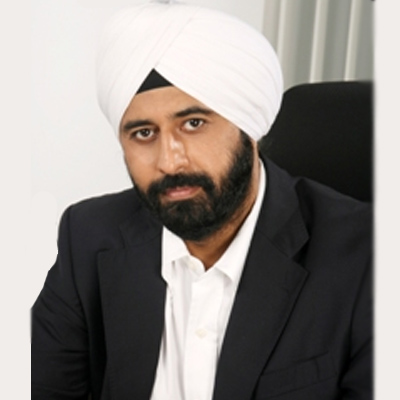
  • ‘Carriage market has exploded and will close this fiscal at Rs 14 billion’ – Gurjeev Singh Kapoor

    ‘Carriage market has exploded and will close this fiscal at Rs 14 billion’ – Gurjeev Singh Kapoor

    Broadcasters are being hit hard by hefty carriage fees as bandwidth is getting choked both on analogue cable and DTH (direct-to-home). Building formidable distribution bouquets is high on their agenda as they struggle to ramp up subscription revenues which are estimated to touch Rs 28 billion this fiscal.

    Star Den, a 50:50 joint venture between Star and Digital Entertainment Networks, is quickly adding regional channels to complete its otherwise strong Hindi and English entertainment-news-kids bouquet. Zee-Turner is the only other broadcasting distribution company which has a formidable regional content lineup.

    Star Den is eyeing a revenue of Rs 10 billion at a time when the television industry is beginning to feel the first serious signs of a slowdown in advertising revenues. Analysts say this will be a hard task to achieve, despite the boon from DTH revenues. Big TV and Airtel Digital TV launched later in the year, reducing prospects of a full-fiscal revenue gain for the broadcasters.

    In an interview with Indiantelevision.com’s Sibabrata Das, Star Den Media Services chief executive officer Gurjeev Singh Kapoor talks about the dark holes in the distribution business and how the company plans to ramp up growth in a tough business environment.Excerpts:

    Is the steep climb in carriage fees upsetting the business model of broadcasters?
    The carriage market has exploded and is expected to end this fiscal at close to Rs 14 billion, up from Rs 6 billion a year ago. As there is a huge amount of bandwidth constraint on analogue cable and even DTH, the industry has changed in terms of carriage. DTH operators are offering 200 channels while the Information and Broadcasting ministry has given the nod to 370 channels. A plethora of channel launches in the Hindi general entertainment, news and regional space has meant that there is a fierce fight for frequency. In a market where funding was easily available, channels were willing to pay more for space on cable networks. Insanity ruled the market.

    Will we see a correction in the carriage market?
    The balancing act has to happen now. With private equity and other sources of funding drying up, many broadcasters have started contracting their distribution budgets. We could see a flat carriage growth next year as channels start rationalising their costs. Broadcasters are in no position to be omnipresent in all cable networks; they will have to pick and choose where they want to be present and optimise their resources.

    But we will continue to see more channel launches next year as Reliance ADAG is planning to get into broadcasting space. Even existing players like Star India have plans to add more channels. Won’t this ensure that the carriage tap continues to flow freely?
    We may see a 10-15 per cent growth in carriage fee market in FY’11 as more channels enter the race. The next two years will be the blue litmus test for many broadcasters. For the weak channels, there could be a shake out. The fact is that distribution costs have grown unmanageably high.

    There can be no potential threat to carriage revenues unless the digital universe expands to at least 25 per cent. When we reach that stage, other models can emerge like broadcasters getting into agreements for sharing their distribution revenues with delivery platform providers.

    Are broadcasters getting united to resist on carriage fees?
    Broadcasters have doled out so much money in the past because of competition that it will be difficult to correct the system fully. More so, as we will see new channel launches. Carriage fee is being governed by market forces. But it is good that the thought process has started to fight carriage fees collectively. How far that will succeed only time will tell.

    Would you want Trai to (Telecom Regulatory Authority of India) come out with some regulation on carriage?
    I wish there could be some kind of formula that can be arrived at to regulate carriage. As an idea, it is definitely good since the regulator has mandated pricing issues.

    How difficult is it to ramp up subscription revenues in the backdrop of MSOs (multi-system operators) consolidating the cable TV market and Trai introducing pricing regulations?
    Subscription revenue for pay-TV broadcasters will close at Rs 28 billion in FY’09, up from Rs 23 billion a year ago. Even though there is a slowdown in the market and the times are tough, the industry expects a 10-15 per cent growth in FY’10.

    Isn’t that growth mainly because of DTH?
    DTH, undoubtedly, has expanded the market. But ARPUs (average revenue per user) haven’t grown in the DTH business; they are virtually the same as that of cable. IPTV, though much talked about, has also not happend this year.

    Will Star Den’s revenue touch Rs 10 billion this fiscal?
    While we are looking at very aggressive numbers and have set ourselves a very challenging task, I can’t comment on our financials.

    Do broadcasting distribution companies see the consolidation in the cable TV sector as a welcome change?
    The marketplace will make it difficult for small networks even as broadcasters rationalise their distribution budgets. Networks who have a geographical spread can bargain hard with broadcasters. In the short term, they will get paid more and will be reluctant to pay for more subscribers. But in the long term, it is better that the industry moves towards a better structured environment. MSOs and broadcasters have to join hands and realise that ultimately money has to come from the ground.

    Since the parent owner of Star Den also runs a cable TV company, how do you leverage the power of your bouquet to push the cable distribution business?
    We operate as independent entities. We treate Den like the other MSOs.

    Star India had earlier inked a distribution deal with sports broadcaster Neo which did not last long after the new management took over. Do you feel that the Star Den bouquet is strong but still incomplete without sports channels in its mix?
    We are currently distributing 23 channels and are in a very strong position to post growth. We have great quality content in the Hindi general entertainment space with Star Plus as the leader and Star One in the fifth spot. In the news television space, we have Times Now which leads in the English segment, CNN-IBN, IBN7 and Star News. CNBC TV18 and Awaaz, of course, are leaders in their segments and are powerful subscription-driven channels.

    In the kids genre, we have Hungama and the three Disney channels. For the English-viewing audiences, we have a formidable presence in Star Movies, MGM and Star World. We also distribute NGC and Zoom.

    We are now filling up the missing pieces and adding the regional bouquet. With Star buying majority stake in Asianet, we will cover all the languages down south. Star has also launched a Bengali and a Marathi general entertainment channel while the one in Gujarati is in the pipeline.

    Will Colors (the second most-watched Hindi GEC from the Viacom18 stable) automatically come to your bouquet when it decides to go pay?
    I wouldn’t like to offer any comments.

    Will you also be getting the MTV channels after Viacom’s contract with One Alliance expires on 31 March, 2009?
    I don’t want to comment on this.

    What about the wedding and home shopping channels that Star is planning to launch next year?
    Whatever niche channels Star launches, we will be happy to service. Niche channels will have a demand particularly on digital platforms. One the Fox channels launch, we will also be happy to distribute them.

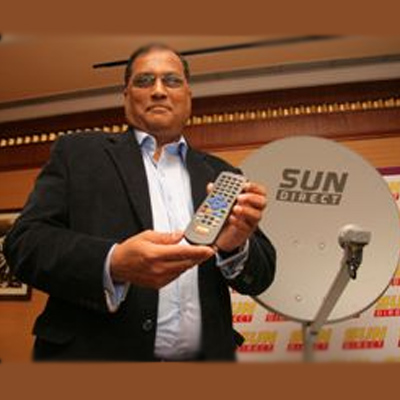
  • ‘Pricing and creation of bouquets is our big differentiator’ Tony D’silva – Sun Direct COO

    ‘Pricing and creation of bouquets is our big differentiator’ Tony D’silva – Sun Direct COO

    Kalanithi Maran is building his DTH empire on one key proposition: pricing. Mopping up two million subscribers in his home turf, Maran expects to taste success in the northern pockets of the country with the very same recipe.

    Armed recently with Hindi content and sports channels, Sun Direct has launched in Mumbai and will be quickly moving to other markets as a pan India direct-to-home service. The target: six million subscribers by FY’10.

    Sun Direct plans to invest Rs 35 billion in the venture over two years, out of which Rs 20 billion will have been consumed by the end of this fiscal. A large chunk of this will be towards providing set-top boxes (STBs) free.

    Malaysia-based Astro has taken a 20 per cent stake in the company for Rs 5.90 billion. Sun Direct is a zero-debt company and there are no plans to raise further money through dilution of equity.

    Sun Direct’s ARPU (average revenue per user) is the lowest among all the DTH operators, ranging between Rs 85-90. But the costs are tightly controlled and the company hopes to break even in six years.

    In an interview with Indiantelevision.com’s Sibabrata Das, Sun Direct COO Tony D’Silva speaks about the company’s ambitious growth plans.

    Excerpts:

    How much is Sun Direct investing in the DTH venture?
    We have an investment plan of Rs 35 billion over two years. We would have consumed Rs 20 billion by the end of this fiscal. We are pumping in the balance Rs 15 billion by FY’10.

    How much has Astro put in so far?
    Astro had made a commitment of putting in Rs 5.90 billion for a 20 per cent stake in Sun Direct. The full amount has already come in. The promoters have invested the rest of the amount. We are a zero debt company.

    Is there a plan to raise further money through equity?
    We have no such plan. We are considering whether it would make sense for us to raise debt and sit in excess liquidity at a time when the money market is tight. No decision has been taken in this regard. The promoters are ready to pump in whatever it takes to grow the business.

    Since Sun Direct is offering STBs free, wouldn’t the company have to absorb huge losses?
    The loss for this fiscal would be in the region of Rs 4.50 billion. This is very much a part of our business plan. For anybody who wants to build scale, the only way forward is to acquire customers with high subsidy offers. We have already mopped up two million subscribers and are looking at ending FY’09 with a base of three million. High volumes will help us reach break even as our costs are not as high as the others.

    Even when Sun Direct’s ARPU is the lowest among all the DTH operators?
    We have grown in the southern region and our current ARPUs are at Rs 85-90. We don’t see them going up significantly even after our launch in Mumbai and the rest of India. In the volumes game, the margins will improve once you reach a particular threshhold of numbers. Our infrastructure cost is also less than the other DTH operators. We will break even in six years.

    Astro has put in Rs 5.90 billion. We are a zero debt company and expect to break even in six years

    Is your content cost also lower than many of the other DTH operators?
    Our content cost is 45-50 per cent, one of the lowest in the industry. We have not done MG (minimum guarantee) deals with broadcasters. Our main strategy is a la carte pricing.

    What is your customer acquisition cost?
    When we made our initial purchases, the STBs were costing us $55. But the economic meltdown is driving down the prices and our STBs currently cost $45.

    The advertising budget for this fiscal is Rs 1.5 billion. We aim to spend a similar amount in the next fiscal unless the market dynamics changes drastically.

    Our customer acquisition cost is Rs 4500. But with our pricing strategy, we expect to garner six million subscribers by FY’10.

    The pricing strategy can attract wrong customers. Isn’t it a dangerous model to have if your churn rate is high while the customer acquisition cost is steep?
    We have a five per cent churn rate. We realise that it is important to have a lower churn.

    What is the strategy Sun Direct has adopted to repeat its success model outside its home turf?
    While 99 per cent of our current two million subscriber base comes from the south, we have an aggressive pricing policy which will help us garner subscribers from the other pockets of the country. Our regional package, “My Pack,” will create hype in the market and drive our growth everywhere. Our bouquet of packages are value for money as we have custom designed packages for every state and region. We spent considerable amount of time since our launch last December.

    We have also introduced a Hindi package. The ‘Shine Pack’ is available at Rs 499 and Rs 999 for five and 10 months respectively.

    We have the highest number of add-on packages, ranging from Rs 6 to Rs 195. And the sports channels are available on a la carte rates.

    Doesn’t it make sense to offer sports channels in packages?
    The rates are too high for us to offer the sports channels in basic tiers or in bundles. We recently added the three ESPN Star Sports channels into our offerings. They are available on a la carte rates – ESPN and Star Sports are priced at Rs 38 each per month while Star Cricket costs Rs 32. Ten Sports is priced at Rs 20 while Zee Sports costs Rs 15. We are in negotiations with Neo.

    Why was your launch in Mumbai delayed?
    Adding Hindi and sports channels in the bouquet took time and the launch in Mumbai was delayed by a shortage of supply in STBs. There has been heavy snowfall in China and Beijing Olympics also delayed the supply of boxes. So during the festival season of Diwali, we did not have STBs to sell. Now the supply is comfortable and we are in a position to launch in other parts of the country.

    Have you added more STB manufacturers into your list of vendors?
    Our STB suppliers are China-based Coship and Korean firm Homecast. We have just added Samsung into our list.

    Have you launched high-end STBs?
    We have, but only in the southern market. They are priced at Rs 10,000 and are made by Homecast. Only a couple of hundreds have moved and we are just testing the waters.
    Are you lining up premium content?
    We feel the market is too early for premium and interactive content. Our first task is to be successful as a pan India operator. The creation of bouquets and pricing has to be a big differrentiator.
    Some DTH service providers are advertising their Hindi movie offerings. Is Sun Direct going to create such content to grab viewers outside the south?
    We don’t have any such plan at this stage. We are examining whether we should do that or go for HD. We have space for 5 HD channels. This will be for the top-end of the market and give us higher ARPUs.
    Has Sun Direct approached Isro for more Ku-band transponders?
    We have asked Isro for two more transponders. We offer 200 channels including 23 radio channels and video-on-demand. We are fortunate that we are co-located on the same satellite used by DD Direct Plus and so can get their channels without consuming our own bandwidth.
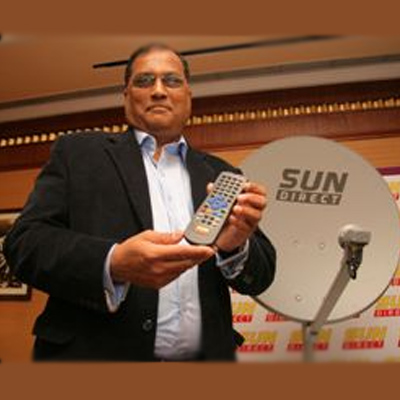
  • ‘Pricing and creation of bouquets is our big differentiator’ : Tony D’silva – Sun Direct COO

    ‘Pricing and creation of bouquets is our big differentiator’ : Tony D’silva – Sun Direct COO

    Kalanithi Maran is building his DTH empire on one key proposition: pricing. Mopping up two million subscribers in his home turf, Maran expects to taste success in the northern pockets of the country with the very same recipe.

    Armed recently with Hindi content and sports channels, Sun Direct has launched in Mumbai and will be quickly moving to other markets as a pan India direct-to-home service. The target: six million subscribers by FY’10.

    Sun Direct plans to invest Rs 35 billion in the venture over two years, out of which Rs 20 billion will have been consumed by the end of this fiscal. A large chunk of this will be towards providing set-top boxes (STBs) free.

    Malaysia-based Astro has taken a 20 per cent stake in the company for Rs 5.90 billion. Sun Direct is a zero-debt company and there are no plans to raise further money through dilution of equity.

    Sun Direct’s ARPU (average revenue per user) is the lowest among all the DTH operators, ranging between Rs 85-90. But the costs are tightly controlled and the company hopes to break even in six years.

    In an interview with Indiantelevision.com’s Sibabrata Das, Sun Direct COO Tony D’Silva speaks about the company’s ambitious growth plans.

    Excerpts:

    How much is Sun Direct investing in the DTH venture?
    We have an investment plan of Rs 35 billion over two years. We would have consumed Rs 20 billion by the end of this fiscal. We are pumping in the balance Rs 15 billion by FY’10.

    How much has Astro put in so far?
    Astro had made a commitment of putting in Rs 5.90 billion for a 20 per cent stake in Sun Direct. The full amount has already come in. The promoters have invested the rest of the amount. We are a zero debt company.

    Is there a plan to raise further money through equity?
    We have no such plan. We are considering whether it would make sense for us to raise debt and sit in excess liquidity at a time when the money market is tight. No decision has been taken in this regard. The promoters are ready to pump in whatever it takes to grow the business.

    Since Sun Direct is offering STBs free, wouldn’t the company have to absorb huge losses?
    The loss for this fiscal would be in the region of Rs 4.50 billion. This is very much a part of our business plan. For anybody who wants to build scale, the only way forward is to acquire customers with high subsidy offers. We have already mopped up two million subscribers and are looking at ending FY’09 with a base of three million. High volumes will help us reach break even as our costs are not as high as the others.

    Even when Sun Direct’s ARPU is the lowest among all the DTH operators?
    We have grown in the southern region and our current ARPUs are at Rs 85-90. We don’t see them going up significantly even after our launch in Mumbai and the rest of India. In the volumes game, the margins will improve once you reach a particular threshhold of numbers. Our infrastructure cost is also less than the other DTH operators. We will break even in six years.

    Astro has put in Rs 5.90 billion. We are a zero debt company and expect to break even in six years

    Is your content cost also lower than many of the other DTH operators?
    Our content cost is 45-50 per cent, one of the lowest in the industry. We have not done MG (minimum guarantee) deals with broadcasters. Our main strategy is a la carte pricing.

    What is your customer acquisition cost?
    When we made our initial purchases, the STBs were costing us $55. But the economic meltdown is driving down the prices and our STBs currently cost $45.

    The advertising budget for this fiscal is Rs 1.5 billion. We aim to spend a similar amount in the next fiscal unless the market dynamics changes drastically.

    Our customer acquisition cost is Rs 4500. But with our pricing strategy, we expect to garner six million subscribers by FY’10.

    The pricing strategy can attract wrong customers. Isn’t it a dangerous model to have if your churn rate is high while the customer acquisition cost is steep?
    We have a five per cent churn rate. We realise that it is important to have a lower churn.

    What is the strategy Sun Direct has adopted to repeat its success model outside its home turf?
    While 99 per cent of our current two million subscriber base comes from the south, we have an aggressive pricing policy which will help us garner subscribers from the other pockets of the country. Our regional package, “My Pack,” will create hype in the market and drive our growth everywhere. Our bouquet of packages are value for money as we have custom designed packages for every state and region. We spent considerable amount of time since our launch last December.

    We have also introduced a Hindi package. The ‘Shine Pack’ is available at Rs 499 and Rs 999 for five and 10 months respectively.

    We have the highest number of add-on packages, ranging from Rs 6 to Rs 195. And the sports channels are available on a la carte rates.

    Doesn’t it make sense to offer sports channels in packages?
    The rates are too high for us to offer the sports channels in basic tiers or in bundles. We recently added the three ESPN Star Sports channels into our offerings. They are available on a la carte rates – ESPN and Star Sports are priced at Rs 38 each per month while Star Cricket costs Rs 32. Ten Sports is priced at Rs 20 while Zee Sports costs Rs 15. We are in negotiations with Neo.

    Why was your launch in Mumbai delayed?
    Adding Hindi and sports channels in the bouquet took time and the launch in Mumbai was delayed by a shortage of supply in STBs. There has been heavy snowfall in China and Beijing Olympics also delayed the supply of boxes. So during the festival season of Diwali, we did not have STBs to sell. Now the supply is comfortable and we are in a position to launch in other parts of the country.

    Have you added more STB manufacturers into your list of vendors?
    Our STB suppliers are China-based Coship and Korean firm Homecast. We have just added Samsung into our list.

     
    Have you launched high-end STBs?
    We have, but only in the southern market. They are priced at Rs 10,000 and are made by Homecast. Only a couple of hundreds have moved and we are just testing the waters.
     
    Are you lining up premium content?
    We feel the market is too early for premium and interactive content. Our first task is to be successful as a pan India operator. The creation of bouquets and pricing has to be a big differrentiator.
     
    Some DTH service providers are advertising their Hindi movie offerings. Is Sun Direct going to create such content to grab viewers outside the south?
    We don’t have any such plan at this stage. We are examining whether we should do that or go for HD. We have space for 5 HD channels. This will be for the top-end of the market and give us higher ARPUs.
     
    Has Sun Direct approached Isro for more Ku-band transponders?
    We have asked Isro for two more transponders. We offer 200 channels including 23 radio channels and video-on-demand. We are fortunate that we are co-located on the same satellite used by DD Direct Plus and so can get their channels without consuming our own bandwidth.
  • ‘We are entering into an era where capital will be scarce’ :  Citi Venture Capital International managing director India region head PR Srinivasan

    ‘We are entering into an era where capital will be scarce’ : Citi Venture Capital International managing director India region head PR Srinivasan

    There may be pressure on Citigroup Inc. to remove the flab with the US government agreeing to infuse $20 billion of capital as part of a rescue package, but Citi Venture Capital International (CVCI) is drawing up plans to make acquisitions at attractive valuations. Out of the $4.5 billion fund, it is yet to invest $3 billion, almost a third of which will pour into the Indian market.


    Though CVCI has made only one media investment in You Telecom, a broadband and cable TV company, it is also eyeing the direct-to home (DTH) and Hindi entertainment broadcasting space.


    In an interview with Sibabrata Das, Citi Venture Capital International managing director India region head PR Srinivasan talks about the opportunities of investing in various sectors including media at a time when capital is going to be scarce.


    Excerpts:

    Being in the midst of an unprecedented global economic turmoil, how comfortable is Citi Venture Capital International (CVCI) in its funding structure to grab buying opportunities in Indian media companies?
    We have a $4.5 billion fund, out of which $3 billion is yet to be invested. We have already invested $500 million in India. We are likely to pump in a further $750 million-$1 billion in this market while the balance will be put in China, Eastern Europe, etc. You Telecom has been our only investment in the media and entertainment sector. But as asset prices come down, we are open to picking up stakes in other verticals within the media sector.

    Have you initiated talks with any of the media companies?
    We see a good investment opportunity in DTH and are talking to one player. We may also start looking at TV channels in the Hindi general entertainment space, if they come at attractive valuations and are managed well. Even if we are headed for a slowdown, the truth is that people will still want entertainment. Since we have already acquired You Telecom, we are not looking at parallel investments in the cable TV sector. We would expand and make further acquisitions through You Telecom.

    Since CVCI has a running investment in a broadband and cable TV company through You Telecom, why is it that you are eyeing a competing distribution platform like DTH?
    There is space for all three forms of carriage – DTH, cable TV and IPTV. No form of distribution is superior or dominates over the other. In the US, both cable and DTH enjoy substantial market shares. The only country which has a single dominant platform is UK where DTH has a content advantage in form of exclusive sports telecast rights. India, however, has a content-neutral policy. The regulatory framework is also in favour of independent distributors and is neutral to broadcasters. The DTH sector also has a 20 per cent equity cap for broadcasting companies.


    The main cost in DTH is advertising. Unlike cable which has a capex requirement in the distribution architecture, DTH doesn’t have a wired cost. If you get scale in DTH, you will become profitable. The expense mix will change with volumes. But in India with so many players getting into the business, not all will get the scale.

    When CVCI bought out British Gas’s broadband business, was the investment attractive because the infrastructure of You Telecom could be used for cable TV service?
    You Telecom had world class network built to FCC standards. We were clear that we would buy this asset and wait for both competition and regulation to fall in place so that this can be developed into a last mile home entertainment network. When the government came out with Cas and DTH became active, digitalisation got a push. For the cable TV business to grow, there was need for competition, the right market, and the right regulation. We are in that environment today. India is in the early stages of having second TV – so we could have a situation where we have both cable and DTH.

    Were you not in discomfort because the cable TV sector has too many players and there is very little of last mile ownership with the multi-system operators (MSOs)?
    In terms of reaching homes, cable with 80 million does much better than telecom. The sector needs to get more organised; it is only a matter of time before this happens. The cable industry in India is a marathon and not a sprint. Though there is a capex requirement and last mile is still not under control of the MSOs, the mix looks good once you have a base of one million digital subscribers.

    ‘For the cable TV biz to grow, there was need for competition, the right market, and the right regulation. India is in the early stages of having second TV – so we could have a situation where we have both cable and DTH

    Why did You Telecom take so long in moving into cable TV service?
    Our efforts to do the video business evolved with the DTH industry. We acquired a 50 per cent stake in Bangalore-based Digital Infotainment, a small-sized cable network, to make our foray into the cable TV business. We also took a majority in Scod18 Networking, an association of cable TV distributors in Mumbai. We have cable TV operations in Mumbai, Bangalore, Vizag and Dharwad in Maharashtra.

    In You Telecom, CVCI has 85 per cent stake. How did you restructure the equity structure as the government allows only 49 per cent FDI (foreign direct investment) in a cable TV company?
    We floated Digital Outsourcing, the company that would handle cable TV business. Tulsi R Tanti and his family members, promoters of Suzlon Energy Ltd, have acquired 49 per cent stake in this company. You Telecom India owns 36 per cent while the rest is held by high net worth Indian individuals.

    How much is You Telecom investing to expand its business?
    You Telecom plans to pump in Rs 4 billion over the next two years to expand its cable TV and broadband business. If we decide to go for Headend-In-The-Sky (HITS), we will require another Rs 1.5 billion. We have 1.3 million cable TV subscribers and expect this to go up to three million. We have seeded 60,000 digital set-top boxes and expect to touch one million in the next 18 months. The cable business will grow through setting up own headends, acquiring networks and forming joint venture partners in different geographies. There is a lot of entrepreneurial talent in the cable community and we want to tap into that.

    Do you have an aggressive plan in acquiring last mile operators?
    The challenge in cable is to get direct points. We bought 5000-7000 points. Our strategy is to own last mile, but all in good time. Our plan is to own a headend and then acquire the last mile. The valuations for last mile were inflated because people thought there was abundant capital available.

    Have the valuations dropped drastically?
    For the last three years, there has been abundant capital and liquidity. Though we purchased at 18-24 months revenue, there were MSOs who bought at 30-40 months turnover. That kind of money is not available; we will not get financing for making purchases like that any more.


    Most of the mid caps have fallen over 80 per cent. The last mile business has to follow along those lines. People are not going to bid prices up. It is only a matter of time before people accept the new world realities. We are entering into an era where capital will be scarce. Business plans will have to evolve accordingly.

    Do you see yourself in an advantageous position because you are sitting on cash at a time when the credit markets are frozen and capital is hard to get?
    Money is not going to be available on tap. This will impact the way the new financial system is going to be reshaped. Every sector will feel the jolt. As new broadcasters need to raise capital, MSOs who have planned carriage revenues over the next 2-3 years to support their business models will find the going very hard. Many of them will have to redraw their plans.


    It is a good time to have cash. For those who are investing now, the returns will be higher than the previous years.

  • ‘A price war will expand the DTH market’ : Anil Khera- Bharat Business Channel Ltd CEO

    ‘A price war will expand the DTH market’ : Anil Khera- Bharat Business Channel Ltd CEO

     Venugopal Dhoot sees opportunity in the direct-to-home (DTH) business as he plans to push Videocon’s Plasma, LCD and premium TV sets.


    As part of Dhoot’s backward integration strategy, the consumer electronics giant will also manufacture the set-top boxes (STBs) in the Aurangabad factory.


    Bharat Business Channel Ltd (BBCL), a separate company for the DTH venture, will have a war chest of Rs 10 billion over two years as it readies to enter a turf that will see intense price competition.


    DTH in India, with players like Dish TV, Tata Sky, Reliance ADAG and Bharti, will be a low ARPU (average revenue per user), high volume game.


    Dhoot, not new to price wars, believes that the DTH market will expand and his distribution network will provide the pipeline for him to mop up one million subscribers in the first year.


    Heading the DTH venture is Anil Khera , who was earlier in charge of Videocon’s Sansui and Kelvinator brands.

    In an interview with Sibabrata Das, Khera talks about BBCL’s plans to quickly penetrate the DTH market across the country.


    Excerpts:

    Why does Videocon want to enter into the DTH business when the market has too many players and the race for subscriber acquisition is going to be led by a huge subsidy element?
    The total number of television households is pegged at 125 million and is growing at 12-15 per cent. The DTH subscriber base, which is currently a little over six million, is expected to touch 15 million by 2010 with the entry of new players like Reliance ADAG, Bharti and us. The DTH market will expand rapidly and there will be enough space for all the players. India will become the world’s largest pay-TV market by the stretch of numbers.

    Is Videocon entering the market because it sees DTH as an integrated business model with its consumer electronics business?
    We will be pushing our plasma, LCD and premium TV sets through our DTH service. Though we will firm up our offer plans closer to the time of launch, there will be some packaging done with subscription pricing, STBs and the TV sets. In many models, we will have in-built STBs. Unlike other DTH operators, we are a TV manufacturing company and will be making the STBs ourselves.

    Will Videocon Industries have any holding in BBCL and how much is being pumped into the DTH business?
    BBCL is a new company that has been floated for this purpose by the Videocon promoters. D2H+ is the brand name under which the service will be offered. We have already budgeted an investment of Rs 10 billion in this venture over the next two years.

    Is BBCL in talks to rope in an equity partner?
    No comments at this stage.

    How many subscribers are you targeting in the first year and at what ARPUs (average revenue per user)?
    We are looking at one million subscribers. We will be a premium service and expect our ARPUs to be Rs 200 in the first year.

    We will be pushing our plasma, LCD and premium TV sets through our DTH service. Unlike other DTH operators, we are a TV manufacturing company and will be making the STBs ourselves

    At what subscriber and ARPU level will BBCL break even?
    We expect to break even faster than expected because of our backward integration model. We will be manufacturing STBs and have strong distribution skills. The market will also expand better than expected due to competition from so many players.

    Aren’t you entering at a time when the price war will be at its height as Reliance and others launch their service?
    There will be a price war. That is when the market will also expand.

    Will Videocon manufacture STBs only for BBCL?
    Videocon has a strong manufacturing background. It will be manufacturing the STBs at its Aurangabad factory with the Korean technology. The STBs will be supplied to BBCL. Already 50,000 boxes have been manufactured.

    When will you launch and how many channels will be on offer?
    We will launch by October-end. The end-to-end instrument testing will happen in a week’s time. We will then conclude the date for friendly users test. We will start with 200 channels. We will have a range of packages available to our customers – from basic to the family and premium range. We will offer choice to the customers and will cater to the entire demographic pop strata, including the regional flavours.

    What is the differentiating content BBCL will offer to mop up subscribers?
    We are working upon many customer friendly schemes which we will announce when the commercial launch is about to happen. We are working upon few unique channels. We will also have a HD ready platform which would be bundled with the offers.

    How many Ku-band transponders have been booked and on which satellite?
    We have taken six Ku-band transponders on SingTel’s ST-1 satellite. We are using MPEG-4 compression technology and will be able to pack in more channels per transponder. Our encryption technology is from Irdeto. The uplinking centre is at Greater Noida.

    What is the call centre facility being created?
    We will be having a multi-lingual 24-hour call centre based at NOIDA/Gurgaon initially. Later we will have one each in the region of South as well as West.

    The telcos feel that they have IPTV plans and DTH will complement that growth. What is the synergy Videocon sees in the DTH business?
    We have been associated with consumer durables for over two decades and have a deep understanding of the viewing experience that a consumer seeks. We will drive penetration across the country soon.
  • Dish TV appoints Salil Kapoor as COO

    Dish TV appoints Salil Kapoor as COO

    NEW DELHI: Zee’s direct-to-home (DTH) company Dish TV has appointed Salil Kapoor as its chief operating officer (COO).


    The appointment follows Vinay Agarwal‘s joining Dish TV as its CEO in June-end.


    Kapoor will be taking the charge from the company’s headquarters in Noida from today. He brings with him an experience of over 17 years spanning across Information Technology, Consumer Durable and Engineering Industries.


    Prior to joining Dish TV, Kapoor was associated with Samsung Electronics as the national sales head.


    He was responsible for Consumer Electronics Revenue and Sales operations through 50 branches. He was also leading the senior level multi disciplinary teams.

  • ‘We expect that HD will arrive in India with sports and general entertainment’ : Krishan Sanghi – Avid country head

    ‘We expect that HD will arrive in India with sports and general entertainment’ : Krishan Sanghi – Avid country head

    As India enters a digital environment with more delivery platforms like direct-tohome (DTH) scheduled for launch this year, television technology firms are looking to service broadcasters who will face new challenges. One such firm is Avid. It offers products and services for digital nonlinear media creation.


    Indiantelevision.com’s Ashwin Pinto caught up with Avid country head Krishan Sanghi to find out more about the company’s plans.


    Excerpts:

    When Avid says that it is a pioneer in digital nonlinear media creation, what does it mean?
    Nonlinear media creation allows one to transfer all the shot material or “rushes” onto a computer hard disk. Unlike linear editing where editing can only be done in a chronological order, the hard disk is a “random access” device which can play your shots one after another regardless of the order they were on your tape.


    Through its Unity storages and Interplay, Avid has pioneered this further to allow multiple users to simultaneously work on the same media and edit, modify and create them in a collaborative environment. This allows processes to be conducted independent of a particular sequence and is, therefore, nonlinear in nature. This technology has revolutionised content creation in video, audio, film, animation, gaming and TV broadcast industries.

    Could you give me an overview of the products and solutions in Avid’s portfolio?
    Our products are used to make television and news shows, commercials, music videos and CDs, corporate/industrial productions and major motion pictures. We deliver solutions that make, manage and move media.


    Avid provides solutions in areas like video, news editing, film editing, special effects for video and films. We also offer integrated newsroom solutions as well as networked storages for workgroup editing. Besides, we offer broadcast and playout automation as well as on-air graphics and animation.

    What is the global broadcast technology market worth?
    The global broadcast technology market is estimated to be worth more than $10 billion, and is set to grow at an expected rate of 11 per cent with the pace being set in Europe, Middle East and Africa.

    What is Avid’s share in this?
    Avid has converted the highest number of broadcasters to digital news workflows in the industry with more than 250 end-to-end news work group installations. Our broadcast and cable customers include national and international broadcasters, such as NBC, Reuters, CBS News, Fox Television, the BBC, NDTV, CNBC, Times Now and DirectTV. Our clients also include network affiliates, local independent television stations, web news providers, and local and regional cable operators that produce news programming.


    We are currently present in 22 countries including India, the US, Canada, Japan and Korea.

    In terms of revenue and business generation, how much do India and Asia contribute?
    India is part of the Middle East and Africa region in Avid. Although we have been well represented here by our dealers, it’s only now that we have started to properly focus on the region.


    Our customers, installed base and revenues have been steadily growing, especially in the broadcast industry. Customers’ confidence in Avid’s technology, products and services is reflected in repeat orders for their new projects. We have invested in trainings and have the best trained manpower in broadcast support and as a result we are targeting a very healthy growth.

    It’s only now that we have started to properly focus on the region. Our customers, installed base and revenues have been steadily growing, especially in the broadcast industry

    What growth is being targeted from here?
    A healthy and sustainable revenue growth is being targeted and has been achieved. This has resulted in healthy demand for people who are able to use our software and systems. So it is not just a question of selling products for us. We are also investing to ensure that training in Avid products is available countrywide.


    Till date, Avid provides training which is available at more than 50 training institutes, a high percentage of which is part of graduation in mass media. We expect to double this number this year, and to achieve this we are partnering with leaders in the IT industry.

    Who are Avid’s major clients in India and could you give me examples of how your solutions are being used by them?
    Avid targets business solutions and not products alone. Some of our major clients in India are NDTV, Star TV Network, Network18, Neo Sports, Kalignar and Kasthuri.


    These customers use Avid’s Unity Isis shared storage media networks which is focussed on the real-time requirements of broadcast production workflows. The new file system and storage architecture combine to provide industry-leading availability, and dramatically increase storage capacity, bandwidth, and client connectivity.

    In terms of providing technical support and servicing, what does Avid offer its clients?
    We ensure that our business partners are well trained and we are proud that our Indian partner Real Image provides support round the clock through its team of engineers. They are in turn supported by our team of product and workflow experts.


    We understand our responsibility to update the technical expertise of the industry. We are, therefore, investing in providing specialised trainings to technical resources available here so that the project implementation is quick and economical.


    Support training on equipment requires a huge pile of equipment, and that’s why traditionally we have been imparting technical support training only at our regional headquarters. However, realising the regional need, we are bringing the experts and required kits to the region at high costs in the second quarter of this year. This will help add to the local knowledge and expertise, and in turn improve the support level considerably. This will be an opportunity for customers to train their own team, and keep the equipment and workflow efficient, at a fraction of traditional costs.

    Would you say that cost-effectiveness is an advantage that Avid offers clients vis-?-vis competition?
    Absolutely! All our efforts and products strive to increase our customers’ cost-effectiveness, which in itself is based on broadly on three operating parameters. Our tools and processes are aimed at enhancing the workflows efficiency and to address the rising cost of manpower and facilities. We reduce the operational cost by increasing efficiency of the employees. Today, it is more important how people collaborate than calculate on cost per machine.


    At the same time, we minimise the loss in revenues by building resilience and reliability in the system and processes. Furthermore, today it is important for media companies to market their assets in more ways than one. We enable our customers monetise their assets in multiple ways. For example, the film captured for production can be easily re-purposed in TV, mobile, IPTV and net, etc. Sharing the media across states and across nations has become important, and Avid makes this possible and easy.

    The technical departments of channels globally often do not understand fully the technology they have bought and its capabilities. Does Avid face this problem vis-?-vis clients?
    Today, the business has changed considerably. The technical department needs to have a vision and understanding of the business as a whole. Deciding on a product without looking at the full workflow is being shortsighted. Many companies fail to see the big picture.


    Yes, we face the challenge wherein the purchases are highly box driven. Judicious customers look at the big picture and visualize, and thereafter make provisions for growth in the very beginning. If you will look around, you will find Avid customers whom we have helped migrate technologically to the latest and are now using their resources for multiple revenue streams. For these companies, growth has been a painless process while others are struggling with incompatible products or obsolete technologies and have to bear the cost of running various parallel operations.


    It is important for broadcasters to bear in mind that technology is changing so fast that even experts may lack information. Therefore, we educate companies in current technologies. Selecting a right product is more important for small companies who cannot afford to take a wrong step.

    Insofar as advancements in broadcast technology are concerned, what are the trends noticeable in India and Asia?
    Broadcast has gained a much wider meaning. Trends in India and Asia are no different than the world. There is pressure of quality as well as quantity. In all, it’s a dynamic industry. Broadcasters and people who have the strength to be flexible and dynamic will survive on the technical front.


    Traditional broadcast is growing by leaps and bounds. Every broadcast station is now a network of a few channels. We are seeing that international content and participation is increasing. We are also seeing a proliferation of small regional channels.


    Sports and entertainment are looking at HDTV. Compression will play an important role here. Avid is the first company to have solutions fully compliant with SMPTE VC3 that allows HD handling at lower rates. News broadcasting will spread to the mobile and internet as well.


    Tape will loose further ground with all acquisition and distribution being digital. The post-production houses will be next to use the digital wave.

    As we move towards a digital environment in India and Asia where new platforms like online and mobile will emerge, what are the challenges that broadcasters will face on the technical front?
    Reliability and resilience is the key to all technology requirements for the broadcast industry and this is where the biggest challenge lies. This is mainly because broadcast businesses rely on stories and footage as their asset; so the technology they adopt has to be reliable.


    Speed is another criterion that is a challenge as the news industry depends on it. As seen in the World Trade Center bombing, the news channels with modern workflows were faster than the ones with traditional workflows. Sky News and Fox were the first to broadcast the bombing and both use Avid solutions.

    Has Avid signed deals with Indian broadcasters that are launching new channels to create their on-air look, graphics, etc?
    On-air looks and graphics reflect a channel’s personality and business space they are in. It is very individualistic. We provide tools and technology to bring out thoughts and creativity.


    However, at the same time we do not recommend any particular on-air look or feel. We have an on-air graphic solution called Deko, which creates on-air graphics in real time.

    What are the new solutions that Avid has recently introduced in India?
    Avid constantly updates its products. Therefore, whenever there is a version change, it is like a new product and we have released new versions in 2007. Our highly expandable storage system Isis and Interplay are recent introductions.


    We expect some more products to be announced in the near future. The future is good.

    In terms of the news genre, how do your solutions facilitate the expanding roles of journalists?
    Our newsroom solutions are used by journalists, producers, assignment editors, reporters and presenters for researching, creating, managing and delivering television news programmes. Avid iNews newsroom computer systems give producers and assignment editors control of an entire news production, including gathering and reading wires, e-mail and other messages, organising assignments, writing stories and preparing news programmes.


    Another product iNews Instinct is a storytelling tool with scriptwriting, shot selection and video and audio editing specifically designed for journalists.

    HD is an area of intense focus for Avid. How long do you feel it will take for HDTV to come to India?
    Avid offers a complete HD workflow, and in fact is playing a leading role. From ingest, storage to playout, Avid can handle HD in all its forms. HDTV compression will play an important role.


    HD has already taken off in a big way outside. However, in India it may take a while. Our expectation is that HD will arrive with sports and general entertainment.

    Could you shed light on Avid’s research and development (R&D) facilities? How much investment goes into this activity?
    Our R&D activities are focused on the development of digital media content-creation tools and workgroup solutions that operate primarily on the Macintosh and Windows platforms. Avid is committed to delivering best-in-class video, film, 3D animation, and audio editing systems to meet the professionals in the television, film, music, broadcast news production, and industrial post-production markets. We have always provided path-breaking technologies and visions, and have patents on a number of technologies.


    Our efforts also include networking and storage initiatives to deliver standard-based media transfer and media asset management tools, as well as stand-alone and network-attached media storage systems for workgroups.


    Avid spends one of the largest percentages of its income, of any company in the sector, on R&D. For instance, our R&D expenditures for 2006 were $141.4 million.

  • STBs apart, industry feels left in the cold

    STBs apart, industry feels left in the cold
     

    NEW DELHI/MUMBAI: While the 2008-09 budget has largely left the media and entertainment industry untouched, Finance Minister P Chidambaram announced some measures that are expected to benefit the cable, direct-to-home (DTH) and IPTV growth in the country.

    Mixed bag for DTH, Cable

    Dish TV MD Jawahar Goel feels the DTH industry has something to feel positive about. “At present there is zero duty on import of set top boxes. Now the Finance Minister has also removed duty on import of specified parts of STBs. This will provide leverage and opportunity for DTH players to evaluate the option of manufacturing STBs locally,” he says.

    Tata Sky MD and CEO Vikram Kaushik, however, doesn’t agree that there is too much for the sector. “The benefits are so insignificant that the impact will be almost homoeopathic,” he says.

    There is only a relaxation on some of the components for manufacture of the STBs. “We had expected much more, especially significant reduction on excise duty, which has been denied us,” Kaushik adds.

    The issue of double taxation, with the entertainment industry having to pay both entertainment as well as service tax, has been left unchanged.

    Goel, however, gives a more detailed rationale behind being upbeat. He argues that since the CVD (countervailing duty) is reduced from 16 per cent to 14 per cent, the cost of the Consumer Premises Equipment (CPE) will go down and will benefit the DTH operator who are already providing considerable subsidies to consumers.

    The new provision introduced by FM in Service Tax, stating that any item being provided under the “Right to Use” to the customer but not covered under VAT, will now be covered under ‘right to use.’ This is a move towards the Goods and Service Tax (GST) regime, Goel points out.

    He says this will partly address the issue of multiple taxation on the DTH industry, where presently along with the service tax, VAT was also being charged on the CPE, though these were being given on rental or lease models.

    “This will help the DTH industry to give more options to the consumers to acquire the CPE on rental, which has been stipulated by Trai in its Quality of Service requirements. It will benefit the industry by taking the CENVAT credit of the service tax paid, thus positively impacting the cash flow of the capital intensive businesses,” Goel says.

    The multi-system operators (MSOs) are more cautious. Says Hathway Cable and Datacom MD and CEO K Jayaraman, “It is too early to see how the STB vendors respond to the duty waiver of some components and set up manufacturing bases in India. This will succeed only if the foreign vendors start producing here. Local manufacturers will also feel encouraged but they have to comply with the conditional access vendor.”

    The MSO Alliance is not happy with the way the demands of the industry have been ignored, especially on the issue of rationalisation of taxes.

    Says MSO Alliance secretary Avnindra Mohan, “There is marginal benefit on some STB components; it would be of some use only when Indian companies start producing STBs on a large scale. As it is, 90 per cent of the STBs are being imported today,” he holds.

    The Cable Operators Federation of India (COFI) is deeply dissatisfied with the budget, saying there is nothing in it for the local cable operators.

    Says COFI president Roop Sharma, “There is no provision of making digital headends cheaper. The marginal help to STB manufacturing would only be good for the DTH players and also of IPTV. But there are only 500000 STBs in the Cas (conditional access system) notified areas. So it hardly makes any difference to us. What the cable industry needed was incentives for digital headends.”

    Broadcasters feel digitalisation should get the push

    Broadcasters, on the other hand, feel the budget is positive in what little it has to offer. Says Star India CEO Uday Shankar, “The incentives provided for STB manufacture is a welcome sign. In fact, anything that goes towards digitalisation is good because this country is a victim of choked distribution pipes on analogue systems.”

    Agrees Global Broadcast News joint MD Sameer Manchanda, “The government has done something for the STBs and also for the convergence equipment. Since this is good for digitalization, it is also good for us as broadcasters.”

    Sums up INX Media founder and CEO Indrani Mukerjea: “The budget has provided an impetus for growth to the Digital revolution – by reducing the duty on certain specific components of STBs to nil. I am also happy that duty on convergence products related to the media and entertainment industry has been halved. Of course, I wish there had been a reduction in corporate tax rates for the industry too.”

    Film industry feels left in the cold

    The film industry has mixed feelings. Speaking for the multiplex operators, E-City Ventures MD Atul Goel has this to offer. “The impact on the entertainment industry would be limited, except for the customs duty reduction on equipment from 10 per cent to 5 per cent. However, we are happy to note, from the Cenvat reduction, that there is a direction towards convergence of indirect tax rates from the existing inefficient regime. We sincerely hope that the Empowered Committee of Finance Ministers recommend a substitution of entertainment tax levied on cinemas with GST (to be rolled out by 2010).”

    Prime Focus CFO Nishant Fadia feels the Indian film and entertainment industry should have liked special tax concessions and a reduction in corporate tax. But, on the positive side, he says, reduction of CENVAT in import duties and customs duty on equipments are steps in the right direction.

    Nothing for FM radio

    FM broadcasters feel the budget has nothing specific to offer to spur the sector’s growth. Says Big FM COO Tarun Katial, “The service tax needed to reduce, especially since the radio industry is at its infancy and has great employment and media opportunities in the semi-urban and rural markets.”

    Radio City CEO and AROI president Apurva Purohit believes reduction in base rate of excise duty from 16 to 14 per cent is positive for the industry overall. But there is little for the sector. She says, “Development and supply of content for use in advertising purposes has been brought under service tax net. This is likely to see an increase in advertising cost bringing a slowdown in advertisement revenues to broadcasters and print media which will ultimately be passed on to the consumer.”