Tag: DTH

  • Tata Sky demos 4K TV with FIFA World Cup quarter-final match

    Tata Sky demos 4K TV with FIFA World Cup quarter-final match

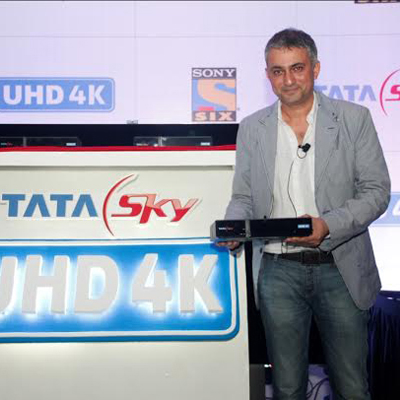
    MUMBAI: The era of India being a country that lags behind the more developed nations is gone. Indian  DTH operators in the country are waking up, ancticipating  future desires of Indian TV viewers. Which is why one of the oldest and largest DTH operators Tata Sky, is keeping itself and its subscribers up to date with the  introduction of its 4k Ultra HD service.


    The first quarter of 2015 will see Tata Sky roll out its set top boxes (STBs) for its 4k Ultra HD service. The STBs are being made by Technicolor and are based on the high efficiency video coding (HEVC) format that 4k uses the world over. However, prices of the STB are not yet known as the DTH operator wants to reveal it closer to the commercial launch date.


    At a demonstration event in Mumbai, Tata Sky along with Sony Six unveiled the 4k UHD service with a live uninterrupted broadcast of the France versus Germany FIFA World Cup 2014 quarter final. The FIFA 4k signal rights had been bought by Sony Six while the cost of acquisition and transmission was split 50:50 by the broadcaster and the operator. The telecast took place live via satellite transmission.  


    Indiantelevision.com readers will note that Videocon d2h had previewed its 4K service on 3 July 2014 too, a day before Tata Sky..


    Even though most industry professionals  claim that it is too early to launch 4k Ultra HD in India, Tata Sky chief commercial officer Vikram Mehra feels otherwise. “When we launched HD in 2010, people doubted us saying it won’t work. As you keep enhancing TV experience, the viewer will appreciate it. So, Ultra HD is our endeavour in that area. A technology becomes popular when mainline pay-TV adopts it.”


    Mehra feels that movies and sports will be the initial drivers for 4k technology and talks with broadcasters have already commenced. In three to four years, he expects it to be the way of life for most Indian TV viewers. Even though currently there is a lack of 4K content, he feels that it isn’t too far away. “We will make a product that makes sense to the customer. Customers will not buy STBs to adorn their homes. They will buy it for content,” he says.


    Sony Six business head Prasana Krishnan feels that more sporting events should be produced in 4K soon, probably in the next year or so. “4K is the future of broadcasting, specially sports. We saw technology move from SD to HD and now HD has become standard. 4K is next,” he says. Krishnan is aware that a full-fledged 4K channel can’t be expected very soon. Big sporting events will have 4K production on crucial days such as the finals, while the run up matches will be in HD and SD.


    The 4K screening of the FIFA World Cup 2014 quarter finals that took place in Mumbai yesterday, 4 July saw the Sony Six logo being superimposed on the FIFA feed on an 84 inch Sony television set that is soon to be launched in India and across the world. 4K screens give four times the clarity as compared to an HD feed.


    Mehra  was not willing to venture any guesstimates about how much uptake the Tata Sky 4K service will have when it launches next year as he feels making futuristic statements is of no use. However, the fact that the DTH operator is confident about its prospects is clear from the contract that it has signed with Technicolor, according to which deliveries of 4K set top boxes in “volume” are expected to commence in early 2015.


    Adds Mehra: “We started active service in 2007 and today we have 2.9million people paying Rs 45 each for them. Close to 65 per cent of our STBs sold today are HD. This from our total subscriber base of 13.5 million.” It is pertinent to note that Tata Sky, since late last year, has stopped buying any more SD boxes.
  • Tony D’silva draws up wishlist for MIB

    Tony D’silva draws up wishlist for MIB

    MUMBAI: The Information and Broadcasting Minister (I&B) Prakash Javadekar wants a happy Media and Entertainment industry. And for the same, he has been meeting the members of the industry personally to understand their concerns and devise a way forward.


    The cable TV industry, which is currently undergoing digitisation, is looking up to the Minister for a better tomorrow. While digitisation of the 120 million cable TV homes in phase III and phase IV took a backseat with the general elections, so did the launch of the Headend in the Sky (HITS) by Grant Investrade, a 100 per cent subsidiary of Hinduja Ventures.


    Now with the Ministry throwing some clarity on the next two phases of digitisation, Hinduja group on Monday paid the Rs 10 crore licence fee to the Ministry to move things forward. But, this isn’t all, with this, the expectations from the Ministry has also risen.


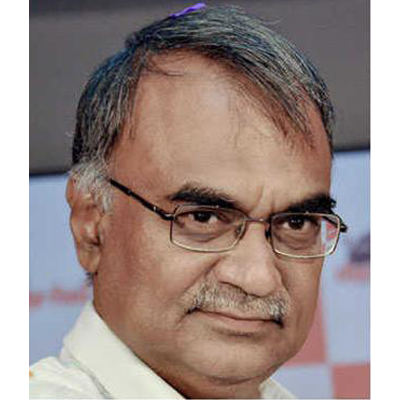
    In a conversation with indiantelevision.com, IMCL MD & group CEO Tony D’silva lists down his wishlist from the new government and especially the I&B Minister.


    • The I&B must demonstrate its commitment to digitisation by immediately announcing the future dates of the remaining two phases.


    • According to me, unlike phase I and phase II of digitisation, the government should consider digitising not phases, but complete states. This will also avoid the confusion of neighbouring markets like Hyderabad / Secunderabad, Mumbai and suburbs, Delhi and surrounding markets as well as prevent piracy of signals.


    The advantage of doing state-wise digitisation is that if the whole state is involved, the state government can easily estimate its revenues and join forces to ensure implementation. (Similar method was followed in some other countries).


    • Broadcaster pricing needs to be worked out more meaningfully in states that are not yet digitised. From my understanding for most broadcasters, phase I and II contribute at least 75 per cent or more of their existing revenues that is from approximately 30 million homes. This means that the rest 25 per cent or so of their business comes from the 100 million- 120 million homes that fall in the next two phases. So when you look at the ratios, then what really should be the pricing of the broadcasters? Broadcaster pricing is the key to the success of digitisation in phase III and IV.


    • The broadcaster pricing has to be different. It has to be territory wise and therefore, digitising a complete state is more feasible. The MSOs, broadcasters and the TRAI can sit and discuss in an environment which is more transparent and also come up with pricing which is more viable for phase III and IV.


    •  The Hinduja group is committed to invest over $100 million, to set up its HITS business, which is a white label backend service provider to support the smaller operators and help them retain their business and livelihood (the industry employs a few million people), hence it’s important to support the LMO. The group has already invested a couple of crores on the project, but needs a confirmed date for digitisation, before its expense meter starts ticking (transponder payments etc).


    • While we do support the government’s effort to encourage indigenisation of set top boxes (STBs), the government should also ensure that it is offered at comparative or better terms than international suppliers (price, credit facilities, repairs, servicing etc). A roadmap for future high end STBs should also be provided.


    • One of the key players in the value chain is the LMO. Enough by way of regulation and processes has not been done for them as yet. This needs a complete relook in light of the present situation in phase I and II markets.


    • I believe that one of the key objectives of digitisation is consumer choice. Government must insist on the prepaid model along with packaging of channels from day one of digitisation in phase III and IV markets, or else we will face the same problems like the ones in phases I and II.


    • The LMO has been the backbone of the C&S industry. In view of this, the government must find a way to encourage them to grow their business. The current licencing policy is completely against the interest of a small LMO. I fail to understand why an operator who has existed for years in the market is asked to get a fresh licence from the centre?  I can’t understand if he is a pan India operator, who already has a licence and has a registered business and is even paying his taxes, then why should digitisation change his status?


    If he does not comply with the guidelines, action can be taken by the regulator or the market forces will anyway drive him out of business as there are alternatives to consumers like DTH etc. This needs some immediate intervention.


    • The industry is heavily burdened with huge investments due to digitisation. Investments have been made in headends, backend services and STBs, among other things. I earnestly request that the C&S business be given an industry status. Also a relief from double tax: service tax and entertainment tax is needed. Reduction in import duties is also a necessity as it directly affects the customer. Also the entertainment tax needs to come down. It should be a percentage of the package the customer chooses, rather than have one set rule for all the households.


    • Another issue is of TRAI’s current regulation on de-aggregation. While the regulation was supposed to help the MSOs, it has had an adverse effect. So, I would like to appeal to the broadcasters and the authorities to intervene and bring about the reasonable pricing model that facilitates business. The broadcasters need to take a long term view of how they can monetise the content, because the old theory of everyone wanting to be on the basic pack cannot work anymore.
  • RC Venkateish elected as president of DTH Operators Association

    RC Venkateish elected as president of DTH Operators Association

    MUMBAI: A new face will be representing the six direct to home (DTH) operators. In a meeting, held by the DTH Operators Association of India, Dish TV CEO RC Venkateish was unanimously elected as the new president for a term of one year.


    The earlier president was Tata Sky MD and CEO Harit Nagpal who was the president for three years. Unlike the earlier rule, where the elected president served a term of three years, it has been now decided that the term will be for one year which can be extendable by another year.


    Speaking to indiantelevision.com, Venkateish expressed delight on his new role. “Of course I am happy but it also means more work to be done,” he says. He takes office from 1 August 2014.


    The association has also decided that from now on it will hold regular meetings every quarter to address issues.

  • Digitisation has failed to show increase in ARPUs: Deloitte

    Digitisation has failed to show increase in ARPUs: Deloitte

    NEW DELHI: Although carriage fees saw a reduction of 15-20 per cent after the first two phases of digitisation, the delay in implementation of the various phases of digitisation means the promised jump in subscription revenues and average revenue per user (ARPU) has not materialized.


    The recently launched Digitization and Mobility: Next frontier of growth for M&E, report by Deloitte states, “One year into the implementation of digitisation, the cable and broadcast sector is still trying to iron out creases and get systems in place. The key goal of digitisation was addressability, which was expected to plug leakages in the system. While cable subscribers have been increasing, rampant under-declaration meant, Multi-System Operators (MSOs) that transmitted the signals to cable operators earned little from the large subscriber base.”


    In 2014, Deloitte predicts that the digital TV distribution space – both digital cable and Direct-to-Home (DTH) would find ample room for growth given the catalysing effect of digitisation and the headroom for growth provided by non-TV households in the country.


    The report prepared for the ASSOCHAM annual M&E meet says about 12 million set-top boxes have been seeded and 80 per cent consumer application forms have been received as of December 2013. The Telecom Regulatory Authority of India (TRAI) claims 100 per cent digitisation in DAS phase II.


    TRAI has also said recommendations on the new DTH licences would be brought out very soon.


    HITS licenses which have been issued to two players, is expected to enable digitisation in phase III and phase IV markets.


    Meanwhile, the report notes, “Complaints have poured in against set-top boxes. People in the city are complaining about digital set-top boxes installed in their houses and offices. Visual and sound disturbances coupled with channels going off air from time to time have left viewers unhappy.”


    It also notes that “in the haste to install set-top boxes in the city, cable operators have overlooked a crucial step – that of filling in the Cable Access Form (CAF) before installation of the device. The purpose behind mandating DAS was to identify the actual number of cable viewers in the country. But with most customers not filling in the form, the purpose still remains defeated.”


    “With penetration of TV in India standing at approximately 65 per cent, at present, the country has close to 80 million non-TV households, which presents a key opportunity for the television distribution players. This low level of penetration holds a great potential for players to increase their subscribers and revenues. Drivers such as rising incomes, decreasing household size, multi TV phenomenon and rising urbanisation would only provide a further fillip.”


    Noting that the government’s digitisation mandate is “slowly but steadily progressing towards its target,” the report says the television distribution space is abuzz with prospects, albeit it would call for investments and improvements, especially from the digital cable players. All metros except Chennai have been largely digitised and the phase II of digitisation, which covers 38 cities, is also nearing completion. Phase III and IV of digitisation targets December 2014 for their completion. This would mean digitisation of additional 40 to 50 million households in the balance towns.”


    The report also says that phase III aims to focus on digitisation of all urban areas (municipal areas). Given the extensive coverage of MSOs and LCOs in such areas, digital cable is expected to make the most in the relatively densely populated areas, notwithstanding the churn of subscribers to DTH. In the first phase of digitisation, DTH operators were able to grab 20 per cent of subscribers converting them from analog to digital.


    Phase IV aims to focus on digitisation for the rest of India, which predominantly aims at rural areas and tier II cities. DTH is expected to gain the most in areas with sparse population and inadequate cable infrastructure.


    Digitisation phases, scope and affected subscribers

    Digitisation phase               Scope                                        Subscribers affected (million)

    Phase I                            Delhi, Mumbai, Kolkata, Chennai        8-10

    Phase II                           All cities with population > 1 million   12-14

    Phase III                          All urban areas (Municipal areas)        30-35

    Phase IV                         Rest of India                                               22-25

    Source: Industry discussions


    DTH, as a sector, had started off by concentrating on rural areas, which were deprived of cable infrastructure and gradually also entered the urban markets. However, they are still strong in rural markets.


    Given the complexity of the exercise across the country and the rate at which television penetration is growing (MPA expects India to have 183 million pay-TV homes by 2020); the scale of undertaking of digitisation will be a big challenge.  


    But it says analysts and sector professionals agree the future looks promising with the lessons learnt from phases I and II.

  • Dish TV’s appeal to the Finance Minister

    Dish TV’s appeal to the Finance Minister

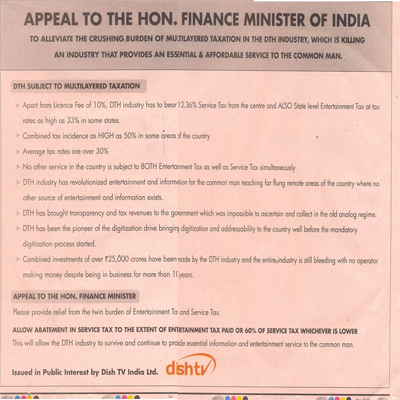
    MUMBAI: The Direct to Home (DTH) industry has been vehemently opposing the heavy taxation being levied on the various operators in the country. In view of the same, the country’s oldest DTH operator Dish TV has appealed to the new Finance Minister Arun Jaitley.


    The DTH operator in its appeal has requested the Minister to alleviate the crushing burden of multilayered taxation in the DTH industry which is in turn killing the industry. The operators are subject to several taxes such as 10 per cent licence fee, 12.36 per cent service tax from the centre and the state level entertainment tax which is as high as 33 per cent in some states. While the average tax rates in most states is 30 per cent, in some it is as high as 50 per cent.


    The appeal states that no other service in the country is subject to both service as well as entertainment tax at the same time. “DTH industry has revolutionised entertainment and information for the common man reaching far flung remote areas of the country where no other source of entertainment and information exists. It has brought transparency and tax revenues to the government which was impossible to ascertain and collect in the old analogue regime,” states the appeal.


    Dish TV says that the entire industry has made investments of over Rs 25,000 crore but is still bleeding with no operator making money despite being in business for more than 10 years.


    The request by the operator on behalf of the entire industry is to provide relief from the twin burden of entertainment tax and service tax. It requests to allow abatement of service tax to the extent of entertainment tax paid or 60 per cent of service tax whichever is lower.   

  • Dish TV adds B4U on its platform

    Dish TV adds B4U on its platform

    MUMBAI: Music channel B4U will now be available on Dish TV in all packs that the DTH platform offers.


    With this move the music channel aims to strengthen its position in the entertainment world.


    The channel’s CFO Sandeep Gupta said, “We are extremely excited to get access on the Dish DTH platform which has more than 11 million active subscriber base. This will facilitate the music loving Indian audience with more choice to entertain themselves. The demand for Indian music across the world has been encouraging us to offer our content through various mediums so that they can entertain themselves with their own choice.”


    With a rich film and varied music library, B4U is a strong platform for Bollywood film soundtracks and latest blockbusters to classic old time movie’s which is now contentedly accessible for all the Bollywood music and old classic movie lovers.  


    B4U music channel will be available on channel number 668 while B4U movie channel will be available on channel number 207.

  • Doordarshan EPG to be carried by all DTH platforms and DD Direct Plus

    Doordarshan EPG to be carried by all DTH platforms and DD Direct Plus

    NEW DELHI: Though it was one of the first channels to go on to the direct-to-home platforms, Doordarshan has finally ensured that the private DTH operators carry its electronic programming guide.


    For this purpose, Doordarshan has entered into a deal with NDTV and What’s on India Media.


    A DD source told indiantelevision.com that NDTV will manage the EPG of all 21 DD channels and deliver it to all multi-system operators and DTH operators of the country.


    Servicing, aggregating EPGs of all the channels of DD Direct Plus and delivering it to DTH Direct Plus platform in compatible format will be handled by What’s on India.


    The source said that some of the DTH operators had already commenced the EPG guide while others will commence shortly.


    This move is expected to increase viewership of Doordarshan, who unlike private TV channels do not always run the same series at the same times on all days of the week. DD has some series which runs on only one or two days a week and others running daily on week days, and this often leads to confusion among viewers.


    The source therefore said this was bound to bring the viewer closer to the channel.


    EPG would provide Doordarshan viewers with continuously updated menus, displaying broadcast programming or scheduling information for current and upcoming programming.

  • MEASAT-3b launch delayed

    MEASAT-3b launch delayed

    MUMBAI: The much awaited MEASAT-3b launch has been delayed. While the satellite was set for launch on 6 June (7 June Kuala Lumpur time), it has now been postponed after the manufacturer of the MEASAT-3b co-passenger requested time for repairs to their satellite.


    “We are clearly disappointed with the delay and are currently in co-ordination with Arianespace (the launch service provider) on the rescheduling of the launch,” said MEASAT Satellite Systems CEO Paul Brown-Kenyon through a press statement. “We will provide an update when we receive further information on the revised launch date,” he continued.


    MEASAT-3b is designed to provide an additional 48 high powered Ku-band transponders to the 91.5°E orbital slot to expand Direct-To-Home and VSAT services across Malaysia, India, Indonesia and Australia. Co-located with MEASAT-3 and MEASAT-3a, the satellite will more than double MEASAT’s Ku-band capacity at 91.5°E creating one of the region’s most powerful and robust orbital locations.


    The delay in the launch of the satellite will further delay DTH operator Sun Direct’s plans of adding more high definition and standard definition channels. With the launch of MEASAT-3b, Sun Direct is set to add nine more transponders to its existing four transponders.  

  • Dish TV adds 8.1 lakh subscribers in FY-2014; ARPU up from Rs 158 to Rs 170

    Dish TV adds 8.1 lakh subscribers in FY-2014; ARPU up from Rs 158 to Rs 170

    BENGALURU:  Dish TV Limited (Dish TV) in its earnings release for FY-2014 says that it has added about 8.1 lakh net subscribers in FY-2014 and 2.26 lakh subscribers in Q4-2014 to take its total subscriber base to 1.14 crore net subscribers during the period.


    The company also claims that it has increased ARPU (Average Revenue Per User) from Rs 158 during the previous year to Rs 170 in FY-2014. It says that it has managed to contain the subscriber churn to 0.6 per cent per month.


    Note: (1) 100,00,000=100 lakh = 1 crore = 10 million.

    (2) Standalone figures in this report 


    FY-2014 standalone revenues stood at Rs 2508.98 crore recording 15.79 per cent growth over the Rs 2166.80 crore in FY-2014. Dish TV reported standalone operating revenue of Rs 636.91 crore, recording 14.68 per cent growth over the Rs 555.40 crore in corresponding period last fiscal and 2.10 per cent more than the Rs 623.81 crore in immediate trailing quarter.


    Dish TV’s net loss for FY-2014, impacted by a prior period adjustment of Rs 116.4 crore, was Rs (-154.2) crore as compared to a loss of Rs (-66.75) crore in FY-2013. Net loss for Q4-2014, impacted by the above mentioned prior period adjustment of Rs 116.4 crore, increased to Rs (-149.05) crore compared to Rs (- 43.62) crore in Q4-2013 and a loss of Rs (-28.36) crore in Q3-2014, says the company.


    Let us look at the other numbers reported by Dish TV for FY-2014 and Q4-2014


    Dish TV’s Total Expense (Tot Exp) in FY-2014 at Rs 2482.30 crore (98.94 per cent of Total standalone revenue) was 12.07 per cent more than the Rs 2214.96 crore (102.22 per cent of Total standalone revenue) in FY-2013. Q4-2014 Tot Exp at Rs 657.05 crore (103.16 per cent of Total standalone revenue) was 4 per cent more than the Rs 631.78 crore (101.28 per cent of Total standalone operating income) in Q3-2014 and 13.21 per cent more than the Rs 580.36 crore (104.49 per cent of Total standalone operating income) in Q4-2013.


    The company’s finance cost increased 3.37 per cent in FY-2014 to Rs 132.68 crore (5.29 per cent of Total standalone operating income) from Rs 128.36 crore (5.92 per cent of Total standalone operating income) in FY-2013. Dish TV’s Q4-2014 finance cost at Rs 32.63 crore (5.12 per cent of Total standalone operating income) was 8.41 per cent more than the Rs 30.10 crore (4.83 per cent of Total standalone operating income) in Q3-2014 and (-5.01) per cent lower than the Rs 35.85 crore (6.18 per cent of Total standalone operating income) in Q4-2013.


    Dish TV’s Programming/content and other cost (Content cost) in FY-2014 at Rs 261.38 crore (10.42 per cent of Total standalone operating income) was 15.81 per cent higher than the Rs 225.70 crore (10.42 per cent of Total standalone operating income). Q4-2014 content cost was 2.29 per cent more at Rs 66.98 crore (10.52 per cent of Total standalone operating income) as compared to the Rs 65.48 crore (10.5 per cent of Total standalone operating income) in the immediate trailing quarter and 15.3 per cent more than the Rs 58.09 crore (10.46 per cent of Total standalone operating income) in the year ago quarter Q4-2013.


    The company paid Rs 288.48 crore (11.5 per cent of Total standalone operating income) as licence fees in FY-2014 which was 25.49 per cent more than the Rs 229.89 crore (10.61 per cent of Total standalone operating income) in FY-2013. Dish TV paid Rs 82.38 crore (12.93 per cent of Total standalone operating income) towards licence fees in Q4-2014 which was 10.96 per cent more than the Rs 74.24 crore (11.90 per cent of Total standalone operating income) in Q3-2014 and 34.34 per cent higher than the Rs 61.32 crore (11.04 per cent of Total standalone operating income) in Q4-2013.


    Dish TV’s selling and distribution expense is made up of two parts – ‘commission’ and ‘other selling and distribution expense’ (distribution exp).


    Commission expense in FY-2014 at Rs 183.67 crore (7.32 per cent of Total standalone operating income) was 17.84 per cent more than the Rs 155.87 crore (7.19 per cent of Total standalone operating income) in FY-2013. Q4-2014 commission expense at Rs 50.65 crores (7.95 per cent of Total standalone operating income) was 0.56 per cent more than the Rs 50.37 crore (8.07 per cent of Total standalone operating income) in Q3-2014 and 31.94 per cent more than the Rs 38.39 crore (6.91 per cent of Total standalone operating income) in Q4-2013.


    Distribution Exp in FY-2014 at Rs148.42 crore (5.92 per cent of Total standalone operating income) was 0.44 per cent more than the Rs 147.77 crore (6.82 per cent of Total standalone operating income) in FY-2013. In Q4-2014, Dish TV paid (-5.85) per cent lower towards distribution exp at Rs 32.66 crore (5.13 per cent of Total standalone operating income) as compared to the Rs 34.69 crore (5.56 per cent of Total standalone operating income) in Q3-2014 and (-8.9) per cent lower than the Rs 35.85 crore (6.45 per cent of Total standalone operating income) in Q4-2013.


    Dish TV’s take


    Dish TV chairman Subhash Chandra said, “The Media industry had its share of opportunities and challenges all through the year. Digitisation kept the industry on its toes. In an uncertain macro environment, Dish TV pursued its strategy of self-funded growth; deleveraging the business while being selective about its subscriber additions notwithstanding the noise around digitisation. The result, a healthier Balance Sheet coupled with the largest subscriber base in the industry and a free cash positive business which is much better equipped to capitalize on the opportunities ahead.”


    Dish TV managing director Jawahar Goel added, “Unlike fiscal 2013, fiscal 2014 was a disruptive period where we had to choose between immediate benefits and long term sustainability in the hyper competitive DTH industry. Choosing the later, we continued to deleverage while maintaining our subscriber acquisition price point. With a much manageable and scalable debt profile now, we have started 2014 with a significant positive overhaul to our macro parameters.”


    “With a new government at the Centre, the DTH industry is optimistic about rationalisation in the tax regime. As notification of the Goods and Services Tax (GST) is taking time, we look forward to allowance of abatement in Service Tax along with moderation in Entertainment Tax in line with the prevailing structure in Gujarat and other forward looking states. We are also hopeful of an early resolution of the DTH license renewal and payment of license fees matter in the industry’s favour. We also expect a firm push to digitisation and are confident that encryption, packaging, billing and other critical requirements will be implemented at the last mile,” he added.


    “Dish TV’s fourth quarter subscriber adds are a result of some serious strategic initiatives taken earlier. The ‘Zing’ sub-brand launched as part of a differentiated strategy to cater to the Phase III & IV markets got a tremendous response and even bolstered the flagship brand’s sales. We exited the fourth quarter bagging the highest incremental market share while keeping a check on our churn, which remained at 0.6 per cent per month. Making further headway on our Sri Lanka Project, we launched test signals as per plan,” said Goel.

  • Sun Direct to add 9 transponders by June

    Sun Direct to add 9 transponders by June

    MUMBAI: Direct to home (DTH) operator Sun Direct is looking at increasing its high definition (HD) and standard definition (SD) channel offering. The DTH operator that currently has four transponders will soon add nine more transponders to its kitty, thanks to the deal signed between Sun Direct and MEASAT Satellite Systems.

    The announcement comes after Sun Direct got a nod from Antrix Corporation for additional capacity. The platform currently has 11 HD and 210 SD channels. “We had applied to Antrix and have got its approval. With this, we will be shifting to MEASAT 3b and hence, will get nine transponders by first week of June. Our HD offering is currently low, but with the extra capacity we aim to take it to 30, while we expect the number of SD channels to go up to 350,” informs Sun Direct MD Mahesh Kumar.

    With this, the total number of transponders will go up to 13. “While we are currently focused on the south market, we can think of targeting other regions after this boost. We will first fill the gaps in our south offering and the HD channel offering,” he adds.

    The increase in the capacity is not the only change the DTH platform is looking at. It was in October 2013 that Sun Direct had announced that it would be launching 500 ‘Sunshine’ centers across south India to improve its customer’s service needs. “Of the 500 ‘Sunshine’ centers, we have already launched 200 centers in eight months,” says Kumar.

    The core aim of these ‘Sunshine’ stores will be to provide customer service, while new connections, demo and recharges will also be available. The stores that have been set up in every district are based on franchisee model. “While the cost for setting up of these stores is being borne by the franchisee, we will be investing for the backend support,” informs Kumar.

    The DTH operator has also introduced a tri-partite conference call service. This 24X7 service hotline number: 076010-12345 which will be manned round the clock will ensure that customer grievances are addressed within 48 hours. “We have started a conference call facility between the company, engineer and the customer. Post the grievance is registered and dealt with, a customer satisfaction survey will also be conducted,” he says.

    Sun Direct is spending approximately Rs 25 crore ($4 million) on the backend support.  According to Kumar, currently the ‘Sunshine’ centre witnesses 50 customers per day per store. The revenue model for the business will depend on the business each store generates.

    The ‘Sunshine’ centers that have been designed by JWT, have a standard format, with store dimensions ranging between 150 and 300 sq ft, depending upon the requirements of the specific town. “The stores have standard colour code which is in line with Sun Direct,” informs Kumar.

    Will we see such centers in other parts of the country as well? Says Kumar, “Currently we are looking at strengthening our service in south, once we get the extra transponders and hence more channels, we can think of other region as well.”