Tag: DTH subscribers

  • Pay DTH operators lost 1.6 mn subscribers in quarter ended 31 March 2022: TRAI

    Pay DTH operators lost 1.6 mn subscribers in quarter ended 31 March 2022: TRAI

    Mumbai: The number of pay direct-to-home (DTH) subscribers decreased sharply from 68.52 million to 66.92 million in the quarter ended on 31 March 2022, as per latest Telecom Regulatory Authority of India (TRAI) performance indicator report. It has lost a total of 1.6 million subscribers during the period.

    DTH operators have seen a consistent decline in their subscribers since reporting an all-time high of 70.99 million subscribers in December 2022.

    Also read: DTH segment expands its subscriber base by 1.01 mn in 2020 | Indian Television Dot Com

    The number of private satellite TV channels permitted by the ministry of information and broadcasting (MIB) for uplinking or downlinking also decreased from 909 to 898 channels. Broadcasters reported 345 pay channels down from 350 pay channels in the quarter ended on 31 December 2021. The number of free-to-air (FTA) channels also declined from 543 to 540 during the same period.

    Tata Play continued to be the leading DTH operator with 33.23 per cent market share down from 33.48 per cent in the previous quarter. Bharat Telemedia’s share stood at 26.24 per cent down from 26.37 per cent.

    Also Read: Geo-targeted campaigns ramp up as brands go hyperlocal

    Dish TV India increased its market share from 22.04 per cent to 22.10 per cent. Sun Direct also increased its market share from 18.11 per cent to 18.43 per cent.

    [[{“fid”:”1087009″,”view_mode”:”default”,”fields”:{“format”:”default”,”alignment”:””,”field_file_image_alt_text[und][0][value]”:false,”field_file_image_title_text[und][0][value]”:false},”type”:”media”,”field_deltas”:{“1”:{“format”:”default”,”alignment”:””,”field_file_image_alt_text[und][0][value]”:false,”field_file_image_title_text[und][0][value]”:false}},”attributes”:{“height”:”416″,”width”:”700″,”class”:”media-element file-default”,”data-delta”:”1″}}]]

    As per the ministry, there are 1764 registered multi-system operators (MSOs) in the country.

    There are 12 MSOs and 1 headend-in-the-sky (HITS) operator whose subscriber base is more than one million, according to the TRAI data.

    GTPL Hathway widened its lead as the largest MSO in the January-February-March 2022 quarter with 8,232,240 subscribers followed by SITI Networks at 7,281,041, Hathway Digital at 5,455,919 and Hathway Digital 4,458,103 subscribers.

    [[{“fid”:”1087019″,”view_mode”:”default”,”fields”:{“format”:”default”,”alignment”:””,”field_file_image_alt_text[und][0][value]”:false,”field_file_image_title_text[und][0][value]”:false},”type”:”media”,”field_deltas”:{“2”:{“format”:”default”,”alignment”:””,”field_file_image_alt_text[und][0][value]”:false,”field_file_image_title_text[und][0][value]”:false}},”attributes”:{“height”:”444″,”width”:”700″,”class”:”media-element file-default”,”data-delta”:”2″}}]]

    There were 20 internet protocol TV operators in the country as of 31 March 2022.


  • DTH sector lost 0.37 mn subs in the quarter ended 31 Dec’21: Trai

    DTH sector lost 0.37 mn subs in the quarter ended 31 Dec’21: Trai

    Mumbai: The total active subscriber base of the pay direct-to-home (DTH) sector declined from 68.89 million at the end of September 2021 to 68.52 million at the end of December 2021, as per data provided by the Telecom Regulatory Authority of India (Trai). This is in addition to the subscribers of DD Free Dish, the free DTH service offered by Doordarshan.

    Tata Play maintained its position as the leading DTH player increasing its market share from 33.34 per cent to 33.48 per cent. It was followed by Bharti Telemedia that also increased its market share from 26.11 per cent to 26.37 per cent. Dish TV India ceded market share from 22.65 per cent to 22.04 per cent. Sun TV Direct gained market share from 17.91 per cent to 18.11 per cent.

    Trai reported the subscriber base of 12 major multi-system operators (MSO) and one headend-in-the-sky (HITS) operator who have a subscriber base of more than one million. GTPL Hathway continued to be the leading MSO followed by Siti Networks, Hathway Digital, Den Networks and Thamizhaga Cable TV Communication. While most MSOs lost subscribers during the quarter, Thamizhaga, Kerala Communicators Cable, Nxt Digital (HITS), V K Digital Network and Nxt Digital (Cable TV) gained subscribers. Notably, Nxt Digital (HITS and Cable TV) gained the highest number of subscribers at 436,990.

    [[{“fid”:”1074109″,”view_mode”:”default”,”fields”:{“format”:”default”,”alignment”:””,”field_file_image_alt_text[und][0][value]”:false,”field_file_image_title_text[und][0][value]”:false},”type”:”media”,”field_deltas”:{“1”:{“format”:”default”,”alignment”:””,”field_file_image_alt_text[und][0][value]”:false,”field_file_image_title_text[und][0][value]”:false}},”attributes”:{“height”:”517″,”width”:”700″,”class”:”media-element file-default”,”data-delta”:”1″}}]]

    There were 909 private satellite TV channels at the end of December 2021 compared to 906 channels at the end of September 2021. Additionally, there were 350 pay channels out of which 253 were SD channels and 97 were HD channels.

    The number of internet subscribers decreased from 834.29 million to 829.30 million during the quarter. There were 792.08 million broadband subscribers and 37.21 million narrowband subscribers. The number of wired internet subscribers increased from 24.47 million to 26.58 million with a quarterly growth rate of 8.62 per cent. The number of wireless internet subscribers decreased from 809.82 million to 802.72 million.

    [[{“fid”:”1074119″,”view_mode”:”default”,”fields”:{“format”:”default”,”alignment”:””,”field_file_image_alt_text[und][0][value]”:false,”field_file_image_title_text[und][0][value]”:false},”type”:”media”,”field_deltas”:{“2”:{“format”:”default”,”alignment”:””,”field_file_image_alt_text[und][0][value]”:false,”field_file_image_title_text[und][0][value]”:false}},”attributes”:{“height”:”500″,”width”:”700″,”class”:”media-element file-default”,”data-delta”:”2″}}]]

    In the wired internet segment, Reliance Jio Infocomm held 17.18 per cent market share with 4.57 million subscribers, followed by Bharti Airtel at 4.20 million subscribers. In the wireless internet segment, Reliance Jio held 51.79 per cent market share with 415.72 million subscribers followed by Bharti Airtel with 28.21 per cent with 226.45 million subscribers at the end of the quarter.

    The total number of VSAT subscribers decreased from 289,557 to 288,848 during the quarter. Hughes Communications is the market leader with 135,374 subscribers and market share of 46.87 per cent, followed by Nelco at 76,166 subscribers and market share of 26.37 per cent at the end of the quarter.

    The average revenue per user (ARPU) per month of wireless services customers increased from Rs 108.16 to Rs 114.16 over the quarter. The average data usage per month for a wireless subscriber was 14.97 Gb.

  • DTH subscribers grow in June quarter, Tata Sky maintains lead in pay TV genre: Trai

    DTH subscribers grow in June quarter, Tata Sky maintains lead in pay TV genre: Trai

    Mumbai: The number of pay DTH subscribers has increased from 68.57 million to 68.86 million during the April-June quarter in addition to subscribers of DD Free Dish, said Telecom Regulatory Authority of India (Trai) in its latest ‘Indian Telecom Services Performance Indicators’ report.

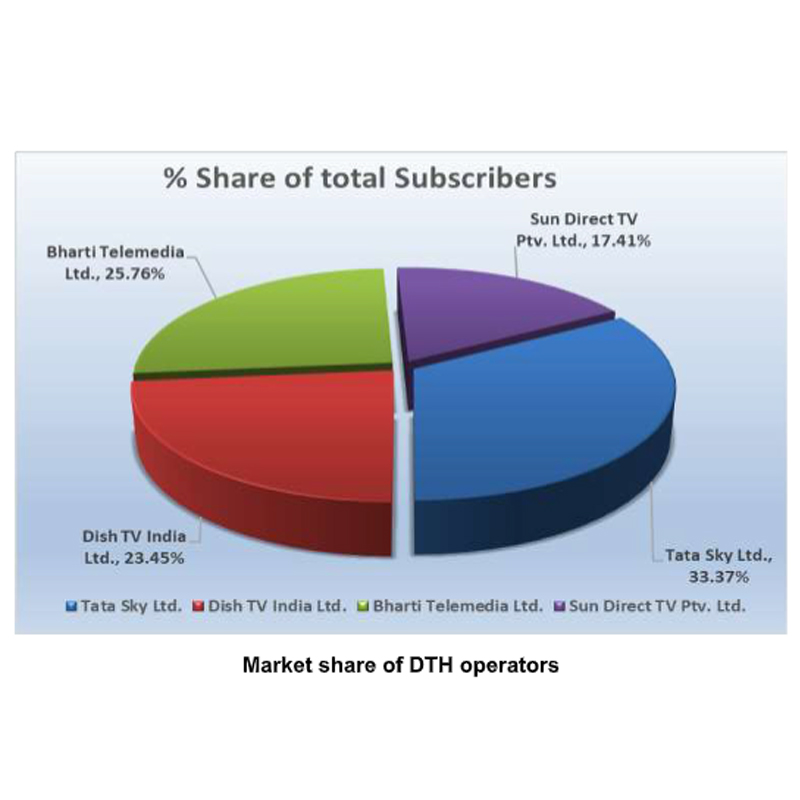
    Tata Sky continued to maintain the lead in the pay-TV genre with a share of 33.37 per cent, followed by Bharati Telemedia with 25.76 per cent, Dish TV India with 23.45 per cent and Sun Direct TV with 17.41 per cent. 

    According to the report, Reliance Jio Infocomm was the market leader in the access provider segment with 440.59 million subscribers and 36.64 per cent market share. It added 14.34 million telephone subscribers at the end of June.

    Bharti Airtel saw a marginal decline in subscribers from 357.17 million to 357.05 million. Vodafone Idea subscriber base also declined from 284.23 million to 273.88. Similarly, BSNL, MTNL, Tata Teleservices, Reliance Communication, and Quadrant lost subscribers in the quarter.

    The internet subscriber base in India grew from 825.30 million to 833.71 million at the end of June. This internet user base comprises 23.58 million wired subscribers and 810.13 million wireless subscribers. Out of the total internet base, 97.09 per cent are using mobile devices and 95.09 per cent are using broadband services to access the internet.

    BSNL is the leader in wired internet subscribers with a 25.57 per cent market share and 6.03 million subscribers followed by Bharti Airtel with 3.37 million subscribers. Reliance Jio holds a 59.901 per cent market share in the wireless internet subscriber base with 436.69 million subscribers followed by Bharti Airtel with a 26.76 per cent share.

    The top five service areas in terms of internet subscriptions (wired+wireless) are Maharashtra (71.21 million), Andhra Pradesh including Telangana (64.38 million), U.P.(East) (63.50 million), Bihar (56.81 million), and Tamil Nadu (56.41 million).

    The broadband internet subscriber base increased from 778.09 million to 792.78 million between March-June. Narrowband internet subscriber base decreased by 13.30 per cent from 47.21 million to 40.93 million.

    The top five broadband (wired+wireless) service providers in terms of subscribers are Reliance Jio (439.91 million), Bharti Airtel (197.10 million), Vodafone Idea Ltd (121.42 million), BSNL (22.69 million), and Atria Convergence (1.91 million).

    The top five narrowband (wired+wireless) service providers in terms of subscriber base are Bharti Airtel (23.05 million), Vodafone Idea Ltd (14.72 million), BSNL (3.01 million), MTNL (0.09 million), and You Broadband (0.01 million).

    In the wired narrowband segment, You Broadband India Pvt Ltd holds 26.23 per cent market share with 0.01 million subscribers followed by Foxtel Telecommunications Pvt. Ltd. with 0.007 million subscribers. In the wireless narrowband segment, Bharti Airtel holds a 56.40 per cent market share with 23.05 million subscribers followed by Vodafone Idea Ltd with 14.72 million subscribers.

    The total number of VSAT subscribers decreased from 293,632 to 289,392. Hughes Communication Limited continues to be the market leader with 44.83 per cent share in VSAT with a subscriber base of 129,724 followed by Tatanet Services with 74,704. Hughes Communication Ltd, added the maximum number of VSAT subscribers at 2344 whereas Bharti Airtel, BSNL, and Infotel Satcom saw a decline in their VSAT subscribers during the quarter.

    The number of private satellite TV channels increased from 901 to 915. The ministry of information and broadcasting has granted 16 channels permission for uplinking only, 70 for downlinking only and 829 for both uplinking and downlinking. There are 346 pay channels out of which 252 are standard definition and 94 are high-definition channels. The remaining 569 channels are free-to-air.

    There are 1731 MSOs registered with Trai out of which only 12 MSOs and one HITS operator have a subscriber base greater than 1 million.

  • DTH expands even as pay TV market saturates

    DTH expands even as pay TV market saturates

    Mumbai: Pay TV subscription revenue is expected to reach $7.6 billion by 2026 over $6.4 billion in 2021, stated Media Partners Asia in its latest report on India’s online video market, which also highlights the increasing market share of Direct-to-home (DTH) even as cable TV remains in structural decline.

    There are 127 million pay TV subscribers in India and DTH has been winning share from cable TV since 2019. While DTH grew its subscriber share from 42 per cent in 2019 to 47 per cent in 2021, the share of cable TV declined from 56 per cent to 52 per cent in the same period.

    According to the report, there will be one billion video screens in India by the end of 2024. There will be 47 million FTA households and 121 million pay TV homes. As many as 13 million homes will have hybrid set-top-boxes, 744 million users will have 4G connections and 155 million users will have 5G connections. In the long run pay TV homes will decline while FTA homes will continue to grow, the report indicated.

    By 2026, two-third of Indians will have access to high-speed mobile broadband reaching 899 million subscribers, out of which 34 million homes will be serviced by fibre, and three million homes will have wireline (digital subscriber line) connections. The report estimates that ~90 per cent of fixed broadband homes will be serviced through fibre.

    In terms of revenues, the video market scale will grow to reach $18 billion in 2026 over $11.6 billion in 2021. Pay TV subscription revenues may reach 7.6 billion, pay TV advertising revenues at $6.1 billion, OTT advertising-video-on-demand (AVOD) to reach $2.8 billion and OTT subscription-video-on-demand to reach $1.8 billion.

    D2C SVOD subscribers to reach 193 million by 2026

    Despite content supply bottlenecks, India’s OTT SVOD subscriptions continue to grow at a robust rate. This year OTT subscribers are expected to grow by 1.6 times over the previous year to reach 88.7 million. Most of these subscribers are expected to come through Disney+ Hotstar in Q4. As per the MPA’s estimate, Disney+ Hotstar subscribers is likely to reach 46 million, Prime Video to reach 21.8 million and Netflix to reach 5.5 million at the end of the year. These platforms will continue to account for 83 per cent of total direct-to-consumer subscribers in India.

    The OTT industry is also expected to invest $1 billion in content in 2021, according to the report. Their share of acquired and local content is 30 per cent and is expected to grow to 40-45 per cent in the near future. New D2C SVOD entrants are going to enter the market by 2022 including services from HBO and Comcast.

    The content strategy of the leading OTT players is diverse and has led to subscriber growth. For Disney+ Hotstar, the combination of sports and local originals has been increasing subscriber growth. It hiked its base plan by 25 per cent “which is justified given the value of its upcoming slate of premium sport and local original content”, said the company.

    Disney+ Hotstar, which is currently at the lower end of ARPUs (<$2), will see its pricing power improve after 2022, according to the report. Prime Video has benefitted from its regional content push and Netflix has invested heavily in original content with 41 original releases in 2021.  

    In 2022, the Indian Premier League (IPL) media rights will be up for grabs once again with TV and digital rights being sold separately. The report estimates that top bidders will include Disney, Amazon, Facebook, Jio and Sony.

  • DTH operators report sharp drop in subscribers in Jan-March: TRAI

    DTH operators report sharp drop in subscribers in Jan-March: TRAI

    Mumbai: The total number of active DTH subscribers declined to 69.57 million at the end of March 2021 from 70.99 million at the end of December 2020, as per the Telecom Regulatory Authority of India (TRAI). This is in addition to the subscribers of DD Free Dish (DTH service of Doordarshan).

    The share of leading DTH players stood at Tata Sky (33.3 per cent), Dish TV India (24.09 per cent), Bharti Telemedia (25.54 per cent), and Sun Direct TV (17.07 per cent).

    A total of 901 satellite TV channels have been permitted by the ministry of information and broadcasting (MIB) out of which 327 are pay-TV channels. There are 235 SD channels and 92 HD channels. All the other channels permitted by MIB may be considered free-to-air channels.

    There are 1726 MSOs registered with MIB out of which only 12 MSOs and one HITS operator have a subscriber base greater than one million. Siti Networks had 8.2 million subscribers followed by GTPL Hathway at 7.7 million, Hathway Digital at 5.6 million, Den Networks at 4.5 million, Thamizhaga Cable TV Communication at 3.5 million, Kerala Communicators Cable at 3.05 million, Tamil Nadu Arasu Cable at 2.9 million, Fastway Transmissions 2.2 million, NXT Digital (HITS) at 2.05 million, KAL Cable at 2.02 million, VK Digital at 1.7 million, Asianet Digital Network at 1.2 million and NXT Digital (Cable TV) at 1.1 million.

    There are 366 private FM radio channels in 105 cities with 30 private FM radio broadcasters. Odisha Television Ltd, has ceased the operation of its single FM radio station in the city of Rourkela, Odisha. The advertising revenue reported by FM radio broadcasters is Rs 321.52 crore as against Rs 323.01 crore in the previous quarter.

    There are 324 operational community radio stations up from 315 in the previous quarter.

  • 35 million DTH subscribers inactive, 7 private channels not operational till March 2015: TRAI

    35 million DTH subscribers inactive, 7 private channels not operational till March 2015: TRAI

    NEW DELHI: Almost 34.90 million subscribers of direct-to-home (DTH) operators in India were inactive as against the total registered subscriber base of 76.05 million until the quarter ending March this year.


    Citing the number of subscribers across platforms such as DTH, television, multi-system operators (MSOs), internet, broadband, radio etc, the Telecom Regulatory Authority of India (TRAI) in its latest quarterly report revealed the following:


    DTH


    The number of active subscribers of the six private DTH operators namely Tata Sky, Dish TV, Videocon d2h, Airtel Digital, Sun TV and Reliance Digital TV stands at 41.15 million.


    TELEVISION CHANNELS


    Seven television channels are still not active, if one goes by TRAI’s quarterly report, according to which the Information and Broadcasting (I&B) Ministry had said that it had cleared 829 private television channels by 31 March, 2015. It may be recalled that Minister of State for I&B Rajyavardhan Rathore had yesterday told the Parliament that a total of 822 channels had been cleared.


    Of these channels, there were a total of 245 pay channels as reported by the broadcasters as on 31 January, 2015.


    However, six new pay channels namely &TV, &TV HD, Star Sports HD 3, Star Sports HD 4, Asianet Movie and Suvarna Plus – were launched, which took the number of pay channels up to 251 by the end of March.


    In areas served by non-addressable systems, the maximum number of TV channels carried in digital form as reported by multi-system operator (MSO) Hathway Cable & Datacom amongst those who have reported, is 393. On the other hand, the maximum number of TV channels carried in analog form, as reported by Ortel Communications amongst those who have reported is 100.


    MSOs


    There are a total of 155 MSOs, who have been granted Permanent Registration (for 10 years) by the I&B Ministry for providing Cable TV services through Digital Addressable Systems (DAS) by March.


    RADIO


    Apart from the radio stations operated by All India Radio, there were 243 operational private FM Radio stations as on 31 March, 2015. Meanwhile, as against the 208 community radio licenses issued, a total of 180 community radio stations were operational by March this year.


    INTERNET & BROADBAND


    The total number of Internet subscribers increased from 267.39 million at the end of December last year to 302.35 million at the end of March, 2015, registering a quarterly growth rate of 13.08 per cent.


    Out of 302.35 million, Wired Internet subscribers stood at 19.07 million, whereas there were 283.29 million Wireless Internet subscribers.


    The number of Broadband Internet subscribers increased from 85.74 million at the end of December 2014 to 99.20 million at the end of March 2015, showing quarterly growth rate of 15.71 per cent.


    NARROWBAND


    The number of Narrowband Internet subscribers increased from 181.65 million at the end of December last year to 203.15 million at the end of March this year, with quarterly growth rate of 11.83 per cent.

  • Tata Sky expands content offering; to add 20 channels

    Tata Sky expands content offering; to add 20 channels

    MUMBAI: By introducing a new compression technology to its network, Direct To Home (DTH) operator Tata Sky will soon be adding 20 new channels to its platform including an unspecified number of HD channels.


    At present, Tata Sky offers 300 channels. The upgrade work meanwhile has hurt close to 17,000 subscribers who received disrupted services during the last few days. The DTH operator has a subscription base of 10 million active subscribers.


    According to a PTI report, Tata Sky CEO Harit Nagpal said that the company had got additional capacity due to its timely decision to shift from MPEG 2 format to MPEG 4 format. “It cost us money, but helped us,” he said.


    Due to the digitisation programme, Tata Sky is expecting the DTH industry to add four million subscribers every year. Nagpal foresees the industry to grow in the next five to six years as there is enough opportunity since digitisation of analogue delivery system of home cable TV is in progress.


    The operator is also undergoing a tariff hike for its subscribers. “Every year, we go for a price hike in March, which is roughly four per cent. Last year, it was Rs 230 and this year we have increased it to Rs 240,” he told PTI.


    The company has average revenue per user (ARPU) of Rs 250 and has a growth of over five per cent on a year-on-year basis. Nagpal stated that Tata Sky would like to keep its ARPU constant and grow its base by adding customers from small places.


    He also informed that the disruption in services was because the platform changed compression standards every three to four months. To address the concerns of its customers, the DTH operator has sent its engineers to their place to resolve the issue.

  • Chandra to pump in Rs 7.5 billion into WWIL, Dish

    Chandra to pump in Rs 7.5 billion into WWIL, Dish

    MUMBAI: Subhash Chandra has big investment plans for the two de-merged entities of Zee Telefilms Ltd (ZTL). Wire and Wireless (India) Ltd. and Dish TV, engaged in the cable TV and direct-to-home (DTH) businesses respectively, will together be pumping in Rs 7.5 billion to fund their expansion plans.

    WWIL will have an investment requirement of Rs 5 billion over the next three years to give a big push to digitisation of cable TV, broadband and voice services. The cable company also expects to rope in an investor. “WWIL has a business plan which would take in an investment of Rs 5 billion over three years. The strategic thrust will be on rollout of digital cable. We are also looking at triple play offerings. We have a network which can be made available to telecom operators for voice,” Essel Group chief executive officer of corporate strategy and finance Rajiv Garg tells indiantelevision.com.

    WWIL is looking at a debt-equity ratio of 1:1. “The net worth of the company currently is not that strong to support that sort of debt. We would like a 1:1 debt-equity ratio,” Garg says.

    Operating revenues from ZTL’s cable line of business stood at Rs 1.5 billion for the fiscal ended 31 March 2006 while net profit was at Rs 7 million.

    For Dish TV, the DTH outfit, there is a Rs 2.5 billion investmen plan over the next two years. The net expenses for DTH operations thus far is Rs 3.8 billion, says Garg. “We project a gross revenue of Rs 3.2 billion from our DTH business in FY07. We aim to have 2.4 million DTH subscribers in the fiscal while the average revenue per user (ARPU) should go up from Rs 190 to Rs 250 a month because of the launch of value-added services,” he adds.

    The operating revenues for the DTH business stood at Rs 818 million in FY06. On the back of subsidies and marketing expenses, the DTH operations incurred a loss of Rs 790 million during this period.

    The de-merged DTH and cable companies are likely to opt for an initial dilution of up to 26 per cent to investors. They are open to both private equity and strategic investors.