Tag: DTH Association

  • DTH players seek removal of eight per cent licence fee to stay competitive

    DTH players seek removal of eight per cent licence fee to stay competitive

    Mumbai: Direct-to-home (DTH) players have approached the government to waive the eight per cent license fee imposed on them that is in line with a similar proposal for broadband services so that they remain competitive in the market.

    According to a PTI report, the industry body DTH association has approached the ministry of information and broadcasting (MIB) following a proposal under consideration of Department of Telecommunications (DoT) to waive the licence fee for broadband services.

    In a letter dated 11 May sent to the I&B ministry, the industry body said the DTH volumes have been declining quarter on quarter for a while now and has put thousands of crores of investments and employment of over a lakh direct and indirect employees of the sector at risk.

    The number of active subscribers with pay DTH operators decreased from 69.86 million at the end of June to 68.89 million by the end of September, according to latest Telecom Regulatory Authority of India (Trai) data.

    It added that broadband is expanding very fast and is being used for content distribution as well.

    The industry body welcomed the proposal to remove licence fees to help the consumers but requested that “the same policy may be applicable to DTH, and therefore seek a waiver of licence fees in line with DoT proposed decision.”

    The Telecom Regulatory Authority of India (Trai) has recommended the DoT to waive license fees on broadband services for five years.

    “Now with the licence fee being waived for broadband, hence IPTV, OTT will become an even more formidable force and DTH will remain the only distribution platform paying an eight per cent content license fee while distributing just as cable, HITS, FreeDish, and IPTV do, making DTH the most uncompetitive in comparison to every other content distribution platform,” the association said.

  • Broadcasters, DPOs to crack down on piracy, analogue transmission

    Broadcasters, DPOs to crack down on piracy, analogue transmission

    NEW DELHI: There is general agreement among broadcasters and delivery platform operators including direct to home (DTH) as well as digital cable operators that a joint industry task force should be set up to check and report cases of piracy in the third and fourth phases of digital addressable system (DAS).

    There was general consensus that certain states – particularly Andhra Pradesh and Telengana – had high levels of pirated material on local television channels.

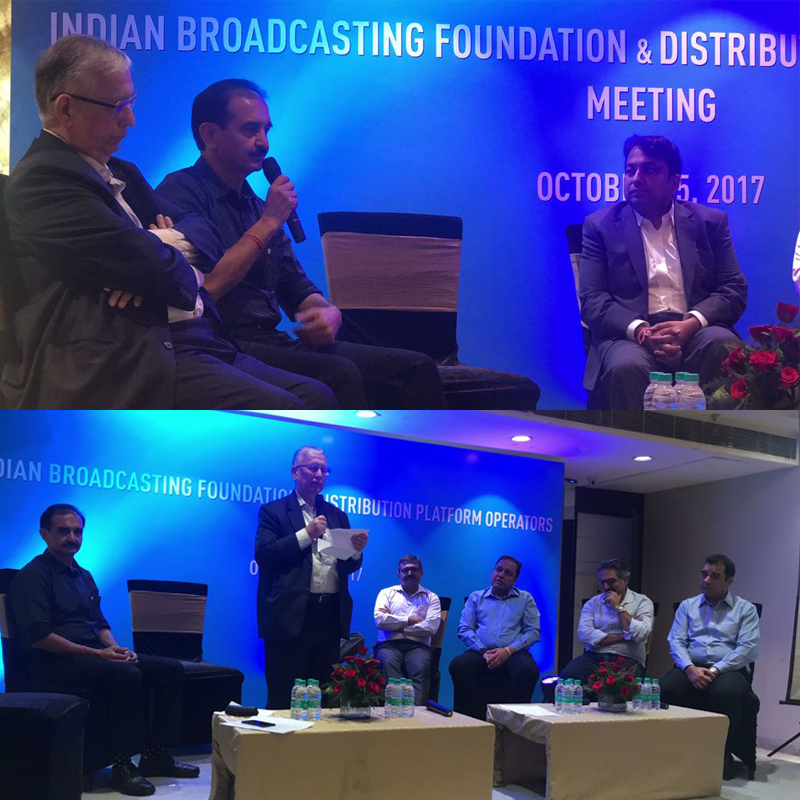
    Such were the thorny issues being discussed in a meeting held between the All India Digital Cable Operators Federation and the DTH Operators with the Indian Broadcasting Foundation (IBF) on Wednesday.

    As senior AIDCF member Ashok Mansukhani said that it was more appropriate for the stakeholders to meet in this manner than in courts of law.

    Among others, the meeting was addressed by IBF President Punit Goenka, Jawahar Goel of Dish TV, AIDCF President Rajan Gupta and senior office-bearer S N Sharma.

    Goel said there was an attempt by Punjab and other states to bring back what he termed as the ‘inspector raj’ by imposition of local taxes. Furthermore, he said broadcasters were free to give content to OTT or YouTube, but this should not be live as it would directly hit the DPOs like the DTH players and digital cable operators.

    The larger multi-system operators (MSO) said the inefficient handling of piracy by broadcasters was the cause of their suffering. Broadcasters neglect to take actiom against operators carrying analogue signal. There are small MSOs who do not have CAS & SMS system and do not follow TRAI QoS guidelines so broadcasters should refrain from giving content to them. Hence a joint industry task force should be made to raid such operators / MSOs and initiate legal action against those operators. The News Broadcasters Association should also be made part of this.

    Issues were also raised relating to OTT, Doordarshan’s FreeDish, and Reliance Jio and the DPOs alleged that providing signals to these entities led to huge losses to the digital cable and DPOs.

    Answering various question in a presentation, Goenka said OTT rights and digital cable rights were two different issues and should not be confused. OTT was an interactive and on-demand platform and in any case was never free being part of a subscription bandwidth. Thus this should not be compared with other platforms.

    YouTube content are only the ones that have already been broadcast and therefore, there was no conflict of interest. He denied any concessions to Reliance Jio and said it was in fact paying more than digital cable.

    He expressed concern by the Jio announcement that its mobile phone could receive the signals of not only new LCD/LED television sets but also the old sets. AIDCF said that this would bring Jio under TRAI’s regulations.

    Goenka said he will advise IBF members to take up the issue with OTT providers, especially Reliance Jio. In any case, he said the present contracts forbid such activity.

    He said broadcasters are not offering OTT content on television screen by connecting Reliance Jio phone through a cable and they prohibit such an activity. But agreeing with the concern of the AIDCF, he said this would be rigorously monitored and action will be taken in case there is any violation.

    Referring to the AIDCF charge that pay channels were being given as Free to Air (FTA) to Doordarshan’s FreeDish after paying huge carriage fees, Goenka said that broadcasters like Star and Sony are offering paid live content free on Freedish but with a time lag of one year. He agreed that this should be implemented across all genres and it should be completely free to all platforms.

    He said that in any case digital cable had more channels than FreeDish which primarily comprised FTA channels and so it was unreasonable to compare the two especially as the content was also being provided to digital cable operators.

    The speakers from AIDCF said MSOs have invested around Rs 200 billion in digitisation and are yet to get the return on their investment. This is primarily on account of the growth in rates that the broadcasters demand every year. Hence it was now the question of viability and survival of the MSOs that broadcasters should come out with their MRP based pricing.


  • Govt. reconstitutes task force for DAS phases III and IV

    Govt. reconstitutes task force for DAS phases III and IV

    MUMBAI: Days after Information and Broadcasting (I&B) Minister Prakash Javadekar announced that digitisation in the country will progress as per the new deadlines; the government has come up with a reconstituted task force for implementation of digital addressable system (DAS) in phases III and IV.


    The new task force will constitute I&B additional secretary chairperson, Telecom Regulatory Authority of India (TRAI) principal advisor for broadcast and cable satellite, I&B Ministry joint secretary broadcasting, representative from the MSO Alliance, five independent MSOs one each from north, south, east, west and north east regions, five registered LCO associations one each from north, south, east, west and north east regions, representatives from the Indian Broadcasting Foundation, News Broadcasters Association, Association of Regional Television Broadcasters of India, DTH Association, FICCI, CII, ASSOCHAM, CEAMA, Department of Telecommunications, Department of Electronics and Information Technology, DG: Doordarshan, DG: All India Radio, BECIL, BIS, five prominent consumer organisations one each from north, south, east, west and north east regions and 33 state level nodal officers one each from the states/union territories governments.


    The task force would act as an interface between the government and the industry in matters related to implementation of DAS in the cable TV sector and monitor the implementation of DAS. It also will have to analyse the roadblocks that may come in the way of digitisation and suggest measures.