Tag: Dr Narender Saini

  • ACHE & DAAD launches “Nasha Mukti Indradhanush Abhiyan India” campaign

    ACHE & DAAD launches “Nasha Mukti Indradhanush Abhiyan India” campaign

    Mumbai: In a resounding effort towards a tobacco-free future, the “Nasha Mukti Indradhanush Abhiyan India” is galvanising the nation with its signature campaign. Launched by the Asian Coalition for Health Empowerment (ACHE) in collaboration with Doctors Against Addiction (DAAD), this campaign is garnering unprecedented support from medical professionals and the public, paving the way for a healthier, addiction-free India.

    Over the past eight months, the campaign has seen a remarkable response, with more than 1,000 medical doctors, public health experts, and undergraduate (UG) and post-graduate (PG) medical students signing on to support the initiative. These signatures are being compiled and shared with health organisations and policymakers, including the prime minister’s office (PMO), to advocate for stringent measures in tobacco cessation.

    Indian Medical Association (IMA) former general secretary Dr Narender Saini asserted, “The Nasha Mukti Indradhanush Abhiyan India is not just a campaign; it’s a movement towards a healthier future. The campaign embodies a comprehensive strategy to eradicate the grip of tobacco addiction while advocating for stricter policies to curb tobacco use and other harmful substances. We are witnessing a dynamic shift in how tobacco cessation is approached. The collective efforts of our dedicated healthcare professionals and the broader community in dispelling myths and fostering awareness are crucial steps toward a healthier society.”

    The campaign’s focus extends beyond tobacco, targeting addictions like drugs, alcohol, and even smartphone overuse. It aligns with the United Nations’ sustainable development Goal-3 (SDG-3), which emphasizes ensuring healthy lives and promoting well-being for all ages, embodying a preventive and curative approach to tackle the crisis.

    BLK-MAX Super Speciality Hospital Delhi, senior consultant, pulmonary medicine, Dr Pawan Gupta emphasised the campaign’s comprehensive approach, saying, “We are witnessing a paradigm shift. Our strategy integrates global best practices with local insights, ensuring a robust framework for tackling addiction. By uniting healthcare professionals and concerned citizens, this campaign creates a powerful voice to advocate for better health practices and policies. This holistic approach is crucial for achieving our goals and making a lasting impact on public health.”

    Subharti Medical College, Meerut, assistant professor, department of physiology, Dr. Sunaina Soni echoed, “The overwhelming response from the medical community indicates the campaign’s importance. The signatures we’ve gathered will drive significant policy changes, making a tangible difference in the fight against addiction. Through this campaign, we’re not just collecting signatures; we’re inspiring hope and accountability. It’s about empowering individuals and communities to believe in and strive for a tobacco-free future.”

    The “Nasha Mukti Indradhanush Abhiyan India” campaign unites healthcare professionals and citizens to combat addiction, driving significant policy changes. With growing support, the campaign aims for a healthier, addiction-free India. The collected signatures and stories are shared with health organisations and policymakers, including the prime minister’s office (PMO), to advocate for stringent tobacco cessation measures and improved public health policies.

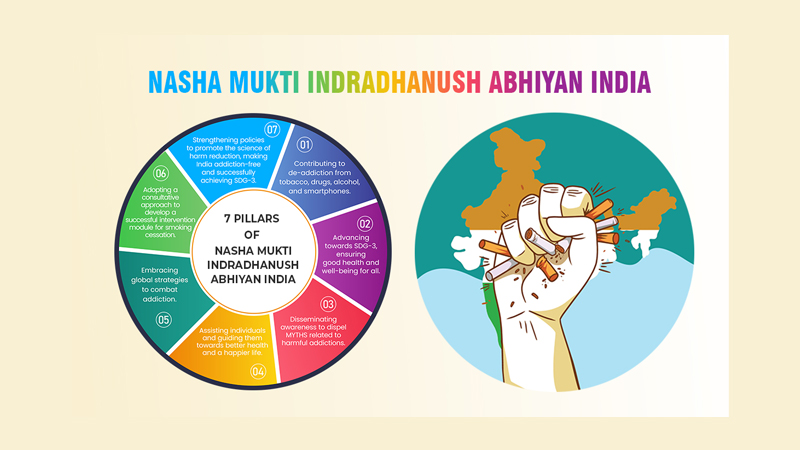
    1.  De-addiction: Aiming to free individuals from tobacco, drugs, alcohol, and smartphone addiction.

    2.  SDG-3 advancement: Striving to ensure good health and well-being for all, in alignment with Sustainable Development Goal-3(SDG-3).

    3.  Myth dissemination: Raising awareness to dispel myths surrounding harmful addictions.

    4.  Individual assistance: Offering guidance and support to individuals seeking better health and a happier life.

    5.  Global strategies: Implementing international strategies to combat addiction.

    6.  Consultative approach: Developing successful intervention modules for smoking cessation.

    7.  Policy strengthening: Advocating for policies that promote harm reduction, aiming for an addiction-free India.

  • Doctor Against Addiction launches ‘A Prescription for Deaddiction’ campaign

    Doctor Against Addiction launches ‘A Prescription for Deaddiction’ campaign

    Mumbai: With various forms of addictions becoming rampant and widespread resulting in fissures in family and personal lives, a steep increase in accidents and crime rate, Doctor Against Addiction (DaAD) has launched a sustained campaign called ‘A Prescription for Deaddiction’. The sharp-focused campaign seeks to empower doctors to play an active role in reducing various forms of addictions by intervening as early as possible at the consultation level.

    “At the heart of the campaign lies a powerful symbol – “HRx.” This symbol represents a prescription for harm reduction, a commitment by doctors to address the harm caused by addiction and harmful behaviours. It serves as a beacon of hope and change. ‘A Prescription for Deaddiction’ is not just a campaign; it’s a call for action. It envisions a healthcare landscape where doctors can be champions of change, equipped with the knowledge, compassion, and tools needed to address harmful behaviours. Often, doctors routinely check height, weight, BP and sugar levels. Now they are being trained to identify classical symptoms of addictions of various forms,” said Doctors Against Addiction (DaAD) chief coordinator Dr Manish Sharma.

    The “HRx” symbol allows doctors to specify the form of addiction or harmful behaviour they aim to address.

    The genesis of Doctors Against Addiction (DaAD) became imminent because in an increasingly complex world, individuals often find solace in various forms of behaviour and substances, from gadget addiction and alcohol to drugs and tobacco. While these may offer temporary relief or pleasure, they can also lead to significant harm to both the individual and society at large.

    Doctors Against Addiction (DaAD) is of the opinion that healthcare professionals can make a profound difference in deaddiction and promote healthier lifestyles as they are closely knit to the patients.

    Deliberating on potential of Doctors Against Addiction (DaAD), and doctor-patient relationship, Yashoda Super-specialty Hospital, Kaushambi, Ghaziabad, DM – infectious disease, senior consultant Dr Chhavi Gupta said, “The foundation of any fruitful doctor-patient relationship is trust. And this is achieved when patients feel comfortable sharing their concerns, even when those concerns revolve around potentially harmful behaviours. By creating an atmosphere of trust and non-judgment, healthcare professionals can empower patients to open up and seek help. During these conversations, they can effectively counsel patients on deaddiction.”

    Doctors are now being trained to patiently listen and ask open-ended questions in an effort to identify the type of addiction and reduce the stigma surrounding it through compassionate and tailormade dialogue.

    ‘A Prescription for Deaddiction’ (DaAD) is not a one-size-fits-all solution. It is a personalised approach, adapting strategies to individual patient needs for effective interventions. It emphasizes involving patients in setting deaddiction goals and maintaining regular follow-ups for progress. Now, healthcare professionals are trained to advocate for addiction awareness and support community initiatives.

    “Beyond physical harm, excessive behaviours can wreak havoc on mental well-being leading to anxiety, depression, and a diminished sense of self-worth. Alcohol and drug abuse can lead to altered mood states, cognitive impairment, and exacerbation of pre-existing mental health conditions. However, by approaching the conversation without judgment, healthcare professionals can make patients feel respected and understood. Consistent monitoring reinforces the doctor-patient partnership. And “A Doctors Against Addiction (DaAD) is a step forward in this direction, to help patients achieve their deaddiction goals,” said Indian Medical Association (IMA) former general secretary Dr Narender Saini.

    Excessive behaviours significantly impact physical health. Excessive screen time causes digital eye strain, disrupted sleep, and posture issues. Alcohol and drug abuse lead to liver damage, cardiovascular problems, addiction-related illnesses, and overdose. These immediate and tangible effects highlight the need for moderation.

    ‘A Prescription for Deaddiction’ envisages to address the issue of addiction holistically, wipe out stigmas and mainstream the affected individuals.