Tag: DPO

  • TRAI directs broadcasters, DPOs to publish updated NTO 2.0 prices

    TRAI directs broadcasters, DPOs to publish updated NTO 2.0 prices

    MUMBAI: The Telecom Regulatory Authority of India (TRAI) has asked broadcasters and distribution platform operators (DPOs) to take necessary steps to ensure a smooth rollout of the amended new tariff order from 1 March. Both broadcasters and distribution platform operators (DPOs)  have also been directed to publish required information on their website to provide consumers sufficient time to exercise their choice of channels and bouquets before the implementation.

    After TRAI came out with the amendments to the new price regime, stakeholders across the industry raised voice against that. There are several petitions pending in the high courts challenging the order. However, the latest directive from TRAI reaffirms that it is firm on rolling out the order.

    The authority also stated that many broadcasters have neither reported nor published the requisite information regarding the changes. It also added that it has been observed from the information available on the websites of many broadcasters that most of the existing bouquets of pay channels are not in compliance with the provisions of the amendments.

    TRAI also pointed out that quite a few DPOs have also not published the required information on their website nor composition of new bouquets compliant to the changes.

    “Further, to ensure that consumers at large are kept fully appraised, all concerned are required to ensure that information about all such existing bouquets which do not conform to the provisions of Tariff Order 2020 and which shall not be available for the consumers on or after 1st March 2020 may be suitably indicated on their website,” TRAI stated.

  • TRAI backs NTO 2.0, says amendment to create level playing field

    TRAI backs NTO 2.0, says amendment to create level playing field

    MUMBAI: The Telecom Regulatory and Authority of India (TRAI) has backed the amendments made in the New Tariff Order (NTO) claiming it to be consumer-friendly. Issuing a statement, TRAI said that it will create a level playing field for all stakeholders in the broadcasting industry.

    The regulator believes that transparent mechanism needs to be adopted to encourage the market discovery of channel price, but any attempt to scuttle consumer choice through non-transparent pricing practices means need to be discouraged.

    Hence, the authority quoted that the intended benefit for consumers to enable the freedom of choice could not be achieved completely due to misuse of available flexibility by a group of service providers.

    Meanwhile, it also clarified that the concern of all the broadcasters regarding placement fee and misuse by few  distribution platform operators (DPO) manipulating Electronic Program Guide (EPG) has also been addressed.

    The release added that post the implementation of NTO, some broadcasters had enhanced their channel prices drastically. This price increase is anti-consumer and forces regulatory interventions. Adding further it said, “The broadcasters, however, continue to have full flexibility to price their channel as Maximum Retail Price (MRP) of any channel remains in forbearance.”

    It further said, “The amendments through NTO 2.0 have left the basic structure of the regulatory framework unchanged with very minor modifications. And it’s targeted to address teething problems relating to smooth implementation.”

    The new amendments provide complete freedom to broadcasters/ DPOs to price their services while ensuring that consumers get the freedom to choose the TV channels, the regulator explained.

    As the amendments provide appropriate time to stakeholders for implementation, consumers will be able to benefit as per the amended provisions with effect from 1 March 2020.

    TRAI also said that the new amendments will usher in better offerings, reduced NCF, more flexible tariff schemes and more choices for consumers.

    On 1 January 2020, the regulator had amended the NTO which created a panic-like situation within the broadcaster and service provider community to opt for the legal option against the new TRAI order.

    TRAI had come up with a slew of measures in the recent amended that it claims are customer-focused. It has asked the broadcasters to come up with the new price list of channels by 15 January 2020.

  • Subscribers’ DTH/Cable bills to go down by 14% for a-la-carte channels: ICRA

    Subscribers’ DTH/Cable bills to go down by 14% for a-la-carte channels: ICRA

    MUMBAI: The recent Telecom Regulatory Authority of India (TRAI) amendments over tariff charges could potentially lower the direct-to home (DTH)/ cable bills of the subscribers up to 14 per cent from the present levels, a credit rating agency ICRA said in an analytical report.

    According to a press statement, ICRA said that the amendment encourage subscribers to exercise their right to choose and opt for a-la-carte channels. TRAI on 1 January 2020 amended some provisions of the Telecommunication (Broadcasting and Cable) Services (Eight) (Addressable Systems) Tariff Order, 2017.

    The amendments are slated to come in effect from March 1, 2020.

    The Tariff Order released in 2017 had allowed the subscribers to choose the nature of channels as free to air (FTA) or pay channel as well as declare a-la-carte pricing of all channels.

    However, contrary to TRAI’s expectations, the rating agency said, given the high channel pricing of the popular general entertainment channels (GECs) and sports channels (with 66 of the 330 existing pay channels being priced at the ceiling rate of Rs. 19 per month).

    This move by broadcaster had tarnished the very purpose of the Tariff Order, resulting in up to 23% surge in bills for subscribers, ICRA estimated, and continued the dominance of bouquets in the subscription patterns.

    ICRA’s vice president Kinjal Shah said, “The recent amendments will adversely impact the broadcasters, revenues, the subscription revenues are also expected to reduce (as subscription charges for a-la-carte channels will reduce and due to the expected shift of subscribers from bouquets to a-la-carte selection).”

    Shah further said, “Furthermore, given the reduction in the number of channels that can be offered in a bouquet (for a given price), bundling of non-popular channels with established ones will reduce, thereby impacting their reach and thus advertisement revenues for the broadcaster. This, however, would eventually lead to an increased focus on content quality.”

    TRAI in the amendment of 2017 tariff order has also increased the channel offerings for the network capacity fee (NCF) of Rs. 130 (excluding taxes) per month to 200 standard definitions (SD) (pay or FTA) channels from the present 100 SD channels.  

    The amendments are expected to be a mixed bag of positives and negatives for DPOs. The overall reduction in NCF and the cap on NCF to be charged for additional TVs in a multi-TV home is negative for the DPOs.

    TRAI has, however, allowed DPOs to offer different NCF across geographical regions (state / district / towns) as well as offer promotional schemes (on NCF / Distributor Retail Price – DRPs), up to 90 days at a time, twice in a calendar year. DPOs are additionally allowed to offer discounts on NCF / DRPs for long-term subscription plans.  

    ICRA’s assistant vice president Sakshi Suneja, said, “After the recent changes in the tariff, the prices of popular GECs and sports channels are expected to reduce from Rs. 19 per month to Rs. 12 per month, given the revised ceiling rates for a-la-carte channels, to be included in bouquets.”

    “The amendments also seek to improve the attractiveness of a-la-carte channels, by reducing discounts that can be offered on bouquet pricing to 33% (vis-a-vis a-lacarte prices, from the existing average levels of discounts of 40-54%),” Suneja said.

    She pointed out that through the introduction of two new conditions: i) capping the maximum retail price (MRP) of a-la-carte channel that can be included in a bouquet to up to three times of the average MRP per month of a pay channel of that bouquet and ii) MRP, per month, of a pay channel to not exceed the MRP, per month, of the bouquet containing that pay channel.

  • TRAI releases telecommunication services DAS audit manual

    TRAI releases telecommunication services DAS audit manual

    MUMBAI: The Telecom Regulatory Authority of India (TRAI) has issued the Telecommunication (Broadcasting and Cable) Services Digital Addressable Systems Audit Manual. The new regulatory framework endeavours to provide a level playing field to all the service providers, effective choice to consumers, and orderly growth of the sector. It envisages a must-carry and must-provide regime where interconnection agreements are based on transparent Reference Interconnect Offer.

    “This manual is the result of the synthesis of all comments, suggestions of BECIL and final analysis by Telecom Regulatory Authority of India. The audit manual will be a guidance document for the audit process as it specifies step-by-step process in simple language. The manual does not supersede any provision of the extant regulations,” said TRAI in its release.

    In order to ensure that the benefits of digitisation are effectively utilised, TRAI, after due consultation process, brought out a common regulatory framework for digital addressable systems. The 'new regulatory framework' comprises Interconnection Regulations, 2017, Quality of Service Regulations, 2017 and Tariff Order, 2017.

    The full benefits of digitisation can accrue to various stakeholders in the value chain only when the business transactions are transparent and based on objective, measurable and computable parameters.

    Effective and factual audit of the systems of DPO will ensure that the equipment and the software (including configuration of systems) comply with the extant regulatory framework.

    “The new framework envisages that the DPO gets its systems audited every year so as to assure the broadcasters that true subscription numbers are being reported. In cases where a broadcaster is not satisfied with the outcomes of audit undertaken by the DPO, a countervailing provision empowers the broadcaster to initiate an audit. Considering the importance of audit to establish the trust-based regime, industry stakeholders suggested to provide an audit manual,” said TRAI.

    Accordingly, the authority constituted a committee comprising of industry stakeholders to prepare and submit draft audit manual to the authority. Consultation Paper on the Telecommunication (Broadcasting and Cable) Services Digital Addressable Systems Audit Manual was issued on 29 March 2019. After receiving the comments, an Open House Discussion (OHD) was held on 20 June 2019 in Delhi to discuss the draft audit manual.

  • MCOF’s Arvind Prabhu on post-NTO era, LCO concerns, OTT regulation

    MCOF’s Arvind Prabhu on post-NTO era, LCO concerns, OTT regulation

    The cable and broadcasting ecosystem started the year 2019 with a disruption – the new tariff order (NTO). With the implementation of NTO, the most dissatisfied section of the ecosystem was local cable operators (LCO) as they found the revenue-share business model would make their survival difficult which caused massive protests from LCOs. As months passed, the turmoil settled, but the ecosystem is yet to benefit from NTO, according to Maharashtra Cable Operators Foundation (MCOF) president Arvind Prabhu.

    In an interview with Indiantelevision.com, Prabhu spoke on major challenges faced by the ecosystem after NTO, how the industry evolved post-NTO, how LCOs can survive in the future with upgradation in technologies amid OTT onslaught, etc. Prabhu will also share his insights on the current state of industry at Indiantelevision.com's Video and Broadband Summit 2019, India's definitive Pay-TV and video distribution get together. 

    Edited excerpts:

    Has the industry settled down after the NTO was implemented?

    The industry has settled down but not the benefits of the NTO as envisaged by TRAI within the ecosystem. Consumers are not getting the benefits of the NTO. So the actual implementation of NTO is still found pending.

    What are the major changes you noticed post-NTO?

    What we would like to highlight is that because of the lack of proper implementation, the consumer is still not getting his choice of channels. There has been an increase in the monthly rates and we still feel the transparency is not there. The transparency which was required is still not there. Also, earlier there were two TV sets in households. Now, the second TV is still not active in post- NTO era. Only the primary TV set has been activated in the new tariff order. So, almost 20-25 per cent of our connections have still not activated.

    Initially, local cable operators showed strong disagreement to the revenue sharing model with MSOs. Has the situation changed?

    The situation has still not changed. The local cable operators (LCOs) are still not happy, especially with the network capacity fee (NCF) factor. We are still demanding the entire NCF should be given to LMO. So, the sharing with the broadcasters, the sharing of 80-20 is still not agreeable to us. There was an open-house discussion recently where lots of suggestions were given, therefore we are awaiting that to come.

    If the model does not change, have you thought of alternatives to prevent the loss?

    The revenue share model has to change. It looks like the broadcasters are going to be reducing the charges. Earlier, we thought broadcasters inflated their charges. From Rs 19 to they have gone down to Rs 12. Obviously, the ARPU is going down. If the ARPU is going down, then the revenue share also needs to be relooked and everyone in the ecosystem has to survive. If the cable operators do not get their fixed price, then they would not be able to survive. We are seeing a lot of cooperative head-ends coming up, a lot of infrastructure-sharing happening. But traditional TV is also now aligning with telcos. BSNL has opened its doors to providing its services as also Reliance Jio. There is going to be a little bit of turmoil in the market. The traditional linear viewing is changing.

    What are the other major concerns of LCOs?

    ,One of the major problem is who is the owner of the set-top box. Even today, the set-top box is given by the MSOs to LCO at Rs 1,150 or Rs 1,200. The receipt they are giving is the installation charge. As per TRAI, the installation charge is Rs 300 and registration charge is Rs 100. So, they cannot charge more than Rs 400 at any case. But they are giving the box at Rs 1,150 and saying it's installation charge. This is a violation of GST they are doing and the ultimate ownership of the box is still a question mark because the Multi-System Operators (MSOs) are taking money from LMOs, keeping the money to themselves, getting the depreciation themselves and also not paying GST.

    Also, the grievance is we are not given the choice to choose the channel that a consumer wants. As a consumer, I should have freedom of choice. But the DPOs are selling their packs, broadcasters selling their packs. I have no mechanism where I can sell my own packs. So, these all are part of NTO that was supposed to happen and that has not happened and the  tariff has gone up. So, now we are at a cross-roads.

    If you ask me whether NTO is a good thing, I will say NTO is a very good thing. It is bringing a lot of transparency, it gives equitable revenue to everyone but broadcasters and MSOs both are flouting the rules. Broadcasters are still doing fixed fee deals and MSOs are still not giving the actual audits. TRAI had also mentioned consumers be offered both prepaid and postpaid options. Now, as an LMO, LCO I am a consumer to the DPO. I have only got a prepaid option whereas my consumer is postpaid. So, what has happened is the entire liquidity of cable operators goes into prepaid mode whereas when the MSOs have to make the content  payment they make, they are easily getting three months of payment difference. So, basically MSOs are sitting on  cash. They are under-reporting to broadcasters, they have done fixed fee deals, they are not paying broadcasters also on time but they are taking prepaid from cable operators for the entire universe. The MSOs are benefitting more than anybody else.

    During the first phase of NTO implementation, a large number of consumers complained against LCOs for not giving a-la-carte channels? Why did this occur?

    Again, there was no awareness then. LCOs cannot give a-la-carte channels. Who gives a-la-carte channels? It is an MSO who has to facilitate the LCO to pass on the a-la-carte channels. MSOs are not giving a-la-carte channels, only DPO packages or the broadcaster packages. Earlier consumers were not getting that facility. Now, consumers thought the LCOs were not giving. Unfortunately, MSOs were not doing their duties and cable operators were facing the wrath of customers.

    As LCOs work on-the-ground, they are generally aware of consumer feedback. Do they think consumers are happy with the new price regime?

    Few consumers are very very dissatisfied because we are forcing packages on them and the prices have increased. Few of them – who were very very smart and educated and understood –  are very very happy with what is happening. A lot of awareness needs to happen. True pictures will emerge when we allow  consumers to select the a-la-carte channels. By and large, the ratio is 50-50.

    There are other changes in the ecosystem as well. How the OTT onslaught is affecting LCOs?

    OTT is making a lot of inroads. That is one of the points we are trying to make to TRAI that they have to bring OTT under this ambit. Because you are seeing a channel which is Rs 90 on cable or IPTV or DTH, on OTT it's available for free. And most of the people are now watching on their handheld devices. If they are getting all their entertainment and sports on an OTT platform that is not charged, it is not fair. It has to be charged and it has to be brought under regulation.

    Has Jio’s entry impacted the LCOs?

    Not much. Because they are struggling to reach a critical point. The pricing they have done also is quite affordable for LCOs to match and at Rs 699 for their basic internet charges, you know only cable operators can match those. Not much but it can be a threat.

    Why did LCOs lose a huge amount of subscribers during this phase?

    25-30 per cent of second  TV set owners may have gone to OTT or IPTV or they are not just renewing. They are finding it a luxury. Earlier they could get two TV sets coonections in Rs 300-400. Now, it's going to Rs 800-1000.

    With all the changes in technology, the emergence of new players, how do you foresee long-term future of LCOs?

    Those LCOs who upgrade themselves and do FTTH, will survive in the long run. Those LCOs who are not upgrading and think they will only do what they were doing and not invest in infrastructure, they will vanish. 
  • TRAI issues consultation paper discussing target market, placement issues between broadcasters, DPOs

    TRAI issues consultation paper discussing target market, placement issues between broadcasters, DPOs

    MUMBAI: The Telecom Regulatory authority of India (TRAI) released a consultation paper on ‘Issues related to Interconnection Regulation 2017'. The objective of the move is to consult all the stakeholders on issues related to target market, placement and other agreements between broadcasters and distributors.

    The authority has received representations from quite a few regional broadcasters highlighting their concerns regarding the declaration of the target market by distributors of television channels (DPOs). As the existing regulations provide freedom to DPOs to declare their target market for the purpose of ascertaining the carriage fee, some of the DPOs have declared multiple states (or entire country in some cases) as their target market.

    In this context, regional broadcasters are compelled to pay very high carriage fee. This has created a negative economic barrier for regional channels thereby limiting their presence on smaller distribution platforms as proposition to pay carriage fee for national market makes it unviable for such channels.

    Not only does this put undesired financial burden on regional broadcasters, it makes them prone to undue arm twisting by the distributors, as their subscription continues to remain lower than the minimum prescribed threshold of five percent (5 per cent ), which is the limit under which a DPO is not mandated to carry any channel.

    "Further, the placement agreement, marketing agreements or any other technical or commercial arrangements between broadcasters and distributors (apart from RIO-based agreements) are in forbearance. But now, quite a few complaints have been received from various broadcasters whereby it is being alleged that some DPOs are resorting to pushing for marketing/placement/promotion agreement, by exploiting the available forbearance,” TRAI said in a press release.

    Recently, Telecom Disputes Settlement and Appellate Tribunal (TDSAT) also recommended the authority to examine the issue. According to a TDSAT order dated 29 July, the main challenge appears to be the wisdom of the regulator in giving liberty to DTH operators to declare their target areas.

    Adhering to the orders, the authority had several meetings with each group of stakeholders in the industry including news broadcasters, broadcasters, DTH operators, MSOs and regional broadcasters to discuss their viewpoints and come forward with a balanced solution that is in the interest of both the concerned parties (DPOs and regional broadcasters).

    According to some of the broadcasters, the decision of declaration of target market should be left upon them as it is their channel and they should have the freedom to decide that which sector of the population will opt for their channels. Almost all the regional broadcasters want that the target market should only be their respective state or city or territory and they should not be asked to pay carriage fee for the entire universe (PAN India).

    However, DPOs have a different opinion. According to some of the distributors, the cost of infrastructure associated with running a channel is significant. In case the provision related to target market is altered to states, it will alter their revenue structure. According to them, any reduction in the revenue stream from carriage fee will result in additional subscription cost for the consumers. Moreover, any smaller target market will mean more and more broadcasters will achieve subscription threshold of 20 per cent. As soon as the subscription crosses the threshold, their carriage fee revenue will reduce to zero. As per extent provisions, a broadcaster is exempted from payment of any carriage fee if the monthly subscription of his channel in the target market exceeds 20 per cent.

    As per TRAI, MSOs declaring its target market as the area covered under a head end or any smaller area within the total area covered by a head end can be an alternative. Another option which has been highlighted as a possible altenative is linking carriage fee to cost of carrying a channel. In this option the cost of carrying a channel may be worked out and the amount of carriage fee that a broadcaster may be required to pay the distributor may be capped at that level.

    The highlighted questions are primary issues for consultation:

    1. Do you think that the flexibility of defining the target market is being misused by the distribution platform operators for determining carriage fee? Provide requisite details and facts           supported by documents/ data. If yes, please provide your comments on possible solution to address this issue?

    2. Should there be a cap on the amount of carriage fee that a broadcaster may be required to pay to a DPO? If yes, what should be the amount of this cap and the basis of arriving at the           same?

    3. How should cost of carrying a channel may be determined both for DTH platform and MSO platform? Please provide detailed justification and facts supported by documents/ data.

    4. Do you think that the right granted to the DPO to decline to carry a channel having a subscriber base less than 5 per cent in the, immediately preceding six months is likely to be misused? If yes, what can be done to prevent such misuse?

  • DPOs suggest changes to draft interconnection addressable regulations by TRAI

    DPOs suggest changes to draft interconnection addressable regulations by TRAI

    MUMBAI: Distribution platform operators (DPOs) have shared their comments to modify Telecom Regulatory Authority of India (TRAI)’s draft on The Telecommunication (Broadcasting And Cable) Services Interconnection (Addressable Systems) (Amendment) Regulations, 2019.  The industry has welcomed TRAI’s move to amend Schedule III of the regulation and believes that provisions related to watermarking, fingerprinting and digital rights management along with CAS and SMS is in right direction.

    AIDCF said, “It is submitted that the provisions relating to watermarking, fingerprinting and digital rights management along with CAS and SMS, is a step in the right direction and AIDCF wholeheartedly supports the same. With respect to amendments proposed to be introduced by TRAI in the schedule III of the Interconnection Amendment Regulations 2019, AIDCF stands in agreement with the same and supports TRAI in bringing about the amendments in the regulations.”

    However, Bharti Telemedia (Airtel), Tata Sky and GTPL recommended a few changes in the draft of interconnection addressable regulations.

    Airtel, with regard to Section C Clause 8 of the regulation, recommended that the capacity of the CAS and SMS should be linked to the volume of transactions rather than the subscriber base. The rationale for the same is that each subscriber can generate multiple volumes of transactions and hence, to handle these transactions of a single customer, the system is equally consumed and therefore, the correct assessment of the system capacity should be linked to the transaction count instead of subscriber base.

    It further commented “The subscriber base may not be the appropriate criteria to assess the capacity of CAS and SMS, more so, in the current framework when a single customer can generate more than one transaction in terms of activation/deactivation of channel, recharge etc. We, therefore, suggest that the criteria of 5 per cent should be measured in context to total volume of transactions.”

    The company in its comments to TRAI also raised concern over generating customised bills. It said, “We submit that the requirement of generation of bills is applicable for the post-paid services and we, therefore, suggest that clause must specify the same to avoid any confusion.”

    Similarly, Tata Sky also expressed that bill generation is a postpaid concept. DTH operators do not have a postpaid platform and are completely prepaid. “Therefore, it is suggested that a suitable clarification be inserted in the regulations as well as the audit manual to avoid any understanding gap between the DTH operators and the auditors,” said Tata Sky.

    Tata Sky also suggested, “The STBs and VCs are issued against a CAF to a subscriber and the subscriber's address is captured in our systems. Consequently, the auditor can check our systems on a random sample basis, however, we will not hand-over our entire database along with addresses to the auditor in compliance with this requirement. We would, therefore, suggest that a suitable clarification be inserted in the regulations as well as the audit manual to avoid any understanding gap between the DPO and the auditors.”

    The draft’s Clause 12(a) & 12(c) states that it is mandated that amongst other things SMS should also be capable of viewing and printing of historical data in terms of the activations and the deactivations of STBs and generating historical data of changes in the subscriptions for each subscriber and the corresponding source of requests made by the subscriber.

    GTPL on the same commented, “It has been observed in the past audits that the auditors have demanded generation of such historical data for all subscribers and from inception which has put undue stress on the systems of the distributors and the resultant inconvenience to the customers. It is suggested that the Authority limit the generation of historical data to reasonable percentage of the total as a sample size. We suggest a sample size of 5 per cent of the active sub base for platforms which have more than 5,00,000 average active subscribers while for platforms which have a lesser active subscriber base the sample size can be 25 per cent.”

  • TRAI tariff order shakes up pay and FTA channel uptake

    TRAI tariff order shakes up pay and FTA channel uptake

    MUMBAI: Six weeks into the new tariff order (NTO) and the television landscape is changing, says Chrome data analytics and media report. It says that 96.5 per cent of the consumers in India are aware of the NTO, with 83.6 per cent coming to know about it via television.

    The report also highlighted the packages that the consumers have chosen. It mentioned that 50 per cent has gone with the DPO-defined packages, packages defined by operators, leaving the balance 50 per cent split into two components– 25 per cent with packages from broadcasters and the rest from a la carte package. 26 per cent has exercised both, which is a combination of a DPO package along with some kinds of a la carte, 2 per cent don't remember what they exercised. The report signalled that the consumers felt that they were earlier paying for content that they were not willingly subscribing to. So that leaves the tariff order in the right spirit of transparency where consumers are getting an idea of what each channel and each bouquet costs and they feel empowered to pick what they want.

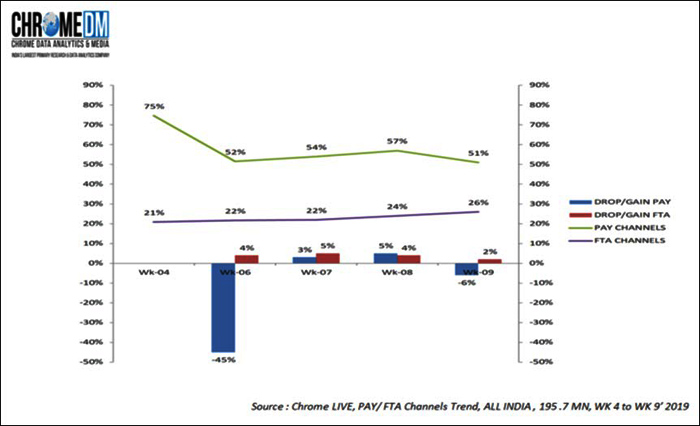
    Specifying about the reach or Chrome connectivity (OTS faired over the last six weeks), while broadly dissected into pay that observed a downfall and FTA which witnessing a hike. On one hand, pay channels with an average national connectivity of 75 per cent went down to an average of 51 per cent. FTA on the other hand, gained from 21 per cent to 26 which is a 23 per cent gain. 

    The report added that the operators right now are competing for consumers by providing the maximum number of channels within the fixed one hundred and thirty rupees. DTH –Tata Sky, Dish, Airtel – Average of 250 channels in the network capacity fee.

    Networks offering maximum channels within their Base pack

    HEAD END

    TOTAL FTA RUNNING

    TOTAL PAY RUNNING

    VISION POINT DIGITAL

    277

    23

    GAJANAN CABLE/NXT DIGITAL

    274

    180

    NXT DIGITAL

    264

    37

    AFTAB CABLE VISION

    230

    4

    JAK COMMUNICATION

    219

    48

    ATHULYA INFO MEDIA PVT. LTD.

    216

    14

    NXT DIGITAL

    190

    37

    CHIKHALI CABLE NETWORK

    186

    74

    KBC DIGITAL

    185

    110

    CRYSTAL CABLE

    185

    46

    PUNE CABLE SYSTEM

    185

    42

    VK DIGITAL NETWORK

    179

    71

    NXT DIGITAL

    177

    38

    MCBS DIGITAL

    176

    100

    ACT DIGITAL

    175

    32

    SITI DIGITAL

    174

    125

    KABLE FIRST DIGITAL

    173

    235

    GRAND GUMBER

    172

    8

    TATA SKY

    262

    135

    DISH TV

    202

    145

    AIRTEL DTH

    195

    125

    Source: Chrome LIVE, ALL India (Urban), WK 10, 2019

    State wise Package offtake status

    MARKET

    100 FTA CHANNELS RUNNING ON NETWORKS

    MORE THAN 100 FTA CHANNELS RUNNING ON NETWORKS

    LESS THAN 100 FTA CHANNELS RUNNING ON NETWORKS

    BIHAR

    17%

    67%

    17%

    GUJ, D&D & DNH

    9%

    55%

    36%

    KERALA

    3%

    72%

    25%

    MADHYA PRADESH

    5%

    31%

    64%

    MAH & GOA

    3%

    44%

    53%

    UP & UTTARAKHAND

    2%

    25%

    74%

    All INDIA

    2%

    46%

    52%


    MARKET

    100 FTA CHANNELS RUNNING ON NETWORKS

    MORE THAN 100 FTA CHANNELS RUNNING ON NETWORKS

    LESS THAN 100 FTA CHANNELS RUNNING ON NETWORKS

    AP & TELANGANA

    0%

    38%

    62%

    CHHATTISGARH

    0%

    60%

    40%

    DELHI

    0%

    42%

    58%

    HHPJ&K

    0%

    20%

    80%

    JHARKHAND

    0%

    17%

    83%

    KARNATAKA

    0%

    50%

    50%

    KOLKATA

    0%

    83%

    17%

    ODISHA

    0%

    53%

    47%

    PUN & CHA

    0%

    100%

    0%

    RAJASTHAN

    0%

    50%

    50%

    TN & PONDICHERRY

    0%

    100%

    0%

    WEST BENGAL

    0%

    89%

    11%

    Source: Chrome LIVE, ALL India (Urban), WK 10, 2019

    According to Chrome DM, in the long term, there is a price-quantity relationship which is already happening with operators putting in maximum number of channels to get maximum subscribers. On the broadcasting level, companies are graduating from pure distribution, lobbying driven business to consumer marketing organisations.

  • FTA channel adoption shoots up post TRAI tariff order implementation; pay channels dip

    FTA channel adoption shoots up post TRAI tariff order implementation; pay channels dip

    MUMBAI: Five weeks into the new TRAI tariff regime, there seems to be some shift in viewership patterns and consumer choices. According to Chrome LIVE data, pay channels witnessed a drop of 24 per cent from week 4 to week 9 in 2019. On the other hand, FTA channels saw a spike from 21 per cent to 26 per cent in the same time span.

    Prior to the implementation of the new tariff order (NTO), DPOs and broadcasters were mostly operating on a fixed fee model. However, the new regime is showing a significant impact on the channel reach, channel share, ratings of non-driver channels and the overall revenue.

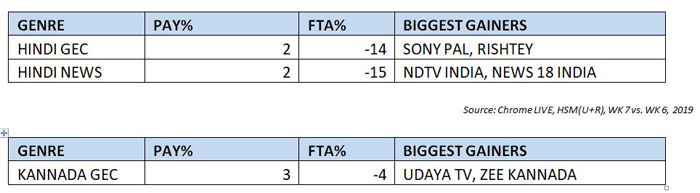
    Major fluctuations were seen across national channels over the last couple of weeks including Hindi GECs which saw a drop ranging between 0.5 to 10 per cent for pay channels and 0.1 to 5 per cent for FTA channels.

    Some passable changes enumerated in week 7 by way of reversal of the impact on connectivity of channels – exponential loss on pay had somewhat reduced owing to multiple operators putting on channels as per the old package after having switched them off. The same has also had an effect on FTA which had seen a spike.

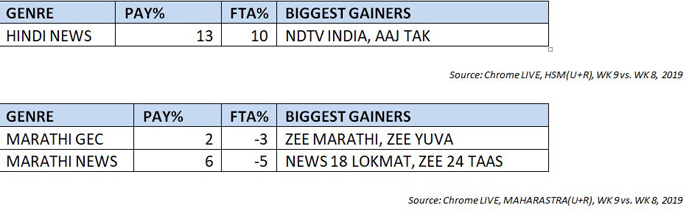
    The second week of NTO extension continued seizing changes at PAN India level which earlier was a 3 per cent gain for pay and 5 per cent gain for FTA channels in Chrome DM’s week 7 data which in week 8 changed to 5 per cent and 4 per cent gain respectively.

    Some more interesting changes as the NTO appendage concluded its third week on ground with pay channels registering a drop of 6 per cent owing to changes in channels’ connectivity across Free Dish and FTA gaining 2 per cent across the standard definition channels in Chrome DM week 9 data.

    The key to address these challenges for securing the correct revenue share amongst other things would entail consumer education, constant monitoring of consumer preferences and realignment of the bouquet packaging strategies taking into account consumer preferences.

    Under the new regime, consumers have the option of paying only for channels they want to watch and can drop other channels from their list and hence, the subscriber base will now solely depend on the communication between the DPOs and the end consumer, and in the event of any communication gap, the last mile consumer will not subscribe to the channels and these may result in significant erosion of subscriber base impacting the revenue of DPOs and the broadcasters.

  • Cable subscribers switching to DTH platforms amid new tariff order implementation

    Cable subscribers switching to DTH platforms amid new tariff order implementation

    KOLKATA: While the Telecom Regulatory Authority of India (TRAI) continues to reiterate that its new tariff order will benefit all stakeholders of the cable and broadcasting industry, implementation of the new norms has witnessed a mixed response on the ground. As the ecosystem adapts to this radical change, local cable operators (LCOs) in Kolkata have started bleeding as cable subscribers are migrating to DTH platforms.

    Many consumers in the city have complained that they are experiencing channel blackouts despite shifting to new packages ahead of the deadline. In addition to that, they also contended that the operators are forcing them to opt for packages and not providing any options of a-la-carte channels. As a result, several consumers have switched over to DTH platforms in order to avoid this hassle.

    One of the major local cable operators in south Kolkata said they have experienced 10-15 per cent churn rate post the new tariff order implementation. On the other hand, another operator in north Kolkata has claimed that his company experienced a 20-25 per cent churn rate. Both of them have opined that the churned out subscribers are not choosing other cable operator but DTH operators only.

    Both the local cable operators blamed MSOs for not having a proper system in place to make the migration smoother. According to them, the websites of MSOs are crashing due to the traffic spikes. In turn, this is hampering the process of new package selection, with the a-la-carte channel activation getting delayed. 

    They also pointed out that web portals of some national MSOs are malfunctioning for last two months. They added that subscribers, being unaware of the problems, are pinning the blame squarely on LCOs.

    Last week the West Bengal government held a meeting with some of the stakeholders of the Indian broadcast and cable industry to understand the tariff issue and challenges in its implementation.

    State government sources told Indiantelevision.com that the meeting, attended by a minister too, was called to explore what the stakeholders could do for local LCOs who have been having a trying time to convince and educate consumers, especially in rural areas of the state.

    It is learnt that those who attended the meeting included senior representatives from Star India, MSO Hathway and Zee group. One of the requests made by the state government, according to official sources, was whether companies like Star and Hathway could also fund educational TVCs relating to the TRAI tariff order in the Bengali language that could be aired by the LCOs on their networks to make consumers better understand the issues relating to  channel selection and their prices. Industry stakeholders, it is learnt, remained mostly non-committal on this particular matter of TVCs in Bengali.

    Maharashtra Cable Operators Foundation (MCOF) committee member Asif Sayed, an LCO based out in Mumbai, too voiced a similar opinion, saying a-la-carte channel activations are getting delayed as MSO web portals aren’t equipped to manage the load.

    According to him, the churn rate is actually 5-10 per cent and another 10-15 per cent may be switching off because of ongoing examinations. Hence, after one month, there would be clarity on the actual churn.

    Since the beginning of tariff order rollout, many LCOs across the country have expressed their reservations about the new regulations. The 80-20 revenue share between broadcasters and DPOs has been a bone of contention, as they maintain there should be revenue cap separately for LCOs.

    “NTO has come at a time industry had settled down after DAS. Obviously it's a major shift and hence causing confusion across the board. Negative propaganda does happen when any change takes place. For example when DAS was declared similar propaganda was there that MSOs are not equipped to provide channels, boxes, and that consumers are migrating to DTH. Some people strategically float these propaganda. DPOs offer packages that satisfy most consumers. If a particular MSO fails to implement that there could be migration to other DPOs which can be to DTH or to other MSOs,” KCCL CEO Shaji Mathews, a veteran in the industry, commented.

    Mathews also added that the major MSOs are equipped to provide high-quality service to their consumers. 

    According to him, MSOs are in a better position to implement the order as cable operators are doing channel activations on ground. He added that in any case, there will be some amount of consumers who will keep jumping on both sides. He does not hold the view that there is any massive migration on either side, neither to cable nor to DTH.

    “Whatever migration is taking place is driven by non-compliance of some stakeholders. While the SC has commented on the need to regulate bouquet rates in relation to a-la-carte rates, the broadcasters have taken liberty to overstep the basic objective of NTO and declare disproportionate rates. With the most important part of the NTO thrown to the wind it's as good as no NTO and is the fundamental cause of confusion. Secondly, I have come across a DTH operator in blatant violation of basic DAS itself and transmitting unencrypted channels including pay channels,” he further added.

    Earlier TRAI said that in case of MSOs and LCOs, the biggest problem was discriminatory treatment by the broadcasters. As a result, it was almost impossible for smaller MSOs to get the content at an appropriate price from the broadcasters because the agreements were not transparent.

    The new tariff order, however, was meant to change that and benefit both the MSOs and LCOs. While a part of cable industry continues to believe the same, a large number of LCOs, at least in Kolkata, are quite disappointed with what implementation of the new tariff order has resulted in.