Tag: DPIIT

  • Zee Media announces winners of Unveiling India Quiz

    Zee Media announces winners of Unveiling India Quiz

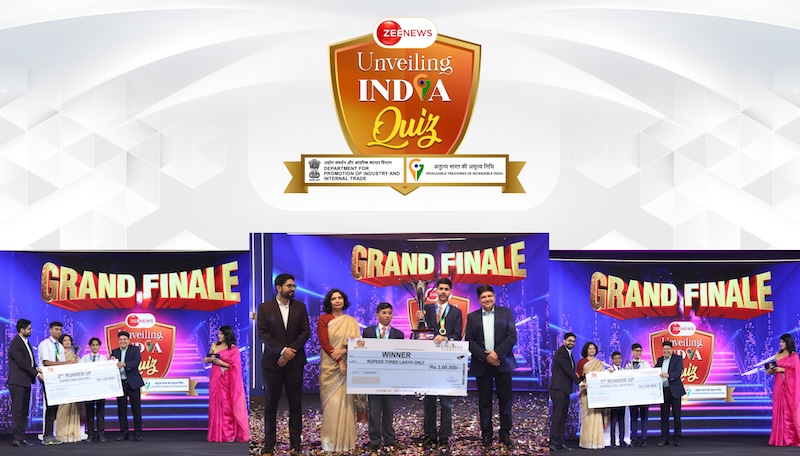
    MUMBAI: The grand finale of the Unveiling India Quiz, a landmark initiative by Zee Media in collaboration with the Department for Promotion of Industry and Internal Trade (DPIIT), captivated audiences nationwide as it aired on Zee Media’s network, gaining its status as one of India’s most impactful knowledge-driven initiatives. The overwhelming response to the telecast highlighted the scale, excitement, and cultural significance of the event.

    The telecast provided a riveting recap of the months-long journey—starting from an online Olympiad, advancing through intense state-level rounds, and culminating in a fiercely contested national finale. Viewers watched as the top eight teams battled for glory, with Army Public School, Jammu Cantt, emerging as the ultimate champion, securing the first prize. Rajagiri Public School, Kerala, claimed the second position, while Little Flower English Medium School, Kerala, took third place. Their stellar performances resonated with audiences, reinforcing the power of education in shaping future leaders.

    The telecast also shed light on the quiz’s unique focus on geographical indication (GI) tags, a defining element that introduced young minds to India’s indigenous craftsmanship and region-specific products. This emphasis on cultural and economic awareness transformed the competition into an immersive educational experience beyond traditional learning.

    Reflecting on the immense success of the initiative, Zee Media CEO Karan Abhishek Singh, said, “At Zee Media, we believe that news is not just about delivering information; it is about shaping a better, more informed society. Our commitment goes beyond headlines—we actively create platforms that empower different sections of society, be it through financial literacy initiatives, business summits, or programs that inspire and educate young minds. Unveiling India Quiz is one such initiative, designed to encourage school children to learn about India’s glorious past and promising future.”

    Adding to this, DPIIT secretary  Amardeep Singh Bhatia stated, “The Unveiling India Quiz has successfully instilled a deep sense of national pride and awareness about India’s economic and cultural diversity. This initiative is not just a competition—it is a long-term movement to nurture curiosity and appreciation for India’s vast legacy.”

    As the winners celebrate their well-earned triumph, the Unveiling India Quiz leaves behind a profound impact, encouraging millions of students across the country to embrace our unique culture, explore their heritage, and take pride in India’s incredible journey. Zee Media and DPIIT remain steadfast in their commitment to expanding such educational initiatives, ensuring that young minds continue to be inspired, empowered, and prepared for a global future.

    The resounding success of Unveiling India Quiz reaffirms the importance of knowledge-driven infotainment, setting a new benchmark in nationwide student engagement. 

  • IPRS celebrates 55 years with ‘Soundscapes of India – Gateway to the World’

    IPRS celebrates 55 years with ‘Soundscapes of India – Gateway to the World’

    Mumbai: On the occasion of its 55th anniversary, The Indian Performing Right Society Ltd (IPRS) has launched ‘Soundscapes of India – Gateway to the World’ in collaboration with MusiConnect India, scheduled from 31 August to 2 September 2024. Set against the backdrop of India’s bustling capital, New Delhi, the Global Music Summit will convene 11 international festival directors representing 13 world music festivals, alongside industry leaders, domain experts, and trailblazing creators from music industry to explore avenues for international collaboration, cultural exchange, and the immense potential to elevate India music and its creators onto the global stage.

    IPRS’s recent journey has been nothing short of extraordinary, solidifying its role as an essential pillar for music creators and owner publishers. As the sole music copyright society representing authors, composers, and publishers, our commitment goes beyond rights management to actively creating opportunities that empower and elevate careers.

    As India continues to emerge as a global music hub, garnering significant international attention, the global summit promises to be a platform for engaging discussions, networking and international collaboration. The conference will drive dialogues on global opportunities, preparing India for its next major leap in the international music market.

    The three-day event promises key note speeches, insightful panels, networking, connect corners, and music showcase.

    Event details:

    Day one: Seminar & conference 
    Date: 31 August | Venue: India International Centre, New Delhi
    Key note speeches, panels, fireside-chats, connect corner and networking

    IPRS has announced the distinguished presence of IPRS chairman Javed Akhtar, DPIIT senior consultant IPR Dr. Raghavender GR, Believe managing director for India & Southeast Asia Vivek Raina, IEMA senior director at Dolby Laboratories Karan Grover, lyricist, author, film director, and IPRS board member Mayur Puri, and Turnkey Music & Publishing managing director Atul Churamani, alongside a host of other eminent speakers and industry leaders at the conference.

    Sessions:

    1    The time is now: Amplifying India’s presence on the global music stage
    2    Navigating IP rights: Global insights and India’s evolving landscape
    3    Digital resonance: Looking forward to the decade – shifting trends and global dynamics
    4    Beyond borders: Exploring physical & digital frontiers – Insights and best practices in recording, publishing & live music
    5    Tourism through music: A complete cultural experience – Case studies and trends

    Days two & three: Music showcase and connect corner

    Dates: 1 & 2 September 2024 | Venue: The Piano Man, Malviya Nagar, New Delhi

    Performances by 15 outstanding artists and bands featuring the soundscapes of India. An eclectic showcase of India’s musical talent, representing a vibrant mix of musical genres and regional diversity.

    This showcase serves as a catalyst for discovery, where the Indian talent will connect directly with 11 top class festival directors representing 13 leading international festivals to explore opportunities for future performances and cross-border collaborations. It aims to be a strategic  networking and collaboration platform that bridges the  gap between local talent and global opportunities.

    International participation: 11 festival directors representing 13 leading international festivals from Poland, Hungary, France, Mongolia, Morocco, South Korea, Philippines, Malaysia, Thailand, and Slovakia, will be in attendance.

    Commenting on the event, The Indian Performing Right Society CEO Rakesh Nigam said, “IPRS is glad to collaborate with MusiConnect India in creating global opportunities for India’s diverse talent across genres and geographies. Soundscapes of India – Gateway to the World, coinciding with IPRS’s 55th Anniversary, marks a new milestone in our long and impactful journey. It is poised to be a landmark event, not only envisioning the future of the music industry but also positioning India as a key player on the global stage. The global music conference on day one serves as a precursor to the two-day music showcase,  where independent artists and music creators from various regions will present their work to top international festival directors.

    At IPRS, we understand the crucial role that music plays in shaping our nation’s creative identity. This conference highlights the vast potential of our cultural heritage and reaffirms IPRS’s commitment to nurturing talent, fostering innovation, and creating meaningful opportunities for our creators. We are delighted to join forces with key stakeholders in the music industry, both in India and abroad, to chart a dynamic future for India’s musical talent.”

    “Soundscapes of India aims to highlight the value of local, traditional, and independent music by unlocking its market potential on a global scale. This initiative aspires to create a platform that showcases the incredible diversity of Indian music, featuring both celebrated artists and those whose music are seldom heard. As an artist-driven venture, Soundscapes of India is committed to creating opportunities that benefit Indian music creators, connecting them with presenters and opportunities worldwide.”, added MusiConnect India founder director, MusiConnect Asia president, Global Music Market Network vice president Kaushik Dutta.

    Secure your spot free of cost for the Global Music Conference on 31 August on Paytm Insider.

  • Make in India push for set-top boxes face challenges

    Make in India push for set-top boxes face challenges

    KOLKATA: Last year it made headlines when large DTH players including Tata Sky, Dish TV announced their decision to move manufacturing of a significant portion of set-top boxes (STBs) in India. The announcements were in line with the government’s renewed push for Make in India. But with complexities looming over the initiative, manufacturers remained worried about the impact of the initiative, if it remained limited to just ‘assembling the products in India’.

    There have been talks around different aspects of the Make in India push for STBs since the last two years. “In 2020, the department for the promotion of industry and internal trade (DPIIT) formed a committee. It asked the ministry of information and broadcasting (MIB) to be a part of it and a meeting was held with operators and STB manufacturers to gauge the overall situation,” said MyBox Technologies MD and CEO Amit Kharbanda. “STB as an electronic product falls under the purview of the ministry of electronics and information technology (MeitY)Meity, but buyers are regulated by MIB, an ‘unusual situation’.”

    According to MIB, Make in India is not just about assembling the product in India but also about promoting Indian designs.

    “Our entire HITS business was premised on furthering the mission of ‘Digital India’ – taking signals to remote semi-rural and rural areas across our pan-India satellite footprint; facilitating a digital transition. As regards local sourcing, our Cable Operator Premise Equipment or COPEs bear testimony to our ‘Make In India’ approach; with a significant percentage of locally sourced components. With Set-Top Boxes, we have already moved whatever inventory production was possible, to India. This includes not just India-based manufacturers but also Indian companies. But, the challenge is that several components of the STBs still need to be procured from overseas manufacturers,” said NXTDigital MD & CEO Vynsley Fernandes.

    The draft National Broadcasting Policy (NBP) finalised early this year also focused on policies to indigenise the production of consumer premises equipment including the set-top boxes, which are heavily import-dependent. This will be done by setting up a self-reliant local manufacturing ecosystem and roping in the Bureau of Indian Standards (BIS) and other agencies to publish the quality benchmark. The policy also called for setting up measures to rationalise the import tariffs and provide preference to domestically manufactured electronic products and mandate increasing deployment of indigenous equipment.

    GTPL Hathway cable TV head and chief strategy officer Piyush Pankaj said, “MIB has been promoting the initiative for the last two-three years, focusing on Indian manufacturers. But, the problem is many components like chipsets still come from a foreign country and are being assembled here. However, the MSO is also buying boxes from Indian vendors.”

    While domestic manufactures are trying to make way for Indian designing, it takes more than a year to develop designing. “Indian design companies have competence but the business is not in good shape, so the domestic manufacturers are requesting the operators to cooperate with them. The operators can be worried about the quality of boxes but they can opt for trial orders,” said MyBox Technologies MD and CEO Amit Kharbanda.

    On the other hand, some operators have distanced themselves from the matter.

    “We support the Make in India initiative. But, we have also clarified that it applies to any product manufactured in India by an entity here, whether it’s an Indian company or a foreign one. As a service provider, I can’t go checking on the antecedents of the company and whether it has ‘designed’ or ‘assembled’ in India, or whether there was a technology transfer or indigenous technology used. It is very complicated for us. We are buying from a company registered in India, paying Indian taxes, not importing. As long as we are doing that, we believe we are buying from India. Now it is up to the government to find out this nitty-gritty and it wants to take a policy initiative,” a senior executive with a large MSO said on conditions of anonymity.

  • MIB directs digital media entities with FDI to share details within one month

    MIB directs digital media entities with FDI to share details within one month

    KOLKATA: A month ago, the department for the promotion of industry and internal trade (DPIIT) clarified certain aspects of 26 per cent foreign direct investment (FDI) in digital media. The ministry of information and broadcasting (MIB) has now directed the entities having foreign investment to share details of the company and its shareholding pattern along with the names and addresses of its directors and shareholders within one month.

    They have to share other details like names and address of promoters, significant beneficial owners, a confirmation with regard to compliance with pricing, documentation and reporting requirements under the FDI Policy.

    Entities which, at present, have an equity structure with FDI exceeding 26 per cent will have to inform MIB and take necessary steps for bringing down the foreign investment to 26 per cent by 15 October 2021 and seek approval of the ministry. To bring any fresh investment, the entities have to seek prior approval of the government.

    “Every entity has to comply with the requirements of citizenship of board of directors and of the chief executive officers (by whatever name called). The entities are required to obtain security clearance for all foreign personnel likely to be deployed for more than 60 days in a year by way of appointment, contract or consultancy or any other capacity for the functioning of the entity, prior to their deployment. For this purpose, the entities will apply to MIB at least 60 days in advance and the proposed foreign personnel shall be deployed by the entity only after prior approval of this ministry,” the ministry added in the notification.

    Earlier DPIIT clarified that the rule would apply to:- 

    ·        Entities uploading/ streaming news and current affairs on websites, apps, other platforms;

    ·        News agencies which supply news to digital media entities and/or news aggregators;

    ·        News aggregators which, using software / web applications, aggregate content from various sources in one location.

  • DPIIT issues clarification on 26% FDI in digital media

    DPIIT issues clarification on 26% FDI in digital media

    KOLKATA: While significant growth in media is coming from digital media consumption, the government amended the foreign direct investment (FDI) policy last year. As a part of the reform, it had announced an approval of  26 per cent FDI in digital media. However, there was a lack of clarity about the niggling details. 

    Mire than a year later, the department for the promotion of industry and internal trade (DPIIT) has thrown some further light on it:

    The rule would apply to :

    ·   Entities uploading/ streaming news and current affairs on websites, apps, other platforms;

    ·    News agencies which supply news to digital media entities and/or news aggregators;

    ·    News aggregators which, using software / web applications, aggregate content from various sources in one location.

    These news organisations would be required to align their FDI to 26 per cent level with governmental the approval, within a year from today. To comply with the FDI policy, the majority of directors on the board of the company and CEO should be Indian citizens.

    "Security nod must for foreign personnel deployed for more than 60 days in India if security nod for any foreign personnel gets denied, the employee has to resign/employment terminated," DPIIT said.

    In this context, the ministry of information and broadcasting (MIB) has announced that it will consider in the near future to extend the following benefits, presently available to traditional media (print and TV), to such entities also:

    ·      PIB accreditation for its reporters, cameramen, videographers enabling them with better first-hand information and access including participation in official press conference and such other interactions.

    ·     Persons with PIB accreditation can also avail CGHS benefits and concessional rail fare as per the extant procedure.

    ·     Eligibility for digital advertisements through Bureau of Outreach and Communication.

    Moreover, MIB has suggested forming a similar self-regulating body in digital media like print and electronic media.

  • DPIIT to issue clarification on capping FDI in digital media

    DPIIT to issue clarification on capping FDI in digital media

    MUMBAI: Amid certain stakeholders raise concern over government’s decision to allow 26 per cent FDI in digital media sector, the Department for Promotion of Industry and Internal Trade (DPIIT) is likely to issue a clarification soon on the same, Economic Times reported.

    According to some stakeholders, the idea to cap FDI (foreign direct investment) in digital media sector to 26 per cent must be clarified  by government as these stakeholders, who were looking to raise funds through FDI is now put on hold.

    There are two main concerns stakeholders have raised and sought clarification: 1) How the FDI policy of the sector would treat news aggregators, and 2) what would happen to those digital media companies where overseas investment is over 26 per cent

    Taking the views of the Information and Broadcasting Ministry on the issue, the DPIIT is expected to issue clarification shortly, Economic Times said quoting sources.

    In this regard, Deloitte India partner Jehil Thakkar had said that the clarity needed was on how to treat cases of television broadcasters that stream news online, but are allowed 49 per cent FDI.

    He questioned, “What happens to those, whether they qualify fewer than 26 per cent or 49 per cent (FDI)? What happens to news websites which are 100 per cent foreign entity?”

  • DPIIT seeks MIB views on issues regarding 26% FDI in digital media sector

    DPIIT seeks MIB views on issues regarding 26% FDI in digital media sector

    MUMBAI: As the cabinet recently amended the foreign direct investment (FDI) policy allowing 26 per cent overseas investment in digital media with government approval, the Department for Promotion of Industry and Internal Trade (DPIIT) has sought the views of the Ministry of Information and Broadcasting on issues raised by certain stakeholders over the new policy.

    "The extant FDI policy provides for 49 per cent FDI under approval route in up-linking of ''News & Current Affairs'' TV channels. It has been decided to permit 26 per cent FDI under government route for uploading/streaming of news and current affairs through digital media, on the lines of print media," an official statement said.

    There was a lack of clarification since the amendment that how the new policy would pan out. According to a PTI report, issues which were raised on the decision have been sent that to the MIB. The ministry is looking into it for suitable clarification, as per an unnamed official quoted by the report.

    The Internet and Mobile Association of India stated in a presentation to the DPIIT that the decision would have an impact on the startup ecosystem as continued FDI is critical to enable Indian digital media startups to achieve global scale. The association also said it would be critically harmful if there is not any clarification.

    “The scope of the impact will be determined by the wording of the provision in the FDI policy. News and current affairs are present on social media platforms, on digital platforms that are subsidiaries of foreign brands etc. How would you differentiate between TV channels which have 49% and their online streams, which will effectively have 26%?” Eros International group chief marketing officer Manav Sethi also said.

  • Draft National e-Commerce Policy: Why international OTT platforms need not worry just yet

    Draft National e-Commerce Policy: Why international OTT platforms need not worry just yet

    MUMBAI: The national e-commerce policy draft appears to have created quite a stir in India's OTT business. In its current form, the proposed policy is bound to pose a regulatory hurdle to international streaming giants, some say. Despite the clear distinction in the dynamics of OTT and e-commerce sector, the policy appears to bring the former under its ambit. That has given rise to speculation over the future of popular OTT platforms like Netflix, Amazon Prime Video and Hotstar.

    At the heart of the problem is the way e-commerce has been defined in the ‘Draft National e-Commerce Policy’ by the Department for Promotion of Industry and Internal Trade (DPIIT). The draft says, e-commerce is “buying, selling, marketing or distribution of goods, including digital products and services; through electronic network". Notably, it also refers to the FDI policy in e-commerce which restricts platforms with foreign direct investment to “exercise ownership or control over the inventory sold” on it. This poses a threat to Netflix Originals, Amazon Prime Video Originals and Hotstar Specials, argue some.

    The situation, however, isn't as dire as it is being made out to be.

    Given the obvious dissimilarities between the two services, there is a need to craft a separate policy for OTT platforms, if at all. Content consumption and buying products online doesn't make for a fair comparison.  When it comes to OTT apps, there is no fixed delivery period unlike an e-commerce platform. OTT platforms cannot swap the inventory model of business with an instant delivery model.

    While subscription based video-on-demand services carry out transactions, they don’t provide an option for permanent download of digital goods that could be regarded as a replacement of physical goods. Unlike e-commerce companies, OTT apps also don’t connect companies while providing content to subscribers.

    Policies of this nature don’t get finalised without struggle in the Indian regulatory system. The authority itself will go through multiple layers of discussions before sending off the final draft. In addition to that, stakeholders also have a fair chance to argue against what they'd like to believe are the flaws in the draft. The upcoming Lok Sabha election will also offer a breather to stakeholders when it comes to any potential forward movement on the bill. Industry sources Indiantelevision.com spoke to claim there is a good chance we may not see a final policy even before 2020.

    According to legal experts, the intent of the policy is good for small retailers in the country. But bringing digital services and data storage issues along with e-commerce platforms will cause more ambiguities for the entire digital economy. Moreover, lack of clarity on how the implementation will happen is being highlighted as a major problem of this draft. They have also pointed out the need for open house discussions to address some of these issues.

    However, it is certain that if the draft in current form becomes the law of the land, international OTT players will be left with no option than to adopt a marketplace model. That, however, would make little sense, as it would force them to showcase their content on other OTT platforms, as per the definition of what constitutes e-commerce. The micromanagement of ownership and control over content will only harm the industry, which is still at a nascent stage of growth.

    While there is a perspective that the proposed policy will help homegrown OTT players, there is also a danger that a less competitive market may lead to fall in quality content. Along with the emergence of homegrown players, the localisation strategy of international OTT players has driven the growth of demand for original conten. Depriving Indian viewers of international shows and original programming may also reduce their enthusiasm for streaming platforms overall.