Tag: Downlinking

  • MIB reverts to earlier norms of seeking nod from ISRO on uplink/downlink of TV channels

    MIB reverts to earlier norms of seeking nod from ISRO on uplink/downlink of TV channels

    NEW DELHI: At a time when one arm of the government is said to be exploring review of usage norms for satellite frequencies for users of satellite services, Ministry of Information and Broadcasting has cancelled an earlier order — which simplified clearances for uplinking and downlinking of TV channels on permitted teleports and satellites — and reverted to an older tradition of also getting an okay from Department of Space (DOS), which could make the process lengthy.

    In a recent official communiqué, MIB stated DOS observed that by not referring TV channels’ applications relating to uplink/downlink to it, certain “key aspects” provided by the applicant were “not getting examined” and which could “create interference issues and difficulties in coordination with Indian satellites” at a later stage.

    Pointing out that a policy decision taken earlier by it has been reviewed

    in the light of DOS observations, MIB added, “It has been decided to revert to the erstwhile practice of referring all applications, seeking uplinking permission/change of teleport and/or satellite in respect of TV channels, to DOS for its no-objection with reference to proposed satellite’s coordination with Indian satellites.”

    A prior nod from DOS for uplink/downlink of TV channels on teleports and satellites, already permitted by MIB, was considered “duplication” of the clearance process and, thus, done away with by MIB in February 2017 as part of PM Modi-led government’s bid to ease norms of doing business in India. DOS, managed directly by the Prime Minister’s Office, oversees activities of Indian Space and Research Organisation (ISRO), an organization responsible for Indian satellites.

    MIB, while withdrawing its early-2017 order, said its decision comes into effect immediately.

    Interestingly, according to government sources, Wireless, Planning and Co-ordination (WPC) division, under Ministry of Telecoms, is exploring a review of clearance norms for users of satellite services in India and also optimizing value of satellite frequencies.

    At present, for a customer of satellite services, whether on Indian or foreign satellite, getting clearance for satellite capacity is a lengthy and time consuming process involving green signal from multiple government organizations, including DOS/ISRO and WPC.

    Telecoms and broadcast regulator TRAI has suggested a couple of times, in lengthy set of recommendations, that with an explosion in communications services, it was time India ought to explore an Open Sky Policy relating to satellite services; especially in KU-band category.

    ALSO READ:

    ISRO stresses on indigenization; TRAI for Open Sky policy

    Prasar Bharati, Dish TV, Star, Zee and BES bat for KU-band open-sky policy
    Will foreigners buy into easing of FDI in cable TV, DTH?

  • TV channels’ failure to start in a yr: 18% permits cancelled

    NEW DELHI: Action is taken whenever a channel which has been given permission to uplink fails to do so within a year, the Parliament has been told.

    Under the roll-out obligations for operationalisation of private satellite TV channels furnished under the clauses 2.5.1 and 3.5.1 of uplinking policy Guidelines 2011 and 5.9 of downlinking policy guidelines 2011, the applicant companies are required to operationalise the permitted TV channels within a year from the date the permission is granted by the MIB.

    Minister of state for information and broadcasting Rajyavardhan Rathore has said that whenever an instance comes to the notice of the ministry where the company fails to fulfil the roll-out obligation, action is taken against the company under the clauses 2.5.2 and 3.5.2 of uplinking guidelines and clause 5.9 of downlinking Guidelines which entails the forfeiture of PBG and cancellation of permissions.

    After the permission for uplinking of a channel is issued by the ministry, the Wireless Planning and Coordination Wing, Department of Telecom, assigns frequency spectrum (bandwidth) to the teleport operators to enable them to uplink such TV channels,  Rathore said.

    The minister said a total number of 1078 permissions had been issued for uplinking and downlinking of private satellite TV channels as on 30 June last, out of which 195 permissions (18 per cent approximately) have been cancelled so far.

    Rathore said the typical value of bandwidth/data rate required to transmit (uplink/downlink) TV channels are calculated in two categories of transmission are:

    TV Broadcasting with platform bit rates per channel (in Mbps)

    Typical

    SDTV with MPEG-2 3

    SDTV with MPEG-4 1.5

    HDTV with MPEG-2 16

    HDTV with MPEG-4 8


  • Smuggled STBs & Indian DTH may be used, IBF advises Nepal to defer Clean Feed

    MUMBAI: Nepal had recently issued a clean feed policy. However, owing to unviable business proposition, it is felt that distribution channels may face discontinuation leading to rampant piracy all over Nepal. It was highlighted that in-cable operators may resort to using Indian DTH connections to re-distribute the signals. Viewers too may start buying Set-Top Boxes (STBs) and Viewing Cards of Indian DTH operators without knowing that the same may have been smuggled into Nepal. IBF has appealed that “the Government of Nepal ought to defer implementation of a “Clean Feed” policy until implementation of digitization so as to evaluate best ways to take advantage of the same as is being done by other countries.

    In the recent past, Government of Nepal issued clean feed policy pursuant to which downlinking licenses of foreign broadcasters is sought to be permitted only if foreign channels being distributed in Nepal do not contain any advertisements (“Clean Feed Policy”). The Clean Feed Policy is sought to be implemented by Government of Nepal from 16 July, 2017.

    To apprise the Government of Nepal on the possible fallouts of the proposed policy and its likely impact on the economic development of Nepal – particularly from the point of view of loss in revenue and employment in the Country, Indian Broadcasting Foundation (IBF) has had a series of discussions with Nepal Government officials. During the discussions, broadcast fraternity of India conveyed the technical and economic unviability of the proposed Clean Feed Policy in Nepal. Broadcasters also conveyed that consumers and various distribution platforms in Nepal would be adversely effected in case the proposed policy is implemented on the designated date.

    (a) It was highlighted to the Government of Nepal that any such policy ought to be framed only after holding transparent and holistic consultations involving all stakeholders in an environment where digitalization of distribution networks in Nepal has been completed and issues relating to implementation of anti-piracy laws have been put in place, as is not the case presently.

    (b) Launch of clean feed would inter-alia entail separate playout, uplink and downlink costs. Nepal being an emerging market with very low ‘Average Revenue Per User’ (“ARPU”), such exorbitant costs to create clean feeds are not justifiable from a business viability point of view.

    (c) Due to unviable business proposition, it is felt that distribution channels may face discontinuation leading into rampant piracy all over Nepal. It was highlighted that in cable operators may resort to using Indian DTH connections to re-distribute the signals. Further, in such a situation, viewers too may start buying Set-Top Boxes (STBs) and Viewing Cards of Indian DTH operators without knowing that the same may have been smuggled into Nepal.

    (d) The demand for ‘clean feed’ is at variance with and may be counter-productive to Government of Nepal’s laudable initiative for implementation of digitalization of distribution networks. This is so because digitization is a cost intensive exercise and any discontinuation of channels on account of implementation of Clean Feed Policy ought to have an adverse impact on revenues of cable operators (thereby affecting their ability to invest monies for digitization). It was submitted that such impact can have a cascading effect on survival of distribution platforms thereby, as a chain reaction affecting employment locally and also distribution / reach of local Nepalese channels.

    (e) Government of Nepal should first allow implementation of digitization before proceeding to evaluate need for introduction of a Clean Feed Policy. It was highlighted that digitization with addressability is a potent tool to keep in check on unaccounted cash transactions, which may not only cause losses to distribution platforms and broadcasters but, also to the Government exchequer in the form of lost taxes.

    (f) Proper and effective implementation of digitization will give an insight to broadcasters on type of content being consumed, and as a consequence, they will be able to evaluate consumer choice better. From Government’s point of view, digitization will also afford a line of sight on content being distributed in Nepal, revenues being generated by distribution platforms and consequential license fees / taxes that they are paying. Such license fees / taxes can be utilized by the Government inter-alia towards cross-subsidizing expenses of Nepalese broadcasters or other initiatives.

    Girish Srivastava, Secretary General of IBF, appealed that “the Government of Nepal ought to defer implementation of a “Clean Feed” policy until implementation of digitization so as to evaluate best ways to take advantage of the same as is being done by other countries. Meanwhile, with the renewal of channel licenses due on 15 July 2017 – we would request the Ministry of Information and Communication (MOIC) to allow existing/new channels to be distributed without the Clean feed condition – with the understanding that the license shall not be withdrawn for at least till the next term is due”. Adding further to his request, Srivastava stated that “entire Indian broadcasting fraternity attaches a great degree of significance to the existing deep cultural, linguistic, social, economic ties between the two nations and its commitment to further the same in times to come”.

  • TV channels’ uplinking / downlinking procedure simplified

    MUMBAI: The ministry of information and broadcasting of the government of India has simplified the procedure for processing of application for uplinking/downlinking of TV channels. Marked to all broadcasters & teleport operators, this order, signed by the joint secretary to the government of India K Sanjay Murthy has come into immediate effect’

    All applications requiring permission for uplinking / downlinking of private satellites TV channels/ teleports/ news agencies/ DSNG etc. are processed as per clause 9.2 of the policy guidelines for uplinking of television channels from India dated 5 December 2011, which is reproduced below:

    “9.2 — On the basis of information furnished in the application form, if the applicant is found eligible, its application will be sent for security clearance to the ministry of home affairs and for clearance of satellite use to the Department of Space (wherever required)”.

    After detailed and careful consideration, the competent authority has decided that the following procedure would be followed in dealing with the phrase “wherever required” as mentioned in clause 9.2 of Uplinking Policy Guidelines’.

    DoS clearance would be required in case of applications seeking permission to set up teleports and operating DSNG vans.

    DoS clearance would not be required for TV channel applications proposing to uplink from teleports which are already cleared by DoS and permitted by the ministry of information and broadcasting.

    Also Read:

    Non-news temporary uplinking approvals in 15 days

    81 teleports permitted to uplink, downlink TV channels


  • Don’t air live Cauvery violence: MIB to b’casters

    Don’t air live Cauvery violence: MIB to b’casters

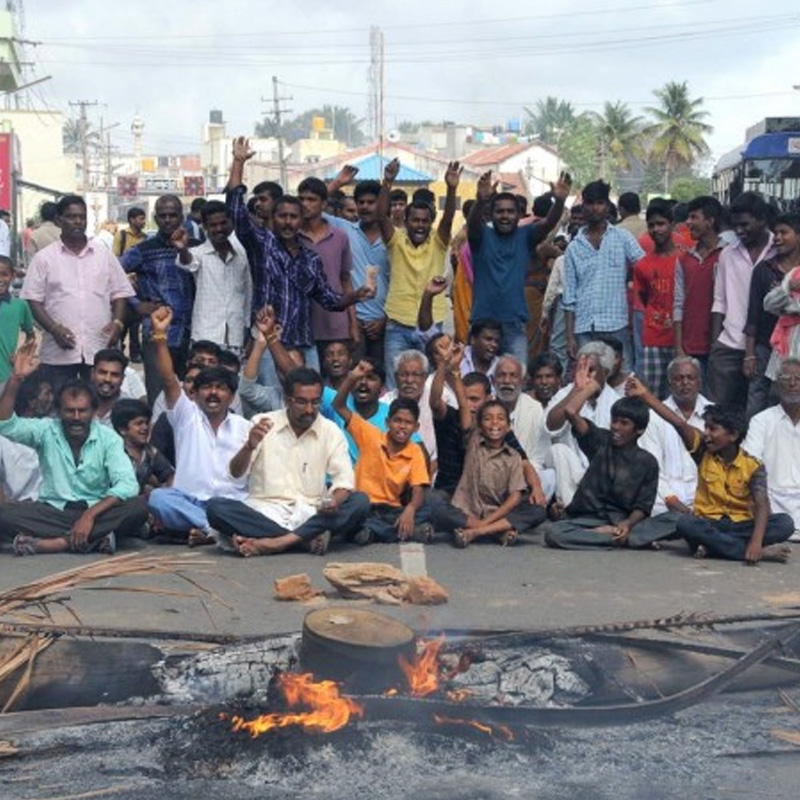
    NEW DELHI: Noting that it had come to its notice that certain television channels had been telecasting provocative news / programmes relating to the Cauvery dispute, the Government on Tuesday evening asked the media to avoid live telecasts or file shots of violence.

    A statement issued by the Information and Broadcasting Ministry said the reportage may use shots of the Cauvery river and security forces. It said news, views or comments relating to the dispute should be telecast only after proper verification of facts and presented with due caution.

    TV channels have been asked to exercise restraint while covering incidents of rioting. Cable TV and satellite channels have been asked not to carry news in such a way that it incites violence. Earlier, I&B Minister M Venkaiah Naidu urged the media to exercise restraint in coverage of such incidents.

    The note issued by Director (Broadcasting) Neeti Sarkar stated that, as per the conditions/obligations of permission / approval for uplinking / downlinking, the channels are bound to follow the Programme Code and Advertising Code prescribed under the Cable Television Networks (Regulation) Act 1995 and rules framed thereunder.

  • Don’t air live Cauvery violence: MIB to b’casters

    Don’t air live Cauvery violence: MIB to b’casters

    NEW DELHI: Noting that it had come to its notice that certain television channels had been telecasting provocative news / programmes relating to the Cauvery dispute, the Government on Tuesday evening asked the media to avoid live telecasts or file shots of violence.

    A statement issued by the Information and Broadcasting Ministry said the reportage may use shots of the Cauvery river and security forces. It said news, views or comments relating to the dispute should be telecast only after proper verification of facts and presented with due caution.

    TV channels have been asked to exercise restraint while covering incidents of rioting. Cable TV and satellite channels have been asked not to carry news in such a way that it incites violence. Earlier, I&B Minister M Venkaiah Naidu urged the media to exercise restraint in coverage of such incidents.

    The note issued by Director (Broadcasting) Neeti Sarkar stated that, as per the conditions/obligations of permission / approval for uplinking / downlinking, the channels are bound to follow the Programme Code and Advertising Code prescribed under the Cable Television Networks (Regulation) Act 1995 and rules framed thereunder.

  • Stern warning to News Live TV for showing disturbing visuals of dead bodies and badly injured people

    Stern warning to News Live TV for showing disturbing visuals of dead bodies and badly injured people

    NEW DELHI: The government today issued a warning to News Live TV channel for showing ‘extremely disturbing visuals of dead bodies and badly injured people including children which were not only disturbing but could also hurt the sentiments of the viewers.’


    In a stern directive to the channel to follow the Programme and Advertising Code as well as the Downlinking/Uplinking Guidelines, the Information and Broadcasting Ministry said ‘visuals were neither morphed nor blurred. The visuals appeared to be in bad taste and against the sensitivities of the victim’s family. Hence, the visuals appeared to offend good taste and decency. The visuals also did not appear to be suitable for children and for unrestricted public exhibition.’


    Any violation shall entail such action against the channel as deemed fit in accordance with the Cable Television Network (Regulation) Act, 1995 and the Rules framed thereunder as also the terms and conditions of the permission granted under uplinking/downlinking guidelines.


    Earlier, a show cause notice was issued to the channel on 5 November last year for the visuals carried in several news bulletins during 2012 and 2013. Initially, the channel said it was required to keep the recordings for only 90 days and therefore was unable to reply as the recordings had been destroyed.


    The Ministry thereafter sent recordings in its own possession and also referred the matter to the Inter-Ministerial Committee which considered the matter on 4 July this year where a representative of the channel was also present.


    The IMC observed that telecast of news bulletins were clear violation of the provisions of the Programme Code, particularly Rules 6(l)(a),6(lXo), and 6 (5) of Cable Television Network Rules, 1994. The IMC observed that even though the channel had accepted their fault and apologised for their mistake, they cannot escape the responsibility of ensuring content on their channel which must invariably be in conformity with the Programme Code.


    ‘News Live’ TV Channel is also governed by the provisions of Uplinking/Downlinking Guidelines and Pride East Entertainments while applying for the uplinking/downlinking permission had undertaken to abide by the Programme and Advertising Codes and the Uplinking/Downlinking Guidelines, read with the permission granted to ‘News Live’ TV Channel. 

  • Narsingha Broadcasting to launch Bengali News channel

    Narsingha Broadcasting to launch Bengali News channel

    KOLKATA: Kolkata-based Narsingha Broadcasting, which has re-started publishing of Bengali daily ‘Ekdin’ from 29 June after acquiring the publishing rights from old owners, now aims to foray into the television media business. The company plans to launch a Bengali satellite News channel soon. While the name of the News channel hasn’t yet been revealed, it is likely to include the word ‘Ekdin’.


    “We have applied for the uplinking and downlinking licence already. Though it would be a Bengali channel, we have set aside 10 minute slots each for Hindi and English news bulletins, keeping in mind the non-Bengali TV viewers settled in Kolkata and other states,” said Ekdin editor in chief Rhitobrata Bhattacharya to indiantelevision.com.


    According to industry sources, the company may take equipments and teleports on lease, at least initially. Narsingha Broadcasting had recently acquired the rights from Siliguri-based Darpan Press to re-start the Bengali daily, which had wound up the broadsheet, leaving close to 120 employees including journalists and technical staff jobless on 15 January, this year.


    Founded by veteran journalist Suman Chattopadhyay, who was also the first editor of ‘Ekdin’, the newspaper was sold off to the Chakra Group after Chattopadhyay joined Eyi Shomoy, The Times Group’s Bengali daily. The Chakra Group later sold ‘Ekdin’ to Darpan, which has owned the daily since 1 October, 2013. Without citing any valid reasons to employees, Darpan shut down the publication.


    When Darpan Press chief executive officer and director Sandip Choudhary was contacted he confirmed that the rights had been sold to Narsingha Broadcasting which had re-launched the newspaper.


    Bhattacharya informed that ‘Ekdin’ would have Kolkata and Durgapur editions and the new management would try to attain a circulation of around one lakh, if not more in the initial months. “We are working to bring out a special supplement on cinema, literary and historical aspects to give something extra to readers apart from hard news,” he revealed.

  • Dish TV appeals to govt against MTV, Nick

    Dish TV appeals to govt against MTV, Nick

    MUMBAI: Subhash Chandra’s DTH service Dish TV has upped the ante by invoking government help in getting those TV channels on board who have refused to do so till now.

    Dish TV’s wrath has been particularly directed at MTV and Nick with which the former has been fighting a legal battle since last year.

    In a letter to the information and broadcasting ministry, Dish TV has petitioned that despite sector regulator’s directive on making available content to all platforms and a favourable judgement from disputes tribunal TDSAT, the “conduct of MTV” has been “clearly in violation” of the interconnection regulation of 2004.

    Dish TV’s parent ASC Enterprises has contended despite carrying on commercial negotiations with MTV Networks India for several months, the content provider and its distributors in India (One Alliance) have stalled any fruitful conclusion of such talks.

    The Dish TV letter to the government states, “We would request you to take cognizance of the consistent refusal of MTV Networks to provide the channels, MTV and Nick, on our DTH platform and non-compliance of the interconnect regulation of Trai (Telecom Regulatory Authority of India)
    and the order of TDSAT before the registration certificate for downlinking of (the) channels is granted to the broadcaster.”

    The government while acknowledging the letter from Dish said it hasn’t taken a view on the issue yet.

    In a related development, an executive of Dish TV said it will be “placing the execution appeal” at the TDSAT within few days.

    Contacted by Indiantelevision.com, MTV senior vice-president, network development South Asia (licensing and merchandising) Sanjeev Hiremath, refused to comment saying the matter relating to Dish TV was subjudice.

    A spokesperson for Discovery-Sony joint venture One Alliance today said that negotiations with Dish TV have been continuing fruitfully and are “likely to be concluded in a few days time.”

    ASC Enterprises, the DTH licence holder for Dish TV, had moved TDSAT in 2005 against MTV’s refusal to provide its channels for the DTH platform.

    Early this year, TDSAT directed MTV to make available its channels to Dish TV on a commercial basis within 30 days by 10 March, 2006.

    MTV Networks appealed against the TDSAT order in the Supreme Court, which admitted the appeal, but did not stay the disputes tribunal’s order.

    During the last hearing on 9 May, the apex court said the case would be taken up again on 12 July after the summer recess.

    Dish TV has also moved the TDSAT against Star India on similar grounds of noncompliance of interconnect regulations.