Tag: Doordarshan

  • News Channels: Sensation-fatigue, government’s attitude and regional channels will decide future content

    For noted media columnist Shailja Bajpai, her wish-list for 2008 includes cleaning up the news channels and getting back to ‘news as news should be. Or as it was in the olden days of print media and just Doordarshan’.

    The latest entrant in the Hindi news genre, Anuradha Prasad – with her News 24 – could perhaps bring some comfort to Bajpai, as Prasad has positioned her channel as one with the aim of “bringing news back to news”. But that will be one Hindi channel anew with that sort of focus from the beginning, whereas the market is in a high state of flux and for sure, eyeball journalism has been getting a better share in the space.

    A few aspects of news channels are quite married into each other and cannot be discussed separately: the growing number of channels in the genre, the issue of ethical journalism, where the advertising is going, the rating system and the government’s Content Code.

    Interestingly, though channels have taken their respective positions (which some differentiate as the ‘perception route’ Vs the ‘numbers route’), there is a lot of cross talk within the channels themselves, and thus it is that we find a Hindi channel editor talking of values of credible journalism and an English channel editor talking of the ‘robustness of Hindi news’.

    It is a melting pot on the boil and the process is not going to crystallise in the next few months, but overall, there is a sense of a lot of soul churning and of the new, just decade-old industry trying to see where it goes and how it survives – and on which formula.

    An analysis of the market share of the derided-by-some sensational (tabloid?) channels shows they have a consistent high rating, and India TV is a case especially in point, where it has become the No. 3 from a much lesser position.

    So where is the market going? Chintamani Rao, CEO, India TV has been consistent: “We are going where the people are going, that is where the market is.” And he cannot be denied this claim because of the consistent rise in the ratings of his channel.

    The other pointer in the same direction is NDTV 24/7 going FTA after the rolling out of Cas in the three metros, as it was a clear indicator that people were staying away from it if it stayed ‘pay’, despite the ‘ideological’ position of sane, serious and credible journalism.

    Hindi news channel NDTV India, despite sliding sharply on the ratings front since last April, has stuck to its ‘credible’ credo and promises to ‘stay the copurse’.

    NDTV Group CEO Narayan Rao, like his surname-sake Chintamani Rao, is consistent in his opposition to what the latter holds as the winning formula. Narayan Rao had told us during his mid-year statement on Hindi news channels: “It is a short term passing phase. In the long term, for any news channel, it is credibility and authenticity that matters. Whatever the situation is, we never opted to go down a certain route. We still have the same philosophy as we had when we conceived the channel.”

    In between comes CNN-IBN and IBN 7, in English and Hindi respectively. The statements from both Rajdeep Sardesai (Editor-in-chief for the group and directly handling CNN-IBN, and Ashutosh, Managing Editor at IBN 7 echo Narayan Rao on the issue of credibility, but are far more eager to experiment with both content and form.

    IBN 7 has brought some of the best exposes through sting journalism but says it is steering firmly away from sensationalism, whatever the cost. Ashutosh says that if it benefits society at large, he is all for stings, but “why should any politician having illicit sex in a state guest house be considered serious journalism, unless this act is coming in the way of his public functioning?”

    At the same time there is an in internal debate on what to show and for how long, and whether the sensational or even trivial has some place as ‘entertaining information and visuals’ punctuating serious news.

    For instance, one channel was showing a half hour repetitive shot of a lion hugging a man from behind the grills of his cage. The side talk at IBN 7 was, this is an interesting shot and people would like to see it, but IBN 7 would perhaps just have a 10 second take on it.

    This is where the moral debate is rooted in business terms: that eyeballs are important, but some say they will not veer a centimetre to get them, and some say a centimetre is OK if we can restrain ourselves to that. The other view is, of course, eyeballs is everything.
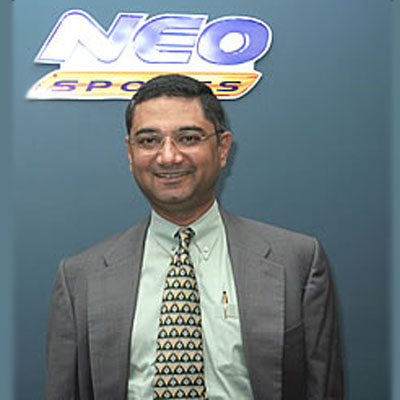
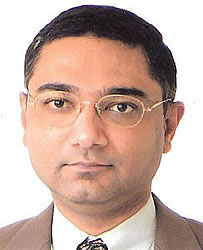
  • ‘Language feeds can get us 30 per cent more viewership’ : Shashi Kalathil – Neo Sports CEO

    ‘Language feeds can get us 30 per cent more viewership’ : Shashi Kalathil – Neo Sports CEO

    Neo Sports has had a testing time. The distribution deal with Star did not work out and the two channels – Neo Sports and Neo Sports Plus – did not find space on cable networks. This, in turn, impacted ad revenues.

    Now with Australia and Pakistan touring India, Neo is ramping up the distribution of its two channels. And it is hoping that strong content will drive in viewership and revenue.

    In an interview with Indiantelevision.com's Ashwin Pinto, Neo Sports CEO Shashi Kalathil reveals the gameplan for the company.

    Excerpts:

    Has Neo Sports gone through a rough weather ever since its launch almost a year back?
    The going has been tough. There was uncertainty on the regulation front. We had mandated Star to handle our distribution, but our channels had serious problems of being carried on cable networks. Cricket also went through its ups and downs, with the World Cup being the lowest point for the sport. There was a lot of media hype which made a not – so – good situation worse.

    What were the factors that made you terminate the distribution contract with Star and decide to do it on your own?
    We had an arrangement with Star. While I do not want to get into details as the matter is under arbitration, I will admit that we got almost zero delivery. We found that we would not be able to survive as a channel if we did not reach anyone. Besides, the payments that were contractually due to us were delayed – or never arrived.

    Did it also badly impact your ad revenue?
    Our ad revenue was hurt as a result of the Star deal. We got away with it to some extent in the Sri Lanka series by keeping ad rates high and through strategisation where some matches aired on Doordarshan. However, we could not fully exploit the Bangladesh Test series. That would have been worth at least Rs 70-90 million. We could not realise even one fifth of that.

    How have you worked out on your distribution strategy?
    We have covered one third of the cable networks. We went to the smaller towns first as there the declaration is much better. A lot of viewership comes from rural areas. We signed with direct-to-home (DTH) service provider Tata Sky. We expect to sign with Dish TV soon. We are also stitching deals with the south-based cable networks.We are now approaching the big multi-system operators (MSOs) like Incablenet, Hathway Cable & Datacom and Siticable. By the time the Australia series starts we will be in three fourths of cable & satellite (C&S) homes.

    Since the matches have to be shared with Doordarshan, doesn't it affect the kind of deals that Neo is able to strike with the cable operators?
    No! The sharing of feed has been going for a long time. The 2003 World Cup was shared. There are guidelines. Last year for a while, the Supreme Court had taken a view on this kind of activity. India-South Africa was a rare example where DD did not air the matches.

    We have a situation where the pubcaster does not bid for cricket but takes feed when it wants to do so. Besides, there is the issue of encryption.

    What was the write off that Neo Sports got from BCCI due to the non-encryption of DD's signals?
    DD's footprint extends from China to the Middle East. We had a protection clause in case of circumstances that dilute the value of our BCCI rights. If DD sends an unencrypted signal, then how can you sell the rights in those markets?

    Right now there are a lot of cricket rights coming up for grabs. Is Neo Sports going after any of these or are you first trying to justify the BCCI investment?
    It isn't a sequential process. If there are rights that are of value, we will bid for them. Right now what we are seeing is that the price appreciation for these boards has not been as high as what it was for the ICC and BCCI rights.

    If someone gets the BCCI rights which are huge, you will see polarisation happening around the ICC rights. These two rights are the definitive ones in the cricket world; nothing else comes close. About 70 per cent of cricket that India plays in the next 13 months will be on Neo. That is an awesome depth to have.

    For the Australia and Pakistan tours, in terms of coverage what are the kind of innovations being looked at?
    We are keen on language feeds. You can get 30 per cent viewer addition doing this. Traditionally, the South has been neglected in terms of the regionalised feed. Neo Sports Plus will be broadcasting the matches in Hindi, Tamil and Telugu while Neo Sports will have English language transmission.

    We are looking at virtual advertising and programming innovations. We are also looking at interactivity on DTH.

    How challenging is it to push up ad rates to match rising acquisition costs?
    The cricket market is well set up. There are certain clients who advertise heavily in it. The economy is opening up which will allow you to have better inventory utilisation. There are ways to exploit cricket like having multiple language feeds.

    There is also a proliferation of general entertainment and movies channels which is resulting in further fragmentation. This will make the monolithic viewership of cricket more cost effective for brands and more valuable. Break viewership is becoming a serious issue for advertisers. On movie channels, often the break might be too long and people surf. Cricket's format is built to counter this.

    You will eventually be able to do multiple visual feeds for advertising. Now, though, it is still expensive and messy. With addressable delivery platforms like DTH coming in, the dependence on advertising will gradually fall.

    'If someone gets the BCCI rights which are huge, you will see polarisation happening around the ICC rights. These two rights are the definitive ones in the cricket world'

    How would you describe the perception of cricket at the moment among viewers and advertisers?
    I don't think that it is changing. Yes, there is noise made in the media on perceptions of how India is faring. It has to do with the quality of the opposition, how they are perceived. However, I do not think that cricket viewership or ad revenues are as sensitive as what the media says it is. When India did not do well in South Africa last year, people said that the sport was in trouble. Then we did well at home against Sri Lanka and the same media said that this was the best team for the World Cup.

    There is huge interest in the Australia series as it takes place during the festive season. Cricket in media parlance offers viewership that other programming cannot match. This will not change.

    Which are the clients with whom Neo Sports has signed long term deals?
    Perfetti and Hero Honda are our anchor sponsors. The concept is to have someone who wants a long term relationship with cricket on board. We have predictability to our calendar. So a client knows that Australia, Pakistan England, South Africa or Sri Lanka will be visiting us. So if a client does media activity, he knows that a footprint is available.

    How many anchor sponsors do you want to have?
    Initially, we had thought of having four anchor sponsors. However, the media space is getting so competitive that we held back a little bit as we did not want to preclude a large media buyer. There are emerging segments like retail and financial services that will become large. We are waiting for the media environment to settle down before we make more long term deals. There is a risk and also a de-risk in long term deals. You might end up paying more. You might end up paying less. Management is about dealing with it.

    During the World Cup there was a lot of grumbling about the deluge of ads. Steve Waugh went public about it in a column. What is Neo Sports' gameplan to ensure that commercial considerations do not interfere with viewer enjoyment?
    Cricket has a certain format which allows you space for ads – between overs, when a wicket falls, and also during the lunch interval. I think that the World Cup was a situation where matches were going beyond midnight. So perhaps the broadcaster was trying to get in as many ads as possible in the first half as viewership would certainly drop precipitously during the second half.

    In terms of domestic cricket with the push that has been given to it by Neo Sports, has there been any increase in viewership?
    We have had a good experience with domestic cricket. Now that our distribution issues have been settled, we will do innovations around domestic cricket.

    We don't air every domestic match. Cricket is tiered at various levels. We broadcast the best part of it. I have heard arguments about having less matches and fewer teams which I will leave for the administrators to settle. But at the end of the day, a Ranji Trophy final has value. It is the question of packaging it. There is also an awareness issue. People have not gotten used to watching domestic cricket. However when they find that the coverage quality is as good as what you get for an international match, there is stickiness. Last year's data shows that domestic cricket has potential. It is for us to develop that.

    However, the ad fraternity does not seem to be getting on board domestic cricket. Is there a perception problem in the market?
    The product needs to be developed and defined. Once you do that and take it to the advertiser, it will draw interest. But it will not happen overnight. There is still work to be done.

    What is the status regarding your second channel Neo Sports Plus?
    One part of its identity is to be an adjunct to Neo Sports. So Neo Sports Plus airs cricket in local languages. We were clear at the beginning that we wanted to adopt a regional multi language feed for it.

    Neo Sports Plus also airs other sports like German soccer, Italian league. We have badminton, cycling, motorsports. We have also found that rugby got a strong niche viewership among males.

    Can we flesh out the definition of Neo Sports Plus to go beyond cricket? That is something we are working on. Other sports have a growing niche. In the long term, you can grow it to a mass level like what EPL has done. Activities were done that led to the product definition being unique. However, no other sport can substitute cricket. The assumption that if India does poorly, a cricket fan will watch another sport is wrong. Our research tells us that a lot of ODI watchers in India do not watch any other sport.

    Could you shed light on the investments made in technology?
    We are set to go live with broadcast management system ForeTV from MSA Focus. This follows the solution's recent implementation at Neo's Mumbai headquarters for $4 million. The Fore TV Broadcast management system allows Neo Sports the ability to efficiently manage the proliferation of new revenue streams that these rights will inevitably generate.

    Unlike traditional systems which treat each stream separately, ForeTV offers a consolidated solution for total revenue management, encompassing income from Internet Protocol Television (IPTV), advertising, sponsorship, pay-per-view (PPV), interactive (iTV) and video on demand (Vod). This system will be fully integrated into workflow of the channel, automation, editing and financial software allowing seamless process from acquisition, production and post production, transmission and billing at the end of the process.

    On the production front, we have installed Vizrt Virtual studio, a virtual studio for sport production. This allows Neo to create a number of different sets for each sport and change it at the flick of a button. There is no need for storing and changing physical sets. The advantages of using Vizrt virtual studio are flexibility in different backdrops, virtual monitors in the set and incorporation of sport results directly to the set. Vizrt Graphics are template based, allowing for rapid changes and are especially suited for the ever changing sport environment.

  • ‘We have stepped up work on digitalization for Prasar Bharati’ : Baljit Singh Lalli – Prasar Bharati CEO

    ‘We have stepped up work on digitalization for Prasar Bharati’ : Baljit Singh Lalli – Prasar Bharati CEO

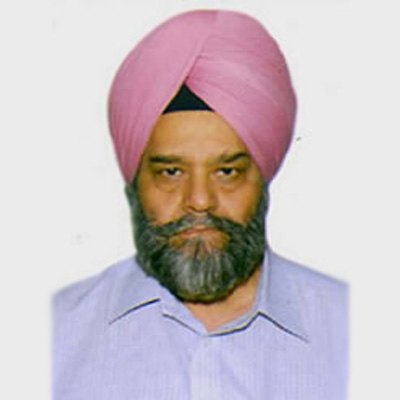
    Baljit Singh Lalli, who took charge as chief executive officer of Prasar Bharati at the end of December 2006, is an Indian Administrative Service officer of the 1971 batch from the Uttar Pradesh cadre with vast administrative and managerial experience spanning over three decades.


    In an interview to indiantelevision.com’s BB Nagpal, Lalli answered various questions relating to the falling revenue of Doordarshan, the cricket telecast rights controversies and other issues.


    Excerpts:

    Doordarshan’s gross revenue fell by about Rs 1300 million to RS 8,182.2 million in 2006-07, as compared to RS 9,469.6 million in 2005-06. But the gross revenue of All India Radio rose marginally by RS 148.2 million to RS 2,836.5 million in the same period. To what do you attribute these losses?
    As you know, Doordarshan has lost around RS 3400 million because it did not have the telecast rights for cricket. If you do not count what we lost because of cricket, the revenues of Doordarshan have actually gone up as far as other programmes go. But we have already made up RS 2 billion. On the other hand, AIR earned just under RS 96.4 million from the World Cup 2007.

    Why is it that Prasar Bharati wakes up so late to bid for the cricket telecast rights and then has to pass a mandatory sharing legislation?
    I cannot answer that because it happened before I joined. But you must understand that the amount for bidding for rights for up to five years is more than what a public broadcaster can afford. As far as the legislation is concerned, it is necessary to understand that the Uplinking and Downlinking Guidelines issued in November 2005 were clear on mandatory sharing of rights for terrestrial showing, but were being violated by the rights holders.

    For a long time, Prasar Bharati has been talking of strengthening its marketing strategy, but the results do not seem to be showing?
    That is not true. As I said, we have made up a lot of the losses caused because of not having telecast rights. We have now taken steps to streamline the marketing procedures. Also, the attempt is to bring in greater synergy between All India Radio and Doordarshan. We have set up a committee and sent out new proposals to our marketing people in Mumbai, Kolkata, Chennai, Guwahati and other places.


    AIR has already made more than five times the projected revenue from cricket. You should also not forget that Prasar Bharati is a public broadcaster and cannot resort to generating revenues the way some other channels can. At the same time, we are now having closer monitoring of the marketing activity, and are also recruiting professionals for the work.

    A Comptroller and Auditor General Report talks of losses on various counts, including arbitrary fixation of advertisement rates for feature films to favour certain filmmakers. How will you ensure proper checks and balances?
    I have not seen the report so far, and in any case it relates to 2004-05. We have now put a new system in place for acquiring films. We will now be able to get the best films at competitive rates, through a policy that will be completely transparent. The films will be selected in good time. The Grading Committee in Doordarshan will then categorise the films as specified in the policy. No individual producer or filmmaker will be shown favours of any kind.

    An Acquisition Policy announced by Doordarshan to acquire quality programmes has reportedly led to scams including submission of duplicate or blank tapes?
    Yes, I am aware of this case. The matter relates to October-November last year when new programmes were being acquired for the DD Urdu Channel. Our internal inquiry showed that around 250 blank tapes had been submitted along with other programmes. A committee of officers in Doordarshan is inquiring into the matter and would be able to identify those guilty and action would be taken, irrespective of whether it is only outside producers or someone within Doordarshan. As no money had been paid to any producers so far, there is no question of any loss of revenue on account of this. I am in principle opposed to acquiring old programmes, and this had been done under a policy announced before I joined.

    But this has already led to an order for transfer of senior officers in Doordarshan who have been in their posts for more than six years?
    That order has nothing to do with the tapes. In fact, I issued that general order separately for transfer at Supervisory levels. And all sections of employees have welcomed it. The section of employees most affected by this, the Programme Staff Association of AIR and DD, has sent me a letter welcoming this decision.

    You had announced earlier that Prasar Bharati would switchover to the Indian satellite Insat-4B by June. Is that work on schedule and how many transponders will you be using?
    Yes, we are shifting DD Direct, the Direct-to-Home service, to the Insat-4B from 1 June. We have been assured by the Indian Space Research Organisation that we will not face any shortage of transponders. We will initially be using five transponders but can ask for more whenever needed.


    The shift from the Netherlands-based NSS 6 will not only mean savings in foreign exchange, but also clarity in picture since the Indian satellite is better placed than the European satellite. Prasar Bharati pays NSS around RS 225 million annually. The initiative was motivated by patriotic instincts. Insat-4B is located in a geostationary orbit of 93.5 degrees East, which is closer to Indian than NSS 6, which is located at 95 degrees East.

    What about the commitment by Isro to Sun TV because of the loss of Insat-4C?
    I am aware of the reported commitment by Isro, but this will not affect DD’s requirement. The Insat-4B has 12 KU band and as many C band transponders for communication and broadcasting services. DD Direct will be able to beam up to 10 channels from each transponder. It presently beams around 32 channels of which 26 are its own, but this number is expected to go up to 50 with private FTA channels becoming available.

    What are you doing to effect a smooth transition to Insat-4B?
    We have held meetings with cable operators, hardware manufacturers and multi system operators to familiarize them with the changes that will have to be made to reach out to 4.8 million viewers of the free-to-air DD Direct. Doordarshan has circulated a four-page brochure to educate viewers and service providers about the changes to be made to their dish antennae and in the set top boxes. Though the service providers will make these changes, this can be done even by subscribers themselves. Each antenna has to be rotated (with the person standing behind the dish antenna) clockwise by 1.5 degrees to the right and tilted up by 1.5 degrees.


    DD’s DTH would be available across five transponders in the KU Band on Insat-4B, on the frequencies 10990, 11070, 11150, 11490 and 11570 MHz on vertical polarisation and a uniform symbol rate of 27500 ksps.

    We have now taken steps to streamline the marketing procedures. Also, the attempt is to bring in greater synergy between All India Radio and Doordarshan

    Will DD Direct continue to be Free-to-air?
    For the present, yes. We do not see it becoming encrypted in the near future.

    The Planning Commission’s Sub-Group on ‘Going Digital’ has recommended that Doordarshan should commence digital terrestrial transmission by the 2010 Commonwealth Games, and should have a phased approach for going digital covering all the seven mega cities by 2011 in the first phase and the rest of the country by 2013.
    Yes, the Report had also recommended a group chaired by me with some private broadcasters like Star, Zee, Sony, Eenadu etc. and their major MSOs to examine an 11-stage process. We will also consider introduction of HDTV in a phased manner starting from Delhi (2008-09), extending it to all the six mega cities to ensure coverage of Commonwealth Games in HDTV format in 2010.


    We have made some proposals which are with the Planning Commission. In fact, this is a major thrust area in the Eleventh Five-Year Plan. I personally met officials of the Planning Commission recently and gave a projection of RS 5000 crore (RS 50 billion).


    Has Prasar Bharati begun working on plans for optimum coverage of the Commonwealth Games?
    Yes. In fact, I have had one meeting with Mr Suresh Kalmadi, President of the Indian Olympic Association and Chairman of the Organising Committee for the Games, and told him we will need financial support for adequate coverage of the Games. I will be meeting him again shortly.

    A Technical Group had been set up to examine Encryption Mandate for DD signals, particularly for cricket telecasts. There appears to be a lot of disagreement among members of the Group on the issue. What is the position about this?
    Yes, the Ministry had set up a Group headed by AIR Director General Brajeshwar Singh to go into the issue. The report of the Group has already been submitted to the Information and Broadcasting Ministry, and perhaps you should be asking the question there. As far as I know, the report was unanimous.

    Prasar Bharati had announced a policy on telecasting series based on Indian Classics. What is the progress on that front?
    The work is going as planned. The Committee met recently and cleared twenty to twenty-five proposals related to Hindi, Punjabi, Bangla, Gujarati and Telugu classics. Filmmakers like MS Sathyu, Gulzar and Muzaffar Ali have been commissioned for some of the classics.

    The concerned Parliamentary Standing Committee has expressed its displeasure over the progress in Digitalisation and building of archives for Prasar Bharati?
    We have stepped up the work on digitalization. We will be able to work even after the Archives are shifted to the Central Production Centre Building in Sirifort Village. This will be done in the next two or three months after DD News shifts to the DD Building in the Mandi House area. Meanwhile, digitalization of broadcasting in the public broadcaster would be completed by 2017. Out of the 64 Doordarshan studio centers, 17 had been fully digitalized while another 30 were partly digitalized.

    DD India is available via Satellite all over the world, but there are few takers even in countries with large Indian population. DD has had to tie up with local cable operators in the United Kingdom recently. What are you doing to popularized Indian channels in other countries?
    Doordarshan has launched two channels DD India and DD News in the United Kingdom with the help of Rayat Television Enterprises Ltd. following an agreement with Prasar Bharati for the distribution of these channels in UK for a period of five years.


    DD India has seven Hindi and six English news bulletins daily, while DD News has 19 English and 24 Hindi news bulletins daily respectively. Although both these satellite channels are free to air and could be seen anywhere in the world, this is the second time that Prasar Bharati has entered into an agreement with a distributor to ensure the channels reach viewers’ homes.


    Prasar Bharati also has a similar arrangement in the United States with companies owned by persons of Indian origin. The aim will also be to reach out in the Middle East, Malaysia, the rest of Europe, Canada and so on, and the broadcaster has invited ‘Expressions of Interest’ from entrepreneurs in these countries.

    Prasar Bharati Act has provision for Broadcasting Council which never came into existence. Will this become redundant under the new Bill that provides for a Regulatory Authority?
    I think you should ask the Ministry to answer that question. I can only tell you that we have urged the Ministry to strengthen our hands, and have asked for extra funds to be invested in public service broadcasting.

    Doordarshan has launched the Digital Video Broadcasting – Handheld (DVB-H) as a Pilot Project in Delhi. What about other cities?
    The Pilot Project is aimed at reaching mobile phones within a radius of 12 kilometers of the Doordarshan television tower on Parliament Street in New Delhi. After watching the outcome of the launch of this service in Delhi, the system will be replicated in Mumbai, Kolkata, and Chennai. The service is initially free to air and the channels available are DD National (DD 1), DD News, DD Bharati, DD Sports, DD Urdu, DD Punjabi, DD Bangla and DD Podhigai. The scheme is ‘vendor neutral’ and any mobile provider with a compatible handset can download the signals and transmit them. I hope the number of channels would be raised to ten to 15 in the next few months.

    There have been promises for increasing a scientific temper in the country through the media. The private channels have not done much, and DD’s efforts in the initial years also appear to have come to a stop?
    That is not true. We recently launched Mike Pandey’s series at an appropriate time, and have commissioned the Bedi Brothers to make a new series. We have finalised an MoU with Vigyan Prasar of the Department of Science and Technology to encourage a scientific temper. Programmes have been made earlier also for Science Channel which is a joint venture of Isro and Vigyan Prasar under Department of Science and Technology (DST). Till August 2006, 60 episodes have been transmitted. The programmes are being transmitted on DD-1 as a 30-minute capsule, and programmes are aimed at children in the age group 12 to 18.

    What specific programmes are being telecast to mark 150 years of the freedom struggle?
    DD has identified a series of programmes from its own archives, like Bharat Ek Khoj by Shyam Benegal based on Jawaharlal Nehru’s The Discovery of India, Swaraj by Manju Singh, and Colours of Freedom by Buddhadeb Dasgupta. DD has also commenced telecast of Dr Girish Karnad’s series Swarajnama.

  • DTT should be completed in Delhi by 2010

    DTT should be completed in Delhi by 2010

     NEW DELHI: A sub-group on ‘Going Digital’, set up by the Planning Commission, has recommended that digital terrestrial transmission by Doordarshan should be launched with a slogan Digital Delhi by 2010 to coincide with the Commonwealth Games in that year.

    The Sub-Group headed by Rajeev Ratna Shah, Member Secretary in the Planning Commission and a former CEO of Prasar Bharati, said a phased approach should be taken for going digital covering all the seven mega cities by 2011 in the first phase and the rest of the country by 2013.

    The sub-group, comprising 17 members, was set up by the Committee on Information, Communication and Entertainment (ICE) that has been examining the larger issue of convergence and advent of modern technology. Members include the secretaries in Information and Broadcasting and Department of Telecommunications, the Prasar Bharati CEO, the presidents of Cetma, Mait, Nasscom, and ISP Association of India, co-chairman of the Ficci entertainment committee Kunal Dasgupta, chairman of the CII entertainment committee, chairman of the Film & Television Producers Guild of India, president of the Cable TV Operators Association, Rajiv Mehrotra who is the managing trustee of the Public Service Broadcasting Trust, Virat Bhatia from AT&T Communications Services, Zee Telefilms President Abhijit Saxena, Sameer Rao who is vice-president in charge of strategy, planning & regulatory in STAR India, and a representative of the Prime Minister’s Office.
     

    It was also agreed that a group chaired by BS Lalli, the CEO of Prasar Bharati who is also chairman of the Indian Broadcasting Foundation, and some private broadcasters like Star, Zee, Sony, Eenadu etc. and their major MSOs will examine an 11-stage process and firm up their sequencing and put the entire process on a “digital upgrade timeline”.

    Digital migration process

    Ideally, the Sub-Group said the migration process must commence from Delhi in 2010, coinciding with the Commonwealth Games, and proceed to other mega cities by 2011 and Tier II and Tier III cities by 2012. In non-urban areas simulcast can continue for a few more years. Analogue transmission should be completely phased out by 2015 as the outer limit. It was decided that to keep the transition costs to the minimum, the switching over time as well as the simulcasting period should be kept to the minimum.

    There is need for convergence in regulation in the light of developments in technology and the I&B Ministry was requested by the sub-group to take a fresh look at the proposal for having a common communications convergence regulator with separate bureaus under it for dealing with content and carriage. A supplementary report will be submitted with regard to regulatory issues relating to going digital.

    All the content producers – Prasar Bharati as well as private operators – should provide agreed and identified channels in the digital / HDTV format to MSO / cable operators under “Must Carry” clause.

    High Definition TV should be introduced in a phased manner starting from Delhi (2008-09), extending it to all the six mega cities. Commonwealth Games should be covered in HDTV format in 2010.
     
    Spectrum planning

    The I&B Ministry, private broadcasters and service providers along with the Department of Telecommunications (WPC cell) should work in a coordinated manner to identify spectrum requirements keeping their rollout plans so that spectrum planning could be proactively made. A Spectrum Management Group could be set up to achieve this.

    Prasar Bharati should work out the financial implications of going digital, covering AIR and Doordarshan operations and submit the same to the Planning Commission.

    Prasar Bharati should digitally archive all its contents including educational contents for providing them for distribution streaming audio-video technologies. Prasar Bharati may also work out a mechanism to leverage the rich content available by appropriately pricing them and retailing them. All Prasar Bharati content of Classics or Fiction should be made web accessible with premium content accessible through payment gateway. Public service broadcasting content should be freely accessible on the web.

    Digital cinema

    The Sub-Group has also recommended amending the Cinematograph Act 1952 for inclusion of digital cinema. It said digital cinema should be seen as a means of securing the Intellectual Property Rights of the producer. Digitally recorded content taken from satellite in an encrypted conduit provides a failsafe method of delivering films to exhibitors directly, without intermediary or distributor’s interface at multiple locations simultaneously, in streaming audio-video-mode. It said this was the best guarantee against piracy. Digital cinema should, therefore, be encouraged by recourse to various fiscal and non-fiscal incentives.

    Production of cinema in digital format could be on lower tax regime and the theaters that have installed digital cinema exhibition facilities can be subjected to say lower entertainment tax. This would need to be taken up with State Governments, the Sub-Group said.

    It said all conditional access devices (and Set Top Boxes) should be built on common standards for inter-operability, so that customers are not put to inconvenience. This will also help in better absorption, acceptability of digital technology. The plain-vanilla-STB should lend itself to modular insertion of proprietary data to include value-added services.

    Content providers should be encouraged to work on creation of domain specific server farms and data depositories. The concept of digital libraries promoted by the Department of Information & Technology should also be publicly made available. Create open access platforms like Google libraries and others should also be encouraged. Memory modules could specially be created for lawyers, doctors, accountants and other professionals for instant data mining and retrieval in respect of their domain.

    Triple play services

    Triple play services riding on entertainment related applications would be able to create the most viable business models for spread of rural connectivity. Applications of Wi Max technology will allow entertainment to rural areas and this will provide ubiquitous Broadband experience to rural areas. Just as Wi Fi band has been delicensed, we need to move to the next step in encouraging proliferation of Wi Max technology for which the Wi Max band (2.5 GHz / 3.5 GHz / 700 MHz or existing Wi Fi band 2.4 – 2.48 GHz) could be delicensed for rural connectivity.

    Content creation would be a specialised area requiring thorough understanding of the local requirements and language that can only be done through local entrepreneurs. The Rural Content Provider (RCP) would provide content and other facilities, including entertainment, which will be of interest to the rural population. Delivery of services could be through home TV or Mobile telephone. The business model of such an RCP would vary from region to region and would be driven by the market. The department of IT and the Department of Telecommunications need to evolve a suitable policy framework that would encourage such RCPs.

    The Deparment of Information & Technology/National Informatics Centre should work out a comprehensive plan for rollout of statewise, regionwise and citywise GIS database and encourage private enterprise to do customized applications and value addition for various public sector as well as private sector applications.

  • ‘Boogie Woogie’ to make a comeback on Sony

    ‘Boogie Woogie’ to make a comeback on Sony

    MUMBAI: In an attempt to sort out its declining fortunes, Sony has decided to ride the comeback wave. The channel brought in CID, Aahaat and even a revamped Karamchand (earlier on Doordarshan) to draw in the viewers.

    Continuing with this formula, SET has decided to revisit past glories with Boogie Woogie. The popularity of Javed Jaffrey, Naved and Ravi on this talent based dance contest has ensured a decade long run on SET.

    ‘The country-wide search for dancing talents will be flagged off with auditions beginning in Mumbai between 16 and 20 February.

    Boogie Woogie is all set to make a comeback on weekends and although no date has been revealed yet it will be aired as a one hour show on Saturdays at 8:00 pm.

    The new format comprises of theme based competitions like horror, villains, super hero kids, TV celebs, cabarets and Shaadi -Vivaah special.

    The reality based dance hunt will feature two championships with 7 episodes each. The proposed themes are ‘mummies and kids championships’.

  • Galli Galli goes to the ‘gallies’

    Galli Galli goes to the ‘gallies’

    NEW DELHI: From the highest level of technology, the TV, to the oldest poor-man’s ‘movie’ entertainment, the bioscope: that’s what mass education programme Galli Galli Sim Sim, will give to the slum children in its mass education programme.

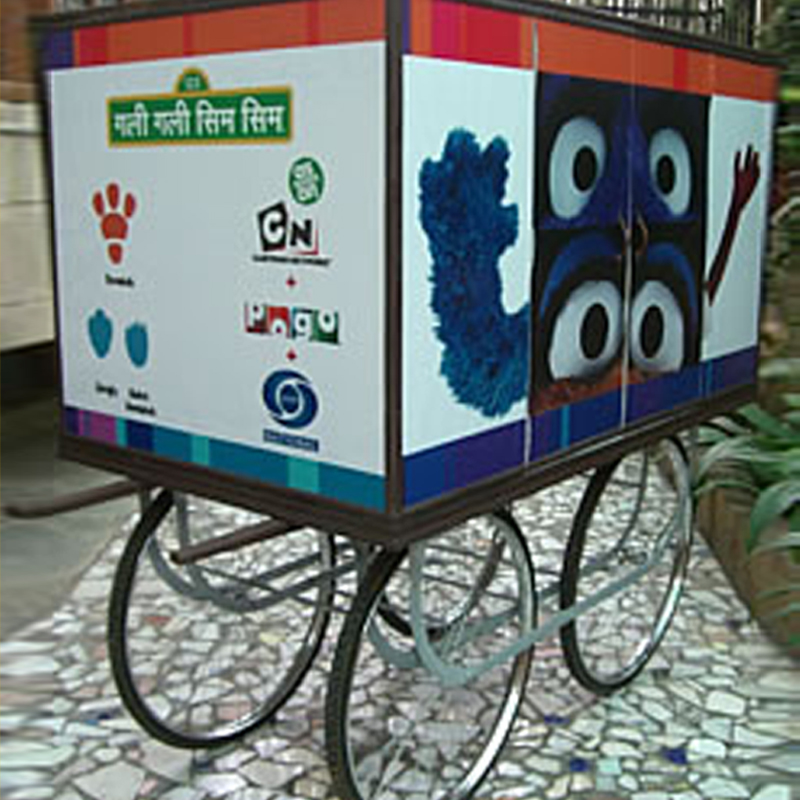
    At the moment, the programme will be shown to children through TV sets carried on designed pushcarts, but the prototype for the bioscope is being readied as well.

    “We have modernised the bioscope and we shall deploy these vends when these are ready to slums as part of our programme for mass education for those millions of children who cannot access TV,” Shaswati Banerjee, executive director Sesame Workshop India (SWI), which runs the programme, tells indiantelevision.com.

    The programme, Galli Galli Sim Sim, is a hit on Doordarshan and Pogo channels, with the TG of two to six-year-olds, and the funding for the initial educational outreach was provided by a corporate social responsibility grant from Turner Entertainment Networks Asia. In an effort to reach these millions, SWI, a subsidiary of Sesame Workshop, the non-profit educational organization behind Galli Galli Sim Sim and other educational media for children, has kicked off a mobile viewings programme, in which during the first phase, starting 15 February, one branded pushcart with a TV set and a DVD player will reach the poorest of slums and show the programme.

    Banerjee explained that the trial phase, in which a Maruti van was used to take the programme to the slums, proved too costly and could not give the intended impact. Hence, they designed a pushcart that can be taken to any corner of a slum.

    “Initially, we reached 22,000 children over the 25-day period of the pilot project. Using the cart, we shall be able to show the programmes to much larger numbers and run the programme during the whole day,” Banerjee said.

    She added that the cart is fitted with cells that would do away with the necessity of power connection, which means it would be able to look at localities where there is no regular power supply. Over all, this changed mode of delivery will increase the number of screenings from just three a day to between eight and 10. The trial with five pushcarts will start in Sanjay Colony, Bawana and Madanpur Khadar slums of Delhi, and in five locations in Mumbai, including Dharavi, Gavandi, Borivili and two other places yet to be finalised, she added.

    January to March will be the testing period, and from April the full programme will be launched. Sometime about then, the bioscope boxes, once extremely popular as entertainment source in villages and small towns, will be introduced as well.

    Testing of the prototype replacing the TV set with the bioscope will start too.

    The baseline survey will be conducted and impact measured during the pilot project. And finally the impact-based model for delivery will be worked out, Banerjee said.

    The cost per child, the ratio that funding agencies use to measure, varies according to the models, of which there are two, she added.

    In the outreach-based model, which is the pushcart with TV set model, in which the programmes are screened and also educational material left with the NGOs handling the Balwadis, costs Rs 25 per child.

    The cost for the impact-based model, in which only educational materials are given, costs Rs 15 per child. These are the ones being tested before being scaled up and become replicable across the country.

    Galli Galli Sim Sim is the Indian version of the world-renowned children’s television series Sesame Street, and airs on Cartoon Network, Pogo and Doordarshan.

    Commenting on the successful completion of the first phase of Galli Galli Sim Sim’s outreach initiatives, Soumitra Saha vice president, regional entertainment advertising sales for Turner Entertainment Networks Asia, said: “Turner’s partnership with Sesame Workshop goes beyond television.

    “Given how many young children in India don’t have access to basic educational and developmental needs, it is highly rewarding for Turner to partner with Sesame Workshop in their carefully created and well coordinated educational outreach programme to help fill this gap.”

    Based on the work in the pilot phase, the Michael & Susan Dell Foundation has awarded Sesame Workshop a grant, which the organisation will use to support Sesame Workshop India to research, develop, and implement similar educational interventions in slum areas in India’s six largest cities such that there are measurable improvements in children’s learning outcomes.

    “Sesame Workshop India’s unique outreach programme reaches large numbers of children and instills them with the power of learning at a very early age, which is extremely important in a country like India where several million children drop out of school before they reach the fifth grade,” said Barun Mohanty, Director of the Michael & Susan Dell Foundation in India.

    “Equally impressive is Sesame Workshop India’s commitment to measuring its impact on learning levels to ensure sustainable, positive changes in early childhood education, Mohanti added.

    “We are excited to help bring this program to India’s urban slums, as Sesame Workshop India draws upon its global expertise and lessons learned from similar communities in Egypt, South Africa and elsewhere,” Mohanti emphasised.

    The initiative is estimated to reach over 1.5 million children and caregivers over the next five years.

  • HC hearing on Nimbus challenge to telecast ordinance on 12 February

    HC hearing on Nimbus challenge to telecast ordinance on 12 February

    NEW DELHI: Even as the Delhi High Court today refused to stay the operation of the ordinance promulgated last week making it mandatory for private sports channels to share live feed of any international sports event with Prasar Bharati, the telecast controversy is coming up for hearing in two different benches of the court on 12 February.

    Justice BD Sharma, who is hearing the appeal by Prasar Bharati against an earlier order of the court permitting seven-minute deferred telecast on Doordarshan, rejected the plea by Nimbus Communications, owner of Neo Sports, seeking a stay on the Ordinance.

    Nimbus informed the Court that it had filed a petition in the court of a division bench headed by Chief Justice MK Sarma challenging the Sports Broadcasting Signals (Mandatory Sharing with Prasar Bharati) Ordinance and that court had fixed the matter for Monday.

    The Counsel for Nimbus Gopal Jain informed the division bench headed by Chief Justice MK Sarma that Neo Sports was challenging the ordinance, as it was arbitrary and unconstitutional.

    The private sports broadcast channel also contended that the Ordinance violates its fundamental right under Article 19 (1) that is rights to speech and expression and its intellectual property right.

    (Mr Justice Ahmed had yesterday questioned the Government’s reasoning in promulgating the Ordinance saying, ”The Rule of Law should not have been subverted,” even as the government said it would challenge any court order favouring Nimbus’ insistence on deferred telecast. Justice B D Ahmed had wanted to know why the government was so swift in bringing an ordinance and added that the whole thing left a bad taste in the mouth.).

  • NDTV Media appointed airtime sales rep for Mi Marathi

    NDTV Media appointed airtime sales rep for Mi Marathi

    MUMBAI: NDTV Media has been appointed as the exclusive airtime sales representative for the soon-to-be-launched Marathi channel, “Mi Marathi” from the Adhikari stable. It will be responsible for all revenue generating efforts for the channel.

    “This venture is the first step towards our entry into the regional space. With more and more niche and special interest channels taking market share, regional markets will witness an exponential growth. We believe that with the majority of the population speaking Marathi, the size of the Marathi regional market advertising pie will cross the Rs 120-crore mark by the year end. We are delighted and proud to be associated with Mi Marathi channel”, said NDTV Media CEO Raj Nayak.

    Markand Adhikari in an earlier interview to Indiantelevision.com had revealed that the channel which has been in the docks for a while would be launched in February.

    The baseline of MI MARATHI is “Aaplya Manasachi Aapli Vahini”, a channel by the Son of the Soil. Sri Adhikari Brothers have in the last 20 years, produced more than 2000 hours of Marathi programming for DD Sahyadri and Doordarshan’s national network.

  • Broadcasters feel need for diversifying TV content, want level-playing field for growth

    Broadcasters feel need for diversifying TV content, want level-playing field for growth

    NEW DELHI: Mobile TV is going to be popular but there is a need to address compatibility issues by using a single chip on the hand held device. That is what was stressed in the `International Conference on Multifaceted Broadcasting – Present and Future’ held as part of the BES Expo 2007 – the 13th Exhibition on Terrestrial and Satellite Broadcasting.

    Speaking on the last day, speakers – including LD Mandloi of Doordarshan, Brajeshwar Singh of All India Radio, Ashok Ogra of Discovery channel, and retired Prasar Bharati official MP Lele – admitted that there was need to diversify content on TV and mobile TV but said viewership appeared to be driven by some accepted formats.

    However, this made niche channels like Discovery and National Geographic very important. They also agreed that the content on news channels was driven only by sensationalism.

    Referring to some government actions like banning of the AXN channel while letting Fashion TV to continue its telecasts, they felt there was need for a level-playing field for growth of the media.

    The three-day event – inaugurated on 1 February by information and broadcasting minister Priya Ranjan Dasmunsi at Pragati Maidan, was organized by Broadcast Engineering Society (India). It was approved by the Union government and endorsed by International Association of Broadcasting Equipment Manufacturers (IABM), and supported by Prasar Bharati (AIR and Doordarshan), Unesco, Asia Pacific Broadcasting Union (ABU), DIT and IGNOU.

    Speakers said IP-based delivery systems – DVB-IP and IPTV for television and DAB-IP for radio – were going to be very popular. Mobile TV on the Hand held devices is already here.

    Keeping in view the large rate of growth of mobile cells in the country, Mobile TV was going to be very popular. Some speakers stressed the need to bring provisions of Emergency Warning Broadcast Systems (EWBS).

    It was accepted that there was a marked shift in the consumer behaviour pattern, with people wanting ‘any time anywhere interactive access’ which can be achieved only by the convergence of broadcasting, wireless and mobile technology. The consumer will decide the primetime and the platform.

    Some of the speakers stressed the need to permit private players to set up Community Radio stations instead of keeping this low-cost technology confined to some niche institutions.
    Digital Radio and High Definition TV (HDTV), which provide much better quality, were going to be introduced in the country in the very near future.

    Around 40 speakers from India and abroad explained the latest technological development in areas like Mobile TV- Anytime Anywhere, Digital Radio – emerging scenario, Role of broadcasting in Warning and Disaster Management, Digital media life cycle, Content creation – cutting edge technology, interactive broadcasting, broadcasting in India: Challenges ahead, and assuring audio and video quality.

    Sixty-five exhibitors from India and abroad displayed the latest broadcast equipment systems and services in the field of radio, television, satellite, internet and interactive broadcasting.


  • Creative Eye Q3 net profit at Rs 3.3 million

    MUMBAI: Creative Eye Ltd’s net profit has posted a net profit of Rs 3.3 million in the third quarter of the current fiscal, up from Rs one million a year ago.

    The company’s revenues stood at Rs.55.2 million as against Rs 39.3 million during this period. For the nine-month period ended 31 December 2006, Creative Eye had posted a net profit of Rs 6.4 million on a revenue of Rs.155.9 million.

    Creative Eye will launch Tulsi Mere Angan Ki, a social programme, on Doordarshan at 8.30 pm every Saturday from 10 March.