Tag: Doordarshan

  • Hindi becoming the language of sports commentary

    Hindi becoming the language of sports commentary

    MUMBAI: English was the language of cricket commentary when it started in India in the early 1940s on All India Radio. The listenership was limited to the English-speaking class. It was in the late 1950s that cricket commentary in Hindi made a beginning. Commentary in the language of the people took the game of cricket to the hinterlands.


    The dominance of cricket commentary in Hindi continued till the mid-1980s. Live commentary of India winning the 1983 cricket world cup was heard by most cricket fans in India in Hindi.


    For the older generation, the names of cricket commentators in Hindi such as Suresh Saraiya, Narottam Puri and Ravi Chaturvedi still bring back memories of the 1970s and early 1980s when words created action happening on the cricket field.


    With the emergence of colour television began the decline of radio commentary and the rise of English commentators on television. The government-owned Doordarshan was the only television channel available in the 1980s.


    The rise of private broadcasters in the 1990s again saw the rise of cricket commentary in English and then its dominance. The first decade of the new millennium did make sports broadcasters aware of the importance of commentary in Hindi but it took almost a decade for them to actually wake up to the full potential of Hindi.


    The likes of Star Sports, Ten Sports, SET Max and Sony Six made a beeline to incorporate more and more Hindi language programming in their sports coverage to grow their viewership.


    Only this year, India’s oldest sports channel, Star Sports, launched the country’s first 24×7 Hindi sports channel, Star Sports 3, following an exercise that involved rebranding as well as reorganisation. 


    “We changed the landscape of cricket broadcast in the country in 2012 with the launch of a world class Hindi commentary simulcast in addition to the existing English language feed,” says Star Sports business head Nitin Kukreja.


    The Hindi language feed attracted immediate attention from viewers. 


    Star Sports says 71 per cent of the viewership for the dual language-feed India-Australia series came from Hindi commentary. Thereafter, Star Sports took the engagement with the Hindi audiences even further.


    “We launched India’s first 24X7 Hindi sports channel, Star Sports 3, with content, graphics and shows in Hindi – a giant step forward to dramatically increase the reach of sports in the country,” says Kukreja.


    Apart from the launch of Star Sports 3, 2013 also saw Star Sports channels providing Hindi commentary feed for the Indian Badminton League (IBL), Barclays Premier League (BPL) and Hockey India League (HIL).


    Says Kukreja: “In a nation where less than 10 per cent of the population understands English, sports broadcasters have traditionally programmed only in one language – English. We want to change that. We want to focus on a language that the viewers understand.”


    For Star Sports, ‘Hindi dedicated’ is not just about the commentary being available in Hindi. It is a comprehensive Hindi offering in terms of graphics, navigation tools and all such constituents.


    To increase its viewer base, Star Sports will now show not just cricket in Hindi but a range of shows on other sports including hockey, badminton and football and special shows such as Star Power, Heroes, Masterclass and Hockey Hotshots. 


    Star Sports is not stopping at just Hindi. The channel is considering providing feeds in languages such as Tamil and Bengali very soon.


    Ten Sports too has jumped onto the Hindi bandwagon. For the recently concluded India-South Africa series, it had Hindi commentary on Ten Sports and English on Ten Cricket and Ten HD.  


    “With the viewer becoming more and more demanding like any other nation, and rightfully so, there is a viewer base that is looking forward to Hindi commentary and then the usual English commentary feed,” reasons Ten Sports CEO Rajesh Sethi. And like Star Sports, Ten Sports too is looking at going multi-lingual in the future to expand its viewership.


    Sony Entertainment Television provided commentary in both Hindi and English for its biggest sports asset, the Indian Premier League (IPL). While Set Max had commentary in English, the nearly two-year old Sony Six had commentary in Hindi for Pepsi IPL 2013.


    “The Hindi feed was very well appreciated. We reached close to a 100 million viewers! The consumers were delighted to be provided with a choice of language preference,” says a Sony Six official. Sony plans to expand the number of IPL games with Hindi commentary.


    Star Sports claims it has had higher core viewers coming from its Hindi feed than Engilsh. “During the period October-November 2013, about 24 million viewers were core to Hindi only, while English language had core viewership of about 9 million. Another 8.4 million viewers were core to both Hindi and English language,” reveals Kukreja.


    On their part, advertisers are happy with the Hindi, English fragmentation of viewers. Madison Media COO Karthik Lakshminarayan says, “Currently, you buy a match, not a feed, so advertisers come on both feeds but soon, we will see that different advertisers will go for the two feeds (separately).”


    The rates for Hindi feed are expected to be higher than the English feed given the much higher core viewership for the Indian language commentary. The segmentation could also attract advertisers who so far had shied away from sports channels. 


    Madison’s Lakshminarayanan says, “The more you can split an audience, the better it is for the advertiser. If you can further a demand with regional languages, then it should work.”


    The Hindi channel being a new proposition, Star Sports isn’t yet selling its two language feeds separately. “Sometime in the future, we see value in unbundling the two offerings to different sets of clients. This will help the clients reach out more effectively to their target audience at one level and/or tailor their communication to suit specific sets of audiences,” says Star Sports’ Kukreja.


    Sports programming in Hindi and other Indian languages can only help expand viewership for sports and will be beneficial to broadcasters as well as advertisers. The sports broadcasters will have their pockets deepened, the advertisers can reach more people and the viewers can watch programming in the language of their choice.
  • The 7th RCF Sujla Doordarshan Sahyadri Krishi Sanman -2014

    The 7th RCF Sujla Doordarshan Sahyadri Krishi Sanman -2014

    MUMBAI: Doordarshan – a public broadcaster started its service in the year 1959 primarily to cater the farmers and the whole agriculture sector in the country. Since its inception, Doordarshan has been fulfilling its mandate religiously.  Doordarshan has recognized as its duty to keep the farmers abreast of the changes in the agriculture field, inform them latest technologies and advancements being imbibed in the sector, guiding farmers and disseminating information and innovations to yield more crops, development of allied sectors like fisheries, animal husbandry & dairy development, poultry & Sericulture etc.


    Right from 1959 and till the year 2008, no individual or organization ever thought of honoring these entrepreneurs through a TV Channel. Needless to say that agriculture is a prime sector in India responsible for country’s economic growth.


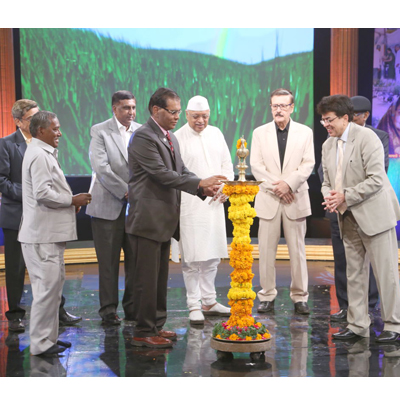
    However, DD Sahyadri understood this lacuna and started honoring the farmers’ fraternity in various categories since 2008. This year, DD Sahyadri will organise the 7th Doordarshan Sahyadri Krishi Awards function on Friday 7th February 2014 at 3.30 pm  in the studio of Doordarshan Kendra, Worli, Mumbai under the auspices of Shri Mukesh Sharma, Additional Director General (West Zone), Doordarshan Kendra, Mumbai. The function will be attended by luminaries belonging to various fields of the society e.g. films, art & culture, education, scientists and farmers of Maharashtra.


    The following farmers / entrepreneurs have been selected for these prestigious awards in eleven categories:

          1. Shri. Dadarao Hatkar, Buldhana (Excellent Work in Water Management)

          2. Shri. Madhukar Ghuge, Parbhani (Excellent Research Work in Agriculture)

          33. Shri. Shekar Dinkar Patne, Satara (Excellent Innovative  Work in Agriculture)

          44. Shri. Rajesh vitthalrao Chopde, Akola (Excellent Work in Rural – Agricultural Processing field)

          55. Shri. Ganesh Shankarrao Deshmukh, Satara. (Excellent Work in Animal Husbandry & Dairy  

             Development)


          6. Smt.  Prabhavati  Janardan  Ghogre, Ahmadnagar. (Excellent Work in Animal Husbandry & Dairy                Development)

          7. Shri. Rajesh Parab, Sindhudurg (Excellent Work in fisheries Development)

            8. Shri. Kuldip Raut, Washim (Excellent Work in Flowers, Fruits & Vegetable Cultivation)

          99. Shri. Mohan Tejrao  Jagtap, Buldhana (Excellent Work in Flowers, Fruits & Vegetable Cultivation)

        1010. Shri. Shankar dashrath Gaddekar, Gadchiroli  (Excellent Work  in Agriculture Allied Industries like,   

             Bee Keeping, sericulture, Varmi Culture,   poultry, sheep and goat rearing, piggeries, agro tourism  etc.)


    These awardees were selected by a four member jury comprising experts in Agriculture and allied fields. They acquire years of hands-on experience and have spent their life in this sector.


    Jury Members:

    1. Dr. A.G. Sawant, Former, Vice-Chancellor, Dr. Balasaheb Sawant Kokan Agriculture University, Dapoli.
    2.  
    3. Dr. S.D. More, Former Director, Marathwada Agriculture University, Parbhani.
    4.  
    5. Smt.  Rohini Bhosle, Deputy Director , Commissionrate of Agriculture Pune.
    6.  
    7. Dr. A.T. Sherikar, Former Vice-Chancellor, Maharashtra Animal & Fisheries Science University, Nagpur.   
    8.  
    9. Dr. Vyankatrao  Mayande, Ex. Vice chancellor, Panjabrao Agriculture University, Akola.
  • Pitroda Committee: Prasar Bharati should be free of govt hold

    Pitroda Committee: Prasar Bharati should be free of govt hold

    NEW DELHI:  A high-level committee under veteran technocrat Sam Pitroda set up to review the working of Prasar Bharati has stressed the need for constituting a Parliamentary Committee, as originally envisaged in the Prasar Bharati Act 1990 to ensure that the pubcaster discharges its duties in accordance with the provisions of the Act and Government defined duties.


    In the report submitted today to the Information and Broadcasting (I&B) Minister Manish Tewari, it has recommended reorganisation of the pubcaster Board to make it a professionally managed body and make it more effective in guiding the organisation.


    Noting that Prasar Bharati’s vision must be to become a genuine ‘public broadcaster’ as against a ‘government broadcaster’, Pitroda told a press meet after submission of the report that he would be meeting both Tewari and I&B Secretary Bimal Julka next week to finalise those steps in the report which can be put into effect immediately.


    The report said there is need to bring in complete transfer of ownership and management of assets and Human Resource to Prasar Bharati ‘to make the organisation administratively and financially autonomous of Government’.


    A Regulatory Body has to be set up to ensure public accountability of Prasar Bharati with respect to all content broadcast on its television and radio networks. The Regulatory Body should be a sub-committee of the Prasar Bharati Board.


    Interestingly, the Committee has suggested setting up of Prasar Bharati Connect (PBC) as the third arm of the public service broadcaster, independent of Doordarshan and All India Radio, to expand the social media. PBC should be mandated to manage the various Social Media initiatives of all the wings of Prasar Bharati. It also wants a Social Media Strategy of Prasar Bharati.


    The Committee was set up on 28 January last year and had decided to put in place eleven working groups on different issues and has come out with a report on eight main areas: governance and organisation, funding, human resource, content, technology, archiving, social media and global outreach.


    It has said that in addition to the public broadcasting function, there is a distinct requirement for the State to broadcast messages and accomplishments of public interest which can be met by using existing Public and Private broadcaster infrastructure.


    The Committee suggests amending the 1990 Act where necessary so as to impart genuine and effective autonomy to the organisation.


    Apart from Pitroda, who is Advisor to the Prime Minister of India on Public Information Infrastructure & Innovation and Chairman of the National Innovation Council, the other members of the committee included additional secretary and nominated Prasar Bharati Board member J S Mathur, National Innovation Council member Shekhar Kapur, former I&B Secretary Asha Swarup, Vikram Kaushik who is a business strategist and brand advisor and part-time member on the Prasar Bharati Board; Prof M P Gupta from the Indian Institute of Technology in Delhi, Dr B K Gairola who is Mission Director (e-Governance), and Prasar Bharati CEO Jawhar Sircar who was the Convenor.


    Pitroda said that about 110 persons gave time to the working groups on various issues. There are 26 main recommendations in the two–volume report.


    Referring to Funding, the report says there is need to undertake a professional study to develop a funding mechanism for Prasar Bharati that addresses the need for autonomy with financial accountability. Such a funding model should include government funding, internal resource mobilisation and private investment. There is need to monetise all available archival and other assets of Prasar Bharati as soon as possible to enhance funding, and augment funding of social messaging through cross-subsidising such content through entertainment-led programming and by co-opting industry through their CSR budgets.


    However, Pitroda said in reply to a question that the time of licensing TV or radio sets as was being done around five decades earlier could not be revived as it was an old concept.


    Referring to Human Resource, he said the pubcaster should be enabled with the power to frame rules and regulations for its employees without seeking prior approval of the Government.


    When it was pointed out that a similar announcement has been made several times since 1997 when the Act was operationalised, Sircar said the pubcaster cannot frame its own rules.


    There was need to undertake a comprehensive manpower audit and HR planning exercise to map workforce requirements for the future in line with Prasar Bharati’s mandate.


    It was necessary to supplement manpower audit with a re-deployment plan that addresses training, re-skilling and promotion of existing manpower through an institutionalised modern appraisal system.


    The committee said there was need to create an effective recruitment system to attract the best talent and allow the hiring of skilled professionals, and encourage and initiate steps for absorption of Government employees as fulltime employees of Prasar Bharati, after an appropriate screening process. The ones who remain in Government may be considered for absorption in other departments within the government as is done in other cases.


    Referring to content, he stressed the need to scale up allocation of funds for content generation to 50 per cent of the total expenditure within a period of 5 to 7 years. The Committee wants a review of all existing channels and content of DD and AIR, based on their relevance, output and viability and phase out those where there is sub-optimal utilisation of resources.


    There should be encouragement of outsourcing of content creation to external producers to attract high quality and diverse programming and creation of distinct brand identities for different TV and Radio channels, and define the content strategy for each.


    Referring to technology, the Committee wants expansion of the satellite and digital cable TV operations to meet the obligation of public service broadcasting. There is need to digitalise the present AM radio system to a new digital radio transmission after due evaluation subject to cost and availability of DRM receivers. In the transition period, FM may be expanded according to demand.


    It stressed the need to selectively digitalise terrestrial TV operations based on commercial viability.


    Any further expansion of and investment in digital terrestrial telecast should be suitably evaluated after field reviews and assessment of developments in the telecom sector, it said.


    Interestingly, the Committee wanted involvement of the private sector to expand the broadcasting market with a view to effectively utilise the infrastructure being built by Prasar Bharati to enable faster growth in the receiver ecosystem.


    On archives, it recommended state-of-the-art digital archives for consolidating and preserving DD and AIR’s content: both existing as well as that being currently generated. There is expansion of scope to make it the National Audio-Visual Archives so as to consolidate and support all other government initiatives.


    The Committee wants the creation of dedicated, multi-platform channels for dissemination of Prasar Bharati’s archival products: for both open access and monetisation.


    Referring to global outreach, it wanted the creation of a world-class broadcasting service benchmarked with the best in the world using next-generation opportunities, technologies, business models and strategies.


    When pointed out that DD India was already working as an international channel, Pitroda said the platform should be designed for new media first and then extended to conventional TV.


    There was need to outline an effective content strategy for Prasar Bharati’s global platforms (TV and Radio) focused on projecting the national view rather than the narrow official viewpoint.


    In a covering note to the Minister, the Committee said: “Today, we have a unique window of opportunity to transform our broadcasting service (both All India Radio and Doordarshan) into a cutting-edge platform capable of delivering its commitment to public service in the best possible manner, while keeping pace with the competitive needs of the 21st Century.  However, as our report suggests, this transformation will require a bold, clear vision, a focus on generational change, and new models and approaches in every aspect of the public service broadcaster’s activities.

  • MIB advisory to news channels over sign language interpretation of R-day parade

    MIB advisory to news channels over sign language interpretation of R-day parade

    M UMBAI: The Ministry of Information & Broadcasting has issued an advisory to all news TV Channels stating that all channels interested in telecasting the live coverage of the Republic Day Parade-2014, with commentary should carry the signals of DD which provide sign language interpretation of the parade. In this context, it had already been decided that three channels of Doordarshan viz. DD- News, DD- Bharati and DD- Urdu would provide the sign language interpretation of the Republic Day Parade commentary in order to ensure access to people with hearing impairment. Prasar Bharati had been earlier directed for making such provisions for having an inset box on the TV screens during the telecast of the Republic Day Ceremony, through which the Sign Language Anchor/Expert could interpret the proceedings of the Republic Day parade. 

    It has been the practice by DD to allow private satellite TV channels to carry the feed of the Republic Day parade and commentary free of cost. As per the practice, this year also DD would be sharing its feed of the Republic Day Parade with those satellite TV channels which wish to telecast the same. 

    The advisory also states that while media has been in the forefront of taking up important issues of national interest, this initiative by the media to facilitate access to the Republic Day parade and commentary to people with disabilities was a step in the right direction. 

    The decision has been taken in the interest of all those who are differently-abled, hearing impaired citizens. Recently the Minister for Information & Broadcasting, Shri Manish Tewari received a representation from the National Association of Deaf requesting for providing sign language interpreter in an inset box on TV screens during the live coverage of the Republic Day Parade. The Minister assured that prompt action would be taken regarding their request. The same has been done. This initiative has been taken for the first time by the Ministry and in the shortest possible duration.

  • DD, Prasar Bharati sign MoU with Korea’s Arirang TV

    DD, Prasar Bharati sign MoU with Korea’s Arirang TV

    MUMBAI: In September 2012, when Prasar Bharati CEO Jawhar Sircar led the Indian delegation to the General Assembly of the Asia-Pacific Broadcasting Union at Seoul, he called on the then President of  Korea and other dignitaries. Since then the Korean Broadcasting System and Prasar Bharati have on-going partnerships.


    However, a new partnership was sought to be made between the Korean International Broadcasting Foundation, Arirang TV and Doordarshan for which Sircar and CEO of Arirang TV Jie-Ae Sohn renewed correspondence recently in November, 2013.


    And now the two stations have signed a Memorandum of Understanding (MoU) which will allows them to share content. The CEOs from the two stations met in New Delhi on Friday and agreed to an exchange that will foster cultural ties between Korea and India.


    The Korean Minister expressed hope for a deeper cultural understanding between India and South Korea. One of the officials was quoted as saying on the Arirang News website, “Through this exchange of broadcasting and broadcasters, we can jumpstart this cultural exchange between two very strong culturally rich countries.”


    The deal took shape when ministers from both the countries were meeting to sign an MoU on Mutual Recognition of Digital Signature Certificates for Efficient E-Governance/Cross Border Trade Facilitation. Minister for Communications and Information Technology, India Kapil Sibal and Minister for Science, ICT and Future Planning, Republic of Korea Mun-kee Choi were present there.


    Under the agreement, Arirang and Doordarshan aim to make their global channels available on satellite platforms in both nations by 2014. Both parties will even explore co-production opportunities related to matters of mutual interest and share TV programmes in the cultural, educational, scientific, agricultural, entertainment, sports, news and any other possible fields. The MoU will be valid for a period of three years from the date of signature and will be automatically renewed for every following three years, unless terminated by either party by giving a written notice of three months.

    Interestingly, as the MoU was being signed, a documentary produced by Arirang TV was being aired on Doordarshan throughout India. The documentary explains the vision for the “creative economy” that President Park Geun-hye has advocated since the very beginning of her term last February.


  • India’s Doordarshan selects Harris Broadcast for nationwide digital transition

    India’s Doordarshan selects Harris Broadcast for nationwide digital transition

    NEW DELHI: Harris Broadcast, a market share leader of content management and network infrastructure solutions serving the global broadcast, communication service provider, government and enterprise markets, today announced it has been selected by national broadcaster Doordarshan to deploy a new DVB-T2 transmission infrastructure across the country.


    The government of India is pushing ahead with plans to complete the move from analogue to digital television transmission by 2017. As the leading public service broadcaster in India, Doordarshan has an obligation to cover the whole country and to reflect the diversity of Indian society, including content in the more than 40 languages. At the same time, it is promoting a boost in quality and viewer engagement by rolling out high definition channels, as well as delivering its multi-lingual content across multiple platforms including mobile devices in the future.


    “This is not only a large-scale project for Doordarshan, but it is also one of the most high profile and important projects the broadcaster has undertaken,” said Joe Khodeir, senior vice president Asia at Harris Broadcast. “Our DVB-T2 solution maximises spectrum capacity, allowing Doordarshan to roll out multiple channels serving different communities as well as offer multiple HD channels. For a project of this scope and significance, Doordarshan looked for a partner with a strong local service commitment and presence along with best-in-class technologies that delivered the lowest lifecycle costs.  Our Maxiva™ ULX architecture provides the best power efficiency in the market, which was a critical consideration for Doordarshan when energy consumption is such a large part of the operating cost.”


    The first of two transmission contracts awarded to Harris Broadcast adds HD channels to digital multiplexes in four major metropolitan areas. Each facility will be served with a new 6kW Harris Broadcast Maxiva ULX DVB-T2 transmitter. The second contract is for 19 Maxiva ULX transmitters, which will be used to roll out digital transmission to the regions of India. In the first instance, these will carry standard definition channels in their multiplexes, but the flexibility of the transmitter and infrastructure design allows for an easy upgrade to HD when the time comes.


    The Maxiva ULX is a liquid-cooled, solid-state transmitter built on a modular architecture for maximum flexibility in inputs, transmission standards and power outputs. By incorporating Harris Broadcast PowerSmart® technology, the Maxiva ULX uses the minimum energy for the radiated power, produces less heat and occupies the smallest footprint in the industry. Together, this provides simplified installation, easier maintenance and reduced total cost of ownership over the lifetime of the transmitter.

  • Sun Direct to add remaining DD channels within 72 hours

    Sun Direct to add remaining DD channels within 72 hours

    MUMBAI: A week after notices were sent by the ministry of information and broadcasting (MIB) to three DTH operators for not carrying the mandatory 24 Doordarshan channels, one of the three  has decided that it will be adding the remaining six channels to its packages within the next 72 hours.


    “Even before the notice was issued, we had initiated a technical upgrade that will facilitate to add more channels on the same transponder. We took steps nearly three months ago to import equipments and to upgrade our software,” says Sun Direct CEO Mahesh Kumar.


    As far as the reply to the MIB notice is concerned Kumar says that he will be writing to the ministry post the addition stating that it is complying with the rules. He also mentioned that currently Sun Direct is carrying 18 DD channels and within the next three days, all 24 will be carried by it.


    Last week Tata Sky had decided to respond to the MIB’s notice expressing his company’s inability to carry any more DD channels as it lacked the bandwidth on its existing transponders, and stating that new capacity it had signed up for on GSAT-10 has not been delivered to it despite several pleas to all the departments in  ISRO, the MIB, department of space, WPC, and what have you.  This leaves only Reliance Digital to decide a course of action regarding the notice given to it.


    According to the MIB directive all DTH operators have to provide 24 DD channels irrespective of whether they provide them a-la-carte or in packages to their subscribers.

    The channels which cable operators must show are DD National, DD News, DD Bharati, DD Urdu, DD Sports, DD India, DD Kashir, DD Punjabi, DD Girnar, DD Sahyadri, DD Saptagiri, DD Malayalam, DD Podhigai, DD Chandana, DD Bangla, DD North East, DD Bihar, DD Uttar Pradesh, DD Rajasthan, DD Madhya Pradesh, DD Oriya, Gyan Darshan, Lok Sabha TV and Rajya Sabha TV. 

  • Tata Sky to reply to MIB’s showcause notice

    Tata Sky to reply to MIB’s showcause notice

    MUMBAI: A month after the ministry of information and broadcasting (MIB) came out with its mandate that 24 Doordarshan channels have to be carried on all DTH platforms; the ministry has cracked the whip on three DTH players in the country for not obeying the notification. Showcause notices have reportedly been sent to Reliance Digital TV, Sun Direct and Tata Sky as to why action shouldn’t be taken against them for not complying with this requirement.


    Now, one of the big players is all set to give a fitting reply to the ministry – Tata Sky, which has unsuccessfully been chasing the MIB for transponders on ISRO’s GSAT-10 satellite. “Our licence with Doordarshan was to carry eight channels but we were carrying 15 since our customers wanted them. We have been running pillar to post to get capacity but no one has been helping us,” says and agitated Tata Sky CEO Harit Nagpal.


    The DTH operator has signed long term contracts with all its channels and has no more capacity left for any more channels. “I am ready to carry the 24 channels that the government says I should but I need time to figure out how to do it. Capacity creation takes time. There are only two ways to create capacity- either get more transponders or remove channels. If I remove channels, customers may not be too happy with it,” adds Nagpal. “And also my contracts with other broadcasters for carriage of their channels have to be kept in mind.”


    The notice was sent to Tata Sky yesterday and it has a deadline of 15 days to submit its reply. However, going by the looks of it, it won’t be too long before the ministry gets Nagpal’s reply. “We had written even when the notification was passed requesting them to reconsider since we could not do it since it had failed to help us get capacity. We got no response from the MIB for that letter,” he reveals.


    According to the rule, all DTH operators have to provide 24 DD channels irrespective of whether they provide them a-la-carte or in packages to their subscribers.


    The channels which cable operators must show are DD National, DD News, DD Bharati, DD Urdu, DD Sports, DD India, DD Kashir, DD Punjabi, DD Girnar, DD Sahyadri, DD Saptagiri, DD Malayalam, DD Podhigai, DD Chandana, DD Bangla, DD North East, DD Bihar, DD Uttar Pradesh, DD Rajasthan, DD Madhya Pradesh, DD Oriya, Gyan Darshan, Lok Sabha TV and Rajya Sabha TV. 

  • IBF panel hopes to standardise TV ratings system

    IBF panel hopes to standardise TV ratings system

    The Indian Broadcasting Federation (IBF), which has representation from all major channels, is setting up a committee to review the television rating systems in India.

    Presently, there are no uniform guidelines wherein agencies can rate programmes on various channels.


    “The IBF is putting together a technical committee to prescribe the technical specifications for a rating system which would be valid for India,” the Financial Express quoted Bhuvan Lall, executive director, IBF, as saying.


    The IBF has 29 members, including representatives of Doordarshan, Star, Zee, Sony, Discovery, TV Today, Sahara, ESPN, BBC, UTV, Enadu, Sabe and Sun TV, among others.


    The review committee, which is expected to present a final report in the next three to four months will have representatives from all major broadcasters/TV channels, Lall said.


    After the committee finalises its report, independent rating agencies that broadcasters subscribe to will have to conform to the guidelines in the report, according to Lall. The IBF expects the initiative to be the first step in offering a fair rating system for TV programmes.


    Rating of TV programmes is a major issue in the industry, and the IBF is determined to address all issues that impact the industry as a whole, Lall said.

  • Thriller series Sach on DD

    Thriller series Sach on DD

    Doordarshan has begun telecast of a new suspense thriller Sach from 28 April.


    The serial is telecast on Saturdays at 9 PM on the National Network. The serial has been produced and directed by Manoj Nautya and music is by Bhaskar Sekiya with screenplay is by Devpriya Dutta. Wakar and Kavita Sukhvinder are the lead players in the suspense thriller which depicts true-life stories dramatised in its original form.