Tag: Doordarshan

  • DD to mark 50 years of the 1965 Indo-Pak war

    DD to mark 50 years of the 1965 Indo-Pak war

    NEW DELHI: Famed singers Suresh Wadekar and Kavita Krishnamurthy today emphasised that artistes from Bollywood always came forward for a good cause without charging any fee, but someone else had to take the initiative for such events.


    Answering questions at a press meet to announce the ‘Smarananjali’ musical programme being held on 30 October to mark 50 years of the 1965 war with Pakistan and pay tribute to those who laid down their lives in the defence of the country, both artistes denied that Bollywood artistes were reluctant in participating in such programmes.


    Smarananjali is the concept of Doordarshan additional director general Mahesh Joshi, who had commenced such programmes when he was in the Bangalore Kendra of Doordarshan and now initiated the same in Delhi.


    To be organised by Delhi Kendra of Doordarshan, the programme will also feature violin maestro Dr L Subramaniam who was present at the press meet along with the other artistes. It will also have performances by Pankaj Udhas, artistes from the Subramaniam Foundation. The musical tribute will be interlaced with specially choreographed dance performances of memorable patriotic songs by Manjula Parmesh and group. An additional attraction is the on-the-spot painting by renowned painter B S Verma and a dance by soldiers from the Madras Engineering Group (MEG) who will perform to the song “Ma Tujhe Salaam”.


    Dr Mukesh Chandra, who is a special police officer for Delhi Traffic Police said he is an amateur flutist and will also perform at the event.


    Prasar Bharati senior advisor Brig. VAM Hussain said it was necessary for the common man to realise the hardships that the armed forces faced. He said the attempt would be to make this programme an annual affair.


    This programme will be telecast later on DD National and is also aimed at helping the brave soldiers and their families and keep the deeds and bravery of valiant soldiers in public memory.   


    ‘Smarananjali’ is being planned in the form of a lyrical tribute by artistes on stage to martyrs in the presence of their families and the Defence Minister Arun Jaitley, Information and Broadcasting Minister Prakash Javadekar, and the Chiefs of Army, Navy and Air force and Chiefs of Paramilitary forces. Religious leaders from different religious groups will also be present to pay homage to the martyrs.


    The selected special guests will pay homage to the martyrs by lighting a candle before a replica of the Amar Jawan Jyoti and a soldier.


    Three Param Vir Chakra Awardees will also be honoured at the tribute event. They are Hony Capt Bana Singh (Retd), 8 J&K LI, Sub Yogender Singh Yadav, 18 Grenadiers and N/SUB Sanjay Kumar, 13 JAK RIF.


    The Defence Ministry has appreciated the concept of the programme and is fully supporting Doordarshan’s efforts to organise the event.
     

  • Veteran journalist A Surya Prakash is the new Prasar Bharati chairman

    Veteran journalist A Surya Prakash is the new Prasar Bharati chairman

    NEW DELHI: Senior journalist A Surya Prakash has been appointed the chairman of the Prasar Bharati Board, succeeding Mrinal Pande whose term ended around six months earlier.


    The appointment, which will be for three years, was made on the recommendation of a three-member committee headed by Vice President M Hamid Ansari and comprising Press Council of India chairman Markandey Katju and Information and Broadcasting Ministry secretary Bimal Julka.  


    Pande completed her tenure on 30 April this year. 


    The pubcaster, which was created by the Prasar Bharati (Broadcasting Corporation of India) Act 1990 but notified in 1997, is governed by the Prasar Bharati Board, which comprises a chairman, an executive member (chief executive officer), a member (finance), a member (personnel), six part-time members, a representative of the I&B Ministry and the directors general of All India Radio and Doordarshan as ex-officio members.


    The chairman is a part time member. 


    Prakash has vast experience of both TV and print media. He has held key positions in several print and electronic media organisations.


    He was editor of Zee News; executive editor of the Pioneer; India editor of Asia Times which is a business and political daily published from Bangkok and Singapore; political editor of the Eenadu Group of Newspapers; and chief of bureau, Indian Express, New Delhi.


    He is also known for his well-researched interventions on national political issues. He is the founder-director of the Film and Media School at the Institute of Integrated Learning in Management, New Delhi, and founder-director of the Pioneer Media School. 


    Prakash is currently consulting editor of the Pioneer newspaper and a distinguished fellow at Delhi-based Vivekananda International Foundation (VIF), a think tank with which National Security advisor Ajit Doval was also associated earlier.  

  • Television and online medium need different approach for revenue making

    Television and online medium need different approach for revenue making

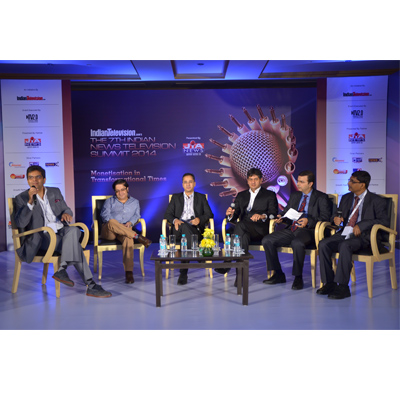
    NOIDA: The news television space is burdened with cash crunch. And addressing this core issue were the news industry giants at the 7th News Television Summit organised by indiantelevision.com. The Summit which began with a session on ‘Content monetisation through conventional and digital platforms of news channel’ was moderated by Provocateur Advisory principal Paritosh Joshi and attended by NDTV Group CEO Vikram Chandra, TV Today Network CEO Ashish Bagga, IBN18 Network CEO Avinash Kaul, Doordarshan ADG news Mayank Agarwal and Focus News Network group CEO Neeraj Sanan.


    Joshi began the session by asking Chandra how viewership data has changed since NDTV raised its voice against the alleged faulty ratings three years ago. Chandra said that they weren’t getting correct ratings and when they talked about it to others they were told to either swim with the tide or do something different which would get the TRPs. Soon after, they were joined by other broadcasters as well.


    Joshi then asked Bagga the secret behind Aaj Tak’s dominance in the genre for the last 10 years. Bagga highlighted that it was not easy to sustain its position given the tough environment. “There was reluctance from various quarters so it was necessary to push that credibility,” he said. He added that the network had grown 25 per cent since last year and while others were growing at just two to five per cent.


    Talking about the ad rates, Bagga said that the price for a slot on news channels, unlike the GECs is pitiable. However, TV Today has put its business on a sustainable model of 20 per cent y-o-y growth. “This has been done by quality, resource, building perception and getting the required numbers,” he said.


    Doordarshan, on being asked about its transformation, said that it had done a good revamp to maintain norms and standards. “People may feel that we put out the news stories a little later than the others, but that’s not the case. We are alert,” said Agrawal.


    He however agreed that a lot is still left to be done apart from the new programmes and the new look it has given to its anchors. “We have also set up new teams in order to cover news better and are also focusing on our online medium,” informed Agrawal.  


    Joshi also highlighted the fact that there is little differentiation in content between the news channels. Disagreeing with the observation, Kaul said that though it could be true, the approach of each channel for a story is different. “You can cater the news to different age groups and segment it differently,” he opined.


    Kaul is optimistic about the new rating system that will be brought out by BARC India. “This will bring in change to the type of content being produced,” he said.


    Joshi also brought out the common criticism that the news industry has to deal with. “Various quarters have said that while the news broadcasters crib about the bad business, the genre still sees new players getting into it every now and then. Is it the political money that is going into it?” questioned Joshi.


     Sanan at this point said that the reason for this was the fact that people see a lot of potential in news because of its ever growing consumption. “If all news channels give same content then that means there is a need for someone to come and stand out. If people are willing to pay and if you can package your content well then there is no reason why one cannot get into it,” he said.


    While digital is a growing platform, Joshi asked whether the algorithm that it follows is trustworthy with regards to journalism. Chandra highlighted the fact that even today the brand of an anchor is important. “When people come to the online medium, they want to come to trustworthy sources rather than a layman giving information,” he opined.


    Kaul said that with BARC India bringing in meters in the rural areas, the genre will have to strengthen its coverage in those areas as well. “With 4G and broadband making in-roads, we will be in a better state,” he said.


    Chandra stated that it was not right to replicate the TV business model for online and that digital was growing at a CAGR of 40 per cent.

  • FTA DD Freedish to soon encrypt with MPEG-4

    FTA DD Freedish to soon encrypt with MPEG-4

    MUMBAI: Since inception, DD Freedish has been the only DTH service that hosts free to air (FTA) channels. Boasting 18 million subscribers on the platform, it soon plans to encrypt signals for its future channels.


    With nearly 60 channels in its roster, Freedish plans to encrypt future channels with MPEG-4 compression technology to take it up to 110. Speaking exclusively to indiantelevision.com, Doordarshan deputy director general CK Jain said that the auction for the encrypted channels will happen in November with the commercial roll out of set top boxes (STBs) soon after. “48 channels will be on MPEG-4 and 64 on MPEG-2. Viewers who opt for MPEG-4 STBs will be able to view a total of 112 channels, including the FTA ones,” he said.


    The extended version of Freedish will have two streams of MPEG-4 and four of MPEG-2 so that the existing subscribers can continue watching the FTA channels. Currently the DTH service has five transponders on Insat 4B and will be soon getting an additional one, taking its tally to six. “The two encrypted streams will allow us to know definite subscriber numbers,” he adds.


    Jain is confident that digitisation drive in phase III and phase IV markets will see households pick Freedish. He is also sure that the plus point would be in the new TV households. The MPEG-4 STBs will be sold at a price higher than the current Rs 1200 for MPEG-2. But Jain says that given an option to watch more channels, he expects people to pick MPEG-4 boxes.


    Both the boxes will be available for sale through its distributors. November will see the auction for the 48 encrypted slots. Broadcasters who wish to be on the MPEG-4 bands, will have to undergo the auction, including ones who are also available on FTA.

  • Doordarshan to hold e-auction for vacant slots on DD Freedish next week

    Doordarshan to hold e-auction for vacant slots on DD Freedish next week

    NEW DELHI: Doordarshan has set a reserve price of Rs 3.7 crore per slot for the 16th online e-auction for filling up slots on Doordarshan’s direct-to-home Freedish platform to be conducted on 28 October.

     
    The e-auction will be conducted by Pune based Synise Technologies on behalf of Prasar Bharati.   


    The reserve price in the last e-auction was Rs 3 crore.


    Prasar Bharati CEO Jawhar Sircar had told indiantelevision.com recently that the aim was to reach the target of 97 channels by October-end and 125 channels by March-end.

    When asked why the number of channels to be e-auctioned had not been disclosed, a Prasar Bharati official told indiantelevision.com that this had been done to prevent bidders forming consortia to bid or resort to other malpractices.
     
    The eligibility terms and conditions including other relevant details for this e-auction are displayed on DD website: www.ddindia.gov.in.
     
    However, the participation amount (EMD) in the e-auction is Rs 1.5 crore which needs to be deposited in advance on or before  27 October evening along with processing fee of Rs 10,000 (Non-refundable) in favour of PB (BCI) Doordarshan Commercial Service, New Delhi.
     
    Applicants have also been asked mandatorily to deposit a Demand Draft of Rs 5,500 registration amount favouring Synise Technologies, payable at Pune at the time of submission of the application.  
    The applicants must provide details of the Uplink/Downlink permission documents received from the concerned ministries with the applications to ensure they are not rejected.
     
    The demand drafts of unsuccessful bidders will be returned immediately or within a week after the e-auction process is completed. 

  • DD’s review committee to bring changes in programming, compete with private channels

    DD’s review committee to bring changes in programming, compete with private channels

    NEW DELHI: A mobile application is to be introduced to ensure that people get Doordarshan news on the move, just as they are getting All India Radio news headlines via SMS.

     
    This was decided by a Doordarshan High-level Review Committee in its meeting in Delhi. The meeting was held after the Committee was reconstituted. The new members are DD director-general Vijaya Laxmi Chhabra, DG (News) Archana Datta and additional directors-general Amit Shukla, Ranjan Mishra, Manoj Pandey, Mayank Aggarwal and S Mathias.

     
    Even while denying that the move was the result of any directive from the Information and Broadcasting Ministry, a Prasar Bharati source told indiantelevision.com that the re-constitution of the committee was a normal process which takes place every time new officials come in.
     

    The source said while the High-level Review Committee looks at all issues relating to programming, the High-level Coordination Committee looks at promotions or transfers etc.  
     

    The source also said that the Review Committee constantly examines the programme content and makes or suggests changes where necessary.


    The Review Committee also examined possible changes to make the programming slick so that it can compete with private channels.


  • Digitisation to offer great opportunity for advanced services, says CDAC

    Digitisation to offer great opportunity for advanced services, says CDAC


    MUMBAI: With the new government focusing on connecting every village with broadband and digitisation of analog cable TV, Centre for Development and Advanced Computing (CDAC) has come up with a number of opportunities for advanced interactive services.

    Set up in 1988, CDAC already provides a number of products and services catering to a large market ranging from health care systems, datawarehousing, multimedia and multilingual technologies, networking solutions to technical consultancy, training and e-governance solutions.

    The company set up a Graphics and Intelligence based Script Technology (GIST) group soon after its origin which built the Indian Language Computing Solutions. Porting of Indian languages onto the video medium with subtitles, this technology is being used by tickers and banners on TV stations, news channels, cable operators, etc.

    Now with the onset of digitisation in India, CDAC-GIST is coming up with new services to broaden the reach of channels by supplementing content in local languages.

    Speaking at Broadcast India conference, CDAC- GIST technical officer Shubhanshu Gupta said, “Digitisation has offered us a great opportunity for advanced services that will offer the viewers day to day information as and when it comes. Our main aim is to enrich the experience of Indian viewers in the grassroot level.”

     “Multilingual subtitle and caption will address the viewers with diverse linguistic background. We plan to transfer television into a multi-lingual university and provide a solution to educate the country in the most cost-effective way. The device will do sub-titling for national as well as some private channels.” he added.

    The company is also planning to facilitate distance learning, public information and alerts, health education on television.

    With a lot of education content already online on various platforms available for e-learning, CDAC will provide a way to re-use the content and disseminate it through television.

    “Our technology will provide the already available content on television through set top boxes. It would also include test whose results could be given to UGC for evaluation and analysis,” revealed Gupta.

    “We also propose getting information regarding the diseases, new medicine, and latest news in the health sector on television with the press of a button to improve the quality of healthcare in the country and keep the citizens more informed,” he added.

    Recently, Doordarshan launched a new channel, DD Kisan, dedicated to farmers, as an extension to their daily programme, Krishi Darshan. It provides full time updates on the latest news on farming. Gupta reckoned that CDAC-GIST will enable interactivity on the programmes.

    “Our technology will give the farmer all relevant information like local market prices, weather information etc in their local languages to help enhance the reach and to incentivize them to use the channel more,” he opined.
    “We are also doing pilot of our Language Independent Programme Subtitles (LIPS) on air digital at four Doordarshan metro DD centres to proliferate Indian language through broadcast media,” he adds.

    LIPS Live technology has made it possible to subtitle movies and programs in Indian languages. Several products like MOVE CG 2001 simplify the titling of video programs with high resolution aesthetic fonts.  

    Another CDAC product MultiPrompter is a solution for teleprompting in Indian languages for TV channels that are mushrooming in the Indian subcontinent.

    CDAC also helped government in launching the bharat domain name in devanagri script covering several languages including Hindi, Bodo, Dogri, Mailthali, Marathi, Konkani, Nepali and Sindhi.

    If a person from Maharashtra opens the website, the home page will automatically open in Marathi while if a person from Tamil Nadu tries, it will open in Tamil, he reveals.

    C-DAC has also helped in establishing standards such as ISCII, Unicode, ISFOC, etc. for Indian language applications on computers and electronic media. It is also working for standardization of W3C (Languages on Web), Internationalized Domain names, Governance, linguistics formats, storage, input, display fonts, etc.

    C-DAC was set up to built Supercomputers in context of denial of import of Supercomputers by USA. Since then C-DAC has been undertaking building of multiple generations of Supercomputer starting from PARAM with 1 GF in 1988.

    It set up National Centre for Software Technology (NCST) in 1985 that initiated work in Indian Language Computing around the same period.

    Similarly C-DAC started its education & training activities in 1994 as a spin-off with the passage of time and it grew to large efforts to meet the growing needs of Indian Industry for finishing schools.


  • DD Bharti pays tribute to Indian music and big names in the field

    DD Bharti pays tribute to Indian music and big names in the field

    NEW DELHI: The cultural channel of Doordarshan, DD Bharati, is doing a series of shows that are aimed at understanding the nuances of Indian music and paying tributes to the big names in this field.

    A specially selected series entitled, “Remembering Legends- Vibhutiyon ko pranaam” will be aired this weekend. The show will offer some nifty archival performances of the Hindustani Classical Music Aces likely the legendary Dagar Brothers, Rampur Seheswan Gharana and Pt. Bhimsen Joshi. All the episodes have exclusively been curated and re-presented by Yatindra Mishra and Smt. Kumud Diwan. The telecast will be on 17 October and 18 October 2014, 9 pm onwards and repeat telecast at 5am and 1pm.

    On 20 October 2014, DD Bharati, in association with the External Affairs Ministry, will telecast the programme, “Kolkata Blues” at 10:30 pm, with repeat telecasts at 6.30 and 2.30pm. This show will present a glimpse of the wide range of musical traditions that Kolkata possesses. Culturally, Kolkata has been at the epicenter of the Bengal renaissance movement and its music reflects the revoluntary sprit of Bengal and their attitude towards reform and action for social change. It shows how music runs and energises the lives of its people.

    The channel will also pay homage to legendary singer Manna Dey on his death anniversary by telecasting some programmes from the rich archives of Doordarshan in “Tu Pyaar Ka Sagar Hai” on 24 October and 25 October at 10.30 pm, repeat telecasts at 6:30 and 2:30 pm. This special programme is a tribute to Dey, born as Probodh Chandra Dey in an orthodox Bengali family on 1 May 1919. Blessed with a distinctly melodious voice, Manna Dey lent his immortal print on many renditions. His popularity was not restricted to the geographical boundaries of India and his voice was worshiped in every nook and corner where an Indian heart stayed.

    Earlier this week, DD Bharati commenced the telecast of “Tridiwasiye Dhrupad Dham Samorah” on 13 October at 9 pm with repeat telecast at 5am and 1pm. Dhrupad is an ancient form of classical music that comes from the Samveda. It has a long rooted history derived from ancient times. The foremost traditions developed are mainly Dagar tardition, Darbhanga tradition, Bettiah tradition, Talwandi Tradition and Bishnupur tradition. The show consists of legendary dhrupad musicians of past and present and will be presented and complied by Prashant Kumar Mallick.

  • MIPCOM 2014: Aamir Khan’s three conditions before starting ‘Satyamev Jayate’…

    MIPCOM 2014: Aamir Khan’s three conditions before starting ‘Satyamev Jayate’…

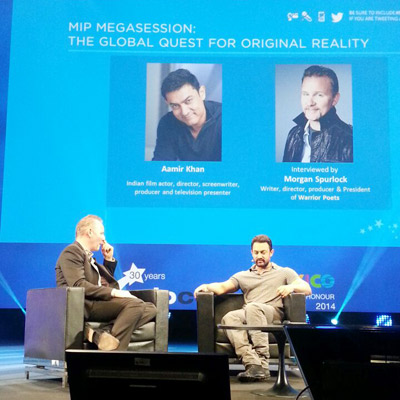
    CANNES: He is a man who can make his mark even on a distant land, far away from home. Yes! We are talking about Indian film actor Aamir Khan, who was in Cannes, giving the MIP Megasession keynote at the ongoing MIPCOM 2014 in a packed Grand Auditorium about his landmark show Satyamev Jayate (SMJ). Indiantelevision.com founder, CEO and editor in chief Anil Wanvari is the Indian representative for all MIP markets.


    So how did it all start? Said Khan, “It all started, becuase I was very inspired from my friend Satya (Satyajit Bhatkal, director of SMJ), who was my friend and class topper from school, was working in the social space. And I being an actor, was doing well in my career, but wasn’t doing much on this.”


    He further went on to say that as TV grew in India, this idea, of doing something on this front, grew bigger. “Star India CEO Uday (Shankar) offered me a game show, which I refused, he then asked me if I could do anything on TV. So I asked him if we could work on something that can bring some change. And he agreed,” he added.


    Khan and his small team comprising Satyajit worked together to create the show, which has gone down in the history of Indian television as one of the most popular shows. “Through the show, we try to understand the society. We try and put the issues to the people, be it child abuse, honour killing, rights and responsibilities etc,” he informed the audience which comprised of content creators from across the globe.  


    All that we see on television wasn’t created in a day. “We took a year to work on research. The reason we researched was to find out if we had a show,” he said. In order to be sure, the team researched with four topics “and once we were confident, it didn’t matter to us if Star would take the show or not. We knew we could go ahead with it and put it on YouTube or anywhere,” he said adding that it took just five minutes for Shankar to approve the concept of the show.


    But, it was not all that easy. Khan then put three conditions in front of Shankar before agreeing to go ahead with Satyamev Jayate.


    One, he wanted the programme to be in multiple languages, since he wanted to reach out to people in their language. “I just didn’t want the main Star channel, but wanted the whole network, which would air the show at the same day and time.”


    The second condition was that in the states, where Star didn’t have a presence, the show was to be given to its competitor and the third was to give it to the terrestrial network Doordarshan. “Many villages in India do not have satellite TV even now and we wanted to reach those homes through Doordarshan,” he announced.  


    But, Shankar, coming from a journalism background, understood where Khan was coming from. “I was talking of a show where I was not investing money but investing time. Star and my team is a part of the show which is made of love,” he said.


    Of the 1.2 billion population in India, 600 million people watch SMJ every week. “We didn’t know if people would be interested in a show like this. It was heartwarming to see how people connected emotionally. There is a huge vacuum of content on social issues and people want a show like SMJ,” he added.


    So how does Satyamev Jayate impact the society? “Well, we empower people by selecting an organisation each week so that one can help financially. What we also do is have partners, who help us on issues.” So far the show has been able to raise $ 45 million for the NGOs connected with it.


    Khan also mentioned how the political and administrative class of the country had also shown interest in the show. “Our show hits out on political and administrative class most of the times and so we didn’t know how they would respond, but I can tell you that there have been 9-10 examples where these people have come ahead and supported us.”


    Explaining the reasons for the show doing so well, Khan said, “There was a need and desire for things to change. India is on a cusp of change so a show like this helps them understand the issue and move towards change,” he said.


    “Sometimes when we research, we feel angry about certain things. But we have to approach people with love. We can’t attack them, if we do that, we will close the door for ourselves,” he added.


    Khan feels that the audiences in India today are looking for content that is engaging. “Even serious content can be made engaging.”


    One of the things that they do to catch the attention of the audience is keep the topic of the show a secret. “No one knows the topic, till the episode is aired. This attracts them to the show.”


    Khan also believes that serious issues can be presented in a way that people can relate to. Giving an example he said, “So when I talk about female foeticide, I do not start with the fact that women are being forced into abortion. That drives away audience, what I do is, I start by asking them, their most favourite person and then go on talking about their mother, my mother and then tell them the reality,” he narrated.


    Khan and his team is taking journalism and combining it with drama and storytelling. “My job as a storyteller is to be engaging,” he concluded.  

  • Doordarshan to monetise content archive through digital platforms

    Doordarshan to monetise content archive through digital platforms

    KOLKATA: Public broadcaster Doordarshan has finally decided to make some money out of its huge treasure of content. It is currently involved in converting its entire archive into digital format which it is also keen to monetise. On the other hand, the broadcaster is also looking at creating its own web portal to disseminate content of national importance, free of cost.


    Two media agencies are being identified that will assist it in marketing this treasure trove. Recently, an expression of interest (EoI) was floated by Doordarshan and in the RFP (request for proposal) process, the names will be announced, said Doordarshan deputy general CK Jain while speaking exclusively to indiantelevision.com on the sidelines of IDOS 2014 in Goa .The tender process will take nearly six months, by the end of which, Jain hopes that it will have a longer list of digital content.


     “We have around two lakh hours of content yet to be converted. In fact we have converted 2,500 hours of content already which is being sold via physical media such as DVDs and CDs,” he said.  The programmes include Nirmala, Discovery of India and other classical programmes.


    The aim is to make the content available online and then monetise it by identifying its worth.  “We will convert the legacy tapes into digital formats,” Jain said adding that the pubcaster has content going back to pre-independence era.


    A national archive committee has been formed for identifying free and monetary content. Doordarshan is also exploring new revenue schemes for content syndication. Through this, it aims at getting a steady revenue stream.


    On the yet unnamed web portal, viewers will be treated to rare recordings of Mahatma Gandhi, Jawaharlal Nehru etc that will be available free of cost to digital audiences. It is further learnt that Doordarshan would make the matter available on platforms such as Bloomberg, Sa Re Ga Ma India, iTunes, Prasar Bharti and other telecom operators in the country.