Tag: Doordarshan

  • DD Freedish fixes reserve price of Rs 3.7 crore for 23rd e-auction

    DD Freedish fixes reserve price of Rs 3.7 crore for 23rd e-auction

    NEW DELHI: Less than four weeks after the last e-auction, Doordarshan will be holding the 23rd e-auction for its free-to-air DTH platform Freedish on 19 October in an attempt to touch the target of 112 television channels in the next few months.


    Doordarshan has set a reserve price of Rs 3.7 crore per slot (as in the last few auctions) for the online e-auction, though Indiantelevision.com learnt that the bid amount went up to Rs 4.7 crore in earlier e-auctions.


    In the 22nd auction on 22 September, it managed to auction eight slots for around Rs 31.3 crore.


    DD sources refused to divulge the number of slots being auctioned to prevent bidders forming consortia to bid or resort to other malpractices.


    Doordarshan DDG C K Jain told this website that Freedish will be encrypted shortly from Mpeg2 to Mpeg4 to keep a tab on the number of subscribers, but it would remain free-to-air.


    The e-auction will be conducted by C1 India Pvt. Ltd., Noida.


    The Rs 3 crore reserve price in the 15th e-auction was raised to Rs 3.7 crore in the 16th auction.


    Currently, Freedish has 64 channels including its own channels, and Lok Sabha and Rajya Sabha TV.

  • DD Freedish auctions 8 channels for Rs 31.3 crore in 22nd online e-auction

    DD Freedish auctions 8 channels for Rs 31.3 crore in 22nd online e-auction

    NEW DELHI: Doordarshan earned Rs 31.3 crore from the auction of eight slots to Indian television channels on its free-to-air DTH platform Freedish in the 22nd e-auction.


    The latest e-auction was held on 22 September. DD’s attempt is to touch the target of 112 television channels in the next few months.


    Speaking to Indiantelevision.com, DD deputy director general C K Jain said that against the reserve price of Rs 3.7 crore per slot for the online e-auction, it earned the highest figure of Rs 4.2 crore from Sanskaar channel, which has come on to the platform for the first time.


    Another channel, which has hopped on to the Freedish platform for the first time is WOW Cinema.


    The other channels are: IBN7, Aastha, Aastha Bhajan, News Nation, Bhojpuri Cinema, and Dangal. While these channels were a part of Freedish earlier, they had to re-bid as their contract had expired.


    The auction was held barely six weeks after the last e-auction in August, which earned DD Rs 23.2 crore.


    Indiantelevision.com has also learnt that the bid amount went up to Rs 4.7 crore in earlier e-auctions.


    DD sources said that while Freedish may be encrypted soon from Mpeg 2 to Mpeg4 to keep a tab on the number of subscribers, it would remain free-to-air.


    The e-Auction was conducted by C1 India Pvt. Ltd., Noida.   


    Currently, Freedish has 64 channels including its own channels, and Lok Sabha and Rajya Sabha TV.

  • Bihar Elections: AIR & DD fix time schedules for poll broadcast

    Bihar Elections: AIR & DD fix time schedules for poll broadcast

    NEW DELHI: All India Radio (AIR) and Doordarshan (DD), which provide a platform for political parties to make poll broadcasts before every election, will also organise a maximum of two panel discussions and/or debates on the Kendras/Stations for the forthcoming elections to the state assembly of Bihar.


    The polling begins in five phases on 12 October with the last day of polling being 5 November.


    Each eligible party can nominate one representative to such a programme, but the Election Commission of India will approve the names of coordinators for such panel discussions and debates in consultation with the Prasar Bharati Corporation.


    The Commission has, as in previous years, worked out a schedule for the time to be given for poll broadcasts to different parties.


    The facilities of use of broadcast time and telecast time will be available only to ‘National Parties’ and ‘Recognised State Parties’ in Bihar.


    A base time of 45 minutes will be given to each National Party and recognised State Party (recognised in Bihar) uniformly on the regional Kendras of DD and AIR network in the State. The additional time to be allotted to the parties has been decided on the basis of the poll performance of the parties in the last assembly election.


    The facilities will be available from the Regional Kendra of AIR and DD in the states and then relayed by other stations within the state.


    In a single session of broadcast, no party will be allocated more than 15 minutes.


    The period of broadcast and telecast will be between the last date of filing the nominations and will end two days before the date of poll. However, there will be no telecast or broadcast during the 48 hours preceding the close of polls as per specific provisions of the Representation of People Act, 1951.


    Prasar Bharati, in consultation with the Commission, will decide the actual date and time for broadcast and telecast. This will be subject to the broad technical constraints governing the actual time of transmission available with the DD and AIR.


    The guidelines prescribed by the Commission for telecast and broadcast will be strictly followed. The parties will be required to submit transcripts and recording in advance. The parties can get this recorded at their own cost in studios, which meet the technical standards prescribed by Prasar Bharati or at the Doordarshan/All India Radio Kendras.


    They can, in the alternative, have these recorded in the studios of DD and AIR by advance requests. In such cases, the recordings may be done at the State Capital and at timings indicated by DD/AIR in advance.


    The broadcasts cannot have criticism of other countries; attack on religions or communities; anything obscene or defamatory; incitement of violence; anything amounting to contempt of court; aspersion against the integrity of the President and Judiciary; anything affecting the unity, sovereignty and integrity of the Nation and any criticism by name of any person.


    Time Vouchers will be available in the denomination of five minutes with one voucher having time allotment from one to four minutes and the parties will be free to combine them suitably.


    Introduced for the first time for the Lok Sabha elections in 1998, the scheme of free broadcasts was extended by the Commission to the State Assemblies held after 1998 and General Elections to the Lok Sabha from 1999 onwards.


    With the amendments to the Representation of People Act 1951 through “Election and Other Related Laws (Amendment) Act, 2003” and the rules notified thereunder, equitable time sharing for campaigning by recognized political parties on electronic media now has statutory basis.


    In exercise of the powers conferred by clause (a) of the Explanation below section 39A of the Representation of People Act, 1951, the Central Government has notified all such broadcasting media which are owned or controlled or financed wholly or substantially by funds provided to them by the Central Government as the electronic media for the purposes of that section. Therefore, the Commission has decided to extend the said scheme of equitable time sharing on electronic media through Prasar Bharati Corporation to the ensuing General Elections in Bihar.

  • DD Gangtok Kendra commences beaming via satellite

    DD Gangtok Kendra commences beaming via satellite

    NEW DELHI: The local programmes from the Gangtok Kendra of Doordarshan were uplinked to satellite on 15 September.


    Doordarshan director general C. Lalrosanga was present on the occasion and welcomed Gangtok to what he called the ‘satellite club’ by coming at par with other Northeastern states.


    The telecast of local programming of DD Gangtok has also been increased by two hours from today, Lalrosanga told Indiantelevision.com in a telephonic message.


    The development comes even as a proposal for separate 24-hour Doordarshan channels for each state in the Northeast is pending with the Information and Broadcasting Ministry.


    Although DD has a 24×7 Northeast channel at present, it covers all the states with the result that not enough time is available to the programming of each state.


    While Prasar Bharati had initially proposed three more channels for the Northeast around two years earlier, this had been revised to one channel per state late last year.


    It was proposed that since Doordarshan had infrastructure worth several hundred crores in each of the states, it would require around Rs 6 – 10 crore for initiating the production of software of these channels. However, it would then require regular funding to keep the channels running.

  • DD Bharati revives classical music learning with new show

    DD Bharati revives classical music learning with new show

    NEW DELHI: In the month when the nation observes Teachers’ Day, Doordarshan’s cultural channel DD Bharati has commenced telecast of a weekly show called Bharati Gurukul to impart systematic and methodical education and training of Hindustani classical music – both vocal and instrumental.


    Bharati Gurukul is telecast every Saturday at 9 pm with a repeat telecast on Sunday at 1 pm.


    In the ancient days, all specialised training was given in the “Gurukuls” or the home of and feet of the Guru (teacher). Students used to go and stay with the Guru and learn the art.


    Similarly, Hindustani classical music has had a glorious past of Guru-Shishya parampara or the teacher-student tradition of learning the rudiments to advanced skills in music from the Guru by living with him. Tradition has it that Swami Haridas who lived in the jungles of Vrindavan taught both Tansen and Baiju Bawra.


    However, this tradition has eroded because of changes in lifestyle and pressures of urban living. Also, the well known musicians became court musicians and their disciples and descendants moved to cities.


    Bharati Gurukul has been conceived with a view to impart training in Hindustani classical music by the music maestros; stalwarts in their specialised field – both vocal and instrumental music.


    The systematic training of classical music in three main ragas is Bhairav, Yaman and Todi. Gurukul features one vocalist and one instrumentalist giving lessons in one of these ragas and four sessions each for a progressive learning of the Raga as the tradition is to cover three basic ragas.

  • Doordarshan turns 56: Time to celebrate or introspect?

    Doordarshan turns 56: Time to celebrate or introspect?

    NEW DELHI: 15 September, 2015 marks 56 years to the day when Indian public broadcaster Doordarshan (DD) was first launched with an experimental telecast starting in Delhi in 1959 with a small transmitter and a make shift studio.


    The regular daily transmission started in 1965 as a part of All India Radio (AIR) and that’s when DD too began a five-minute news bulletin. The television service was extended to Bombay (now Mumbai) and Amritsar in 1972. Up to 1975, only seven Indian cities had a television service and Doordarshan remained the sole provider of television in India. Krishi Darshan was the first program telecast on Doordarshan. It commenced on 26 January, 1967 and is one of the longest running programs on Indian television.


    Television services were separated from radio on 1 April, 1976. Each office of AIR and DD were placed under the management of two separate director generals (DG) in New Delhi.


    Finally, in 1982, DD came into being as a National Broadcaster. National telecasts were introduced in 1982. In the same year, colour TV was introduced in the Indian market with the live telecast of the Independence Day speech by the then Prime Minister Indira Gandhi on 15 August, 1982, followed by the 1982 Asian Games, which were held in Delhi.


    Since then, DD has seen growth in many ways. Today, DD broadcasts in 17 languages including DD Urdu, and has the country’s only free-to-air (FTA) sports channel. DD Bharati has kept alive the decades-old archives of broadcasting in the country, DD India reaches almost the entire world and is watched by the diaspora, and it also recently launched DD Kisan, which is a dedicated channel for farmers. In addition, DD News – barring a few aberrations – remains one of the most dependable news channels in the country.


    More than five decades down the line, while the numbers have changed with greater reach, little else has and the pubcaster is struggling for viewership. Though it is claimed that DD has the largest viewership in the country since it is a terrestrial network, the fact remains that viewers in the metros and the larger cities generally tend to stay away from Doordarshan, which despite the so-called autonomy is perceived a propagandist channel.


    Today, Doordarshan’s terrestrial coverage is estimated to be available to about 92 per cent of population spread over 81 per cent area of the country. There are 1416 TV transmitters of varying power in the country. However, by the government’s own admission, the percentage of rural viewers who are accessing Doordarshan through its terrestrial network is a mere seven – eight per cent of 170 million TV households.


    The areas uncovered by terrestrial transmitters along with rest of the country have been provided with multichannel TV coverage through Doordarshan’s free to air DTH service FreeDish. Pertinent to note here is that despite claims that its capacity would be raised to accommodate over 100 channels, FreeDish today has a total of 56 channels, of which a majority are DD’s own channels.


    As far as the clause for all platforms to mandatorily show DD channels in the prime band is concerned, very few are doing so and in any case viewers do not bother since they feel attracted to the juicer sagas that most channels put out.


    Even though it has been in the eye of constant criticism, DD has still not been able to ensure that private DTH players or even its own FreeDish carries the name of the programme and a basic summary – something which DTH players do for all the major private broadcasters.


    The British Broadcasting Corporation (BBC) – arguably having the most diverse, exciting and long history – keeps examining and re-examining its role as a pubcaster and independently takes its decisions about changes it wishes to make to reach out to more and more viewers in an era of increasing competition from private broadcasters.


    The BBC, which will be marking its centenary in 2022, has come out with a Green Paper, which examines whether it is failing audiences, whether it should be advertisement-funded or take licence fee as it has been doing, and even whether it should be putting on-air certain shows that have drawn the ire of the general public. Not only that, the document has been made public for viewers to react as it would help decide the pubcaster’s future course.


    In comparison, Doordarshan has failed to make any in-depth study into why it has failed to make a dent in the hearts of the viewers despite its largest geographical reach. Its own Audience Research Unit exists only in name, and with a sample of only 900 homes, TAM does not cover DD adequately. Now that BARC India and TAM have formed a JV to form a meter management company, what DD’s representation in that will be, remains to be seen.


    If BBC has issued a Green Paper, there have been endless reports before Doordarshan became part of the pubcaster Prasar Bharati through an act of Parliament of 1990, which was only half-heartedly notified in 1997. And it had taken the country around 20 years to – at least on paper – notify an autonomous body since the first report on such a body came in the form of the BG Verghese Committee report in 1978, the aftermath of the manner in which the electronic media was controlled by then Prime Minister Indira Gandhi during the National Emergency.


    Sadly, there has been just one report after the pubcaster was operationalised: the Sam Pitroda Committee Report.


    Unfortunately, this report came out with nothing new that was not already being done by the pubcaster or had not been said by the Parliamentary Standing Committee in report after report, year after year.


    The pubcaster’s real test would have been to implement the recommendations given by the Sam Pitroda Committee but that is not the case. This is because the biggest stumbling block to the pubcaster moving ahead is the government, which does not leave it free to move on its own and instead believes in the general principal of he who pays the piper plays the tune.


    If there has been any movement within Prasar Bharati – like the recent appointment of a large number of fresh talent to fill the huge number of vacancies – it has been due to the individual action of the different chief executive officers or chairmen of the Board at different times. 


    What Prasar Bharati needs to do is to take a serious look at the Sam Pitroda Committee recommendations to find out why these were not implemented when they were under consideration much before the Committee came on the scene, and also to radically examine the relationship of Prasar Bharati with the Government or the ruling party.


    However, that is easier said than done, since the pubcaster and particularly Doordarshan continues to be a valuable tool for the government in power.


  • DD Freedish e-auction scheduled on 22 Sept with reserve price of Rs 3.7 crore

    DD Freedish e-auction scheduled on 22 Sept with reserve price of Rs 3.7 crore

    NEW DELHI: Barely six weeks after the last e-auction, Doordarshan will hold the 22nd e-auction for its free-to-air DTH platform Freedish on 22 September in an attempt to touch the target of 112 television channels in the next few months.


    Doordarshan has set a reserve price of Rs 3.7 crore per slot (as in the last few auctions) for the online e-auction, though Indiantelevision.com learnt that the bid amount went up to Rs 4.7 crore in earlier e-auctions.


    In the 21st auction on 12 August, DD Freedish managed to auction six slots for approximately Rs 23.2 crore.


    However, DD sources refused to divulge the number of slots being auctioned to prevent bidders forming consortia to bid or resort to other malpractices.


    Sources also said that while Freedish may be encrypted from Mpeg2 to Mpeg4 shortly to keep a tab on the number of subscribers, it would remain free-to-air.


    The e-auction will be conducted by C1 India Pvt. Ltd., Noida which is also conducting the FM Radio Phase III auctions on behalf of Prasar Bharati.   


    The reserve price in the 15th e-auction was Rs 3 crore and was raised to Rs 3.7 crore in the 16th auction.


    Currently, Freedish has 64 channels including its own channels, and Lok Sabha and Rajya Sabha TV.


    The participation amount (EMD) in the e-auction is Rs 1.5 crore, which has to be deposited in advance before or by 12 noon on 22 September along with the non-refundable processing fee of Rs 10,000 in favour of PB (BCI) Doordarshan Commercial Service, New Delhi.


    Incremental amount for the auction will be Rs 10 lakh and the time for every slot e-auction will be of 15 minutes duration.


    Of the reserve price, Rs 1.1 crore has to be deposited within one month of placement and another Rs 1.1 crore within two months along with service tax of 14 per cent on the bid amount.


    The balance bid amount needs to be deposited within six months, failing which the reserve price will be forfeited.

  • MIB yet to clear DD’s proposal on 24×7 TV channels in all NE states

    MIB yet to clear DD’s proposal on 24×7 TV channels in all NE states

    NEW DELHI: The Ministry of Information and Broadcasting (MIB) is yet to clear a proposal for separate 24-hour Doordarshan (DD) channels for each state in the Northeast.


    Confirming this to Indiantelevision.com, a Prasar Bharati source said that the proposal, which has been gathering dust in the MIB for a fairly long time, had been sent to ensure greater coverage of the seven states in the Northeast.


    Although DD has a 24×7 Northeast channel at present, it covers all the states with the result that not enough time is available to the programming of each state.


    Although Prasar Bharati had initially proposed three more channels for the Northeast around two years ago, this had been revised to one channel per state late last year.


    It was proposed that since DD had infrastructure worth several hundred crores in each of the states, it would require around Rs 6 – 10 crore for initiating the production of software of these channels. However, it would then require regular funding to keep the channels running.


    While a letter had also been sent recently by Prasar Bharati to the Ministry in this regard, the issue is also expected to come up in the meeting of the Board on 7 September.


    This will ensure that the programming of each state gets greater coverage and there is greater understanding in the rest of the country about the art and culture of these states. 


    The source said efforts would be made through the Prasar Bharati Board to push the proposal so that these channels are cleared at the earliest, particularly since the Government is very keen to ensure that the northeast is very much a part of the mainstream.

  • STB shortage, lack of awareness continue to plague DAS implementation, DD & AIR to help in publicity

    STB shortage, lack of awareness continue to plague DAS implementation, DD & AIR to help in publicity

    NEW DELHI: With the third phase of digital addressable system (DAS) expected to be implemented by 1 January 2016, the single biggest challenge facing the government and stakeholders is the dire shortage of set top boxes (STBs).


    A senior Information and Broadcasting Ministry source told Indiantelevision.com that the main hurdle was that very few manufacturers were coming forward with proposals despite the government support to the Make in India programme.


    This issue and the problem of adequate publicity about the benefits of DAS perplexed those who attended the tenth Task Force meeting on DAS held on 17 August under the chairmanship of Additional Secretary J S Mathur.


    Meanwhile, Joint Secretary (Broadcasting) R Jaya said Regional Units were being established at twelve places and these would start operating from September to monitor and report the progress of digitisation in each State/UT. 


    While Consumer Electronics and Appliances Manufacturers Association (CEAMA) complained that no major orders were being placed with it by multi system operators (MSOs). A representative of the CEAMA said, “This is the time to place orders if they want the STBs, which are required to be delivered before the cut-off date.”


    A Telecom Regulatory Authority of India (TRAI) representative said under the regulations, MSOs and LCOs have to offer STBs to consumers on rent, installment, outright purchase or any other scheme according to the standard tariff package prescribed by it. Any complaint on this issue should be addressed to TRAI. 


    A representative of the Uttarakhand Government said adequate number of STBs are not provided by MSOs in the State, resulting in slow progress of digitisation. 


    A representative of Maharashtra Cable Operators’ Federation (MCOF) said there are 5000 head-end owners, which are MSOs or LMOs. But many of them had not applied for registration. He apprehended that it may result in some dark areas once the deadline is over. 


    Jaya said MSO registrations were still on and any one can apply. She said 349 MSO registrations had been granted till mid-August including 126 provisional ones. Referring to apprehension of dark areas, she said these will be identified through State nodal officers and broadcasters. 

    Meanwhile, there was a lengthy discussion about publicity about DAS. ASSOCHAM with some broadcasters had planned a Chetna Yatra from next month covering 450 cities/towns/villages in the country. 

    Representatives of direct-to-home (DTH) platforms said they were ready to give free publicity regarding cable TV digitisation if asked. 


    A representative of the News Broadcasters Association (NBA) said there are financial constraints facing broadcasters. However, they will carry advertisement spots and would be preparing these.


    The TRAI representative said it had placed an advertisement on mandatory digitisation on its website. It had also planned to come out with a quarter-page print advertisement in newspapers very soon. 


    TRAI is holding five consumer outreach programmes per quarter in each region. From its perspective, awareness about digitisation is happening. The TRAI representative said the advertisement could be shared with MSOs for publicity by them. 


    All India Radio (AIR) and Doordarshan (DD) have been carrying advertisements on mandatory digitisation for several months. It was suggested that Doordarshan may also give video advertisements on cable digitisation in local languages on their popular regional channels in prime time. The Doordarshan representative agreed to get this done. 


    A representative of the Gujarat MSO GTPL said they have been carrying out a publicity campaign through scrolls on their local channels and public gatherings. 


    A representative of Indusind-Media said a team of about 300 persons had been deployed on this job to carry the campaign.


    On the other hand, a representative of an LCO association from West Bengal said they were unaware of the consumer outreach programme arranged by TRAI. It was suggested that members should regularly check the websites of MIB and TRAI for all such information regarding cable digitisation. 


    According to Jaya, four regional workshops were held by the Ministry with the State nodal officers of some of the States/UTs to sensitise them about their role and responsibilities in implementing cable TV digitisation in their States. Registered MSOs permitted to operate in these States were also invited in these workshops. 


    She said it was heartening to know from these workshops that State Governments are also gearing up to meet the challenge of cable digitisation in their States. The MSOs participating in these workshops said they were carrying publicity awareness campaign on digitisation on their local channels and through pamphlets being distributed by them. 


    She added that seven more regional workshops have been planned by the Ministry in 45 days at different places. Another workshop has since been held with the nodal officers from the states in the North East and the registered MSOs operating there on 21 August at Shillong.


    A representative of an LCO association from Assam said broadcasters were not providing content to them and they were being forced to come to Delhi for filing cases in TDSAT. The TRAI representative said this was a matter of dispute and TDSAT was the only appropriate forum. But for issues related to regulations, the TRAI regional office in Kolkata could be approached. 


    On signing of interconnect agreements, the IMCL representative said it was working on delivery through headend in the sky (HITS) platform besides cable. It was now in the final stage of negotiations with broadcasters. The TRAI representative said all MSOs who had not received any response to their requests for interconnect agreements from broadcasters had been asked to inform TRAI by 24 August and a meeting had been slated with broadcasters on 28 August. 


    A representative of the Indian Broadcasting Foundation (IBF) said deals are happening and parallel negotiations are taking place.

  • Kisan Channel wins accolades, film industry asks for entertainment tax parity

    Kisan Channel wins accolades, film industry asks for entertainment tax parity

    NEW DELHI: “This is the only channel of this kind in the whole world, which is dedicated to the farmers and their welfare. It is serving more than 65 per cent of the Indian population, which stays in villages and is in agricultural business in India.”


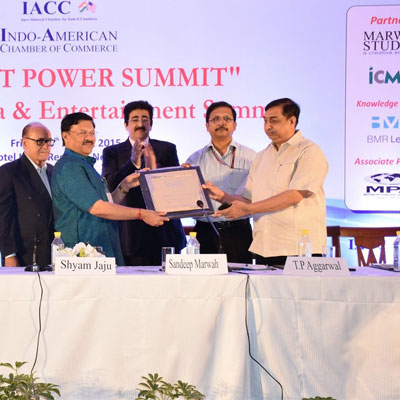
    With this citation, the International Chamber of Media and Industry presented a special Award to Doordarshan’s Kisan Channel.


    The citation was read out by ICMEI founder-president Sandeep Marwah at the inaugural function of the International Media And Entertainment Summit here. Delegates from 30 countries attended the summit.


    “We are thankful to the chamber for considering the efforts of our team to start something unusual but the most needed for the nation,” said Naresh Sirohi, who is advisor to the channel.


    “It is a great moment for the team of Kisan Channel to receive its first award. I am happy that the media and entertainment industry has understood the need of Kisan Channel, which is only of its kind in the world,” said Doordarshan ADG Ranjan Mukherjee, who heads the channel.


    The award was handed over to the officers jointly by Bharatiya Janata Party senior vice president Shyam Jaju Senior and Marwah.


    Senior advocate Lalit Bhasin, who heads the Indo American Camber of Commerce, American deputy minister counselor economic, environment, science & technology affairs Peter Kemp, Indian Motion Indian Picture Producers Association president T P Aggarwal and Film Federation of India president J.P.Chowskey were also present.


    Jaju said, “The role of media is very essential in a developing economy. But it should not cross its limits. Entertainment has a very important place in our life.”


    “Comparing Indian media and entertainment industry of the United States, Bhasin said, “We have yet to grow at the level of America, both quantity wise and quality wise. We have to be more responsible in our actions.”


    “India is the largest film producing country in the world. We make around 2000 films in a year. The turnover of the film industry is going to touch Rs 12,000 crore. The industry is surviving because the passionate people, they are deriving it to its best,” said Marwah.


    “When there is no tax on cinema and other entertainment segments downloaded from internet why should it be imposed on cinema at theatres where much more efforts are involved. Where film industry is helping so many other industries to grow simultaneously,” added Marwah.


    “Most of the films are not doing well; we very rarely get our money back. Seventy five per cent of the films are in losses. Many producers have stopped making films, as recovery is difficult. Government should understand the point of view of Producer who is the real entrepreneur,” said Chowksey.


    “Every one who is working for cinema right from actors to spot boy gets their remuneration even before the release of the film. The producer is always at the risk. We need government support in reducing entertainment tax so that large number of people can watch cinema,” added Agarwal.


    All the film organisations have joined hands to pursue with the government to reduce the tax rates and bring all India entertainment tax at par to give same rebate to producers.


    Representatives of FFI, IMPPA, Film Craft, Western India Film Producers Association, Film Makers Combine will write a joint application to the Government very soon, informed ICMEI secretary general Ashok Tyagi.


    Marwah, who is chairperson of the IACC Media and Entertainment Committee, initiated the discussion by quoting figures from the Indian media and entertainment industry. “We are one of the biggest industries and we need more synchronisation and planning in developing and promoting this industry so that we can be more helpful to the government as well as to the large audience of this country.”


    “The business may look glamorous but the hard work and investment in the entertainment business is huge. The Government has to come down to support the industry by way of reducing taxes,” said Chowskey.


    Agarwal added, “We are ready to join hands on all issues, which are for the benefit of the industry. ICMEI is a strong platform to remind the government about our concerns.”


    “The American market of media and entertainment is in the hands of private people. The demand and supply measures the quantum of business. The industry is huge and we have catered to international business for their survival,” said Kemp.