Tag: Doordarshan

  • Goafirst BRICS U17 live telecast on DD Sports today

    Goafirst BRICS U17 live telecast on DD Sports today

    NEW DELHI: The first-ever BRICS U-17 Football Tournament, being held in Goa this month, will be telecast live by DD Sports.

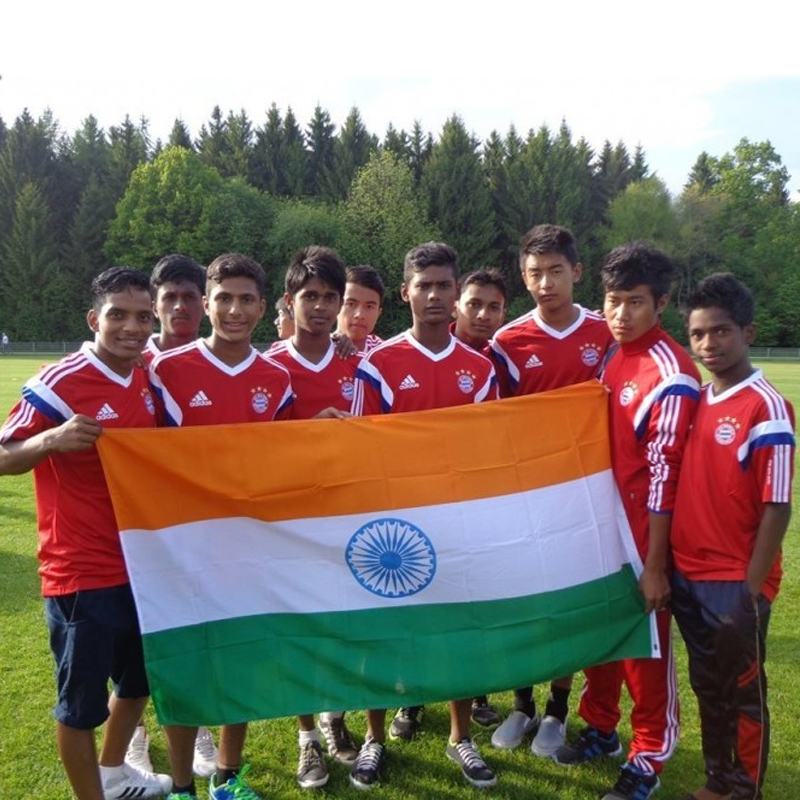
    The tournament kick-starts in Goa on 5 October and will see Brazil, Russia, India, China and South Africa in the challenge for the trophy. India will play Russia in the opener at the GMC Stadium, Bambolim, today.

    The tournament will witness two matches every alternate day which will be telecast live on DD Sports Channel.

    Doordarshan has made elaborate arrangements to telecast the tournament for its viewers on DD Sports. Around 60 officials have been drafted for a seamless broadcast. Doordarshan has deployed its high-tech OB vans to ensure crystal clear quality for its viewers.

    For the first time, Doordarshan has tied up with the local Kendras to broadcast the event in four languages (English, Hindi, Malayalam and Bangla).

    Apart from this, an added feature would be that viewers can watch free mobile TV using DVB-T2 dongles in OTG-enabled smart phones and tablets, Wi-Fi dongles for moving vehicles, besides the TV sets having built-in DVB-T2 tuner which are called Integrated Digital TV (iDTV).

    Earlier last week, the prime minister Narendra Modi had unveiled the trophy for BRICS U-17 football tournament. Modi reiterated the nation’s commitment to ‘Sports for All’ and ‘Khelo India’ and taking football to every corner of the country.

    The prime minister also wished the tournament a grand success, and said he was confident that it will meet its objective of facilitating greater understanding and friendship amongst all participants.

    The tournament aims at taking the ongoing interaction and cohesion among the BRICS nations to a new level of exchange between the youth of these countries in the field of sports.

  • Goafirst BRICS U17 live telecast on DD Sports today

    Goafirst BRICS U17 live telecast on DD Sports today

    NEW DELHI: The first-ever BRICS U-17 Football Tournament, being held in Goa this month, will be telecast live by DD Sports.

    The tournament kick-starts in Goa on 5 October and will see Brazil, Russia, India, China and South Africa in the challenge for the trophy. India will play Russia in the opener at the GMC Stadium, Bambolim, today.

    The tournament will witness two matches every alternate day which will be telecast live on DD Sports Channel.

    Doordarshan has made elaborate arrangements to telecast the tournament for its viewers on DD Sports. Around 60 officials have been drafted for a seamless broadcast. Doordarshan has deployed its high-tech OB vans to ensure crystal clear quality for its viewers.

    For the first time, Doordarshan has tied up with the local Kendras to broadcast the event in four languages (English, Hindi, Malayalam and Bangla).

    Apart from this, an added feature would be that viewers can watch free mobile TV using DVB-T2 dongles in OTG-enabled smart phones and tablets, Wi-Fi dongles for moving vehicles, besides the TV sets having built-in DVB-T2 tuner which are called Integrated Digital TV (iDTV).

    Earlier last week, the prime minister Narendra Modi had unveiled the trophy for BRICS U-17 football tournament. Modi reiterated the nation’s commitment to ‘Sports for All’ and ‘Khelo India’ and taking football to every corner of the country.

    The prime minister also wished the tournament a grand success, and said he was confident that it will meet its objective of facilitating greater understanding and friendship amongst all participants.

    The tournament aims at taking the ongoing interaction and cohesion among the BRICS nations to a new level of exchange between the youth of these countries in the field of sports.

  • IDOS 2016: Prasar Bharati could share infra with private players: Sircar

    IDOS 2016: Prasar Bharati could share infra with private players: Sircar

    GOA: Prasar Bharati has thrown an invitation to all private broadcasters and it reads: come and use our under-utilised resources and infrastructure to increase your reach in digital format terrestrially. What’s more, the Indian pubcaster will help in the distribution.

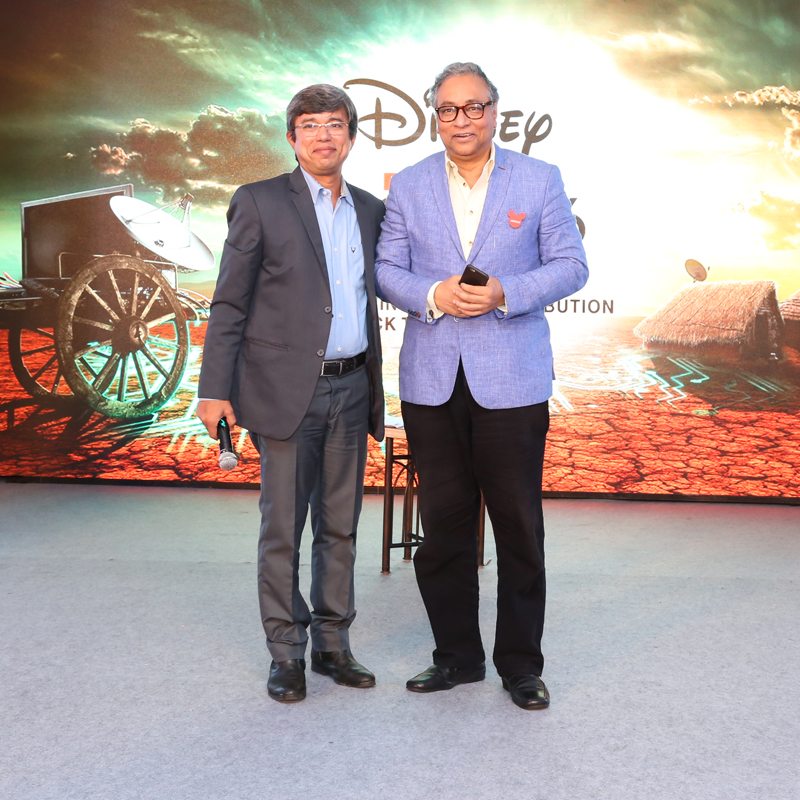
    According to Prasar Bharati CEO Jawhar Sircar, the best spectrum available for broadcasting was between 470-585  MHZ, which is with the pubcaster Doordarshan lying  highly underutilised. And, private TV channels can join hands as the organisation plans to make linear TV available to the public on their hand-held devices via digital terrestrial transmission (DTT).

    “Twenty  channels can be relayed per two antennas as such (via DTT) in four metros. All that people have to do with DVB-T2 is attach an affordable dongle on their mobile handsets and watch TV channels on the go. We can give it away free to consumers to experience it and then charge for it in the second year,” Sircar said while speaking at IDOS 2016 here on Friday.

    As Doordarshan has 1,400 broadcast towers and in the event of complete conversion to digital, DD may not need all those towers for the sake of broadcasting its own channels. The tower infrastructure could therefore be shared and private broadcasters could look at Prasar Bharati as an alternate delivery medium, Sircar explained. There would then be digitised cable, DTH and DTT on offer to the consumer.

    In conversation with indiantelevision.com founder CEO and editor-in-chief  Anil Wanvari, Sircar admitted that DD’s viewership may be falling and which was getting reflected in BARC’s audience measurement.

    “The grand days of DD happened not at the hands of DD’s personnel producing content but duringRamayan, Buniyaad, etc, all of which were made by private producers,” he said. “Hence DD should not make the content on its own. The people over here don’t know how to. The time slot sale to private producers is the best way to go,” he said, adding Prasar Bharati will primarily work on sharing its resources and reduce (in-house) content creation.

    To drive home his point on indifferent quality of present programming on DD, Sircar said the reach of the pubcaster’s resources hasn’t diminished and added, “We allowed private players to come on DD’s FreeDish platform. Yes, they are willing to pay from Rs 1.5 crore (Rs. 15 million) a year in the beginning to Rs 5.5 crore ( Rs. 55 million) today for a slot on FreeDish. That’s because it’s getting them viewership.”

    However, the former bureaucrat, now in the last lap of his present assignment, was evasive and forthcoming at the same time on FreeDish’s actual reach. “Nobody knows how many set top boxes for FreeDish are there, but the industry knows about missing subscribers of (private) DTH players. Those are our FreeDish subscribers. They could number 30 million or so,” he asserted, adding that DD had not initially put in CAS, but now  intends to do so with Indian CAS, take the boxes up to MPEG4 , and add more transponders for distribution, thereby increasing the DTH platform’s capacity to 250 channels in a phased manner.

    Asked about DD’s role as a pubcaster and obvious comparison with the BBC, Sircar was quick to point out that the British pubcaster gets thousands of crores of rupees every year from consumers  in licence fee, apart from government funding.

    Still, unable to restrain himself from taking a dig at the present Indian system regarding pubcasting, Sircar quipped, “They (BBC) know for sure what is expected from a pubcaster. The problem with DD is that we don’t know our real goal and mission.”

    Quizzed further on muddled policies and the pubcaster’s objectives, Sircar, with is tongue firmly in cheek, quipped, “I am Jawhar Sircar, not Bharat Sarkar.” The punning on his last name and Sarkar (Hindi for Indian government) was telling.

    Also read

    http://www.indiantelevision.com/regulators/trai/prasar-bharati-responds-to-trai-consultation-paper-open-to-sharing-dtt-infrastructure-160926

  • IDOS 2016: Prasar Bharati could share infra with private players: Sircar

    IDOS 2016: Prasar Bharati could share infra with private players: Sircar

    GOA: Prasar Bharati has thrown an invitation to all private broadcasters and it reads: come and use our under-utilised resources and infrastructure to increase your reach in digital format terrestrially. What’s more, the Indian pubcaster will help in the distribution.

    According to Prasar Bharati CEO Jawhar Sircar, the best spectrum available for broadcasting was between 470-585  MHZ, which is with the pubcaster Doordarshan lying  highly underutilised. And, private TV channels can join hands as the organisation plans to make linear TV available to the public on their hand-held devices via digital terrestrial transmission (DTT).

    “Twenty  channels can be relayed per two antennas as such (via DTT) in four metros. All that people have to do with DVB-T2 is attach an affordable dongle on their mobile handsets and watch TV channels on the go. We can give it away free to consumers to experience it and then charge for it in the second year,” Sircar said while speaking at IDOS 2016 here on Friday.

    As Doordarshan has 1,400 broadcast towers and in the event of complete conversion to digital, DD may not need all those towers for the sake of broadcasting its own channels. The tower infrastructure could therefore be shared and private broadcasters could look at Prasar Bharati as an alternate delivery medium, Sircar explained. There would then be digitised cable, DTH and DTT on offer to the consumer.

    In conversation with indiantelevision.com founder CEO and editor-in-chief  Anil Wanvari, Sircar admitted that DD’s viewership may be falling and which was getting reflected in BARC’s audience measurement.

    “The grand days of DD happened not at the hands of DD’s personnel producing content but duringRamayan, Buniyaad, etc, all of which were made by private producers,” he said. “Hence DD should not make the content on its own. The people over here don’t know how to. The time slot sale to private producers is the best way to go,” he said, adding Prasar Bharati will primarily work on sharing its resources and reduce (in-house) content creation.

    To drive home his point on indifferent quality of present programming on DD, Sircar said the reach of the pubcaster’s resources hasn’t diminished and added, “We allowed private players to come on DD’s FreeDish platform. Yes, they are willing to pay from Rs 1.5 crore (Rs. 15 million) a year in the beginning to Rs 5.5 crore ( Rs. 55 million) today for a slot on FreeDish. That’s because it’s getting them viewership.”

    However, the former bureaucrat, now in the last lap of his present assignment, was evasive and forthcoming at the same time on FreeDish’s actual reach. “Nobody knows how many set top boxes for FreeDish are there, but the industry knows about missing subscribers of (private) DTH players. Those are our FreeDish subscribers. They could number 30 million or so,” he asserted, adding that DD had not initially put in CAS, but now  intends to do so with Indian CAS, take the boxes up to MPEG4 , and add more transponders for distribution, thereby increasing the DTH platform’s capacity to 250 channels in a phased manner.

    Asked about DD’s role as a pubcaster and obvious comparison with the BBC, Sircar was quick to point out that the British pubcaster gets thousands of crores of rupees every year from consumers  in licence fee, apart from government funding.

    Still, unable to restrain himself from taking a dig at the present Indian system regarding pubcasting, Sircar quipped, “They (BBC) know for sure what is expected from a pubcaster. The problem with DD is that we don’t know our real goal and mission.”

    Quizzed further on muddled policies and the pubcaster’s objectives, Sircar, with is tongue firmly in cheek, quipped, “I am Jawhar Sircar, not Bharat Sarkar.” The punning on his last name and Sarkar (Hindi for Indian government) was telling.

    Also read

    http://www.indiantelevision.com/regulators/trai/prasar-bharati-responds-to-trai-consultation-paper-open-to-sharing-dtt-infrastructure-160926

  • Prasar Bharati responds to TRAI consultation paper; open to sharing DTT infrastructure

    Prasar Bharati responds to TRAI consultation paper; open to sharing DTT infrastructure

    NEW DELHI: Pubcaster Prasar Bharati has sent its viewpoints  to the Telecom Regulatory Authority of India (TRAI)’s consultation paper on the involvement of the private sector in digital terrestrial broadcasting (which has been its forte, so far).

    In its response, it has stated that, even as it supports the move, it feels that the potential of available distribution options need to be critically analysed to fulfill their requirements (for example coverage, capacity, reception mode, type of service etc).

    The public broadcaster has also said that the terrestrial broadcast platform will be relevant in the long term if its usage offers veritable benefits to the broadcasters, the audiences and the society as a whole. Even in countries where cable, satellite or broadband hold a significant market share, terrestrial broadcasting is usually regarded as an essential, flexible and reliable way of delivering broadcast content to a mass audience.

    In its response to 11 questions asked by TRAI in its Consultation Paper on ‘Issues related to Digital Terrestrial Broadcasting in India,’ the pubcaster says that the terrestrial platform must be digital to remain viable in the long term.

    Prasar Bharati CEO Jawhar Sircar had told indiantelevision.com in an interview earlier that it had cleared DTT for the private sector more than a year ago.

    Given the vast landscape of the country, Prasar Bharati says DTT is absolutely vital. It is thus crucial to ensure that, in the long term, the terrestrial distribution networks should be capable of delivering the current and future, advanced linear broadcast services, and fulfilling the  ever-increasing  requirements for quality and  choice  of services, including non-linear broadcast services.

    The benefits offered by DTT according to the pubcaster are:

    •         Near-universal coverage,

    •         Ability to provide for fixed, portable and mobile reception,
                Ability to efficiently provide regional and local content

    •         It is flexibility and content format agnostic. The newer formats of TV channels such as HD TV, 3D TV, UHD TV, data and radio services etc. can thus be delivered.

    •         Technical and cost efficiency,

    •         Efficient  use  of  spectrum  as  multiple  program channels  can  be transmitted using one TV spectrum channel of 8 MHz

    •         Network has ruggedness and not prone to catastrophic failure and sabotage from enemies

    •         Terrestrial broadcasting has strategic importance along the borders

    •         A potential for further development.

    Even with the presence of huge number of DTH and cableTV channels, a strong terrestrial platform is critical to healthy competition in the TV and radio market and to the realisation of a wide range of social and cultural benefits and most essentially an all-weather reliable platforms for the distribution of radio and TV signals, says the pubcaster.

    As indicated in the consultation paper, there are 247 million households in India as per the 2011 census, and a large number of these, particularly in rural and remote areas, depend completely on the FTA (free-to-air) terrestrial broadcasting TV services provided by the public broadcaster.

    Thus, in order to meet consumer expectations and ensure optimum utilization of resources, a digital terrestrial TV service having suitable bouquet of TV channels and nationwide coverage is very essential, says the pubcaster.

    It stresses that DTT is being provided in FTA mode in most of the countries. Its capability to provide local content will facilitate in providing social benefits of promoting local talent, local culture and music, generating employment, catering to local self-governance information needs, etc.

    This powerful combination would be difficult to replicate by any single alternative technology. DTT secures greater plurality in platform ownership, ensuring that no single platform owner is so powerful that it can exert undue influence on public opinion, and hence is the need for every country.

    DTT broadcasting has emerged as one of the popular digital television platforms in countries such as the UK, the US, Japan, Germany, France and Australia as it turns out to be one of the most economical broadcast transmission systems. In the DTT broadcasting process, everybody watches the same content at the same time, and it guarantees everybody the same high level of service, since they are all bathed in the same signal, and that too free to air, whereas, in OTT, the received signal quality depends upon number of viewers watching it, simultaneously.

    By the end of 2015, DTT constituted the second highest user base worldwide among the digital TV broadcast platforms next only to that of digital cable TV services.

    The pubcaster feels that, to optimise the time and resources, DTT can be started with two multiplexes at each location, and can be enhanced to three/four in due course of time, may be after analogue switchoff (ASO). Nation-wide coverage plan may further be implemented in time-bound phased manner as has been done in the case of implementation of DAS cable system.

    Infrastructure sharing will be essential for easy and cost-effective implementation of DTT service in India. Sharing would be essential so as to minimise the cost of implementation and faster roll-out. The experience sharing during implementation of FM expansion may be considered as an input for DTT roll-out.

    Deciding a national standard for DTT service is quintessential to have a volume of scale in terms of DTT ecosystem.  Doordarshan has already adopted DVB-T2 for itsDTT service, and it would be beneficial for the nation to adopt DVB-T2 as the national standard. Besides volume of scale, it may eliminate interoperability issues. Most of the countries are following a single national standard for DTT.

    The television viewer needs variety in programming content which may be possible when private channels are allowed on terrestrial platform. This is also required to make attractive and competitive bouquet.

    Prasar Bharati, however, says that it has to be ensured that the consumers are not impacted or charged heavily for private services. Issues regarding quality of service, grievance redressal etc. are also important.

    Doordarshan also needs to see that it continues to be the public service provider while providing wholesome content. The faster roll-out of DTT would require support from every stakeholder (government/private) for creating nation-wide network.

    Prasar Bharati already has huge infrastructure such as land, building, towers, trained manpower, networks, etc, for its terrestrial transmission. It has also initiated setting up of DTT transmitters. Doordarshan has already installed 23 DVB-T2 transmitters at 19 locations and services have been started at 16 locations. Also, it is in the process of expanding this to 63 locations.

    Doordarshan has gained enough experience and has good expertise in the field of DTT implementation including coverage and frequency planning, design of DTT network, procurement, execution, measurement and testing, field  surveys  etc.  It  is , therefore, a  better-placed  entity  for setting  up Integrated DTT Broadcasting network that includes private broadcasters as well.

    In this scenario, Prasar Bharati may also become a content aggregator for sharing transmitter capacity with private service-providers to give variety of content while the platform remains with it.

    This will ensure public service broadcasting can be strengthened in the country and reach of services from public broadcaster will enhance immensely; dissemination of social, educational programmes to masses; no new regulatory framework required for implementation of DTT; existing infrastructure will be optimally utilized; and introduction of a variety of services making DTT more competitive.

    Doordarshan has already got funds from government to pioneer DTT, and it is seeking additional funds from it to complete it.  Private broadcasters may be charged a suitable fee for using this infrastructure. This has already been implemented in the DD DTH service.

    For DTT expansion plan phase 1 and 2, one option could be that Prasar Bharati  (Doordarshan) gets government funds and charges a fee from private broadcasters as in the case of the pioneer plan; or Doordarshan (Government) and private broadcaster can share the capital expenditure in a suitable sharing model. Revenue may also be shared using the same model.

    Considering the present situation in India and to optimise  time and resources, DTT can be started with two multiplexes at 63 locations and can be enhanced to three/four in due course, may be after ASO.  A suggestive model for integrated DTT broadcasting network could be:

    i)      DTT may be implemented at 630 locations almost immediately where Doordarshan (Prasar Bharati) has already started implementation of DTT and infrastructure is almost ready. Private operators may be allowed to share this infrastructure by paying a suitable fee to Doordarshan as is being done in the case of DD DTH service. [This may be called DTT Pioneer Plan]

    ii)      Of the remaining 567 locations, wherever Doordarshan has sufficient requisite infrastructure, DVB-T2 multiplexes may be established and private  broadcasters can  share  those  exactly  in  the  same  way. [This may be called DTT Expansion Plan-Phase1]

    iii)     A new CTI (common transmission) infrastructure may be established at all other places where Doordarshan infrastructure is not available. These CTIs may be established by an experienced separate entity (e.g., BECIL). However, the ownership may be with Doordarshan (or a consortium). The process for this may be started in parallel to phase-1 but may have a different target date as establishment of new CTI will take more time. [This may be called DTT Expansion Plan-Phase2]

    It will be difficult to earmark exclusive spectrum for DTT as Doordarshan is already using the UHF band-IV for analog TV service. Besides, Doordarshan is also using band-IV for DTT and has planned utilization of band-IV and band-V frequencies for already approved DVB-T2 transmitters. It has also planned a DTT transmitter network at 630 locations with 2 MUXs, in Band-IV and Band-V.

    For the simulcast period, additional spectrum is required for the parallel transmission of TV services in analogue and digital mode. The required amount of spectrum will heavily depend on the introduction strategy adopted for DTT. ITU-R studies have concluded that 224 MHz spectrum would be required in UHF band for implementation of four to five DTT Multiplex at each location. Whereas, in India, practically only 176 MHz (470-646MHz) spectrum is available in UHF band. It would be appropriate that the entire broadcasting band 470-698 MHz may be made available.

    In a statement that may help the private sector, Prasar Bharati said that countries boosted switching to digital by giving subsidy on STBs; mandatory DTT tuner in all TV receivers after a certain date; awareness campaign regarding ASO; incentives to broadcasters in terms of spectrum charges for providing simulcast, and dialogue and incentives to manufacturer/importer of DTT receiving equipment.

    India would certainly need such concerted efforts to popularize digital reception and achieve ASO. With the concerted effort, India may think of a simulcast period of at least 6-12 months before switching off analogue transmitters. As the digitization is proposed to be implemented in a phased manner, ASO will also happen in a phased manner. However, the situation will have to be reviewed before actually switching off.

    The pubcaster has suggested that provision of DVB-T2 Tuner can be made mandatory on all TVs imported/manufactured in India after 1 April 2018. Similarly, embedding of DVB-T2/T2 Lite tuner in mobile phones should also be mandated on the same date.

    Also read: http://www.indiantelevision.com/television/tv-channels/terrestrial/prasar-bharati-ceo-prasar-bharati-not-opposed-to-private-players-entry-in-dtt-160620
     

  • Prasar Bharati responds to TRAI consultation paper; open to sharing DTT infrastructure

    Prasar Bharati responds to TRAI consultation paper; open to sharing DTT infrastructure

    NEW DELHI: Pubcaster Prasar Bharati has sent its viewpoints  to the Telecom Regulatory Authority of India (TRAI)’s consultation paper on the involvement of the private sector in digital terrestrial broadcasting (which has been its forte, so far).

    In its response, it has stated that, even as it supports the move, it feels that the potential of available distribution options need to be critically analysed to fulfill their requirements (for example coverage, capacity, reception mode, type of service etc).

    The public broadcaster has also said that the terrestrial broadcast platform will be relevant in the long term if its usage offers veritable benefits to the broadcasters, the audiences and the society as a whole. Even in countries where cable, satellite or broadband hold a significant market share, terrestrial broadcasting is usually regarded as an essential, flexible and reliable way of delivering broadcast content to a mass audience.

    In its response to 11 questions asked by TRAI in its Consultation Paper on ‘Issues related to Digital Terrestrial Broadcasting in India,’ the pubcaster says that the terrestrial platform must be digital to remain viable in the long term.

    Prasar Bharati CEO Jawhar Sircar had told indiantelevision.com in an interview earlier that it had cleared DTT for the private sector more than a year ago.

    Given the vast landscape of the country, Prasar Bharati says DTT is absolutely vital. It is thus crucial to ensure that, in the long term, the terrestrial distribution networks should be capable of delivering the current and future, advanced linear broadcast services, and fulfilling the  ever-increasing  requirements for quality and  choice  of services, including non-linear broadcast services.

    The benefits offered by DTT according to the pubcaster are:

    •         Near-universal coverage,

    •         Ability to provide for fixed, portable and mobile reception,
                Ability to efficiently provide regional and local content

    •         It is flexibility and content format agnostic. The newer formats of TV channels such as HD TV, 3D TV, UHD TV, data and radio services etc. can thus be delivered.

    •         Technical and cost efficiency,

    •         Efficient  use  of  spectrum  as  multiple  program channels  can  be transmitted using one TV spectrum channel of 8 MHz

    •         Network has ruggedness and not prone to catastrophic failure and sabotage from enemies

    •         Terrestrial broadcasting has strategic importance along the borders

    •         A potential for further development.

    Even with the presence of huge number of DTH and cableTV channels, a strong terrestrial platform is critical to healthy competition in the TV and radio market and to the realisation of a wide range of social and cultural benefits and most essentially an all-weather reliable platforms for the distribution of radio and TV signals, says the pubcaster.

    As indicated in the consultation paper, there are 247 million households in India as per the 2011 census, and a large number of these, particularly in rural and remote areas, depend completely on the FTA (free-to-air) terrestrial broadcasting TV services provided by the public broadcaster.

    Thus, in order to meet consumer expectations and ensure optimum utilization of resources, a digital terrestrial TV service having suitable bouquet of TV channels and nationwide coverage is very essential, says the pubcaster.

    It stresses that DTT is being provided in FTA mode in most of the countries. Its capability to provide local content will facilitate in providing social benefits of promoting local talent, local culture and music, generating employment, catering to local self-governance information needs, etc.

    This powerful combination would be difficult to replicate by any single alternative technology. DTT secures greater plurality in platform ownership, ensuring that no single platform owner is so powerful that it can exert undue influence on public opinion, and hence is the need for every country.

    DTT broadcasting has emerged as one of the popular digital television platforms in countries such as the UK, the US, Japan, Germany, France and Australia as it turns out to be one of the most economical broadcast transmission systems. In the DTT broadcasting process, everybody watches the same content at the same time, and it guarantees everybody the same high level of service, since they are all bathed in the same signal, and that too free to air, whereas, in OTT, the received signal quality depends upon number of viewers watching it, simultaneously.

    By the end of 2015, DTT constituted the second highest user base worldwide among the digital TV broadcast platforms next only to that of digital cable TV services.

    The pubcaster feels that, to optimise the time and resources, DTT can be started with two multiplexes at each location, and can be enhanced to three/four in due course of time, may be after analogue switchoff (ASO). Nation-wide coverage plan may further be implemented in time-bound phased manner as has been done in the case of implementation of DAS cable system.

    Infrastructure sharing will be essential for easy and cost-effective implementation of DTT service in India. Sharing would be essential so as to minimise the cost of implementation and faster roll-out. The experience sharing during implementation of FM expansion may be considered as an input for DTT roll-out.

    Deciding a national standard for DTT service is quintessential to have a volume of scale in terms of DTT ecosystem.  Doordarshan has already adopted DVB-T2 for itsDTT service, and it would be beneficial for the nation to adopt DVB-T2 as the national standard. Besides volume of scale, it may eliminate interoperability issues. Most of the countries are following a single national standard for DTT.

    The television viewer needs variety in programming content which may be possible when private channels are allowed on terrestrial platform. This is also required to make attractive and competitive bouquet.

    Prasar Bharati, however, says that it has to be ensured that the consumers are not impacted or charged heavily for private services. Issues regarding quality of service, grievance redressal etc. are also important.

    Doordarshan also needs to see that it continues to be the public service provider while providing wholesome content. The faster roll-out of DTT would require support from every stakeholder (government/private) for creating nation-wide network.

    Prasar Bharati already has huge infrastructure such as land, building, towers, trained manpower, networks, etc, for its terrestrial transmission. It has also initiated setting up of DTT transmitters. Doordarshan has already installed 23 DVB-T2 transmitters at 19 locations and services have been started at 16 locations. Also, it is in the process of expanding this to 63 locations.

    Doordarshan has gained enough experience and has good expertise in the field of DTT implementation including coverage and frequency planning, design of DTT network, procurement, execution, measurement and testing, field  surveys  etc.  It  is , therefore, a  better-placed  entity  for setting  up Integrated DTT Broadcasting network that includes private broadcasters as well.

    In this scenario, Prasar Bharati may also become a content aggregator for sharing transmitter capacity with private service-providers to give variety of content while the platform remains with it.

    This will ensure public service broadcasting can be strengthened in the country and reach of services from public broadcaster will enhance immensely; dissemination of social, educational programmes to masses; no new regulatory framework required for implementation of DTT; existing infrastructure will be optimally utilized; and introduction of a variety of services making DTT more competitive.

    Doordarshan has already got funds from government to pioneer DTT, and it is seeking additional funds from it to complete it.  Private broadcasters may be charged a suitable fee for using this infrastructure. This has already been implemented in the DD DTH service.

    For DTT expansion plan phase 1 and 2, one option could be that Prasar Bharati  (Doordarshan) gets government funds and charges a fee from private broadcasters as in the case of the pioneer plan; or Doordarshan (Government) and private broadcaster can share the capital expenditure in a suitable sharing model. Revenue may also be shared using the same model.

    Considering the present situation in India and to optimise  time and resources, DTT can be started with two multiplexes at 63 locations and can be enhanced to three/four in due course, may be after ASO.  A suggestive model for integrated DTT broadcasting network could be:

    i)      DTT may be implemented at 630 locations almost immediately where Doordarshan (Prasar Bharati) has already started implementation of DTT and infrastructure is almost ready. Private operators may be allowed to share this infrastructure by paying a suitable fee to Doordarshan as is being done in the case of DD DTH service. [This may be called DTT Pioneer Plan]

    ii)      Of the remaining 567 locations, wherever Doordarshan has sufficient requisite infrastructure, DVB-T2 multiplexes may be established and private  broadcasters can  share  those  exactly  in  the  same  way. [This may be called DTT Expansion Plan-Phase1]

    iii)     A new CTI (common transmission) infrastructure may be established at all other places where Doordarshan infrastructure is not available. These CTIs may be established by an experienced separate entity (e.g., BECIL). However, the ownership may be with Doordarshan (or a consortium). The process for this may be started in parallel to phase-1 but may have a different target date as establishment of new CTI will take more time. [This may be called DTT Expansion Plan-Phase2]

    It will be difficult to earmark exclusive spectrum for DTT as Doordarshan is already using the UHF band-IV for analog TV service. Besides, Doordarshan is also using band-IV for DTT and has planned utilization of band-IV and band-V frequencies for already approved DVB-T2 transmitters. It has also planned a DTT transmitter network at 630 locations with 2 MUXs, in Band-IV and Band-V.

    For the simulcast period, additional spectrum is required for the parallel transmission of TV services in analogue and digital mode. The required amount of spectrum will heavily depend on the introduction strategy adopted for DTT. ITU-R studies have concluded that 224 MHz spectrum would be required in UHF band for implementation of four to five DTT Multiplex at each location. Whereas, in India, practically only 176 MHz (470-646MHz) spectrum is available in UHF band. It would be appropriate that the entire broadcasting band 470-698 MHz may be made available.

    In a statement that may help the private sector, Prasar Bharati said that countries boosted switching to digital by giving subsidy on STBs; mandatory DTT tuner in all TV receivers after a certain date; awareness campaign regarding ASO; incentives to broadcasters in terms of spectrum charges for providing simulcast, and dialogue and incentives to manufacturer/importer of DTT receiving equipment.

    India would certainly need such concerted efforts to popularize digital reception and achieve ASO. With the concerted effort, India may think of a simulcast period of at least 6-12 months before switching off analogue transmitters. As the digitization is proposed to be implemented in a phased manner, ASO will also happen in a phased manner. However, the situation will have to be reviewed before actually switching off.

    The pubcaster has suggested that provision of DVB-T2 Tuner can be made mandatory on all TVs imported/manufactured in India after 1 April 2018. Similarly, embedding of DVB-T2/T2 Lite tuner in mobile phones should also be mandated on the same date.

    Also read: http://www.indiantelevision.com/television/tv-channels/terrestrial/prasar-bharati-ceo-prasar-bharati-not-opposed-to-private-players-entry-in-dtt-160620
     

  • New addl secy, advisor in IT Ministry

    New addl secy, advisor in IT Ministry

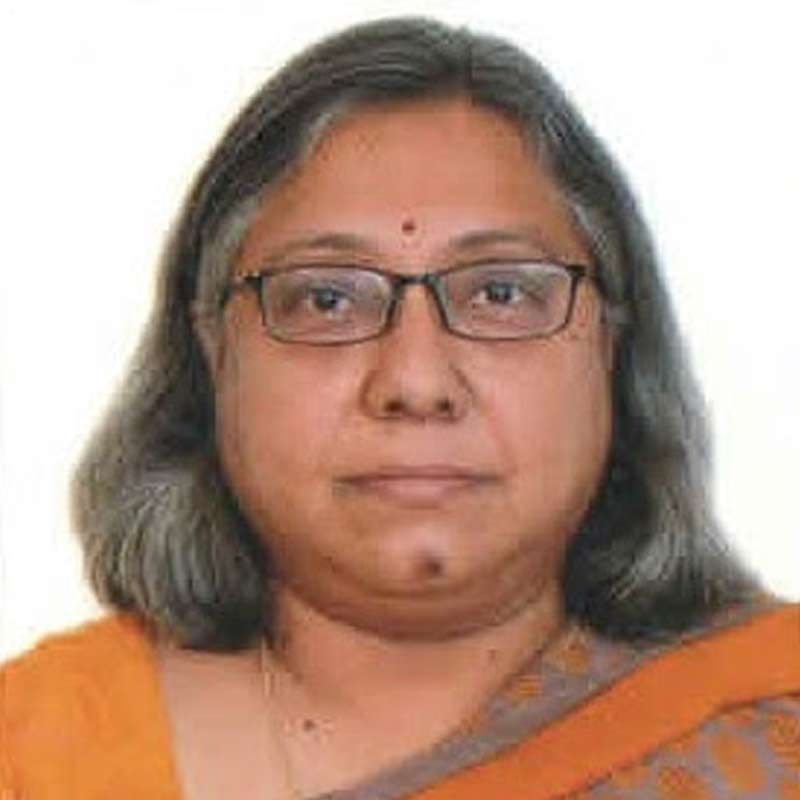
    NEW DELHI: Anuradha Mitra has been appointed as the additional secretary and financial advisor in the electronics & information technology ministry. Mitra is a 1984 batch officer of the Indian Defence Accounts Service.

    She was until now the joint secretary & financial advisor in the same ministry. She has been assigned the new role by upgrading her position for a period of two years or until further orders, whichever is earlier.

    The ministry is in charge of the development of set-top boxes for digital addressable system, and for implementing the Indian conditional access system (iCAS) which has been adopted by Doordarshan’s Freedish DTH platform.

  • New addl secy, advisor in IT Ministry

    New addl secy, advisor in IT Ministry

    NEW DELHI: Anuradha Mitra has been appointed as the additional secretary and financial advisor in the electronics & information technology ministry. Mitra is a 1984 batch officer of the Indian Defence Accounts Service.

    She was until now the joint secretary & financial advisor in the same ministry. She has been assigned the new role by upgrading her position for a period of two years or until further orders, whichever is earlier.

    The ministry is in charge of the development of set-top boxes for digital addressable system, and for implementing the Indian conditional access system (iCAS) which has been adopted by Doordarshan’s Freedish DTH platform.

  • Prasar Bharati looks at digitizing archives; to seek Rs 250 crore from govt

    Prasar Bharati looks at digitizing archives; to seek Rs 250 crore from govt

    MUMBAI: Pubcaster Prasar Bharati is taking another stab at digitizing and monetising the huge archival content catalogue that is lying in the shelves of All India Radio and Doordarshan. And it is all set to make a formal request to the ministry of broadcasting and broadcasting (MIB) for nearly Rs 250 crore to help it achieve what it intends to do. It says included in this archive are prominent speeches of national leaders, popular programmes and music.

    Prasar Bharati officials recently made a presentation to the MIB enumerating why it needs to do this. Sources say both Doordarshan and All India Radio have millions of hours of both audio and video content. In fact, All India Radio had digitized some of its content around a decade ago and even monetized some of it by selling CDs. The UK pubcaster BBC is amongst the world’s largest exporters of TV content with worldwide sales of around 400 million Euros. If Prasar Bharati manages even 10 per cent of that, it will more than recover its digitization costs.

    The problem, however, is that its archive has not been maintained in the best manner and is on beta and VHS tapes, many of which could be damaged or unrecoverable. And some of it could be have been stolen or lost.

    It is also looking at drafting a syndication policy to sell its content worldwide to other media outlets or online directly to consumers.

    Says a media observer: “Hopefully, it takes up the task seriously this time and the MIB helps it see it through to conclusion. DD is in danger of becoming a dinosaur; digitisation will allow it to bring new legs to old content which a generation has not seen. It could be put out online or on mobile for consumption apart from finding customers for its clips worldwide.”

  • Prasar Bharati looks at digitizing archives; to seek Rs 250 crore from govt

    Prasar Bharati looks at digitizing archives; to seek Rs 250 crore from govt

    MUMBAI: Pubcaster Prasar Bharati is taking another stab at digitizing and monetising the huge archival content catalogue that is lying in the shelves of All India Radio and Doordarshan. And it is all set to make a formal request to the ministry of broadcasting and broadcasting (MIB) for nearly Rs 250 crore to help it achieve what it intends to do. It says included in this archive are prominent speeches of national leaders, popular programmes and music.

    Prasar Bharati officials recently made a presentation to the MIB enumerating why it needs to do this. Sources say both Doordarshan and All India Radio have millions of hours of both audio and video content. In fact, All India Radio had digitized some of its content around a decade ago and even monetized some of it by selling CDs. The UK pubcaster BBC is amongst the world’s largest exporters of TV content with worldwide sales of around 400 million Euros. If Prasar Bharati manages even 10 per cent of that, it will more than recover its digitization costs.

    The problem, however, is that its archive has not been maintained in the best manner and is on beta and VHS tapes, many of which could be damaged or unrecoverable. And some of it could be have been stolen or lost.

    It is also looking at drafting a syndication policy to sell its content worldwide to other media outlets or online directly to consumers.

    Says a media observer: “Hopefully, it takes up the task seriously this time and the MIB helps it see it through to conclusion. DD is in danger of becoming a dinosaur; digitisation will allow it to bring new legs to old content which a generation has not seen. It could be put out online or on mobile for consumption apart from finding customers for its clips worldwide.”