Tag: Donald Trump

  • Epstein Files resurface in Times Now bombshell

    Epstein Files resurface in Times Now bombshell

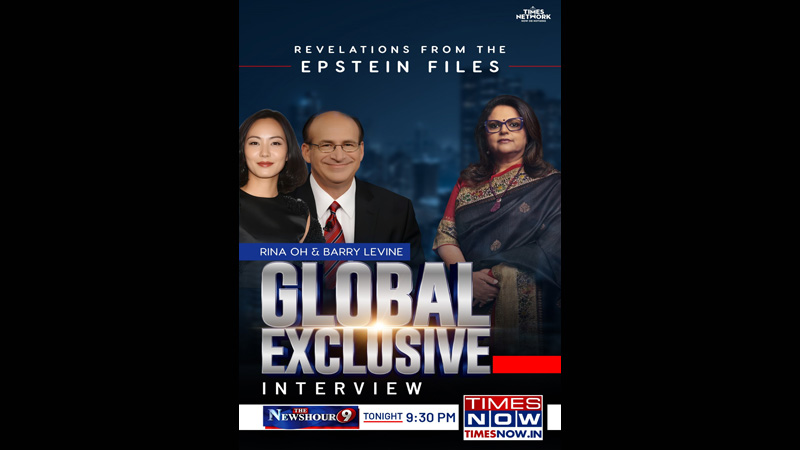
    MUMBAI: The ghost of Jeffrey Epstein refuses to rest quietly. In a Times Now Global Exclusive that’s shaken the corridors of power, survivor Reena Oh and veteran investigative journalist Barry Levine have reignited the world’s most chilling scandal, hinting that the darkest secrets may still lie buried in classified files.

    Speaking with Times Now and Times Now Navbharat group editor-in-chief  Navika Kumar, the duo revealed shocking new details about the Epstein network, the alleged cover-ups, and the silence that continues to shield the powerful.

    The revelations follow the leak of Virginia Giuffre’s memoir, which reportedly includes explosive rape allegations against a man described as a “prime minister.” Levine disclosed that more than 100,000 pages of FBI documents on Epstein remain sealed, potentially containing multiple references to former U.S. president Donald Trump. “Epstein and Trump were friends for nearly 15 years,” Levine said, adding that the two were photographed and filmed together at private events.

    Reena Oh, who survived Epstein’s circle of abuse, offered a haunting account of Ghislaine Maxwell’s home, describing “a closet full of sadistic objects” that stood as proof of the horrors endured by young girls. She confirmed she had cooperated with the U.S. Department of Justice and the FBI, helping investigators piece together parts of Maxwell’s prosecution.

    “Oh, many survivors have stopped speaking out,” she said quietly. “They’re scared. Some have even received death threats. That’s why the Epstein files must be made public.”

    Levine echoed her call for transparency. “Until those files are released,” he said, “justice remains unfinished and democracy untested.”

    With Maxwell already convicted and Epstein’s network still under scrutiny, the storm around his legacy is far from over. As Navika Kumar summed it up on air, “The truth is in those files. It’s time the world learns what power tried to bury.”

    The full interview airs tonight at 9:30 pm on Times Now, in The Epstein Files: The Secrets, The Silence, The Survivors, a broadcast that promises to raise more questions than it answers.


  • Trump to slap 100 per cent tariff on foreign films?

    Trump to slap 100 per cent tariff on foreign films?

    WASHINGTON: Donald Trump has declared war on foreign-made movies. The American president announced on Monday that he would impose a 100 per cent tariff on all films produced outside the United States, threatening to blow up Hollywood’s international operations. As well as possible revenues that Indian films make in Uncle Sam. 

    The move, posted on Trump’s Truth Social platform, marks an audacious expansion of his protectionist trade agenda into cultural industries. “Our movie making business has been stolen from the United States of America, by other Countries, just like stealing candy from a baby,” he wrote, taking a swipe at California’s “weak and incompetent” governor Gavin Newsom.

    Yet the announcement left crucial questions unanswered. The White House offered no details on the legal authority Trump would invoke or how such tariffs would work in practice. Studio executives are baffled: modern filmmaking splices together production, financing, post-production and visual effects from multiple countries. How would a film shot in New Zealand with British money and American stars be classified?

    Legal experts are equally sceptical. Films are intellectual property traded as services—a category where America typically runs a surplus. That raises doubts about whether tariffs can even be applied. Co-productions with foreign studios have become routine, further muddying the waters.

    Trump first floated the idea in May, calling foreign productions a “national security threat” that imports “messaging and propaganda.” Entertainment executives were flummoxed then and remain so now.

    The industry has increasingly decamped from Hollywood to chase tax breaks in Britain, Australia and New Zealand. California is scrambling to compete: Newsom has pushed to expand the state’s film tax credits. But some productions film abroad simply because their stories demand it. Directors like Denis Villeneuve and Christopher Nolan favour shooting on location rather than on soundstages.

    The major American studios declined to comment to Reuters. Netflix shares, however,  slipped 1.5 per cent in early trading.

    The silence from studios suggests an industry still trying to parse whether Trump’s threat is bluster or genuine policy. Either way, it signals fresh uncertainty for an entertainment business already grappling with streaming upheaval and rising costs.

  • Trump’s ‘Victory’ scent muscles into celebrity perfume mania

    Trump’s ‘Victory’ scent muscles into celebrity perfume mania

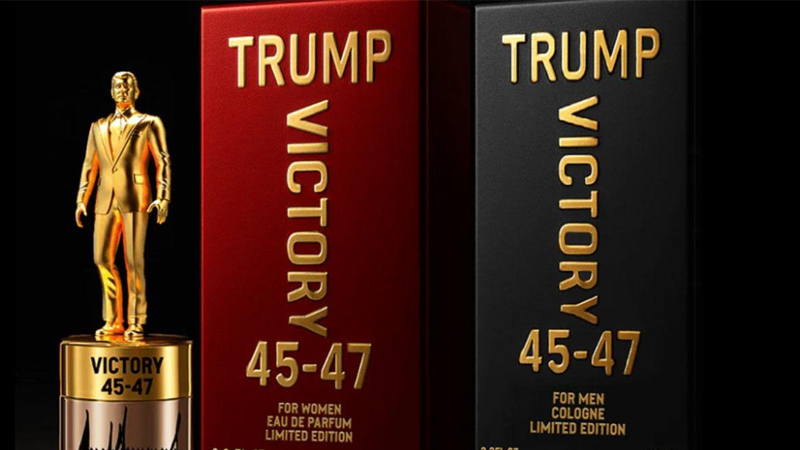
    MUMBAI: Celebrity perfumes are big business. And now, Donald Trump wants a whiff of victory too. As the current US president and a real estate mogul, he has just added cologne to his ever-growing merchandise empire. His latest launch, ‘Victory 45–47’, is a perfume duo pitched as an olfactory power play, bottled with the promise of “Winning, Strength, and Success.” The perfumes are packaged in stylish boxes — black with gold for men and red with gold for women. The bottles are shaped like miniature statues of Trump.

    Smells like confidence? Certainly. Subtle? Not in the slightest. But that’s the point.

    Trump’s entry into the celebrity fragrance fray marks a bold twist in a trend that’s already one of the most lucrative crossovers in pop culture. Perfume, once the province of Paris and prestige perfumers, is now the ultimate flex for the famous bottled personality, a scent-led story, a sensory souvenir of stardom.

    Celebrity scents are no longer novelty side-hustles; they’re billion-dollar businesses. And for stars with rabid fan bases, launching a perfume line offers more than just revenue as it offers a way to linger long after the applause fades.

    Before Trump spritzed “success,” there was Taylor Swift’s Wonderstruck, Paris Hilton’s Heiress, Jennifer Lopez’s Glow, and Britney Spears’ Fantasy series — sugary, sparkling olfactory time machines for a generation that grew up with them. The Kardashian sisters transformed their brand of reality-glam into perfume bottles shaped like crystals. Each scent sold a persona, a feeling, a filter.

    In India, Shah Rukh Khan dipped into the fragrance scene with an offering as suave as his on-screen presence, while Amitabh Bachchan’s foray echoed his gravitas and enduring appeal. For fans, these perfumes weren’t just products — they were accessible. Affordable. Aspirational. And wearable.

    The process isn’t as simple as lending a name and collecting royalties. Crafting a celebrity fragrance involves late-night mood boards, deep dives into personal stories, and the careful balancing of notes that reflect personality without alienating mass-market palates.

    Top perfumers often sit with celebrities to understand their vision — or at least their vibe. What results is a cocktail of emotion and olfactory chemistry: floral highs, musky lows, and a middle note of “this smells like me.” The packaging? Almost as crucial as the juice. It’s storytelling in glass — and shelf appeal is everything.

    Celebrity scents today are more than aromatic accessories. They’re extensions of personal style, markers of mood, and declarations of fan loyalty. Wearing a celebrity fragrance is not just about smelling good — it’s about aligning with a lifestyle, be it Swift’s soft girl elegance or Trump’s chest-thumping alpha masculinity.

    As social media and AI reshape how fragrances are marketed, the future of celeb scents is set to get even more personalised — think interactive campaigns, name-dropped reels, and algorithm-powered fragrance matches. Fans won’t just buy the perfume; they’ll star in its story.

    Trump’s Victory 45–47 might raise eyebrows, but it also raises an important point: in a world of fleeting fame, fragrance lingers. For celebrities, perfume offers permanence — a way to stay relevant, even when the spotlight dims.

    So whether you reach for Paris Hilton’s sparkle, Swift’s sweetness, or Trump’s testosterone, remember: behind every bottle is a brand, a story, and a scent of ambition.
     

  • Global ad market to be hit by trade wars, tariffs, and turmoil, says Warc

    Global ad market to be hit by trade wars, tariffs, and turmoil, says Warc

    MUMBAI: The global advertising industry is set for a bumpier ride than expected thanks to Donald Trump’s recent trade pronouncements and the retaliatory measures by the countries  affected and the continuing conflicts in certain parts of the world. 

    With this background in mind, Warc has slashed its ad spend growth forecast for 2025 by almost a percentage point to 6.7 per cent. The revised estimate pegs global ad spend at $1.15 trillion, down $20 billion over the next two years, thanks to economic stagnation, trade tariffs, and regulatory upheaval. The outlook for 2026 has also taken a hit, with growth now expected at 6.3 per cent.

    Warc director of data, intelligence & forecasting James Mcdonald put it bluntly: “The ad market is feeling the squeeze from tariffs, economic stagnation, and regulatory crackdowns, prompting brands to rein in budgets. Despite the volatility, digital ad spend remains robust, with Alphabet, Amazon and Meta set to control over half the market by 2029.”

    Automakers are slamming the brakes on ad budgets, cutting spend by 7.4 per cent as manufacturing stalls and supply chain woes deepen. Key players like General Motors and Ford have already slashed marketing budgets, focusing more on digital and social channels over traditional TV spots. Meanwhile, tariffs on Mexican, Canadian, and Chinese car imports threaten to worsen the crunch, with 40.7 per cent of the industry at risk, per the European Automobile Manufacturers Association.

    Retailers, too, are tightening belts. The sector, the biggest spender in global advertising, is set to cut ad budgets by 5.3 per cent this year, as rising costs and trade barriers squeeze margins. Chinese disruptors like Temu and Shein, which fuelled a retail ad boom in 2024, are expected to dial back their spending due to new trade restrictions.

    Tech brands, once the ad market’s golden child, are now facing a slowdown. The sector’s projected growth has been halved, down to 6.2 per cent, as new tariffs on semiconductors hit supply chains. Warc had previously forecast a 13.9 per cent jump in tech ad spend—now it’s looking at a much cooler landscape.

    Despite the broader slowdown, digital advertising remains a money-spinner. Search advertising will grab 21.7 per cent of global ad spend this year, rising eight per cent to $250 billion. Social media, the biggest single advertising channel, will rake in $286.2 billion—almost a quarter of all ad spend—powered by TikTok (+23.6 per cent), Instagram (+17 per cent) and Facebook (+8.6 per cent).

    Retail media, the rising star, is set to be one of the fastest-growing advertising formats, with a 15.4 per cent surge this year. However, trade barriers could dent ad receipts from consumer goods brands that rely on global supply chains. 

    Yet, there are storm clouds ahead. The EU has slapped Apple and Google with Digital Markets Act violations, putting billions in ad revenues at risk. UK courts could soon allow consumers to opt out of personalised ads, threatening the backbone of search and social media advertising.

    The US remains a bright spot, with ad spend expected to rise 5.7 per cent to $451.9 billion. But that’s a far cry from the 13.1 per cent growth seen in 2024. Warc predicts a stronger 2026, with a 6.5 per cent uptick, thanks to the FIFA World Cup and US midterms.

    China’s ad market, however, is losing steam. Growth is slowing to 5.3 per cent this year to $205.5 billion – compared to growth of 7.1 per cent recorded in 2024 – as weak domestic demand takes its toll. This year’s growth rate equates to a 3.5 per cent rise in real terms.

    Europe’s major economies, meanwhile, are teetering. The UK’s ad market is still growing—up 7.1 per cent to $52.6 billion—but inflation-adjusted figures tell a less rosy story, with real growth at just 5 per cent. Germany, bogged down by economic sluggishness, is heading for a 2.1 per cent decline in ad spend, while Japan is bracing for a 2 per cent drop. Japan’s market is set to grow 3.3 per cent this year when measured in local currency, demonstrating the current strength of the greenback against the yen.

    Trade wars, tariffs, and economic turmoil are reshaping global ad spend, forcing brands to rethink strategies. The digital giants remain dominant, but regulatory pressures are mounting. In a market full of uncertainty, one thing’s clear—advertisers will need to stay agile to keep ahead of the curve.

  • Donald Trump, Mukesh & Nita Ambani, Kalpesh Mehta & Pankaj Bansal: What’s the connection?

    Donald Trump, Mukesh & Nita Ambani, Kalpesh Mehta & Pankaj Bansal: What’s the connection?

    MUMBAI: When the incoming president of the US invites you, you definitely have to go. The pre-swearing in inaugural festivities thrown by the to-be -President  Trump at an intimate gathering of  friends and family at Trump National Sterling in Virginia saw a handful  of Indians mark their presence. But those who really want to make a splash of it are two Indian real estate developers who are the Republican leader’s Indian partners in Trump Towers. 
     

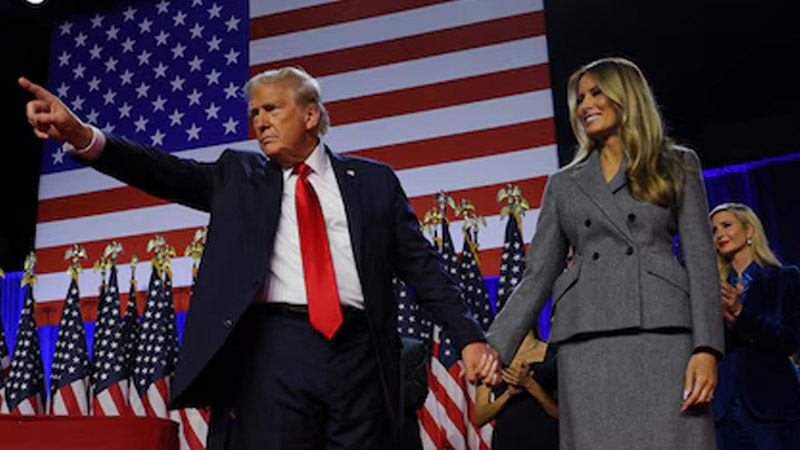
    Mr & Mrs Trump The fireworks celebration

    We are referring to Tribeca Developers founder Kalpesh Mehta and M3M Developers managing director Pankaj Bansal who were seen hobnobbing with Trump and sharing a glass of bubbly with him.  Both Mehta and Bansal are key partners in the development of Trump Towers in India, reflecting the strong ties between Indian business leaders and the Trump Organisation. Kalpesh Mehta, the licensed Indian partner for Trump Towers, has been instrumental in bringing the Trump brand to India. They were also seen cracking a few jokes with India’s richest couple – Mukesh and Nita Ambani.  Mukeshbhai and Nitabhabi, apparently, took an overnighter on their private jet for a spin to Washington DC.

    Global leaders, including Amazon.com founder Jeff Bezos and other prominent business figures, were also in attendance.

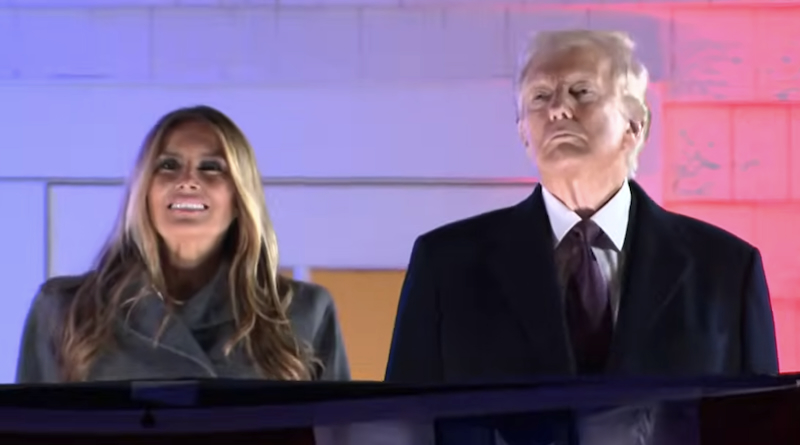
    A nearly 20 minute firework display was watched by Trump and his wife Melania and his extended family from the balcony of his club.

    Trump’s alleged excesses have already got critics carping  about his proximity to several American billionaire friends of his who are getting crucial posts and others (one of them read crypto currency industry)  who are handing out $250 million to  the inauguration committee for spending on what is being called the most expensive inauguration  (read party) of a president in history. Other presidents have reportedly spent less than $50  million (Obama) on their inauguration spending prior to Trump who spent a massive $107 million following  his 2017 election victory.


    With the Trump-baiters getting their knives out even before he has got into the White House, we wonder what they will come up with after he does. We can only wait and watch.  

  • TikTok Bids Farewell to US  users amid ban and uncertainty; Trump throws lifeline

    TikTok Bids Farewell to US users amid ban and uncertainty; Trump throws lifeline

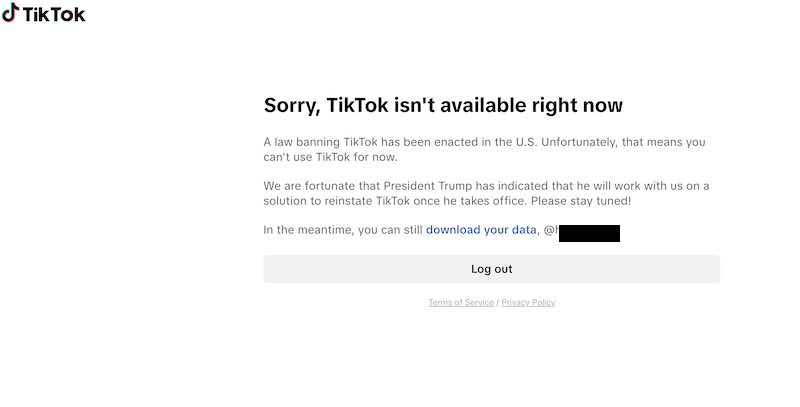
    MUMBAI: The curtains have fallen on TikTok in the United States as the popular short-form video platform voluntarily shut down its service to users ahead of a sweeping legal ban. Upon attempting to log in, users are greeted with a stark message: ” A law banning TikTok has been enacted in the U.S. Unfortunately, that means you can’t use TikTok for now.We are fortunate that President Trump has indicated that he will work with us on a solution to reinstate TikTok once he takes office. Please stay tuned!”

    This abrupt shutdown has left 170 million young users in the US in a state of disarray. TikTok has become a vital part of their daily lives, serving as a platform for creativity, self-expression, and social connection. Users have taken to social media to express their frustration and disbelief as they can no longer upload content or build their online presence on the app.

    The US government has been vocal about its concerns regarding TikTok’s ties to China, citing national security risks due to the app’s ownership by Chinese parent company ByteDance. Lawmakers have long argued that TikTok must either be operated in the US  by an American company or divested from its Chinese stakeholders. Congress set a firm deadline of 19 January, coinciding with the incoming presidency, for TikTok to comply with the law.

    Despite TikTok’s efforts, a last-minute legal challenge to overturn the ban was thwarted when the Supreme Court ruled that the law does not infringe on the First Amendment. This left the company with no legal recourse. The Biden administration has deferred enforcement of the law to the incoming Trump administration, which has signaled a willingness to negotiate a solution.

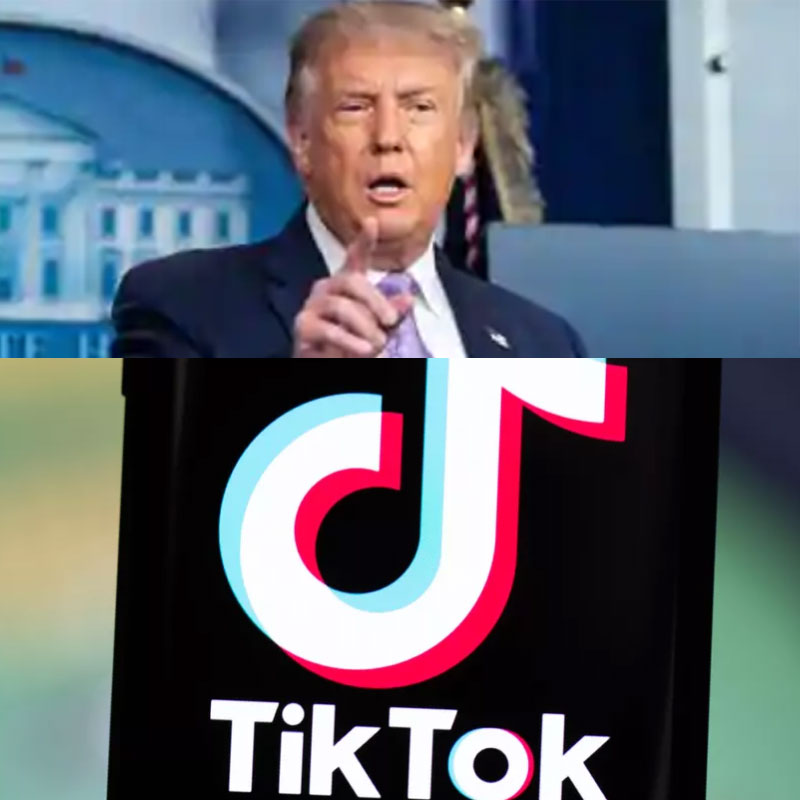
    President-elect Donald Trump indicated he might take action to extend the ban’s enforcement deadline. In a recent NBC News interview, he mentioned, “The 90-day extension is something that will be most likely done because it’s appropriate. If I decide to do that, I’ll probably announce it on Monday.” Under the law, the president can grant a one-time extension of up to 90 days regarding its implementation.

    As of now, TikTok users who attempt to access the app will find it absent from both the Apple App Store and Google Play Store, and users can only retrieve their data through a specific process. TikTok’s help section remains operational, but with the app effectively disabled, users are left hanging.

    TikTok itself has criticised the Biden administration for its lack of clarity and assurance regarding the continuation of its services. The company remarked, “Unless the Biden Administration immediately provides a definitive statement… TikTok will be forced to go dark on January 19.”

    As uncertainty looms over TikTok’s future in the U.S., millions are left to wonder if they will ever reconnect with their  app, or if this is truly the end of the line. The situation remains fluid, with potential developments hinging on the incoming administration’s actions in the coming days.

    President Donald Trump later in the day thew the management of TikTok a lifeline later in the day saying he would be considering issuing an executive order giving TikTok 90 days to find itself an American partner. This came as a relief to its 170 million users in the US. 

    Said Trump on TruthSocial: “I am asking companies not to let TikTok stay dark! I will issue an executive order on Monday to extend the period of time before the law’s prohibitions take effect, so that we can make a deal to protect our national security. The order will also confirm that there will be no liability for any company that helped keep TikTok from going dark before my order.

    “Americans deserve to see our exciting inauguration on Momday, as well as other events and conversations.

    “I would like the United States to have a 50 per cent stake in the joint venture. By doing this, we save TikTok, keep it in good hands and allow it to say up. Without U.S. approval, there is  no Tik Tok. With our approval, it is worth hundreds of billions of dollars – maybe trillions.”

    (Updated on 19  January 2025 at 10:30 pm)

  • Meta shakes up public affairs policy team with Trump set to become president

    Meta shakes up public affairs policy team with Trump set to become president

    MUMBAI: Well, well, so, that’s how the cookie crumbles.

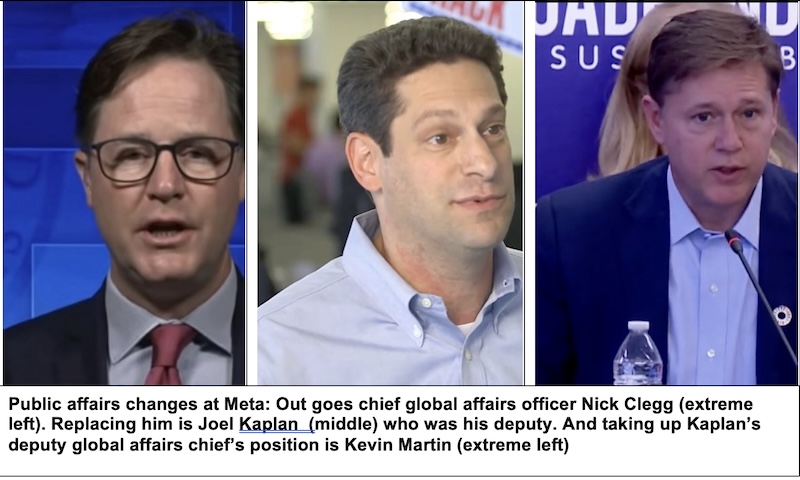
    Meta has replaced its Democrat-leaning chief global affairs officer Nick Clegg with Joel Kaplan who is known for his Republican leanings and was Clegg’s deputy.  Kaplan   was the deputy chief of staff for policy at the White House during the presidency of George W. Bush between 2006 to 2009.

    Clegg a former British deputy prime minister and  an ex-leader of the country’s liberal democrats,  joined Meta in 2018, playing a key role in developing policies related to content and elections. He was named president in 2022.

    Kaplan joined Meta in 2011 and was once vice-president of US public policy at Meta.

    Kevin Martin, the current head of US public policy at Meta, will step into Kaplan’s former role and will be just below him. Kevin was once appointed to the Federal Communication Commission  by George Bush and is also known to be Republican in his leanings.

    The changes are happening just as the Republican party’s Donald Trump is set to take over as the US president. 

    Mark Zuckerberg and team are doing their best not to take steps that can attract his ire and, if anything inadvertently does, his team should be in a position to get it fixed quick.

    If readers recollect, Facebook had taken extreme steps like banning Trump from the social media network for a while but had reinstated his account a while later. Clearly, Meta and Mark Zuckerberg will have to tread carefully as far as the president is concerned.

  • Donald Trump secures historic return to White House as 47th president

    Donald Trump secures historic return to White House as 47th president

    Mumbai: “Sometimes by losing a battle, you find a new way to win the war,” Donald Trump once proclaimed. Today, that statement finds its proof in history as in a comeback that defies precedent and expectation, Trump has clinched the U.S. presidency for a historic second time, becoming the 47th president by defeating incumbent vice president Kamala Harris.

    Trump’s return to the White House, after a tumultuous single term, is more than a political triumph; it’s a testament to his unwavering grip on the American electorate. Amid a deeply polarised nation, Trump’s resurgence paints a vivid picture of ambition, resilience, and the fierce loyalty of his supporters, redefining what’s possible in American politics.

    Trump’s path to victory involved pivotal wins in key swing states. He secured Pennsylvania, Georgia, and Wisconsin, surpassing the requisite 270 electoral votes.   These victories reflect his campaign’s effective mobilisation of his base and successful outreach to undecided voters in these regions.

    The international community has responded with a mix of congratulations and caution. Israeli Prime Minister Benjamin Netanyahu extended his congratulations, while European leaders expressed concerns about potential shifts in U.S. foreign policy. Indian prime minister Narendra Modi tweeted, “Congratulations to my friend Donald Trump on his historic election victory. Looking forward to working together for global peace and prosperity.”  

    Financial markets reacted swiftly to the election outcome. The Indian stock market experienced a rally, with the BSE Sensex closing up by 1.13 per cent, and the Nifty rising by 1.12 per cent. Conversely, the Indian rupee depreciated to an all-time low against the U.S. dollar, reflecting investor uncertainty.

    Major U.S. media outlets have portrayed Trump’s victory through various lenses. The New York Times highlighted his ability to tap into voter economic anxieties and concerns over immigration, while The Washington Post emphasised the historic nature of his nonconsecutive terms and his status as the first felon to assume the presidency.

    In India, the ancestral village of Kamala Harris in Tamil Nadu expressed sorrow over her defeat, with residents acknowledging her fighting spirit and expressing hope for her future endeavours.

    Trump’s return to power is expected to bring significant policy shifts, particularly in trade and foreign relations. He has previously criticised China’s trade practices and indicated intentions to implement stricter measures.  Domestically, his administration is anticipated to focus on immigration reform and economic policies aimed at bolstering the working class.


  • Twitter permanently bans Donald Trump

    Twitter permanently bans Donald Trump

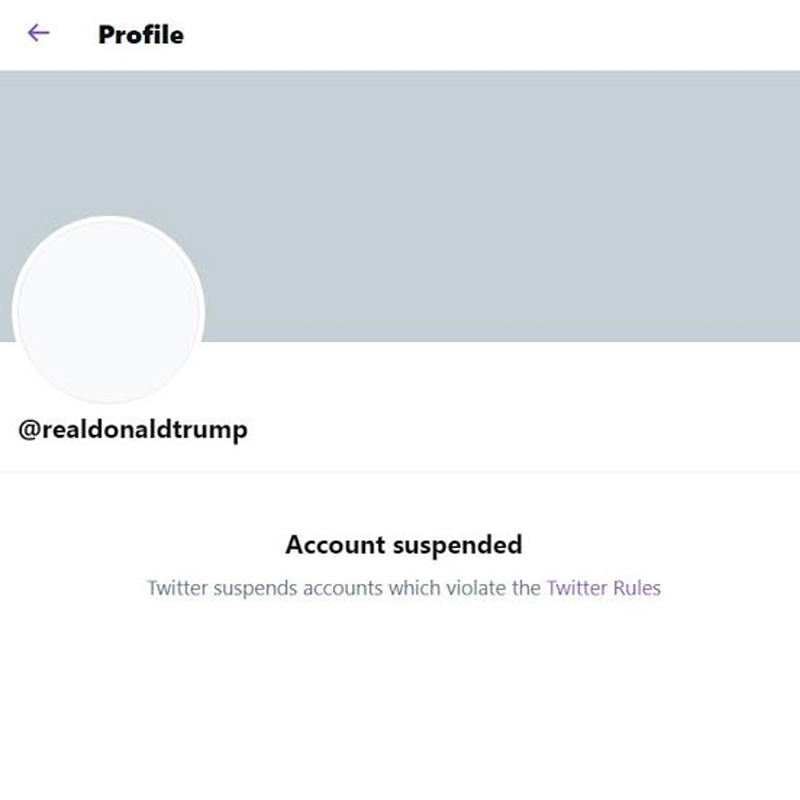
    NEW DELHI: After years of hectoring allies, attacking opponents and disseminating disinformation, US President Donald Trump’s favourite online mouthpiece has been shut down. Twitter on Friday permanently suspended Trump’s account citing “risk of further incitement of violence,” thereby effectively cutting him off from his 88 million plus followers on the microblogging platform.

    Twitter’s move comes days after hundreds of pro-Trump protesters stormed Capitol Hill in Washington DC and unleashed chaos in the very seat of American power. The service clearly stated the incident was the trigger leading to the permanent ban on Trump, especially since the president had taken to Twitter to further propagate false claims about the 2020 US elections.

    Initially, in the wake of the Capitol riot, Twitter had locked Trump’s account for 12 hours following three tweets that violated the company’s terms of service. It restored his handle after 12 hours had elapsed, even as Facebook indefinitely suspended Trump’s page as “the risks” of allowing him to post on the platform are “too great.”

    No sooner was his Twitter account restored that Trump took to it and posted a video message telling his supporters to go home. He not only did not censure them for their actions, but instead, referred to them as “special people” and told them “we love you.” While he eventually posted another video statement saying he would support a peaceful transition of power, he followed it up with a tweet stating his intention to skip president-elect Joe Biden’s inauguration on 20 January.

    And while many commentators agree that it was a long time coming, Jack Dorsey gave Trump the boot from his platform as “in the context of horrific events this week, we made it clear on Wednesday that additional violations of the Twitter Rules would potentially result in this very course of action.”

    Trump, of course, did not take the snub lying down, and accused Twitter of having “coordinated with the Democrats and Radical Left” to suspend his @realDonaldTrump account. He also, according to several media reports, tried multiple times to post from alternate handles, like the official @POTUS account, but these tweets were promptly deleted by the platform.

    Apart from Twitter and Facebook, other social media networks have also shown some spine and are finally cracking down on Trump. Instagram, Snapchat and Twitch barred access to the president’s account, while YouTube enacted a stricter misinformation policy which makes it easier to suspend Trump for posting false election claims.

    Calls for Trump’s impeachment have been gaining momentum over the last couple of days, as bipartisan lawmakers and the common people alike hold the president responsible for spewing unfounded lies of voter fraud and provoking the mob that broke into and defaced the US Capitol. Five people, including a policeman, died in the riot.

    Democrat and House Speaker Nancy Pelosi has said the House would move ahead with the process to impeach Trump if he did not resign immediately. A CNN report stated that "multiple Republicans" and former Trump allies are considering supporting his impeachment. And while Trump was the third US president to have impeachment proceedings initiated against him (in January 2020), he may well be the first leader of the free world to be impeached twice.

  • Donald Trump barred from Facebook ‘indefinitely’

    Donald Trump barred from Facebook ‘indefinitely’

    NEW DELHI: Facebook has indefinitely banned US president Donald Trump from its platform after he tried to incite violence at the US Capitol earlier this week.

    Mincing no words, a far cry from the social media giant’s prior treatment of Trump with kid gloves, Facebook founder and CEO Mark Zuckerberg stated that the president intends to use his remaining time in office to undermine the peaceful and lawful transition of power to his elected successor, Joe Biden.

    “We believe the risks of allowing the president to continue to use our service during this period are simply too great,” he wrote in a community post. As a result, he said, Facebook and its photo-sharing site Instagram would extend blocks on Trump’s ability to post “until the peaceful transition of power is complete.”


    The shocking events of the last 24 hours clearly demonstrate that President Donald Trump intends to use his remaining…

    Posted by Mark Zuckerberg on Thursday, 7 January 2021

    Trump is also banned from using Instagram.

    Earlier in the day, when Trump made false claims about election fraud and the legitimacy of the next US president Joe Biden, nearly all social media platforms – Twitter, Facebook, Instagram and Snapchat — locked his account for a brief period. Facebook imposed a ban for 24 hours and Twitter for 12 hours. The latter also asked the US president to remove three tweets for severe violation of its civic integrity policy, and failing to do so would lead to permanent suspension of his account.

    Trump’s Twitter account had been unlocked at the time of filing this report.

    The diverging actions showed how social media companies were still grappling with how to moderate one of their most powerful and popular users. Trump has routinely used his online mouthpieces to attack others, rile up supporters and disseminate disinformation, and these social media platforms had offered platitudes of “upholding free speech” to defend their inaction in the matter of not curtailing such provocative posts.

    YouTube had also removed the video where Trump told his supporters who had broken into the Capitol ‘I love you’ and described the agitators as patriots. The platform also cited that the video violated its policies. 

    The march was partly organised online, including on Facebook groups and pages. Facebook has mentioned that it was looking for and removing content that had incited or supported the storming of Capitol Hill. The violence at the US Capitol led to the death on one person and several injured.