Tag: Domino’s

  • Domino’s Pizza launches “Order Karna Safe Hai” campaign

    Domino’s Pizza launches “Order Karna Safe Hai” campaign

    NEW DELHI: Domino’s Pizza, the market leader in chained pizza segment in India, has unveiled its new digital campaign “kitne dino se Domino's Nahi khaya.”

    Domino's as a brand has been so much a part of all the happy memories and the social fabric, that it being absent during the lockdown, has made so many really crave for the taste of favourites on their menu. Now with the lockdown relaxed, Domino's is back and has instituted a lot of safety measures and made sure anyone who craves it, gets it safely.

    The campaign aims to strengthen the feeling of safety and trust when ordering from Domino’s. With the company’s “Zero Contact Delivery” across all its 1,325 restaurants in the country, the campaign showcases that now no one needs to extend their craving for Domino’s Pizza as customers will receive their order without coming in contact with the delivery staff.

    This is a part of the ongoing part digital campaign for the brand and has been conceptualised and executed by Enormous brands.

  • Kapil Grover appointed as Domino’s Pizza CMO

    Kapil Grover appointed as Domino’s Pizza CMO

    MUMBAI: Food service company, Jubilant FoodWorks has appointed Kapil Grover as chief marketing officer of Domino’s Pizza. He brings with him a rich experience of 18 years and will be responsible for leading the marketing strategy for the brand.

    Jubilant FoodWorks CEO and whole-time director Pratik Pota says, “We are delighted to welcome Kapil to the Domino’s family. Kapil is a seasoned marketing professional with a proven track record of building brands and driving consumer relevant innovations. We are confident that Kapil will use his immense experience to deepen Domino’s connect with its customers and to drive growth”.

    Grover mentions, “I am delighted to be a part of Domino’s Pizza, the most loved pizza brand in India. The new role presents an exciting opportunity to lead the brand’s endeavours to create a great pizza experience for the customers, strengthen the core delivery proposition and further expand its market share. I look forward to contributing significantly to its ongoing growth journey.”

    Grover took over his new responsibility from July 2018. He was earlier associated with Burger King India as chief marketing officer and has also worked with KFC India, Radico Khaitan and Luxor Writing Instruments in his past stints.

    Jubilant FoodWorks Ltd (JFL/Company) is part of Jubilant Bhartia group and is one of India’s largest food service companies, with a network of 1,144 Domino’s Pizza restaurants across 268 cities (as of 30 June 2018). The company and its subsidiary have the exclusive rights to develop and operate Domino’s Pizza brand in India, Sri Lanka, Bangladesh and Nepal.

    At present, it operates in India and Sri Lanka. The Company also has exclusive rights for developing and operating Dunkin’ Donuts restaurants for India and has 37 Dunkin’ Donuts restaurants across 10 cities in India (as of 30 June 2018).

  • Challenge the establishment to crack digital code: Hotstar’s Ajit Mohan

    Challenge the establishment to crack digital code: Hotstar’s Ajit Mohan

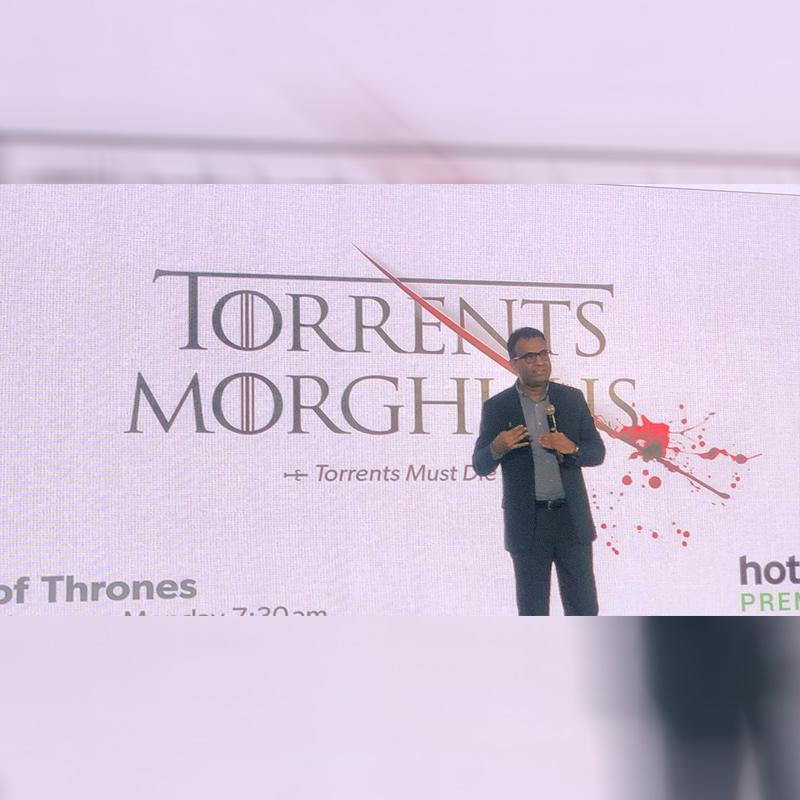
    MUMBAI: Just when India was warming up to the concept of internet on the mobile, Star India came out with its over the top platform Hotstar. Today, it is the top OTT platform in the country and one may think the road to success was entirely smooth. But Hotstar CEO Ajit Mohan spoke about the streamer’s journey  while speaking at The Advertising Club’s D-Code.

    Hotstar was initially a free-ad supported venture when it was launched in 2015 causing rapid growth in users. The challenge was when it had to convince the price-conscious Indian consumer to pay. Indians were so used to free goodies that paying for content was unheard of.

    It had just bagged the streaming rights for the popular show Game of Thrones season 6 and came out with a campaign leveraging the lingo of the American fantasy drama. Though it was a great campaign for Game of Thrones fans, the subscription number did not move.

    The game changer campaign which makes the Hotstar CEO very proud, was launched during season 7 of the stalwart show. The multimedia campaign titled ‘Torrents Morghulis’ is a twist on the phrase ‘Valar Morghulis’ from the show. The meaning of the original phrase “All men must die” was tweaked into “All torrents must die.”

    “It clearly communicated the fearlessness of the premium proposition,” Ajit Mohan said. It was not easy to challenge torrents which enjoyed a lot of loyalty and commitment among its users. “…Therefore it was a statement to tell them (torrent users) that not just did we have a better proposition than torrent but torrent was dying,” he added. The campaign led to a “dramatic rise” in Hotstar Premium Subscription numbers.

    Mohan also spoke about a campaign from Domino’s which can give valuable lessons to brands. The “classic video campaign” was rolled out during this IPL leveraging Hotstar’s WatchN’Play. While WatchN’Play provided cricket fans to play along with their favourite teams virtually, Domino’s was the first brand to utilise the opportunity. The rule for users was that the points collected from the game help to access Domino’s coupons. 19 million coupons were distributed across the country on the back of this campaign. Domino’s blurred the line between brand and performance according to Mohan.

    This IPL itself was a benchmark for Hotstar as 202 million viewers logged on to its video streaming platform to watch the T20 tournament. Moreover, it successfully handled more than 10 million concurrent viewers during the IPL final match.

    The man who saw the challenges from the initial days of OTT business in India and built a world-class platform along with his team thinks challenging the establishment is very important, however small a brand could be. A campaign line alone does not suffice to crack digital code without an articulated philosophy. He concludes with, “Look for the truth in humour and the humour in truth.”

  • eCommerce, jewellery brands among most advertised on television

    eCommerce, jewellery brands among most advertised on television

    BENGALURU: The annual ‘Big Billion Day’ and ‘Great Indian Festival sale’ will be back soon – and the respective players are quite noisy about them on television. Innovative creatives, rehashes of previous creatives are back to announce the big great deals that will be on offer. Flipkart’s annual Big Billion Day television communication has newer stories from kids acting as adults while Amazon.in speaks of getting big discounts without the effort of having to check out the best deals in the market to promote its Great Indian Festival sale.

    The festival season in India is approaching, and, along with it offers from eCommerce players and jewellers. As decibels increase for attracting eyeballs and consumers, brands from these two genres are amongst the most advertised on television during the recent weeks according to Broadcast Audience Research Council of India (BARC) weekly data.

    In week 35 of 2017, (Saturday, 26th August 2017 to Friday, 1 September 2017), Amazon.in was the most advertised brand on television with 14,985 insertions and LalithaJewelly was the second most advertised brand with 13,856 insertions according to BARC’s weekly list ofTop 10 Brands Across Genre: All India (U+R) : 2+ Individuals. In week 36 (Saturday, 2 September 2017 to Friday, 8 September 2017), Lalitha Jewellery was the most advertised brand on television with a jaw-dropping 16,301 insertions followed by Amazon.in with 11,329 insertions at second place. Not far behind these two at rank 3 was Indian eCommerce player Flipkart.com with 11,900 and 10,130 insertions in weeks 35 and 36 respectively.

    Both Amazon.in and Lalitha Jewellery have been present 15 times each during the first 36 weeks of 2017 in BARC’s weekly top 10 brands list. Of these, Amazon.in has been the most advertised brand for eight weeks, including during the first three weeks of 2017. Lalitha Jewellers has been the most advertised brand on television in terms of insertions for five of the first 36 weeks of 2017. Flipkart.com found itself in BARC’s weekly top 10 brands list for the first time in week 35 of 2017 and again in week 36 of 2017, as the third most advertised brand in terms of insertions during both the weeks.

    Please refer to the chart below for the BARC’s list of most advertised brands in week 35 and 36 of 2017

    public://F_3.jpg

    While FMCG brands are the most advertised brands in general, as September 20 approaches viewers are likely to be bombarded with more and more eCommere ads.The period of Navratra’s and Diwali are considered as auspicious days for buying gold, automobiles, apparel, consumer durables, etc., by many Indians. Data for the most advertised brands over the next few weeksshould be quite interesting.


  • Digital is nothing, says Havas Media’s Tom Goodwin

    Digital is nothing, says Havas Media’s Tom Goodwin

    NEW DELHI: Tom Goodwin is not happy with the way marketers have abused the word ‘digital.’ In fact, he doesn’t want the word to be used at all. To the roomful of marketing enthusiasts gathered at Zee MELT 2016, who anticipated a lecture on cutting edge technology and the disruption it brings to the brand world, this 37-year-old SVP of strategy and Innovation at Havas Media said: ‘Sorry, no change.’

    “Things have never changed so fast before, but it will never change so slowly again. If you look at the daily everyday lives of people in suburbs, not everything is changing. While it’s important to look ahead, we need to pay more attention to what is not changing,” Goodwin made it clear.

    One needs to be mindful of the human behaviour that has evolved from centuries, that won’t change so easily.

    Through a number of pictorial slides, Goodwin then took the audience to a time before the industrial revolution to point out how that big change had effected how we function, and its implication in the new world of disruption.

    Giving the analogy of how power plants looked almost the same before and after electricity was discovered, Goodwin implied that technology can be embraced at surface and at deeper levels. Only when the latter is done that real efficiency kicks in a system.

    Putting it in context with the current ‘digital’ onslaught, “currently businesses are trying new technology only at the fringes. Whenever something new comes up, they are tacking it on their existing system without rebuilding the entire structure,” Goodwin said.

    Goodwin then cautioned creative agencies from celebrating their so called ‘digital ads.’ “Simply sticking a TV ad on a pre roll before an online video, or publishing an ad on an online portal doesn’t make it digital. There is nothing new about using the same old ideas in different devices,” he said.

    Calling the current use of technology in marketing as a ‘digital garnish’ done mostly for PR attention rather than serving a functional purpose, Goodwin called said businesses were getting complacent on using digital in silos or add-ons.

    “That Dominos ad with drones delivering pizza was an attractive piece of content but we still await a drone to deliver pizza at our doorstep. British Airways went all high tech and introduced Neuroblankets that would gauge its passenger’s emotions for collecting data, when its website doesn’t have an email address to write to! That’s a perfect waste of marketing spends when the same purpose could be served if they get their basics right,” Goodwin advised.

    In order for business to get these basics right, Goodwin suggested a few pointers. To start with “we need to stop getting awed by digital like we are still in the 90s, as if it is some place to go to. In today’s world there is no concept of ‘online’ or ‘offline.’ An 11 year old boy who has grown up with Internet, doesn’t go to shop ‘online on his smart phone’, he simply shops. Marketers need to understand this concept of ‘disappearing of digital world,’ and stop introducing new ‘digital arms’ in their respective organisations,” Goodwin explained.

    “People really don’t care about how a product gets to them, they don’t want to understand what is radio, print, digital, display, out of home, television or streaming, so marketers too should stop overanalysing over the different channels,” he said.

    Marketers should be mindful of the new realities like virtual reality augmented reality, chat bots and even AI; but ensure that technology or tools aren’t limiting their imagination and growth. “There is a famous saying that goes ‘we shape tools and then they shape us.’ Hotel lobbies still use a giant desk to separate the consumer from the staff, when it was a product of pre digital age and can be done without off now,” cited Goodwin.

    Goodwin sees huge potential in the use of anticipatory computing in advertising where contextual information on how a consumer lives his or her day can help brands target them with meaningful and relevant advertising. “The goal of an advertiser is to make people’s life easier. Brand building can play a huge role in this. Advertising should help us navigate through life not woo us at points with cool tech toys,” Goodwin opined.

    Lastly, Goodwin left the room with a thought: Digital is nothing. It is vital but noticeable only through its absence. This mad race to add another ‘digital’ silo to our business isn’t challenging any system, but following it. No changes there.


  • Digital is nothing, says Havas Media’s Tom Goodwin

    Digital is nothing, says Havas Media’s Tom Goodwin

    NEW DELHI: Tom Goodwin is not happy with the way marketers have abused the word ‘digital.’ In fact, he doesn’t want the word to be used at all. To the roomful of marketing enthusiasts gathered at Zee MELT 2016, who anticipated a lecture on cutting edge technology and the disruption it brings to the brand world, this 37-year-old SVP of strategy and Innovation at Havas Media said: ‘Sorry, no change.’

    “Things have never changed so fast before, but it will never change so slowly again. If you look at the daily everyday lives of people in suburbs, not everything is changing. While it’s important to look ahead, we need to pay more attention to what is not changing,” Goodwin made it clear.

    One needs to be mindful of the human behaviour that has evolved from centuries, that won’t change so easily.

    Through a number of pictorial slides, Goodwin then took the audience to a time before the industrial revolution to point out how that big change had effected how we function, and its implication in the new world of disruption.

    Giving the analogy of how power plants looked almost the same before and after electricity was discovered, Goodwin implied that technology can be embraced at surface and at deeper levels. Only when the latter is done that real efficiency kicks in a system.

    Putting it in context with the current ‘digital’ onslaught, “currently businesses are trying new technology only at the fringes. Whenever something new comes up, they are tacking it on their existing system without rebuilding the entire structure,” Goodwin said.

    Goodwin then cautioned creative agencies from celebrating their so called ‘digital ads.’ “Simply sticking a TV ad on a pre roll before an online video, or publishing an ad on an online portal doesn’t make it digital. There is nothing new about using the same old ideas in different devices,” he said.

    Calling the current use of technology in marketing as a ‘digital garnish’ done mostly for PR attention rather than serving a functional purpose, Goodwin called said businesses were getting complacent on using digital in silos or add-ons.

    “That Dominos ad with drones delivering pizza was an attractive piece of content but we still await a drone to deliver pizza at our doorstep. British Airways went all high tech and introduced Neuroblankets that would gauge its passenger’s emotions for collecting data, when its website doesn’t have an email address to write to! That’s a perfect waste of marketing spends when the same purpose could be served if they get their basics right,” Goodwin advised.

    In order for business to get these basics right, Goodwin suggested a few pointers. To start with “we need to stop getting awed by digital like we are still in the 90s, as if it is some place to go to. In today’s world there is no concept of ‘online’ or ‘offline.’ An 11 year old boy who has grown up with Internet, doesn’t go to shop ‘online on his smart phone’, he simply shops. Marketers need to understand this concept of ‘disappearing of digital world,’ and stop introducing new ‘digital arms’ in their respective organisations,” Goodwin explained.

    “People really don’t care about how a product gets to them, they don’t want to understand what is radio, print, digital, display, out of home, television or streaming, so marketers too should stop overanalysing over the different channels,” he said.

    Marketers should be mindful of the new realities like virtual reality augmented reality, chat bots and even AI; but ensure that technology or tools aren’t limiting their imagination and growth. “There is a famous saying that goes ‘we shape tools and then they shape us.’ Hotel lobbies still use a giant desk to separate the consumer from the staff, when it was a product of pre digital age and can be done without off now,” cited Goodwin.

    Goodwin sees huge potential in the use of anticipatory computing in advertising where contextual information on how a consumer lives his or her day can help brands target them with meaningful and relevant advertising. “The goal of an advertiser is to make people’s life easier. Brand building can play a huge role in this. Advertising should help us navigate through life not woo us at points with cool tech toys,” Goodwin opined.

    Lastly, Goodwin left the room with a thought: Digital is nothing. It is vital but noticeable only through its absence. This mad race to add another ‘digital’ silo to our business isn’t challenging any system, but following it. No changes there.

  • Nickelodeon takes its toons outside TV

    Nickelodeon takes its toons outside TV

    MUMBAI: There are no second thoughts when we say that India is a significant player in the ever growing consumer products and brand licensing market.  Reports peg the brand licensing market globally at close to $ 150 billion at retail, while India contributes $450 million. And banking on this is Viacom18’s consumer products business which sees a massive growth in kids’ merchandise and products space.


    While ramping up core categories like toys, apparel, footwear, back to school, eyewear, publishing and accessories for its Nick brands, Viacom18’s consumer products aims to accelerate and build its toons outside broadcast through promotional licensing model. Reason: the network aims to leverage Nickelodeon’s popular kids’ brands to support the promotional requirements of client brands that typically have mothers or families as their media audience and kids and tweens as end consumers.


    To kick start this strategic thrust, Viacom18’s consumer product business has partnered with Domino’s, the fast food chain in the country, to launch the first ever ‘Junior’s Joy Box Meal’, to cater to kids’ taste buds and their love for toys alike.


    As part of the partnership, families that order ‘Junior’s Joy Box Meal’ for their kids from the nearest Domino’s Pizza outlet can take home Nickelodeon’s popular Nicktoon and SpongeBob Squarepants merchandises.


    Priced at Rs 99 per meal, the box includes a slice of pizza, a few breadsticks seasoned with oregano, a rainbow sprinkled custard desert and a mango based beverage.


    So why did the network lock the deal with brand Dominos? “Dominos is the number one QSR (Quick Service Restaurant) in its category. Given its reach and popularity we chose to partner with it. We wanted to go beyond the broadcast space while Dominos wanted to associate with a strong and reputed brand like Viacom18,” answers Viacom18 Media head – consumer products Saugato Bhowmik.


    According to him, Viacom18 is very selective while partnering with a brand. “The network’s internal preference was Dominos,” he adds.


    The three-month deal which was rolled out in May 2014 will be on till September. “Kids loved this since apart from the customised ready meal they are getting an attractive figurine of SpongeBob,” says Bhowmik.


    According to him, SpongeBob was a natural fit for the choice of merchandise, because of its happy, cheerful and optimistic characteristics. SpongeBob Squarepants is an extremely popular toon amongst both, kids and adults, “Hence this partnership with Domino’s is set to gain much traction,” hopes Bhowmik.


    The association is being supported by 360 degree marketing campaign. This partnership brings two brands together to deliver a product that can be enjoyed, not just by the kids but parents as well.


    The network has taken the route of mass marketing to promote this deal starting with a TVC that is being aired on all its channels. Going forward, they are also looking at meet and greets with the children and the toons across India.


    According to Domino’s Pizza India VP marketing Harneet Singh Rajpal, Junior’s Joy Box as a product was created to broaden the full meal options for kids, who are already a part of their consumer base. “With our new product, we are also giving out SpongeBob Squarepants as a package during the launch phase.”


    Rajpal believes that tying up with Nick gives them an added advantage as it creates higher level of engagement and attraction amongst kids.  


    For Bhowmik the deal has helped them go beyond television and bring the famous toons closer to kids. Moreover, the network claims to have achieved three times more business targets that it had even aimed at.


    The network has a global partnership out of its international office in the US for ‘Teenage Mutant Ninja Turtles’ which is available with the McDonald’s Happy Meal.

  • Contract Advertising promotes Rohit Srivastava to chief strategy officer

    Contract Advertising promotes Rohit Srivastava to chief strategy officer

    Mumbai: Rohit Srivastava has been named chief strategy officer at Contract Advertising. He will develop and integrate the strategic planning capabilities.

    Srivastava has been with Contract Advertising for 23 years and is being recognised for his role and responsibility, especially his strategic skills and capabilities.

    He will help deliver on Contract’s creative vision and partner with Contract India COO Rana Barua to create the best value proposition for its clients.

    “Rohit has been one of the biggest strengths Contract has had over two decades. As he takes over the role of the chief strategy officer across all verticals of Contract, he will partner me in fortifying client relationships and ensure the future growth of Contract”, Barua said.

    Srivastava will continue to lead Core Consulting, the marketing and strategic consulting division of Contract. As the head of the strategic planning function Srivastava has worked closely on a wide portfolio of brands including Asian Paints, Crompton Greaves, Dabur, Dominos, Godrej, HSBC, Kraft-Cadbury (Mondelez), NIIT, Shoppers Stop, Edelweiss Tokio Life Insurance, Marico, Aditya Birla Group, Prudential, Franklin Templeton, Honda, Emami, Britannia, Louis Philippe, Hypercity and ICICI Bank.