Tag: DMA

  • INOX deploys Dolby Multichannel Amplifiers

    INOX deploys Dolby Multichannel Amplifiers

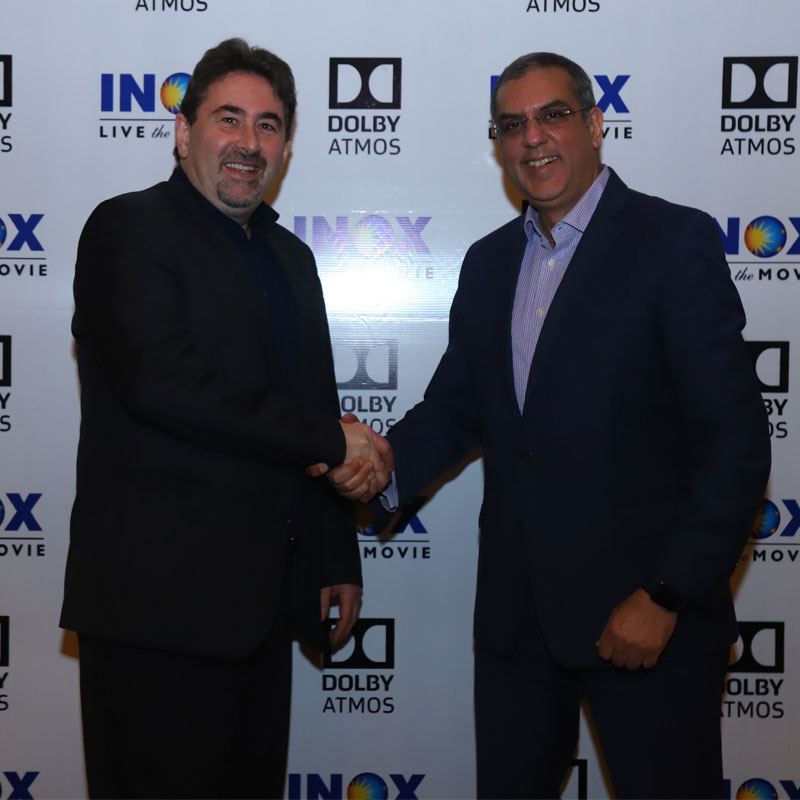
    MUMBAI: Cinema chain INOX Leisure Limited (INOX) today extended its strategic partnership with Dolby, a leader in immersive entertainment experiences to provide the best in class cinema solutions. With Dolby Atmos screens already present at INOX multiplexes across the country, INOX today announced that it will be deploying Dolby’s latest and best in class Dolby Multichannel Amplifiers (DMA). In the process, INOX will be the first Indian cinema chain to acquire the versatile DMA.

    The DMA’s are D Class digital amplifiers which have a smaller footprint that can save a lot of rack space and hence real estate, air conditioning and power consumption. Using DMAs in the audio chains escalates audio reproduction without distortion making the experience better than best. These new-generation amplifiers also bring other benefits like ease of connectivity, less cabling, robust design, built-in redundancies for uninterrupted playback, ability to monitor the health of the amplifiers over central NOC, and also the ability to compensate for a failed speaker till replacement, ensuring consistent and high-end experience for patrons what they expect from INOX.

    INOX has been extremely aggressive in pioneering cinema technologies into the country in order to enhance the cinema-viewing experience of its patrons. A testimony INOX’s technology focus is INOX Megaplex, the world’s first cinema with six different cinema viewing formats. Located at Inorbit Mall, Mumbai, INOX Megaplex houses IMAX, Samsung Onyx LED, ScreenX, MX4D and INSIGNIA formats. INOX also offers Laser Projection and Dolby Atmos experience to its patrons.

    INOX Leisure Ltd CEO Alok Tandon said: “Technology is the cornerstone of our business strategy, and cinema sound plays an extremely critical part in the overall cinema-viewing experience. I am delighted to share that we are further strengthening our association with Dolby with the acquisition of Dolby’s multi-channel amplifier. As we become the first cinema chain in the country to use these versatile amplifiers, we are all set to be more energy-efficient, cost-efficient and space-efficient. We are proud to pioneer one more technology intervention into the country with this deployment.”  

    Friedrich Deininger, Sr. Director, Cinema Sales, EMEA and India, Dolby Germany GMBH, said that Dolby offers a full range of imaging, content management, and accessibility solutions to give audiences an immersive cinema experience with 700+ Dolby Atmos Screen installed or committed in India and over 700+ Dolby Atmos titles in six Indian languages.

    INOX, amongst India’s largest multiplex chains, offers 146 multiplexes and 614 screens in 68 cities.

  • Nielsen and Fox television stations renew local television ratings agreement

    New York, NY – March 22, 2017 – Nielsen (NYSE: NLSN) has announced today that it has signed a long-term renewal agreement with FOX Television Stations (FTS) for audience measurement services. As part of the agreement, FTS licenses Nielsen’s Local Television ratings across all of the group’s 28 stations, in 17 designated market areas (DMA), including the Charlotte FOX O&O WJZY/WMYT, which was not in the previous agreement. FOX Station Sales, their national sales representative group, is also part of the renewal agreement.

    By extending its relationship with Nielsen, FOX’s owned-and-operated stations and national sales representative group can demonstrate their advertising and market value to marketers by leveraging currency measurement that provide breadth and depth into local audiences. The agreement includes Nielsen’s announced plans to enrich its Local TV panels with data from its Portable People MeterTM technology and set-top-boxes, delivering significantly larger sample sizes and driving increased ratings fidelity. Out-of-home audience will also be included for the first time in local measurement.

    The investments that Nielsen is making to Local TV are part of its overall strategy to deliver all-electronic measurement across all 210 DMA. This effort combines Nielsen’s gold-standard panels with the strength of big data sources to provide Local TV clients like FTS with stable and accurate data that help them better compete in the marketplace.

    “FOX continues to be at the forefront of delivering valuable local content to its viewers,” said Jeff Wender, Managing Director for Nielsen Local Media. “This strategic agreement builds on the long-term relationship and mutual respect that exist between FOX Television Stations Group and Nielsen. We are excited to deliver an enhanced local measurement portfolio for more strategic decision making and increased ROI to advertisers.”

    About Nielsen

    Nielsen Holdings plc (NYSE: NLSN) is a global performance management company that provides a comprehensive understanding of what consumers watch and buy. Nielsen’s Watch segment provides media and advertising clients with Nielsen Total Audience measurement services for all devices on which content—video, audio and text—is consumed. The Buy segment offers consumer packaged goods manufacturers and retailers the industry’s only global view of retail performance measurement. By integrating information from its Watch and Buy segments and other data sources, Nielsen also provides its clients with analytics that help improve performance. Nielsen, an S&P 500 company, has operations in over 100 countries, covering more than 90% of the world’s population. For more information, visit www.nielsen.com.

    About Fox Television Stations

    FOX Television Stations is one of the nation’s largest owned-and-operated network broadcast groups, comprising 28 stations in 17 markets and covering over 37% of U.S. television homes. This includes seven duopolies in the top 10 markets: New York, Los Angeles, Chicago, Dallas, San Francisco, Washington, D.C. and Houston; as well as duopolies in Minneapolis, Phoenix, Orlando and Charlotte.

  • ‘Marketers must not fall prey to the viral trap:’ KS Chakravarthy

    ‘Marketers must not fall prey to the viral trap:’ KS Chakravarthy

    MUMBAI: Speaking at Association for Data Driven Marketing and Advertising (DDMA) India Annual and Awards on Greatness — The New Minimum For Survival, digital marketing and social media agency Liqvd Asia CCO KS Chakravarthy (Chax) points out that accepting the changing role of advertisers and consumers is the bare minimum for the digital world that marketers are operating in today.

    Going back few years, one can see how the internet has changed the way consumers behave. From viewers, they are increasingly looking for outlets to be heard. With social media, advertisers and marketers aren’t the only story tellers; consumers are also partaking in the creative process. In fact, according to Chakravarthy, marketers are no more storytellers, but responders looking out for meaningful conversation touch points in a consumer’s life.

    Citing Google’s concept of micro moments, Chakravarthy highlights how technology enables one to target much sharper. “The entire journey to purchase can be broken down into moments. There is a moment to know, which is when a consumer is seeking information, and it is also the time when you can engage them in conversation and build relationship. And then there are moments to to go when the consumer is actually purchasing… these moments creates avenues for marketers to not just drive sales but to engage consumers,” says Chakravarthy.

    Chakravarthy moves on to expand on the statement with numerous examples of how brands have effectively anticipated and converted consumer engagement with campaigns to brand communications, starting with the Old Spice advertisement in 2010, which the marketers responded to Twitter backlash to generate more conversation about the brand resulting increased sales. While that was accidental, American FMCG brand Honey Maid anticipated negative feedback on their campaign and incorporated that into their follow up campaign.

    Apart from the new take on consumers, the key benchmarks that emerged from the session that digital marketers must take note of are reality of the second screen adoption and the vista of opportunity it poses to the marketers to capitalise upon; social influences or the viral stars of the digital world be it on YouTube, Pinterest or Vine; and the importance of collaboration or branded content, which is being tried but is still at a nascent stage in India compared to other markets.

    Having said that, Chakravathy pointed out why marketers should not fall prey to the viral trap. “It’s sad that in India only 20 per cent of the digital spends goes to video content, while the number is almost 80 per cent in a market like Japan where digital marketing is much more evolved. The issues isn’t just with infrastructure and bandwidth consumption. Whenever we think of digital marketing through videos we think of viral videos. Somehow we all think that we will make a video that will go viral, which is not the case. If one were to analyse YouTube’s data, one can see that most of the videos we know as viral in India are paid for by brands. It’s not organic and hence of no use to marketers,” he said. 

    “Unless a video engages a consumer in something informative, and ensures meaningful consumer engagement, it will not convert to anything even close to sales for a brand,” Chakravarthy asserted.

    When queried as to whether he finds digital marketers lacking confidence in the Indian market, Chakravarthy gives them the benefit of doubt and expresses his primary concerns with the medium in the current landscape. “Apart from a few B2B brands, most brands can’t to without television in India, especially FMCG brands. Moreover even with the buzz around digital marketing, clients haven’t really got what they want from digital practices in India on marketing. Once that happens, this question of confidence won’t come. The fact remains that marketers must engage brands in all touch points of their purchasing journey using digital as a tool. That’s the bare minimum,” Chakravarthy signed off.

  • ‘Marketers must not fall prey to the viral trap:’ KS Chakravarthy

    ‘Marketers must not fall prey to the viral trap:’ KS Chakravarthy

    MUMBAI: Speaking at Association for Data Driven Marketing and Advertising (DDMA) India Annual and Awards on Greatness — The New Minimum For Survival, digital marketing and social media agency Liqvd Asia CCO KS Chakravarthy (Chax) points out that accepting the changing role of advertisers and consumers is the bare minimum for the digital world that marketers are operating in today.

    Going back few years, one can see how the internet has changed the way consumers behave. From viewers, they are increasingly looking for outlets to be heard. With social media, advertisers and marketers aren’t the only story tellers; consumers are also partaking in the creative process. In fact, according to Chakravarthy, marketers are no more storytellers, but responders looking out for meaningful conversation touch points in a consumer’s life.

    Citing Google’s concept of micro moments, Chakravarthy highlights how technology enables one to target much sharper. “The entire journey to purchase can be broken down into moments. There is a moment to know, which is when a consumer is seeking information, and it is also the time when you can engage them in conversation and build relationship. And then there are moments to to go when the consumer is actually purchasing… these moments creates avenues for marketers to not just drive sales but to engage consumers,” says Chakravarthy.

    Chakravarthy moves on to expand on the statement with numerous examples of how brands have effectively anticipated and converted consumer engagement with campaigns to brand communications, starting with the Old Spice advertisement in 2010, which the marketers responded to Twitter backlash to generate more conversation about the brand resulting increased sales. While that was accidental, American FMCG brand Honey Maid anticipated negative feedback on their campaign and incorporated that into their follow up campaign.

    Apart from the new take on consumers, the key benchmarks that emerged from the session that digital marketers must take note of are reality of the second screen adoption and the vista of opportunity it poses to the marketers to capitalise upon; social influences or the viral stars of the digital world be it on YouTube, Pinterest or Vine; and the importance of collaboration or branded content, which is being tried but is still at a nascent stage in India compared to other markets.

    Having said that, Chakravathy pointed out why marketers should not fall prey to the viral trap. “It’s sad that in India only 20 per cent of the digital spends goes to video content, while the number is almost 80 per cent in a market like Japan where digital marketing is much more evolved. The issues isn’t just with infrastructure and bandwidth consumption. Whenever we think of digital marketing through videos we think of viral videos. Somehow we all think that we will make a video that will go viral, which is not the case. If one were to analyse YouTube’s data, one can see that most of the videos we know as viral in India are paid for by brands. It’s not organic and hence of no use to marketers,” he said. 

    “Unless a video engages a consumer in something informative, and ensures meaningful consumer engagement, it will not convert to anything even close to sales for a brand,” Chakravarthy asserted.

    When queried as to whether he finds digital marketers lacking confidence in the Indian market, Chakravarthy gives them the benefit of doubt and expresses his primary concerns with the medium in the current landscape. “Apart from a few B2B brands, most brands can’t to without television in India, especially FMCG brands. Moreover even with the buzz around digital marketing, clients haven’t really got what they want from digital practices in India on marketing. Once that happens, this question of confidence won’t come. The fact remains that marketers must engage brands in all touch points of their purchasing journey using digital as a tool. That’s the bare minimum,” Chakravarthy signed off.

  • ‘Digital marketers need to be more confident:’ Digital Marketer Awards

    ‘Digital marketers need to be more confident:’ Digital Marketer Awards

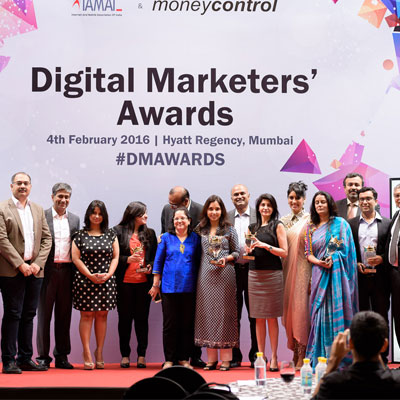
    MUMBAI: For the first time, India’s top digital marketers came under one roof to appreciate and uphold the brilliant work that their peers are doing exclusively on the digital front. Put together by Moneycontrol and IAMAI, the maiden Digital Marketing Awards saw a healthy turnover of CMOs, executives and creatives from various sectors in the industry.

    Dentsu Aegis Network chairman & CEO South Asia Ashish Bhasin set the tone of the awards function with his address to the audience. “Digital marketers should get confident,” he said, adding, “We must move on from convincing others and ourselves about the imminent digital future with quotes, studies and results. If someone isn’t convinced already, leave them be. They will soon follow after.”

    Staying true to the medium that the show was vouching for, attendees were requested to tweet about the event with #DMAwards, with a live Twitter feed visible to all on the monitor.

    Network18 group board of director Rohit Bansal was the Keynote Speaker at the award ceremony and shared his views on the future of digital marketing where new trends were being introduced every day.

    On the difficulty in categorising the entries, jury and Mahindra Holidays & Resort India CMO Deepali Nair shared that the first edition of the awards was definitely a learning experience and based on the results and feedback the jury is considering to club or separate a few categories. “When deciding on how many categories to have it is always a debate as to what to club and what not to. After we got the entries, there was a bit of learning on how to categorise the digital campaigns. You may see one or two more categories next year because in clubbing some categories, we saw some entries losing out. Some brands are restricted by virtue of their categories and hence we are thinking of separating them. A category like Travel and Hospitality is vast and there is a lot of good work, so each deserve their own category for the awards,” Nair said.

    Conversely, she added, “In several awards we have seen bank, insurance and mutual funds as separate categories. But when you think of financial services and what they are doing on the digital front in their digital brand communication, I feel that is a category we can club together.”

    Speaking on the occasion, Moneycontrol COO Rubeena Singh said, “Brands have started investing a lot of money in digital marketing, which is significantly growing every single day. We at Moneycontrol have also taken path breaking initiatives to reach out to the youth through this medium. Being the face of India’s digital growth story, we feel there couldn’t have been a better opportunity for us to recognise the leaders in the digital marketing industry today.”

    The awards come at a crucial juncture when the industry upgrades itself to the changing times and not only churn out serious digital work but have yardsticks and standards to compare and appreciate the trends setters.

    The winners, who took away the Digital Marketing Awards are as follows:

    • Karthi Marshan, Kotak- Digital Marketer of the Year, Banking/ Insurance

    • Gaurav Suri, UTI mutual fund – Digital Marketer of the Year, Mutual Fund / Broking

    • Naveen Kukreja, Policy Bazar – Digital Marketer of the Year, ECommerce / Online Classified

    • Manmeet Vohra, Starbucks – Digital Marketer of the Year, Travel /Hospitality

    • Bedraj Tripathy, Godrej Interio- Digital Marketer of the Year, FMCG / Consumer Durable

    • Aparna Lal, Microsoft – Digital Marketer of the Year, IT / ITES

    • Karan Sarin, One Plus – Digital Marketer of the Year, Mobile Service/Hardware

    • Reema Kundnani, Oberoi Realty – Digital Marketer of the Year, Real Estate

    • Amit Tiwari, Philips – Digital Marketer of the Year, Healthcare

    • Virat Khullar, Renault – Digital Marketer of the Year, Automobile

  • ‘Digital marketers need to be more confident:’ Digital Marketer Awards

    ‘Digital marketers need to be more confident:’ Digital Marketer Awards

    MUMBAI: For the first time, India’s top digital marketers came under one roof to appreciate and uphold the brilliant work that their peers are doing exclusively on the digital front. Put together by Moneycontrol and IAMAI, the maiden Digital Marketing Awards saw a healthy turnover of CMOs, executives and creatives from various sectors in the industry.

    Dentsu Aegis Network chairman & CEO South Asia Ashish Bhasin set the tone of the awards function with his address to the audience. “Digital marketers should get confident,” he said, adding, “We must move on from convincing others and ourselves about the imminent digital future with quotes, studies and results. If someone isn’t convinced already, leave them be. They will soon follow after.”

    Staying true to the medium that the show was vouching for, attendees were requested to tweet about the event with #DMAwards, with a live Twitter feed visible to all on the monitor.

    Network18 group board of director Rohit Bansal was the Keynote Speaker at the award ceremony and shared his views on the future of digital marketing where new trends were being introduced every day.

    On the difficulty in categorising the entries, jury and Mahindra Holidays & Resort India CMO Deepali Nair shared that the first edition of the awards was definitely a learning experience and based on the results and feedback the jury is considering to club or separate a few categories. “When deciding on how many categories to have it is always a debate as to what to club and what not to. After we got the entries, there was a bit of learning on how to categorise the digital campaigns. You may see one or two more categories next year because in clubbing some categories, we saw some entries losing out. Some brands are restricted by virtue of their categories and hence we are thinking of separating them. A category like Travel and Hospitality is vast and there is a lot of good work, so each deserve their own category for the awards,” Nair said.

    Conversely, she added, “In several awards we have seen bank, insurance and mutual funds as separate categories. But when you think of financial services and what they are doing on the digital front in their digital brand communication, I feel that is a category we can club together.”

    Speaking on the occasion, Moneycontrol COO Rubeena Singh said, “Brands have started investing a lot of money in digital marketing, which is significantly growing every single day. We at Moneycontrol have also taken path breaking initiatives to reach out to the youth through this medium. Being the face of India’s digital growth story, we feel there couldn’t have been a better opportunity for us to recognise the leaders in the digital marketing industry today.”

    The awards come at a crucial juncture when the industry upgrades itself to the changing times and not only churn out serious digital work but have yardsticks and standards to compare and appreciate the trends setters.

    The winners, who took away the Digital Marketing Awards are as follows:

    • Karthi Marshan, Kotak- Digital Marketer of the Year, Banking/ Insurance

    • Gaurav Suri, UTI mutual fund – Digital Marketer of the Year, Mutual Fund / Broking

    • Naveen Kukreja, Policy Bazar – Digital Marketer of the Year, ECommerce / Online Classified

    • Manmeet Vohra, Starbucks – Digital Marketer of the Year, Travel /Hospitality

    • Bedraj Tripathy, Godrej Interio- Digital Marketer of the Year, FMCG / Consumer Durable

    • Aparna Lal, Microsoft – Digital Marketer of the Year, IT / ITES

    • Karan Sarin, One Plus – Digital Marketer of the Year, Mobile Service/Hardware

    • Reema Kundnani, Oberoi Realty – Digital Marketer of the Year, Real Estate

    • Amit Tiwari, Philips – Digital Marketer of the Year, Healthcare

    • Virat Khullar, Renault – Digital Marketer of the Year, Automobile

  • Dish, NAB & others urge FCC to deny Charter-Time Warner Cable merger

    Dish, NAB & others urge FCC to deny Charter-Time Warner Cable merger

    MUMBAI: The Charter Communications, Inc – Time Warner Cable, Inc merger is facing a lot of opposition from broadcasters. 


    The National Association of Broadcasters (NAB) has filed a petition with the Federal Communications Commission (FCC) that it should not approve the merger unless it is also willing to change broadcast ownership rules, which limits the number of radio and TV stations that a single entity can own.


    Joining the NAB is Dish Network Corp, which has filed a petition with the FCC to deny the proposed merger citing substantial harm to competition and consumers. Additionally, set top box maker Zoom Telephonics also asked the FCC to deny the said merger between the two over the issue of access to third-party modems.


    As broadcast ownership rules limit mergers, NAB said that broadcasters have far less negotiating power than big cable companies, which will only get bigger if the FCC allows the latest cable merger to proceed.


    According to the NAB, the greater imbalance will harm broadcasters in retransmission consent negotiations, in which cable operators pay broadcast stations for the right to air their channels.


    NAB said that if the pending merger was approved, then the top four multichannel video programming distributors (MVPDs) will control 79 per cent of the nationwide MVPD market, measured in terms of subscribers, and the top three alone, according to SNL Kagan, “will control two-thirds of the video delivery universe.” If consummated, the merger also would exacerbate concentration levels at the local and regional levels, with clear implications for consumers, as empirical research has shown that large, clustered cable companies charge higher prices than smaller, unclustered ones.


    The creation of yet another pay-TV behemoth would further competitively disadvantage local broadcast stations kept by outdated ownership rules from achieving a fraction of the vital economies of scale and scope that MVPDs enjoy and, as the FCC has recognized, can advance the public interest. The gross regulatory disparities between the pay-TV and the free-TV industries are illustrated in any number of ways, including the sheer size of MVPDs compared to TV broadcasters. The market capitalization of the combined AT&T/DIRECTV, for example, is more than 200 times larger than the market cap of several of the most sizable broadcast TV companies. New Charter – which the merging parties describe as “modest” in size – will have a market capitalization 72 times larger than some of the biggest broadcast TV station groups. Beyond this national scale, single pay-TV providers control access to significant percentages of viewers in many local markets. Even standing alone, Time Warner Cable (TWC), for instance, controls over 40 percent of the total MVPD market in 30 different Designated Market Areas (DMAs), and in eight DMAs, TWC’s share of the entire MVPD market exceeds 60 percent. Broadcast TV stations unable to combine under the FCC’s local TV ownership rule are at a notable disadvantage in negotiating retransmission consent agreements with such locally and nationally consolidated MVPDs.


    On the other hand, Dish Network Corp’s petition to deny the merger, outlines, among other things, the critical role that high-speed broadband plays in the video industry and the potential for the merger to significantly damage competitive development of over-the-top (OTT) video and limit consumer access to online video programming.


    Dish Network said that the merger presents risk of significant harms:


    New Parties, Same Harms: The proposed transaction would be no better for the public interest than the one proposed between Comcast and Time Warner Cable.


    A Suffocating Duopoly: The transaction will create a suffocating duopoly. Where a Comcast/Time Warner Cable merger would have created one behemoth, this transaction will result in two broadband providers (Comcast and New Charter) controlling about 90 per cent of the nation’s high-speed broadband homes between them.


    Threats to Online Video: The top two cable providers post-merger will not need to collude in order to bring their collective weight to bear on an online video distributor (OVD). Parallel foreclosures, with one of the two following the other, would be enough for an OVD to be shut off from most of the homes in the country.


    Concentration of Broadband Subscribers: The impact of New Charter would cause a significant proportion of the combined company’s high-speed broadband subscribers to lack access to alternative high-speed broadband options. Indeed, Charter admits that almost two-thirds of households in the New Charter footprint will not have access to at least one alternative high-speed broadband provider. For these customers, switching ISPs is not just an inconvenience, but an impossibility.


    Choke Points on the Charter/TWC Broadband Network: New Charter would have a panoply of foreclosure techniques at its disposal. It would be able to foreclose or degrade the online video offerings of competing MVPD and OTT video providers at any of three “choke points”: (1) the points of interconnection to the combined company’s broadband network, in effect the “on ramp” to the New Charter network; (2) the “public Internet” portion of the pipe to the consumer’s home; and (3) managed or specialised service channels, which can act as super HOV-lanes and squeeze the capacity of the “public Internet” portion of the New Charter broadband pipe. In addition, New Charter would have increased leverage that it could use to coerce third-party content owners and programmers to withhold online rights from online video platforms, thereby stifling a source of competition and innovation in the video industry.


    Sling TV CEO Roger Lynch states, “I believe that the proposed merger…. would cause significant and irreparable harm to emerging competitive online video products and services, as well as the performance of traditional satellite television service, ultimately reducing competition and choice for consumers. Accordingly, I believe that the merger as currently constructed is not in the public interest and should be denied.”

  • Beyonce slammed for sampling NASA shuttle audio clip

    Beyonce slammed for sampling NASA shuttle audio clip

    Dentsu wins at DMA Asia awards, Snapdeal appoints Amitava Ghosh, Askme launches TVC, SonySinger and actor Beyonce has been criticised for using an audio clip related to the space shuttle Challenger disaster in the love song “XO” from her fifth studio album “Beyonce,” which released earlier this month.


    The song “XO,” which was written and produced by Ryan Tedder and Terius Nash, also known as “The Dream”, includes an audio segment involving NASA’s then public affairs officer Steve Nesbitt on Jan 28, 1986.


    “Flight controllers here are looking very carefully at the situation. Obviously a major malfunction,” Nesbitt said at the time, when the Challenger shuttle exploded 73 seconds into its flight, over the Atlantic Ocean, off the coast of central Florida, leading to the deaths of its seven crew members.


    Former NASA employees and NASA families have slammed Beyonce for sampling audio from the space shuttle Challenger explosion on her new song “XO”.


    Beyonce responded in a statement to ABC:


    My heart goes out to the families of those lost in the Challenger disaster. The song ‘XO’ was recorded with the sincerest intention to help heal those who have lost loved ones and to remind us that unexpected things happen, so love and appreciate every minute that you have with those who mean the most to you. The songwriters included the audio in tribute to the unselfish work of the Challenger crew with hope that they will never be forgotten.financial  – Indiantelevision.com AD Linx dated 10 August

  • DY Works elevates Rekha Pamani-Gulati to post of COO

    MUMBAI: Rekha Pamani-Gulati has been promoted as Chief Operating Officer of brand strategy and design firm DY Works.

    Gulati had joined the company as Director – New and International Business Development in January 2010.

    DY Works President Alpana Parida said, “Rekha’s cross cultural experience and strong understanding of both the Indian and International markets will be invaluable in creating unique and meaningful brand propositions for our clients.”

    Gulati said, “I am excited to take on this new challenge. In recent years, the company has built an impressive client portfolio and strong team. As COO, I look forward to building this further.”

    Gulati has over eighteen years of branding and marketing experience across both agencies and clients. Prior to joining DY Works, she began her professional career at the Golden Tulip Hotel Chain, Ghana (West Africa). She also worked with The Concern India Foundation and DMA Branding. In 2001 she individually set up Yellow Resources – an independent branding and design team to take on non-competitive business from the successful DMA Brand.

    In 2002, she was made Director of the Alia Group and was in the advisory capacity to all group companies following which she spent much time back at DMA Branding as CEO in conjunction with New Business initiatives.

  • DMA: India unveils new brand identity

    DMA: India unveils new brand identity

    Mumbai: Direct Marketing Association: India (DMA: India) has donned a new ‘avatar‘ for its corporate brand to mainstream direct marketing as an overarching arm of marketing.

    The logo has been conceptualised by DMA‘s creative agency RAPP. The new strapline of the logo reads ‘Marketing Made Smarter‘.

    The new logo has a contemporary look and has used vibrant solid colors to enhance the position of authority and visibility. It has a speech blurb embedded in the D of DMA to signify its dialogue or communications objective, the company said.

    DMA: India CEO Vatsal Asher said, “With direct marketing going digital, it was important to introduce a new positioning and a platform which resonates with the modern smart methodology of business. We wanted to give it a modern feel without changing the core identity. The new brand identity of DMA: India is based on the rebirth of direct marketing in the digital age and communications around it. We found the RAPP approach to be thorough and insightful. Their strategic thinking and drive gives us the confidence to believe that RAPP will be our creative partners in India and we are looking forward to making this convention popular in India with their help.”

    Tribal DDB and RAPP India president Venkat Mallikarjunan said, “New age Direct Marketing agencies are taking ahead the good things about direct marketing like the discipline, the performance and ROI focus while not limiting themselves to direct mail as a medium. The re-crafted Direct Marketing agency is now a genuinely new age lead agency with significant skills in new media, new age engagement tools, and new age insight frameworks, as well as, brand thinking. The DMA: India wants to propagate this change and get brand and business leaders in India to take notice. At RAPP we have been the leading edge of this change across the world and are delighted to be partnering the DMA of India in this endeavor.”