Tag: Divyendu Sharma

  • Joy Personal Care ropes in Mithila Palkar and Divyendu Sharma for new facewash TVC

    Joy Personal Care ropes in Mithila Palkar and Divyendu Sharma for new facewash TVC

    MUMBAI: Joy Personal Care from the house of RSH Global has launched a new TV campaign with Mithila Palkar and Divyendu Sharma to promote its range of face wash with natural extracts.

    The TVC, which goes on-air on 14 March showcases new age relationship between a young couple and emphasises on the fact that people who love us, love us for what we are, our ‘Asli Chehera’.

    Link: http://bit.ly/JoyFacewash

    Talking about the campaign and signing Mithila and Divyendu, RSH Global chief marketing officer Poulomi Roy said, “According to our estimates, Facewash in India is a Rs 1600 crore category and largely the user base is youth hence connecting with them is crucial. We have chosen Mithila and Divyendu for this campaign as they have immense influence over the younger generation and bring a fresh youthful vibe to Joy and we are confident that the youth will be able to connect with them and the story. Simultaneously as a brand, we do not believe in creating artificial standards for beauty, instead we strongly promote our philosophy of being ‘beautiful by nature’ and the communication in this TVC also revolves around the same. We see a great interest in natural based products amongst the youth and all Joy products are made from natural extracts which helps in maintaining healthy skin.”

  • Toilet: Ek Prem Katha … Part fun, part sermon

    With little choice of genres left for films after themes like family social, horror and mythology were taken away by TV channels, filmmakers have to find variations in what they are left with: romance, action and comedy.

    Toilet Ek Prem Katha is a small town love story, and a love story needs a villain in some form. Unless the coming together of two lovers is met with some hindrances causing anxiety among the viewers, it remains incomplete. In this film, the villain that becomes the cause of separation between two lovers is a tradition that stops the villagers from creating the facility of toilets within the house.

    The character of Akshay Kumar is a small town lad who is well past his marriageable age due to the superstitions of his father played by Sudhir Pandey, a pandit, who is convinced that the character of Akshay’s marriage will fail since he has a negative influence of planet Mars on his horoscope and that his wife will have to have two thumbs in her palm if the marriage has to work. Pandey gets rid of half the ill effects of horoscope by getting Akshay married to a buffalo cow. Now all that remains to be made sure for Akshay to enjoy a blissful married life is to find a girl with two thumbs!

    But, fate ordains otherwise. While travelling on a railway shuttle, Akshay comes across Bhumi Pedenkar and both get into an argument over toilet manners. There is little in common between the two as Akshay’s character is a 12th-standard pass while Bhumi is a university topper. Her small family of four keeps pace with times while Akshay’s father, who dominates his life, lives in past. Akshay is 37 while Bhumi is a student.

    However, all these do not deter Akshay from falling in love with Bhumi. He starts chasing her till, like it happens in such love stories; Bhumi too is attracted to Akshay. The families agree to the match. While Bhumi’s family has no reservations, to deceive Pandey, Akshay gets an artificial extra thumb fitted on Bhumi’s hand.

    It is all lovey dovey for Akshay and Bhumi. But at the first dawn post-marriage a bunch of women come to call Bhumi to join them. Called Lota Gang, the women are on their way to far off fields for their daily ablutions.Having been brought up in a house with all the comforts, Bhumi cannot cope with this situation. She demands that a toilet be built within the house.

    While Akshay is trying to convince Pandey, he and Bhumi find ways to make things comfortable for her. Akshay comes up with what is called Jugaad, an ad hoc arrangement, each day so Bhumi need not go to fields. One of them is to take her to the local railway station where a particular train stops for seven minutes during which she is supposed to finish her business. Once, Akshay even steals a portable toilet. And, finally he builds one in his house only for it to be broken down by Pandey and other village folk.

    The film now shifts to the campaign run by the present government which aims to build toilet facility for every individual or community. However, the climax is the same as many such films about crusades the corruption in government departments, the involvement of the media and so on. What is different but inspired from real life incidents is the married woman leaving her husband and home because it does it not have a toilet.

    Having taken up the issue of toilets and the lack of it, the film takes too long to touch the crusade against a certain class’s mindset that prevent them from installing this basic facility in the house. Towards the end, especially in the last 50 minutes or so, it becomes preachy. The proceedings should have been crisper.

    The direction is fair. While the first half offers some entertainment, the later part has only little of it. The film has one song that works for it in Gori tu latth maar…. as it has visual appeal. Production values are average.

    The film scores on casting. Akshay Kumar is good as a confident small town lad. Bhumi Pednekar is convincing. Divyendu Sharma, Anupam Kher, Sudhir Pandey and Rajesh Sharma support well.

    Toilet Ek Prem Katha has average merit but is expected to enjoy a huge weekend from Saturday till Tuesday, and again a restricted holiday to follow for the Parsi New Year on 17th. This should help the film reach its target.

    Producers: Aruna Bhatia, Shital Bhatia, Prernaa Arora, Arjun N. Kapoor, Hitesh Thakkar.

    Director: Shree Narayan Singh.

    Cast: Akshay Kumar, Bhumi Pednekar, . Divyendu Sharma, Anupam  Kher, Sudhir Pandey and Rajesh Sharma.

  • Ekkees Topon Ki Salaami…20 guns too many

    Ekkees Topon Ki Salaami…20 guns too many

    Selling honesty as a theme is a tough proposal. It is considered boring and not as readily acceptable as corruption is. Ekkees Topon Ki Salaami juxtaposes one honest man who never wavered despite temptations and desperations, against a totally sold-out system including the local CM. How that honest man, in whom even his sons don’t have faith, finally gets his way is an interesting idea.


    Anupam Kher works for the Mumbai municipal department’s malaria control wing, setting out every day with his fogging machine diligently to do his job. His two sons, Divyendu Sharma and Manu Rishi, are totally wayward. Sharma, the dominant of the two, does hatchet jobs for the local CM and is the star of the local political branch (shakha).


    Divyendu holds a degree of influence over the CM, Rajesh Sharma. When he gets hurt at a pro-CM rally, the CM foots his five-star hospital bill. Divyendu’s hotline in the CM’s house is his girlfriend, Aditi Sharma. She is the trustworthy aide of the CM.


    There is a scandal breaking out against the CM; he is reported to have gifted a Rs 12 crore worth bungalow on sea-facing, government land to his concubine, Neha Dhupia. The news is all over and Neha has no scruples using it to gain mileage for herself. While she is busy telling the media the inside story, the CM is ashamed that he is in news for a meagre Rs 12 crore scam when anything below Rs 1000 crore is considered petty cash!


    Meanwhile, it is D day for Kher. He is due for retirement and goes to the office beaming for a golden handshake, a certificate and a box of sweets. Instead, what he gets is a humiliating discharge sans retirement benefits. His fault, the day before, the last day of his duty, was that he did not surrender his fog machine officially. He is accused of stealing it and selling it to cheat the municipality.


    Kher is humiliated and devastated, and on his deathbed as a result of the shame, but his son’s only care to scavenge on whatever little his dead bones have to offer. They want his pension and they want to inherit the municipality-allotted room. They want him to sign a letter asking for a pardon for stealing the fogging machine so his benefits are restored. Kher would sign that pardon letter on one condition; his sons should send him off with a 21-canon salute.


    Divyendu has sworn to fulfil his father’s last wish not knowing how!


    However, he sees a ray of hope. The CM’s sexual excitement with Neha has given him his third, final fatal heart attack. He is declared dead. Having died in office, he will get a state funeral along with a 21 canon salute.


    By this time, the sons have realised that if anybody deserved a 21 canon salute, it is Kher and not the CM. Since there is no way Kher can get that honour, things will have to be managed to make Kher take the CM’s place.


    This was a good idea, but, it consumes a lengthy second half and goes into too much detailing and emotional overload. By the time it happens the viewer is not emotionally connected, just relieved.


    The film has spoilt its bright idea by taking too long over it. The director has an eye for detail but no control over content and needed a better editor. Dialogue is funny at times and bland at others. Divyendu is impressive. Manu Rishi is a natural. Aditi is very good. Rajesh Sharma is good as always, a seasoned actor that he is. Neha is effective in a brief role. Kher plays the signature role he started off with in Saaranash. Uttara Baokar and Sudhir Pandey are fine.


    Ekkees Topon Ki Salaami would have been watchable had the approach had been on a lighter note towards its goal.


    Producers: Anurradha Prasad and Abhinav Shukla.


    Director: Ravindra Gautam.


    Cast: Divyendu Sharma, Neha Dhupia, Anupam Kher, Manu Rishi, Aditi Sharma, Rajesh Sharma, Uttara Baokar, Sudhit Pandey, Aashif Sheikh.


    Spark Is missing


    They just don’t work, these films about UP-Bihar local feudal gang lords-cum-politicians. After all, UP has one such gang lord in each village. It is the same old story: The more gun-wielding goons you have on your muster, the bigger your don-ness. Focusing on just one such gang makes things extra monotonous so Spark has some ex-loyalists from the same gang rising to form their own. Nothing you have not seen before; nothing that you have approved either.


    It starts like a 1970s film as some shotgun brandishing guys barge in to a haveli and shoot down two women and a man. However, because of an alert victim, a small child is hidden in a closet. He survives and makes this story into an unending saga.


    Rajneesh Duggal, like all other heroes, is a popular member of his college excelling at everything from dramatics to debates. During rehearsal, with the college lacking female talent, the college invites Shubhashree Ganguly. Both get acquainted but Duggal’s time in India has ended.


    Duggal gets into an altercation with the nephew of the biggest bahubali of the region, Ashutosh Rana, who, like in all such films and like all such bahubali types, literally runs the local governments, granting of contracts and so on. Duggal is bashed up by Rana. Ranjeet has brought up the orphan Duggal and loves him like his son. He decides to dispatch Duggal off to Germany to keep him away from trouble.


    As things would have it, Duggal spots Shubsharee in Germany; it is time to resume the romance because there won’t be time for that once the film moves into action mode.


    Back home, the villains have realised that the family they set out to kill 20 years back has one survivor, Duggal. However, they don’t know who he is, what he looks like and where is he. Only Ranjeet can reveal that.


    Govind Namdeo, an ex-henchman of Rana has branched out with his own ambition to be the next leader. He knows he can use Duggal against Rana by revealing to him that he is the one who ordered his family killed 20 years back.


    What follows are a lot of revelations you don’t really care to know, followed by too many back-stabbings. Finally it is time for the showdown where the hero deals with hundreds of gun-toting and sword-swishing goons, leaving him and Rana to fight it out alone.


    A very poor concept which is out of sync with any era, with direction to match. Duggal is okay while Shubshashree has a pleasant demeanour. Ranjeet supports well. Rana, Namdeo, Manoj Joshi are the loud villains performing more through decibels than acting. The musical score offers a few pleasant numbers. Some parts have been shot in Germany but it is no help.


    Spark is a poor film.


    Producer: Naresh Gupta.


    Director: V K Singh.


    Cast: Rajnees Duggal, Shubhashree Ganguly, Ashutosh Rana, Govind Namdeo, Manoj Joshi, Rati Agnihotri, Ranjeet.


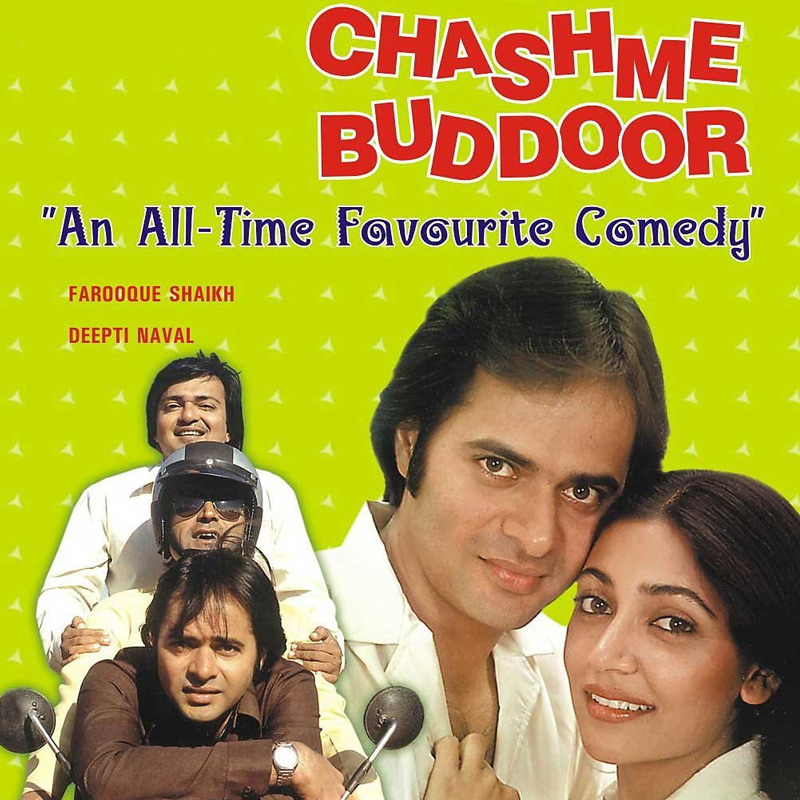
  • Chashme Buddoor: Old remains gold

    Chashme Buddoor: Old remains gold

    MUMBAI: Among the three memorable films that filmmaker Sai Pareanjpye gave in the early 1980’s, Chashme Buddoor remains the most successful. It catered to the typical youth of that time, dealing with lads studying away from home and, in the process, not only sharing accommodation and cigarettes but also the ups and downs in life. (The other two acclaimed films by Sai were Sparsh and Katha.)

    Producer: Gul Anand, Jayshree Anand Makhija.
    Director: Sai Paranjpye.
    Cast: Farooq Shaikh, Deepti Naval, Ravi Baswani, Rakesh Bedi, Saeed Jaffrey, Leela Mishra, Vinod Doshi.

    Farooq Shaikh shares an accommodation with his two friends, Ravi Baswani and Rakesh Bedi, in Delhi. While Shaikh is a studious kind, Baswani and Bedi want to make the most of the freedom of being away from home, so much so that they don’t go home despite summer holidays and stay put in Delhi. They are always on the lookout for a girl to chase and the most vital link in their combined lives is Saeed Jaffrey, the local cigarette vendor where their account is always in the red.

    The glad-eyed duo spot Deepti Naval, a neighbourhood girl and decide to approach her. Both try to gain entry to Naval’s house but fail miserably and feel humiliated. However, on return from failed mission, each concocts a colourful success story about his encounter. But, soon to their surprise, the shy Shaikh has scored with Naval and their romance blooms. Both are worried now that their failure and lies will be caught. They start plotting to make sure the lovers breakup.

    The film is a clean romantic comedy with a racy first half which sags a bit in the second half.

    It is a piece of able craftsmanship by Paranjpye who has done the script, dialogue as well as the film’s direction. She elicited great performances from all her actors: Shaikh, Naval, Baswani, Bedi, Leela Mishra and Jaffrey. The film has popular music track. The film also has a scene with Amitabh Bachchan and Rekha, a combination that meant a lot in those days.

    A jubilee hit when released in 1981, the film has been digitally restored and being released at 33 cinemas spread across various cities in one show a day. Despite the over three decade gap, the film feels as refreshing as it did when it first released.

    Chashme Baddoor: A farcical version of the original at best

    Producers: Viacom 18.
    Director: David Dhavan.
    Cast: Ali Zafar, Siddharth, Taapsee Pannu, Divyendu Sharma, Rishi Kapoor, Anupam Kher, Bharti Achrekar.

    Remaking a film that is slotted among classics is not the wisest ideas and that too by David Dhawan, one who is known for his run of the mill comedies that thrive on loud gestures and double meaning exchanges. In short, though often successful, there has been nothing classic about Dhawan’s approach to filmmaking.

    Dhawan sticks to the basic frame of three friends sharing a house in Goa and comes up with the farcical version of the original. Of the three, Ali Zafar is the sincere type while the other two, Siddharth and Divyendu Sharma, are the chaalu types chasing skirts. When they spot Taapsee Pannu, they are besotted. With Zafar playing the referee, both decide to have a go at wooing her. While one is chased and bitten by Pannu’s pet dog, the other gets lashes from her granny, Bharti Achrekar. Both hide the truth and tell glorious stories of their encounter with Pannu. Then, Pannu and Zafar have a fluke encounter and are instantly impressed with each other.

    The friends are worried as they can’t let Pannu or Zafar find out about their misdeeds. They plot to play spoilsports and create a misunderstanding between the two. They achieve that and now there is nothing left for film to proceed any further! So, another romance is introduced: between Rishi Kapoor, a bar owner, and Lilette Dubey, the trio’s landlady. And, the two, Sharma and Siddharth, are also working on destroying this romance; why is that?

    In fact, Dhawan takes the original script and removes anything and everything that was logical in there and turns it into a hackneyed series of events on the screen. The outcome is not a compliment to Dhawan’s reputation. While the Goa parts are visually good, the home set is badly made with unnecessary props. The acting is all about being loud and making faces. Rishi Kapoor and Anupam Kher have little to do. As for the music, whichever number borrowed from old films is good but from the original score, only Har ek friend kamina hotta hai.… has some youth appeal.

    Chashme Baddoor 2 is okay for those who don’t compare it with the original. For them, the one-liners patch-up shairis mouthed by Sharma through the film should make the film tolerable. With its 1200+ screen solo release, it should sail safe.