Tag: distribution

  • Chrome Data: Marginal gain in week 49

    Chrome Data: Marginal gain in week 49

    MUMBAI: Continuing with its downward trend, the week 49 of opportunity to see (OTS) collated by Chrome Media Analytics and Media didn’t see much gain.

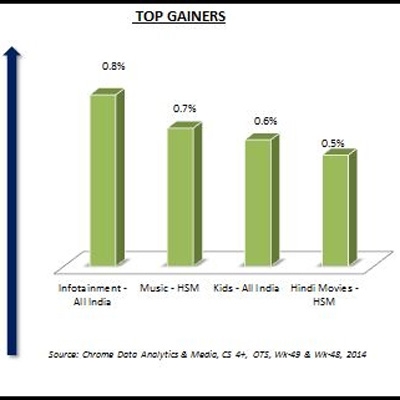
    With 0.8 per cent growth, Infotainment channels across India led the pack of gainers for the week. Discovery with 85.5 per cent OTS continued its reign in the genre.

    It was followed by Music in the Hindi speaking markets (HSM) with 0.7 per cent jump, Kids across India with 0.6 per cent and Hindi Movies in HSM with 0.5 per cent hike. In their respective genres, the channels which topped were MTV with 89.8 per cent OTS, Cartoon Network with 83.6 per cent OTS and Max with 95.9 per cent OTS.

    As for the losers, Business News in the eight metros saw a fall of 1.7 per cent. CNBC Awaaz with 82 per cent OTS gained the most in the genre.

    Sports across India too fell by 1.1 per cent with DD Sports topping the category with 73.2 per cent OTS.

    In the eight metros, English Entertainment and English Movies saw a drop of 1 per cent and 0.7 per cent, respectively. AXN with 63.9 per cent OTS and Movies Now with 68.3 per cent OTS gained the maximum in their respective genres.


  • TS Panesar joins Hathway

    TS Panesar joins Hathway

    MUMBAI: TS Panesar, who recently quit Star India as EVP distribution has joined Hathway Cable & Datacom as head-video business.  

    Confirming the news to indiantelevision.com, Panesar, who had a few options to choose from, says, “Distribution has a long way to go and with Hathway leading the way, I think it’s a sector with a bright future.”

    As for the plans for the multi system operator (MSO) Panesar, who joined the company on 8 December, says it’s too early to comment.

    Hathway which has two verticals: broadband and video, created the new portfolio for head-video starting today. “Yes, Panesar has joined Hathway to head the video segment. In his new role he will look after carriage, subscription and placement,” informs Hathway Cable & Datacom MD and CEO Jagdish Kumar.   

    “He will help us grow the video business,” adds Kumar.

    Panesar had been entrusted with the responsibility of handling distribution for national DTH and digital addressable systems (DAS) earlier this year when the JV between Star and Zee- MediaPro was broken. He was earlier ESPN Software India VP for affiliate sales.


  • TS Panesar quits Star India as EVP Distribution

    TS Panesar quits Star India as EVP Distribution

    MUMBAI: Star India’s EVP for distribution TS Panesar has decided to move on to the company sources told indiantelevision.com.

    He is currently serving his notice period and will move out of the company at the end of the month.

    Panesar had been entrusted with the responsibility of handling distribution for national DTH and digital addressable systems (DAS) earlier this year when the JV between Star and Zee- MediaPro was broken.

    He was earlier ESPN Software India VP for affiliate sales.

    Industry sources hinted that Panesar could be moving to Discovery Networks.


  • Star’s incentives to MSOs

    Star’s incentives to MSOs

    MUMBAI: The industry could now move to a whole new module of distribution, if Star India is able to successfully attract MSOs to its new formula of distribution.

     
    The national broadcaster has from today decided to give incentives to the multi system operators (MSOs) for carrying its channels. The move will empower the viewer and platforms, usher in a new era of transparency, and boost the entire digitisation eco-system.

     
    Star India, which over the next three to four days will talk to all the platform operators for getting the deals in place, hopes it see the light of the day soon.


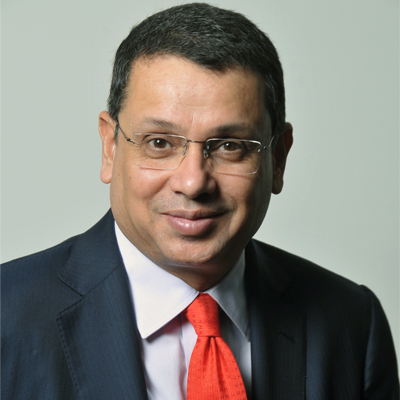
    According to Star India CEO Uday Shankar, the platforms and subscribers have one goal: to save money, while the broadcaster’s aim is to ensure that its content is available to as many people as possible. “We want to create an alignment between both the goals and so have created an attractive incentive plan,” says Shankar.


    The broadcaster has decided to incentivise platform operators, if they meet the three criteria: Firstly, provide more Star channels on its platform, secondly. give it to as many subscribers as it can and thirdly. give easy access by placing the channels in the top LCN on its platform. “The greater the reach of the channel, the cheaper the content would become for the operator,” informs Shankar.


    So why come up with this incentive? Answers Shankar, “Earlier, RIO was the default price on which negotiations took place between the broadcaster and platform operator. Negotiations are a process of give and take. However, because of some of the issues that cropped up in the TDSAT, the Tribunal said that broadcasters must make non-discriminatory deals. But how do you do deals which is equal in a scenario when two parties are completely different, in terms of size, importance of market etc. Hence, we decided that we will offer our content only on RIO.”


    RIO for the first time has been made the trading currency for deals between the broadcaster (Star) and the platform. “And now, in order to make sure that costs for the platform and the subscribers remain in control and manageable, we have decided to give incentives to platforms that help us achieve our goal of maximum reach,” he says.


     “We have done two things. One, made RIO the trading currency and because it is the common currency, it is non-discriminatory and secondly, have created a very transparent alignment between Star’s objectives and the platforms’ goals,” he adds.


    The revised RIO will be in force for one year with digital platforms in DAS areas. And as per the DAS Act, the broadcaster has the right to audit the subscriber details provided by the platform. This will help Star ensure that the MSOs are complying by the figures they present while doing the deal. 


    The one big question now is will the MSOs accept the new system? “The concept has been proven by the DTH operators over the years. They do not sell everything to every customer and instead make sharp packages. The consumer picks the package which is what is offered to them. At a broadcaster level, this is what we are aiming at doing. I think this will work for MSOs as well, if they were to make the packages and sell them.”


    Shankar expects the module to take off soon. “The only way to have Star content on one’s platform is through RIO and so I am sure the MSOs will take this up.”


    The MSO, if accepts all the three conditions: Of taking as many channels, of providing it to all its subscribers and give it on a certain LCN, the incentives could add up to giving the platform a discount of up to 60 per cent.


    “We need to understand that not all the channels will be taken by everyone. So if we take that, then some channels will have 100 per cent penetration, while some may have 80 per cent or 60 per cent penetration and on top of that if you layer it with LCN incentives, then the total benefit to the platform will be very lucrative,” informs Shankar.


    The MSOs, with these incentives, can put the Star channels back in their existing packages.


    So do we see this becoming an industry norm? Says Shankar, “This is a pricing issue and one cannot work as a group on this. We are doing it because of a set of issues that came to us. There were too many litigations and as Star we are clear that we want to be totally transparent of how we do business.”


    Platforms that still opt out of the revised RIO will have the option to choose and take channels as per the original list price.


    Click here to read the full RIO


    Click here to read about the rate card
  • IDOS 2014: India’s broadcast, DTH & cable television industry’s captain congregate

    IDOS 2014: India’s broadcast, DTH & cable television industry’s captain congregate

    MUMBAI: Heads of India’s pay TV, distribution and broadcast sector are headed for Goa between 25 and 27 September 2014 for the industry’s annual confab – The India Digital Operators Summit (IDOS) – 2014. In its third edition, IDOS 2014’s theme is ‘Digitisation: The Next Big Push.’ 

     
    Organised by IndianTelevision.com and Media Partners Asia (MPA), it unites stakeholders across the value chain to drive meaningful dialogue and facilitate practical solutions to drive the content and distribution markets forward.


    The three day summit will kickstart with HBO hosting the most awaited party of the season on 25 September at The Leela in south Goa. 


    The highlight for the three day conference is TRAI chairman Rahul Khullar who will address the gathering on ‘Policy, practices and the way forward – The Next Five Years for Indian Television.’

    Day two of the summit will commence with a keynote on the ‘State of the TV Nation’ by Indiantelevision.com founder, CEO and editor in chief Anil Wanvari and MPA executive director Vivek Couto. 


    A panel comprising leading investment analysts and investors will next discuss the key drivers of industry economics and value creation and if digitisation extension dates will cause concerns for investors and ROI.


    ‘Unity and The Way Forward for the Next Five Years’ will be another topic for discussion at the upcoming summit. During the session, industry leaders will be seen discussing on how there is a need to converge upon and the urgency of proper execution in the coming months. The other sessions will see brainstorming on ‘Specialized content and channels in the digital ecosystem’, ‘Broadband and the digital economy – A focus on ground deployments’, ‘In focus: The growth of alternative video platforms’ and ‘Technology shifts in Indian Pay-TV’ among others.


    Amongst the headline names who are slated to attend and speak include: Star India CEO Uday Shankar, Zee TV CEO Punit Goenka, TRAI principal advisor N Parmeswaran, FoodFood promoter Sanjiv Kapoor, Dish TV CEO RC Venkateish, Videocon d2H CEO Anil Khera, Hathway Cable & Datacom MD and CEO Jagdish Kumar, Siti Cable CEO VD Wadhwa, DEN Networks CEO SN Sharma, Mybox CEO Amit Kharbanda, Scripps Networks Asia Pacific head Derek Chang,  Ortel CEO BP Rath, among others. 


    Says Indiantelevision.com founder, CEO, and editor in chief Anil Wanvari: “For decades, it has been seen as a land of promise. But India’s $7.5 billion television industry has somehow or the other belied that potential. Forced by the government to digitise, India’s TV distribution ecosystem has been struggling to get its act together. While set top boxes (STBs) have been rolled out, transparent customer billing, pricing deals between content owners and distributors, and conditional access have yet to occur seamlessly. This has left industry precisely at the same spot it was at before digitisation was mandated.”


    Adds Media Partners Asia executive director Vivek Couto:  “Revenue leakages continue, and industry discord has only heightened, amongst broadcasters, cable and DTH satellite operators. Clearly, key changes are required with the Government recently calling for an extension to the digitisation deadline to December 2015 for phase III and December 2016 for phase IV. It is in this perspective we expect IDOS to play a key role in getting likeminded  professionals from industry to come together to analyse the just completed phase I and phase II of digitisation and brainstorm for a better phase III and phase IV.”


    The title partner for the event executed by ITV 2.0 Productions is Star India. The summit partners are BBC World News, Cisco, Discovery Channel, HBO Defined HBO Hits, SES, Surewaves and Videocon D2H. The associate partners are Akamai, Asiasat, CSG International, DEN, Hathway and Scripps Network. Broadband India Forum is the support partner, while 24 Frames Digital is the webcast partner. The media partners for the event are Avishkar, Cable Quest, Radioandmusic.com, Satellite @ Internet India and Tellychakkar.com


    IDOS is to be held at the Hotel Leela in south Goa between 25-27 September 2014.

  • Times Television Network, TheOneAlliance terminate distribution alliance

    Times Television Network, TheOneAlliance terminate distribution alliance

    MUMBAI: When the Telecom Regulatory Authority of India (TRAI) came out with its regulation on the fate of the content aggregators, the industry did predict that many networks could now move out of the current distribution ventures. And clearly they weren’t wrong.


    The first to move out of the joint venture was Star India and Zee TV as they announced the disbanding of MediaPro and setting up of their independent cable TV affiliate distribution teams. If this wasn’t enough, MediaPro also decided to not renew its distribution deal with New Delhi Television (NDTV) with effect from 1 April and Media Content & Communications Services (MCCS) and MGM programming Service India (MGM) with effect from 16 April. As a result of this, NDTV (NDTV India, NDTV 24×7, NDTV Good Times and NDTV Profit), MGM (MGM) and MCCS (ABP News, ABP Majha and ABP Ananda) decided to distribute their respective channels through their own independent affiliate teams.


    While this was just the beginning, now through a public notice published in the leading newspapers, Times Television Network has informed the stakeholders, that starting 1 April, the network will no longer be distributed by the content aggregator TheOneAlliance. “MSM Discovery has ceased to distribute the Times channels effective 1 April,” reads the public notice.


    “This is to inform all concerned that with effect from 1 April 2014, Times Global Broadcasting Company Limited (TGBCL) is the sole and exclusive distributor for the television channels namely, Romedy Now, Romedy Now+, Zeem, ET Now (of Bennett, Coleman & Co.), Movies Now (of Zoom Entertainment Network) and Times Now (of Times Global Broadcasting Co.) all forming part of the Times Television Network,” adds the notice.


    With this, the channels will now be distributed solely and exclusively by TGBCL that will undertake all activities that are necessary, ancillary and incidental for effectively distributing the channels throughout the country.


    TGBCL will also be responsible for collection of subscription revenue for the channels, through the distribution platforms comprising analogue cable, digital cable, DTH, IPTV, HITS, OTT, 4G and new emerging digital technology platforms, hotels and commercial establishments and marketing and channel penetration activities.

  • MediaPro terminates distribution alliance with NDTV, MCCS, MGM

    MediaPro terminates distribution alliance with NDTV, MCCS, MGM

    MUMBAI: The MediaPro split is known to all. With Star and Zee setting up their affiliate sales teams for their respective channels, a few networks that formed a part of the content aggregator have now been left with no choice but to distribute the channel on its own.


    The three year distribution venture split after the Telecom Regulatory Authority of India (TRAI) came out with its regulation on the role of content aggregators. News now is that MediaPro has decided to not renew its distribution deal with New Delhi Television (NDTV) with effect from 1 April 2014.


    The content aggregator has also terminated its distribution alliance with   Media Content & Communication Services (MCCS) and MGM programming Service India (MGM) with effect from 16 April 2014.


    As a result of this, NDTV (NDTV India, NDTV 24×7, NDTV Good Times and NDTV Profit), MGM (MGM) and MCCS (ABP News, ABP Majha and ABP Ananda) will now distribute their respective channels through their own independent affiliate teams.

  • BBC Global News appoints Naveen Jhunjhunwala as India COO

    BBC Global News appoints Naveen Jhunjhunwala as India COO

    MUMBAI: Last month, indiantelevision.com broke the news that BBC Global News India COO Preet Dhupar had decided to move out of her 14 year stint with the company. Now, the global broadcaster has found a person to fill the space in Naveen Jhunjhunwala.


    Jhunjhunwala was previously with Turner International India for 15 years as vice president for corporate finance and administration, looking after the financial functions for distribution, ad sales and marketing of CNN International, Cartoon Network, POGO and HBO in India, Pakistan, Sri Lanka, Maldives, Bangladesh, Nepal and Bhutan.


    Speaking on his new role Jhunjhunwala said, “I am delighted to be joining the BBC. I am looking forward to taking up my new role and to being part of the talented team at one of the world’s most renowned news operations. The BBC is an iconic brand and carries a special position for the Indian audience and in today’s dynamic market place, with digitisation, growing online penetration and the BBC’s special focus on India, it has exceptional potential for growth in both television and online space.”


    At Turner, he helped launch the company’s India operatons including the CN subscription business, launch of new channels like HBO, POGO and WB. He also helped set up the Zee Turner distribution JV, including MediaPro as well as CNN-IBN. Prior to Turner, he was with Ernst & Young in New Delhi.


    The role of COO for India was created last year to better organise the company’s business operations in a growing Indian market. Apart from looking at finance, Jhunjhunwala will also be responsible for determining BBC’s commercial priorities and targets for news across the country as well as ad revenue, content distribution and audience growth.


    “I’m pleased to welcome Naveen on board at such an exciting time for the BBC’s news interests in India.  Naveen brings with him a wealth of experience and will be a real asset to the BBC, building on the successful work to date of our teams in Delhi and Mumbai,” said BBC Global News CEO Jim Egan.


    “India is a country we are proud to have been broadcasting to and from for more than seven decades and we remain committed to our audiences here. We have featured India in two dedicated programming seasons on BBC World News already this year, have recently launched a new Indian edition of bbc.com/mobile and are mid-way through our most comprehensive coverage ever of the Indian general election. I am sure Naveen will be invaluable as we work to develop even further in this exciting and dynamic market,” he added.


    Naveen will take up his position in Delhi on 1 May. He replaces Preet Dhupar who left the organisation earlier this month.

  • Neo Sports decides to break away from The One Alliance

    Neo Sports decides to break away from The One Alliance

    MUMBAI: Three weeks after the Telecom Regulatory Authority of India (TRAI) issued its television content aggregation regulation, Neo Sports Broadcast has decided to break away from its distributor The One Alliance.


    A statement from the company states that the broadcaster has decided not to renew its agreement with The One Alliance that expires on 31 March. From 1 April, the sportscaster will be distributing its channels Neo Sports and Neo Prime through an in-house distribution team.


    When contacted by Indiantelevision.com, The One Alliance president Rajesh Kaul says, “The contract was coming to an end on 31 March and we were contemplating of not renewing the contract because they have lost all the sporting properties from the network. With MSM investing heavily on Sony Six and with IPL and FIFA, it is a formidable sports channel and so we did not want anything else in the bouquet.”


    Apart from Neo Sports, The One Alliance currently distributes television channels of Multi Screen Media, Discovery, Times Television Network and TV Today.


    Neo Sports believes that it can on its own strength build a robust relationship with cable operators, DTH operators and HITS companies. Even when its channels were being distributed by the aggregator to cable platforms, it was handling distribution through DTH on its own.


    According to Neo Sports, standalone channels with good content mix at affordable prices can be good and effective business cases in a digital environment.


    Says Neo Sports Broadcast EVP distribution platforms, Dilip Sharan, “The suggestive regulatory approach combined with digitisation clearly points that future distribution deals will be dictated by the relevant content that is made available to various audiences and the ability to work with the platforms keeping in mind the business issues and not entirely on the strength of the channels size in the bouquet, a prevalent practice in the analogue era.  Our cable distribution deal with MSMD made better commercial sense in the analogue environment.”


    TRAI’s regulation has barred aggregation of television channels from different broadcaster groups and allowed the aggregators six months of transition period.


    Neo Sports believes that there is a lot more scope to monetise from digitisation. The analogue era didn’t allow many channels due to bandwidth limitation. “The new regulation is indicative of how things are likely to pan out in the future. We were waiting for TRAI’s view on it to take this step at the opportune time,” adds Sharan.


    One of the major concerns of various broadcasters is that an aggregator might be bias against the smaller networks. Although Sharan doesn’t agree, he does feel it is very natural for an aggregator to give preferential treatment to its own channels.


    Most aggregators are aligned with several broadcasters.


    Will some other broadcasters also follow suit? “I won’t be surprised if others also do the same,” says Sharan.


    Neo Prime and Neo Sports channels are currently available on DTH platforms such as Dish TV, Videocon D2H, Airtel Digital TV, Reliance DTH and Sun Direct. The Neo channels are available on cable channels across all the leading networks.

  • TRAI plea in SC for raising pay channel tariff cap

    TRAI plea in SC for raising pay channel tariff cap

    MUMBAI: The Telecom Regulatory Authority of India (TRAI) has petitioned the Supreme Court to allow it to raise the ceiling on tariff for pay channels distributed in non-addressable areas.


    The tariff for pay channels in areas where cable TV is distributed through analogue technology has remained capped at the pre-2009 rates, following a direction by the Supreme Court in March 2009 for maintenance of status quo.


    TRAI says there is a need for reviewing the ceiling to adjust the tariff for pay channels in non-addressable areas for inflation.


    The court is likely to hear the TRAI plea towards the end of March.


    TRAI in its appeal to the SC says, “The present tariff was based on the figures of 2009 and the appellant is of the view that an across the board adjustments be provided in respect of tariff to compensate for increased costs on account of inflation.”


    The TRAI had amended the tariff order of 2007 by providing for a 7 per cent increase on account of inflation effective from the year 2009.


    TRAI says, “The authority since then has not been able to revise the tariff for non-addressable systems, even though more than five years have passed.”


    Before 2009, the tariff orders were amended periodically, thereby providing for adjustments for inflation.  No such exercise has been undertaken after 2009.


    The TRAI through its appeal has informed the Supreme Court that it had in its ‘Recommendations on Issues relating to Broadcasters and Distribution of TV Channels’ provided for a provision to periodically review the ceiling on tariff to make adjustments for inflation.


    “According to the Ministry of Commerce and Industry, a substantial increase in the price has taken place and the ceiling thus needs to be reviewed immediately,” reads TRAI’s appeal to the SC, a copy of which is with Indiantelevision.com.


    According to the current tariff ceiling, the subscriber for up to 20 pay channels and minimum 30 free to air (FTA) channels in A1 and A class cities has to pay not more than Rs 160, in B1 and B class cities not exceeding Rs 140 and in other areas not more than Rs 130.


    Likewise for more than 20 and up to 30 pay channels and minimum 30 FTA channels, the subscriber in A1 and A class cities has to pay not more than Rs 200, in B1 and B class cities not exceeding Rs 170 and in other areas not more than Rs 160.


    For viewing more than 30 and up to 45 pay channels, the subscriber as per the tariff has to pay not exceeding Rs 235 in A1 and A class cities, Rs 200 in B1 and B class cities and not exceeding Rs 185 in other cities.


    Also for viewing more than 45 pay channels and minimum 30 FTA channels, subscribers, according to the current ceiling on tariff, has to pay not more than Rs 260 in A1 and A class cities, Rs 220 in B1 and B class cities and Rs 200 in other cities.


    While the broadcasters would welcome over the appeal by TRAI, but cable operators feel the subscription charges for consumers in non-addressable areas will rise by as much as 36 per cent if the ceiling is approved.