Tag: distribution

  • FY-16: TV Today revenue up 14.6 percent; PAT up 16 percent

    FY-16: TV Today revenue up 14.6 percent; PAT up 16 percent

    BENGALURU: TV Today Network Limited (TVTN) reported 14.6 percent increase in consolidated revenue (consolidated total income from operations, consolidated TIO) for the year ended 31 March 2016 (FY-16, current) as compared to the previous year. The company’s consolidated Profit after Tax (PAT) increased 16 percent in FY-16. TVTN reported consolidated TIO of Rs 546.01 crore in FY-16 and Rs 476.58 crore in FY-15. PAT in the current year was Rs 95.04 crore (17.2 percent PAT margin) as compared to Rs 81.03 crore (17 percent PAT margin) in FY-15.

    Note: The unit of currency in this report is the Indian rupee – Rs (also conventionally represented by INR). The Indian numbering system or the Vedic numbering system has been used to denote money values. The basic conversion to the international norm would be:
    (a) 100,00,000 = 100 lakh = 10,000,000 = 10 million = 1 crore.
    (b) 10,000 lakh = 100 crore = 1 arab = 1 billion.

    The company’s total expenditure in the current year increased 14.8 percent to Rs 430.25 crore (78.8 percent of TIO) from Rs 374.91 crore (78.7 percent of TIO) in the previous year.

    Simple EBIDTA increased 11.1 percent to Rs 146.33 crore (26.8 percent EBIDTA margin) from Rs 131.70 crore (26.7 percent EBIDTA margin) if FY-15.

    TVTN’s advertising, distribution and sales promotion (ad expense) in FY-16 increased 17.5 percent to Rs 119.52 crore (21.9 percent of TIO) from Rs 101.75 crore (21.3 percent of TIO) in FY-15.

    The TVTN board has recommended a final dividend @ 35 percent on the paid-up capital of the company, i.e., Rs 1.75 per share of Rs 5/- each for FY-16 subject to the approval of shareholders at the ensuing Annual General Meeting (AGM) of the company.


  • FY-16: TV Today revenue up 14.6 percent; PAT up 16 percent

    FY-16: TV Today revenue up 14.6 percent; PAT up 16 percent

    BENGALURU: TV Today Network Limited (TVTN) reported 14.6 percent increase in consolidated revenue (consolidated total income from operations, consolidated TIO) for the year ended 31 March 2016 (FY-16, current) as compared to the previous year. The company’s consolidated Profit after Tax (PAT) increased 16 percent in FY-16. TVTN reported consolidated TIO of Rs 546.01 crore in FY-16 and Rs 476.58 crore in FY-15. PAT in the current year was Rs 95.04 crore (17.2 percent PAT margin) as compared to Rs 81.03 crore (17 percent PAT margin) in FY-15.

    Note: The unit of currency in this report is the Indian rupee – Rs (also conventionally represented by INR). The Indian numbering system or the Vedic numbering system has been used to denote money values. The basic conversion to the international norm would be:
    (a) 100,00,000 = 100 lakh = 10,000,000 = 10 million = 1 crore.
    (b) 10,000 lakh = 100 crore = 1 arab = 1 billion.

    The company’s total expenditure in the current year increased 14.8 percent to Rs 430.25 crore (78.8 percent of TIO) from Rs 374.91 crore (78.7 percent of TIO) in the previous year.

    Simple EBIDTA increased 11.1 percent to Rs 146.33 crore (26.8 percent EBIDTA margin) from Rs 131.70 crore (26.7 percent EBIDTA margin) if FY-15.

    TVTN’s advertising, distribution and sales promotion (ad expense) in FY-16 increased 17.5 percent to Rs 119.52 crore (21.9 percent of TIO) from Rs 101.75 crore (21.3 percent of TIO) in FY-15.

    The TVTN board has recommended a final dividend @ 35 percent on the paid-up capital of the company, i.e., Rs 1.75 per share of Rs 5/- each for FY-16 subject to the approval of shareholders at the ensuing Annual General Meeting (AGM) of the company.


  • Warner Bros. Worldwide Television Distribution promotes Allen Etherton to SVP

    Warner Bros. Worldwide Television Distribution promotes Allen Etherton to SVP

    MUMBAI: Warner Bros. Worldwide Television Distribution has promoted veteran finance executive Allen Etherton to senior vice president – planning & analysis.

    Etherton expanded his aegis to include financial planning on a global basis, last year. A 10-year veteran of Warner Bros., Etherton has been overseeing the entire Worldwide Television Distribution Financial Planning and Analysis team, responsible for all financial planning and analysis for the global television distribution businesses in order to guide senior management (both Domestic & International) in key decision making. Etherton will continue to report to Warner Bros. Worldwide Television Distribution executive vice president – finance & contract administration Andy Lewis.

    “Allen’s knowledge, expertise and insights truly make him an integral member of the senior leadership team,” said Lewis. “We look forward to our continued ability to tap into Allen’s strategic smarts in our efforts to facilitate growth within our businesses.”

    Etherton joined Warner Bros. Domestic Television Distribution in 2005 as director of finance. He has worked his way up through the ranks being promoted to executive director and then vice president, adding responsibilities during that time to include cable and subscription-video-on-demand and, last year, international territories to his responsibilities.

    Etherton got his start in the participations department at Paramount, where he worked for three years. He joined Warner Bros. as an audit manager in the participations department. He returned to Paramount in 2000 as a production finance executive assigned to Entertainment Tonight, before returning to Warner Bros. in 2005.

  • Warner Bros. Worldwide Television Distribution promotes Allen Etherton to SVP

    Warner Bros. Worldwide Television Distribution promotes Allen Etherton to SVP

    MUMBAI: Warner Bros. Worldwide Television Distribution has promoted veteran finance executive Allen Etherton to senior vice president – planning & analysis.

    Etherton expanded his aegis to include financial planning on a global basis, last year. A 10-year veteran of Warner Bros., Etherton has been overseeing the entire Worldwide Television Distribution Financial Planning and Analysis team, responsible for all financial planning and analysis for the global television distribution businesses in order to guide senior management (both Domestic & International) in key decision making. Etherton will continue to report to Warner Bros. Worldwide Television Distribution executive vice president – finance & contract administration Andy Lewis.

    “Allen’s knowledge, expertise and insights truly make him an integral member of the senior leadership team,” said Lewis. “We look forward to our continued ability to tap into Allen’s strategic smarts in our efforts to facilitate growth within our businesses.”

    Etherton joined Warner Bros. Domestic Television Distribution in 2005 as director of finance. He has worked his way up through the ranks being promoted to executive director and then vice president, adding responsibilities during that time to include cable and subscription-video-on-demand and, last year, international territories to his responsibilities.

    Etherton got his start in the participations department at Paramount, where he worked for three years. He joined Warner Bros. as an audit manager in the participations department. He returned to Paramount in 2000 as a production finance executive assigned to Entertainment Tonight, before returning to Warner Bros. in 2005.

  • Q3-2016: Network18 YoY EBIDTA up 27.5%

    Q3-2016: Network18 YoY EBIDTA up 27.5%

    BENGALURU: Network18 Media & Investments Limited (Network18) reported 8.9 per cent YoY growth in consolidated income from operations (TIO) at Rs 905.6 crore in the quarter ended 31 December, 2015 (Q3-2016, current quarter) as compared to the Rs 831.9 crore and was 13 per cent higher QoQ as compared to Rs 801.1 crore.


    The company’s EBIDTA in the current quarter increased 27.5 per cent YoY to Rs 85.6 crore (9.5 per cent margin) from Rs 67.2 crore (8.1 per cent margin) and more than quadrupled (up 4.5 times) QoQ from Rs 19.2 crore.


    Note: 100,00,000 = 100 lakh = 10 million = 1 crore


    The company reported a lower consolidated YoY loss of Rs 2.4 crore for the current quarter than the loss of Rs 12.2 crore and less than one tenth QoQ loss as compared to Rs 27.43 crore.


    Network18 has holdings in TV18 Broadcast Limited (TV18). TV18 reported 14 per cent YoY growth in Income from operations (TIO) in Q3-2016 at Rs 692.42 crore as compared to Rs 607.23 crore and a 13.8 per cent QoQ growth as compared to Rs 608.53 crore. TV18 reported net profit after tax (PAT) for the current quarter at Rs 78.29 crore (11.3 per cent margin) as compared to Rs 60.38 crore in Q3-2015 (9.9 per cent margin) and Rs 20.27 crore (3.3 per cent margin) in the immediate trailing quarter.


    Network18 paid 5.1 per cent more YoY towards programming costs in the current quarter at Rs 212.5 crore (23.5 per cent of TIO) as compared to the Rs 202.1 crore (24.3 per cent of TIO) and was 11.5 per cent more QoQ as compared to Rs 190.6 crore (23.8 per cent of TIO).


    Network18’s distribution, advertisement and business promotion costs in Q3-2016 declined five per cent YoY to Rs 203.3 crore (22.4 per cent of TIO) and declined 2.4 per cent QoQ from Rs 208.2 crore (26 per cent of TIO).


    Network18’s employee benefit expense increased 11.3 per cent YOY in Q3-2016 to Rs 159.3 crore (17.6 per cent of TIO) as compared to Rs 143.1 crore (17.2 per cent of TIO), but declined two per cent from the Rs 162.5 crore (20.3 per cent of TIO.


    Network18’s finance costs in Q3-2016 declined 17.5 per cent YoY to Rs 22.7 crore (2.5 per cent of TIO) as compared to Rs 27.5 crore (3.3 per cent of TIO) and declined 1.7 per cent from Rs 23.1 crore (2.9 per cent of TIO).

  • Q3-2015: PVR reports almost four fold Q2-2015 PAT

    Q3-2015: PVR reports almost four fold Q2-2015 PAT

    BENGALURU: Last fiscal (FY-2014), Indian motion picture exhibition, production and distribution house PVR Limited (PVR) entered the Rs 1000 crore club by posting operating income (TIO) of Rs 1351.23 crore for the year. The company’s PAT in Q3-2015 almost quadrupled (went up 3.88 times) to Rs 31.59 crore from Rs 8.15 crore and was 2.27 times the PAT of Rs 13.91 crore in the corresponding quarter of last year (Q3-2014). However, year to date (TTD) PAT for 9M-2015 at Rs 47.2 crore was 15 per cent less than the Rs 55.33 crore in 9M-2014.


     Note: 100,00,000 = 100 Lakhs = 10 million = 1 crore.


     In Q3-2015, the company recorded a rise in TIO of 5.3 per cent to Rs 419.35 crore from Rs 399.30 crore in the immediate trailing quarter and recorded a 24.8 per cent jump from the Q3-2014 TIO of Rs 336.66 crore. In 9M-2015, PVR reported TIO of Rs 1182.77 crore, up 14.1 per cent from the Rs 1037 crore in 9M-2014.


    Let us look at the other Q2-2015 and HY-2015 numbers reported by PVR:


     PVR reported a drop in Total Expenditure in Q3-2015 of 0.6 per cent at Rs 369.47 crore as compared to the Rs 372.66 crore for Q2-2015, and 19.9 per cent more than the Rs 308.24 crore in Q3-2014. For 9M-2015, TE was 18.1 per cent higher at Rs 1078.81 crore against Rs 913.54 crore in 9M-2014.


     The company’s Film Exhibition Cost (FEC) in Q3-2015 went up 5.6 per cent to Rs 98.49 crore from Q2-2015 FEC of Rs 93.25 crore and was 18.2 per cent more than the Rs 83.34 crore in Q3-2014. 9M-2015 FEC at Rs 279.22 crore was 7 per cent more than the Rs 260.89 crore in 9M-2014.


     The cost of Food and Beverages consumed (food) in Q3-2015 at Rs 30.05 crore was 4.9 per cent more than the Rs 28.65 crore in Q2-2015 and was 37.3 per cent more than the Rs 21.89 crore in Q3-2014. For 9M-2015 food costs rose sharply by 23.5 per cent to Rs 86.33 crore from Rs 69.92 crore in 9M-2014.


     PVR’s other expense (OE) in Q3-2015 at Rs 39.85 crore also increased by 9.5 per cent from Rs 32.78 crore in Q2-2015 and was 22.7 per cent more than the Rs 32.49 crore in Q3-2014. OE in 9M-2015 was up by 21.6 per cent at Rs 116.88 crore as compared to the Rs 96.1 crore in 9M-2014.


    Segment Revenue


     Three segments add to PVR’s numbers – movie exhibition, movie production and distribution and others that comprises bowling, gaming and restaurant services.


     Movie Exhibition


     The largest contributor to PVR revenues is movies exhibition. Revenue from this segment increased 7.1 per cent to Rs 393.48 crore from Rs 367.28 crore in Q2-2015 and increased 24.7 per cent from Rs 315.59 crore in Q3-2014. For 9M-2015, revenues from the movies exhibition segment increase 13.1 per cent to Rs 1099.89 crore from Rs 971.90 crore in 9M-2014.


    Though this segment reported an 82.6 per cent growth in operating profits to Rs 50.55 crore in Q3-2015 from Rs 27.14 crore in Q-2015 and growth of 83.3 per cent from Rs 27.58 crore in Q3-2014, its operating profit fell 15.9 per cent in 9M-2015 to Rs 104.06 crore from Rs 123.74 crore in 9M-2014.


    Movie production and distribution


    Revenue from PVR’s MPD segment in Q3-2015 fell 37.2 per cent to Rs 11.85 crore from Rs 18.87 crore in Q2-2015 and was 75 per cent more as compared to the Rs 6.77 crore in Q3-2014. In 9M-2015, revenue from the MPD segment went up 2.01 times to Rs 37.71 crore from Rs 18.72 crore in 9M-2014.


    This segment returned an operating profit of Rs 0.43 crore in Q3-2015, Rs 1.34 crore in Q2-2015 and an operating profit of Rs 2.54 crore in Q3-2014. For 9M-2015, this segment reported a lower operating profit of Rs 1.21 crore versus an operating profit of Rs 1.59 crore in 9M-2014.


    Others


    PVR’s Others segment reported a 4.5 per cent increase in revenue in Q3-2015 to Rs 19 crore from Rs 18.19 crore in Q2-2015 and an increase of 10.2 per cent from Rs 17.24 crore in Q3-2104. For 9M-2015, this segment’s revenue at Rs 56.69 crore was 3.3 per cent more than the Rs 54.86 crore in 9M-2014.


    Loss from PVR’s Other segment was lower at Rs 0.13 crore in Q3-2015 as compared to the Rs 0.96 crore in Q2-2015 and loss of Rs 1.65 crore in Q3-2014. For 9M-2015, loss from this segment was lower at Rs 1.34 crore as compared to a loss of Rs 1.67 crore in Q3-2014.

  • Chrome Data: 8 metros witness gain in week 2

    Chrome Data: 8 metros witness gain in week 2

    MUMBAI: The second week of opportunity to see (OTS) collated by Chrome Data Analytic & Media saw maximum hike in the eight metros.


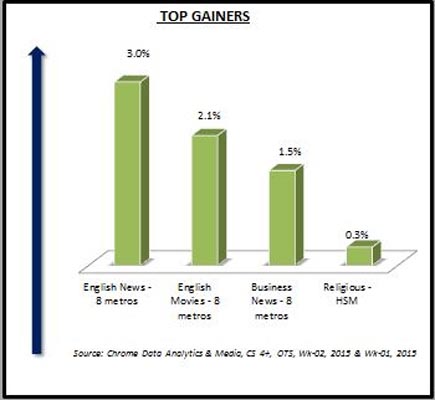
    English News in the eight metros grew by 3 per cent with Times Now continuing its reign on top with 79.8 per cent OTS.


    English Movies and Business News in the eight metros witnessed a jump of 2.1 per cent and 1.5 per cent, respectively. Romedy Now with 69 per cent OTS and CNBC Awaaz with 81.2 per cent OTS gained the most in their respective genres.


    Religious channels in the Hindi speaking markets (HSM) too saw a marginal growth of 0.3 per cent. Aastha continued reigning supreme with 97.1 per cent OTS.


    As for the losers, English Entertainment channels led the way with 1.6 per cent drop in the eight metros. AXN with 59.6 per cent OTS topped the genre.


    Both Infotainment and Kids genres across India witnessed a fall of 0.4 per cent. Discovery with 84.9 per cent OTS and Cartoon Network with 80.7 per cent OTS ranked number one in their respective genres.


    Hindi GECs in the HSM too saw a marginal drop of 0.3 per cent. Sony with 97.3 per cent topped the charts in the category.


  • Sony tops week 1 of OTS chart

    Sony tops week 1 of OTS chart

    MUMBAI: The first week of 2015 didn’t see much hike, when it comes to opportunity to see (OTS) collated by Chrome Data Analytics and Media.

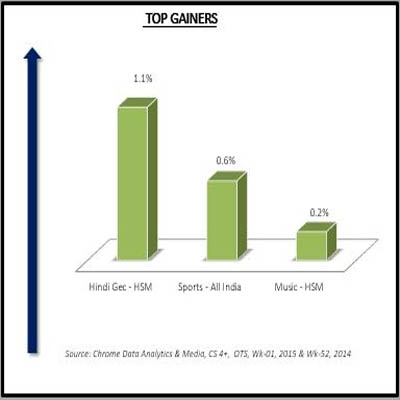
    Hindi GECs in the Hindi speaking market (HSM) witnessed a marginal jump of 1.1 per cent. Sony with 96.9 per cent OTS topped the charts.

    Sports across India jumped 0.6 per cent followed by Music in the HSM with 0.2 per cent. DD Sports with 74 per cent OTS and MTV with 90.7 per cent OTS gained the most in the respective genres.

    As for the top losers, English News in the eight metros saw a steep fall of 6.9 per cent. Times Now with 79 per cent OTS continued its reign in the genre.

    English Movies with 3 per cent fall followed suit in the eight metros. Romedy Now with 66.7 per cent OTS laughed its way up in the category.

    Infotainment channels across India and Business News in the eight metros saw a drop of 2.8 per cent and 2.4 per cent, respectively. Discovery with 85.4 per cent OTS and Zee Business with 81.1 per cent OTS gained in the respective genres.


  • DTH could push HD penetration in next one year: MPA

    DTH could push HD penetration in next one year: MPA

    MUMBAI: As the year comes to an end, the multi system operators (MSOs) have finally come out with their packages and the pricing module for the Star India channels, after the broadcaster decided to give its channels only on Reference Interconnect Offer (RIO) basis.


    But according to Media Partners Asia (MPA) while Star has the right intent, it has to remain flexible on the incentives offered for better ground adoption. From the operator’s viewpoint, the Star scheme needs to address the following issues:


    1. Despite availing of the maximum discount on the scheme, the content cost for operators remains higher than previous CPS deals, exacerbated as operators are not receiving any carriage fees.


    2. The scheme does not factor in volume discounts on the basis of an absolute number of subscribers offered through a given operator network.


    3. Channel pricing is based on filed RIO rates. These are not reflective of consumer preferences. For instance, Star Plus which enjoys 2x the viewership of Life OK, has a lower price than Life OK.


    4. To generate higher discounts, the scheme demands carrying maximum channels with 90 per cent penetration. This will result in a rich basic pack offering which will disincentivise future upselling to an operator’s high value packages.


    5. Even if operators are able to pass through content costs to subscribers, MSOs face the risk of paying more and collecting less as the current backend systems for operators are not robust and transparent enough to collect and pass on revenues for channels on an a-la carte basis.


    6. The scheme does not factor in HD channels. MSO action plan and execution risk Star has been transparent on rates and discounts for its channels. Some national MSOs have accordingly started to work on their blueprint of tiering channels through a broad revenue share arrangement with local cable operators (LCOs). On the backend, according to MPA, the operators now critically need to have their technology systems in sync with consumer preferences, collected through KYC (Know Your Customer) forms. They will also need to decentralise control by extending their consumer databases to respective LCOs to enable the upgrading and downgrading of packages as per consumer choice. As backend systems get re-engineered, MSOs will need to concurrently conduct roadshows and training programmes for LCOs. MSOs will also need to undertake marketing campaigns to create awareness on a consumer’s need to make choices on revised cable packages.


    MPA also feels that MSOs intend to pass their increase in net content cost to consumers by undertaking an average price hike of Rs 40-60 ($0.7-1) per month. Even if consumers accept the price increase, the risk to MSOs lies in collecting their legitimate share of incremental revenues from LCOs. In order to offset this, MSOs plan to shift to trade prepaid services, which should have positive consequences.


    Long term implications for the Pay TV industry


    Broadcasters: Currently, all broadcasters are looking to reduce carriage fees and bring it to parity with DTH in terms of total payout. A number of broadcast networks are taking a wait-and-see approach. Having already eliminated carriage in DAS markets, if Star manages to obtain reasonable viewership for its driver channels with a nominal growth in subscription revenues, MPA believes that others too will broadly follow Star’s approach.


    According to MPA, non-carriage discounted rate schemes could become the template for future content deals. This will have direct implications on several advertisement-skewed and reach-dependent genres, such as news and music. Channels in such genres might then remain feasible by converting to free-to-air. Launching new channels will become difficult and as a result, the industry could see rebranding and a frequent change in the programming mix of existing channels.


    MSOs: As carriage and placement revenues start to dry up, the priority for MSOs for the next 12 months will be to shift to establishing robust back-end systems for better subscription monetisation in phases I and II. Consequently, voluntary digitisation and reach expansion in phases III and IV could take a back seat. MPA in its report also points out that national MSOs have already invested and outsourced backend systems to renowned IT vendors, which need to now streamline the secondary point network in order to attain authenticated customer information and deliver strong customer support services.


    “Critical is the increasingly important need to successfully rollout trade prepaid services and rationalising content cost by identifying active paying subscribers which will address the current cash flow crisis and determine the future feasibility of an MSOs business model.


    As the industry shifts gears, we may see more consolidation of cable players which fail to invest and execute on establishing B2C processes,” says MPA.


    DTH: Over the last 30 months, the DTH industry had implemented a 53 per cent increase in its base pack pricing. Just when it seemed that rate hikes on base packs had hit a ceiling, the price hikes implemented by MSOs provided the DTH industry with additional headroom to undertake further price increases. In addition, with tiering of channels on cable, the value gap in the form of realisation per channel between cable and DTH operators will narrow, feels MPA.


    As per MPA, a lighter base pack for both cable and DTH will gradually result in the upselling of subscribers to high value packs, thereby boosting ARPU growth.


    Moreover, Star’s entertainment and sports channels have been key drivers for HD in India.


    MPA in its concluding remarks points out that acquiring Star’s HD channels on RIO makes it unfeasible for cable and thus enables DTH operators to push HD penetration aggressively for the next one year. Through attractive pricing and marketing, DTH operators could leverage HD to win some subscribers from cable.


  • RIO to affect Star’s sports and niche channel distribution: MPA

    RIO to affect Star’s sports and niche channel distribution: MPA

    MUMBAI: Star India’s new distribution approach has been the talking point for the industry. And now highlighting the same is Media Partners Asia (MPA) in its new report.

    Post the announcement of Reference Interconnect Offer (RIO) deals by Star, most multi system operators (MSOs)in order to keep both content cost and churn under check, opted to carry Star’s key Hindi channels on the base pack, along with free-to-air channels and lower RIO rate channels such as Nat Geo. In certain markets, 1-2 relevant regional channels have been bundled in the base pack.

    Not only this, many of the niche channels (English cluster) have been moved to higher or expanded basic tiers or available on a-la-carte basis.

    “This will adversely impact channel reach and viewership. However, the revenue losses on these channels will be partially compensated by reduction in carriage fee costs,” says MPA in its report.

    MPA, however sees a bigger risk, potentially to Star’s sports channels, as sizeable investments have already been made to creating non-cricket sports leagues leveraging Indian soccer and badminton.

    “These leagues are still in their infancy and require maximum distribution reach,” points out MPA.

    It further goes on to say that in cricket too, Star will broadcast the ICC World Cup in February 2015. However, according to MPA, with all India matches, semis and finals also available to viewers on public broadcaster Doordarshan, Star may have to rethink its incentive schemes in order to maximise its distribution of sports channels.  

    MPA estimates that the commercial rollout of package could take at least two to three months (completing in the early half of Q1 2015) and in the meantime, the delay will put pressure on the distribution of Star’s niche channels.

    “New channel launches for Star could also become equally challenging as it loses the luxury of having 100 per cent sampling on the cable platform,” it reports.

    In conclusion, Star’s new distribution strategy, will be a true acid test of consumer demand for its portfolio of channels. Viewership trends over the coming weeks will reflect such demand.

    “On a positive note, the outcome will help Star to prioritise and rationalise its content budgets, which have swelled across multiple genres, in recent years,” opines MPA.