Tag: Disney+Hotstar

  • After Rs 3,000 crore ad revenue haul, Star India eyes bigger pot in IPL 14

    After Rs 3,000 crore ad revenue haul, Star India eyes bigger pot in IPL 14

    KOLKATA: 2020 was a tough year for broadcasters as major live sports events were cancelled. Cricket fever resumed in India with the Indian Premier League (IPL) returning in September after a six month hiatus, which helped rights-holder Star India garner Rs 3,000 crore in advertising revenues, including the digital segment.

    According to a Moneycontrol report, the broadcaster saw 100 new advertisers despite the economic slowdown. Hence, it is expected that advertisers will be upbeat about IPL 2021 as well.

    While last year Rs 12.6- 12.7 lakh was charged for a 10 second ad spot on TV, Star India is charging Rs 14 lakh for a slot of the same duration this year. The network has already sold out most of the ad inventory this year. Experts project that Star India's TV segment will likely see a 15 per cent jump in ad revenues from IPL 14.

    On the other hand, Disney+Hotstar is charging a 20-25 per cent premium for ad rates. CPMs (cost per mille) are in the range of Rs 200-350 depending on the type of advertisements. The streaming service has priced a 10-second spot at Rs 180. BFSI, telecom, d2c platforms, e-commerce platforms and FMCG brands are interested in the slots this year too. Last year, the streamer earned around Rs 400 crore from ad revenues, up from around Rs 250 crore in 2019.

    Disney+Hotstar has already signed 10 sponsors for this year's tournament. Dream11 is the co-presenting sponsor, Upstox and Vimal Pan Masala are the co-powered by sponsors. Phone Pe, Association of Mutual Funds in India (AMFI), Unacademy, Pharmeasy, Livspace, Swiggy, and Parle Agro have come on board as associate sponsors.

    The network is already raking in the moolah in terms of TV advertisers. Dream11, Byju’s, Phone Pe and Just Dial have signed as co-presenting partners of the league, while Chinese handset manufacturer Vivo has returned as the title sponsor this year.

  • Disney+ Hotstar onboards 10 sponsors for IPL 2021

    Disney+ Hotstar onboards 10 sponsors for IPL 2021

    KOLKATA: Disney+ Hotstar is gearing up for Vivo IPL 2021 and has already signed 10 sponsors for this year's tournament. Last year’s title sponsor, Dream11, has returned as the co-presenting sponsor this time, while Upstox and Vimal Elaichi are the ‘co-powered by’ sponsors. Phone Pe, Association of Mutual Funds in India (AMFI), Unacademy, Pharmeasy, Livspace, Swiggy, and Parle Agro have come on board as associate sponsors. 

    “IPL is a prime sporting property that provides advertisers an opportunity for real-time consumer engagement on Disney+ Hotstar. Going by the response from the market, IPL 2021 promises to be an even more significant opportunity for brands. All key features such as Super 4s, Super 6s, Fall Of Wickets, Milestones, and Super Savers have sold out within a short period, and we see early closures across categories,” Star & Disney India ad sales president Nitin Bawankule said.

    “With a host of innovative advertising formats, targeting on connected TVs, and custom branded content solutions, brands have the unique opportunity to reach a highly engaged and affluent audience through the sharp targeting options available on live sports,” he added.

    IPL 14 will be streamed on Disney+ Hotstar in five languages – English, Hindi, Telugu, Kannada, and Tamil and will be exclusively available to subscribers of Disney+ Hotstar VIP (Rs 399 for 12 months) and Disney+ Hotstar Premium (Rs 1499 for 12 months).

    The last season of the IPL was a blockbuster event for the network after resumption of live sports in post-Covid times. Top global disney executives have also emphasised the league’s contribution to Disney+ Hotstar's success. In the tournament’s thirteenth edition, the platform innovated around user experience and interactivity in the absence of live audiences.

  • Disney+ surpasses 100 million subscribers

    Disney+ surpasses 100 million subscribers

    KOLKATA: In the last one year, the direct-to-consumer (d2c) segment has been prioritised by The Walt Disney Company more than ever before, and it has yielded results for the media giant. Its d2c streaming platform Disney+ has surpassed 100 million subscribers, Disney CEO Bob Chapek stated during its annual meeting of shareholders.

    “The enormous success of Disney+, which has now surpassed 100 million subscribers, has inspired us to be even more ambitious, and to significantly increase our investment in the development of high-quality content,” Chapek said.

    Disney+ was launched in November 2019 and has reached the impressive 100-million mark in 16 months. He also noted that the incredible success of the streaming platform in its first year prompted them to accelerate their pivot to d2c first business model. In fact, at the peak of the pandemic, the company reorganised its media and entertainment businesses –  separating content creation from distribution – to boost d2c growth strategy.

    Further, Chapek has revealed that the mouse house has set a target of 100+ new titles per year, and this includes Disney Animation, Disney Live-Action, Marvel, Star Wars, and National Geographic. While the d2c business is the company’s top priority, the robust pipeline of content will continue to fuel its growth, he added.

    Disney+ launched the general entertainment brand Star on 23 February in Australia, New Zealand, Canada and Western Europe. As Chapek shared, the response has been overwhelmingly positive in all the markets. Moreover, the company will drop an exclusive Star+ service in Latin America this summer, as well as Disney+ including Star in other European markets.

    Disney+ Hotstar has also seen rapid growth in India. While India is expected to remain a major growth driver for overall Disney+, the rebranded Disney+ Hotstar is projected to end 2021 with more than 50 million subscribers, a recent Media Partners Asia (MPA) report stated.

    Chapek had expressed his confidence at a recent conference that Hotstar would scale from 30 million to 100 million paid subs by 2024, pointing out to the investment in programming that the company is making.

  • 2020: The tipping point for the Indian OTT ecosystem

    2020: The tipping point for the Indian OTT ecosystem

    KOLKATA: The Covid2019 pandemic has walloped many industry verticals this year but digital-first categories including over-the-top (OTT) or streaming video services have actually been given a leg up. A host of new users, paid subscribers have tuned in to consume online platforms, due to stay-at-home directives, limited social activities, enforced theatre shutdowns, fewer entertainment options. With multifold growth across metrics, the sector has witnessed growth that would have normally taken four to five years.

    The Indian OTT industry has been steadily growing in the past couple of years, especially since Jio democratised internet for the country’s masses. As the country entered into lockdown, fresh content on TV dried up and OTT platforms emerged as the most sought after medium for entertainment. India’s data consumption went through the roof with demand on OTT and VoD platforms rising by a whopping 947 per cent within July compared to the pre-pandemic period, according to data from internet exchange DE-CIX.

    As the curtains to 2020 are being pulled down, we look at not only statistics but at the emerging trends as well.

    Indian consumers are willing to pay more than ever for OTTs:

    Along with the growth in consumption and users, the number of paid subscribers has also gone up during the year. Back in 2017-18, there was a myth in the market that Indian subscribers would not pay for premium content. While 2019 was already indicating otherwise, 2020 has strongly broken all notions. According to a Boston Consulting group report, pandemic has increased growth of over-the-top (OTT) subscriptions by 60 per cent. It is not only a fad but more than half of these new users are likely to continue using the service. A PwC report has also forecast that subscription based video-on-demand (SVoD) will be the prime driver of revenue, growing at a 30.7 per cent CAGR.

     Although global streaming giant Netflix has not released any country-focused data as yet, it is likely to end the year with 4.6 million paid subscribers in India, as per estimates from researcher Media Partners Asia (MPA). Previously held estimates for 2019 were two million subscribers. Media giant The Walt Disney Co. (Disney)’s digital arm Disney+ entered in India combined with the existing Hotstar service as Disney+Hotstar. Now, Indian streamer accounts for 30 per cent of Disney’s overall subscriber base that is 26 million subscribers. Among indigenous players, ZEE5 also contributed significantly to its parent company’s overall revenue, thanks to its subscription revenue growth. Other platforms like ALTBalaji saw daily additions of 17,000 subscribers at the beginning of lockdown. Newly launched subscription services like Voot Select, Discovery Plus also claimed that the platforms exceeded expectations around customer acquisition.

    Launches, relaunches, the rush continues, even as some exit

    India is seen as the new streaming Mecca and the OTTs are rushing in like lemmings.  Both international and local players launched their services this year. Apple+ which launched towards late 2019, pushed forward with its customer acquisition plans through the year. And one of the most awaited services, Disney+ entered the country through its Indian cousin Hotstar, part of the Star India network, which it acquired the previous year from Twenty First Century Fox. The service was branded Disney+Hotstar and it was introduced just as India was entering the Covid2019 lockdown. Discovery began its video streaming journey with the launch of Discovery+. Hollywood Studio Lionsgate strengthened its direct-to-consumer presence with Lionsgate Play, while it was playing earlier in a distribution partnership model. SonyLiv went in for a relaunch, serving out a very different looking new version Voot from Viacom18 introduced its Voot Select offering.  ErosNow – a part of Eros Media – went for a refresh announcing the launch of new extensions and services  after its merger with US entertainment mid-sized player STX Entertainment.  

     A host of new hyperlocal platforms have also been launched like Aha as they strive to capture a piece of the regional language preferring audiences. Telugu diaspora targeted YuppTV took another shot at domestic audiences by launching an educational service as well as launching new shows.

    Like in satellite television, pan Asian or global  streaming services backed with relatively less capital and by local entrepreneurs, went belly up or restricted their focus on specific countries. Five year old Hooq – a streaming service which promised a lot – shut shop by May 2020, including its Indian operations. The just as the year 2019 was ended, another streamer Viu promoted by HongKong based PCCW, wound up in India.  The biggest disaster was the downward spiral of the Jeffrey Katzenberg-Meg Ryan run short from professional produced video streamer Quibi after guzzling down nearly a billion dollars in investment worldwide. In the US, AVod service Tubi, which had its eye on India, was acquired the Murdoch-run Fox Corp for $440 million. Expect some India play from this player going forward.

    OTT platforms increases direct-to-digital releases:

    The streaming services started premiering movies directly on the platforms earlier but this year saw movies with big names also debuting on those platforms as theatres were closed for six months across the country. Deep-pocketed  players including Amazon Prime Video, Disney+Hotstar went aggressive to acquire big-budget movies. A PwC report has stated that global SVoD revenue will overtake box office spend in 2020.

    At the initial phase of the lockdown, Disney+Hotstar launched  its ‘Multiplex’ feature and went on an acquisition binge acquiring titles such as Laxmmi Bomb, Dil Bechara, Lootcase, Sadak 2. Amazon Prime Video, the Jeff Bezos owned platform, also released Gulabo Sitabo , Shakuntala Devi and several others. Netflix jumped on the bandwagon with the likes of Ludo, and  Gunjan Saxena. Platforms like SonyLIV, Zee5 also turned to old, unreleased films. This trend is not only limited to India but is reflected globally. For instance, WarnerMedia has announced to release its entire 2021 movie slate on HBO Max and simultaneously in theatres. At the same time, ShemarooMe also launched Box Office to release small budget Bollywood movies. 

    Higher investment in original content:

    As the user base, consumption rate grows; appetite for quality premium content amongst India’s massive populace has also ballooned. For consumer stickiness, broadcaster led OTT platforms are heavily investing in original content. One of the early movers in the OTT segment SonyLIV has reinvented itself this year with a higher focus on churning out original content like its runaway hit Scam 1992. The idea was to increase its subscriber base significantly. Viacom18’s Voot also launched a subscription service called Voot Select with a promise of releasing more than 30 originals. Other international OTT players like Amazon Prime Video, Netflix, Disney+Hotstar are also upping their content significantly. London-based technology research and consulting firm Omdia has projected that the three OTT players are expected to collectively spend approximately Rs 2824.9 crore ($383 million) on original content in India in 2021.The OTT players are collectively expected to spend Rs 4,905 crore ($665 million) in 2021. However, Covid2019 restrictions have postponed around 30 per cent of the projects programmed to start in 2020.

    Enriching content library with diverse content, new features:

    Many of the OTT players are aiming to build themselves as super apps. ZEE5 has forayed into short-video category HiPi, gaming. Times Internet’s MX Player has also built a short video platform Mx TakaTak which has been considered as one of the most successful user generated apps post the  TikTok ban. To provide more value to users, ZEE5 partnered with an edu-tech platform at the beginning of the year. During the lockdown, Disney+Hotstar, Voot expanded their health and wellness portfolio on the back of new partnerships. Another niche area,  the kids segment , has also emerged as a big area of attention. While Voot already launched Voot Kids in 2019, ZEE5 added a dedicated section for kids this year with content focused on a blend of fun and learning. Amazon Prime Video which has already established a stronghold with its rich original content, has forayed into live sports acquiring rights for broadcasting New Zealand cricket matches in India. 

    Rising regional market:

    A recent BCG-CII report has shown that 35-40 per cent of the consumption on OTT services happens in local languages. And the hours of original programming in local languages have tripled in the past two years standing at 1,400-1,800. Throughout the year, a number of hyperlocal platforms have sprung up. Many among them, like the Telugu language Aha have committed huge investments to release more than 50 originals in a year. Bengali OTT platform Hoichoi has also announced a huge line up of content on its third anniversary. SunNXT is also looking at investing Rs 200 core for original content in FY 22. National players like ZEE5, Voot, and MX Player have strengthened their local offerings producing many hits across languages. Even international players have also gone deeper into regional markets as digital infrastructure across tier-II and III cities and  rural areas has increased, gradually leading to more traffic.

    Business models expand

    The year 2020 also saw attempts being made at unearthing a new business model transactional video on demand, with ZEE5, Shemaroo and bookmyshow announcing initiatives in this direction. The latter two at least have been planning their services seriously in building such a model. They are taking heart from the tremendous success that Universal’s Trolls World Tour had from digital rentals logging in almost $100 million in collections.

    Of course, the most prevalent model in the OTT ecosystem is the AVoD one or one that depends on advertising and offers free content to subscribers. Amongst the biggest players in this space is MX Player which claims around 200 million subscribers. Of course all the Indian majors – Disney + Hotstar, ZEE5, SonyLiv, Voot – have skin in this game, but their premium shows, sports events, and films are behind pay walls. The free content is used to upsell subscribers to premium services. Advertising is expected to contribute 43 per cent of all OTT revenues.

    Almost every player experimented with pricing during the year. Netflix was the prime example with the introduction of the mobile only plan of Rs 199 per sub in 2019, followed by a mobile+ package of Rs 349 in 2020 which offered streaming to handsets, tablets or laptops. Others too launched varying pricing points to cater to different audiences.  

    Connected TV viewership growth:

    The lockdown has not only increased consumption but has brought significant change in how online content is consumed. While India has been always described as mobile centric market, the growth in high-speed broadband connectivity, and affordable smart TVs has brought more users to connected devices. Moreover, the spike in family viewing has boosted connected TV viewership. A few leading players like ZEE5, Amazon Prime Video, Disney+Hotstar has seen it as a potential trend which can emerge soon. In addition to that, the steady rise in home broadband and increasing OTT partnerships with internet service providers will boost the viewership.

    Challenges ahead:

    2020 has definitely been the tipping point for Indian OTT market, albeit few challenges. The regulatory intervention into online content has ignited the fear of censorship with a negative sentiment looming over the players, and the creative fraternity. A number of petitions are pending before several Indian courts challenging a number of shows. While users flock to OTT platforms for more progressive content, it would be a challenge for the latter to balance between creative freedom and the regulatory noose.


  • #Throwback2020: The year the world of TV changed

    #Throwback2020: The year the world of TV changed

    KOLKATA: If there's one signal that 2020 strongly gave: it was that consumption of content via streaming, both video and audio, is here to stay. And media and entertainment organisations globally have to pivot around that change in viewing that has taken strong root; that they have to go direct to consumer.

    Yes, the doomsayers have for a few years been shouting from the rooftops that the days of TV are numbered, considering the rash of consumers who have cut the cord on cable and satellite TV. Yes, media conglomerates have been pottering around with digital, not fully confident that Netflix’s streaming gambit is the future. But the Covid2019-induced lockdown, which accelerated digital adoption by a few years, not only allowed OTTs to take flight and soar, it also gave linear TV a new lease on life.

    For traditional broadcast outfits, cable, satellite and terrestrial transmissions are not the only modes of distribution – wherein they have to go through intermediaries to get their content to viewers – it has become crucial, a question of survival to deliver content via IP directly to viewers who watch what they want to watch and whenever they want to. Streaming is at the forefront of change that they are undergoing.

    Global media giants overhaul organisational structure:

    The OTT revolution was started by Netflix a decade ago and the platform has led the change for years now. But following the success of the Reed Hastings-led streamer and Amazon Prime Video, large media conglomerates which traditionally offered TV content and owned rich movie libraries are placing big bets on their digital arms. The Walt Disney Co (Disney) is the greatest example of this.

    While the media empire was already embracing a new future gradually under its new CEO Bob Chapek, it accelerated the reorientation due to the challenges posed by Covid2019. In October, the company revealed its plan to centralise its media businesses into a single organisation that will be responsible for content distribution, ad sales and Disney+. Kareem Daniel has emerged as the star of the re-organisation as he has been promoted to lead the new media and entertainment distribution group. After the announcement, Chapek also acknowledged that Covid accelerated the rate at which they made this transition, albeit the transition was bound to happen anyway.

    Later at its investor day, the entertainment giant shared some glimpses of “tremendous success” achieved through its portfolio of streaming services with 137 million subscribers worldwide. Riding high on this humongous wave, it now expects its streaming services to hit 300–350 million total subscriptions by fiscal 2024.

    Moreover, a new service is also in offing, from the international general entertainment content brand Star. Hence, it is clearly inevitable that Disney will put all its money behind streaming over in the next few years.

    Warner Bros is another media giant raising the stakes in the digital game, as it recently unveiled its plan to launch its slate of 2021 films on HBO Max on the same day they’re released in US cinemas. It could be seen as a crisis-led response but it indicates how streaming could significantly shorten the theatrical window overall in reaction to rapidly changing consumption habits. Like Disney, WarnerMedia also rejigged its organisational structure this year under new CEO Jason Kilar. He said the changes were meant to help WarnerMedia successfully reach consumers amid accelerated direct-to-consumer demand during the pandemic. While the two Hollywood giants made a buzz recently, other media companies like NBCUniversal, ViacomCBS, Discovery are also experiencing the same wave of reorganisations and betting their futures around streaming video.

    Indian media companies rejig organisation too:

    Cut to India. Zee Entertainment Enterprises Limited (ZeeL) has been investing highly in its streaming business in the last couple of years. ZeeL CEO and Punit Goenka announced that the company would gather all of its digital assets under a single umbrella, which includes Zee5 (domestic AVOD+SVOD), Zee5 Global, SugarBox and digital publishing to align with its future strategy. As a part of the restructure, Amit Goenka took over as digital businesses and platforms president. 

    In line with the global overhaul, another major broadcaster Star India (a part of Disney post 21st Century Fox acquisition) is also facing major shake-up at the top executive levels. Star & Disney India president Uday Shankar announced his departure from the organisation and Star Sports CEO Gautam Thakkar also called it quits just a few days after Shankar’s resignation. A separate head of Disney+Hotstar, Sunil Rayan, was roped in after a global search to replace Ajit Mohan, who left to head Facebook India.

    Many industry sources indicated that Disney Star India would reduce its spend on TV, and its sports content catalogue and increase its focus on Disney+Hotstar. Expect considerable muscle to come behind Disney+Hotstar as its subscribers makes up 30 per cent (26.8 million subscribers) of the total subscriber base of parent Disney+.

    Traditional broadcasters put more money in online content:

    Another noticeable trend in 2020, other than the restructuring that has swept through the Indian streaming services, is higher investment in content. Sony Pictures Networks India (SPN) entered the streaming war on the back of its TV content and sports portfolio. With more global and homegrown rivals ramping up their spends, it was not able to make a mark in the race. In mid-2020, SPN relaunched its digital service SonyLIV 2.0 with increased spends on original content and a fresh brand identity. With the rebranding, SonyLIV has emerged as the dark horse in the Indian OTT space, especially due to successful shows like Scam 1992 which have been appreciated widely.

    Among other broadcaster-led streaming platforms, Viacom18 also upped its game in premium content with the launch of subscription service Voot Select. Regional broadcasters like Sun TV are also not far behind. The south-based network is planning to invest around Rs 200 crore in its digital venture SunNXT. Not to be outdone, Public broadcaster Doordarshan is also building up its digital portfolio through its YouTube channels.

    What do the numbers say?

    The reason for everyone moving their guns in one direction could be explained through numbers. The OTT market is expected to grow at a CAGR of 28.6 per cent over the next four years to touch revenues of $2.9 billion, a report from PwC forecasts. Moreover, the pandemic has tuned more consumers to pay for subscription-based services as the segment has registered a 55-60 per cent year-on-year growth in India in 2020. Further, more than half of these new users are likely to continue using the service, according to the annual M&E report by the Boston Consulting Group (BCG). Even the pay-per-view model is also gaining traction as mental barriers for online payment are slowly lifting. To grab a slice of this growing market, all the traditional players are also trying to secure a place for themselves in the consumers’ consideration sets.

    For Indian companies, the story may play out differently as compared to their western counterparts. They will be surfing two concurrent waves: the digital one and the traditional linear TV, as they cannot overlook the latter courtesy its potential to grow further.    

  • Disney+Hotstar crosses 26 mn subs, makes up 30% of Disney’s global base

    Disney+Hotstar crosses 26 mn subs, makes up 30% of Disney’s global base

    New Delhi: The Walt Disney Company conducted its annual Investor 2020 day where it shed light on the current properties and the future plans associated with them. Several executives – including media & entertainment distribution chirman Kareem Daniel, Disney+ and ESPN+  president Michale Paull,  international operations and D2C chairman Rebecca Campbell, Hulu president Kelly Campbell, ESPN and sports content chairman Jimmy Pitaro, Walt Disney Television entertainment chairman Dana Walden, FX chairman John Landgraf, Lucasfilm president Kathleen Kennedy, National Geographic content president Courteney Monroe, Walt Disney Studios Motion Pictures Productions president Sean Bailey, Walt Disney Animation Studios chief creatie officer Jennifer Lee, Pixar chief creative officer Pete Docter, Marvel Sutidos president and Marvel chief creative officer Kevin Feige, executive chairman &  chairman of the board  Bob Iger, senior executive vice president & chief financial officer Christine McCarthy – spoke at length about their progress of their charges and the milestones they have set for them globally and in the US. 

    McCarthy shared that Disney+ Hotstar subscribers accounted for 30 per cent of Disney+'s 86.8 million subscriber base as of December 2, 2020. This accounts for nearly 26 million sign ups for the OTT platform in India. One of the primary drivers for this has been its partnership with Jio. 

    This accounts for nearly 7.5 million increase in the subscriber in the last two months, as the last reported numbers on the Hotstar’s subscriber base were 18.5 million in September 2020.

    Indian Premier League has clearly played a strong role in increasing this subscriber base.

    Disney+Hotstar is currently offered in seven languages and has over 17,000 hours of original local programming. It also plans to expand Disney+ Hotstar to more markets. The service is currently available in India and Indonesia.

    “With a rapidly growing middle class, India is a promising market opportunity and we are uniquely positioned to succeed in the country due to our existing presence with Star TV and Hotstar,” added Campbell.

    McCarthy further mentioned that Disney+ Hotstar is expected to contribute 30-40 per cent of its projected paid subscriber base of 230-260 million by 2024. It also expects to become profitable in the same year.

    Disney+ has added over 16 million subscribers to it already existing 73.7 million global subscriber base pool (reported in the last earnings call).

    The overall portfolio of the organisation including Hulu, ESPN+ and Disney+ includes over 137 million plus paid subscribers. This includes – Hulu (38.8 million), ESPN+ (11.5 million) and Disney + (86.8 million). The company shared its expectations to hit 300 – 350 million subscriber base by 2024.

    The executives  further announced that the company  will include its general entertainment content brand Star on Disney+ in a few international markets. It will be launched in Latin America in June 20201 while in Europe, Canada, Australia-New Zealand, and Singapore the date has been set as  February 2021. Star has a huge library of television shows and movies and thousands of hours of local programming content including content from multiple sources – Disney Television Studios, FX, 20th Century Studios, 20th Television, and others. The cost for service in ANZ, Europe, Canada and Singapore will be at 8.99 euros.

    The company also revealed its original content slate over the next few years. Disney+ plans to release approximately 10 Star Wars series and 10 Marvel series, as well as 15 Disney live-action, Disney Animation, and Pixar series, as well as 15 Disney live-action, Disney Animation, and Pixar features.

  • Disney+ Hotstar collaborates with MediaMath

    Disney+ Hotstar collaborates with MediaMath

    MUMBAI: Disney+ Hotstar has collaborated with MediaMath to enable advertisers and agencies to measure reach and frequency on the OTT platform’s programmatic inventory in a trusted, and brand-safe environment.

    With this offering, brands can purchase premium inventory on Disney+ Hotstar through programmatic guaranteed (PG) and private marketplace (PMP) deals to reach India’s affluent, urban audiences via a multitude of ad formats that suit their marketing objectives. Disney+ Hotstar currently offers pre-roll and mid-roll ad formats on entertainment content and  pre-rolls on sports content for programmatic buying. The streaming platform also offers a wide range of targeting solutions with its audience solution.

    Disney+ Hotstar’s massive reach and sharp targeting options extend an incredible opportunity for brands, especially regional players, to tap the right audience whether on live sports or entertainment.

    Star & Disney India president Nitin Bawankule said, “We are committed to enabling marketers and agency partners to reach new and existing audiences at scale and build incremental reach. By activating audience-based buying in a private programmatic environment, brands can target precise, highly engaged audience cohorts, exercise more control with transparency, and attain higher visibility of their campaigns. MediaMath offers a cutting-edge technology platform and this association will help us offer efficient programmatic advertising solutions to clients.”

    “OTT is a critical and fast-growing channel for driving addressability, and our association with Disney+ Hotstar helps us offer a forward-looking, sophisticated programmatic setup,” MediaMath country manager Pranjal Desai said. “Disney+ Hotstar has already established itself as the largest AR4 player in the OTT space, and this collaboration has been the natural next step in making media buying on OTT a more streamlined, efficient and accountable process.”

    Swiggy director marketing Umesh Krishna said, "Swiggy and Disney+ Hotstar have had a long association, especially when it comes to cricket. In fact, food and video-on-demand are categories that go hand-in-hand, and they both cater to similar psychographics. Having tried out programmatic campaigns on the Disney+ Hotstar marketing platform recently, we are extremely pleased about the scale and targeting options that it offers us. I am confident that it can serve our various marketing goals effectively." 

    Interactive Avenues co-founder & CEO Amardeep Singh said, "We are looking forward to programmatically accessing India’s most premium and brand-safe video inventory on Disney+ Hotstar via MediaMath – the leading independent DSP in the country. This is an offering that the market has been waiting for quite some time now. Interactive Avenues works extensively with both MediaMath and Disney+ Hotstar and we are very excited for this offering which will help us to further augment our promise to our clients to give them the best ROI on their investments."

    Additionally, buyers can access other key features such as viewability measurement, frequency-capping, and real-time analytics. With Disney+ Hotstar, brands can reach India’s affluent, urban audiences via a multitude of ad formats that suit their marketing objectives. The platform’s massive reach and sharp targeting options extend an incredible opportunity for brands, especially regional players, to reach the right audience whether on live sports or entertainment.

  • Disney+Hotstar thanks partner brands post IPL 2020

    Disney+Hotstar thanks partner brands post IPL 2020

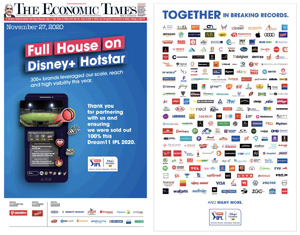
    KOLKATA: Disney+Hotstar has seen massive traction during IPL 2020, both in terms of audience as well as advertising. More than 300 brands leveraged the platform’s scale and reach during the tournament. Thanking partners, the OTT platform tooted the horn of its success from the front page of The Economic Times’ last Friday.

    “Thank you for partnering with us and ensuring we were sold 100 per cent during this Dream11 IPL 2020,” said Disney+Hotstar in the jacket spread. However, the platform did not share any metrics on engagement or viewership like it did the last two years.

    Disney+Hotstar currently boasts 18.5 million subscribers, a figure shared by its parent company The Walt Disney. “Disney+ ended Q4 with 73.7 million paid subscribers or an increase of over 16 million subscribers versus Q3. Disney+ Hotstar subscriber additions were the largest contributor to this increase, driven by the start of the delayed IPL season. Disney+ Hotstar subscribers now account for a little over a quarter of our global subscriber base,” Disney senior executive vice president and chief financial officer Christine McCarthy said.

    The platform decided to take IPL matches behind a paywall this year. It struck a deal with Jio and Airtel to boost subscriptions too. Hence, the bold move allowed brands to reach high spender quality audiences. It also added new features to the interactive Watch’N Play social feed. Replicating the exhilarating roar of the stadium, fans were able to use an interactive emoji stream, a move designed to boost engagement and social media traction.

    Every year, once the tournament gets over, the platform advertises to thank its partner brands and share the overall metrics that it has achieved during the tournament. It helps in creating a strong perception for the tournament as well as about Disney+Hotstar and how it is preferred by the audiences across the country.

  • OTT players up their focus on Tamil market

    OTT players up their focus on Tamil market

    KOLKATA: In India, content is king and over-the-top (OTT) players are increasingly dishing out programming to audiences in their local flavour, moving beyond the Hindi and English speaking segment. As developments in these frontier markets gain momentum, Tamil has emerged as an obvious choice. Some domestic players have already planted a flag in this domain over the last couple of years, and now, the deep-pocket streaming colossuses are also moving in.

    Disney+Hotstar, which started focusing on regional content since 2019, recently revealed its first Tamil original content slate, including feature films. A few days before that, Amazon Prime Video announced nine direct-to-digital premieres, and two of these big ticket releases are in Tamil language. Moreover, the service also started streaming its first ever Tamil anthology film Putham Pudhu Kaalai, a collaborative effort by five well-known Tamil directors. And while Netflix hasn’t made inroads in the regional market yet, the global streaming giant announced two Tamil anthologies in October.

    “Indian audiences have really diverse tastes and enjoy films and series in several languages. At Netflix, we’re steadily growing our original and licensed film catalogue across multiple Indian languages, including Hindi, Tamil, Telugu and Malayalam. We are honoured to showcase the brilliance of Tamil storytelling to our members in India and around the world through two new Tamil originals, Paava Kadhaigal and Navarasa. We will continue to engage with established and emerging creators from different parts of the country and hope to share their stories with the world,” Netflix India international original film director Srishti Behl Arya commented.

    Then there are streaming platforms like MX Player, Zee5 that have gone the regional route since the beginning. For instance, MX Player’s Tamil original Queen was a runaway success that won several accolades. The platform’s chief content officer Gautam Talwar said the series was probably the largest bet any OTT platform took for a regional piece of content, but what it proved was that a good story in any language transcends all barriers. According to him, its performance in Telugu and Hindi has been equally phenomenal, along with witnessing a 6X increase in Tamil consumption on the platform post the launch of the show. He noted that the platform has a robust slate for Tamil audiences planned for 2021.

    Moreover, the huge Tamil diaspora offers an opportunity to platforms beyond two-three states. “When we started conceptualising content including originals for the Tamil market, we knew that it is a huge opportunity, possibly as big as a Hindi venture. Tamil is also a language which allows you to go international very easily. So, you can end up targeting countries like Sri Lanka or Singapore. The language does not relate only to the Tamil Nadu market,” pointed out Zee5 programming head Aparna Acharekar.

    The Tamil market is an interesting segment in terms of content creation too. The audience is a developed film, TV market and has great expectations due to the variety of content they are already exposed to, Acharekar said. MX Player’s Talwar also stated that the Tamil market has historically had a palette for differentiated and bold content, which gives platforms more leeway to experiment with unique narratives and storytelling styles.

    “The big players always had the intent to invest in the regional market. Within the regional market, the largest markets are Tamil, Telugu. These are 65-70 per cent of the overall regional market. So, whenever one starts to move to regional, they will definitely choose Tamil, Telugu because it is a large audience base,” Elara Capital VP research analyst (media) Karan Taurani said.

    Asked to share his observations on the recent activity by leading OTT players in the regional space, Taurani shared that most of the leading players have already exploited the Hindi and English speaking market. At present, there is a low-competition intensity as no streaming giants have made a mark in the market, other than Zee5, MX Player. In fact, none of the OTT players has aggressively invested yet, he added. This, despite the fact that the Tamil viewers have a huge appetite for content, given their higher than national average time spent on TV, cinema occupancy.

    This recent trend of every player trying to expand their footprints – especially Amazon Prime Video, Netflix – may increase the competition significantly, especially for homegrown players. Zee5’s Acharekar seemed less worried as she is of the view that competition helps a market evolve, giving consumers more varieties in the narrative. Along with that, Zee5 possesses last two years’ learning in the episodic format, whereas others have been mainly experimenting with movies till now.

    Elara Capital’s Taurani noted that as more players stream into the Tamil market, the production cost will go up as global deep-pocket players invest at a different scale. Hence, domestic players may feel the pinch of higher content production costs. However, he mentioned that all of these platforms have a different target audience.

    “There is a huge audience base consuming online content right now, especially since the lockdown. Viewers have not only fast adopted OTT platforms as a medium of choice but are also investing time in watching and experimenting with different kinds of content. I think the more the content produced and served by platforms in regional languages, the more the overall category will grow and that is beneficial to all the platforms. So it’s not about the competition as much as it is about the category growth. Everyone is trying to tell stories in their own unique way and there is a large audience base to cater to for all these stories,” Talwar said.

  • Disney+Hotstar taps 13 sponsors for IPL 2020

    Disney+Hotstar taps 13 sponsors for IPL 2020

    KOLKATA: Disney+Hotstar has bolstered its sponsorship portfolio for IPL 2020 with 13 sponsors. The brands which have onboarded for the largest cricket showbiz span across categories.

    The start-up unicorn Dream11 is the co-presenting sponsor and Boost is co-powered by sponsor. The 11 associate sponsors include Acko, Maruti Suzuki, KhataBook, Flipkart, Swiggy, Ace23, HDFC Bank, Great Learning, MX Player, Kingfisher Calendar and AMFI (Association of Mutual Funds in India).

    “Dream11 IPL 2020 will be a major catalyst for viewers and fans, who are longing to see their favourite stars back on the field. We have created avenues for interactive advertising innovations which enable brands to engage with their audience more effectively," Star and Disney India ad sales president Nitin Bawankule said.

    Read more news on Disney + Hotstar

    "This has resulted in interest and investment from prestigious brands across categories as varied as auto to e-commerce to banking. All of this, coupled with enormous interest from viewers and fans, makes us confident that this year’s Dream11 IPL will be a resounding success,” he added.

    Considerably, Disney+ Hotstar recently decided to take IPL matches behind paywall this year. It has struck deal with Jio and Airtel to boost the subscription too. Hence, the bold move will allow brands to reach high spender quality audiences.

    Read more news on IPL

    Earlier, the platform has also announced the addition of new features to the interactive Watch’N Play social feed. Replicating the exhilarating roar of the stadium, fans will be able to use an interactive emoji stream.