Tag: Disney +Hotstar

  • Disney+ Hotstar, Endemol Shine India and Ram Madhvani Films to bring ‘Aarya’ season 3

    Disney+ Hotstar, Endemol Shine India and Ram Madhvani Films to bring ‘Aarya’ season 3

    MUMBAI: The Sherni is all set to sharpen her claws as OTT platform Disney+ Hotstar greenlights a new season of International Emmy-nominated Hotstar Specials’ Aarya. The series from filmmaker Ram Madhvani has officially entered its scripting stage. This show  follows the journey of a fierce mother to keep her family safe from the world of crime after entering the vicious network following her husband’s demise.

    The show’s lead actor Sushmita Sen said, “It is a new dawn for Aarya Sareen, and she is fierce. In Season 3, she is going places and starting her own story free from the obstacles of her past. Reprising the role of Aarya is like slipping into old jeans but for a brand-new journey. It feels great to be back with Ram Madhvani and the Disney+ Hotstar team, can’t wait to return the love and appreciation viewers have showered on Aarya.”

    Madhvani said, “Disney+ Hotstar has been an amazing partner in building Aarya through two seasons and we are delighted to associate with them once again for yet another season. The journey of developing a gripping storyline, thrill and family love has started and we are sure this will once again leave audiences wanting more! The stakes are only getting higher from here…! It’s great to be back with Sushmita Sen and co-producer Amita Madhvani and the full Ram Madhvani films team.”

    Disney Star HSM Entertainment Network head Gaurav Banerjee said, “Being nominated in the International Emmy Awards last year, Aarya is a crown jewel of Disney+ Hotstar. Since its first season, the show has truly been a game-changer, redefining Indian storytelling with women breaking stereotypes. We have received immense love and appreciation from viewers for the first two seasons, coupled with high anticipation on knowing what follows. We look forward to unfolding what happens next through the narrative of season 3! ”

  • Anish Mehta moves on as CEO of animation studio Cosmos-Maya

    Anish Mehta moves on as CEO of animation studio Cosmos-Maya

    Mumbai: Anish Mehta has decided to move on from his role as CEO of animation studio Cosmos-Maya after a ten-year stint. He built the studio from a 30-member team to a 1200+ powerhouse.

    He will be soon announcing his new venture sometime this year.

    Under Anish’s leadership, the studio has grown multifold owing to his strong ability to maintain a fine balance between business and creativity. He is credited with achieving quite a few milestones not only for the studio but also for the industry at large. Anish had been the CEO and minority shareholder of Cosmos-Maya since 2012.

    He led the studio’s foray into original Indian animation IP creation with the launch of Motu Patlu, India’s most successful animation series.  Post that, the studio created over 10,000 half hours of kids’ animation content across 20+ shows; maintaining a 50 per cent+ market share of the original Indian kids and family content space for a decade. The studio’s key clients include – Nickelodeon, Disney, Cartoon Network, Sony, Amazon Prime Video, Disney+ Hotstar, Netflix, Discovery Kids, Facebook and YouTube.

    During his tenure, the company grew with four different business streams globally and revenue and earnings before interest, tax, depreciation and amortisation (EBITDA) growth of 25x+ from 2012 to 2022. Globally he spearheaded efforts towards co-productions with European and other international players, which were able to sell in 100+ countries the world over.

    His most notable achievement was to steadily attract organized investment into the business and consistently give investors a profitable exit through a higher valuation of the company. He played an instrumental role in getting private equity investors into the Indian animation business, first with KKR backed Emerald Media and later with TPG affiliate NewQuest Capital Partners.

    Commenting on his exit, Anish Mehta said “I would like to thank Ketan and Deepa, the promoters of Cosmos-Maya for trusting me with the opportunity of growing the company. I would also like to extend gratitude to our previous investors KKR backed Emerald Media, Rajesh Kamat and angel investor Tilak Sarkar for providing the right guidance and support on this journey. It has been a great pleasure working with the current investor, TPG affiliate NewQuest Capital Partners and I wish them and the team of Cosmos-Maya all the very best for future growth and to carry the legacy forward.”

    He also led the initiative of building the company’s YouTube network, WowKidz with 35 channels, which achieved 80 million+ subscribers, and 41 billion+ views worldwide across 10+ languages in a short span of 5 years. “I feel very passionately about content creators and believe that digital media has offered a rather egalitarian and equalizing platform to all creators. I find the best way to express my appreciation is to be able to support and mentor the new generation of digital content creators as they set out to create path-breaking content that will have a positive impact on countless lives of kids & family audiences. The intention is to partner with global investors and pioneers to achieve this vision”, said Mehta.

  • Voiro has always helped publishers to understand & manage their revenue better: Kavita Shenoy

    Voiro has always helped publishers to understand & manage their revenue better: Kavita Shenoy

    Launched back in 2014, Voiro is a revenue management product suite for media houses and digital publishers. It consolidates diverse technologies & multiple sources of revenue. A data technology company, Voiro brings automation and intelligence to media organisations across the world, enabling them to make data-driven business decisions.

    Currently, Voiro cpowers many OTT players, digital publishers & media houses in India. The company says that it is trusted by prominent OTT players and publishers such as Disney+ Hotstar, Voot, BookMyShow, Zee5, OLX, Flipkart, and DSTV (South Africa).

    Co-founded by Kavita Shenoy & Anand Gopal, Voiro Technologies positions itself as being India’s first definitive revenue analytics and technology stack for content, media and publishing. Voiro’s engineering products that power revenue optimization & workflow automation for ad-led companies. Its SaaS based product harnesses the power of data to track ad inventory in real-time and gives their customers instant access to actionable intelligence.

    The company’s technology has driven colossal live events year after year such as the IPL, the Oscars, Bigg Boss and Big Billion Day. The company has already raised ₹2.5 crore in a pre-Series A round from crowdfunding platform 1Crowd’s investor community and angel fund. The funding has propelled it to grow ~4x in the last year, pushing the annual recurring revenue (ARR) towards the ~$1mm mark that helped the company to bag its first international customer.

    An ex-googler and a tech-aficionado, Shenoy heads business strategy and development at Voiro. She is one of the few Indian women entrepreneurs who has carved out her niche and solidified her position in the tech and SaaS space. She believes that technology is an enabler and has the power to revolutionise & drive business, which is Voiro’s core strategy. She is devoted to solving problems faced by media houses, digital publishers and top OTT players in India, which is bringing the digital/operational transformation as well as helping to become future-ready.

    She is an undergraduate major in Economics from the University of Mumbai and began her career in advertising, with Lowe Lintas where she managed some of the country’s largest consumer brands. At Tirage Worldwide, she handled media consultancy & experiential marketing for various businesses. She proved her prowess in the content analytics domain by spearheading the launch of Doubleclick YouTube in India & South East Asia.

    At Google, she conceptualised & delivered compliant launches & programmes in media platform policies through advocacy and governance frameworks. Having worked intensively with large advertiser programs for Google, she used her deep understanding & knowledge of the space to identify gaps that existed between advertisers & publishers. Armed with this insight, she founded Voiro which was at the intersection of data meets technology, which is a strong central need in the market currently.

    At Voiro, she has been working hard to scale up the company and to build a dominating presence not only in India but also in the overseas markets. She has been leading a lean, agile, expert team towards steady growth over the past six years. She envisions Voiro being the SaaS partner of choice to all the major content companies in the world. 

    Indiantelevision.com caught up with founder & CEO Kavita Shenoy to find out more on the company’s plans.

    By Ashwin Pinto

    Excerpts: 

    On the market gap she witnessed in 2014 when Voiro was launched

    Voiro was built to address a gap on the publisher side of the advertising industry. That was a time when the use of data in digital advertising was only just beginning to proliferate, but a large part of the evolution was on the advertiser side. We realised that publishers were going to grapple with new data-related problems, and we set out to solve some of those. 

    The company evolved its offerings over the years

    The core problem that Voiro solves has always been to help publishers understand and manage their revenue better. And what has changed is that more & more sectors face similar challenges, so our product has evolved to serve not just media / OTT businesses, but also e-commerce, telecom and potentially gaming. Essentially, anyone who makes money from digital advertising.

    On the product front, we have been able to go deeper into our problem space every year. For example, we began with just revenue reporting, but have moved into workflow automation, as well as insights and recommendations. In short, anything to help publishers make more money from their ad inventories.

    On the goals for this year

    Our focus for this year is growth. We see the industry expanding, our target customer is growing, and we know that the problems we solve are problems that every publisher faces at some point in their growth journey. Our goal for the year is to ride this wave and take our products to more customers and geographies. 

    On how Voiro is leveraging growth in the OTT space

    OTT has for many years been our core focus, and we work with nearly all of India’s large OTT players. Our goals are to grow our presence in the OTT space abroad, while also ensuring that we take our product to other promising sectors such as e-commerce.

    On the challenge that media & entertainment companies face in being data first

    Today, collecting data is never a problem, especially for any business in the media space. Putting that data to good use is a completely different problem. We see businesses across our target sectors struggle to organise their wealth of data, ask the right questions, and put the data to use in a way to help drive growth. It is because growth is the only thing that matters to these businesses; just having data is not enough.

    On Voiro’s recently launched revenue reconciliation product

    Revenue reconciliation is at the heart of what Voiro does, and is built to answer a single crucial question for publishers: “How much have I earned so far?”

    Digital advertising is incredibly dynamic, and advertising campaigns are subject to extensions, truncations, changes in targeting, and several other situations that affect the delivery of these campaigns. For a media business to understand the state of delivery of several hundreds of parallel campaigns can be challenging, and borders on impossible at a large enough scale.

    Revenue reconciliation automates this process for publishers, helping them understand how much money they have made at any point in time, where it came from, and what they should do to grow.

    On finding the right product market fit in a rapidly evolving media & entertainment industry

    Although media and entertainment businesses are rapidly evolving, the core problem that Voiro solves are the revenue visibility and management – is constant. A business could make money via direct sales or programmatic, from India or abroad, via their website, app or streaming platform. As long as they sell ads, we can help them. And to that extent, product-market fit has not been a challenge to find. 

    On the evolution of ad tech from where it was a few years ago

    As with the broader industry, adtech is constantly evolving. Products have appeared that solve all kinds of problems on either side of the advertising equation.

    But for both publishers and advertisers, the challenge is this: building an adtech stack is easy. Getting the most out of the stack, making sure all the parts work together, and building the right organization around that stack, are the most important questions about adtech today.

    OTT platforms need to be more innovative in terms of offering solutions to advertisers

    OTT platforms are constantly experimenting with the solutions that they offer advertisers. In fact, to use a prominent example, the growth of IPL ad revenue over the years is due in large part to Star’s willingness to experiment & innovate.

    Advertisers are always looking for new ways to reach their customers, just so long as the value is clear. Therefore, OTT platforms are always going to continue to look for new ways to earn their next marketing dollar.

    On whether the lack of single currency measurement for digital is hurting the revenues that OTT platforms get

    Measurement is an essential aspect of advertising. Advertisers have been willing to accept a variety of measurement metrics for digital marketing, which led to the growth of performance marketing. So on the contrary, this has probably helped grow digital ad revenues, rather than hurt them. However, all publishers (including OTT platforms) must be aware that advertisers will always seek a balance between brand and performance spends. The publishers will always have to look for better and more accurate ways to demonstrate outcomes, even more so as ad rates rise and if businesses are under economic pressure.

    On platforms needing to improve the ability to deliver ads in the right context

    The challenge here is to achieve micro targeting in a cookie-less world. And inevitably, the answer is for publishers (including OTT platforms) to make use of first-party data. A platform that is able to truly leverage their first-party data will outperform the one that does not, and should be able to command a significant premium for their ad inventory.

    On the role of augmented reality (AR) and virtual reality (VR) when it comes to content & advertising on OTT platforms

    AR and VR, at this point, are very nascent technologies, even more so in markets like India. It may be a while yet before we see commercial-scale content and advertising making use of AR and VR, but smart advertisers and publishers are always going to keep an eye out for opportunities.

    On how she observes Viacom18 faring with the digital rights of the IPL in the next five years.

    The bids for IPL rights, as expected, were significantly higher than the 2017-22 auction, and the winners are going to find it challenging to make a profitable business of it. Regarding the digital rights, it is clear that Viacom18 will have to explore all possible monetisation routes: subscriptions, advertising and transactions.

    We see their road ahead in three parts: first, ensuring that they win over all the viewership that Hotstar has amassed over the last five years; this will by no means be automatic. Second, building the infrastructure to deliver advertising at scale to this audience. And finally, pulling out all the stops to maximize their ad revenue over five years. This last part will be hard; Viacom18 will have to really innovate to create more ad spots, formats and properties to monetise, as well as demonstrating real value to advertisers so as to command premium rates.

    On whether it is mainly going to be a subscription play

    It is hard to see the winners being able to monetise their rights solely via subscriptions. India has been a hard market to win over from a subscriber point of view; this is most easily seen in Netflix & Disney’s performance over the last two years. These companies, both running massive and successful global subscription businesses, have both struggled to match that success in India. For the winners, the next five years has to be about a combination of advertising & subscriptions.


  • Bharti Airtel launches new broadband plans for connected TV homes

    Bharti Airtel launches new broadband plans for connected TV homes

    Mumbai: Bharti Airtel on Monday announced the launch of new bundled plans for its home broadband customers. The highest tier plan at Rs 1,599 includes subscriptions to Netflix, Amazon Prime and Disney+ Hotstar. All the plans include subscriptions to 14 OTT (over-the-top) platforms and 350 TV channels and speeds up to 300 mbps.

    The new Airtel Xstream fiber broadband plans include single-login access to the OTT platforms SonyLIV, Eros Now, Lionsgate Play, Hoichoi, ManoramaMax, ShemarooMe, Ultra, Hungama Play, EpicOn, DivoTV, Klikk, Nammaflix, Dollywood and Shorts TV for customers who purchase the Airtel 4K Hybrid TV Box.

    The home broadband market has grown by 2X while the number of OTT has jumped from 9 in 2012 to 40+ in 2021. Bharti Airtel has launched the new bundle plans keeping in mind the entertainment needs of connected TV homes.  

    Bharti Airtel CEO – homes Vir Inder Nath said, “Our new plans are built for India’s emerging entertainment needs. Through these bundle offers we plan to offer our discerning customers great value, convenience and unlock a multi-faceted digital experience.”

    “Increased broadband consumption in Indian homes has given rise to the phenomena of hybrid viewing, where families are looking to consume OTT content on the TV screen along with linear TV without the hassle of managing multiple subscriptions and devices,” he said in a statement.

  • My11Circle Women’s T20 Challenge to air on Star Sports & Disney+Hotstar

    My11Circle Women’s T20 Challenge to air on Star Sports & Disney+Hotstar

    Mumbai: Even as the pulsating IPLT20 tournament has entered the playoff stage, Disney Star India has announced that it’s going to add to cricket lovers’ excitement by airing My11Circle Women’s T20 Challenge from 23 May to 28 May on the Star Sports network and stream it on Disney+ Hotstar as well. The tournament will have multilingual feeds in English, Hindi, Tamil, Telugu, and Kannada.

    The tournament features three teams Supernovas, Trailblazers and Velocity with Hamanpreet Kaur, Smriti Mandhana and Deepti Sharma respectively leading them. Shafali Verma, Deepti Sharma, Jemimah Rodrigues, Pooja Vastrakar, Yastika Bhatia, Rajeshwari Gayakwad, Richa Ghosh, Poonam Yadav, Shafali Varma, Sneh Rana, and Taniya Bhatia are some of the national Indian cricketers who will be battling it out in Pune’s MCA stadium. The teams are also sprinkled with some overseas greats like Sophie Ecclestone, Deandra Dottin, Laura Wolvaardt. Hayley Matthews, Kathryn Cross, Salma Khatum and Sophia Brown.

    Each of the teams will play a match against the other, with the top two sides featuring in the final on 28 May.  

    Star Sports has launched a promo film in two languages (Hindi and Telugu) ahead of the start of the tournament. Created and conceptualised by the in-house team of Disney Star, it features Bollywood star Taapsee Pannu. 

    “My love for sports is known to all but the love for cricket is different,” said Taapsee Pannu. “In the last few years, we have seen that women’s cricket, in India and across the globe, has made huge progress not just in its technicality and competitiveness, but in popularity as a brand as well. The WT20 Challenge 2022 will undoubtedly be an extraordinary tournament featuring top cricketers and will offer immense excitement to fans and supporters of the game of cricket worldwide.”

    The WT20 Challenge has attracted Games24X7’s MyCircle 11 as a title sponsor, even as FanCraze, Ceat and Boost have come on as official partners. These were announced by the BCCI over the weekend. 

    “The return of the My11Circle Women’s T20 Challenge and with the interest being generated around the tournament we are well on our way to solidifying the pathway to a dedicated Women’s IPL and continue to grow participation of women in the sport,” IPL chairman Brijesh Patel had said during the announcement. “New partners coming on board is testament to the quality and popularity of the tournament. We hope the My11Circle WT20C provides ample opportunities for players to step up and be a role model for all the budding women cricketers and for those young fans who are the backbone of the sport. We thank all the Partners for their continuous support.”

    Added Games 24×7 co-founder & co-CEO Bhavin Pandya: “We are very excited to be title sponsors of the upcoming Women’s T20 Challenge 2022. One of the most endearing developments in the cricket world in the last few years is the growing popularity of women’s cricket. This contest, which will feature some of the finest cricketers in world cricket, will give a further fillip to the rising popularity of women’s cricket, and will offer immense excitement to fans and supporters of the game of cricket worldwide.”

    For cricket crazies, there’s a bounty in store. 

  • ‘We’re a company of technologists and storytellers’: Disney+ Hotstar’s Content Head Gaurav Banerjee

    ‘We’re a company of technologists and storytellers’: Disney+ Hotstar’s Content Head Gaurav Banerjee

    Mumbai: Gaurav Banerjee has successfully straddled the realms of television and digital to deliver the most popular content in India. He runs Star India’s content studio that has delivered nine out of the top 15 web series and six out of the top 10 Hindi TV shows in the country. On the TV side, he’s responsible for popular shows such as Diya Aur Baati Hum, Sasural Genda Phool and on the digital side he’s responsible for hits such as Aarya and Special Ops amongst others.

    He began his career at Star TV Network as a primetime anchor and senior producer at Star News. He launched the Bengali news channel of the group Star Ananda in 2005 and later moved to lead the content strategy of the network’s regional entertainment channels in 2008. Banerjee was responsible for expanding the network’s reach in two key markets West Bengal and Maharashtra with the channels Star Jalsha and Star Pravah, respectively. In 2009, he led the content strategy for the Hindi entertainment channel Star Plus as general manager. He propelled Star Plus into a leading brand with hit shows like Yeh Hai Mohabattein and Mahabharata. In 2015-16, he took charge of Star India’s content studio and refreshed the storytelling approach for Star Plus and Star Bharat.

    Transforming India’s Content Landscape

    Banerjee is a man on a mission to transform India’s content landscape. He is leading Disney+ Hotstar’s foray into original content and has produced several Hotstar Specials that appeal to the unique tastes of digital audiences. While media executives are accustomed to treating television and digital as disparate creative ecosystems, Banerjee’s view is that good content can find its audience on any medium.

    Disney Star head content for HSM entertainment network and Disney+ Hotstar Gaurav Banerjee joined The Adaptation Company creative entrepreneur specialist and producer Sunil Doshi for a candid fireside chat at an event held recently in Mumbai. He spoke about driving the storytelling agenda at Star India, the advantage of being a legacy media company, producing innovative content for Disney+ Hotstar and helming Star India’s writers’ program.

    Edited Excerpts…

    Sunil Doshi: The traditional wisdom says that creating stories for television medium and creating stories for OTT medium are two different things. How have you successfully straddled both these words making Disney+ Hotstar a leader with enviable subscriptions?

    Gaurav Banerjee: We’ve always thought of ourselves as a storytelling and content company. When we’re looking at a script, we want to understand three simple things. First, how is the story going to be fresh to us and our viewers as well? Second, whether it might be relevant to our audience. Third, who is the storyteller and why is he/she excited to tell this story.

    We’ve always approached our scripts essentially using this process. We don’t think too much about distribution in the beginning phase because linear television and streaming are just different ways of distributing content. We’re comfortable with the idea that consumers can choose what technology or distribution platform works for them best. There may be format related choices depending on the media (some formats sit better on TV while others sit better on digital) but those are second order questions.

    Fundamentally, Star has a rich tradition of storytelling that goes back two decades. When we entered digital, we wanted to be native to the digital world and so, we expanded the brief of what we were as a company. Today, we’re a company of technologists and storytellers. The journey we have traversed has taken us from being a company with a consumer and storyteller mindset to a company that understood the product, technology, engineering and storytelling.

    Sunil Doshi: The economic models of streaming are changing. There is global inflation and war in Ukraine. There are streaming platforms that are gaining subscribers and others that are losing subscribers. Amidst all of this do you see Disney+ Hotstar as a technology company or a creative company?

    Gaurav Banerjee: I think Disney+ Hotstar is both. We see ourselves as a content platform that is always thinking about how to create technology that is intuitive for our viewers in India today. As we were building this platform eight years ago, we realised to achieve the scale we needed to reside on mobile phones. This was different from what was happening in the West where streaming was happening on connected TVs in people’s homes. The fact that we were mobile-first meant that our technology needed to be different.

    We were a legacy media company thinking about streaming. There were two advantages to this. First, we knew India’s consumers because we were the biggest broadcaster in the country and second, we understood storytelling having done it for two decades. The fundamentals we arrived at to be a platform that had scale were three things. First, we needed to have a big presence in live sports. Second, we needed to have a big presence in the movie business. Third, we needed to have a really big presence in drama.

    From day one, our content portfolio has tried to traverse and build on these three pillars. I’ve been in TV for 22 years now and these are the big pillars of Indian television. These three pillars take care of most of the entertainment needs of consumers.

    Sunil Doshi: You’ve dealt with technology. Now, you’ve done some exciting content innovations at Disney+ Hotstar where traditional TV content is feeding streaming content. What is your creative team doing to spot such opportunities?

    Gaurav Banerjee: Star is an interesting company with a great culture. While in some ways we’ve been leaders of entertainment in this country, we’ve always thought of ourselves as challenges.

    When we entered the digital space, we felt that there was a bias working against us. We were this legacy media company that has entered the streaming space and was not accustomed to the industry jargon or ways of working. We didn’t create this ecosystem or arrive here first. But we asked some fundamental questions and reimagined this world.

    The first decision we took was that streaming is something that can and should happen at scale. Therefore, the kind of content that is made for streaming should be high quality but cater to all audiences and not some niche.

    We took two strategic decisions, first, we decided to put our best content on streaming platforms. So, our linear TV content is first available on Disney+ Hotstar for paying subscribers. We observed that a lot of fans of the show will catch up on the latest episode during the day without waiting for it to be telecast at 10 pm on Star Plus.

    In a traditional setup, if we had taken such a decision, I would be worried because I’m doing something that’s threatening the ratings and viewership of the TV show. However, we changed the way we incentivized creative teams to focus on building a great show and not where consumers are supposed to watch it.

    There was a real feeling that TV shows, TV producers, and TV actors are in some way not good enough for digital. As someone who’s coming from a television background, we were clear that we were not going to participate and fuel this bias against TV content in any way.

    That’s why I’m incredibly proud of our Anupama prequel that’s streaming on Disney+ Hotstar called Namaste America. The show reveals when the first cracks appeared in Anupama’s marriage before the events in the TV series transpired. Another popular franchise Bigg Boss was doing well for our regional channels in Telugu and Tamil. Here, we felt a digital-only version with Stars like Kamal Haasan and Nagarjuna would work and both those seasons have done well. There are franchises such as “Special Ops” where we did a spin-off series that was just four episodes which worked on digital. We’re open to more experiments on OTT like Namaste India, Bigg Boss and Dance+.

    Sunil Doshi: I consider Star television as a thought leader as they have created so many iconic IPs. In the near absence of TV schools and film schools in our country, where is the new talent that is going to fuel creativity on digital and television going to come from?

    Gaurav Banerjee: We look at ourselves as an IP creation company. If we keep creating high-quality IP and continue to capture the imagination of audiences then monetisation will follow. That also means that we’re in the business of finding the best creative people, the best creative ideas and jostling with them in a healthy environment. The writing and creative community deserve our empathy because as an executive I’m looking at several scripts every day but they’re working on 1-3 stories and putting pen and ink to paper. We need to be conscious that we’re doing a good job of finding the best creative talent and treating them with empathy.

    When I was a student, I wanted to get into the creative business and understand how to make a TV show or film. This was in the year 1998 and after coming out of college I discovered there were only two places in India of any repute where you could learn to become a filmmaker or TV producer. One of them admitted 15 people and the other admitted 18 people. There were just 33 seats and I hoped to get one of those 33 seats. The luck of the draw.

    I got lucky but I realised this is a small number for an industry that is so big. For several years, I struggled to find new writers to bring to television. The belief we had as broadcasters is that there is a market need and so someone will come and build these institutions to feed this market. But nobody came. I urged both the institutions known for TV and filmmaking to start a course that teaches students how to write TV series. But that did not happen. How is the industry going to get better if no one is going to share knowledge, best practices and learn from each other?

    Star India put together a budget, teachers and a syllabus and a website to launch the program. We hired people and essentially, I asked all my writer friends in the industry to come to take classes and get the program going. We hired someone to put together a syllabus as this was a specialised program. I don’t know how many other companies are there where you can go to the CFO and say we’re spending a few X crores and there’s going to be no monetary return at the end of it. With a new show, you can get some revenue but with the writer’s program, no money is immediately going to come. It was just something to set up these budding writers and hopefully, if they become good writers, they might write something for us in three to four years but not necessarily.

    The great thing about our company and my pitch was that as long as the industry improves and there’s great writing then it is understood that we will also improve. That’s how we created the Star writers’ program and we had about 35-40 writers on our payroll over the last three to four years. While it undoubtedly has had its share of problems, it is also something that we’re very proud of.

  • Vamsi Murthy joins Disney+ Hotstar as ED and Head-content marketing

    Vamsi Murthy joins Disney+ Hotstar as ED and Head-content marketing

    Mumbai: Disney+ Hotstar has appointed Vamsi Murthy as executive director and head content and partnerships marketing. He announced his new role on LinkedIn.

    Vamsi was previously associated with BookyMyShow as head of marketing from May 2021. He has been associated with Zee5 as vice president marketing, Myntra Jabong as director brand marketing and MakeMyTrip.

    He has completed his MBA in marketing from Welingkar Institute of Management and is an alumnus of SIES College of Commerce.

  • Programmatic is enabling the transition of OTTs to open internet: Tejinder Gill

    Programmatic is enabling the transition of OTTs to open internet: Tejinder Gill

    Global technology platform The Trade Desk helps marketers advertise on the ‘open internet’ i.e., outside the ecosystems of Google and Facebook. The Trade Desk can deliver campaigns across a multitude of devices such as computers, mobile devices, OTT, connected TV (CTV) to reach quality audiences at scale via video, audio, display and native ads.

    Founded in November 2009, the company launched in India almost a year ago, setting up their leadership teams in Delhi and Bangalore. It immediately integrated with leading OTT players including Disney+ Hotstar, Zee5, SonyLIV, MX Player and Voot and publishers to enable programmatically-driven advertising and bring transparency to the purchase of online inventory.

    The Trade Desk is only a demand-side platform, meaning it optimises and solves for advertisers only. It helps them understand the break-up of their media investments at scale in a complicated supply-side ecosystem that has up to seven to eight partners. Its most important USP (unique selling point) is that it offers marketers more choices to advertise outside the established walled garden ecosystems.

    Helming The Trade Desk’s business in India is Tejinder Gill who is responsible for the business growth strategy, executing the company’s vision and long-term goals and leading the product development. He is spearheading the expansion of programmatic across digital, audio, video and connected TV for Trade Desk. Gill has more than 17 years of experience, starting his career in 2008 with Yahoo, he was later part of LinkedIn’s leadership team for six years and Truecaller’s executive management team for nearly five years.

    In conversation with IndianTelevision.com, The Trade Desk India general manager Tejinder Gill spoke about the challenge that the company is trying to solve, online advertising trends, growth of advertising video-on-demand (AVOD), moving away from third-party identifiers and more.

    Edited excerpts:

    On the challenges addressed by The Trade Desk

    We are all about open internet which means anything outside the walled gardens. The biggest keyword missing in India, when it comes to digital media buying, is choice. Marketers want to get a certain reach and scale that you can only get within the walled gardens. So, the vision we saw was how to build an open internet advertising platform at scale.

    Let’s say, $100 is spent on advertising. Almost $53 goes to Google, $28 goes to Facebook and the remaining $19 is shared among the rest of the players which includes any player other than these two. The biggest reason that marketers are looking for a third choice is that these platforms make their own rules. They withhold data and the inability to measure performance in these walled gardens has led to a lot of frustration among marketers.

    I have observed that 70 per cent of the time spent by a user is on the open internet while 70 per cent of marketer’s budgets are spent on walled gardens. This is disproportionate. The biggest challenge for me is to educate marketers and partners about the benefit of the open internet and how we can solve for reach and scale.

    Think about the open internet as a bunch of different islands and walled gardens as continents. However big you are, you will always remain an island. Our platform makes these islands come together, and talk to each other so that everything is more accessible. The future will see all publishers come under the open internet umbrella. And programmatic is enabling this transition.

    Publishers still have direct sales teams to sell their premium inventory and sponsorships but the bulk of their inventory is now available on programmatic. That means all their pipes are connected to us. We’re building a marketplace where advertisers can pick and choose any inventory they want. They can use any measurement tool or any data partner that they want.  Individually, you can never win the game of scale, but together the open internet is a very strong value proposition for marketers to move away from walled gardens.

    When I joined the company 16 months ago, and the next month we complete a year of launch in India, programmatic talent was a big issue. We addressed this with Trade Desk-Edge Academy certifications, and interestingly, 40 per cent of members who have taken the certification in Asia-Pacific (APAC) are from India. I have built a diverse leadership team across Delhi and Bangalore since then.

    We’ve done strategic partnerships with publishers, OTTs and connected TV manufacturers to be the platform of choice for marketers. This includes partnerships with Samsung TV, OTT platforms such as Disney+ Hotstar, Zee5, SonyLIV, Voot and MX Player and audio streaming services such as Gaana, JioSaavn, and Spotify.

    On the rise of programmatic video advertising

    The OTT consumer base has gone up in the last two years. There are new players entering the global and local markets creating more competition. While linear TV has been there for many years, consumer trends are changing. Some consumers are opting for cutting the chord as a result of the adoption of OTT platforms. OTT offers a seamless viewing experience across devices making it the preferred platform for consumers and building an attractive reach and scale for marketers.

    Online curated content platforms (OCCs) are offering premium high-quality content. An OTT platform attracts a large and diverse audience. The biggest difference between a user-generated content platform and an OCC platform is brand safety. Since curated content will be safer and more positive in nature, brands will want to invest in it. It also helps that you can put a data layer on top of it that delivers better performance, measurement and offers real-time insights to marketers.

    The biggest difference between linear and OTT platforms is the application of data intelligence. Linear TV has always relied on third party intelligence. The impact of an OTT campaign is measurable and you can take the insights and apply them to any other campaign.

    It is also more controlled. For example, suppose you want to target a consumer only three times a day then you can apply a frequency cap. If you want to target him once on Disney+ Hotstar, Voot and SonyLIV then you can adjust your parameters accordingly. This translates to a better consumer experience.

    The one thing that marketers love about programmatic is optimising their media dollars and talking to the same user across the media funnel. This means that whether I’m watching TV, mobile, laptop, OTT or audio, the same message will be played in a different format across.

    A study we did last year in partnership with YouGov found that 55 per cent of Indians prefer to see an ad versus paying for content. This indicates that the future business model for OTT platforms will be one that will be supported by subscription and advertising.

    Our founder Jeff Green predicted three years ago that Netflix will embrace advertising. Today, international players such as Disney+ and Netflix are planning to launch ad-supported models.

    On moving away from third-party cookies

    Third-party cookies are a three-decade-old technology and a shrinking part of the internet. Now, we have to think of a more sophisticated solution and we’ve created our own identifier called UnifiedID 2.0. It is a string of numbers and letters that cannot be reverse engineered to reveal the identity of the user, say for example his email ID.

    If third-party cookies go away, what are the scenarios that marketers arrive at? Walled gardens get more control over the internet. Paywalls keep consumers from accessing content. Consumers having to login multiple times to access the internet.

    That’s why the future will have multiple identity solutions that will be interoperable, meaning that these identity solutions will work across the ecosystem and will need to talk to each other. Our identity solution has got a lot of adoption in the Western market and we’re hoping APAC will start running it soon.

    On the trends in programmatic video advertising

    There are a few trends that I see.

    Connected TV (CTV) will drive the next phase of growth. We expect CTV to hit 40 million devices in the country in the next two years. This means that budgets will start moving from linear TV to connected TV.

    Marketers will start asking everyone about more real-time business outcomes. Marketers will move away from metrics such as CPA (cost-per-action), CPC (cost-per-click), CPM (cost-per-mile) and start measuring in more detail. For example, in-store footfall.

    A cookie-less future is good. It is happening for the benefit of the entire industry. Advertising will be able to target with more precision enabling brands to present different ad opportunities at different points in time. I think this is a new approach for the future.

    Five years ago, when we launched programmatic the idea was to automate the entire paperwork also known as programmatic guarantee. That’s not the real advantage of programmatic. Programmatic is all about decisioning i.e., it is about choices. If a marketer wants to buy audiences who may reside on OTT, mobile, CTV then he can find them across channels and devices. That’s the biggest trend that will drive programmatic in India over the next two years.

    Decisioning is different from upfront media buying. In upfront media buying, an advertiser blocked the front page of a Times of India or a 15 sec slot on a channel. The advertiser would pay upfront and get the ad displayed.

    In a real-time environment, the advertiser wants more control. He wants to pick up the right audience, at the right time and at the right price. The advertiser can control whether that ad should reach 1000 or one million consumers and pay for the reach that he wants. The journey of the ad needs to be mapped. That’s why I say decisioning will take precedence over the existing programmatic guarantee.

  • Disney+ Hotstar aims to produce 100 local original titles in India

    Disney+ Hotstar aims to produce 100 local original titles in India

    Mumbai: The Walt Disney Company has revealed that there are 500 local original titles in various stages of development and production for Disney+ and gave a breakdown of the number of titles slated for each region during its second-quarter earnings call for fiscal 2022. According to The Walt Disney Company senior EVP and chief financial officer Christine McCarthy, there are 140 local content titles slated for the Asia Pacific region including Southeast Asia, 150 titles for Europe, the Middle East, and Africa (EMEA), 100 titles in production in India and 200 titles in Latin America.

    “We are enthusiastic about our growth potential in international markets,” said The Walt Disney Company chief executive officer Bob Chapek. “We currently have over 500 local original titles in various stages of development and production. 180 of those titles are slated to premiere this fiscal year, increasing to over 300 international originals per year in a steady state. We believe these premium local originals, along with branded content with broad international appeal, will attract new subscribers and drive engagement.”

    The Walt Disney Company has said that it plans to spend $32 billion on content in 2022 out of which one-third will be in sports, and the balance will be dedicated to investments into general entertainment content including linear, theatrical, and direct-to-consumer (DTC) platforms.

    The company recently announced plans to introduce an ad-supported subscription offering for Disney+ in the US by the end of the calendar year that will roll out internationally in 2023. The company saw a stellar quarter for its streaming services with more than 205 million subscriptions overall (Disney+, ESPN+, Hulu) adding 9.2 million subscriptions in the quarter. The majority of the new subscriptions were driven by Disney+ which added 7.9 million subscribers which came to a total of 138 million global paid subscribers. A little over half of the net adds were from Disney+ Hotstar which benefited from the start of the new IPL season towards the end of the second quarter, noted McCarthy.

    Excluding Disney+ Hotstar, internationally the service added over two million paid subscribers with Latin America being the strongest contributor.

    As per the earnings report, Disney+ has 44.4 million subscribers in the US and Canada and 43.2 million international subscribers excluding Disney+ Hotstar. Disney+ Hotstar has 50.1 million subscribers, a massive jump of 42 per cent over the corresponding quarter in the previous year. The average revenue per paid subscriber in the US and Canada is $6.32 while for Disney+ Hotstar it is at $0.76.

    The average monthly revenue per paid subscriber for Disney+ Hotstar increased from $0.49 to $0.76 due to launches in new territories with higher average prices and higher per-subscriber advertising revenue, partially offset by a higher mix of wholesale subscribers.

    The company’s direct-to-consumer revenues for the quarter increased 23 per cent to $4.9 billion and operating loss increased to $0.9 billion. The increase in operating loss was due to higher losses at Disney+ and ESPN+ and lower operating income at Hulu.

    The lower results at Disney+ were due to higher programming, production, marketing and technology costs offset by increase in subscription revenue. The higher subscription revenue was due to subscriber growth and increases in retail pricing. The increases in costs and subscribers reflected growth in existing markets and expansion into new markets, to a lesser extent.

    “Direct-to-consumer programming and production costs in Q3 (third quarter) are expected to increase by more than $900 million year-over-year, reflecting higher original content expense at Disney+ and Hulu increased sports rights costs and higher programming fees at Hulu Live,” Christine McCarthy stated.  “At Disney+, while we still expect higher net adds in the second half of the year versus the first half, it’s worth mentioning that we did have a stronger-than-expected first half of the year.”

  • Cred IPL 2022 campaign: Has the brand lost the plot with its ‘nostalgia’ overkill?

    Cred IPL 2022 campaign: Has the brand lost the plot with its ‘nostalgia’ overkill?

    Mumbai: Love them or hate them, you can’t ignore them! Yes, we are referring to the ubiquitous Cred bounty ads. Whether you tune into Disney+ Hotstar to catch the day’s play of IPL or switch on your TV, the Cred bounty advertisements are out in full force. This time around, the brand turned the clock back to the 1990s, going on to serve the viewers a ‘bounty’ful of small screen nostalgia in a scene-by-scene recreation of the period’s all-too-familiar advertisements and television shows. There might even be a risk of overkill, with the jarringly repetitive call of “Cred Bounty” playing on a loop, ad nauseam.

    Nostalgia done right? Let’s hear what the industry executives and discerning netizens have to say on the latest bounty of Cred ads unleashed on the unsuspecting viewer.

    Cred ads have consistently played up the 90s nostalgia factor. Be it their 2020’s ‘Not everyone gets it’ IPL campaign with the decade’s popular film stars, playback singers, musicians who have you jamming to Cred jingles. Or its 2021’s ‘Great for the good’ IPL campaign, that had a staid Jim Sarbh doling out the credit card payment app’s virtues followed by a video of diverse celebs and sports stars from the decade in wholly uncharacteristic avatars. So we had a fuming, ballistic Rahul Dravid, a team of 90’s cricketers featuring in a boy-band and an eclectic Kapil Dev channelling his inner Ranveer Singh to the hilt. There was even a normally reticent, fresh off his Olympic-win Neeraj Chopra showing off his acting chops, though he technically belongs to this era.
    These ads were high on entertainment quotient and managed to grab one’s attention without trying too hard. Of course, whether they helped sell the product or not, is another matter entirely.

    For this year’s IPL season, the Bengaluru-based fintech brand has notably decided to play it a tad differently for its ‘Play it different’ 2022 IPL campaign, promoting its Cred Bounty feature.

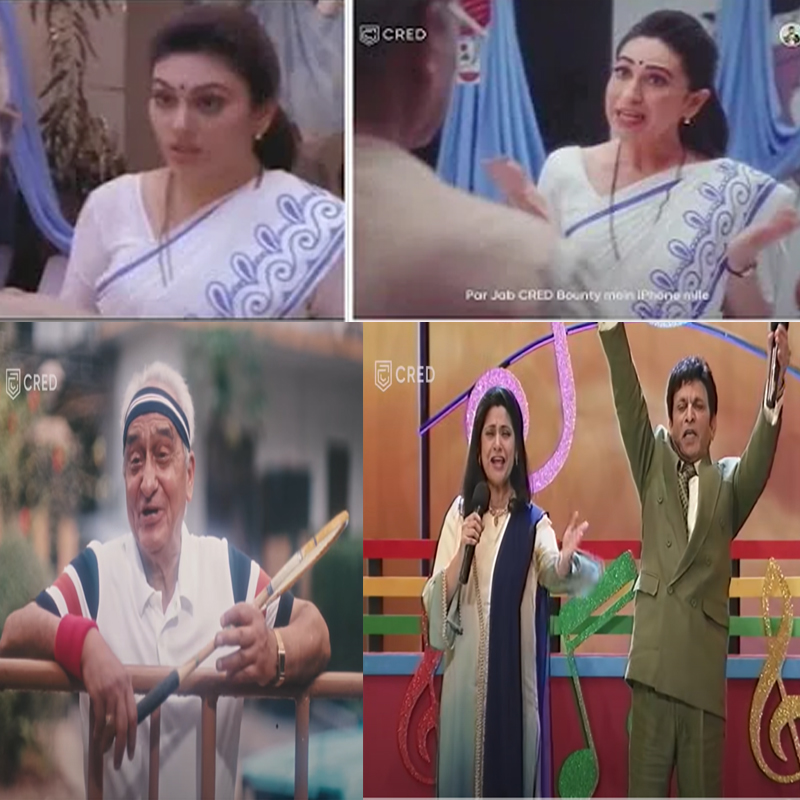
    So we have the vintage Nirma Super Detergent ad recreated with Karisma Kapoor starring as the modern-day ‘Deepikaji’ in a near-perfect reproduction of the original ad. Then there was the recreation of the 90’s popular reality TV show Antakshari with its original anchors, Annu Kapoor and Renuka Shahane pumping up the energy levels of their teams ‘Afsane,’ ‘Begane,’ and ‘Tarane’ as well as that of the viewers with their infectious enthusiasm. The latest in the series shows Sharma ji chatting up his neighbour Gupta ji about the prizes in store with Cred bounty, in yet another throwback to the 90s ads. All three of the brand’s latest attempt at rewinding the years are rendered in the definitive technicolour aesthetic of the retro-era that effectively transport one back in time.

    While there were several individuals who felt the fintech brand is “revolutionising” the advertising industry with its novel and innovative marketing experiments to grab attention there were the naysayers too, with one user on social media going so far as to declare, “The only reason I am not seeing IPL this season is due to the flurry of irritating ads from Cred.”

    “I don’t hate the new Cred ads. How can I hate something I don’t understand?,” posted Schbang creative strategist Devargh Mukherjee on LinkedIn, with several voices from the corporate world chiming in agreement.

    Bombay Shaving Company founder and CEO Shantanu Deshpande noted tongue-in-cheek that the quality of the Cred ad is directly proportional to the value of the Cred coin.

    Some were scathing in their critique. “Cred I guess you have bought the wrong book of 1000 best marketing ideas or got the wrong agency. Go buy another one or change your agency,” ABC Talkies founder and chief executive officer Shalibhadra Shah held.

    The ads are conceptualised and written by the brand’s established team of writers, comprising Tanmay Bhat, Devaiah Bopanna, Puneet Chadha and Deep Joshi, and produced and directed by Early Man Film and Ayappa respectively.

    “IPL with Cred is a platform for us to work with iconic celebrities in the most creative and twisted ways possible,” Ayappa had said of the latest 90’s blitzkrieg from the Cred factory.

    There were many who lauded the campaign’s production values and attention to detail to reinvent the bygone era’s ads. “Bhai maan gaye, aapki soch and production dono ko,” extolled one netizen.

    “What makes both the antakshari and the Karisma Kapoor ads stand out is the authentic recreation of the square-sized video and the then picture and sound quality, in order to hit the nostalgia among the credit card users,” stated SoCheers Film director Jitendra Hirawat to IndianTelevision.com. “For this year’s IPL campaign too, they picked up yet another strong insight that most credit card users in 2022 would have grown up in the 90s. Hence, the use of typical 90s ad templates for the execution,” he said, adding that, despite the execution for the campaign being “a little different from all their other properties,” it held up “Cred’s innovative USP.”

    Independent brand strategist Ambi Parameshwaran had a differing point of view. “Cred advertising is attempting to do just one thing: Brand recall. Their ads featuring old film stars and cricketers were much talked about. Their recent series spoofing old ads is patchy. Some of the ads spoofed were hardly memorable to start with. And their spoofs are missing the zing of the Bappi Lahiri or Rahul Dravid spots,” he lamented.

    According to White Rivers Media influencer marketing and video production director Tanish Shah the ad is well shot and packaged too, but slightly more could have been done instead of simply playing repeat. “Perhaps, a lot could have been done to explain the product than just speaking about a particular feature of the product – which is vital. Besides, if I think from that lens, it kind of missed the bus. I’d have to say that the earlier ads were much better, he added.

    There were some who praised the creative agency but dissed the product, saying that Cred ads have done really well in using that to hide a “subpar” product.

    Some industry executives also lauded the brand for the creative freedom the writers of their ads got, positioning “creative freedom” as the most important thing in marketing.

    “Kudos to Cred for giving its agency free rein. However this is also reflective of the dangers of giving agencies free rein,” noted Singapore-based Ambrish Chaudhry on LinkedIn. “Half interesting idea but probably felt more powerful in the boardroom with its advertising and marketing echo chamber than in the real world. Also no consistency with the previous hugely successful campaign and no link to existing brand assets. This could have been an ad for any brand. In my opinion, the recall and link with Cred will be minimal,” he added.

    Similar sentiments were echoed by several creatives. “While everyone’s talking about Cred, Jar, and Zepto for aptly portraying the 80s and 90s, some of us are still dealing with clients who’ve rejected similar ideas in the past and will probably show us these brand films tomorrow as a reference,” rued creative strategist Palak Kaur Anand.

    Meanwhile, J Walter Thompson creative director Anurag Acharya wrote: I think there should be a ‘Cred’ category in ad awards for ads that cater to consumers, not to awards, made for products/services, not for a document called brief.

    One argument that is consistently made out in favour of these ads are that they are meant to strike a nostalgic chord with their target audience- that’s the growing-up-in-the-90 generation and present day credit card users and payers. Millennials aren’t their TG. It’s the people in their late 30s, 40s and 50s, who are the majority spenders of their credit cards. It’s the perfect way to hook the 90s kid, felt many.

    But is the “90s kid” such a prospective demographic as a customer for the brand? Apparently, yes!

    “Well played, Cred, once again! 🙂 Attention-grabbing for those who have grown up with/ seen the older DD ad!,” communications strategy consultant Karthik Srinivasan posted about the campaign.

    So, what is it about nostalgia and why do brands latch onto it for marketing?

    Cred’s not the first, and far likely to be the last to peddle nostalgia- There’s beverage brand Paperboat, which right from its brand name to its packaging has been invoking nostalgia.

    Nostalgia marketing” is a strategy rooted in psychology, and these processes are incredibly effective. Because nostalgia makes us crave the past, and when used in advertising, it appeals on a sentimental, emotional, and powerful level to the audience.

    Well, if the surge in traffic to its app is any indicator, the strategy seems to have paid off for the fintech brand, at least so far. The Cred app saw a spike in traffic to the tune of 10-20 times during the IPL powerplays this season, according to Ganesh Subramanian, who heads architecture at the fintech company.

    So, whether it’s brickbats or bouquets its ads have been garnering, Cred may well be laughing its way to the bank! How much longer will the “nostalgia economy” work for the brand, however, remains to be seen.