Tag: Disney and Star India

  • Star India consolidated its market share post-lockdown: Kevin Vaz

    Star India consolidated its market share post-lockdown: Kevin Vaz

    Mumbai: In the 18 months post-lockdown, Star TV network has emerged as the top broadcaster with over 30 per cent network share and strong growth across network channels, said Star and Disney India president and head – network entertainment channels Kevin Vaz.

    In the Hindi segment – Star Plus and Star Utsav are leaders, and Star Plus has grown to a seven year high, said Vaz while addressing the APOS India summit that began virtually on Tuesday. 

    While there have been tectonic shifts in the regional markets, Vaz said Star Pravah initially ranked third among the top channels reached the top position, and Star Vijay, which was Star India’s first regional channel competing in one of the toughest markets, became number one in primetime. Markets where Star TV had a stronghold – Malayalam (Asianet) and Telugu (Star Maa) have only grown further.

    In conversation with Media Partners Asia co-founder and senior partner Vivek Couto, he also spoke about the recovery of TV advertising business, the future of regional TV, investments in content on TV, resurgence of free-to-air (FTA) and future of mass TV.

    “There are several positive macroeconomic factors that are indicating that the economy is bouncing back,” noted Vaz, adding that the IMF has predicted 10 per cent growth in the coming year. “IIP Index reported 11.9 per cent growth in August. GST collections are up by 17 per cent compared to 2019. The last three months have seen GST collections crossing Rs one crore every month. The successful vaccination drive where 1.2 billion Indians have received at least one shot has led to a positive future outlook.”

    In terms of depth of advertisers, Vaz observed that the set of advertisers has shifted in the past five years. For instance, five years ago 92 per cent of advertising for the Indian Premier League (IPL) came from categories such as beverages, telecom, handsets and consumer durables. However, now the new age companies such as e-commerce, fintech, gaming and edtech are changing the paradigm.

    “These companies have grown their contribution from eight per cent to 40 per cent with the remaining 60 per cent constituted by traditional advertisers. Five years back there were 35 unicorns in the country. This year there are 72 unicorns which are expected to grow to 100 unicorns in the year ahead. These companies have a lot of funds, they want to grow their customer base and advertising on TV is their first point of call,” said Vaz.

    Discussing the situation during the lockdown, Vaz said TV broadcasters were caught in a dichotomy as advertisers were pulling back yet with the consumer sitting at home, this was the best chance to create strong partnerships and serve them really good content. “We decided to double down on investments and keep investing in brands keeping the consumer at the focus. We also changed the programming schedule. For example, Star Pravah increased its original programming from two hours to five hours and regional channels such as Star Vijay and Star Maa started serving 45-55 hours of original content every week. The result we see today is that every channel is a leader,” he added.

    TV has a lot of scope to grow in the country, noted Vaz. There are 300-325 million households out of which TV reaches 210 million. The rural markets added 20 million homes in the last five years, he said. Every week 750 million viewers tune in to watch TV and consume one trillion minutes of content, indicating that TV is the preferred entertainment medium. Vaz said that TV viewers in regional markets consume four hours of TV every day which is 25 per cent higher than the national average. So, growth in HSM markets will come by getting them to stick to TV for a longer period of time.

    In terms of content investments, Vaz said that Disney and Star India’s strategy is agnostic to screens. He remarked, “We continue to invest more on TV by launching new channels, opening in new markets. In each market, we intend to have one entertainment, one movie and one music channel to serve wholesome viewing to the consumer.”

    He also talked about how the production values on TV have also been scaled up with the launch of big historical dramas and mythological shows. Apart from regular fiction shows, he said finite shows where production values are higher will also be part of TV offering.   

    Speaking about the resurgence of FTA channels, Vaz said, “We are committed to serving every consumer segment. The FTA market is an incremental opportunity. There are 40 million FTA households. The awareness of pay channels is not high in these markets. Most consumers will begin their TV journey with an FTA channel. The monetisation opportunity is to upsell them. It is important to target this audience as their consumption is disproportionate in the rural markets.”
  • Trai must focus on regulating process, not prices : Broadcasters at CII Big Picture Summit

    Trai must focus on regulating process, not prices : Broadcasters at CII Big Picture Summit

    Mumbai: As a regulator, the Telecom Regulatory Authority of India (Trai) must focus on regulating the process and not the prices, argued broadcast industry stakeholders at the CII Big Picture Summit held on Wednesday. The discussion was around the impact of new tariff order (NTO) 1.0 and 2.0 on linear TV broadcasting and the need for light touch regulation.

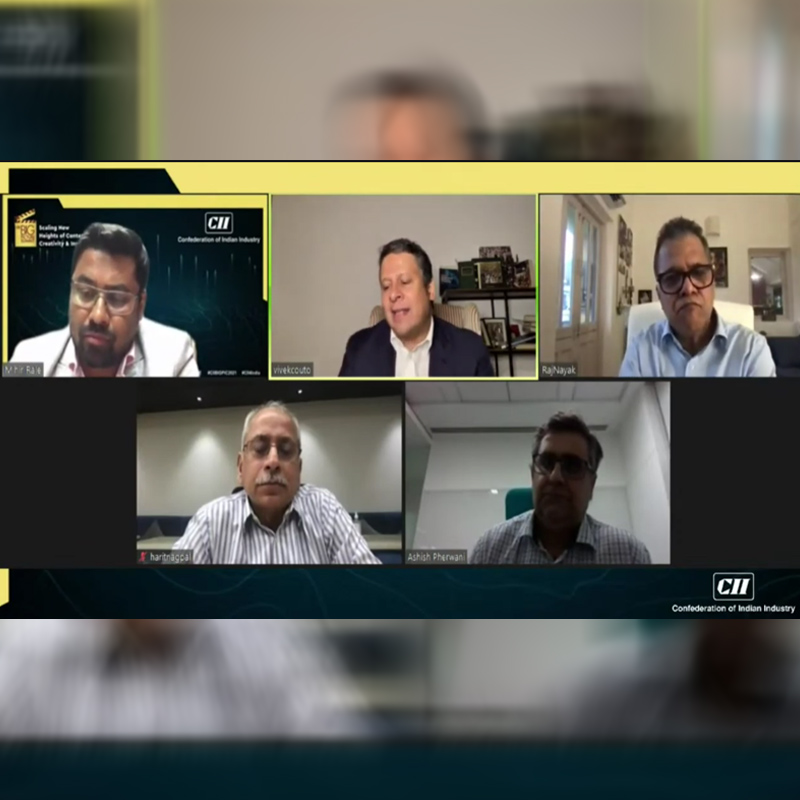
    The session was joined by Tata Sky managing director and CEO Harit Nagpal, Disney and Star India chief regional counsel Mihir Rale, House of Cheer Networks founder and managing director Raj Nayak, Ernst and Young Indian media and entertainment practice leader Ashish Pherwani and was moderated by Media Partners Asia co-founder and director Vivek Couto.

    The pay TV industry in India is the cheapest in the world and not by a small margin. Broadcasting is the largest contributor to India’s media and entertainment industry. India’s M&E industry accounts for 1.1 per cent of total GDP whereas in mature markets the contribution is usually 3-4 per cent. Panellists argued that excessive regulation by Trai is holding back the growth of the industry.

    “We belong to the service industry,” said Harit Nagpal. “A product like Tata Sky is aimed at customers who are willing to pay five to ten per cent extra to watch premium quality content. But when Trai regulates the prices, even if the customer is willing to pay extra, we can’t increase the prices. There is no incentive to invest in quality.”

    Trai’s intent seems noble on paper. The NTO regulations want to create parity in prices in linear TV broadcasting. However, there is a wide spectrum of customers in India that watch content. The players in the TV broadcast ecosystem understand the consumer’s needs and try to meet them with attractive prices. Trai’s regulation is akin to saying that a three BHK apartment must be priced the same whether you live in Cuffe Parade or the suburbs of Pune, remarked Raj Nayak.

    “When the regulator framed and implemented NTO 1.0 the stated objective was a-la-carte needs to be pushed in the interest of the consumer. Today, we know that if the consumer picks a-la-carte then his/her content costs will go up,” said Mihir Rale.

    Trai most contentious provisions in the NTO 2.0 were its twin conditions which mandated that average MRP prices of channels in a bouquet must not be more than 1.5 times the bouquet price. The second condition, which was struck down by a Bombay high court judgment, states that MRP of an individual channel in a bouquet should not exceed three times the average MRP of a channel in that bouquet.

    Rale said, “Linking a-la-carte pricing to bouquet pricing is a fundamentally flawed approach. The ability of the broadcaster to subsidise the cost to the consumer is important. Bouquets have an intrinsic value from an advertiser standpoint. We can customise and tailor our prices to everyone’s ability to pay. Why should that be taken away?”

    Stakeholders were of the view that Trai must step back and take a long hard look at the impact of NTO 1.0 regulation before implementing the amendment order. They said that consumer costs have gone up by 25-30 per cent and broadcasters have had to shut down a few of their channels. It was also noted that Trai must not assume every consumer is digitally savvy and will make the transition into the new regulatory mechanism easily. It is estimated that NTO 1.0 implementation resulted in the drop off of 12-15 million pay TV subscribers. 

    “We are in a free economy and the regulatory has come and put a price cap saying it is in the interest of the consumer. In fact, since there is a lot of competition in the linear broadcasting industry the fact is that broadcasters can’t raise prices indiscriminately without losing market share,” observed Raj Nayak.

    Trai has acknowledged that NTO implementation has yielded different results than what they expected. The need of the hour is for the industry to come together with the regulator and introspect on what’s best for the consumer.

    “The M&E industry is a creative industry. What we call different parts of the industry is just distribution. There are 130,000 digital influencers in India. How did this happen? Not by a regulated creative industry,” said Ashish Pherwnai. “The Indian media sector is $ 17 billion in size. How can regulation help us meet our targets in terms of percentage of GDP? Global companies like Disney and Lionsgate Universal get 50 per cent or more revenues from exports. In India that number is less than eight per cent.”

    Pherwani also talked about how the top studios in the US spend $20 billion on content, and in Europe, the top studios spend $40-45 billion. If 10 per cent of that market comes to us, then it is a $4 billion opportunity on a base of $17 billion, he said.

    The panellists hoped that the trust deficit between the regulator and broadcasting ecosystem can be dramatically reduced in the coming years and TV growth returns to 2017 levels.