Tag: Dish TV

  • TRAI issues DTH licensing consultation paper; Dish TV given extension

    TRAI issues DTH licensing consultation paper; Dish TV given extension

    NEW DELHI : Currently, India has six pay DTH operators, apart from the free-to-air DD Direct Plus operated by Doordarshan. Dish TV, was the first DTH licencee which got the wireless operating licence (WOL) for starting its DTH services on 1 October 2003. The other five DTH operators got the WOLs during 2006 to 2008. Dish TV’s licence was due to expire on 30 September 2013. The DTH Guidelines are silent on the course of action to be adopted after expiry of the 10 year licence period.


    As the time left before the due date of expiry of the licence period for the first licencee (Dish TV) was ‘simply not sufficient for TRAI to follow the due consultation process,’ it suggested some interim measures on 11 September to the Minister for the protection of the interests of consumers and keeping in view the large subscriber base of the said licencee.


    It was suggested that, in the interim, the Ministry may consider allowing Dish TV to continue its operations/services on the existing terms and conditions subject to Dish TV renewing the existing bank guarantee and a suitable undertaking that once the final policy in this regard is laid down by the government, the said DTH operator will comply with that policy for the interim period also. Any financial obligations arising from the change in policy shall also be honoured.


    The existing DTH Guidelines provide for the issue of a licence for 10 years. They do not explicitly provide for an extension or a renewal, implying that at the end of the 10-year period of validity, the licence expires.


    TRAI has noted that ‘starting a DTH business entails a huge investment of resources. It would, therefore, be a reasonable expectation on the part of DTH licencees that, on the expiry of the initial 10 year licence, they would be eligible to apply for issue of a new licence so that they can continue their business.’


    DTH broadcasting services were opened up in the country in 2001. On 15 March 2001, the government issued the ‘Guidelines for obtaining licence for providing Direct-to-Home (DTH) broadcasting service in India’ (hereinafter referred to as ‘DTH Guidelines’). These guidelines prescribe the eligibility criteria, the procedure for obtaining the licence to set up and operate DTH services in India, and the basic terms and conditions/obligations reposed in the operators.


    After a company applies for a licence, the Ministry obtains the security clearance from the Home Ministry and clearance for usage of satellite from the Department of Space. Once the clearances are obtained, the player is asked to pay the entry fee of Rs 10 crore. On payment of the entry fee, the Ministry communicates its intent to the applicant to issue a licence, after which it needs to approach the Wireless Planning and Coordination (WPC) for Standing Advisory Committee for Frequency Allocation (SACFA) clearance. Once the SACFA clearance is obtained, the company has to give a bank guarantee of Rs 40 crore and sign the licence agreement with the Ministry.


    After this, the company has to apply to WPC for obtaining the WOL. The duration of the DTH licence is 10 years from the date of issue of the WOL. Licences to establish, maintain and operate the DTH platform are granted under Section 4 of the Indian Telegraph Act 1885, and the Indian Wireless Telegraphy Act, 1933.

  • TRAI issues DTH licensing consultation paper; Dish TV given extension

    TRAI issues DTH licensing consultation paper; Dish TV given extension

    NEW DELHI : Currently, India has six pay DTH operators, apart from the free-to-air DD Direct Plus operated by Doordarshan. Dish TV, was the first DTH licencee which got the wireless operating licence (WOL) for starting its DTH services on 1 October 2003. The other five DTH operators got the WOLs during 2006 to 2008. Dish TV‘s licence was due to expire on 30 September 2013. The DTH Guidelines are silent on the course of action to be adopted after expiry of the 10 year licence period.

    As the time left before the due date of expiry of the licence period for the first licencee (Dish TV) was ‘simply not sufficient for TRAI to follow the due consultation process,‘ it suggested some interim measures on 11 September to the Minister for the protection of the interests of consumers and keeping in view the large subscriber base of the said licencee.

    It was suggested that, in the interim, the Ministry may consider allowing Dish TV to continue its operations/services on the existing terms and conditions subject to Dish TV renewing the existing bank guarantee and a suitable undertaking that once the final policy in this regard is laid down by the government, the said DTH operator will comply with that policy for the interim period also. Any financial obligations arising from the change in policy shall also be honoured.

    The existing DTH Guidelines provide for the issue of a licence for 10 years. They do not explicitly provide for an extension or a renewal, implying that at the end of the 10-year period of validity, the licence expires.

    TRAI has noted that ‘starting a DTH business entails a huge investment of resources. It would, therefore, be a reasonable expectation on the part of DTH licencees that, on the expiry of the initial 10 year licence, they would be eligible to apply for issue of a new licence so that they can continue their business.‘

    DTH broadcasting services were opened up in the country in 2001. On 15 March 2001, the government issued the ‘Guidelines for obtaining licence for providing Direct-to-Home (DTH) broadcasting service in India’ (hereinafter referred to as ‘DTH Guidelines’). These guidelines prescribe the eligibility criteria, the procedure for obtaining the licence to set up and operate DTH services in India, and the basic terms and conditions/obligations reposed in the operators.

    After a company applies for a licence, the Ministry obtains the security clearance from the Home Ministry and clearance for usage of satellite from the Department of Space. Once the clearances are obtained, the player is asked to pay the entry fee of Rs 10 crore. On payment of the entry fee, the Ministry communicates its intent to the applicant to issue a licence, after which it needs to approach the Wireless Planning and Coordination (WPC) for Standing Advisory Committee for Frequency Allocation (SACFA) clearance. Once the SACFA clearance is obtained, the company has to give a bank guarantee of Rs 40 crore and sign the licence agreement with the Ministry.

    After this, the company has to apply to WPC for obtaining the WOL. The duration of the DTH licence is 10 years from the date of issue of the WOL. Licences to establish, maintain and operate the DTH platform are granted under Section 4 of the Indian Telegraph Act 1885, and the Indian Wireless Telegraphy Act, 1933.

  • No# 1 spot for Zee Khana Khazana in the food and lifestyle category

    No# 1 spot for Zee Khana Khazana in the food and lifestyle category

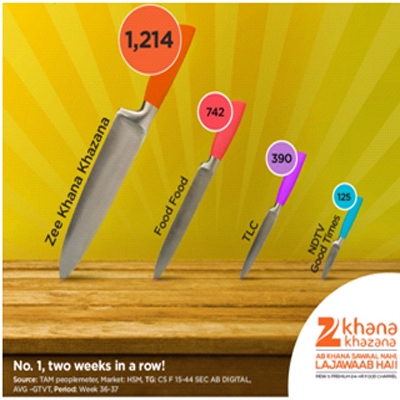
    Zee Khana Khazana, India’s first 24 hour food channel has attained the numero uno spot in the food and life style category. With 1214 Avg- GTVT (‘000s), Zee Khana Khazana has left behind other channels for the second week in a row. Zee Khana Khazana is in the number one position in Hindi speaking Markets, TG – F (15-44 yrs), SEC AB Digital households.


    The brand new content is fresh, simple and showcases ease in replicating cooking methods and dishes at one’s home. Through this exercise, the channel aimed to become the one-stop shop for ‘simple yet delicious’ cooking with its engaging and instructive approach. With chefs of great repute and interesting concept based shows, Zee Khana Khazana has managed to scale new heights. The channel has been reaching out to their audiences with various mall activations, contests and interesting opportunities to be a part of some shows.


    A delighted Amit Nair, business Head Zee Khana Khazana said “We are very pleased with the audience response to our channel. It is indeed a humbling experience to see our recent brand refresh and repositioning exercise beginning to yield fruit. We have some more exciting shows / events lined up for our viewers and look forward to endearing ourselves with our unique and refreshing content.”


    All the shows on Zee Khana Khazana are interactive with the audience being offered the chance to get in touch with the channel’s Chefs / Anchors via a call or SMS or email thereby taking the engagement level a notch higher. The channel web site also sports a fresh new look, with an easy to navigate interface and acting as a one stop shop for recipes and a food guide.


    Zee Khana Khazana is currently available on Dish TV, Videocon D2h and across all digital cable homes in the country. It will soon be available on other DTH platforms as well.


    For more information please log on to – www.zeekhanakhazana.com

  • Cinema TV channel will now be available on Dish TV

    MUMBAI: Cinema TV movie channel, the 24×7 Hindi movie channel from Naaptol, will now be available on Dish TV. Cinema TV CEO Hitesh Sabharwal confirmed the news. The channel broadcasts a classic blend and popular Bollywood movies that offers a unique entertainment perspective to the viewers.

    Cinema TV movie channel showcases titles from its vast library, including award winning features, cult favourites, comedies and gripping drama movies.

    The USP of Cinema TV is that it follows appointment viewing, which simply put is a scheduled time for different kind of movies for different target audience. The content for the channel is based on research done to gauge the interest of their target audience. They plan to expand across geographies and aim to grow into a multi-channel network.

    “We’re seeing a robust demand for movie content channel across various regions of India and in an effort to meet the customers’ needs; Cinema TV was specifically designed for the movie buffs, bringing out high quality catalogue of feature films directly to viewers,” said Cinema TV CEO Hitesh Sabharwal.

  • Big Magic strengthens distribution network, hops on board Videocon d2h

    Big Magic strengthens distribution network, hops on board Videocon d2h

    MUMBAI: Big Magic, the flagship GEC from the Reliance Broadcast Network stable amplifies its reach with the announcement of a distribution deal with Videocon d2h. After meeting with a great success in the heartland of India, it is Big Magic’s endeavor to extend its assorted entertainment offering across the Hindi Speaking markets and this alliance takes it to an additional 8mn subscriber base.

    The alliance allows Videocon d2h to offer its viewers an excellent television viewing experience, while the GEC reaches its content to a relevant audience base across relevant markets. Its programming mix which ranges from family dramas, crime shows, reality shows, cookery shows, game shows to weekend movies promise to offer a stimulating and refreshing entertainment experience. The Channel, which launched in April 2011, is in the process of strengthening its reach, offering audiences a programming offering that is backed by their very own predilections.

    Speaking on the occasion, Big Magic business head Sunil Kumaran said: “We are happy to announce our alliance with Videocon d2h, which allows Big Magic to immediately grow reach by an additional eight million subscriber base. We are confident of our product, which has been designed as per audience penchants and want to strengthen our reach. We look forward to reaching a matchless entertainment offering to maximum audiences of India.”

    Videocon d2h CEO Anil Khera added: “Big Magic has performed well since its launch. We are extremely happy to provide this channel on our platform as it promises content across various genres. We are certain that our audience will enjoy and appreciate the addition of this channel on our platform.”

    Big Magic is already available across key DTH players ranging Airtel, DD Direct, Dish TV, Reliance Digital TV along with Hathway, Incable, Digicable, DEN, 7 Star, ABS, Siticable, Star Broadband and GTPL amongst others.

  • Indian pay TV operators making their mark globally: researcher SNL Kagan

    Indian pay TV operators making their mark globally: researcher SNL Kagan

    MUMBAI:India‘s pay TV operators are coming of age. And they are bursting on to the global pay TV scene, if one goes by data released by researcher SN L Kagan for 2012. Almost four of them feature in the top 10 list for Asia Pacific. Amongst these figure: Dish TV, DEN Networks, Siti Cable and Tata Sky.

    According to the SNL Kagan report, DishTV with 14.7 milllion subscribers is the largest pay TV operator (fourth placed in the Asia-Pac rankings), Den Networks wih 11.2 million subs, Siti Cable with 10.5 million subs and Tata Sky with 10.2 million subs are at the No 8, 9, and 10 positions. Chinese operator Jiangsu Broadcasting with 20.9 million subs leads the Asia Pac table, while China Telecom with 19.9 million subs is at No 2.

    The numbers can only go up for Indian pay TV ops, says an industry observer, as the government mandated digitisation spreads further into smaller and smaller towns forcing consolidation on the industry. Some MSOs are likely to expand even as DTH will attempt to garner new subscribers.

    The researcher says that Videocon d2H leads the Indian pay TV operator pecking order if one looks at net subscriber additions with its number of 2.3 million. Dish TV is also doing well with 2.2 million net new subscriber adds. While Tata Sky follows with 1.98 million new additions.

    India‘s BSNL with 9.9 million broadband subsribers and Bharati Airtel with 1.38 million are the only Indian firms featuring in the broadband table.

    On the whole, SNL Kagan has crowned US cable TV service provider Comcast, as the world‘s largest pay-TV provider last year with nearly 22 million subscribers. However the next two are not far behind. China‘s Jiangsu Broadcasting has 20.9 million and DirecTV has 20.1 million.

    China Telecom was the top fixed broadband provider, reaching 90.1 million high-speed Internet customers. India, China and the US accounted for 50 or nearly half of the 106 top pay-TV operators, with 27 companies based in China and 12 in India. The US is third with 11 operators, followed by France, Germany, South Korea, Brazil and Mexico, each with five.
     
    In Asia, of the top 10 platforms by subscriber number, six were in China and the rest are in India led by Dish TV.

    Comcast is still the number one broadband provider in the US, with about 19.4 million subscribers ahead of AT&T with 16.4 million and Time Warner Cable with 11.4 million subscribers.

    For a list of the Global Top Multichannel Operators by Year-End 2012 Video Subscribers. Click Here

    For a list of the Global Top Multichannel Operators by Year-End 2012 Video Net Adds. Click Here

    For a list of the Global Top Broadband providers by Year-End 2012 Subscribers. Click Here

    For a list of the Global Top Broadband providers by Year-End 2012 Net Adds. Click Here

    Also Read:

    SNL Kagan‘s global media & entertainment heavyweights

    US multi-channel video subscriber universe sees small growth in 2012: SNL Kagan

  • Dish TV slashes losses in FY 2013; outlook improves

    Dish TV slashes losses in FY 2013; outlook improves

    MUMBAI: The Zee TV group DTH service provider Dish TV India Ltd (Dish TV) is slowly but gradually emerging from a sea of red ink; especially if one looks at the company‘s financials for the year ended 31 March 2013. Losses have been more than halved to Rs 66 crore from Rs 133.14 crore in the previous fiscal. Even its quarter losses have been reduced. Additionally, it added new subscribers in Q4 2013 at 200,000, taking up its net subscribers to 10.7 million.

    And things look likely to get even better for it if one goes by the massive 27 per cent it commands of the DTH market, and the fact that it is looking at raising average revenues per user (ARPUs), reducing customer subsidies in the medium term and in the process increasing profitability.

    Let us look at the standalone Q4-2013 results as against the corresponding Q4-2012

    Revenues for Q4 FY 2013 stand at Rs 555.40 crore, a rise of 7.5 per cent from the corresponding last year quarter Rs 516.44 crore. Subscription revenues at Rs 500 crore recorded a growth of 15.3 per cent. Total expenses too went up 7.4 per cent, standing at Rs 580.36 crore in Q4 FY 2013 (Rs 540 crore in Q4 FY 2012). Programming and content cost accounted for a large chunk of this increase rising 34 per cent during this period to Rs 196.72 crore as against Rs 146.76 crore.

    Although Dish TV reported a loss of Rs 43.62 crore, it is a 11 per cent improvement over the Q4-2012‘s loss of Rs 49 crore.

    Let us take a look at the Q4-2013 financials in comparison with Q3-2013

    Revenues in Q4-2013 have marginally decreased by Rs 2.42 crore as against Rs 557.82 crore reported in Q3-2013. While programming and content costs have risen by over 20 per cent to Rs 196.72 crore (Rs 162.69 crore in the immediate preceding quarter), it has got more efficient while reducing its selling and distribution expenses to Rs 74.2 crore (Rs 90 crore.). Additionally, it scaled down its advertising expenses by 30 per cent to Rs 16.6 crore (Rs 23.7 crore). EBITDA in Q4 2013 fell 12.8 per cent to Rs 120 crore against Rs 137.77 crore in Q3-2013. And losses fell to Rs 43.62 crore as opposed to Rs 44.48 crore.

    Dish TV has increased its new subscriber prices and pack prices in the past few months and has managed to bring down its subscriber acquisition cost (SAC) to Rs 1,996 as against Rs 2,201 in the immediate preceding quarter.

    The company added 200,000 net subscribers in Q4-2013- its lowest net new adds for a quarter since 2007 – taking its net subs base to 10.7 million. This low net add figure has alarmed some observers; but this has happened at a time when India is going through a gut wrenching change of digitisation of its cable TV infrastructure. Phase II of digitisation has been moving rather slowly with cable TV operaors in many cities which were supposed to come under the digitisation hammer fighting the government‘s mandate in courts and getting stay orders. So, many subscribers there are continuing to receiving analogue signals and hence have not moved to digital as yet. Hopefully, in the coming days as digitisation moves forward DTH providers will have some spillover benefits of subs moving to digital services.

    Dish TV‘s ARPUs were also lower for Q4-2013 at Rs 157 as against Rs 160 for the immediate preceding quarter.

    Let us look at the consolidated FY-2013 results as against FY-2012

    FY-2013‘s consolidated revenues stood at Rs 2,166.80 crore, a rise of 10.7 per cent as against last fiscal‘s Rs 1957.9 crore. It reported an EBITDA of Rs 575.9 crore as against Rs 496 crore last fiscal (a 16.1 per cent increase) with its EBITDA margin standing at 26.7 per cent.

    It has reported a 5.1 per cent YoY increase in content costs as against an overall increase of 11.5 per cent in total expenses to Rs 2,215 crore (Rs 1,983.8 crore).

    What is noteworthy is the way it has managed to bring down the net loss for FY-2013 to Rs 66 crore compared to Rs 133.14 crore in FY-2012. The earnings per share (EPS) too has shown a massive improvement from a negative Rs 1.25 to a negative Rs 0.62.

    Dish TV has a bouquet of 400 plus channels and it added another five HD channels in April 2013 taking its offering to 42 HD channels and services on its platform. Most analysts are bullish on the stock, currently trading at Rs 64.30.

    Says Dish TV chairman Subash Chandra, “In the media sector, digitisation, though not fully up to speed, holds big potential for the industry. DTH platforms, in particular, look forward to a level playing field contributing to meaningfully higher ARPUs and stickier subscriber bases over time. Dish TV‘s industry leading initiative, to hike acquisition and pack price is likely to be a catalyst to achieve that.”

    Dish TV recently launched India‘s first standard definition recorder, Dish+ with an unlimited recording facility. This was initially launched in the 42 cities covered under Phase 1 and Phase 2 of digitisation and is now available across India as a value for money differentiator over its competitors‘ offerings.

    Dish TV managing director Jawahar Goel points out that fiscal 2013 saw most players in the Indian DTH industry evolve to the next level and Dish TV led the industry and helped it pull off a significant increase in the new subscriber acquistion price over the last several months thereby reducing the effective cash burn per subscriber.

    “While the resultant decline in industry gross additions is marginal, it is expected to be well compensated by the quality of subscribers,” he highlights. “There was no respite though from the multiple taxation which the DTH industry is reeling under. Uncertainty on the rollout of goods & services tax (GST) continues to be an overhang on the earnings potential of the industry,”

    He is quite confident that DTH will score over cable TV thanks to the strong service back up the sector has built and its increasing focus on value growth rather than chasing subscriber numbers.

    “On the digitisation front, the MSO‘s readiness on encryption, packaging, dunning and effective business processes is taking undue time. With increasing expectations, customers however will gradually align to a technologically progressive and service oriented mass-scale platform, albeit at a premium. Dish TV has experienced strong though early signals of churned subscribers getting back to its platform in select markets in the current quarter,” says Goel says in a parting statement.

    Other points for FY 2013 to be noted are:

    * The company set up a 70:30 joint venture company Dish T V Lanka (Pvt) Ltd on 25 April 2012 under the laws of Sri Lanka with Satnet (Pvt Ltd). Satnet has a DTH licence and the joint venture will work on providing DTH related service in the island country.

    * The company has extended the life of the consumer premises equipment (CPE) for depreciation purposes of to five years for equipment activated on or after 1 April 2012. Upto 31 March 2012, in certain cases, the one-time advance contribution towards the CPEs in the form of rental was being recognized over a period of three years from the activation date. There is no significant impact on financial results of the quarter and year-ended 31 March 2013 on account of change in estimate for revenue recognition.

    * Dish TV’s net-worth as at 31 March 2013 is eroded by its accumulated losses. However, the management has prepared the financial results assuming that the Company will continue as a going concern considering that it has adequate resources in the form of operating cash flows, sanctioned credit facilities from lenders and bank deposits to adequately meet its obligations.

    * The name of the Company’s wholly owned subsidiary in Singapore, namely, Dish TV Singapore Pte Limited was changed to Digital Network Distribution Pte Limited on 12 March 2013. The Company entered into a share purchase Agreement dated 19 March 2013 with a party for transfer of its investment at an agreed price of Sing$12,000. On 1 April 2013, the share holding in Digital Network Distribution Pte Limited was transferred and, accordingly, as at 31 March 2013, the investments has been shown under current maturities of long term investment.

    * During the current year, Direct Media Distribution Ventures Pvt. Ltd (formerly known as Dhaka Warriors Sports Pvt Ltd) disinvested its holding in the Company from 59.86% to 45.24% and consequently, it ceases to be the holding company of Dish TV India Limited.

    *Hitherto, the exchange differences arising from foreign currency borrowing to the extent that they are regarded as an adjustment to interest cost, were treated as borrowing cost in terms of AS – 16, “Borrowing Costs.”

    During the year ended 31 March 2013, pursuant to a clarification dated 9 August 2012 from the MCA, the Company has changed the accounting policy w.e.f. from 1 April 2011, to treat the same as “foreign exchange fluctuation”, to be accounted as per AS – 11 “Effects of Changes in Foreign Exchange Rates,” instead of AS – 16 “Borrowing Costs”.

    This change has resulted in a reversal of finance cost of Rs. 70.68 crore and increase in depreciation by Rs. 11.24 crore during the year ended 31 March 2013. The aforesaid change, resulting in a net gain of Rs 59.44 crore, has been shown as ‘exceptional items’ in the financial results for the year ended 31 March 2013. In this regard, if the company had followed the same accounting policy as in the previous year, finance costs for the year would have been higher by Rs 58.41 crore; depreciation expense would have been lower by Rs 14.15 crore and the loss for the year would have been higher by Rs 44.26 crore.
  • Zee Entertainment notches up stellar results in FY 2013

    MUMBAI: The folks at Zee Entertainment Enterprise Ltd (Zeel) have been working with a lot of zeal, it would seem. Especially if one looks at its latest Q4-2013 financials and also its results for the financial year ended 31 March 2013. A big upward tick of 21.6 per cent in its net profit to Rs 718.2 crore on 31 March 2013 over the previous year‘s Rs 591 crore is a hallmark of the Zeel performance.

    As far as its Q4-FY-2013 results were concerned they were in line with various analysts’ bullish expectations. Commanding an astounding 670 million plus viewers worldwide, a scale of operations across 169 countries with 32 channels and over 100,000 hours of programming to its credit, it has maintained its leading position in most of its major business operations including television broadcasting, cable distribution, DTH services etc.

    Says Zeel chairman Subhash Chandra: “FY 2013 was a defining year for the media sector in many ways. The biggest transformation was the implementation of DAS in 42 cities nationally. There were 33 million DTH subscribers and 16 digital cable TV homes as fiscal 2013 ended as against 29 million DTH and 4 million DAS homes in the previous year. We believe we can continue to return meaningful amount of capital even as we strengthen our business and invest in the growth of our businesses. We will continue to pursue growth opportunities which would enhance long term shareholder value.‘

    “DAS phase 2 has been implemented across the country. Industry ARPUs on DTH seem to be growing with exciting consumer offers being provided by operators on premium channel subscriptions,” adds Zeel managing director and chief executive officer Punit Goenka. “We believe similar effort by digital cable operators will ensure a robust growth of the industry for all stakeholders. The improving economic outlook augurs well for the media and entertainment sector. We are hopeful that a steady growth in ratings will help Zee deliver better performance in the coming quarters. Our content focus approach combined with better monetisation of subscription revenues, especailly from digital markets, will contribute to the company delivering steady and sustainable returns in the year ahead.”

    Let us look at the consolidated Q4-2013 financials as against the corresponding Q4-2012

    The Q4-2013 financials report a fair positive trend with the operating revenues for the quarter standing at Rs 964.3 crore, an increase of 11 per cent from the previous year‘s corresponding quarter’s (Q4-2012) which stood at Rs 869 crore. Q4-2013 ad revenues at 479.2 crore are up 15.5 per cent over Q4-2012‘s Rs 415 crore. Subscription revenues have surged to Rs 454.5 crore as against Q4-2012’s Rs 402.1 crore, a 13 per cent increase, courtesy the spread of digitisation and the fact that it was able to draw further benefits of its distribution joint venture with Star India – MediaPro. Of this, domestic subscription revenues rose to Rs 337.4 crore in Q4 2013 (its accounting treatment for MediaPro changed in Q4 2012 hence it says the figures can‘t be compared with Q4 2012). International subscription revenues climbed 11.7 per cent to Rs 117.2 crore in Q4 2013.

    Zeel has managed to tighten the screws on its total expenses, allowing these to rise by only 2.2 per cent over the previous corresponding quarter. As a result, its EBITDA skyrocketed 51 per cent to Rs 242.3 crore as against Rs 160 crore in the last corresponding fiscal quarter. At those numbers, its EBITDA margin is a fat 25.1 per cent. Even its PAT numbers are looking good. They are up 10.7 per cent in Q4-2013to Rs 180.35 crore as against the corresponding last Q4-2012’s Rs 163 crore.

    On the business front, Zeel‘s flagship Zee TV, the flagship Zeel channel had an average of 220 GRPs in Q4 and a 19 per cent market share, and was placed among the top six Hindi GECs.

    As far as its regional language offerings are concerned, all its channels including Zee Marathi, Zee Bangla, Zee Telegu and Zee Kannada have reported good growths in average GRPs.

    While the sports business has yet to breakeven, an improving and promising trend is anticipated with various events and leagues lined up for telecast. The sports business revenues for the quarter stood at Rs 107.2 crore. Dish TV, the largest DTH service provider reported an ARPU of over Rs 159, significantly higher than its peers in the segment.

    Let us look at the consolidated results for FY-2013

    Thanks to the sharp rise in net profit in the full fiscal year and its net margin of 19.4 per cent, its earnings per share (EPS) too climbed up to a handsome Rs 7.51 as against last fiscal’s Rs 6.08.

    Zeel‘s total income for the year to 31 March 2013 (advertising sales and subscription revenues) registered healthy growth with FY-2013’s total revenues standing at Rs 3669.57 crore, up by 19.7 per cent from last year’s Rs 3040.56 crore.

    Its full year domestic subscription revenues were up to Rs 116.48 crore, and international subscription revenues were Rs 458.6 crore, a growth of 26.3 per cent and 14 per cent respectively, over the previous fiscal year‘s revenues. Overall ad revenues for the full year have shown a double digit growth of 24 per cent to Rs 1963.9 crore from the last fiscal’s Rs 1584 crore.

    The YOY expenses have sharply risen 19.4 per cent, with FY-2013’s expenses standing at Rs 2785.18 crore. This increase is majorly contributed by a 21.5 per cent increase in its operating cost and its employee benefit expenses rising over 19 per cent. The latter cost is justified for a conglomerate commanding an employee base of over 2050 employees.

    Zeel‘s EBITDA (operating profit) for the full year FY-2013 stands at Rs 954.3 crore, growing 29 per cent YoY as against Rs 739.6 crore in FY 2012.

    With this fiscal year marking the 20 years of Brand Zee in the industry, the Board has recommended a cash dividend of Rs 2 on a face value of Re 1 per share. In addition to this the board has also announced a distribution Rs 2,000 crore through a bonus issue of redeemable preference shares.

    The company’s share is currently being traded at Rs 241. Many analysts have predicted that the stock will cross Rs 270, as it starts deriving more and more subscription revenues courtesy cable TV digitisation.

    The outlook for the media conglomerate is extremely bright. It has a loyal viewer base for its GEC channels, it has a presence in cable TV through Siticable, then its DTH operation DishTV has a huge subscriber base of 13-14 million. It recently announced it would take a stab at the movies through its subsidiary Zee Motion Pictures which plans a couple of film launches in the near future. In the television space, Zee reported a decent market-share for the full year FY-2013, while revenues significantly poured in from its international operations, especially with the launch of Zee TV across several networks in Canada. Zee TV and Zee Cinema did well in the UAE and were the No 1 TV channel among south Asians for the March 2013 quarter.

    Meanwhile, Zeel’s board has said it would be approaching shareholders to approve its plan to increase the FII investment limit in the company to beyond the existing 49 per cent and to the maximum allowed under the government’s FDI norms for the media sector.

  • Dish tv launches new ad campaign featuring SRK

    Dish tv launches new ad campaign featuring SRK

    Mumbai: Direct to home service provider Dishtv has unveiled its latest ad campaign featuring Shah Rukh Khan. The actor dons the hat of an HD Inspector for this latest commercial that promises maximum ‘tru HD channels‘.

    The TV commercial is created by McCann Delhi and is directed by Piyush Raghani. The campaign will feature three TV commercials set on the making of TV programs across different genres like daily soaps, movies and wildlife documentary.

    This TVC showcases Khan keeping an eye on the minor details of production like the bindi of the bahu not being perfectly round in a Hindi daily soap, dancer’s nail not being chipped in a bollywood item song and crocodile’s tooth not looking clean in wildlife documentary. He points and rectifies these mistakes because Dish truHD+ ’’mein sab dikhta hai’.

  • Govt revenues from DTH licensing fees zoom

    Govt revenues from DTH licensing fees zoom

    New Delhi: The six private direct-to-home operators paid Rs 3.078 billion as licence fee to the government for the year 2011-12, compared to Rs 1.778 billion in 2010-11 and Rs 1.262 billion in 2009-10.

    The revenue in 2008-09 was Rs 893 million from four operators, since both Airtel Digital TV (Bharti Telemedia Ltd.) as well as Videocon d2h (Bharat Business Channel Ltd.) had not commenced services.

    The other DTH players are Dish TV, Tata Sky, Sun Direct TV, and Reliance Big TV.

    Under DTH licensing norms, the platforms pay a non-refundable entry fee of Rs 100 million and an annual fee equivalent to 10 per cent of gross revenue every financial year. Thus, the platforms have paid Rs 600 million as one-time entry fee.

    Interestingly, Tata Sky paid a licence fee of Rs 793 million in 2011-12 as against Airtel Digital’s Rs 618.7 million and Dish TV’s Rs 300 million. Sun Direct paid Rs 360 million, Reliance Big TV paid Rs 95 million, and Videocon d2h paid Rs 50 million.

    DTH services are governed by the DTH Guidelines and terms and conditions issued by the Information and Broadcasting Ministry on 15 March 2001 and amended from time to time.

    The seven DTH players in the country including Doordarshan’s free-to-air DD Direct Plus cover around 35 million TV homes.