Tag: Dish TV

  • Videocon d2h, Dish TV merger comes to fruition

    Videocon d2h, Dish TV merger comes to fruition

    MUMBAI: The long drawn out merger of direct-to-home operators Dish TV India Ltd (Dish TV) and Videocon d2h Ltd (Videocon d2h) has finally come to pass.

    A release issued by Dish TV that taking further steps for effecting the scheme of arrangement for the amalgamation of Videocon d2h with Dish TV, the companies, earlier during the day, filed the copy of the order dated 27 July 2017 passed by the National Company Law Tribunal (NCLT) along with the approved scheme in Form INC-28 with the Registrar of Companies, Mumbai.

    “Accordingly, post completing all the steps pursuant to the scheme, Videocon d2h has merged into and with Dish TV on 22 March 2018, the effective date of the scheme,” the release added.

    The combined entity, to be named Dish TV Videocon, will have approximately 29 million subscribers, making it the second largest DTH company in the world. There was a halt in the merger scheme about two months ago when Dish TV wanted Videocon d2h to clarify some of the insolvency proceedings against it.

    Dish TV CMD Jawahar Goel said, “We are extremely pleased to announce that the D-Day is finally here. Today, Videocon d2h and Dish TV have become one entity. This amalgamation positions the new entity for exceptional future growth and profitability and puts on us the responsibility to lead the DTH industry in India to the next level.”

    “It has been a long journey and I would once again like to put on record, through these pages, our appreciation for the Ministry of Information and Broadcasting, the National Company Law Tribunal, the Competition Commission of India, the Securities and Exchange Board of India, the NSE, the BSE, NASDAQ and all other stakeholders for showing their trust in us. I would also like to express our gratitude to the shareholders of both companies for standing by us through the transaction and believing in the company,” he added.

    A meeting of the board of directors of the company is scheduled to be held on Monday, 26 March 2018, to inter alia consider and initiate necessary incidental actions in relation to the scheme of arrangement for amalgamation of Videocon d2h into and with Dish TV.

    The merger paves way for the creation of the largest listed media company in India taking into consideration the last reported full-year revenue and EBITDA numbers of the two DTH players on a pro-forma basis. Dish TV and Videocon D2h reported separate revenue and EBITDA numbers that, at a pro-forma level, added up to Rs 60,862 million and Rs 19,909 million for financial year 2016-17.

    The two companies had entered into definitive agreements in November 2016 for amalgamation of Videocon D2h into and with Dish TV through a scheme of arrangement amongst Dish TV, Videocon d2h and their respective shareholders and creditors.

    The proposed transaction had been notified to the Competition Commission of India (CCI) for its approval and CCI had given its approval for the proposed transaction vide its letter dated May 4, 2017.

    On May 12, 2017, in a meeting convened by the NCLT, the shareholders of the company had also approved the scheme for amalgamation of Videocon D2h into and with Dish TV.

    Subsequently, the Mumbai bench of the NCLT, at a hearing held on 27 July 2017, had approved the scheme under the provisions of Sections 230-232 and other applicable provisions of the Companies Act, 2013. The appointed date for the scheme was therein fixed as 1 October 2017.

    Dish TV Videocon is expected to provide better synergies and growth opportunities through enhanced after-sales, distribution and technology capabilities. Aon, Deloitte and PwC have been roped in to help it with project management for seamless integration of core functions, processes and technology infrastructure.

    It has been a long journey for Dish and Videocon d2h since they announced the intent to merge in November 2016. Last year, it received the nod from both the Ministry of Information and Broadcasting and the National Company Tribunal Law to go ahead to create the giant DTH player.
  • DTH focus shifts to ARPU from subscriber numbers

    DTH focus shifts to ARPU from subscriber numbers

    MUMBAI: In the last six months, the direct-to-home (DTH) industry has faced lots of challenges. The industry saw big DTH players consolidate, shutting down of a player and fights between DTH operators and broadcasters.

    In the early days, customer acquisition was the key for most distribution platform operators but, currently, their eyes are set on cost-efficiencies.

    An industry source tells Indiantelevision.com, “The biggest worry in the market right now is the elephant in the room, which is Reliance Jio. In the last three quarters, DTH growth has been very muted and is not growing as actively as it should have. The challenge for DTH players right now is pushing up the average revenue per user (ARPU) and push high definition (HD) subscription. Tata Sky, for instance, is pushing HD channels to 110 and trying to create HD packs. It is not trying to increase the subscriber base but planning towards increasing the ARPU.”

    Tata Sky came up with a Make My HD pack for as low as Rs 30 per month and a regional HD Access pack at Rs 50 per month for users subscribed to regional SD channels. The channel targeted the south market with a special pack at Rs 290. Dish TV campaigned for HD in all homes by removing the access fee on it and advertising a cost as low as Rs 169 per month (excluding taxes). Countering DD FreeDish, the oldest DTH player also introduced a free to air (FTA) pack with a price translating to Rs 32 a month.

    After more than a year of twists and turns, Dish TV and Videocon d2h are set to formalise a merger to create India’s largest DTH company valued at around $2.4 billion and the world’s second largest in terms of subscribers with 29 million, just behind AT&T’s DirecTV. According to the original plan, Dish TV shareholders will own 55.4 per cent in the combined entity, to be named Dish TV Videocon, while Videocon d2h shareholders will hold 44.6 per cent in the company.

    “After the deal, there will be group content deals since they are thrice strong with Dish TV, Videocon d2h and Siti Cable. If they go to the broadcaster for the content deal, the pricing leverage will be much higher,” the source adds.

    India accounted for 65 per cent of revenue for regional pay-TV channel groups in 2017, led by large local channel businesses owned and operated by 21st Century Fox, Sony and Viacom as per a Media Partners Asia (MPA) report.

    “The whole landscape is undergoing a change. The cable operators are facing many challenges and are punching back hard. They are focussing on growing ARPUs from the rural market in phase 3 and 4 and the subscriber base. ARPU in the rural market is still very low which is around Rs 40-45. If they make it equal to urban around Rs 70-75 with a subscriber base of 1 million, then also it will give them an extra Rs 35 million every month. So everyone is working on a strategy, but they are not saying it upfront,” the source points out.

    Videocon d2h saw ARPU at Rs 208 for Q3 2018 (September – December 2017), higher than the Rs 212 in the previous quarter. Dish TV’s ARPU stood at Rs 144 for the same quarter, lower than Rs 148 in the trailing quarter. The highest ARPU among listed companies was with Airtel Digital TV with Rs 233.x

    Dish TV CMD Jawahar Goel says that the industry is on the pay channels’ side. “The MSOs have different pricing in the market. Whereas for DTH it is a very steep charge and this is the reason for the shutdown of Reliance BIG TV,” he says.

    KCCL CEO Shaji Mathews says that if DTH had been launched in India in the year 1997 as envisaged by some of the leading media companies, cable TV would have been a minority player today. “Ever since its launch half a decade later, DTH thrived on the deficiencies in analog cable. Another decade later when digitisation commenced, again DTH pitched to take a share from cable and become the majority player. However, cable withstood the challenge and retained its position at the end of 2017,” he says.

    The scenario emerging is that of media players consolidating to face the challenge from telecom. However, Mathews says that in this fight, historically, cable TV has been the partner that media companies can rely upon. “The polarisation is evident from the exit of non-media Videocon and Rcom, though the latter has other reasons also,” he highlights.

    Media Partners Asia VP Mihir Shah shows two reasons for growth in the industry. “As BARC continues expanding its coverage, it has pushed up the value of rural reach for broadcasters, which today is primarily delivered through DTH. With this merger, the DTH market has consolidated with top three players accounting for 90 per cent share of the paying subscriber base. These two structural developments will improve DTH’s subscriber economics in the coming year,” he said. “Warburg Pincus’ investment in Airtel Digital last year and now Dish TV-Videocon d2h merger going through serves as a confident booster for the sector.”

    The active DTH subscriber base in India is over 50 million as of December 2017. Sun Direct is a major DTH player in the south holding about 40 per cent of the area. Southern subscribers also make up 97 per cent of its total. Sun Direct took up an HEVC media solution from Harmonic to increase its HD channel number to 80 recently.

    On 16 February, Star had issued a disconnection notice to Bharti Telemedia for non-signing of the subscription agreement, non-payment of subscription fees and non-submission of subscribers reports. However, even before the broadcaster gave effect to its disconnection notice, the DTH operator decided to temporarily discontinue Star India channels from its subscription packs from 8 March as it had not been able to arrive at mutually acceptable terms with the broadcaster.

    “Due to failure to arrive at mutually acceptable terms with Star India, with effect from 8 March 2018, all Star network channels will be temporarily discontinued from your packs,” the DTH operator informed its subscribers.

    In the latest update, the Telecom Disputes Settlement Appellate Tribunal (TDSAT) has asked Star India and Airtel DTH to negotiate and enter into an agreement. The tribunal also directed the DTH operator to pay all lawful dues in accordance with the agreement by the due date as indicated in Star’s letter dated 7 March, except the amount of Rs 9.8 crore.

    As competition within the industry as well as the fight for the pie continues with MSOs, DTH players will have to focus on giving value add at reasonable rates. Increasing ARPUs will also enable the red to turn black on the company balance sheet, which is what most of them are currently sweating about.

    Also read:

    TDSAT tells Airtel DTH, Star to negotiate

    Airtel Digital TV disconnects Star India channels

    Madras HC gives split verdict in Star India versus TRAI case


  • Videocon d2h delists from NASDAQ, merger with Dish TV likely on 22 March

    Videocon d2h delists from NASDAQ, merger with Dish TV likely on 22 March

    MUMBAI: Videocon d2h, which is looking at a merger with Indian direct-to-home (DTH) company Dish TV, has announced that it will be delisting from the US bourse NASDAQ.

    The amalgamation scheme between Dish TV and Videocon d2h is likely to take place on 22 March 2018 after due regulatory approvals from the Maharashtra registrar of companies and the high court. Videocon d2h shareholders will get Dish TV shares through global depositary receipts. Dish TV shares will not be registered in the US.

    Videocon d2h had made its intention to delist in mid-December 2017 but later postponed it because of a change in its plan to amalgamate with Dish TV. 4 April 2018 will be Videocon d2h’s last date of listing and it will be delisted from 5 April. After this, Dish TV will have to file the remaining requirements of US regulator Securities and Exchange Commission (SEC) to terminate Videocon d2h’s reporting obligations. The deregistration will be effective 90 days after Form 15F is filed.

    “Pursuant to the Scheme and following the effectiveness of the amalgamation, all outstanding equity shares of Videocon d2h, including equity shares underlying the ADSs, will be mandatorily exchanged for new equity shares of Dish TV. Dish TV is expected to be subsequently renamed Dish TV Videocon Limited. Videocon d2h ADS holders will receive new global depositary receipts (GDRs), each GDR representing one equity share of Dish TV, exchanged at a rate of approximately 8.07331699 new GDRs for every one Videocon d2h ADS (rounded off up to eight decimal places), unless such holders elect to receive equity shares of Dish TV in lieu of GDRs by cancelling their Videocon d2h ADSs,” a release to the NASDAQ stated.

    The combined company is to be named as Dish TV Videocon and will hold approximately 29 million subscribers, making it the second-largest DTH company in the world. There was a halt in the merger scheme when Dish TV wanted Videocon d2h to clarify some of the insolvency proceedings against it.

    Also Read :

    Dish TV-Videocon d2h merger date postponed

    Dish TV re-evaluating Videocon d2h merger

  • TDSAT tells Airtel DTH, Star to negotiate

    TDSAT tells Airtel DTH, Star to negotiate

    MUMBAI: The Telecom Disputes Settlement Appellate Tribunal (TDSAT) has asked Star India and direct to home (DTH) operator Airtel DTH to negotiate and enter into an agreement.

    Both the parties had threatened to take action against each other. Airtel DTH said it would remove all Star India channels while the broadcasters said it would disconnect its signals. Bharti Telemedia, which operates Airtel DTH, had moved TDSAT against Star India’s disconnection notice. The tribunal has restrained Star from giving effect to its disconnection notice while directing the DTH operator to clear the dues. 

    The tribunal directed the DTH operator to pay all lawful dues in accordance with the agreement by the due date as indicated in Star’s letter dated 7 March, except the amount of Rs 9.8. crore.

    “Parties are at liberty to negotiate and enter into an agreement in accordance with the regulations and their understanding. If need be, either of the party can file an application for clarification and directions,” the TDSAT said in the order.

    On 16 February, Star had issued a disconnection notice to Bharti Telemedia for non-signing of the subscription agreement, non-payment of subscription fees and non-submission of subscribers reports.

    “Due to failure to arrive at mutually acceptable terms with Star India, with effect from 8 March 2018 all Star network channels will be temporarily discontinued from your packs,” the DTH operator informed its subscribers.

    The tribunal has also clubbed the matter with those involving Star India and DTH operators Dish TV and Videocon d2h. The two DTH operators had moved TDSAT in August 2017 after Star rebranded its Hindi GEC Life OK as Star Bharat and launched the pay channel on DD’s free DTH platform Free Dish.

    Also Read:

    Airtel Digital TV disconnects Star India channels

    Tata Sky woos new customers with free Star Sports channels

    Madras HC gives split verdict in Star India versus TRAI case

  • DTH subscriber growth muted in CY-2017

    DTH subscriber growth muted in CY-2017

    BENGALURU: DAS, especially phases 3 and 4, was supposed to be a great growth opportunity for television direct-to-home (DTH) service providers. Has that been the case? Not if one were to go by data released by the Telecom Regulatory of India (TRAI) and three of the six private DTH players in India.

    The status quo
         
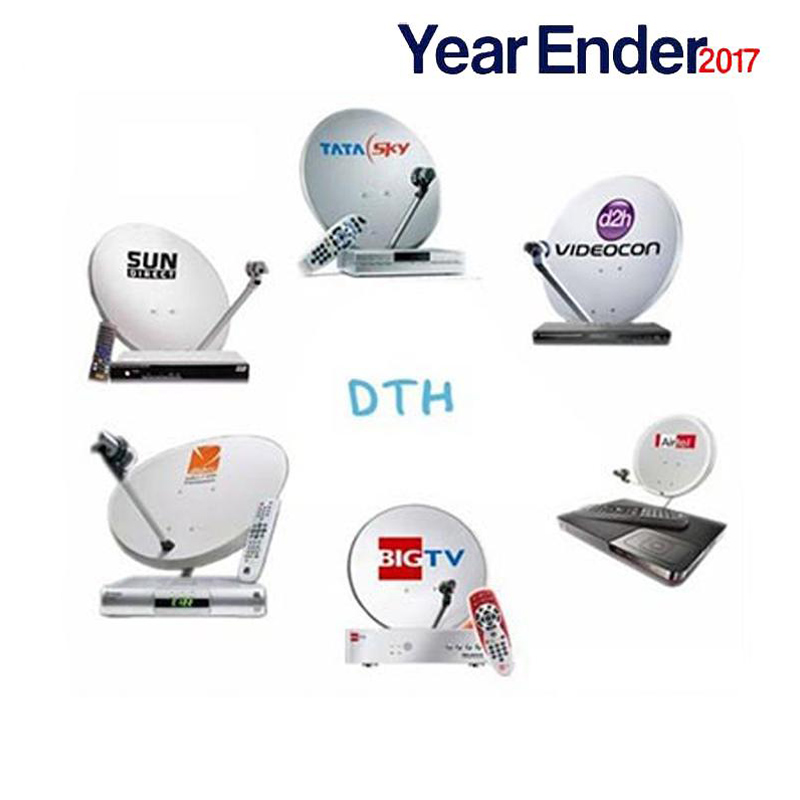
    At present, there are six private pay-TV players (five active in the true sense of the word) and one government free-TV player DD FreeDish. The five players are: Airtel Digital TV or Airtel DTH, Dish TV, Sun Direct, TataSkyand Videocon DTH–the sixth player being Reliance Digital TV or Big TV.

    Reliance Big TV has been acquired by Pantel Technologies and Veecon Media. Normal operations have to recommence as yet. A number of Big TV customers were acquired by other players and the true status of its operations and current subscriber numbers are still unclear at the time of writing.

    Please refer to the figure below for subscriber share of the six private players at the end of 30 September 2017 (Q2-18 or Q2-2108).

    public://11_0.jpg

    DTH subscriber acquisition seems to have petered down in calendar year 2017 (CY2017, 1 January 2017 to 31 December 2017) as compared with CY 2016. Please refer to the chart below for active subscribers addedas per TRAI data until 30 September 2017 (Q2-2018) and data reported by the three private players – Airtel DTH, Dish TV and Videocon d2h until 31 December 2017. It may be noted that these three players had almost 63 percent share of subscribers according to the above-mentioned Dish TV investor presentation.

    The continuous blue curved line in the chart below represents the total number of net active subscribersaddedfor each quarter – this number has been obtained by deducting the number of active subscribers in a quarter from the number of subscribers in the previous quarter. The combined total number of the three subscribers has been obtained by addition of net subscribers added by each of the three players – Airtel DTH, Dish TV and Videocon d2h – as declared by them in their financial/other releases and presentations. Thesecombined subscriber additions are represented by the continuous maroon line in the figure. The broken grey line represents the percentage of the combined net subscriber additions by the three players of the total subscriber additions as per TRAI data.

    public://2_6.jpg

    The chart below indicates the subscriber base of the three players and all private DTH players as per quarterly data released by TRAI. TRAI data for the October-December 2017 quarter has not been released at the time of writing. Subscriber data for each of the three players mentioned below has been obtained from their respective financial releases and presentations. The numbers have been rounded off to the nearest lakh by the author.

    As is obvious, Dish TV is the biggest player in the country in terms of subscribers followed by Airtel DTH and Videocon d2h in that order. It may be noted that Tata Sky subscriber base could be higher than Airtel’s subscriber base. Tata Sky data is not available in the public domain, and hence this cannot be verified.

    public://3_2.jpg

    Overall, the players are faced with declining monthly average revenue per user (ARPU). In absence of complete ARPU data, the author has taken the liberty to calculate ARPUs of each of the three players by using quarterly operating revenue/subscription revenue of the players and dividing it by the subscriber base at the end of that quarter and then calculating the ARPU per month. Similarly, the quarterly operating/subscription revenues of the three players have been added and then divided by the combined subscriber base of the three players at the end of that quarter and then the average monthly average ARPU has been arrived at. In each case calculated ARPU numbers have been rounded off to the nearest rupee.

    The combined four quarter average monthly ARPU of the three players across four quarters of 2017 has declined by Rs 9 to Rs 183 from Rs 192 in CY-2016. Airtel DTH is the premium player – its four quarter average monthly ARPU in 2017 increased by Rs 2 to Rs 230 from Rs 228 in 2017. Dish TV is a value player, its average declined by Rs 18 in 2017 to Rs 143 from Rs 161 in 2016. Videocon d2h four quarter average monthly ARPU in 2017 declined by Rs 9 to Rs 186 from Rs 195 in 2017. It must be reiterated here that the ARPU numbers mentioned in this paper have been calculated by the author and may vary from the actual numbers. The numbers in the graph below are just indicative numbers.

    public://4_1.jpg

    Besides the six private pay DTH players, FreeDish is a major player in terms of subscribers with an estimated 2.2 crore as per the numbers available in the public domain. It must however be noted that an exact number for registered or active subscribers is not available even with DD, since this is a free DTH service. If and when the announced Dish TV Videocon d2h merger happens, the merged entity will probably be one of the largest DTH players in the world in terms of subscriber numbers.

    According to an E&Y report titled ‘India’s Free TV’ released in July 2017, among the DTH operators in India, FreeDish has grown to become the largest with its estimated 2.2 crore subscribers which E&Y predicted could cross 4 crore over the next two to three years.

    A number of reasons can be attributed to this dismal performance–two of the chief ones that have been touted over the recent past by most players in media and entertainment industry are demonetisation in November 2016 and the implementation of the new GST regime. Given that most of India faced a cash crunch for a few months post demonetisation, money spends for entertainment took the least priority for the common man.Subscriber acquisition seems to have picked up in the April-June 2017 quarter, only to be dampened in the July-September 2017 – the quarter in which the new GST regime was implemented. The glitches of the new GST are slowly being ironed out. In the absence of TRAI data for the October-December 2017 quarter, numbers reported by the three players seem to indicate that DTH subscriber acquisition should have improved. Despite this, it seems unlikely that the industry was able to surpass or even match subscriber growth of CY-2016.

    Another important reason could be that DTH is considered a premium service – by all the stakeholders in carriage ecosystem with the resulting perception that procurement as well as monthly subscription will be premium and hence a deterrent for the consumer. While some players such as Dish TV have been making attempts to come up with packages that it perceives should attract the masses, but, results as per TRAI data seem to indicate otherwise. Yes, Dish TV is the largest private player in the country that has come up with different pricing models under different brands, whether unwittingly or not, most of the other players present themselves as premium players and seem to have done little in that direction.

    Also Read :

    DTH’s year of consolidation

    Recalibrating India’s DTH sector after Airtel DTH-Warburg Pincus deal

    Veecon Media acquires Reliance Big TV

  • Dish TV bemoans govt’s neglect of DTH sector

    Dish TV bemoans govt’s neglect of DTH sector

    MUMBAI: Dish TV, while lamenting neglect and step-motherly treatment of the whole DTH sector by the government, has exhorted policy-makers to remove various discriminations in the licencing conditions of various distribution platforms as it has resulted in taxing times for DTH operators.

    Furthermore, Dish TV has also pointed out that video distribution on OTT platforms should be brought under government regulations, similar to those governing other distribution platforms (DPs) to remove anomalies and creation of a level playing field for every stakeholder.

    “The present [regulatory] regime for the licence fee is discriminatory against the DTH operators and is designed to provide the leveraged position to cable operator, HITS, IPTV and MSO, etc in the market place as they are not required to pay any annual licence fee,” Dish TV has said in its submission to regulator TRAI’s consultation paper on issues related to uplink/downlink of TV channels and whether they could be auctioned in a way similar to FM radio licences.

    One of the largest satellite TV operators in India has added that because of discriminatory licencing regimes, the additional financial burden in terms of monthly subscription fee is put on a subscriber of DTH service when compared to subscribers of cable TV or HITS services.

    “It is a matter of record that in the month of March 2008, the Ministry of Information and Broadcasting (MIB) had taken a decision to fix the [DTH operator’s] licence fee @ 6 per cent of the gross revenue, which had the concurrence of the TRAI also. However, for reasons best known to the government, the decision is yet to be put into effect,” Dish TV has said.

    Pointing out that the DTH sector (India has six DTH licencees at present, according to MIB) has played a critical role in making the digitisation dream a success even while providing a world class experience to consumers, Dish TV has urged the government/regulator to “remove anomalies” by creating a level playing field for the DTH operators and rationalising the licence fee.

    Dish TV is also hopeful that TRAI’s new tariff structure and inter-connect regulations—which are in suspended animation owing to being legally challenged in Madras and Delhi High Courts by Star TV and Tata Sky and Airtel Digital combine, respectively—would go a long way in easing the pains of DTH ops. “Though the tariff order and the regulation are under challenge, however, it is just a matter of time that when the new regulation will sail through these minor hiccups and become a reality,” it added.

    Incidentally, as reported by Indiantelevision.com earlier, MIB is contemplating referring the issue of DTH policy guidelines review to its sister organisation, Ministry of Law, for an opinion.

    Meanwhile, Dish TV in its submission to TRAI has made a strong financial case for rationalisation of DTH licencing regime, while highlighting how owners of TV channels continue to play favourites with various DPs, has also urged a regulatory regime for video distributed on OTT platforms.

    In a section that dwells on OTT platforms, Dish TV has accused broadcasters or owners of TV channels of circumventing regulatory framework by distributing video on the internet or OTT platforms.

    Arguing that by starting OTT platforms broadcasters don’t just remain ‘broadcasters’, but also become ‘distributors’ of TV channels, Dish TV has said that such an arrangement breaches various existing regulations, including cross-media and cross-services restrictions.

    “It is important to note that the content being provided by the broadcasters [on OTT platforms] are free of cost with an intention to create a captive subscriber base and create a monopolistic situation. Because of ‘free of cost’ provision of the content by the broadcasters through OTT services, other distributor[s] of TV channels are heavily prejudiced… threatening the existence of other distribution platforms,” Dish TV has stated, adding such an arrangement could also create a monopoly where the broadcaster, being the distributor, would also control the end mile solution.

    It may be pertinent to note here that Dish TV’s sibling Zee group too has an OTT platform whereby it distributes TV programming to subscribers. Zee unveiled on Valentine’s Day a new avatar of its video streaming service called ZEE5.

    Though TRAI had initially left video streaming services out of a regulatory framework when it announced guidelines pertaining to Net Neutrality late last year, a section of the media has reported that the regulator is now thinking afresh and could bring in regulations for video content distributed via the internet (read video OTT platforms).

    Also Read :

    Law ministry likely to give opinion on DTH guidelines review

    Broadcasters, DPOs oppose TV channel auction proposal

    Dish TV-Videocon d2h deal on course

  • Despite lower ARPU, Videocon d2h posts higher Q3 profit

    Despite lower ARPU, Videocon d2h posts higher Q3 profit

    BENGALURU: The Saurabh Dhoot-led Indian DTH player Videocon d2h reported profit after tax (PAT) at Rs 30.85 crore for the quarter ended 31 December 2017 (Q3 2018, quarter under review). The company had reported PAT of Rs 16.78 crore for the immediate trailing quarter Q2 2018 and PAT of Rs 21.77 crore for the corresponding year ago quarter Q3 2017. Adjusted EBITDA increased 9 per cent yoy in Q3 2018 to Rs 291.41 crore from Rs 267.24 crore. Adjusted EBITDA less capex increased 62.9 per cent yoy to Rs 188.50 crore during the quarter under review as compared to Rs 115.70 crore.

    Videocon d2h revenue from operations increased 7.2 per cent yoy during the quarter under review to Rs 833.6 crore from Rs 777.39 crore. Subscription and activation revenue increased 7.3 per cent yoy to Rs 763 crore in Q3 2018 from Rs 711.20 crore.

    Subscriber matrices

    The company’s subscriber base increased by 1.6 lakh  (1 crore = 10 crore = 100 lakh) during Q3 2018 to 134.1 lakh from 132.5 lakh in the immediate trailing quarter Q2 2018. The company had a subscriber base of 127.7 lakh in Q3 2017. Videocon d2h reported a quarterly subscriber churn of 1 per cent, higher than the churn of 0.62 per cent reported for Q2 2018. Subscriber churn for Q2 2017 was 0.87 per cent. The company has reported lower average revenue per user of Rs 208 for the quarter under review as compared to Rs 212 for the immediate trailing quarter, but higher than the Rs 205 for the corresponding year ago quarter.

    Let us look at the other numbers reported by Videocon d2h

    Total expenses increased 6.5 per cent yoy to Rs 726.59 crore in Q 2018 from Rs 681.97 crore. Operating expenses increased 8.9 per cent yoy to Rs 423.61 crore in Q2 2018 from Rs 407.38 crore. Administration and other expenses reduced 14 per cent yoy to Rs 18.89 crore during the quarter under review from Rs 21.97 crore. Employee benefits expenses declined 4.3 per cent yoy to Rs 28.92 crore in Q2 2018 from Rs 30.21 crore. Selling and distribution expenses reduced 3.5 per cent yoy to Rs 50.84 crore in Q2 2018 from Rs 52.69 crore.

    Company speak

    Videocon d2h executive chairman Dhoot said, “I am pleased to report that we continued to deliver a strong quarterly result with our adjusted EBITDA being our highest ever quarterly adjusted EBITDA at Rs 2.91 billion. Our adjusted EBITDA per subscriber continued to improve further and came in at Rs 73 per subscriber per month.”

    “We continue to see a recovery on the ground and expect overall business prospects to improve driven by several factors including lower content availability on the FreeDish platform and the Indian government’s focus on increasing affordable housing and improving rural income levels in the recent budget,” he added.

    “During the quarter, the company received all the necessary approvals relating to its amalgamation with and into Dish TV India. The two companies now intend to file the relevant intimations / e-forms with the Registrar of Companies, Ministry of Corporate Affairs, Maharashtra, Mumbai in the last week of February 2018, which filing date will become the effective date for the proposed merger. The company will issue the relevant timelines and other mandatory notices in relation to the merger in due course,” concluded Dhoot.

    Also Read :

    Dish TV-Videocon d2h deal on course

    Dish TV re-evaluating Videocon d2h merger

    Videocon d2h reports another profitable quarter

  • Law ministry likely to give opinion on DTH guidelines review

    Law ministry likely to give opinion on DTH guidelines review

    MUMBAI: Even as the government admitted in Parliament yesterday that it has granted six companies licences to operate DTH services in India, the Ministry of Information and Broadcasting (MIB) has, reportedly, referred to the Law Ministry a long-pending proposal to review DTH guidelines in the country.

    Replying to a question in Lok Sabha or Lower House on the DTH sector, Minister of Information and Broadcasting Smriti Irani, in written statement, said Dish TV, Tata Sky, Sun Direct, Reliance BIG TV, Bharti Telemedia and Videocon d2h are licenced to provide services in India under the DTH guidelines issued on 15 March 2001, which is amended from time to time.

    She said that in addition to the private players, pubcaster Doordarshan too operated a free to air DTH services in the country and there was no restriction on the total number of DTH licences.

    According to the minister, a licencee, in addition to an initial non-refundable entry fee of Rs 10 crore (Rs 100 million), is required to pay an annual licence fee that amounts to 10 per cent of its gross revenue.

    In the meanwhile, the DTH players who had been lobbying for the last 24 months or so for another review of the DTH guidelines, aimed at bringing down the annual revenue sharing percentage to between 6-8 per cent amongst other things, may have to wait for relief.

    MIB, which was studying a proposal to review the DTH guidelines based also on some past recommendations of the Telecom Regulatory Authority of India, has already referred or is in the process of referring the matter to the Law Ministry for an opinion, if government sources are to be believed.

    Amongst the six DTH licencees, a few are operating on the basis of temporary extension of their licences as the DTH guidelines do not spell out clearly the modalities for licence renewal once the initial 10-year period is over, DTH industry sources explained.

    MIB’s indecision on the regulatory review process hasn’t helped the industry much as the sector is witnessing consolidation — for example, the ongoing Dish TV-Videocon d2h merger and the sale of Reliance’s DTH business to a set of new investors — apart from the expiry of the 10-year licence period.

    Also Read:

    DTH’s year of consolidation

    Recalibrating India’s DTH sector after Airtel DTH-Warburg Pincus deal

    Dish TV-Videocon d2h deal on course

  • Dish TV-Videocon d2h deal on course

    Dish TV-Videocon d2h deal on course

    MUMBAI: After a few hiccups, the merger deal between direct-to-home (DTH) operators Dish TV and Videocon d2h is on course again.

    As part of the amalgamation scheme, Dish TV and Videocon d2h will file the relevant intimations/e-forms with the registrar of companies (ROC) and the Ministry of Corporate Affairs (MCA) in the last week of February 2018.

    In a filing to the BSE, Dish TV has said that it “intends to take further steps for effecting the said merger.”

    The filing date shall be the effective date for the scheme.

    On 11 January, Dish TV had said that it is evaluating whether insolvency proceedings against the promoters of the Videocon Group will have an impact on its rights and obligations under its agreement with Videocon d2h.

    Dish TV had asked its advisors to the transaction to evaluate the position and advise the company with its findings within a period of 60 days.

    Before this sudden development took place, the two DTH companies were expected to file the relevant intimation/E-Forms with the RoC, MCA, Maharashtra, Mumbai, by 27 December 2017. However, the filing got delayed after Dish TV got to know about the insolvency proceedings against Videocon d2h promoters.

    Dish TV also said that the merger deal is being taken forward after receiving a go-ahead from the advisors. “Upon evaluation of the above circumstances by the Advisors to the Scheme, the Company shall be taking necessary steps for completion of the Scheme,” it added.

    For the purpose of seamless integration of the businesses of Videocon d2h into Dish TV India and for synchronising the operations of two companies to derive the benefits and objectives of the scheme, Dish TV has nominated two Directors namely Amitabh Kumar and Raj Kumar Gupta on the board of Videocon d2h.

    On 15 December, the Ministry of Information and Broadcasting (MIB) had approved the merger between the two companies.

    Commenting on the merger deal, Dish TV India CMD Jawahar Goel said, “We acknowledge our shareholders’ growing impatience with respect to the merger. We would like to assure them that work around the completion of the deal is going ahead at full steam now and should be completed soon.”

    Also Read:

    Dish TV-Videocon d2h merger date postponed

    Sluggish rural consumption, distribution expenses pull down Dish TV’s Q3 numbers

    Dish TV re-evaluating Videocon d2h merger

  • Sluggish rural consumption, distribution expenses pull down Dish TV’s Q3 numbers

    Sluggish rural consumption, distribution expenses pull down Dish TV’s Q3 numbers

    BENGALURU: A recovered but not fully-up-to-speed rural sector and higher selling and distribution expenses during festival time led to Indian direct-to-home (DTH) major Dish TV India Ltd (Dish TV) reporting lower numbers for the quarter ended 31 December 2017 (Q3 2018, the quarter under review) as compared with the corresponding year ago quarter (yoy). Though the company added net 250,000 subscribers during the quarter, lower ARPU brought down Dish TV’s operating revenue and EBITDA by 1 per cent and 15.5 per cent, respectively, yoy. The company reported a net subscriber base of 1.61 crore at the end of Q3 2018. ARPU of Rs 144 in Q3 2018 was the lowest in the current fiscal as against Rs 148 in Q2 2018 and Rs 149 in Q1 2018. Dish TV’s ARPU before demonetisation in November 2016 was Rs 162. The company has reported net loss after taxes of Rs 3.58 crore in Q3 2018 as against profit of Rs 8.39 crore in Q3 2017.

    Dish TV CMD Jawahar Goel said, “One year down the line from demonetisation, we have come a long way but somehow the sting in rural consumption is still missing. This was probably well recognised by the government and hence the impetus towards a stronger rural India. Television continues to remain the cheapest and most wholesome means of entertainment for the masses. DTH has presence in places where few other television service providers have reached. Dish TV, amongst such DTH players, has perhaps the deepest rural connect and hopes to benefit from rural India’s increasing propensity to consume everything including television content.”

    In its investor release for Q3 2018, Dish TV said that the pending Dish TV–Videocon d2h merger had hit a roadblock as the company was forced to evaluate the impact of certain proposed proceedings, against the Videocon group, on its rights and obligations under the definitive agreements, and consequential effects on the transactions contemplated thereunder.

    Dish TV, on 15 December, had secured the Ministry of Information and Broadcasting’s approval to the request made by the company for closing the merger of Videocon d2h with and into Dish TV.

    Talking about the merger, Goel said, “We acknowledge our shareholders growing impatience with respect to the merger. We would like to assure them that work around the completion of the deal is going ahead with full steam now and should be completed soon.”

    “We are excited about the future of the merged entity and are raring to put the business in overdrive as soon as the merger completes. Though we have lost some time in FY18, we would want to regain our leadership as well as extract the highest possible synergies in the year ahead,” he explained.

    A look at the numbers

    Dish TV reported a 1 per cent yoy decline in operating revenue for the quarter under review at Rs 740.77 crore as against Rs 747.98 crore. EBITDA for Q3 2018 was 15.5 per cent y-o-y at Rs 200.52 crore (27.1 percent margin) as compared with Rs 237.42 crore (31.7 percent margin).

    Total expenditure for Q3 2018 increased by 4.3 per cent y-o-y to Rs 775.12 crore. Employee benefits expense declined 1.5 per cent y-o-y to Rs 35.80 crore. Operating expenses in Q3 2018 increased by 6.2 per cent yoy to Rs 374.08 crore. Other expenses during the quarter under review increased by 8 per cent to Rs 127.84 crore yoy. Finance costs in Q3 2018 reduced by 18.4 per cent yoy to Rs 50.16 crore.

    Also Read :

    MIB clears path for Dish TV Videocon

    Dish TV reports improved operating profits for second quarter