Tag: Directorate of Film Festivals

  • MIB merges film media units with NFDC

    MIB merges film media units with NFDC

    Mumbai: The ministry of information and broadcasting (MIB), through three different orders, transferred the mandate of the production of documentaries and short films, organisation of film festivals and the preservation of films to the National Film Development Corp (NFDC), a PSU working under the ministry.

    The government of India has made a budgetary allocation of Rs 1304.52 crore up to 2026 for all these activities, which will be implemented through NFDC. 

    In order to further strengthen the NFDC, it has been decided that the revenues generated by these activities will also accrue to NFDC. The merger of Film Media Units under the Corporation will ensure a balanced and synergised development of the Indian cinema in all its genres- feature films, documentaries, children’s content, animation and short films and will lead to better and efficient utilisation of existing infrastructure and manpower.

    The production of documentaries was earlier done by Films Division. The legacy and brand name of Films Division will be taken further and the production vertical for production of documentaries in the NFDC will be named as ‘Films Division.’

    Similarly, the organisation of film festivals that was the mandate of the Directorate of Films Festivals has been transferred to NFDC. This will bring the organisation of different national and international film festivals under one roof, thereby bringing in more synergy and a focused international outreach. Some of the major upcoming Film Festivals to be organised by NFDC are the Mumbai International Film Festival, International Film Festival of India at Goa, and Children’s Film Festival.

    The Preservation related activities that are carried out by National Film Archives of India have also been transferred to NFDC. The National Film Heritage Mission aiming at digitisation and restoration of films and documentaries will now be implemented by NFDC.

    Bringing all these activities under a single management will reduce the overlap of various activities and ensure better utilisation of public resources. The mandate of production of feature films is already being carried out by NFDC. It will give a strong impetus to the production of films of all genres including feature films, documentaries, children films and animation films; promotion of films through participation in different international festivals and organising various domestic festivals; preservation of filmic content, digitisation and restoration of films; and distribution and outreach activities. The ownership of the assets available with these units will, however, remain with the Government of India.

    Audio Visual Service is one of the 12 Champion Service sectors identified by Dept of Commerce, and the MIB is the nodal Ministry for this sector. Financial incentives for audio-visual co-productions with foreign countries and for promotion of shooting of foreign films in India have also been approved by the Government to further stimulate the Audio-Visual service sector of the economy and promote creative and technical services. This will also be spearheaded by the NFDC through its Film Facilitation Office.

    In December 2020, the union cabinet had decided to merge four of its film media units, namely Films Division, Directorate of Film Festivals, Directorate of Film Festivals, and Children’s Film Society, India with the National Film Development Corporation Ltd. by expanding the Memorandum of Articles of Association of NFDC, which will then carry out all the activities hitherto performed by them with the objective of ensuring synergy, convergence of activities & better utilisation of resources. The ministry had shared these major policy decisions in its interaction with the film industry held in Chennai and Mumbai earlier this month.
  • Cabinet approves merger of four film units with NFDC

    Cabinet approves merger of four film units with NFDC

    NEW DELHI: The government has given its nod to the merger of four of its film media units with the national film development corporation (NFDC).

    The decision was taken in the Cabinet meeting chaired by PM Narendra Modi on Wednesday. As part of the plan, the four units namely films division, directorate of film festivals, national film archives of India, and children’s film society, India will now operate under the NFDC, which will then carry out all the activities hitherto performed by them.

    While this will lead to rationalisation of infrastructure and manpower, the government highlighted that interests of employees of all the concerned media units will be fully taken care of and no employees will be retrenched. A transaction advisor and legal advisor will be appointed to advise on the transfer of assets and employees, and to oversee all aspects of operationalisation of the merger.

    “There was a lot of duplication in activities and there was a need to bring synergy. However, all the work which is currently underway at each of the units will remain in progress. Our aim is to ensure good films reach masses,” said Union information and broadcasting minister Prakash Javadekar post the meeting.

    India is one of the largest film producers in the world with an industry led by the private sector. Over 3,000 films are produced every year. After the merger, all promotion, production and preservation of film content will come under one management.

    The films division, a subordinate office of the ministry of information and broadcasting, is among the oldest of the four media units. It was formed in 1948 to produce documentaries and news magazines for publicity of government programmes and cinematic record of Indian history.

    Formed in 1964, the national film archives is mainly responsible for acquiring and preserving Indian cinematic heritage, and the directorate of film festivals, set up in 1973, focuses on promoting Indian films and cultural exchange. The children’s film society, India is however, an autonomous organisation formed under the Societies Act in 1955 to specifically provide children and young people value-based entertainment through the medium of films.

    All the four media units will now operate as one unit under the NFDC – the central public sector undertaking  which was formed in 1975 for planning and promoting an organised, efficient and integrated development of the Indian film industry. “The vision of the new entity will be to ensure balanced and focused development of Indian cinema in all its genres – feature films, including films/content for the OTT platforms, children's content, animation, short films and documentaries,” stated the government.

  • Films and music bridge cultures and connect people, says Rathore

    Films and music bridge cultures and connect people, says Rathore

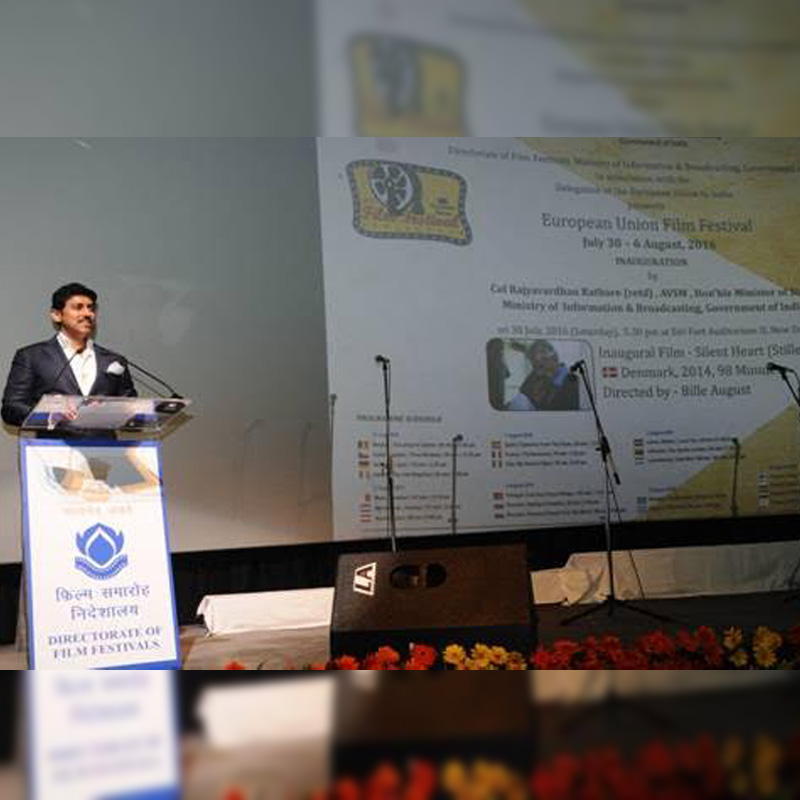
    NEW DELHI: Noting that films and music provided a bridge between cultures that connects people across nations, Minister of State for Information & Broadcasting Rajyavardhan Rathore has said Film Festivals provide an opportunity to understand different cultures from different regions.

    Inaugurating the European Film Festival over the weekend in the capital, Rathore said the medium of cinema helps humanity to understand the people, their relationships and their emotions.

    A delegation of European Union including ambassadors from European Union member states was also present on the occasion.

    There was also a musical performance by Neemrana Choir. Neemrana Choir consists of 50 singers of all ages and backgrounds.

    The opening film of the festival was famous Danish Film Silent Heart (Stille Hjerte) directed by Bille August. The film was premiered at the San Sebastián International Film Festival where it received a 20-minute standing ovation. Bille August is a Danish Academy Award-winning film and television director. His film Pelle the Conqueror in 987 won the Palme d’Or, Academy Award and Golden Globe. He is one of only eight directors to win the Palme d’Or twice, winning the prestigious award again in 1992.

    The festival was organized by the Directorate of Film Festivals in collaboration with the delegation of the European Union of India. The festival ommenced on 30 July and will conclude on 6 August 2016. Twentythree films would be screened during the period.

  • Films and music bridge cultures and connect people, says Rathore

    Films and music bridge cultures and connect people, says Rathore

    NEW DELHI: Noting that films and music provided a bridge between cultures that connects people across nations, Minister of State for Information & Broadcasting Rajyavardhan Rathore has said Film Festivals provide an opportunity to understand different cultures from different regions.

    Inaugurating the European Film Festival over the weekend in the capital, Rathore said the medium of cinema helps humanity to understand the people, their relationships and their emotions.

    A delegation of European Union including ambassadors from European Union member states was also present on the occasion.

    There was also a musical performance by Neemrana Choir. Neemrana Choir consists of 50 singers of all ages and backgrounds.

    The opening film of the festival was famous Danish Film Silent Heart (Stille Hjerte) directed by Bille August. The film was premiered at the San Sebastián International Film Festival where it received a 20-minute standing ovation. Bille August is a Danish Academy Award-winning film and television director. His film Pelle the Conqueror in 987 won the Palme d’Or, Academy Award and Golden Globe. He is one of only eight directors to win the Palme d’Or twice, winning the prestigious award again in 1992.

    The festival was organized by the Directorate of Film Festivals in collaboration with the delegation of the European Union of India. The festival ommenced on 30 July and will conclude on 6 August 2016. Twentythree films would be screened during the period.

  • Gujarat bags National award for Ease of Doing business in cinema, UP and Kerala get special mentions

    Gujarat bags National award for Ease of Doing business in cinema, UP and Kerala get special mentions

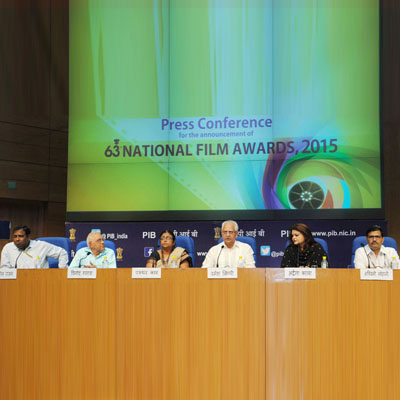
    New Delhi: Gujarat was named the Most Film-Friendly State at the 63rd National Film Awards here today. This is the first time that the Information and Broadcasting Ministry has bestowed this award in order to promote film tourism in states.

    Film Festivals Director Senthil Rajan said: “We had 16 entries from different states, and this is a major step by the Indian government to promote film tourism in the states because this sort of an award will enthuse the states.”

    He added: “We chose Gujarat primarily because of the efforts in the direction of ease of doing business and facilitation of films and towards the promotion of Indian cinema.”

    A special mention was also given to Uttar Pradesh for its single window clearance efforts and incentives offered by the government, and to Kerala.

    The awards were selected by a separate jury constituted by the Directorate of Film Festivals.


  • Gujarat bags National award for Ease of Doing business in cinema, UP and Kerala get special mentions

    Gujarat bags National award for Ease of Doing business in cinema, UP and Kerala get special mentions

    New Delhi: Gujarat was named the Most Film-Friendly State at the 63rd National Film Awards here today. This is the first time that the Information and Broadcasting Ministry has bestowed this award in order to promote film tourism in states.

    Film Festivals Director Senthil Rajan said: “We had 16 entries from different states, and this is a major step by the Indian government to promote film tourism in the states because this sort of an award will enthuse the states.”

    He added: “We chose Gujarat primarily because of the efforts in the direction of ease of doing business and facilitation of films and towards the promotion of Indian cinema.”

    A special mention was also given to Uttar Pradesh for its single window clearance efforts and incentives offered by the government, and to Kerala.

    The awards were selected by a separate jury constituted by the Directorate of Film Festivals.


  • Third Indian Panorama Film Festival to kick off in Shillong

    Third Indian Panorama Film Festival to kick off in Shillong

    NEW DELHI: A festival of selected films from the Indian Panorama is being held in Shillong in Meghalaya from 12 March. 


    To be inaugurated by Meghalaya Chief Minister Mukul Sangma in the presence of Information & Broadcasting Secretary Bimal Julka at the U Soso Tham Auditorium, it will present a bouquet of the best of contemporary Indian cinema produced in different languages with a view to promoting quality cinema from different parts of the country.


    Eight feature films and three non-feature films will be screened over three days. The film festival is being organised by the Directorate of Film Festivals in collaboration with the state government.


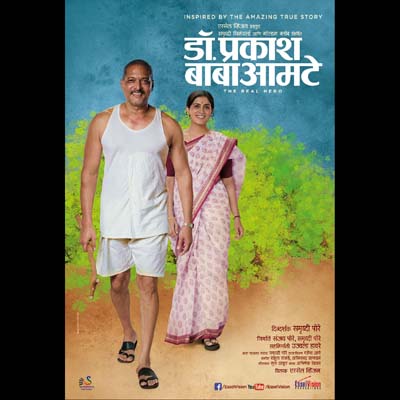
    The festival will open with the Marathi feature film, Dr. Prakash Baba Amte – The Real Hero directed by Samruoddhi Porey. 

    Other feature films to be screened during the festival are Drishyam (Malayalam), December 1 (Kannada), Kuttram Kadithal (Tamil), Ankhon Dekhi (Hindi), Othello (Assamese), Ri (Khasi), Teenkahon (Bengali) and Ranjana Ami Ar Ashbona (Bengali). Non-feature films to be screened during the festival are Songs of the Blue Hills by Utpal Borpujari (Nagamese/English), A Dream Never Dies (Assamese) and Ek Hota Kau (Marathi). 

    Indian Panorama Film Festival is being held in Shillong for the last two years and this will be the third edition of the festival.

  • Films to form important part of Festival of India in China

    Films to form important part of Festival of India in China

    NEW DELHI: A film festival organised by the Directorate of Film Festivals on behalf of the Information and Broadcasting Ministry will form an important component of the Festival of India in China which will be celebrated from next month to March next year.


    Culture Secretary Ravindra Singh on Thursday launched the logo, posters and webpage for the festival, simultaneous with their release in Beijing by Indian Ambassador to China Ashok K. Kantha. 

    Singh said pursuant to the mutual understanding reached during the visit of the Chinese Premier Li Keqiang to India in May 2013 and that of Prime Minister Manmohan Singh to China in October 2013, the year 2014 was designated as the India-China Year of Friendly Exchanges. As part of the Year of Friendly Exchanges, the Culture Ministry in collaboration with the Ministry of External Affairs and the Embassy of India in Beijing, along with the Consulates in Shanghai, Guangzhou and Hong Kong, are organizing the Festival of India in 12 cities in China. 

    A 75 member Indian delegation led by Singh would be visiting China in the first two circuits beginning 7 May. 

    The Festival of India in China covers a wide-range of events showcasing Indian performing arts, exhibitions of modern Indian art, visual and photographic exhibitions on Buddhist heritage of India and its links with China, food festivals, and film festivals, as well as events involving eminent Indian and Chinese scholars and writers. Business and tourism promotion events will also constitute key components of the Festival.


    The Ministry of Culture Institutions – Kalakshetra Foundation, Nava Nalanda Mahavihara, Sangeet Natak Akademy, Kathak Kendra, National Gallery of Modern Art, and Sahitya Akademi – would be participating in the festival. In addition the Ministry of Information and Broadcasting, Department of Ayush and the Ministry of Tourism would be participating in the Film Festival, Yoga Festival and Food Festival. 

    The Festival of India in China will be celebrated in four circuits, circuit one covering Shanghai, Hong Kong, Beijing and Chengdu, Circuit two will cover Beijing, Kunming, Dali and Shenzen; Circuit three will cover Lhasa, Urumqui, and Hangzhou and Circuit four will cover Chongquing, Beijing, Shanghai and Guangzhou. The classical dance program of Kalakshetra will cover the following: Krishna Leela, Kolkali, Suppada, Excerpts from Meenakshi Vijayam, Kalinga Narthanam and Thillana. The Sangeet Natak Academy would be presenting a new composition by senior choreographer Madhavi Mudgal comprising six dance forms representing the diversity of India’s culture Bharatanatyam of Tamil Nadu (and the rest of southern India); Kathak, preeminently the dance of northern India; Odissi, from Odisha in eastern India; Manipuri from Manipur, the north-eastern State of India; Kathakali of Kerala at the southern tip of the Indian peninsula; 

    The colourful logo designed for the Glimpses of India Festival consists of a Kathakali and a Beijing Opera mask side by side. It has been chosen to depict the Indian and Chinese cultures that are shown to be seamlessly blending into one another, thus mirroring the long tradition of friendship and cooperation between the two countries. The left side of the logo is a Kathakali mask from the classical Indian dance tradition that originated in Kerala. The right part of the mask derives from world famous Beijing Opera – a vivid embodiment of Chinese performing art. While the Kathakali dance involves delicate use of hand and eye gestures to communicate, masks in Beijing Opera symbolize different characters and emotions. This convergence of elements from great art forms of the two countries reflects the centuries-old civilizational contacts between India and China. Encompassed within a circle, a symbol of perfection, and with Indian and Chinese colours and motifs symbolising happiness and celebration, the logo represents the spirit of cooperation and harmony underlying the ‘Glimpses of India Festival’. 

    Two posters for Circuit one and Circuit two have been released indicating the festival’s events. 

    The Culture Ministry has created a dedicated webpage http://indiaculture.nic.in/FOI for the Festival of India in China. The webpage covers event schedule and the updates as also photographs and video links.