Tag: director

  • Optimystix appoints Rajesh Bahl as director and group CEO

    Optimystix appoints Rajesh Bahl as director and group CEO

    MUMBAI: Optimystix, the leading production house in both Fiction and Non-Fiction programming, appointed Rajesh Bahl as the Director and Group Chief Executive Officer.

    In his role as Director & Group CEO, Rajesh will not only be responsible for Optimystix’s growth strategy but will also help the company accelerate its next phase of growth and transformation from a bespoke TV production company to creating and producing digital content and venturing into feature film business.

    "Till date our focus as a company has been in growing our TV production business which has shown credible growth YOY and now to create  more significant value and harness the growth across 3 big content spaces i.e. TV, OTT & Feature Films we need someone to guide us strategically and be the torchbearer of our next round of growth. In order to reimagine and reinvent Optimystix I have invited Rajesh Bahl to lead this initiative for us," said Optimystix Entertainment chairman and managing director Vipul. D. Shah.

    Bahl is a senior M&E & Digital business leader with over 20 years of experience of being at the helm in globally acclaimed media companies, namely Times Group, Star TV, Eros International, Universal Music Group and Sony Music, and has been instrumental in establishing their digital & content businesses.

    “I am very excited to join hands with Optimystix at this time when the demand for premium content is on massive upsurge and is being consumed by various audience segment across screens, across platforms, across languages, across genres and across story-telling formats which in turn is fuelling demand from the TV broadcasters, OTT services, and feature film business alike. This presents a great opportunity for Optimystix to expand businesses furthermore”, said, Bahl.

    Before joining Optimystix Rajesh Bahl was the Founding CEO, of Times Studio, A Times of India Group (BCCL) entity where he played a pivotal role in setting up Times Studio business. Under his leadership Times Studio grew from 0-60+ member team, produced few marquee original shows for MX Player and have executed many digital video campaigns for multiple brands and advertisers.

    In his previous stint as the COO at Eros International, he overlooked the development and digitization plans of the digital arm of Eros International. He successfully built and launched www.erosnow.com, India’s first premium OTT service and was involved in driving the product, content & marketing strategy for the same apart from being responsible for feature film marketing. 

  • First Step Entertainment Capital announces ‘Writer’s Lounge’ in Mumbai

    First Step Entertainment Capital announces ‘Writer’s Lounge’ in Mumbai

    Mumbai : A good story is essential to make a film and, hence, writers are critical in the film making process. To consistently create some good stories, writers need a workspace that allows them to sit, think and pen-down their thoughts. The lack of such a space in Mumbai was noticed by Swati Semwal, Creative Head of First Step Entertainment Capital (FSEC). Being a writer herself of many notable short films, she created the FIRST-EVER-FREE co-working space called Writer’s Lounge. It is an inviting space that is located at the epicentre of Television and Films, Versova, Andheri West, Mumbai.

    Writer’s Lounge does not levy any charges for using its space. Its aim is to fill a lacuna that exists due to space constraints in the city. It is available for writers of all ages, associated with Screenwriters Association (SWA), to come, sit and write. Talented writers are groomed in the company of senior writers and peers while they write freely without the fear of paying exorbitant rent.

    Actor, director, writer Swati Semwal, the Creative Head of First Step Entertainment Capital, says, “The idea to start the space actually came to my mind while trying to meet my own needs of finding a suitable space to write. I came from Dehradun to Mumbai and soon realized that there was a need for a common place, where writers could collect, sit, write, exchange and bounce-off ideas amongst each other. This space should become the destination for production houses to come looking for budding writers with fresh ideas. We are helping them feel the ownership of their space. We hope Writer’s Lounge becomes a haven for all aspiring writers.”

    Research indicated that though there were a few websites offering a virtual lounge offering support to writers to send in their stories or exchange ideas across the world, but there was no such facility on-ground in Mumbai. There is a need for a common place, where budding writers are groomed, and nurtured, in good company of senior writers and peers.

    “All writers should have access to a place where their creativity flows easily to become strong narratives. Writer’s Lounge will ensure that all serious writers, who are members of the Screenwriters Association in India, are given a comfortable place and a peaceful environment to write their stories. It allows like-minded people to work under a common roof”; says National Award Winner, Juhi Chaturvedi.

    The well-known Director-Writer of several films, Tanuja Chandra says, “Since the time we were young, we were highly encouraged to read and write and to be creative. Despite being into creative arts, it took me a while to write my first book because I found it very intimidating, since every word counts and affects the impact of the story. When I ventured into script writing and direction, Bollywood was largely a male dominated industry. I managed to make a mark. Today, as I see myself standing with my fellow writers, all women, I must say women have always had to move against the tide and they have come up as winners. I believe if you have talented and motivated people, they should be encouraged to work in a peaceful arena where creativity or efficiency is the highest priority. Here’s wishing Writer’s Lounge the very best to be a successful destination for writers.”

    Writer’s Lounge is a community workspace that’s more than just a few desks, fast internet and free coffee. The team at First Step Entertainment Capital have been working hard at curating the ambience of the lounge and creating a workspace where the writers can just get their head down, and be focused and productive.

    First Step Entertainment Capital’s vision is to support small budget Indie Cinema, and give creative people all they need to make their ‘First Break’ into films, be it in terms of a beautiful space like Writer’s Lounge to write their stories and in giving them all the facilities to make their stories a reality– as a short film, feature film or documentary and can also give them a platform, Net Pix Shorts to showcase their short films.

    Speaking on the occasion Imran Ashraf, the Founder of First Step Entertainment Capital says, “First Step is an incubator of content and creative talent with a goal to discover and nurture fresh talent of film makers and writers. We believe in good storytelling, because content is the king. The mission of First Step Entertainment is to tell stories with social impact, have thought leadership in content, make films fast and give writers of all ages who have innovative ideas and concepts an opportunity to make a film.”

    “At First Step, we personally handpick content and execute it without compromising the story. We want to bring newer and differentiated stories by giving opportunities to fresh talent, and make movies that will make you ‘Think, Laugh and Thrill;” Imran further adds.

    Do visit Writer’s Lounge and enjoy the neat and clean surroundings, with no maddening din to clutter the mind. With the availability of essentials like free community writing space, WiFi, Writer’s Lounge is the First Step towards bringing about a change in a writer’s life!.

    Writer’s Lounge is located at Z A Tower, Yari Road, Versova, Andheri West, Mumbai.

  • Films for telecast should be re-certified: Shyam Benegal Committee

    Films for telecast should be re-certified: Shyam Benegal Committee

    NEW DELHI: Films submitted for telecast on television or for any other purpose should be re-certified.

    This has been recommended by the committee on Film Certification headed by renowned filmmaker Shyam Benegal set up in January following the controversy relating to film certification in December last year.

    The committee has made it clear that any complaints received by the central government should be  referred to the Central Board of Film Certification whose chairperson may, if he considers it necessary to do so, refer the film to a revising committee for examination once again in view of alleged violation of Section 5B(1) of the Cinematograph Act, 1952.

    Regarding the categorisation of films, the committee recommends that it should be more specific and apart from U category, the UA Category can be broken up into further sub-categories – UA12+ & UA15+. The A category should also be sub-divided into A and AC (Adult with Caution) categories.

    The committee has said that online submission of applications as well as simplification of forms and accompanying documentation should be permitted.

    In order to preserve Indian Cinema, the committee recommends that every applicant should deposit the Director’s Cut in the National Film Archives of India for preservation. At present, only the certified version is submitted but the committee felt that the original will ‘truly reflect the cinematic history of Indian cinema’.

    Out-of-turn certification may be permitted on condition that the applicant pays five times the fee that would have to be paid if the certification were done in the normal course.

    Meanwhile, the committee was given time by Information and Broadcasting minister Arun Jaitley to give recommendations on the certification of films regarding issues relating to clearances to be obtained from the Animal Welfare Board under the Prevention of Cruelty to Animals Act; depiction of smoking in films wherein films are required to show a disclaimer in every scene that involves smoking, according to a directive from the Health and Family Welfare ministry.

    Following the request by the committee, it has been asked to give its recommendations on these issues by 20 June 2016.

    An official note said the committee had been set up on 1 January 2016 in sync with the overarching vision of the prime minister Narendra Modi and Arun Jaitley to lay down a holistic framework for certification of films.

    The committee was asked to lay down norms for film certification that take note of best practices in various parts of the world and give sufficient and adequate space for artistic and creative expression,  lay down procedures and guidelines for the benefit of the CBFC Board to follow and examine staffing patterns with a view to recommending a framework that would provide efficient and transparent user friendly services. 

    Other members of the committee are actor and filmmaker Kamal Hassan, filmmakers Rakeysh Om Prakash Mehra and Goutam Ghose, ad guru Piyush Pandey, critic Bhawana Somaaya, and National Film Development Corporation MD Nina Lath Gupta. I and B Joint Secretary (Films)   K Sanjay Murthy is Member-Convenor.

    The committee also said the  CBFC should only be a film certification body whose scope should be restricted to categorizing the suitability of the film to audience groups on the basis of age and maturity.

    However, it could make recommendations to refuse certification if a film contains anything that contravenes the provisions of Section 5B (1) of the Cinematograph Act, 1952; and when content in a film crosses the ceiling laid down in the highest category of certification.

    The applicant must specify the category of certification being sought and the target audience.

    The committee said that the objective of these guidelines would be to ensure that children and adults are protected from potentially harmful or unsuitable content; audiences, particularly parents are empowered to make informed viewing decisions; artistic expression and creative freedom are not unduly curbed in the process of classification of films; the process of certification is responsive, at all times, to social change; and the certification keeps within the rights and obligations as laid down in the Indian constitution.

    The highlights of the recommendations of the committee broadly cover the areas related to Film Certification Process and its simplification, Restructuring staffing pattern of central and regional censor advisory panels and re-certification of films for purposes of telecast on television and measures to preserve the identity of Indian Cinema.

    The certification of films will be carried out in accordance with the guidelines proposed for certification that have been split into three sections, with each section required to be read with the other two – General Guidelines, Issue Related Guidelines and Category Specific Guidelines.

    The committee has also made certain recommendations regarding the functioning of the board and has stated that the board, including chairman, should only play the role of a guiding mechanism for the CBFC, and not be involved in the day-to-day affairs of certification of films.

    The functions of the board shall be confined to the duties defined in the existing CBFC rules, which include an annual review of CBFC work, submission of annual report to the government, review of public reactions to films, and periodic recommendations for revision of guidelines.

    Given these limited functions, the size of the board should be compact with one member representing each regional office. Therefore, the total composition of the board should not be more than nine members and one chairman.

    Regarding the Regional Advisory Panel the committee has laid down the criteria for appointment. All nine regions will have advisory panels comprising persons who are acquainted with the languages being certified by that regional office.

    The panels should have 25 per cent members from all walks of life, recommended by the National Film Development Corporation to the central government; 25 per cent members of the general public recommended by the Federation of Film Societies of India; 25 per cent members recommended by the National Council for Protection of Child Rights (NCPCR) and National Commission of Women (NCW); and 25 per cent representatives of the local film industry as recommended by FFI (Film Federation of India).

    Women should have a 50 per cent representation on each panel, the committee said.

  • Films for telecast should be re-certified: Shyam Benegal Committee

    Films for telecast should be re-certified: Shyam Benegal Committee

    NEW DELHI: Films submitted for telecast on television or for any other purpose should be re-certified.

    This has been recommended by the committee on Film Certification headed by renowned filmmaker Shyam Benegal set up in January following the controversy relating to film certification in December last year.

    The committee has made it clear that any complaints received by the central government should be  referred to the Central Board of Film Certification whose chairperson may, if he considers it necessary to do so, refer the film to a revising committee for examination once again in view of alleged violation of Section 5B(1) of the Cinematograph Act, 1952.

    Regarding the categorisation of films, the committee recommends that it should be more specific and apart from U category, the UA Category can be broken up into further sub-categories – UA12+ & UA15+. The A category should also be sub-divided into A and AC (Adult with Caution) categories.

    The committee has said that online submission of applications as well as simplification of forms and accompanying documentation should be permitted.

    In order to preserve Indian Cinema, the committee recommends that every applicant should deposit the Director’s Cut in the National Film Archives of India for preservation. At present, only the certified version is submitted but the committee felt that the original will ‘truly reflect the cinematic history of Indian cinema’.

    Out-of-turn certification may be permitted on condition that the applicant pays five times the fee that would have to be paid if the certification were done in the normal course.

    Meanwhile, the committee was given time by Information and Broadcasting minister Arun Jaitley to give recommendations on the certification of films regarding issues relating to clearances to be obtained from the Animal Welfare Board under the Prevention of Cruelty to Animals Act; depiction of smoking in films wherein films are required to show a disclaimer in every scene that involves smoking, according to a directive from the Health and Family Welfare ministry.

    Following the request by the committee, it has been asked to give its recommendations on these issues by 20 June 2016.

    An official note said the committee had been set up on 1 January 2016 in sync with the overarching vision of the prime minister Narendra Modi and Arun Jaitley to lay down a holistic framework for certification of films.

    The committee was asked to lay down norms for film certification that take note of best practices in various parts of the world and give sufficient and adequate space for artistic and creative expression,  lay down procedures and guidelines for the benefit of the CBFC Board to follow and examine staffing patterns with a view to recommending a framework that would provide efficient and transparent user friendly services. 

    Other members of the committee are actor and filmmaker Kamal Hassan, filmmakers Rakeysh Om Prakash Mehra and Goutam Ghose, ad guru Piyush Pandey, critic Bhawana Somaaya, and National Film Development Corporation MD Nina Lath Gupta. I and B Joint Secretary (Films)   K Sanjay Murthy is Member-Convenor.

    The committee also said the  CBFC should only be a film certification body whose scope should be restricted to categorizing the suitability of the film to audience groups on the basis of age and maturity.

    However, it could make recommendations to refuse certification if a film contains anything that contravenes the provisions of Section 5B (1) of the Cinematograph Act, 1952; and when content in a film crosses the ceiling laid down in the highest category of certification.

    The applicant must specify the category of certification being sought and the target audience.

    The committee said that the objective of these guidelines would be to ensure that children and adults are protected from potentially harmful or unsuitable content; audiences, particularly parents are empowered to make informed viewing decisions; artistic expression and creative freedom are not unduly curbed in the process of classification of films; the process of certification is responsive, at all times, to social change; and the certification keeps within the rights and obligations as laid down in the Indian constitution.

    The highlights of the recommendations of the committee broadly cover the areas related to Film Certification Process and its simplification, Restructuring staffing pattern of central and regional censor advisory panels and re-certification of films for purposes of telecast on television and measures to preserve the identity of Indian Cinema.

    The certification of films will be carried out in accordance with the guidelines proposed for certification that have been split into three sections, with each section required to be read with the other two – General Guidelines, Issue Related Guidelines and Category Specific Guidelines.

    The committee has also made certain recommendations regarding the functioning of the board and has stated that the board, including chairman, should only play the role of a guiding mechanism for the CBFC, and not be involved in the day-to-day affairs of certification of films.

    The functions of the board shall be confined to the duties defined in the existing CBFC rules, which include an annual review of CBFC work, submission of annual report to the government, review of public reactions to films, and periodic recommendations for revision of guidelines.

    Given these limited functions, the size of the board should be compact with one member representing each regional office. Therefore, the total composition of the board should not be more than nine members and one chairman.

    Regarding the Regional Advisory Panel the committee has laid down the criteria for appointment. All nine regions will have advisory panels comprising persons who are acquainted with the languages being certified by that regional office.

    The panels should have 25 per cent members from all walks of life, recommended by the National Film Development Corporation to the central government; 25 per cent members of the general public recommended by the Federation of Film Societies of India; 25 per cent members recommended by the National Council for Protection of Child Rights (NCPCR) and National Commission of Women (NCW); and 25 per cent representatives of the local film industry as recommended by FFI (Film Federation of India).

    Women should have a 50 per cent representation on each panel, the committee said.

  • Digi Osmosis unique campaign for ‘Ki & Ka’

    Digi Osmosis unique campaign for ‘Ki & Ka’

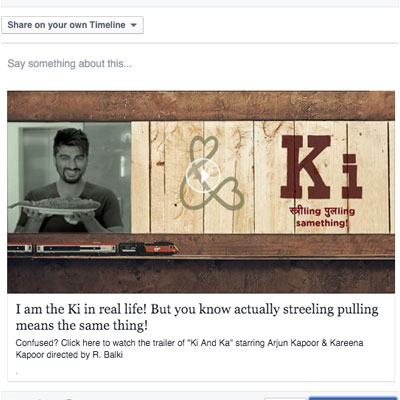
    MUMBAI: Digi Osmosis has crafted a unique campaign for R Balki’s latest production Ki &Ka from the T-Series Films stable by creating a special app for the Ki & Ka facebook page. Once the viewer has watched the trailer on Facebook, a question pops up asking the viewer ‘Who are you in your life, Ki or Ka?’. It further asks  viewers if they are the independent, career-oriented, outspoken Ki or the homely, loving and caring Ka. 

    After the viewer answers and clicks the share button, the trailer is shared on the user’s timeline on Facebook with another caption – ‘I’m Ka in real life but you know, ??????ling (Feminine) and ???ling (Masculine) means the same thing!’

    Commenting on the campaign Digi Osmosis founder Manish Kumar said, “For this trailer, the strategy was simple; there are thousands of people who identify with Ki&Ka on a very personal level. They will find it to be a very interesting activity and in turn share it with their friends. Their friends in turn, find it a quirky and engage with the trailer, repeating the process. This encourages share-ability, a factor crucial for social media and creates a simple viral chain garnering the reactions required. ”

    Ki & Ka director and producer R Balki mentioned that “It has been a terrific learning experience for me working with the Digi Osmosis team. I gave them the trailer of Ki & Ka and they just had a few hours to convert it into an active engagement piece rather than a passive experience. They developed an app embedded in the trailer to make the viewer see herself/ himself as the characters in the story and respond. Simple. Innovative. And really on the ball.”

  • Digi Osmosis unique campaign for ‘Ki & Ka’

    Digi Osmosis unique campaign for ‘Ki & Ka’

    MUMBAI: Digi Osmosis has crafted a unique campaign for R Balki’s latest production Ki &Ka from the T-Series Films stable by creating a special app for the Ki & Ka facebook page. Once the viewer has watched the trailer on Facebook, a question pops up asking the viewer ‘Who are you in your life, Ki or Ka?’. It further asks  viewers if they are the independent, career-oriented, outspoken Ki or the homely, loving and caring Ka. 

    After the viewer answers and clicks the share button, the trailer is shared on the user’s timeline on Facebook with another caption – ‘I’m Ka in real life but you know, ??????ling (Feminine) and ???ling (Masculine) means the same thing!’

    Commenting on the campaign Digi Osmosis founder Manish Kumar said, “For this trailer, the strategy was simple; there are thousands of people who identify with Ki&Ka on a very personal level. They will find it to be a very interesting activity and in turn share it with their friends. Their friends in turn, find it a quirky and engage with the trailer, repeating the process. This encourages share-ability, a factor crucial for social media and creates a simple viral chain garnering the reactions required. ”

    Ki & Ka director and producer R Balki mentioned that “It has been a terrific learning experience for me working with the Digi Osmosis team. I gave them the trailer of Ki & Ka and they just had a few hours to convert it into an active engagement piece rather than a passive experience. They developed an app embedded in the trailer to make the viewer see herself/ himself as the characters in the story and respond. Simple. Innovative. And really on the ball.”

  • Adfest 2016: 37 directors aspire to be ‘Fabulous Four’

    Adfest 2016: 37 directors aspire to be ‘Fabulous Four’

    MUMBAI: Thirty seven aspiring directors from eight cities are in the running to become Adfest 2016’s ‘Fabulous Four.’


    ‘Fabulous Four’ is a visionary mentoring program run annually by Adfest, which is designed to nurture up-and-coming directors.


    Every year, Adfest invites new directors and assistant directors to submit a five-minute short film script inspired by the theme of the festival, which is slated as ‘Creative Intelligence’ for this year.


    A total of 37 scripts were submitted from Brisbane, Dhaka, Fukuoka, Kuala Lumpur, Mumbai, Shanghai, Sydney and Tokyo this year, which is up from 33 last year.


    All 37 scripts will be judged by the Film Craft and New Director jury, which is led by jury president Sihabutr Xoomsai, Thailand’s award-winning director at Triton Film in Bangkok.


  • Pathrabe to replace Narain as FTII director; no decision on Gajendra Chauhan

    Pathrabe to replace Narain as FTII director; no decision on Gajendra Chauhan

    NEW DELHI: Even as the protest against the appointment of actor Gajendra Chauhan as chairman of the Film and Television Institute of India (FTII) continues, former National Film Archives of India head Prashant Pathrabe has been appointed as the director of the Institute, replacing DJ Narain.


    The Information and Broadcasting (I&B) Ministry decided to replace Narain, who is considered popular with students, despite reprimands from the government.


    Meanwhile, the protest against Chauhan’s appointment as FTII chairman has been going on for over a month now and has even seen multiple actors entering the fray either for or against him.


    Many Bollywood celebrities including Salman Khan and his father Salim Khan, Ranbir Kapoor, Anupam Kher and Rishi Kapoor have expressed their opinion on the issue, siding with students.


    FTII students have been protesting against government interference, saying that Chauhan who had enacted the role of Yudhishtra in the mega series Mahabharata, lacked qualification for the important post.


    On the other hand, Narain’s term was to end at the end of July. He is a 1990 officer of the Indian Information Service.


    Pathrabe has been in the media field for more than 18 years, having previously worked in Doordarshan News and All India Radio News in Mumbai. He has also been spokesperson for Southern Command, Pune.


    Pathrabe, a MBA from IIM Ahmedabad, joined the Indian Information Service in 1993 after a stint in public and private sector companies. He is currently with the Press Information Bureau in Pune.

  • Star Gold HD announces ‘Director’s Cut’

    Star Gold HD announces ‘Director’s Cut’

    MUMBAI: Star Gold HD, India’s favorite destination of movies, is all set to entice its viewers by bringing the best of director’s movies starting from 1st June to 14th June, daily at 9pm. The festival will showcase blockbuster movies by renowned directors like Karan Johar, Rakesh Omprakash Mehra, Prakash Jha, Imtiaz Ali, Farah Khan, Zoya Akhtar and many others.

    The festival has curated 14 best films from the library of these renowned directors. The two week-long festival will begin with ‘Rajneeti’, directed by Prakash Jha starring Ranbir Kapoor & Katrina Kaif. Followed by ‘Om Shanti Om’ directed by Farah Khan, ‘Bhaag Milkha Bhaag’ & ‘Rang De Basanti’ by Rakesh Omprakash Mehra, ‘Highway’ and ‘Rockstar’ by Imtiaz Ali, Zoya Akhtar’s ‘Luck By Chance’ and ‘Zindagi Na Milegi Doobara’. Karan Johar’s blockbuster hits like ‘My Name Is Khan’ and ‘Kabhi Khushi Kabhi Ghum’, R Balki’s ‘Cheeni Kum’ and Sanjay Leela Bhansali’s ‘Guzaarish’ are also a part of the movie festival. 

    Experience the biggest hits of your favourite directors in Director’s Cut on Gold HD from 1st June to 14th June at 9.00 pm.

  • “Write down your goals and give deadlines. This is the roadmap to success”

    “Write down your goals and give deadlines. This is the roadmap to success”

    MUMBAI: The newest addition to his portfolio is Aur Pyaar Ho Gaya, which premiered on Zee TV last month. Known to have a keen eye for talent, director-turned-producer Rajan Shahi’s latest venture too serves as a launch pad for debutants Mishkat Varma and Kaanchi Singh who play the show’s lead pair.

    Since making his directorial debut in 1999 with Dil Hai Ki Manta Nahi through launching his own production house Director’s Kut Productions in 2007 and till date, Shahi has seen a meteoric rise in the television industry.

    Having directed clutter-breaking shows like Jassi Jaisi Koi Nahi, Hamare Tumhare, Ghar Ki Laxmi Betiyaan and Maayaka and gone on to produce a couple more such as Sapna Babul Ka… Bidaai and Yeh Rishta Kya Kehlata Hai, Shahi is a much sought after figure in the industry.

    Ask him his success mantra and he says: “In the hustle and bustle of our everyday lives, we often forget what it is we are working so hard for! Write down your goals and give yourself deadlines. This is the roadmap to your success.”

    Directorial dreams

    The influence of his maternal grandfather and veteran actor P Jairaj led to Shahi’s fascination with the entertainment industry from an early age.

    After graduating in English Literature from Hindu College, New Delhi, he moved to Mumbai, by which time, he was sure he wanted to become a director. Eventually, he landed up in the production department under Ravi Rai. Two years into production designing, Shahi got the opportunity to prove his mettle when asked to chip in for an absentee assistant director. Soon after, he graduated to assisting Rai in Thoda Hai Thode Ki Zaroorat Hai and Teacher.

    Sometime in between, he met and fell in love with writer Pearl Grey, whom he later married. With her script of Dil Hai Ki Maanta Nahin finding a willing producer in Hemant Seth, Shahi too bagged his first project which propelled him into the big league. He then shot pilots of two other serials, Mera Ek Sapna and Ansh, following which, there was no looking back. Shahi proceeded to direct hit series including Jassi Jaisi Koi Nahi, Hamare Tumhare, Rishtey, Kareena Kareena, Reth, Mamtaa, Millee, Virasaat and Saathi Re and got to work as series director on Ghar Ki Laxmi Betiyaan and Maayaka on Zee TV.

    Shahi believes that “a director is like the captain of the ship and more than anything else, needs to be extremely patient with all his crew members.”

    Turning producer

    Twelve years into direction and Shahi started his own production house which he christened Director’s Kut Productions (DKP).

    Ask him why he decided to turn producer and he has several reasons to give. Firstly, in television, one needs to reinvent oneself every five years. “In films, you can say you are a director for 15-20 years, a producer for 15-20 years or a writer for 30 years. But in television, you need to rejuvenate yourself,” says he.

    Secondly, production was the logical next step after directing for so many years. “While I learnt a lot under all the production houses and producers with whom I collaborated, personally, I wanted to have more control. Especially when there is creativity, I didn’t want to be restricted by the production part of it,” he explains.

    So when Bidaai came along on Star Plus, Shahi took the plunge as producer. “I owe my becoming producer largely to Uday Shankar who gave me the chance. Not that I did not express my desire to other big channel heads but he was the only one who had faith in me at a time when no other person would back me as a producer,” recalls Shahi, adding, “I was very happy that with Bidaai, a technician was given the opportunity to produce a show.” At the time, big production houses ruled the roost and creativity wasn’t exactly the first priority.

    Lastly, with so many layers in television i.e. scripting, concept, shooting, editing and post production, Shahi wanted to minimise the chaos by being that one person in every department who is answerable for everything. “I wanted to multi-task. So in that area I scored where even today, I am personally answerable for everything in my company. They know there is just one person to be called instead of talking to 50 other people. With serials such as Bidaai and Yeh Rishta, these things got consolidated,” he elaborates.

    Ask him about the name DKP and he says: “I have been in this industry for 21 years, but I have directed properly for 12 years. People used to identify me as a director and wanted to give a name which could identify with my character and the reason people know me for.”

    About DKP                                         

    Shahi believes DKP is what it is today because of his team which is hungry for work and strives to deliver the best product. “Since DKP’s inception, we have done some very good shows and there is a certain reputation it enjoys. You may be the face of a company but it cannot run properly if you don’t have a good team,” he says.

    The DKP office at Lakshmi Industrial Estate in Mumbai houses around 30 to 40 staff while the core team is about 100-strong constituted by creative and technical personnel at different levels. 

    “There is a definite core team in the company and DKP is synonymous with the excellent people working for it. Fortunately, the majority of them are the same since its inception; be it creative directors, creative people, editors and so on. Fact is in my 12 years as director, I have seen some of the best talent which I have retained while letting the rest go by,” he exults. 

    For Shahi, DKP is all about the goodwill and blessings and good wishes of all its actors, technicians and workers. He sincerely believes it is the workers’ support and hard work that has taken the production house to such dizzying heights.

    “The biggest award or achievement you can say is my workers. Again, I have seen a lot of people who project a high-flying image by travelling in luxury cars and chartering private planes but keep workers’ money inside their own pockets. While I cannot keep everyone happy, each one of my workers knows that if there is a problem, I will be there to solve it. I don’t want DKP to be big if I don’t stay connected to my workers. My work exudes quality and it is straight from the heart. I might not have eight or nine shows with me today, I might not have the biggest cars with me today, but I have the goodwill of all my actors, technicians and creative people, most importantly, my workers,” he explains.

    Having realised earlier on in his career that television is essentially about what happens on the sets, Shahi has set up office on the sets itself with most of his team concentrated there.

    A bumpy ride

    With dynamics changing from day to day, it is next to impossible to keep tab on the highs and lows of producing television shows but “it’s all part of the learning process,” says Shahi. Yet, when Bidaai and Yeh Rishta were number one or two across channels, it was a real high. “We were on a very big platform like Star Plus and it was a huge responsibility. For a technician who didn’t have crore in his bank, entering an arena where the big players were was a big thing,” he adds.

    Bidaai had a successful run for more than two years till Yeh Rishta Kya Kehlata Hai took over variously as number one and number two across channels. For two years, these two shows were ruling the roost and in one particular week, both were number one across all channels and garnered TRP of 7.1. That was a big moment for the entire team; informs Shahi, pointing out that his highs come from people placing their faith in him which is what inspires him to give his 100 per cent to any project. 

    Speaking of the lows, Shahi recalls the time when Bidaai went off air in 2010. “We thought we were back to ground zero and anything is possible in this industry. But it was a conscious decision to end the show on a high. At the time, the actors… the entire unit… had tears in their eyes and were wondering why we were pulling the plug on the show when it was in the top five across channels. The moment was such when I knew I didn’t have an answer…” he says.

    Lessons learnt

    Shahi considers himself lucky to have interacted with some of the best producers in the industry and learnt so much from them. Even today, he doesn’t shy away from calling them whenever in need of advice. He has always believed in the adage: “Learn from the leaders, learn from the people you admire and learn from the people around you!”

    Another key takeaway has been that audiences cannot be taken for granted any more, what with social media bringing producers and viewers closer to each other than ever before.

    “Today, we get instant feedback and don’t have to rely on the channel or probably the research team. Instantly, I get to know whether people have liked the track or not. Viewers are very vocal about what they like and what they don’t so you can’t take them for granted anymore,” he says. “This connect the media has brought about between me as a maker and my audience is the biggest thing that has happened.”

    Road ahead

    Shahi wants to be known as a producer who is creatively involved. “I have done a few shows, but each show is different from the other. I always look into scripts where I have a creative say. It’s not just about quantity but also quality in whatever we do,” he says.

    With a handful of scripts lined up this year; some are in the scripting stage, others in the casting stage, and still others evolving.

    The company plans to foray into other genres as well, comedy being one. Getting into films is also on the cards though TV is a priority. “Right now, my whole attention is towards consolidating Aur Pyaar Ho gaya which is our latest launch. And even consolidating Yeh Rishta, which now is showing six days a week,” he says.

    Don’t daily soaps make for a very erratic shooting schedule? “Daily soaps are always hectic. In the past when Bidaai was on, shows were aired for one hour every day, five days a week. There have also been occasions when they have extended to six or seven days for one or two weeks. I look at it as a challenge to not only make them but also maintain the quality. We are used to such volume of work,” he signs off.

    MediaSpeak

    Former programming head at Zee TV Ajay Bhalwankar who is now chief creative officer at Sony Entertainment Television believes that it is always a great experience working with Shahi. “He is a very dedicated, passionate and gifted producer. It is somebody who is very sincere also and somebody who is extremely open to listen to your ideas and incorporate them. It has been wonderful working with him and is extremely talented.”

    Shahi who has worked with cross section of producers and from each producer, he believes has learnt a lot. Whether it’s Deeya and Tony Singh from DJ’s Creative Unit or Sunjoy Waddhwa from Sphere Origins, all have been there for him always. They say:

    DJ’s Creative Unit producer Deeya Singh opines: “My association with him has been extremely good. It is so nice to see when good talented people grow, it feels good. He understands the medium very well. The industry needs more such people and feels really nice when one sees so much success that comes to him. I have known him as a director and watched him as a producer and he is good at both. I think that is the special talent, because not everybody can do both. He has managed to do the impossible and be both.”

    “With him, it’s been a very good association. I know him from the time we did Saath Phere and I know him more now as a Producer. He is a very easy-going and good guy. I feel very good for him because he has also come up from an independent director to a very good producer who has given some excellent shows to the industry. He is one of the very good producer’s who has a good thinking head,” expresses Sphere Origins producer Sunjoy Waddhwa.