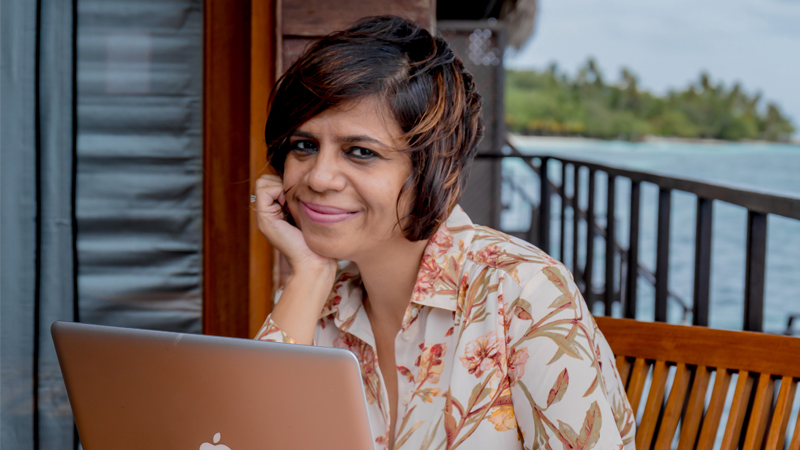
Mumbai: Movies, cinema, TV, and OTT shows serve as portals to diverse worlds, emotions, and experiences, captivating audiences worldwide. At the heart of these visual delights are screenwriters, the architects who craft compelling narratives, flesh out characters, and weave intricate plots that keep viewers hooked. They are the unsung heroes behind the scenes, shaping the stories that resonate with audiences for generations.
Anuraadha Tewari stands as a prominent figure in this realm, with a multifaceted career spanning across various mediums. From her early days as a chief assistant to Mahesh Bhatt to her groundbreaking work as a director and screenwriter, Tewari has left an indelible mark on Indian entertainment. With a repertoire that includes acclaimed television shows like “Yeh Meri Life Hai” and “Ek Hazaaron mein Meri Behnaa Hai,” as well as hit films like “Fashion” and “Heroine,” she continues to push creative boundaries. Currently, her focus on OTT platforms underscores her adaptability and foresight in an ever-evolving industry. Tewari’s journey embodies the spirit of innovation and excellence in storytelling, inspiring aspiring writers and filmmakers worldwide.
Indiantelevision.com in conversation with Anuraadha Tewari spoke about her inspiration behind persuing independent creative endeavors, her focus on screenwriting for TV and cinema, on the creation of Kosen-Rufu and the current projects she is working on and more…
Edited Excerpts:
On the inspiration behind your transition from assisting Mahesh Bhatt to pursuing independent creative endeavors
It was very early in my career and I was mostly one film old as an associate but I think it was the joint faith of Bhatt Saab and Mr Anupam Kher that made me take the plunge. I joined Mr Kher’s Media Entertainment Co. as the creative director and started writing and directing myself as well. I remember I was hailed as the youngest director in India when I helmed my first project (Femina 1996) I was the youngest member of my Crew and most people would come and ask for the ‘Director’, It was quite a joke 🙂
I think what happens is when you are young you are brash. You don’t know what you don’t know so you are fearless. I thought I knew everything thanks to my MA degree in Mass Com. I was the topper of my class and I had landed a job on day one in Mumbai, why wouldn’t I turn a director that early? That was more or less going on in my mind. I pitched some very out-of-the-box ideas, one was a silent show, the other a live-action animation one and lo and behold the heads of Star TV and Sony Entertainment Television said yes immediately. So I just went into them with the cockiness of someone who was going to change the business haha.
Mostly I think people were betting on my confidence and supporting my crazy ideas. I went on to direct several such shows as well as many live events like Filmfare, The Screen Awards, Lata Mangeshkar live in concert. and so on. Those were times when people were experimenting a lot and I was a new kid on the horizon.
On shifting your focus to screenwriting for television and cinema
The year was 2004. I had been a director for seven years and had also headed various companies as a head of content or a CEO ( Channel V, Crest Communications, etc). I had already written my first few films ( Rahul, Yaadein, Supaari). It was time to direct my first film and I decided to turn a freelancer for good and turned down all offers to head channels. I was immediately signed up along with directors Neeraj Pandey and Kabir Sadanand for a certain banner. However, none of our films took off. Suddenly there was a slump. After six months of waiting and prepping, I had no film or job. It all felt a little directionless. But I was sure I didn’t want to go back to a job.
That is when, out of the blue, Himesh Reshammiya called me to create a show for his TV production house (he is also a successful TV producer). I was very reluctant but he was very convincing. In fact, the jargon didn’t exist then but I did create the first show Bible and sort of started the trend of paid pitches for shows. Unfortunately for Himesh, the show didn’t materialise. But my friend Venita Coelho, the then content head of Sony, convinced me to write another TV show while Tarun Katial, the business head offered a two-year writing contract with the channel.
Frankly, at that point it was the best thing to happen. And so despite my initial reluctance I began writing one show after another and began enjoying the discipline of it all. I was writing all the urban or youth/kid shows anyway and I began to have a blast. And slowly I warmed up to the idea of being a full-time writer and now 20 years later, haven’t regretted a day!
On your experience working with renowned directors like Prakash Jha and Madhur Bhandarkar
The two experiences are definitely as different as chalk and cheese! Mr Jha was actually the first person to give me a break as a writer. Meeting me way back in his small office he asked me to write a story based on a concept he had. I didn’t even have a computer then, so I stayed up the night to write it in his office. When he read the 10 pager the next day, he said he was impressed and I was on. Thereafter, our working relationship was that of mentor and student. Mr Jha is a teacher, a taskmaster. With every draft, I felt I was learning something new. I was also touched that he respected every thought of mine, despite being that new and that young. In fact, when I turned a freelancer he let me work out of his office for six months. That’s the kind of grace he has.
Madhur Sir on the other hand is a different entity altogether. He is a friend first. He seeks personal comfort with you before you start work. There is an incredible ease around him that comes from taking himself too seriously. Yet, he has this whole spiritual quotient to him, like a part of him is watching himself do what he does. So with him I struck off this instant friendship. We bonded over cinema like two boys. Despite the initial ‘memsaabness’ that he was wary of initially, Madhur Sir brought back the Gorakhpur in me! I find that invaluable because when a part of you becomes elitist, you tend to lose touch with your core audience. With him, I learnt to marry my intellectual thoughts with an Indian groundedness that is unique to him. So yes, I can safely say that both Mr Jha and Mr Bhandarkar have contributed immensely to my growth as an Indian filmmaker.
On the creation of KOSEN-RUFU, and the projects you’re currently working on through the company
The year was 2017. I was done with writing for television and done with working solo. I did briefly contemplate changing professions as well since I was dabbling with psychology already. However, a deep introspection revealed to me the fact that I wasn’t done being creative, I was simply bored of the way I had been working for the last 13-14 years. It was monotonous and creatively lonely. That is when the idea of Kosen Rufu was born. Incidentally, it is a phrase from my Buddhist chanting practice and when people ask what it means I get to spread the message :))) It was a simple idea. To create an umbrella where I gather small teams of writers and do live jam sessions over stories. A lot like musicians jam on songs.
It was still very early days of the web business in India and writers’ rooms were still not fashionable yet but I had sprung them already, out of simply my own need! And as manifestations go, just as I left TV a lot of web show Bibles started coming our way (illegal on Voot being one of them) and that is how it became our focal point and specialisation. By 2018, I concretised the idea and actively found many a young and fresh mind who I trained via live projects. It became a sound model and each year I found a new ‘batch’ of fresh minds. I am so proud to see a whole lot of them turned independent writers or absorbed into platforms now!!! It was a bit like a writers’ room cum writing workshop rolled into one. We worked out of a co-working space in Araamnagar and created some mammoth ideas. I also trained myself on how to run a writers’ room under Ilene Chaiken, the writer of ‘The L Word’. This has been how I have been working ever since. Over the last two years, I have cut down on the number of projects we do since it got a little exhausting. Currently, the show on air is Raisinghani vs Raisinghani which went through a writers’ room in its first month of episodes. We next have ‘Dil, Dosti, Dilemma’ produced by Ten Years Younger which will be the next Kosen Rufu endeavour out there.
On the landscape of OTT platforms influencing your creative process in recent years
OTT platforms have certainly given a lot more freedom to writers and created value for us. You see, the web with its eigth-10 episode Narrative is heavily dependent on story structure. Unlike a film or an Indian TV show, a web show will not be picked up unless structurally sound. Especially because it is meant for binge-watching. Hence, writing is the hero on the web. One has seen that a web series doesn’t require a ‘face’ to become a hit. It actually requires authenticity. False notes and meandering stories don’t work on the web because you will be fast-forwarded. So yes, writing is the mainstay of the web and that has given us all a huge shot in the arm.
The fact that you have to make a show Bible shows how a story and its arc, character details, the world etc are now important to Indian storytelling as well. There is a little more time and thought being given to the writing. Show creators are being regarded with some respect and there is just more value for what you create. So certainly this has made the process less stressful for us.
Having said that, the nature of a web series is such that it gets ingested over just two weekends. It gets forgotten in the third! Unlike a film it has no real value for posterity and unlike a TV show, it has no long-term emotional engagement. Hence, the entire business is still figuring out the way forward and I do believe that our show ‘Raisinghani Vs Raisinghani’ despite its obvious challenges seems to have shown the way for a new format that may engage Indian viewers in a form they are more used to. I call it TWeb.