Tag: digitisation

  • DAS Phase III: Status report

    DAS Phase III: Status report

    MUMBAI: It was in September 2014 when the then Information and Broadcasting Minister Prakash Javadekar extended the deadline for completion of phase III of cable TV digitization. Not only did Javadekar extend the deadline, but also set separate deadlines for phase III and IV, which initially were supposed to be completed in the same time frame.


    So, while the deadline for phase III was set to be December 2015, phase IV could be completed by December 2016.


    Notwithstanding these developments, it should be noted that interconnect agreements between multi system operators (MSOs) and last mile owners (LMOs) are not in place for phase I and II cities even now. Moreover, close to 700 MSOs interested in phase III areas have not yet been given the license to operate.


    With no announcement about the new Telecom Regulatory Authority of India (TRAI) chairman, the huge number of litigations between broadcasters, MSOs and LMOs pending in several High Courts and with the Telecom Disputes Settlement and Arbitration Tribunal (TDSAT), there looms a big question mark on the timely completion of Digital Addressable System (DAS) for phase III.


    Maharashtra Cable Operators Federation president Arvind Prabhoo says that not more than five per cent of the cable TV homes falling in the phase III universe would have been digitized.


    “The government will have to step in if they want the deadline to be met. The government needs to incentivize cable operators by coming up with a cable modernization fund, which could be set at Rs 500 per subscriber. This can be recovered by the government in the next two years through GST,” he said.


    Prabhoo also points out that close to nine crore cable TV households in the phase III areas need to be digitized. “If the government sets incentive of Rs 500 per subscriber, we are looking at a modernization fund of only Rs 4500 crore for the whole ‘Digital India’ campaign. I am sure it is not asking for much,” he added.


    MSO Hathway Cable & Datacom along with its various subsidiaries has already seeded 50 per cent of its universe. Speaking toIndiantelevision.com on the issues affecting the smooth rollout of digitization in phase III, Hathway MD & CEO Jagdish Kumar Pillai said, “The biggest issue is getting content agreements executed at reasonable costs. The government is doing excellent work in facilitating this process.”


    The government on its part has been taking steps like holding not just task force meetings, but also consumer outreach programmes to ensure that the deadline for phase III is met. “We should be thankful to the government for taking a pro-active role in organising task force meetings and also meeting with and between stakeholders. Now it is up to the industry to step up and make it happen,” added Pillai.


    A source in TRAI tells this website that there will be no extension in the deadline for phase III. “The government may help facilitate the process, but there is no question of any more extension,” the source said adding that the consumer today is prepared to pay, and the broadcaster is going all out to publicise its digitised platforms. “So if there is any delay from LCOs or MSOs, the consumer will find other ways of going digital, which could be moving to HITS or DTH platform,” the source said.


    Speaking about signing off interconnect agreements, the TRAI official informed, “In the last task force meeting, stakeholders were asked to enter into interconnection agreements by June, and if they do not do so, they will be the one to lose. However, if requested, the government may give some more time.”


    Concurring with the TRAI official, a broadcaster, on condition of anonymity said, “I agree that there has been a slow start, but it is now picking up pace. There is some amount of progress in signing of contracts.”


    The broadcaster is also of the opinion that while 100 per cent of the phase III universe will not be digitized in the given deadline, it doesn’t call for any extension. “Both MIB and the TRAI are closely monitoring the stakeholders through the task force meetings,” he said.


    According to the broadcaster, close to 20 million set top boxes (STB) in phase III would have been seeded so far. “Digitisation has been happening for long. Even in phase III, the MSOs were giving digital but non-addressable boxes and now they are switching to addressable boxes and simultaneously activating the addressable feature of the earlier boxes. So, in terms of seeding of addressable boxes, it could be only five – six per cent, but the actual number is much higher,” he added.


    With only six months left for completion of digitization of phase III, the MIB has decided to give provisional registration to those MSOs who had applied for the license for phase III. For the same, the Ministry asked applicants to file their applications in an affidavit, which wants MSOs to commit that they have no criminal cases pending against them, and that they will shut down if they are refused security clearance by the Ministry of Home Affairs.


    MIB additional secretary JS Mathur said, “There is no reason for any extension of dates for completion of phase III. Work is proceeding as per schedule.”


    While the regulators have been taking all steps possible to ensure timely completion of phase III, the stakeholders do not seem to have learnt their lesson from phase I and II. Now how much of the DAS phase III area will be digitized till December 2015, only time will tell.

  • TRAI Chairmanship: An onerous responsibility fraught with delicate diplomacy & balancing acts

    TRAI Chairmanship: An onerous responsibility fraught with delicate diplomacy & balancing acts

    NEW DELHI: For any bureaucrat assigned to an autonomous organization under any Ministry, the biggest problem is to ensure smooth functioning between the Ministry and the organization.


    Even as Ram Sewak Sharma, a 1978-batch IAS officer of Jharkhand cadre who is currently serving as secretary in the Department of Electronics and Information Technology appears to be the favourite for the hotseat of chairman of the Telecom Regulatory Authority of India (TRAI), he is one of over seventy-five contenders who reportedly include Information and Broadcasting secretary Bimal Julka.


    Erstwhile chairman Rahul Khullar had taken charge of the regulatory body on 14 May 2012, and demitted office earlier this month on 13 May.


    TRAI had been established under an Act of Parliament to deal with telecom issues, but was given additional charge of broadcasting just over a decade earlier. Even though it appears to have handled broadcasting issues with fair competence, the bent of mind of the officials in the regulator is still towards telecom.


    Convergence: A delicate balancing act


    The task for the seventh chairman of TRAI becomes even more onerous: he has to ensure smooth coordination with two Ministries. Even though TRAI technically falls under the Communication and Information Technology Ministry, it has to also work at tandem with the Information and Broadcasting Ministry. 


    This balance between the two Ministries becomes crucial, considering that the National Democratic Alliance (NDA) Government is again talking about convergence at a time when two of the primary players who were involved on this issue a decade earlier when the matter had come up – to utter failure – are still in the cabinet. Arun Jaitley then headed Law and now heads the Finance and I&B Ministries, whereas Sushma Swaraj, who was then in charge of I&B Minister is now in External Affairs. In that round, the late Pramod Mahajan as Communications Minister was also part of the Group of Ministers headed by then Finance Minister Yashwant Sinha.


    The fact remains that convergence is bound to become a hotly debated subject during the tenure of the new chairman, and a lot of diplomacy will be required to balance the demands of the two ministries.


    Digital India and Broadband


    Even as a lot has been heard about programmes on Digital India and Make in India with little tangible showing so far in telecom and broadcasting, one of the greatest challenges the new incumbent will have to face is ensuring the growth of broadband.


    At present, India is at the 89th position in Network Readiness Index with countries like Singapore, Finland and Sweden having become leaders and by TRAI’s own admission the broadband connectivity is abysmally low with just 99.2 million subscribers by March this year. 


    In view of this, the government’s ambitious national broadband plan to connect as many as 2.5 lakh villages through optic fibre appears to be too far-fetched and even came in for sharp criticism from outgoing chairman Khullar, who termed the move as “impossible” to implement and something that is bound to “fail.” In fact, he said a plan to connect the entire country at one go is not the right way of providing broadband connectivity to all.


    Broadcasting Sector


    Expectedly, TRAI will need to not only strengthen its broadcasting team but also ensure greater coordination among officers in both broadcasting and telecom. This is also obvious from the number of policy decisions with regard to broadcasting, which have been taken to the Telecom Disputes Settlement and Addressable System and the Courts.


    The primary challenge that TRAI faces in broadcasting is to establish its credibility of being impartial and not playing into the hands of the broadcasting lobby. The cable operators and independent multi-system operators have been crying hoarse over this issue, often leading to litigation.


    In fact, the regulator has had to backtrack several times in the recent past, either on its own or because of Telecom Disputes Settlement and Appellate Tribunal (TDSAT) and court decisions and hopes the Supreme Court will come to its aid.


    A day after Khullar laid down office, TRAI on 13 May announced that amendments to its tariff orders issued on 1 October, 2004 and 21 July, 2010, which had been set aside by TDSAT earlier this month would be subject to the outcome of the appeal filed by the regulator before the Supreme Court.


    The two amendments made by the TRAI to its tariff orders that aimed at preventing broadcasters from giving their channels directly to the subscribers and putting commercial subscriber at par with ordinary subscribers were struck down by TDSAT on 9 March.


    TDSAT said TRAI must now undertake a fresh exercise ‘on a completely clean slate. It must put aside the earlier debates on the basis of which it has been making amendments in the three principal tariff orders none of which has so far passed judicial scrutiny. It must consider afresh the question whether commercial subscribers should be treated equally as home viewers for the purpose of broadcasting services tariff or there needs to be a different and separate tariff system for commercial subscribers or some parts of that larger body. It is hoped and expected that TRAI will issue fresh tariff orders within six months from to-day.’


    On 16 May, TRAI failed to get a stay from the Supreme Court of the order of TDSAT setting aside the amendments in two tariff orders, which had sought to put an inflation-linked hike of 27.5 per cent on addressable and non-addressable systems.


    The regulator also failed to get permission to take action against television channels violating its diktat of a total of 12 minutes of commercial and promotional advertisements every hour, though all broadcasters were asked to keep records of this by the Delhi High Court.


    Despite announcements, there has been little progress in the Make in India campaign as far as indigenous set top boxes for digital addressable systems go and most consumers have to put up with Chinese or other boxes.


    Similarly, analogue transmission continues in many parts of the cities and towns that have gone digital and the Government failed to get the stay of Digital Addressable Systems (DAS) in Chennai vacated.


    The subscription charges for the average consumer under DAS still continues to create confusion as far as free to air and pay channels go and that is the primary reason for the LCO’s inability to do proper billing – giving a reason for the broadcaster to complain.


    The Direct-to-Home (DTH) sector also complains about the fee charged by the Ministry, which they say makes it difficult for them to continue or earn profits.


    Both Internet Protocol TV (IPTV) and headend-in-the-sky (HITS) are still considered nascent technologies despite having been around for some years, and TRAI will have to find ways to encourage their growth, particularly in the face of smartphones which can receive live TV signals for which they often pay nothing.


    While the nation is talking about digital technology, Prasar Bharati feels that Frequency Modulation, which is an analogue technology, should be promoted until the nation is read for digital radio sets. This seems to militate against the crores of rupees spent by All India Radio (AIR) in Digital Radio Mondiale technology. Though TRAI has not interfered as it is a matter between the I&B Ministry and the public service broadcaster, it may have to do so if digitization has to succeed.


    Both the Government and TRAI have been announcing that e-auctions of the first batch of Phase III FM would begin in May but the month is almost at an end and no date has been fixed yet.


    Telecom Sector


    The new chairman would be taking charge at a time when the telecom sector is facing major turmoil with the emergence of over-the-top (OTT) operators. While the broadcasting community appears to be happy as the communication OTT will help popularize its programmes, the cellular operators feel OTT will affect their revenues adversely. The TRAI consultation paper also touched upon net neutrality, which is bound to gain controversy in the era of convergence.


    If the successor is Sharma, then his task will become even more challenging as it is bound to militate against the post he has been holding until now and where he had in fact set up a committee on the same subject even as a Parliamentary Committee is also considering this issue.


    Spectrum and the inability of the government to auction the entire spectrum available in the last e-auction – with 12 per cent remaining unsold – is bound to trouble the regulator. Added to that is the fact that despite the fact that the last e-auction was held in the tenure of the present government, Minister Prasad recently assuring the industry that the auction of spectrum in the future too would be conducted in a timely, fair and transparent way.


    Even as 3G is still to become a success, the regulator has been asked to look at 4G at a time when many telecom service providers are facing problems.


    Other challenges in telecom include extending the mobile network to rural India, and a debate whether India is ready for Virtual Network Operators.


    Clearly, the new chairman has to burn the midnight oil and at the same time avoid heartburn as he goes about his task of resolving the multifarious tasks before him.

  • India to add 95 million digital TV homes by 2020: Digital TV Research

    India to add 95 million digital TV homes by 2020: Digital TV Research

    MUMBAI: As India moves towards digitising phase III and phase IV areas, the number of digital TV homes in the country is set to double by 2020. According to a recent report launched by Digital TV Research, India will add 95 million digital TV homes between 2014 and 2020 to double its total.

    According to the report, based on forecasts for 138 countries, the number of digital TV homes will increase by more than one billion between 2010 and 2020 to 1.65 billion – or up by 180 per cent. The total will climb by 134 million homes in 2015 alone.

    Source: Digital TV Research Ltd

    The ‘Digital TV World Household Forecasts’ report further points that the global digital TV penetration will reach 97.6 per cent of television households by end-2020, up from 40.5 per cent at end-2010 and 67.2 per cent at end-2014.

    By 2020, 93 countries will be completely digital compared to only 17 at the end of 2014. About 124 countries will have more than 90 per cent digital penetration by 2020.

    The number of digital TV households in Asia Pacific is slated to increase by 400 million between 2014 and 2020, with 93 million to be added in 2015 alone. The region will supply two-thirds of the 608 million digital TV household additions between 2014 and 2020. Sub-Saharan Africa will more than double its base over the same period, with Latin America nearly doubling its total.

    Source: Digital TV Research Ltd

    China will boast of 454 million digital homes by end-2020 – or 27 per cent of the global total – up by 169 million reported in 2014. Moreover, the report says that India is poised to overtake the US and claim the second place in 2015.

    On the other hand, Brazil will take fourth place and Russia will be on the fifth spot by 2020. Indonesia, which stood at the 23rd position in 2014, will take a giant leap to settle at the sixth place, by adding 43 million digital TV households.

  • Indian satellite TV revenues to touch $2.5 billion by 2020: Digital TV Research

    Indian satellite TV revenues to touch $2.5 billion by 2020: Digital TV Research

    NEW DELHI: Satellite TV (DTH or DBS) revenues will overtake total cable TV revenues in 2015, and the growth of digitisation in India will have a major role to play in this.


    According to Digital TV Research, India will add the most satellite TV revenues to the tune of $2.5 billion, moving from tenth to fifth place between 2014 and 2020.


    India will add $3.2 billion in digital cable TV revenues to take its total to $4.3 billion. India’s revenues will climb by $4.7 billion between 2014 and 2020, with China up by $1.6 billion and Japan increasing by $1.1 billion.


    Covering 138 countries, the Digital TV World Revenue Forecasts report estimates that satellite TV accounted for 44 per cent of the total in 2014, going up to 46 per cent by 2020. However, cable TV revenues (both analogue and digital) will drop from 46 per cent of the total in 2014 to 40 per cent in 2020. Meanwhile, IPTV – the fastest growing platform – will climb from a 10 per cent share in 2014 to 13 per cent by 2020.


    Satellite TV revenues will reach $94.8 billion in 2020. The United States will remain satellite TV market leader. Brazil will be second by 2020 ($6.8 billion); having overtaken the United Kingdom in 2013. However, the US will fall by $421 million, Canada by $805 million and France by $232 million.


    Global cable TV revenues peaked at $93.8 billion in 2012, and will fall to $81.9 billion in 2020. However, cable operators will gain extra revenues by converting subscribers to bundles. Analogue cable TV revenues will plummet by $14.4 billion between 2014 and 2020 to only $1.5 billion.


    Digital cable TV revenues will climb by 5.6 per cent from $76.1 billion in 2014 to $80.3 billion in 2020 – or up by nearly $19 billion between 2010 and 2020. Digital cable TV revenues in the US will fall by $8.9 billion between 2014 and 2020 to $34.1 billion. In fact, digital cable TV revenues will drop for 20 countries over the same period. Second-placed China will increase its revenues by $2.1 billion to $8.9 billion and third-placed Japan by $2.0 billion to $5.1 billion.


    IPTV revenues will climb to $27.9 billion in 2020; triple the 2010 figure. US IPTV revenues will increase by $1.3 billion between 2014 and 2020 to $9.5 billion, with Canada second with $2.3 billion. Third-placed China will be up by $1.1 billion to $2.1 billion – just ahead of Japan.


    Pay-TV revenues will more than double in 33 countries between 2014 and 2020. Most of the fast growing nations by percentage increase will be in Africa, with Myanmar, Laos and Bangladesh providing notable exceptions. India’s revenues will climb by $4.7 billion between 2014 and 2020, with China up by $1.6 billion and Japan increasing by $1.1 billion.


    Global pay TV revenues (subscription fees and on-demand movies and TV episodes) will only grow by 2.6 per cent between 2014 and 2020 to $207 billion. This follows 14.5 per cent growth between 2010 and 2014. 


    Total revenues in North America will fall by 11.7 per cent (or $12 billion) between 2014 and 2020. Western Europe will be flat at $32 billion.


    On a more positive note, revenues will grow by nearly $10 billion (up by 30 per cent) in the Asia Pacific region to $42 billion. Asia Pacific will overtake Western Europe in 2015, and will be larger than the whole of Europe by 2019. Eastern Europe will add $1 billion (up by 17 per cent) between 2014 and 2020. Latin America will add a further $2.6 billion (up by 13 per cent) between 2014 and 2020.


    Revenues will rocket by 76 per cent (up by $2.7 billion) in the Sub-Saharan Africa region and by 32 per cent (up by $1.4 billion) in Middle East and North Africa. Sub-Saharan Africa will pass Middle East region in 2018.

  • Den Network reports 11.5% growth in FY-2015 cable subscription revenue; posts loss

    Den Network reports 11.5% growth in FY-2015 cable subscription revenue; posts loss

    BENGALURU: Den Networks Ltd reported that its cable business subscription revenues net off LCO share grew 11.5 per cent to Rs 966 crore in FY-2015 from Rs 866 core in FY-2014. In the current quarter, cable business subscription revenues net off LCO share grew 13 per cent to Rs 252 crore from Rs 223 crore in Q4-2014.


    Note: 100,00,000 = 100 lakh = 10 million = 1 crore


    Including LCO share, Den Networks cable business subscription revenues grew 3.6 per cent to Rs 1093 crore in FY-2015 from Rs 1055 crore in FY-2014. Cable business subscription revenues including LCO share in Q4-2015 declined seven per cent to Rs 265 crore from Rs 285 crore in Q4-2014.


    In FY-2015, Den Networks reported loss of Rs 144.01 crore as compared to a profit of Rs 38.40 crore in the previous year. Loss in Q4-2015 was Rs 61.15 crore as compared to a profit of Rs 10.05 crore in the corresponding year ago quarter. Loss in Q3-2015 was slightly higher Rs 62.60 crore


    Den Networks says that it added 10 lakh set top boxes (STB) in FY-2015, taking the total STBs deployed to approximately 70 lakh. It says further that its current digital subscriber base in Phase 1 and 2 stood at approximately 51 lakh.


    Let us look at the other numbers reported by Den Networks


    Den Networks TIO in FY-2015 at Rs 1129.64 crore was 1.2 per cent more than the Rs 1116.69 crore in FY-2014. TIO in Q4-2015 at Rs 270.30 crore was 10.5 per cent lower than the Rs 301.86 crore in Q4-2014, but 0.6 per cent more than the Rs 268.81 crore in Q3-2015.


    Total expense (TE) in FY-2015 at Rs 1223.18 crore was 27.2 per cent more than Rs 961.92 crore in FY-2014. TE in Q4-2015 at Rs 323.79 crore was 20.3 per cent more than the Rs 269.18 crore in Q4-2014 and was 2.2 per cent more than the Rs 316.75 crore in Q3-2015. 


    The company’s content cost in FY-2015 at Rs 454.52 crore was 22.3 per cent more than the Rs 371.73 crore in FY-2014. Content cost in Q4-2014 at Rs 139.13 crore was 38 per cent more than the Rs 100.85 crore in Q4-2014 and 26.4 per cent more than the Rs 110.06 crore in Q3-2015.


    Den’s EBIDTA (without considering other income) in FY-2015 at Rs 92.41 crore was much lower than the Rs 302.17 crore in FY-2014. Q4-2015 EBIDTA was negative Rs 5.97 crore in Q4-2015 as compared to an EBIDTA of Rs 73.18 crore in Q4-2014 and EBIDTA of Rs 0.28 crore in the immediate trailing quarter.


    Company Speak


    Den Networks CEO Pradeep Parameswaran said, “We are laying the foundation of building a powerful consumer franchise in broadband, cable television and television shopping. Significant investments are being made to bring disruptive consumer offerings to the market. We are augmenting our historical strength in cable operations with high quality talent in all functions. Besides focus on internal changes, I am also hopeful of a stronger collaboration with LCOs’ and other industry partners to take steps for successful execution of digitisation process thus supporting the government push towards digital India. Our excitement in the scale of opportunities and our ability to capture it continues to remain strong.”


    “We have seen positive results on subscription revenues and collections in Q4 of the current year. The profitability has been impacted because of the new business initiatives of the company including broadband, TV Shop and Football as we build Den Networks for the future,” added Parameswaran.

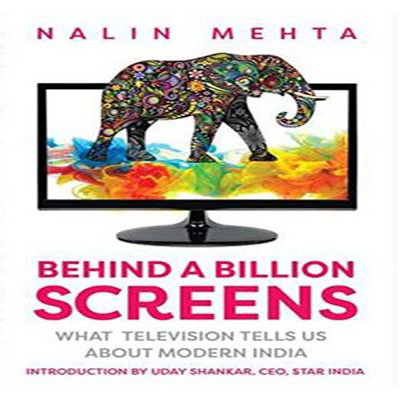
  • Nalin Mehta’s ‘Behind a Billion Screens’ examines Indian TV industry

    Nalin Mehta’s ‘Behind a Billion Screens’ examines Indian TV industry

    MUMBAI: India is a country where television forms the most important part of one’s life. Everybody watches television, everybody has an opinion on it and everybody thinks they know exactly what is wrong with it. 


    It’s a topic that often raises a lot of heat and smoke but too little light. Throwing some light on this trend of television is author and journalist Nalin Mehta’s new book ‘Behind a Billion Screens.’


    The book closely examines how television works in India, how TV channels make their money or not, how this is changing and what this means for the cacophony that appears on our screens.


    The book, which was initially going to be a joint effort by Star India CEO Uday Shankar and Mehta, was later written independently by the latter.
    The book answers key questions like:


    • Who owns Indian television? Just how much is it controlled by politicians, corporations and real estate companies? What are the patterns of control nationally and across regional languages? How does India compare with other countries and why does this matter?


    • What explains television’s terrible crisis of content? Is there really no market for intelligence in India and is dumped down content the only thing that audiences want? Why do channels keep behaving like Bollywood producers of the 1980s who kept churning out the same old tired formula films till a new multiplex-savvy breed of film-makers started challenging old orthodoxies? Is there a talent problem or management problem or a crisis of business models?


    • What is wrong with current government controlling system on television and why this ‘terrible-backend’ needs to change? Indian television continues to be controlled by outdated regulations, even as it is mired in public battles for greater regulation, as called for by Justice Katju. Studying the role of the Ministry of Information and Broadcasting, Telecom Regulatory Authority of India (TRAI), state governments and the judiciary, this book answers just how much control the state still has on broadcasting, why its jugaad nature of regulation is now unsustainable and why a major change is needed.


    • Does self-regulation work? How did self-regulatory bodies governing television come into being and what has been their factual record? Has self-regulation made any difference to programming or is it simply a chimera only designed to keep government out?How does India compare to other countries?
    • Does public broadcasting still matter, what exactly is wrong with Prasar Bharti and how can it be fixed?


    • Is television becoming irrelevant in the digital age? How is television shape-shifting in response to mobiles and the net, how are companies changing their businesses and programming, where is India going and how different is India from the rest of the world.


    The book highlights how India’s $15 billion media and entertainment industry – including television, print, radio, digital media – is growing at roughly 14 per cent a year. This, by some accounts, is impressive, benefitting immensely from the tailwinds of GDP growth of the last decade. But the stark fact is that even at $15 billion, India’s entire media taken together is just about one fourth the size of Google ($59 billion in revenues) – a fourteen-year-old company that is younger than most major Indian TV channels.


    “Let us not even go that far. If the entire Indian media was a company, it would rank seventh or eighth in India! Media is a globally growing industry but our participation in that ecosystem is zero and India is hardly factored into the global thought process of technology or content,” the book points out.


    Mehta, in the book, highlights how India is drunk on its own volumes: the largest number of newspapers in circulation, the second largest number of television viewers and millions of digital consumers. Digital, in particular, is an indictment of our creative and strategic limitations.


    “We have over 700 million mobile screens and yet we do not have a relatively unique content proposition for the medium. So, our ability to convert that into corresponding value is disappointing. Both in business and creative terms, the Indian media and entertainment sector still remains much smaller than it should be in a country of 1.2 billion people,” the book says.


    Even at these volumes, the reach as a percentage of population is not spectacular. India has 100 million households with no television, their time spent on it is abysmally low when compared to global standards; some 350 million people read the newspaper – but that tells us how many do not read!


    Mehta points out that in television, India needs a lot more content and this will come not only by scaling up production but through a fundamental transformation of the ecosystem. Resources, talent and every related facet have to evolve dramatically. For example, the production infrastructure in Mumbai, studio space, access to talent is creaking and unable to keep pace with the demand.


    Despite all the gloom and doom, India’s media and entertainment sector has consistently delivered impressive growth rates for the past few years. But, this is not a sector whose value is measured just by the size of its financial contribution. Media and entertainment remains central to defining the direction of India’s social and economic path; its work remains key to the imagination and inspiration of a billion Indians every day; and its health will be central to the ethos and values of the society we collectively shape.


    Mehta, through the book, says that with Narendra Modi’s new government in place, since May 2014, there is a renewed focus on reassessing things and trying to improve them. 

    “We need to make the case, for example, digitisation is not just about putting boxes and laying cables. It entails a fundamental transformation of the way we look at media and there is an opportunity for Indian media and content to move from just being a provider of entertainment content to being a creative industry, like the IT sector, for example, that plays a much larger role in the overall economic vision for the country,” Mehta opines in the book.


    He further writes that the media has been more than just a silent victim. Too often, the news media has focused on what is sensational rather than what is important. Too often, the point of news seems to be to reduce the extraordinary diversity of the country to the most banal, a contest between extremes that canonly be resolved through a shouting match on live television. With singular dominant narratives, the trend seems to be to create heroes on a particular day only to label them as thugs and crooks the next.


    Until recently, for a long time the media–government equation seemed like a broken relationship, and one that has had dire consequences for both the industry as well as the government. The failure to establish credibility and importance meant the industry perennially stayed on the back foot, defending itself against every new wave of regulation aimed only at curtailing its wings further. In return, governments were not able to leverage either the impact that mass media can have in India or harness the power of media as an economic engine that can create jobs and wealth.


    The book, in order to put things in perspective, says, “As a $15 billion industry, we employ over six million people. This can be so much more significant and meaningful. According to official estimates, about fifteen million people are entering the job market every year while the country is generating only about three million new jobs a year. This means that we are adding, as filmmaker Shekhar Kapur eloquently put it, a city of unemployed people as big as Delhi every year. And yet, the lens often used to look at this industry is largely one of glamour and propaganda and the biggest debate is on how to control and contain it.”


    There are 161 million cable and satellite homes but the measured universe so far is much smaller. “I do not know how many subscribers I have with a particular MSO and the MSO doesn’t know how many households his LCO delivers the signals to. The same is true in advertising too. The country’s premier media agencies can’t even seem to agree on a fact as basic as the size of the advertising market. One leading agency recently estimated the total market size to be Rs 35,000 crore, while the other, equally illustrious, estimated it to be Rs 29,000 crore. A variance of no less than 20 per cent! The ambiguity in data for other sectors of the media and entertainment industry is no less. Numbers are supposed to be the foundations of rational business decisions but how can we make decisions when professionals in the business of numbers can’t get their numbers straight?”


    Reacting on the book, Shankar said, “Nalin is probably the best media academic in India…this book is a seminal contribution to the evolving debate about the role of the Indian media.”


    Author and India Today Group consulting editor Rajdeep Sardesai added, “Excellent… an incisive and much needed study of how television is changing in India.”
    Times Now editor in chief Arnab Goswami said, “Fantastic… Nalin has beautifully pieced together the real, untold story behind the sound bytes.

  • Govt. issues urban TV households’ list to be covered in DAS Phase III

    Govt. issues urban TV households’ list to be covered in DAS Phase III

    NEW DELHI: A total of 38,799,074 television households will be covered in 7,709 urban areas in 630 districts in 35 states and union territories in Phase III of Digital Addressable System (DAS) expected to be completed by the end of this year.


    The list is based on the Census Report of 2011 carried out for the government of India.


    The list mentions two other areas: Delhi and Chandigarh, where it says DAS was completed in Phase I.


    Tamil Nadu tops the list of urban areas with 1095, primarily because DAS was stayed in Chennai after Madras High Court orders. 


    Uttar Pradesh comes next with 906, followed by West Bengal with 858 and Maharashtra and Kerala with 524 and 520 districts respectively.


    The Ministry website gives details of each state and union territory and also lists every urban area along with TV households. 

  • TDSAT sets aside 27.5% inflation-linked hike for addressable & non-addressable systems

    TDSAT sets aside 27.5% inflation-linked hike for addressable & non-addressable systems

    NEW DELHI: The Telecom Disputes Settlement and Appellate Tribunal (TDSAT) today set aside the amendments in two tariff orders, which had sought to put an inflation-linked hike of 27.5 per cent on addressable and non-addressable systems, opening the doors to a re-think on the entire policy of tariff orders.


    TDSAT chairman Aftab Alam and member Kuldip Singh said in their order today that the ‘The Telecommunication (Broadcasting & Cable) Services (Second) Tariff (Eleventh Amendment) Order, 2014’ and ‘The Telecommunication (Broadcasting & Cable) Services (Second) Tariff (Thirteenth Amendment) Order, 2014’] were ‘untenable.’


    The Tribunal also said it thought the Telecom Regulatory Authority of India (TRAI) “will be well advised to have a fresh look at the various tariff orders in a holistic manner and come out with a comprehensive tariff order in supersession of all the earlier tariff orders.”


    “While doing so, it may consider all the agreements and relevant data available with it. It may consider differentiating between content which is of a monopolistic nature as against that the like of which is shown by other channels also.”


    “It may also consider classifying the content into premium and basic tiers. It may identify the major cost components so that increase or decrease in such costs may be suitably factored while working out the inflationary hikes. Increase in costs of such components as may be available in indexes such as WPI, GDP deflator etc. can then be applied. While working out the tariffs, the effort should be to encourage a correct declaration of SLR. While carrying out the exercise, it may take the inputs from various stakeholders and give a reasoned order for accepting or rejecting the same. We want to be amply clear that the above are only some suggestions and TRAI being an expert body may arrive at suitable tariffs independently; it is up to it to consider the above and/or any other factors,” the Tribunal said.


    The tariff hike was challenged by Home Cable Network, the Centre for Transforming India, Lucknow 9 Cable Network, Good Media News India Pvt Ltd, Sikkim Digital Network and Cable Combine Communication Siliguri.


    Later, the Indian Broadcasting Federation (IBF) supported the order as intervener while the other interveners comprising Direct to Home (DTH) operators, Multi System Operators (MSOs) and Association of Cable Operators/Cable Operators opposed the order on the same grounds as the Appellants.


    TRAI had allowed a 15 per cent hike from 1 April, 2014. The second installment of 12.5 per cent tariff hike came into effect from 1 January, 2015.


    TRAI said the inflationary increases given by it are based on increase in the Wholesale Price Index (WPI). In the Explanatory Memorandum with the Second Amendment to the Principal Tariff Order, it was explained that for making adjustments for inflation Wholesale Price Index (WIP) had been used. It was explained that Consumer Price Index (CPI) was not used as latest information for this was not available and further this related to certain specific consumption baskets. As per the Explanatory Memorandum to the impugned Tariff Order, the WPI has increased by 43.69 per cent and giving a pass through of 63 per cent, an inflation linked increase of 27.5 per cent is allowed.


    Appearing for the appellants, advocate Vivek Sareen, who is a former employee of Tata Sky and is therefore from the industry, had argued the case on economic modules from all over the country, which in fact showed that the prices had actually come down according to the GDP Deflator, and therefore the hike was unjust.


    Senior counsel for the appellants Arun Kathpalia said the original exercise on which tariff fixation is predicated is not a tariff exercise and therefore all tariffs fixed on that basis are not tariff fixation exercises. He added that the entire increase is arbitrary as it is on an ad-hoc and interim fixation, as such itself arbitrary in the first place. The increase is otherwise also wholly arbitrary and suffers from non-application of mind. He also said the tariff order has been issued in complete violation of section 11(4) and there is no transparency whatsoever in the process adopted by the TRAI.


    It was also submitted that despite availability of all the relevant information for price fixation in Digital Addressable System (DAS), TRAI arbitrarily linked ceiling of rates in DAS with analog regime vide 4th Tariff Order dated 21 July, 2010. The upward revision by 27.5 per cent in wholesale price for Non-DAS area will automatically result in revision of the ceiling of corresponding prices in DAS regime. TRAI has created another ad-hoc regime for DAS by linking the ceiling of charges of DAS with analog, it was argued.


    TDSAT said, “It was argued that the tariff based on historical costs is one of internationally accepted methods. We find that even that is required to be based on a proper exercise conducted for the purpose. We may note that in the United States following the Cable Television Consumer Protection and Competition Act of 1992, US Congress asked Federal Communications Commission to ensure that rates for basic services tier are reasonable. FCC decided to go for price caps and the first thing it did was to collect data on rates being charged by cable operators operating in competitive as well as non-competitive areas. We can understand the freezing of rates being charged on a particular date as an interim measure but we fail to understand why TRAI did not examine the rates being charged in the agreements at the time of giving inflationary hikes.”


    The Tribunal had in May last year asked broadcasters to maintain a separate account for the additional subscription amount that they have collected from distribution platforms as a result of the tariff hike as this would be subject to the outcome of the case.

    Sareen had argued that the impugned tariff order had adversely impacted the interest of the addressable platform because the wholesale pricing of the addressable system is based on the wholesale pricing of the non-addressable platform. He said the impugned tariff was heavily tilted towards broadcasters and seriously prejudiced the interest of the consumers, MSOs and stifles orderly growth of the cable and broadcasting sector.


    Sareen argued that TRAI ignored the fact that the wholesale pricing of non-addressable system and addressable system are inter related. The wholesale price for addressable platform is derived from the wholesale price of non-addressable system. By its order, TRAI indirectly and in substance increased the wholesale price for addressable platform / DAS notified area. The said increase in the wholesale price for addressable platform is affected in violation of section 11(4) of the Act.   


    TRAI completely disregarded the fact that by changing the content pricing and increasing the same by 27.5 per cent with reference to the price existed immediately prior to 31 March, 2014, this would immediately increase the price of content for addressable platform. The authority did not provide any hearing opportunity to the stakeholders including the Appellants to represent its view as a stakeholder in the consultation process.


    It was stated that TRAI, in utter disregard of the valuable rights of the stakeholders including the Appellant and the consumers provided under Section 11(4) of the Act, rushed to issue the impugned order thereby increasing the wholesale price for addressable platform by 15 per cent with effect from 1 April, 2014. Thus the impugned order failed to take into account the inputs from such stakeholders.

  • I&B slots MSOs & broadcasters’ open house meet on 20th of each month

    I&B slots MSOs & broadcasters’ open house meet on 20th of each month

    MUMBAI: The Information and Broadcasting Ministry (I&B) is taking all steps possible to ensure that the sector prospers and any issue, which hampers the growth is addressed well in time.


    The Ministry, over the past several months, has taken active measures to ensure that the various stakeholders of the ecosystem meet from time to time. The meeting is aimed at becoming a forum for the stakeholders to voice their concerns and come up with solutions.


    In its latest notice, the Ministry has informed both the broadcasters and MSOs, that the open house meetings, which were earlier held on the 5th of every month, will now take place on the 20th of every month. In case, of the day being a holiday, the meeting will be held on the next day.


    The meeting will be held from 11 am to 12 pm, in two different rooms of Shastri Bhawan, New Delhi involving broadcasters and MSOs.


    The notice clearly states that only regular employees of the company, well versed with the issue, would be allowed to participate in the open house meeting. “Therefore, the participant shall have to bring authorisation letter from the top executive of the company in his/her name to participate in the open house meeting, along with photo identity card issued by the employer company,” reads the notice.


    Companies, which desire to participate in the open house have been asked to send the request of participation detailing out the issues to be discussed latest by 10th of the month to director (BC) through email at dirbc-moib@nic.in


    However, for the meeting scheduled on 20 April, issues to be discussed may be sent latest by 13 April.

  • Tata Sky introduces first ever daily recharge voucher

    Tata Sky introduces first ever daily recharge voucher

    MUMBAI: In yet another first, DTH operator Tata Sky has introduced the first ever daily recharge voucher empowering subscribers to pay only for the days they watched TV. This pioneering concept allows a minimum recharge value starting at Rs 8, making it the smallest denomination of recharge voucher in the television viewing sector globally.


    This innovation by Tata Sky puts the subscriber in control of his/her TV viewing expenses. There are a substantial number of subscribers who pay a monthly charge, but for some reason or another are unable to view TV on a daily basis.


    Tata Sky’s daily recharge enables them to now choose when to pay for their TV viewing. For a large part of the population, they can economize and re-charge their set top box on days when electricity is available, or when they are back from vacation. Similarly, they can decide on days when not to recharge for example during exam days or when travelling away from home.


    Tata Sky MD and CEO Harit Nagpal said, “We are confident that the introduction of Tata Sky’s ‘Daily Recharge’ will gain traction across the nation. The ‘Daily Recharge’ option available at Rs 8, 10, 20, 50 and 100 enables us to put power in the consumer’s hands to choose their level of convenience. It also elevates the DTH sector by redefining the pace of digitization and reach to markets nationwide.”


    With the understanding that there is a demand in smaller towns and villages for bite sized consumption (much like shampoo sachets and small sized mobile recharges), the ‘Daily Recharge’ card enables Tata Sky to make inroads into these untapped markets. Moreover, with digitization phase III still a year away, this plan should help accelerate acceptance of DTH sector in India.