Tag: digitisation

  • Chrome Data: The slowdown continues in week 47

    Chrome Data: The slowdown continues in week 47

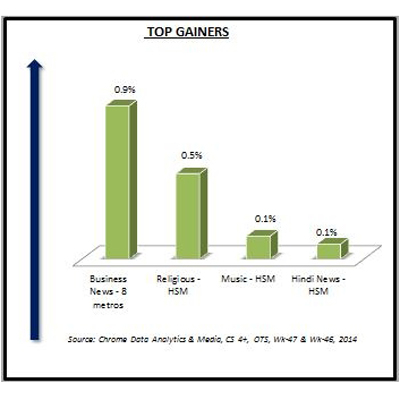
    MUMBAI: The week 47 of opportunity to see (OTS) collated by Chrome Data Analytics and Media didn’t see much gain.

    Business News in the eight metros saw the maximum jump of 0.9 per cent. Zee Business with 82.3 per cent OTS topped the genre.

    Religious channels came in second with 0.5 per cent in the Hindi speaking market (HSM). Aastha continued its rein in the genre with 97 per cent OTS.

    Music and Hindi News channels in the HSM saw a 0.1 per cent growth. MTV with 91.2 per cent OTS and ABP News with 95.9 per cent OTS topped their respective genres.

    On the other hand, English Entertainment channels in the eight metros fell by 8.4 per cent. AXN with 67.5 per cent OTS continued to rule the chart.

    Across India, Infotainment and Sports channels dropped by 3.4 per cent and 2.3 per cent, respectively. Discovery with 86.2 per cent OTS and DD Sports with 72.7 per cent OTS topped their respective genres.

    English Movies in the eight metros saw a drop of 2 per cent with Movies Now gaining the most in the category with 73 per cent OTS.


  • Nodal monitoring units for DAS to be formed by mid-January, task force to meet every month

    Nodal monitoring units for DAS to be formed by mid-January, task force to meet every month

    NEW DELHI: A total of 11 crore set top boxes (STBs) will be needed for the third and final phase of digital addressable system of which only three crore will be for direct-to-home (DTH) platforms.

     
    The Information and Broadcasting Ministry (I&B) says the requirements for phase III have been worked out on the basis of census 2011 data and the compiled data will be sent to state governments for vetting.
     

    The data for TV households is also being collected from the Registrar General and Census Commissioner for verification.

     
    The Ministry, which claims that manufacturers have assured it of adequate supplies of STBs, has constituted a publicity committee and begun issuing advertisements in newspapers and the electronic media in this regard to encourage multi-system operators to place orders.

     
    During the recent task force meeting for the next two phases of DAS, the Ministry said it will facilitate a meeting of manufacturers of indigenous STBs and MSOs in view of complaints by the manufacturers that no orders were being placed for the STBs.

     
    A multi-lingual call centre will be set up by the end of February, and 12 nodal regional monitoring units will begin working by 15 January. The task force will meet every on the second Wednesday of every month.

     
    The task force meeting under the chairmanship of Ministry additional secretary J S Mathur was also addressed by the advisor for DAS Yogendra Pal.

     
    A road map has been prepared by the government for the final two phases, and MSOs have been asked to apply by 21 December this year for licences.

     
    The Home Ministry will clear all security licences within 90 days, the meeting was informed.

     
    Publicity awareness campaigns have also commenced, for which a Publicity Committee has been formed.

     
    The Department of Information Technology is in the process of developing an Indian cable access system that will be ready in a year and will make interoperability of STBs possible. A participant pointed out that there was still the issue of certification involved in the embedment of CAS in set top box manufactured by the domestic STB manufacturers. The integration of CAS with the STB is a time consuming process and indigenous STB manufacturers must clear the apprehensions on this account.

     
    The long pending demand of “C” Form had been resolved to give fillip to domestic manufacturing of STBs.

     
    Interestingly, the Telecom Regulatory Authority of India has not attended any of the two task force meetings, a point noted by several participants. However, Mathur said TRAI was being apprised of the proceedings.

     
    The Ministry officials said that MSOs could simply download the forms for registration and did not have to come to the Ministry.

     
    A participant pointed out that the carriage fee which had fallen initially after announcement of DAS had again shot up. Others said issues relating to billing, packaging and reference interconnect order had still not been ironed out by TRAI.

     
    There was also a reference to entertainment tax, and it was stated by some participants that the Uttar Pradesh Government had sharply raised this tax.


  • Carriage fee on a rise again?

    Carriage fee on a rise again?

    MUMBAI: Delayed digitisation of phase III and phase IV areas have marred the hopes of broadcasters, multi-system operators (MSOs) and the local cable operators (LCOs) alike. With implementation of digitisation in phase I and II, while broadcasters were enjoying the reduced carriage fees, MSOs were hoping for better on-ground collections with increasing transparency. But all this has taken a U-turn with the Ministry of Information and Broadcasting announcing 2016 as the year when India will be fully digitised.

    The MSOs who have invested heavily for digitising phase I and II markets are still waiting for reaping the benefits of it. And now even the broadcasters who saw some reduction in carriage fees (industry sources peg it between 10 per cent to 30 per cent) during the first two phases have gone back to basics.

    If one has to go by the Media Partners Asia (MPA) report, the cable TV industry has seen a 14 per cent jump in carriage fees. The reason for the jump in carriage fee could be many. Here are a few reasons which we understand could be playing a role in the changed carriage fee pattern:

    1)    Delayed digitisation: The MSOs have already invested heavily in phase I and II and have also borrowed money for phase III and IV markets. Now with the government announcing the final dates for digitisation as 2015 for phase III and 2016 for phase IV, MSOs fear that the LCOs will not increase their collections from the ground.

    2)    Low ARPUs: Even in phase I and II areas, the ARPU hasn’t gone up as expected by the MSOs. And so they haven’t been able to recover the money they had invested.

    3)     New channel launches: Broadcasters launching new channels need greater reach and visibility and so pay more in order to get carried by the platform and also to ensure that it is available to all the subscribers of the platform. This in turn sets a benchmark for the other players also.

    4)    Lack of transparency: Even though one of the aims of digitisation was bringing in transparency and addressability, both haven’t happened as yet. The cable operators have not been able to get the consumer application forms filled and thus, are still unaware of the choice of consumer. Also, there is still under declaration of consumers. 

    “This is true especially for news channels, niche channels and the new channels that have been recently launched. While the existing channels have not seen any hike in carriage fees, broadcasters that launched new channels in the different genres, right from GECs to regional to music and movies have seen a jump in carriage fees, which ranges from 15-25 per cent,” says a distribution head on condition of anonymity.

    Another source close to the development agrees and says, “Yes! The carriage fee for broadcasters launching new channels have gone up. This can be anywhere between 20-25 per cent, depending on the distribution strategy of the broadcaster and the visibility it is looking for.”

    Many in the industry blame the new channel launches for the increase in the carriage fee. “While for the news channels the carriage fee had seen a drop by 10-15 per cent, the new channels that are being launched every now and then, sets a different benchmark. Since broadcasters want better reach for their new channels, they pay huge sums as carriage fee to MSOs and this affects the news channels as well,” says a news broadcaster.

    Even at the recently concluded MIPCOM 2014, Colors CEO Raj Nayak during a panel discussion had stressed that there needs to be complete implementation of digitisation. “While in the phase I of digitisation, the carriage fees had come down by 20 per cent, it has now gone back to square one and this is a dangerous trend,” he had then said.

    Viacom18 group CEO Sudhanshu Vats feels no different. In his recent interaction with Indiantelevision.com he had said, “Carriage, rather than continually coming down, has begun to rise again in recent months.”

    According to India TV chairman and editor-in-chief Rajat Sharma, when digitisation kickstarted, news broadcasters expected consumers to get better quality channels and carriage fees to disappear. “For the MSOs, it is the carriage fee from the news channels that helps them sustain, since they pay the GECs huge sums for getting their programming on their platform,” opines Sharma.

    Unlike the expectations by many, carriage fees haven’t yet been abolished.  “When phase I of digitisation was implemented, carriage fees did come down in terms of what was being paid in the four metros. The national level MSOs saw the benefits of digitisation and passed on some of that benefit to broadcasters. However, with phase II, it hasn’t happened. On the contrary they are going up and extortionist demands are being made again. Perhaps because in other parts of the country the MSOs are in partnership with local or regional players who do not want to let go of carriage fees even though that was meant to be a natural outcome of digitisation,” informs NDTV executive vice chairperson KVL Narayan Rao.

    Rao further adds, “It is impossible for news broadcasters to withstand payment of high carriage fees. Other components of digitisation like buoyant and fair subscription revenues, have not kicked in either. Something needs to be done about these aspects immediately. Carriage fees in particular have to be rationalised.” Rao also pegs the carriage fee increase between 10-30 per cent.

    As for Focus Network group CEO Neeraj Sanan, carriage fee revenues for MSOs are likely to reduce. “However the carriage paid by a broadcaster to an MSO, will increase post first year of DAS due to aggregation at MSO level and the ever increasing number of channels,” he adds.

    Even the MSOs agree that the carriage fee has seen an upward trend. “This is true mostly for the new channel launches. Broadcasters want better reach for their new channels and are ready to pay more carriage fee for those channels. The new channels are seeing a hike in carriage fee by about 20-25 per cent,” concludes the MSO.
  • “Digitisation will bring quality and transparency in subscriber base”: Arun Jaitley

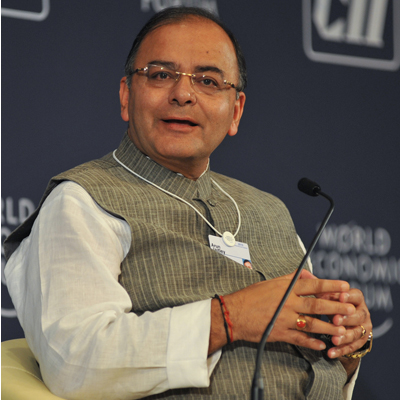
    “Digitisation will bring quality and transparency in subscriber base”: Arun Jaitley

    NEW DELHI: Information and Broadcasting Minister Arun Jaitley has emphasised the importance of the digitisation programme in providing better quality of service, wider choice of content and its important role in bringing about transparency within the subscriber base.

     
    As a process it had also brought about a change in the broadcasting landscape as well as enabled broadband penetration within the country, he told the first Consultative Committee Meeting of Members of Parliament attached to his Ministry.


    The meeting devoted its deliberations to the issue of digitisation of cable TV network in phase III and IV.  Minister of State for I&B Col. Rajyavardhan Singh Rathore was also present in the meeting.


    A presentation was made on behalf of the Ministry giving an overview of the digitisation process. The presentation highlighted the steps taken during phase I and II and the proposed road map for phase III and IV.

     
    Specific reference was made to the initiatives undertaken by the Ministry including the discussions with stakeholders and the campaign to sensitise masses.


    Members of the Committee gave suggestions to ensure that the concerns of all stakeholders were addressed. It was also emphasised that MSOs should operationalise grievance redressal mechanisms to address the concerns of cable subscribers. They emphasised that quality of domestically manufactured Set Top Boxes (STBs) must be ensured.

     
    The issue of digitisation, plan of Doordarshan terrestrial network and the steps being taken to implement the process was also deliberated upon.

     
    It was also mentioned that the Ministry needed to take proactive steps to ensure timely registration of MSO applications so as to ensure the large presence of MSOs to implement the digitisation programme during phase III and phase IV.


    During the discussions emphasis was laid on the efforts being made by the Ministry to integrate the domestic STB manufacturers with the ‘Make in India’ programme. Specific reference was made to the initiative of the Ministry in resolving the long pending issue of ‘C’ Form to create a level playing field for domestic STB manufacturers. Members were also informed that interactions were being held with the STB fraternity to ensure that they utilised their capacity to fulfill the demand for STBs during phase III and phase IV.


    The Members of Parliament who attended the meeting included Dr. Jayakumar Jayavardhan, Tapas Paul, V. Sathyabama, M P Achuthan, P Rajeeve, Pawan Kumar Varma and Vivek Gupta.


  • So who does DAS benefit and what does RIO have to do with it?

    So who does DAS benefit and what does RIO have to do with it?

    When the BJP government was last in power with Ms Swaraj at the helm of the MIB, the digitisation process was first mooted in its original form of CAS. The populist notion was to bring down cable prices with the false concept of pay for what you want, so pay less. But little did the government realise that the customer’s cable bill was so significantly subsidised because of ‘under declaration’ that the ‘spoilt’ consumer in the cheapest cable market in the world would either have to reduce his current offering by half or more or if he wanted the same channel line up, would actually have to pay twice as much!

    At that time, the broadcasters were resentful as reduced reach was imminent in an advertising driven market and for DPOs it was definitely not favourable as they would need to reduce the number of analogue channels to piggyback digital cable on some of the frequencies which was otherwise used for analogue channels. (This was because both digital and analogue had to be offered on the same network). And this reduction of analogue channels impacted their carriage potential and hence revenues.

    So who won? None of the key stake holders- broadcaster, DPO or consumer.

    So who does DAS in its new avatar benefit?

    Certainly not the consumer from his cable bill point which was the original populist premise. Sure, the DPOs and broadcasters, once the dust settles down. With the transparency of set top boxes and doing away with ‘under declaration’, the MSO can now collect from the ground higher revenues and hence a bigger chunk eventually to the broadcaster. (Cable revenues were significantly lower than DTH revenues even though cable homes far exceeded DTH homes.) Who else benefits? The government, for sure, by way of higher taxes.

    And the losers of course in the value chain would be no doubt the consumer now shelling out higher ARPUs. And of course the LCO who till now reigned king keeping the bigger chunk of collections.
    So what’s wrong with DAS?

    Fundamentally, the current consumer pricing structure, the RIO rates and the business model. If DAS was to benefit the consumer why is there no B to C model, why are there no retail prices with direct offers from broadcasters to consumers with pipeline commissions to DPOs. Why are RIO rates unrealistic? Why are DPOs free to do retail pricing? The problem is RIO is a regulatory created framework and broadcasters have maxed out after years of price freeze not knowing what to expect.  

    If DAS has to succeed then this whole pricing scenario has to be re-looked. How can the broadcaster market his product if the DPO controls retail pricing? Or given the RIO pricing (which will now be used as a basis for negotiation) will the broadcaster really allow the DPO to play the role of a wholesaler and buy in bulk and retail at attractive customer offerings significantly lower than RIO.

    When regulation hinders market dynamics, it creates more absurdities. Any consumer product needs an MRP. Packages or stand alone. RIO is definitely not helping this process. It’s best the two beneficiaries – the DPOs and the broadcasters finally come together, see eye to eye and work out what is the magical pricing so that packaging and pricing is offered by both and directly to the consumer. If the DPO truly acts as a wholesaler he can surely better any packages the broadcaster directly offers unless of course the broadcaster/channel can go it alone which no doubt will be the true test of content and certainly a success yardstick to measure addressability.

    So can the government bury RIO and keep the consumer in mind!  TV entertainment is mass and needs to be looked at (retailed) as a service similar to that of consumer products! Let’s have an MRP, let’s also have a distributor pricing better than MRP. There is scope for both models to co-exist- DPOs mixing it up and offering multi-broadcaster packages and broadcasters also retailing with negotiated discounts to DPOs for pipeline usage and payment gateway.

    A 100 million plus pay TV homes is a very robust subscription market!

    Lastly, with the BJP now back surely we hope they will complete what they chaotically started. With the honourable I&B Minister Arun Jaitley and MoS Rajyavardhan Singh Rathore now at the helm it certainly looks like MIB is priority and our industry will definitely be both in competent hands and in their cross hairs!


    (These are purely personal views of consultant Sanjev Hiremath and indiantelevision.com does not necessarily subscribe to these views.)

  • DTH, an innovative platform for advertisers: Matrix Publicities & Media

    DTH, an innovative platform for advertisers: Matrix Publicities & Media

    MUMBAI: It has been a stupendous growth story. Contrary to popular trade perception the DTH advertising growth story has only ended up surprising all.


    With approximately 65 to 68 million households across India and about 55 per cent of the C&S base in the country, this is one of the primary reason why a lot of advertisers are looking to engage customers on the medium. 


    What began with a low scale, low noise start with barely two to three advertisers three years ago, has grown more than 10 times in a very short span, says Matrix Publicities & Media India, a WPP company, which has been at the forefront of this revolutionary advertising blitzkrieg. 


    There are in all six DTH operators, who operate out of the paid DTH subscriber sphere, whilst planning, the agencies need to keep in mind the fact that DTH as a medium is a frequency builder and should necessarily be used to ensure incremental reach.  Like television, DTH reaches out to all SEC and demographic profiles, unlike otherwise perceived.  There are various options within the medium, however, to delivery impact too and on a case to case basis the medium allows innovations, albeit at a very competitive outlay.


    As a media sales aggregator for all the DTH operators to GroupM & non-GroupM clients and agencies, Matrix has been able to bridge the gap between the science, art and commerce for sales on this new age media platform. 


    The agency feels that the platform acts as a gatekeeper to the TV viewing audience and they are exposed to the DTH visuals prior to the TV channels.  Additionally, TV also faces a lot of clutter with regard to the various genres available for viewing.  With the 10+2 ad cap in place, in principle, with most channels, getting inventories across is also an issue.  All the factors put together have ensured that this medium has turned into a ‘pull’ medium from the erstwhile ‘push’ medium. 


    Hence, the company has not stopped at just mere vanilla sales as this is a philosophy that does not appeal to its business head Sparsh Ganguli, who has been at the forefront of this business since its inception three years ago.


    With this idea in mind, the advertisers have been divided into broad categories and an in-depth analysis has revealed a lot about the spending patterns of all advertisers on this medium.  Needless to say the research not only takes into consideration the brand spent from the GroupM set of clients but even some part of the non-Group M clients to help present a more clear and fair picture.  The efficacy of the study can be gauged from the fact that the entire categories can be bifurcated month wise and the spend patterns can be highlighted for future strategic pitches.


    The broad categories that have been the top spenders across this medium are: automobiles (two and four wheelers), FMCG, F&B, BFSI, e-commerce, watches and jewellery.


    A FMCG media planner says, “The DTH platform has been influential in targeting the housewives through sustained awareness campaigns during afternoon hours and worked phenomenally well for our client’s brands.  That’s the very reason why they look to optimise spends on these platforms.” 


    The ad rates are in sync with the growth of the medium.  The rates range from Rs 40,000 to Rs 1,00,000 depending on the options that are availed, highlights the agency.


    Ganguli, however, feels that there is still a lot of ground to be covered from the advertiser’s front.  He feels that technologically the platform is evolving in a positive manner that is both beneficial to the viewer as well as for the advertiser.  According to him, “The next revolutionary way of reaching out to the viewing household is on the spliced beam format which allows the advertiser to geo-target their consumers.  This has in turn made it possible for the brands to reach out and give a customised pre-buying experience, thus resulting into more reach and effective frequency for the brand campaign.” 


    He adds, “DTH has shown tremendous growth but I still feel clients can do a lot more, as of now we have been able to break new grounds by providing upgraded technology and this helps the clients and new clients to optimise the medium for every campaign as innovation is the way ahead.” 


  • I&B sets deadline for MSOs interested in DAS phase III

    I&B sets deadline for MSOs interested in DAS phase III

    NEW DELHI: All multi-system operators interested in distributing digital cable television services through the local cable operators in areas covered under phase III have been asked to apply by 21 December, this year.


    Phase III Digital Addressable System comes into effect from 31 December 2015, according to the revised deadlines.


     This phase will cover all remaining Municipal Corporations and Municipalities.


     The application in Form 6 (in triplicate) duly filled in and complete in all respects along with enclosures/documents and processing fee etc., has to be submitted to the Information and Broadcasting Ministry.


     It must contain details of the company/firm, directors/key executives and shareholding pattern etc in the prescribed Proforma.


     Application can also be submitted in person during Open House Meeting held on every Tuesday between 11 AM to 12 noon after sending request by email at das.mib@qmail.com or sobpandl@omail.com .


     The application form (Form 6) and Proforma for details of company etc can be downloaded from Ministry’s official websites: www.mib.nic.in or www. digitalindiamib.com.


     Applications received after 31 December 2014 will not be accepted/entertained for phase lll areas till cutoff date of phase lll is over. Incomplete applications will not be accepted.


     Queries in this regard can be addressed to das.mib@omail.com or contact Section Officer (DAS) on telephone no. 011-23381478.

  • Chrome Data: Week 44 sees fall in HSM

    Chrome Data: Week 44 sees fall in HSM

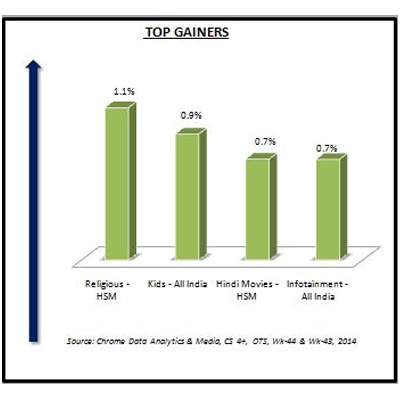
    MUMBAI: The week 44 of opportunity to see (OTS) collated by Chrome Data Analytics & Media saw Religious channels in the Hindi speaking market (HSM) gaining the most.


    The genre grew by 1.1 per cent with Aastha channel continuing its run at the top with 96.8 per cent OTS.


    It was closely followed by Kids genres across India which saw a jump of 0.9 per cent. Cartoon Network with 79.2 per cent OTS once again remained on top.


    Hindi Movies in the HSM and Infotainment channels across India witnessed a high of 0.7 per cent. Star Gold with 96.7 per cent OTS and Discovery with 87.3 per cent OTS topped their respective genres.


    The downward trend was witnessed by the eight metros with English Entertainment channels losing the most with a fall of 2.2 per cent.


    However, AXN with 68.8 per cent OTS continued with its winning trend in the genre.


    English News and Business News too dropped by 1.8 per cent and 1.2 per cent, respectively. Times Now with 84.9 per cent OTS and CNBC Awaaz 78.7 per cent OTS topped in their respective categories.


    English Movies too saw a drop of 1.2 per cent with Pix topping the chart with 72.8 per cent OTS.

  • We are introducing the concept of packaging: Star India

    We are introducing the concept of packaging: Star India

    KOLKATA: Commending the decision of the Telecom Disputes Settlement Appellate Tribunal’s (TDSAT) to put Star India channels on a la carte, the network said with this it is likely to introduce the concept of packaging.


    Star India legal & regulatory senior vice president Pulak Bagchi and distribution strategy & marketing senior vice president Vivek Takalkar were in the city to explain the benefits of packaging.


    The officials from the network highlighted that even though a number of cable TV homes in phase I and II are digitised, the addressability of digitisation has not yet been completed.


    They further said that since the main aim of digitisation was to offer choice to the customers in terms of channels they want to subscribe, Star India would offer the bouquet of channels via different packs and thus, offer true benefits of digitisation.


    “Customers would get the real choice,” the star official said.


    Multi system operators (MSOs) have already met Star India representatives two or three times and are waiting for an “amicable solution”, and if they don’t hear from the Star in next 24 hours, the MSO are most likely to move to the RIO rates options, said Siticable Kolkata director Suresh Sethiya.


    “We met with Star India people to find a way out for the RIO rates. The rates should be fashioned in such a way that the broadcaster does not lose revenue and at the same time, consumers do not have to shell out huge amount to watch cable TV,” Sethiya said.


    When asked to comment on the TDSAT order which directs the MSOs to put Star channels on RIO from 10 November, Sethiya said the MSOs will have to sign the contract with Star. “MSO would do it in next couple of days and we will run campaign in every media and our channels so that the consumers are well informed,” he concluded.

  • Germany’s Panaccess bets big on CAS in India

    Germany’s Panaccess bets big on CAS in India

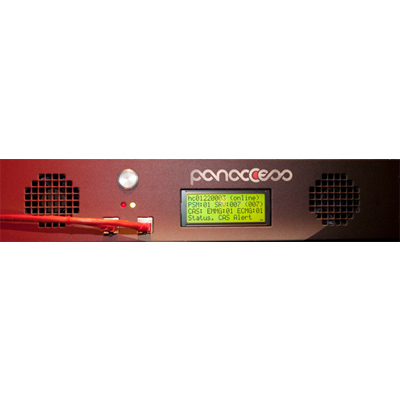
    KOLKATA: Panaccess, a German-headquartered company for CAS, SMS, billing and VoD, aims to promote CAS in India. The company is not only betting on business from the remaining phases i.e. III and IV, but is also approaching the multi-system operators (MSOs) in phase I and II.


    “There is good scope for CAS, SMS and billing in the next phases. And a few existing clients want to replace with our CAS and hence, we are approaching the MSOs in phase I and II along with newer ones,” informs Panaccess sales consultant GK Viswanath.


    “We have commissioned our conditional access system, subscriber management system and billing for a MSO in Pondicherry,” he answers, when asked about the work executed in the country.


    The company, which is slated to open a service centre in Bengaluru by April 2015, has already established its products and services in 32 countries across the world. It serves as a single window for a set of secured and revenue protected suite of solutions that complements and adds revenue streams to existing and new cable TV and DTH operations.


    After April, the company will start visiting all the major MSOs and plans to advertise a lot more as well. “We participate in all the major cable TV exhibitions etc,” he states.


    On the problems MSOs face with existing CAS system, he says, “They can resolve the problems by replacing with our CAS i.e. SMS and billing which are built in. Hence, there is no need for MSOs to go any anywhere else for these facilities. Apart from this, we also provide with solutions through broadband services.”


    In the coming months, the company, which currently employees around 15 people in the country, plans to recruit a few more.  “Next fiscal will see at least 10 for sales and 15 for technical and five for backend and five demonstrator appointments,” he says.


    On the extended deadline of cable TV digitisation in India from 2014 to 2016, he comments, “There are some people who had already started manufacturing STBs indigenously; they are the ones which have been affected by this decision.”


    “We can coordinate with the MSOs those who are planning to go for headends or STBs. We hope to capitalise the market early,” he concludes.