Tag: digitisation

  • 2014: The year that changed landscape of distribution

    2014: The year that changed landscape of distribution

    2014 has been the most exciting and an eventful year for us in the Media and Distribution Industry. The phrase “There is never a dull moment” is so apt to define the year of 2014 that changed the landscape of distribution so significantly and posed challenges like never before. The year started on a promising note for the Industry with the impact of digitisation settling down and the benefits of this shift starting to roll in. Reduction in carriage fees and an upswing in subscription revenues indicated change, yet the industry continued to grapple with implementation of packaging at the retail level.

    Value chain as a whole moved towards a more structured form, with constituents at each level moving from an adhoc/ flat fee commercial arrangement to CPS model. Subscription flow from LCO to MSO which was significantly low in analog era started growing. Wider choice at the subscriber end also helped growth in ARPUs.

    One of the biggest changes that shall significantly impact the distribution model is BARC becoming a reality. It is set to redefine the way all of us look at distribution. Expansion in LC1 markets and forthcoming BARC measurement is pushing every broadcaster expand visibility to the deepest, darkest corners of the country. Such is the scope of expansion that it will require any organisation 24-30 months to plan, execute and brace one of the biggest change in the history of distribution.

    DTH industry saw a major shift this year in their outlook towards the business. Almost all of them moved away from the customer acquisition mode to better profitability. While the story of subscriber acquisition was not exceptionally different over the previous year, DTH companies managed churn, HD and ARPU increasingly well.    

    No other year has seen a bigger storm than 2014 in the Regulatory environment. There were so many storming changes that touched every stakeholder in the distribution chain. TRAI came out with regulatory changes like Disaggregation, DAS phase III and IV, Commercial establishments and Ad-Cap. The new regulatory environment posed new challenges such as keeping partners together, protecting bottomline revenue and remaining relevant in the new regime. Postponement of digitisation in phase III & IV caused recalibration of business plans by all stakeholders. TRAI’s regulatory change for commercial establishments affected an entire revenue stream of broadcasters and the matter continues to be fiercely litigated.

    Going into 2015, we strongly believe the industry will undergo some paradigm shifts in the way we do business. Implementation of RIOs in cable will see packaging in cable become a reality. Digital platforms hence shall compete effectively. Carriage fee, a big cost for broadcasters will get reduced to miniscule or only exist for FTA channels. HD and broadband in cable will see a big swing to drive revenues significantly for the cable companies. More interesting deals like DEN-Snapdeal shall emerge. DTH players shall equally bring about next level of offers to bring more value to the subscribers such as OTT, 4K boxes, TV Everywhere, and Binge viewing being offered to the consumers.

    For us here at IndiaCast UTV, the year 2014 was equally exciting. In face of compelling challenges, we en-cashed on the opportunities to attain significant growth. There is ample evidence that we are moving forward and in the right direction. In light of disaggregation, IndiaCast UTV was successfully appointed as the authorised agent for TV 18, Disney UTV and ETPL and the broadcasters reposed full faith in the our team. Transcending these regulatory changes, we emerged stronger than ever.

    On the DTH front, we saw all our renewals happening during the year. We had to up our ante and attain a fair share for the unmatched content that the network stands for. It was tough convincing the platforms but eventually they saw sense in the value we bring to the table. We are proud to say that we were able to stitch our multi-year content deals with all the DTH platforms at a healthy growth rate. On the visibility front, we embarked upon the biggest challenge to put in place an entire LC1 team and collectively put in thousands of manpower hours to expand our reach across the length and breadth of the country. Our ratings in the past few months are a testimony to the efforts of the affiliate team who seeded our channels in a number of new networks across smaller markets.

    The year also saw us successfully launching and distributing the third Hindi GEC “EPIC” which expanded the GEC space by offering a season based formats based on Indian Mythology and folklore. Viacom18 gave a myriad of entertainment options with Colors being the frontrunner in Hindi GEC space, launch of new Hindi GEC “Rishtey”, MTV Indies creating a new space in Music genre and by launching “24” – India’s first international non-reality format show with international standard production quality. TV 18 maintained its leadership position and added a business news channel in Gujarati called CNBC Bajar to its portfolio. The regional offering was strengthened by launching four news channels under the ETV banner – Kannada, Bangla, Gujarati and Haryana.

    This year has seen IndiaCast UTV coming of age, adding stability and propelled us to achieve more. We are confident of setting new benchmarks for ourselves and for the industry and embark on a larger journey which will see us coming out stronger than ever before. We are looking forward to an exciting and eventful 2015.


     (These are purely personal views of IndiaCast UTV Media Distribution EVP Amit Arora and indiantelevision.com does not necessarily subscribe to these views)
  • MSOs applying for DAS may get extension of four or five weeks, Task Force informed

    NEW DELHI: The deadline for multi-system operators (MSOs) wanting to apply for digital addressable systems (DAS) licence for phase III and IV may be extended by four to five weeks.


    This was indicated during the Task Force meeting on DAS held today, presided over by Ministry Additional Secretary J S Mathur and attended among others by the Adviser for DAS, Yogendra Pal.


    MSOs were asked to provide detailed seeding plans for the third phase which concludes in December next year.


    MSOs who want to complete DAS in their areas even before the last date on a voluntary basis were asked to negotiate directly with broadcasters, and with the subscribers in their respective areas.


    When some MSOs and cable operators referred to some ‘cable-dark’ areas – areas not reached by cable operators, the Ministry wanted the MSOs and other stakeholders to identify such areas.


    The meeting was held in keeping with an assurance last month that the meeting would be held every month.


    In the last meeting that was held on 21 November it was told that a total of 11 crore set top boxes will be needed for the third and final phase of digital addressable system of which only three crore will be for direct-to-home platforms.


  • Chrome Data: English News gains the most in week 52

    Chrome Data: English News gains the most in week 52

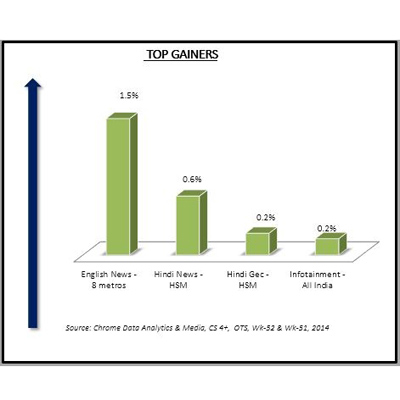
    MUMBAI: The English News in the eight metros gained the most when it comes to opportunity to see (OTS) collated by Chrome Data Analytics & Media for the week 52.

    The channels in the category jumped by 1.5 per cent with Times Now continuing its supremacy in the genre with 80.8 per cent OTS.

    Hindi News and Hindi GECs saw a 0.6 per cent and 0.2 per cent rise, respectively, in the Hindi speaking market (HSM). ABP News with 95.8 per cent OTS and Star Plus with 97 per cent OTS ruled their respective genres.

    Across India, Infotainment channels too saw a rise of 0.2 per cent. Discovery reigned the genre with 85.2 per cent OTS.

    As for top losers, English Entertainment channels in the eight metros saw the steepest fall with 4.3 per cent OTS. Comedy Central with 61.4 per cent OTS toppled AXN in the genre.

    English Movies too fell by 0.9 per cent in the eight metros. Movies Now topped the charts with 68.2 per cent OTS.

    In the HSM, Religious channels and Music channels fell by 0.6 per cent and 0.5 per cent, respectively. Aastha with 95.8 per cent OTS and MTV with 90.2 per cent OTS gained in their respective genres.


  • Standing Committee wants complete digitisation before amending act on illegal channels

    Standing Committee wants complete digitisation before amending act on illegal channels

    NEW DELHI: A Parliamentary Standing Committee has opposed any amendments to the Cable Television Networks (Regulations) Act 1995 with regards to illegal channels.

     
    Information and Broadcasting Ministry sources told indiantelevision.com that the Committee on Information Technology in its 36th report observed that the requirement of amending legislation may not be feasible in view of the ongoing process of digitisation of cable network as it can provide solution to address the issue of showing illegal / unregistered channels on the cable networks.

     
    The Ministry had been informed by security agencies about carriage of some unregistered foreign channels by cable operators.

     
    To address the problem of carriage of unregistered channels by cable operators, the Ministry had introduced the Cable Television Networks (Regulation) Second Amendment Bill, 2011 in Lok Sabha on 15 December 2011 but this was referred to the Standing Committee.


    There are 93 private satellite TV channels which are Uplinked from outside India and have been granted permission to downlink in India under the policy guidelines for Downlinking of Television Channels.


    The scheme of enforcement envisaged under this Act is primarily through the authorized officers who are district magistrate, sub divisional magistrate and the commissioner of police of the State Governments.
     

    Whenever a complaint is brought to the notice of the Ministry, they are sent to the authorized officers since the action as per the Act primarily remains in the domain of authorized officers, the sources said.


  • 2014: Cable TV’s year of missed opportunities?

    2014: Cable TV’s year of missed opportunities?

    2014 many would say has been a year of more downs than ups, especially for the cable TV industry. But, if one peels off the superficial layers and looks deep, it would be fair to say that it was indeed a year of opportunity for all the stakeholders in the cable TV ecosystem, despite all the trappings that it had of a Bollywood film with all the drama and twists and turns.

    The year began with industry regulator the Telecom Regulatory Authority of India (TRAI) cracking the whip on errant multisystem operators (MSOs) and last mile owners (LMOs) who had not implemented simple hygiene requirements such as subscriber information and billing in Digital Addressable System (DAS) phase I and II areas. 2014 probably was the most litigious one in recent memory for those in the cable TV ecosystem with the various constituents spending more time in courts or in the portals of the Telecom Disputes Settlement Appellate Tribunal (TDSAT) than in upgrading their systems or moving ahead on business models. LMOs and MSOs snapped at broadcasters and aggregators, even as the latter took swipes at them with their heavy hands. No resolution seemed in sight and hence the anti-climactic postponing of phase III and phase IV DAS to 2016 by the Information and Broadcasting (I&B) Ministry almost came as a lifeline to the industry. Some carped about the postponement, some decided to take it upon themselves to voluntarily digitise, while other LMOs just got back to squabbling once again.

    Even as international strategic and financial investors got repelled by the chaos in Indian cable TV land, domestic lay investors and equity investors too gave the sector a thumbs down. One of the leading stocks, the Sameer Manchanda-run Den Networks, which was the investors’ darling in 2013, registered a 19 per cent erosion in its share price from Rs 161.65 in early January 2014 to Rs 131.30 on 24 December. Hathway Cable & Datacom rose 25 per cent from Rs 278.75 to Rs 347.50. Both underperformed the Bombay stock Exchange Sensex which rose 28.5 per cent from 21,000 on 2 January 2014 to 27,206 on 24 December 2014. However, an exception was the stellar performer  Essel group owned Siti Cable which appreciated 80 per cent from Rs 18.15 to Rs 32.75 on the same dates. 

    November 2014 saw Star India take a big punt and play pioneer by deciding to enter into only Reference Interconnect Offer (RIO) deals with MSOs in DAS areas.  The hope was that it would push cable operators to come up with better subscriber packages and hopefully improve realisations for themselves and Star too. With ARPUs sneaking up marginally, the big MSOs and cable TV cooperatives aggressively moved ahead with the more lucrative broadband offerings to subscribers.

    The year began with the MSOs meeting in different parts of the DAS areas to ensure gross billing could be started. While Delhi and Kolkata could, at least in a few parts start gross billing, Mumbai and other phase I and II cities, even as the year comes to an end, haven’t seen bills being rolled out. The reasons for this being no consensus: on the biller’s name (whether it should be of the LCO or MSO), revenue share between the two and the pending entertainment tax case in the Bombay High Court.

     The next big development in the year was when Hathway Cable and Datacom announced a cricket pack, wherein the MSO created a separate offering consisting of all the sports channels. When the announcement was made, little did people know that the issue would be dragged to the court and would keep the TDSAT occupied for almost the rest of the year. Hathway has been one player that has been in the news throughout, mostly for its progressive moves- from launching new local cable channels, to launching DOCSIS 3 broadband technology. It also wrestled with the major broadcasters such as Star and Zee through the year on terms and conditions.

     2014 was the year of opportunities, as it opened doors for the $100 million Hinduja’s Headend In The Sky (HITS) project and the Cable Virtual Network Operator (CVNO) model. As part of this LMOs can come together and join hands with the MSO to take its infrastructure, thus giving the former the power to own their consumers. The former Indusind Media CEO and promoter of Bhima Riddhi Digital Services Nagesh Chhabria too showed his intent of getting into the cable TV market with a national MSO. A much hyped $200 million announcement – in July about his agreement with Atlas Consolidated LLC (a joint venture between Greenwich Equity Partners and Jagran Infra-Projects led by Sanjiv Mohan Gupta) – to create a national MSO it has been followed by a strange silence since.

    It was a year of opportunity, as after a gap of long seven years, the TRAI decided to defreeze prices and allowed a price hike. The regulator in March, released a notification, offering a 27.5 per cent inflation-linked hike to stakeholders in the tariff ceiling. The hike was to be implemented in two phases: 15 per cent from April 2014 and the remaining 12.5 per cent from January 2015. The move gave some hope to stakeholders to increase their Average Revenue Per User (ARPU) which was at around Rs 180 – a 20-25 per cent increase. But the industry is clearly aiming at much higher ARPUs of Rs 300-350 in the short to medium term. 

    The most important month for the cable TV industry was August. Ask why? Well, this was the month, which shocked the whole value chain.  While the LCOs were relieved, the worried ones were the broadcasters and the MSOs. The newly appointed Information and Broadcasting Minister (now former)  Prakash Javadekar, looking at the condition of phase I and II cities, which had undergone seeding of set top boxes (STBs) decided to further push the digitisation dates for phase III to December 2015 and phase IV to December 2016, from the earlier deadline of December 2014. The reason given by the Minister was that he wanted to promote indigenous STB manufacturers, who had not benefitted much from the earlier two phases.

     The news brought in some cheer for the indigenous STB manufacturers who said that this would help the indigenous manufacturing industry give employment to about 50,000 people and would attract an investment of about Rs 500 crore. The move, according to many would also generate local support facility for repair of STBs and help in smooth implementation of digitisation in the country.

    While, everyone has their own take on the decision, one should take this as an opportunity to be able to complete phase III and IV cities, which includes the small towns and villages, in a much more organised manner. Currently in phase I and II, while boxes have been seeded, no proper rollout of package and billing has happened. The stakeholders have time to ensure that along with seeding of boxes in phase III and IV cities, they can ensure that Consumer Application Forms (CAFs) are filled, the information is added in the Subscriber Management System (SMS), packages are created, offering consumers the option to choose and proper bills are rolled out, bringing in complete addressability and transparency.

     According to many, with delayed digitisation, carriage fees are once again on the rise. According to a Media Partners Asia (MPA) report, carriage fee has gone up by 14 per cent, while broadcasters and MSOs peg this at around 20-25 per cent for niche and news channels. In fact, Colors CEO Raj Nayak at this year’s India panel in MIPCOM said that carriage fees which had come down by 20 per cent are again climbing and have gone back to pre-digitisation rates. Yes, all these can be counted as the drawback of delayed digitisation, but tackling the same is broadcaster Star India’s take on the deals with MSOs.

    The case which kept TDSAT busy this year was the Hathway vs Zee and Star case. It was during this, that Star India, in order to fight discrepancy in deals with MSOs, took a firm decision of entering into only RIO deals with MSOs. While this did hit the MSOs, since their cost of content went up, it did two things. One, it nipped carriage fees and two, opened the doors for the MSOs to increase their ARPUs. In fact broadcasters, who feel that the carriage fees are headed northwards, should consider entering into RIO deals, as was also said by MPA in one of its reports.

     With the extension of digitisation dates, a number of MSOs also decided to opt for voluntary digitisation, which was a welcome move, since it showed the intent of MSOs to see the country fully digitised.

    Keeping digitisation and broadband plans in mind, the year saw a few MSOs raising funds for themselves. Considering the money spent by the MSOs in acquiring content and taking digitisation forward did not match with the on-ground collections, MSOs were left with no choice but raise more funds to complete the task in hand. So while Hathway got board approval to raise Rs 300.80 crore through preferential allotment of shares, Essel Group’s subsidiary Siti Cable Network raised Rs 600 crore through the issuance of securities. Last mile owner Ortel Communications too made its move towards getting listed. The LMO, this year, filed its draft red herring prospectus (DRHP) for its proposed initial public offering (IPO) with the securities and exchange board of India (SEBI). The IPO may raise as much as Rs 360 crore.

    The year also saw the I&B cracking its whip on a few MSOs like Digicable and Kal Cable as their licences were cancelled following refusal of security clearance by the Home Ministry. But the duo got relief from their respective state High Courts and are still up and running. Even as Tamil Nadu former Chief Minister J Jayalalithaa owned Arasu Cable struggles to get its DAS licence, Karnataka state government Minister for Information, Public Relations and Infrastructure R Roshan Baig too showed some interest in entering the cable TV business, this year.

     The cable TV industry, like every year was brought together through one forum organised by indiantelevision.com and MPA, IDOS 2014, held in Goa. The three day event threw light on some important statistics:

    ·         Of the 262 million households in the country only 162 million houses have a TV. Of this, 27 million is taken up by the free to air service providers such as Freedish via satellite and 7 million by terrestrial DD, while the rest comes under cable and satellite.

    ·         Rs 32,000 crore has been invested in digitisation since 2005 with a bulk of the investment coming from the DTH operators followed by the MSOs and LCOs since 2011. Out of this, over Rs 11000 crore in the last 24 to 30 months has been invested by MSOs and LCOs.

    ·         While the cost of all the pay channels on a wholesale basis is Rs 922 to digital platforms, the highest pack price is Rs 550 which is an anomaly and needs correction. Retail pricing is the answer to correct this. And it is competition amongst six DTH, two HITS, five national MSOs and several regional ones and the local cable ops will keep retail rates in check.

     We at indiantelevision.com hope that broadcasters, LMOs, MSOs will take a progressive view towards digitisation of their operations and also becoming transparent with their partners in 2015. The fact is there is a lot of work to be done: more than $3-4 billion are needed to digitise India’s cable TV infrastructure; a large part of these will most likely come from international players.   Many of these who were pacing the sidelines watching the developments clearly got a stomach upset and decided to park their funds elsewhere. Now it is up to the industry to restore investor confidence; that cable TV is a sector where one can see adequate returns. Failing which newer distribution technologies like OTT, video streaming and 4G might end up being good options which video lovers could end up considering.

  • “We are looking at funding options and are actively engaged with investors”: JK Jain

    “We are looking at funding options and are actively engaged with investors”: JK Jain

    Cable TV industry in the country has been the hub of the action for the past one year, especially with the government pushing through digitisation of cable TV homes. An important player in the industry is the headend in the sky (HITS) player JAINHITS, which did face some initial hiccups in being accepted by the broadcasters and local cable operators (LCOs), but has now finally made in-roads in several homes pan-India.


    And leading the HITS platform from the front is Dr. Jinendra Kumar Jain, who is not only a surgeon, a former member of parliament, but also the founder chairman of Jain TV Group.  


    He pioneered the satellite TV era in India by launching the country’s first round-the-clock satellite television service in Indian languages. JAINHITS is his latest initiative to serve the national goal of digitisation. 


    The HITS platform proposes to distribute 200 to 500 digital channels via satellite to the existing ground networks of cable operators. It is designed to integrate broadcasting and broadband services and thus, help bridging the digital divide in one go all over the country.


    Jain’s leadership, innovative ideas in the ICT sector and entrepreneurial initiatives have led to establishment of several successful businesses, including: Video on Wheels (Vow), a countrywide network of mobile video and health service vans, Noida Software Technology Park Limited (NSTPL), India’s first private teleport that provides both fixed (FSS) as well as mobile (MSS) satellite services, Medical Communication Network (MCN) whose publications include the Indian edition of FIGO Journal, IJGO (International Journal of Gynecology and Obstetrics) and the Population Reports for John Hopkins University, National Broadcasting Academy (NBA), a graduate and post graduate educational programme providing degrees in Management and Communication fields.  


    While the eyes are fixed on the soon-to-be launched HITS platform from Hinduja, Indiantelevision.com’s Seema Singh spoke to Jain on the platform’s performance, the struggle in getting accepting, his future plans and much more….


    Excerpts…


    How did you think of launching a HITS platform in a market which was dominated by multi system operators (MSOs)? How long did it take from planning to finally launching the service?


    We were the very first company that explained the headend in the sky (HITS) strategy to deliver digital signals to the cable operators. It was somewhere in the year 2003 that the then Minister Sushma Swaraj declared the decision of digitisation. They had obviously not done any homework and officials in her Ministry were willing to learn the technological aspects of the task. I had an opportunity to explain Anil Baijal, the then additional secretary in the Ministry about HITS. He liked the idea and I agreed to submit a detailed project report with all the relevant information.  The Government issued us the permission letter to deliver HITS services from our Teleport which had already been set up. In the beginning, there was no market and therefore we did not show any hurry. In fact, Citi Networks also got the similar permission and even started HITS based services without waiting for finalisation of rules and regulations. They arrived in the market before time but we waited for the right time and that is how they closed their shop without waiting for the market conditions to ripe and our timely decision is now giving us full benefits. Today we are the market leader in this sector. 


    Was it a task to get the broadcasters onboard? How did they initially react to the HITS model?


    Yes it was quite a task to get the broadcasters onboard. This became possible only with the help of judicial intervention. The big monopoly houses of the Indian cable industry have been offering resistance at every step of our journey. Nobody doubts the fact that cable digitisation will be a game changer in India. The cable distribution market is flourishing and millions of people in India watch TV via cable. Digitisation is certainly good news for broadcasters and tax authorities because subscriber numbers will be reported accurately and transparently.  Even the subscriber shall benefit from itemised billing detail so that they will be charged only for the channels that they wish to subscribe.


    It is true that the vertical chain of the industry stands divided between big and small players.  But, the game is turning in favour of small cable operators and their victory would mean the success of HITS platform.


    While a lot of the issues have been resolved with the court ruling in your favour, how have you dealt with the issues the broadcasters were raising, that of piracy?


    We have deployed best technology solutions to prevent piracy related issues.  As a company we take ‘Piracy’ very seriously. We have our own anti-piracy teams who look into such piracy issues.


    We also work in tandem with our business partners- broadcasters, LCOs, and distributors and take inputs from them to fight back the malice of Piracy. At present, during the audits conducted by the broadcasters they have found our systems working efficiently and exceeding industry standards. 


    How big is the company today, in terms of number of offices, employees, ground stations, revenue?


    NSTPL is a Public Ltd. profit making company. The business of the company is divided across three verticals:


    NSTPL Infra

    NSTPL Broadband

    JAINHITS


    The company has presence across the country with its own offices as well as distribution partners spread across India. NSTPL that operates India’s only National Cable and Broadband Platform called JAINHITS, operates teleports in Greater Noida and Hyderabad, serving 70 broadcasters. The Teleport is duly authorised & licensed by various regulatory bodies such as Ministry of Information & Broadcasting and Ministry of Communications, Government of India.


    When you started, what was the initial investment that was made into the company? Who were the partners? How have you grown the company over the years?


    NSTPL is a closely held Limited Company with fully paid up share capital of Rs 30 crore. 86.66 per cent of its shares are held by  Ankur Services Growth Fund, 13.33 per cent is held by Jain Studio and 0.002 per cent is held by individuals. We have invested approximately Rs 150 crore in JAINHITS since the concept initiation i.e. from April 2012.


    The response to JAINHITS has been extremely encouraging and thus, in a short span of one year we have signed up with over 300 cable operator partners across India.


    How many TV channels does the platform have currently? How many homes do you reach to and in which regions?


    We have around 254 channels today. Out of which 7 channels, namely, Disney, Cartoon Network, Pogo, Discovery, History, TV18, Animal Planet and Nickelodeon have dual audio feeds. Our services are available pan-India.


    How will digitisation benefit JAINHITS? What are the steps that are being taken to reap the maximum benefits of digitisation?


    Owing to pressure from DTH and on account of the digitisation law, all cable operators have to go digital. JAINHITS provides most cost-effective digitisation solution for such cable operators across India. Any cable operator across India can go completely digital and be fully DAS compliant with mere investment as low as Rs 5-10 lakh, while retaining full control of their business. They also have a chance to enhance their monthly Average Revenue Per User (ARPU) by offering additional value added services like Triple Play Services throughout India – Video, Data & Voice, Broadband Services.


    We keep announcing consumer friendly schemes so that our business partners i.e. the cable operator community have the best to offer to its customers. We conduct LCO meets in every state almost once a quarter. This is a platform where partner LCOs along with potential prospective cable operators come face to face and get their concerns addressed. We participate in industry events and expos to reach more and more cable operators.


    What are the services that the platform provides to its consumers?


    JAINHITS provides a platform of 254 SD channels at present. Very soon we will introduce HD platform and additional value added services like Triple Play Services– Video, Data & Voice, Broadband Services throughout India.


    How do you think HITS platform will play a major role in phase III and IV of digitisation? Will you be competing with DTH and MSOs? What’s the strategy?


    Phase III & IV of digitisation covers over 1350 Municipal Corporation and 597,464 Villages (as per Census 2011) spread in the far flung areas across India. These are the areas where the reach of cable TV is at its lowest level on account of non-availability of adequate infrastructure. For the land based networks and MSOs, this vast area in phase III & IV is the most difficult to reach.


    Only and most effective method of reaching this area is through HITS platform. JAINHITS allows all cable operators in these phase III & IV markets to go digital at a miniscule cost of Rs 5 lakh. The platform also provides these cable networks to offer broadband services to their consumers in these far flung areas. Above all, it is the only platform in the country, offering complete empowerment and ownership to even the smallest LCO by making him a leader & cable owner and an ISO (Independent Service Operator). It provides a simple “Plug & Play cost effective digitisation solution” to cable operators.


    Recently, MSOs have been facing issues with a few broadcasters like Star and Zee. Also with TDSAT ruling that Star channels will be available on RIO, does that impact JAINHITS in any way? What’s your take on the judgment?


    We have most of our content available on RIO basis and accordingly we offer our viewers a choice wherein they can opt for A-la-Carte choice of content to meet their individual needs.


    Per say this Judgment, really doesn’t affect our business models.


    While the cable TV industry in phase I and II are still struggling with packaging and billing, what’s the scenario with the HITS platform?


    HITS services were envisaged with an inbuilt SMS & CAS system. Accordingly, we at JAINHITS have also sensitized our partners- ‘the need’ of different types of packaging that may be required based on the area they will service. Accordingly, we have created different types of packs that serve the needs of large cross-section of people in India. Billing is automated and done through SMS platform.


    Are you looking for funding to go ahead with your plans? Any plans for IPO?

    We are indeed looking at funding options and are actively engaged with investors interested in the Indian cable & broadband market.

  • Axom Communications signs bandwidth agreement with Airtel

    Axom Communications signs bandwidth agreement with Airtel

    KOLKATA: Assam-based multi-system operator (MSO), Axom Communications and Cable, has signed an agreement with telecom major Airtel for one year. The main objective of this is to have better bandwidth and reach in all the seven north eastern states, where the company operates.

    Currently, the MSO boasts of around six lakh cable TV connections in Assam including the lower and central parts of the state. It had installed a digital headend in 2009 and had laid down the fiber connecting around 250 kms from three sides of Guwahati, the commercial hub of Assam.

    Axom Communications and Cable director Sanjive Narain said that this bandwidth would easily help in connecting all the seven north eastern states. “Before the cable TV digitisation starts in full swing in phase III and IV, we have already finished 60-70 per cent of the work in Guwahati,” he added.

    “Out of the six lakh connections, more than 70,000 cable homes have been converted into digital signal even before the digitisation process has started in the state,” he explained talking about Guwahati.
    “Fiber network connectivity work is on in other states like Tripura, Nagaland, Meghalaya to name a few,” he further added.

    The company has around 10 analogue headends and one digital headend in total, informed Narain.

    It should be noted that Assam and other north eastern states are likely to digitise their cable TV homes in the phase III and IV of digitisation. “Right now the process has not started in the true sense, but the industry is getting ready,” he said.

    With a terrain where cable cannot reach easily, there is a sizeable penetration of DTH in this market. “We will convert a DTH home into cable TV home by giving a lucrative option to consumers,” he concluded.


  • 400 cable operators demonstrate outside I&B Ministry

    400 cable operators demonstrate outside I&B Ministry

    NEW DELHI: Senior officials of the Information and Broadcasting Ministry met members of the Indian Broadcast Foundation (IBF) and the News Broadcasters Association (NBA) along with other stakeholders to discuss hurdles in the way of digitisation of cable television.

    The discussion primarily centered on carriage fee and the format of agreements between the various stakeholders including subscribers.

    The broadcasters were emphatic that carriage fee should be done away with it. Senior officials including joint secretary (broadcasting) Sanjay Murthy agreed to consider the various issues that were raised at the meeting.

    A ministry source told indiantelvision.com that the meeting was part of a series that was being organised to ensure smooth switch over to digital addressable systems.

    Around 400 local cable operators, who are members of Cable Operators Welfare Federation (COWF) demonstrated outside Shastri Bhavan, which houses the ministry, to gain entry and express their point of view at the meeting. Around 150 of them were later detained by the police and taken to Parliament Street police station where they were later let off.

    The ministry source, however, said that local cable operators (LCOs) who are the members of the taskforce had been invited to the meeting but only one of them had attended.


  • “Thanks to fruitful elections, balance sheets look better in 2014”: Rajat Sharma

    “Thanks to fruitful elections, balance sheets look better in 2014”: Rajat Sharma

    The news industry has taken a full circle – from providing welfare information to entertainment to astrology to cricket to sensationalism and now almost pure news taking back the centre stage. In a recent phase, news channels were dominated by frivolous content and Hindi news channels stood as the main suspects. The industry has worked really hard get over it to regain its lost respect. I can now safely say that “NEWS IS BACK”.

    While the news channels have proved themselves as an effective platform for promoting culture, movies, sports and many other activities, at the same time they have played a pivotal and decisive role in tackling core issues like corruption, rape, terrorism and inflation. Relentless coverage of Delhi rape case, Anna Hazare’s Lokpal agitation, 26/11 etc. to name a few stand a testimony to that fact.

    Despite the fact that news channels comprise an enormously important element of the socio-economic and geo-political ecosystem of the country, most such channels are facing monetary issues – characterised by negative pressures on the revenue toplines and ever increasing costs. The current year though may prove to be an exception and the respective balance sheets may look better than explained, because the industry has seen a relatively long and fruitful election season.

    The carriage fees regime stemming out of the analogue pipeline (despite a couple of phases of digitisation already complete) still plagues the industry. However, with the recent developments over the last couple of years, we hope that the actual correction (from digitisation) will start happening in the near future.

    The increased bandwidth due to transition to the DAS regime, will not only push the carriage fee down, but also bring in the transparency that shall further help proper monetary compensation for the operators so that the pressure can further reduce on broadcasters. This will help boost the profitability and further the cause of more investments in developing quality content that will be dished out with better audio/video quality.

    What could have been another blow to the industry, which is already reeling under multiple pressures, a 12 min/hour advertising cap that was introduced by TRAI for all the channels. We are happy that after a series of discussions with TRAI and TDSAT, High Court has finally put a stay on the same.

    I think it’s time now that broadcasters should unite and work towards the growth of broadcasting industry that not only provides employment to thousands but is an important pillar of India’s democracy. In an example of this unity, IBF & NBA along with other industry stakeholders, have created BARC as an alternate to TAM which we are sure will be a transparent and incorruptible currency.

    (These are purely personal views of India TV chairman and editor in chief Rajat Sharma and indiantelevision.com does not necessarily subscribe to these views.)

  • Star’s RIO approach should form template for other broadcasters: MPA

    Star’s RIO approach should form template for other broadcasters: MPA

    MUMBAI: Leading broadcaster Star India’s move towards a more transparent and uniform template for distribution deals with cable multi-system operators (MSOs) should form a template for other major broadcast groups (i.e. Zee, Network 18 / IndiaCast, Discovery) to follow over 2015.

    According to a report released by Media Partners Asia (MPA), over the next few months, all eyes will be on the MSO’s readiness to rollout channel packages and related consumer acceptance of price increases as well as potential churn to DTH.
    Also critical will be the rollout of prepaid services for legitimate pass through of subscription revenues to MSOs and broadcasters. “If executed successfully, these new mechanisms will help bring in long-awaited addressability across the cable industry, reduce dependence on carriage fees while also drive ARPU growth to improve economics for all industry stakeholders,” the MPA reports says.

    Star’s decision of providing channels on Reference Interconnect Offer (RIO) came after the Telecom Regulatory Authority of India (TRAI) came up with its regulation to unbundle channel aggregators, which further raised the prospect of a level playing field between broadcasters and distributors.

    The unbundling of aggregators, according to MPA, exposed platforms favoured by vertically aligned broadcasters, thereby bringing to the fore the disparity of content costs amongst operators.

    In the midst of the dissolution of top channel aggregator MediaPro in April 2014, major MSO Hathway levied a charge of disparate pricing by MediaPro in DAS (Digital Addressable System) markets, offering favourable channel rates to Den, which had an effective 25 per cent stake in MediaPro, as well as Siti Cable, a sister concern of the Zee group. “Hathway, despite having more digital subscribers in DAS markets than both Den and Siti Cable was asked to pay a ~15 per cent higher cost per sub or CPS (at Rs 35 per sub per month) for MediaPro channels,” the report reveals.

    Hathway referred the matter to Telecom Disputes Settlement and Appellate Tribunal (TDSAT), claiming a refund of Rs 700 million from MediaPro.

    It was In November that Hathway, which had been receiving channels from Zee on a RIO basis, settled with Zee and signed a CPS-based agreement.

    Star, however, to bridge the divide on disparate pricing for operators, subsequently filed an affidavit making all its channels (including sports channels) available only at RIO rates. And since 10 November, all Star channels have been available, on a RIO basis, for cable operators.

    Implications of Star’s distribution strategy for DAS markets

    According to MPA, Star’s filed RIO rates are steep and are not reflective of the actual fees collected from subscribers. As a result of this Star rolled out an incentive scheme (based on number of channels carried, logical channel number and channel penetration) for MSOs. “The existing DAS markets remain characterised by an absence of tiers and limited addressability to monetise on subscription income; therefore, MSO dependence on carriage in these markets remains high,” says the report.

    As per MPA, Star’s “RIO-only but incentivised distribution approach” is a bold step as it deprives cable operators of carriage fees. “In addition, we expect Star’s content cost for all MSOs to increase by at least 15-20 per cent, at a minimum. Therefore, in order to absorb the increase in net content costs and benefit from available price incentives, MSOs have been forced to introduce tiering and implement rate hikes in DAS markets,” highlights the report.