Tag: digitisation

  • “Digitisation will boost GDP growth” – Ravi Shankar Prasad

    “Digitisation will boost GDP growth” – Ravi Shankar Prasad

    MUMBAI: Taking a leaf out of Prime Minister Narendra Modi’s Digital India initiative, Union Minister of Communication and Information Technology Ravi Shankar Prasad today stressed on how the country’s growth is interlinked to this programme.
    “The government is dedicated to creating a digital ecosystem that will enable internet to touch the lives of all Indians,” Prasad, who was speaking at the 9th India Digital Summit of IAMAI, said.
    He further pointed out how it was imperative to create hubs in rural India that will help the growth of e-commerce, which remains unexplored so far. “Unless connectivity reaches every village of India, the dynamics of growth will remain unchanged,” he said.
    Speaking on access, Prasad said, “It took 30 years to cover 10 lakh kilometres of optic fibre laying, and in just next three years, seven lakh kilometres will be added, making rural connectivity a reality.”
    Releasing the IAMAI &The Boston Consulting Group (BCG) report India@Digital.Bharat, Prasad said, “For the internet economy to touch $200 billion by 2020 that will contribute five per cent of GDP, we need to move at a fast pace towards computer literacy. The other key areas which will help the internet economy to grow is mobile internet. The government is committed to digitisation and we look at extensive public-private partnerships (PPP) to the have successful implementation.”
    The India@Digital.Bharat report establishes that India is headed towards an internet economy worth $200 billion by 2020, that will contribute five per cent of the GDP growing at 23 per cent compared to 13 per cent overall.

    As the following chart shows, Internet in India by 2018 will be more mature and mobile will be more predominant.

    The number of internet users in rural areas will touch 210 million by 2018, aiding India’s internet user base to cross 500 million by 2018.

    Speaking at the launch of the report, BCG senior partner and director Alpesh Shah said, “India will have more than half a billion internet users in the next three years – this growth has the potential to fundamentally change the way in which consumers save, learn, play, move and work. However, the extent of shift will depend a lot on how the government and the industry come together to unlock the true potential of the internet.”
    IAMAI chairman and Google India managing director Rajan Anandan, stressed on the growth of internet in India and successful roll-out of the government’s Digital India programme. “India is the third country in the world to have over five Internet companies valued at over $1 billion. India is the fastest growing Internet country but we need to move from narrow band to broadband at the earliest,” Anandan said.


  • Chrome Data: 8 metros witness gain in week 2

    Chrome Data: 8 metros witness gain in week 2

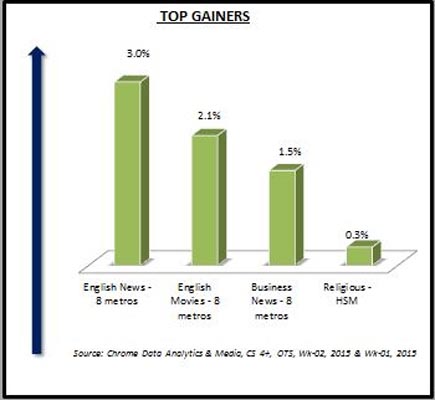
    MUMBAI: The second week of opportunity to see (OTS) collated by Chrome Data Analytic & Media saw maximum hike in the eight metros.


    English News in the eight metros grew by 3 per cent with Times Now continuing its reign on top with 79.8 per cent OTS.


    English Movies and Business News in the eight metros witnessed a jump of 2.1 per cent and 1.5 per cent, respectively. Romedy Now with 69 per cent OTS and CNBC Awaaz with 81.2 per cent OTS gained the most in their respective genres.


    Religious channels in the Hindi speaking markets (HSM) too saw a marginal growth of 0.3 per cent. Aastha continued reigning supreme with 97.1 per cent OTS.


    As for the losers, English Entertainment channels led the way with 1.6 per cent drop in the eight metros. AXN with 59.6 per cent OTS topped the genre.


    Both Infotainment and Kids genres across India witnessed a fall of 0.4 per cent. Discovery with 84.9 per cent OTS and Cartoon Network with 80.7 per cent OTS ranked number one in their respective genres.


    Hindi GECs in the HSM too saw a marginal drop of 0.3 per cent. Sony with 97.3 per cent topped the charts in the category.


  • Hathway Cable gets board nod to hike FII limit to 74 per cent

    Hathway Cable gets board nod to hike FII limit to 74 per cent

    MUMBAI: It was in 2012, when the government had relaxed foreign direct investment (FDI) limit in direct to home (DTH), cable TV industry and teleports from 49 per cent to 74 per cent. In keeping with this, Hathway Cable & Datacom which early this week became the first multi system operator (MSO) to have crossed the $1 billion mark in terms of enterprise valuation, is now probably looking at attracting overseas capital into the company.

    The MSO has in an announcement to the BSE informed that its Board of Directors have approved and passed the resolution to increase the foreign investment limit from the current 49 per cent to 74 per cent, this subject to approval from the Foreign Investment Promotion Board of India, Ministry of Finance and/or the Reserve Bank of India.

    “Subject to receipt of approval of the Foreign Investment Promotion Board of India, Ministry of Finance (FIPB) and / or the Reserve Bank of India (RBI) and all other applicable authorities, increasing the foreign investment limit only by Foreign Institutional Investors, Foreign Portfolio Investors, etc. under the Portfolio Investment Scheme in accordance with Schedules 2 and 2A of the Foreign Exchange Management Act (Transfer or Issue of Security by a Person Resident Outside India) Regulations, 2000 in the Company from 49 per cent to 74 per cent of the issued arid fully paid-up share capital of the Company,” reads the announcement.

    The Hathway Board has also passed the resolution of a postal ballot notice along with the explanatory statement and calendar of events for seeking approval of the shareholders of the Company by postal ballot for its foreign investment proposal.

    According to Hathway Cable & Datacom CEO and MD Jagdish Kumar Pillai, the cable TV sector is becoming lucrative for foreign investors. Pillai had earlier told Indiantelevision.com, “With broadband and cable TV getting more transparent, the market is viewing this as a great industry to invest in the next five years, and that’s reflected in the balance sheet. It is a promise of a good potential.”

    With the industry getting more organised courtesy its digitsation drive, Pillai expects more foreign investors to pump in funds into the cable TV sector.


  • 142 MSOs get 10 year DAS licence for specified areas, 26 denied permission

    142 MSOs get 10 year DAS licence for specified areas, 26 denied permission

    NEW DELHI: A total of 11 multi-system operators (MSOs) from  all over the country have been granted permanent registration for 10 years to operate the digital addressable system (DAS) during the last two months, bringing the total number of registered MSOs to 142 as compared by 131, as on 7 November.

    Most of these MSOs had been given provisional permission earlier.

    The MSOs who have received permission after the last list released of 7 November are Karuvai Communications for DAS areas in Tamil Nadu, Ajana Cable Network for DAS notified area of phase III in Vaijapur, Aurangabad in Maharashtra, New Peime Network DAS notified in Dehradun, Haridwar, Tehri Garhwal, Pauri Garhwal, Rudraprayag, Chamoli Garhwal, and Uttarkashi Districts in Uttarakhand; Jai Mata Di Cable Network for DAS notified areas in Mehendergarh, Rewari, Bhiwani & Jhajjar District of Haryana and Alwar & Jhunjhnu Districts of Rajasthan; Onsky Technology for PAN India; Space Television Network for DAS notified area in Municipal Council of Greater Mumbai in phase I and rest of Maharashtra in phase III; Haldwani Digital Services for the State of Uttarakhand; V. R. Cable for the cities of Kanyakumari, Tuticorin and Chennai in Tamil Nadu; Satellite Cable Communication for phase II, III, and IV areas in Pune District and Nasik District; R.D Cable Network for DAS notified area in Canacona, Quepem, Sanguem and Salcettte in Goa; the Orugallu Communications for DAS notified areas under Phase II,  III and IV in Andhra Pradesh and Telangana;

    The list of MSOs who have been refused permission has gone up to 26 from the earlier figure of 22 with four MSOs being denied permission. Some of those in the cancelled list applied as early as March 2013.

    MSO sources, however, said that the approved list was in addition to the 140 whose names had been approved earlier in March last year.

    The Ministry website mib.nic.in has listed the areas and the date from which the MSOs have been given permission.


  • Broadcom India eyes huge growth potential in cable broadband & OTT services

    Broadcom India eyes huge growth potential in cable broadband & OTT services

    KOLKATA: With digital television (DTV) and digitisation, household penetration is increasing in the country. “There exists tremendous opportunities for cable broadband and over-the-top (OTT) services”, opines Broadcom India managing director Rajiv Kapur.
     
     “The over-the-top television market may still be in its infancy in India, but it holds much promise for the future. The demand for OTT is going up. There are progressive operators who have been talking about value-added services. Internet entertainment on TV is on the rise,” says Kapur.
     
    Looking ahead, “one can see existing television sets transformed into smart TVs, enabling internet applications everywhere in the home,” adds Kapur. “We are expanding the options for entertainment in the home.  We are revolutionizing television by providing a full-range of platform solutions for content-sharing and video streaming throughout the home,” he further informs.
     
    Broadcom’s video and broadband solutions enables service providers offer a high-quality, TV-watching experience to its subscribers along with high-speed internet browsing.
     
    He went on to explain Broadcom’s role in OTT and broadband services through Set Top Boxes (STBs). Kapur says that the company constantly educates and trains various operators on the OTT services.
     
    India is currently witnessing the digitisation of analog cable TV signals as mandated by the Ministry of Information and Broadcasting (I&B). With digitisation, analog cable subscribers have been also migrating largely to digital cable, which has gained about 10 million subscribers in 2013, while net DTH subscribers increased by approximately three million.
     
    Post digitisation, while the viewing experience and expectations of the subscribers are soaring, it has also increased the demand for high-speed broadband.
     
    As per the Cisco Visual Networking Index 2014, in India, mobile data traffic will grow by a colossal 24-fold from 2013 to 2018, a Compound Annual Growth Rate (CAGR) of 88 per cent and Internet-Video-to-TV traffic will increase 8-fold between 2013 and 2018 (50.9 per cent CAGR).
     
    “Consumers are now more acutely aware about the content on their portable devices and the TV”, he further adds.
     
    As the users evolve with digital content streamed to them, the demand for OTT services increases.
     
    It should also be noted that in a report borne out by PricewaterhouseCoopers (PwC) survey, it forecasts 176 million OTT viewers by 2015 generating revenues of $552 million.


    Moreover, Morgan Stanley, a multinational financial services company, projects in its report that mobile data subscribers in India are likely to grow on an average by 25 per cent every year to reach 519 million by fiscal 2018, driven by falling handset prices and rise in smart phone usage and penetration.


    ‘With Wi-Fi internet access, end-users are looking for enhanced ways to communicate with large format screens too,” S Rajagopalan, a media analyst opines.


    “With this, users can also use Smart TV, though the interface is not user-friendly. The manufacturer, therefore, has to innovate with the interface, such as Flex Smartphone or Bluetooth / Wi-Fi-enabled keyboard to be integrated, which will grab the attention of the end-user. Maybe over a period of time, Smart TV will be preferred by the end-user to laptops, which will lead to more speed and bandwidth in the broadband segment,” concludes Rajagopalan.

  • Hathway Cable becomes India’s first $1bn enterprise valuation MSO

    Hathway Cable becomes India’s first $1bn enterprise valuation MSO

    MUMBAI: New year celebrations don’t seem to have ended at the Raheja group company and multi system operator Hathway Cable & Datacom. The MSO has become the first company from the cable TV industry to have crossed the $1 billion mark in terms of enterprise valuation.

    At the time of filing the report, as on 6 January 2015, (1 USD= 63.4286 INR mid- market rate), the total valuation of the company including market cap (Rs 5581 crore) and debt (Rs 806 crore) and excluding cash and cash equivalents  was close to $ 1 billion (Rs 6387 crore).  

    Hathway Cable & Datacom MD and CEO Jagdish Kumar Pillai is over the moon with this feat.  Says he, “This achievement has got more to do with the potential of the Indian cable TV market, and not just with what Hathway does.”

     For Pillai, digitisation has opened up the potential of unlocking the value that Indian cable TV industry holds. “With broadband and cable TV getting more transparent, the market is viewing this as a great industry to invest in the next five years, and that’s reflected in the balance sheet. It is a promise of a good potential,” he opines.

    With the industry getting more organised, Pillai expects more foreign investors to pump in funds into cable TV. “And that is what Hathway is doing. We are corporatising the whole industry and bringing the professionals to run our business. We have invested heavily in computer software and automation. It has become more like a telecom company. We expect a lot of investment interest in the industry now,” he adds.

    Pillai feels that it is Hathway’s broadband service which differentiates the company from the other players. “Our broadband service is strong and that has, along with our strong CATV, helped us reach at this level,” he says.  

    The plan for Hathway from here is clear: monetisation of the investments made in the phase I and II markets. “We have deployed 7 million set top boxes in the first two phases of DAS and we would like to monetise that. Also as we get closer to phase III and IV deadlines, we will look at opportunities which will enable us to expand further,” he informs.

    As for broadband, Hathway which has already upgraded its platform to DOCSIS 3.0, is looking at expanding to all the cities in which it has a presence.  “The investment will be two-fold, both in broadband and in cable TV,” concludes Pillai.

    Coming on the back of the announcement that the Videocon group has signed an agreement with US-based Silver Eagle Acquisition Corp to sell 33.5 per cent of its shares in its DTH venture Videocon d2h for $300 million, the Hathway landmark shows that confidence amongst investors for TV distribution initiatives seems to be reviving. And that’s good news for the entire TV ecosystem which has been struggling to digitise its TV viewer base.


  • MSO’s request govt to set up regional units to facilitate DAS registrations

    MSO’s request govt to set up regional units to facilitate DAS registrations

    NEW DELHI: Even as the government has agreed to consider extension of four to five weeks for registration of multi system operators (MSO), who want to opt for phase III of the Digital Addressable System (DAS), the government has been asked to consider setting up regional units to facilitate such registrations.

    Speaking at the task force meeting last week, several stakeholders also wanted online registration for MSO’s wanting to enter their names for phase III.

    Ministry additional secretary J S Mathur, who chaired the meeting, also said that meetings were being organised between manufacturers of indigenous set top boxes and the Ministry of Information and Technology.

    Mathur responding to queries from some MSO’s wanted them to prepare a list of areas in phase III which were currently not being reached by cable television. A member had pointed out that a Headend In The Sky (HITS) platform could be used in such areas.

    Some consumer organisations which are part of the task force, said they will need to organise workshops in different parts of the country to help people understand DAS.  

    The Confederation of Indian Industry (CII) representatives said that the association was planning such workshops in Kerala and Guwahati. Mathur asked CII to give him details of the workshops when they are scheduled.

    Mathur regretted that the number of stakeholders attending the meetings was very minimal and expressed hope that later meetings will be attended by larger number of members.

    In the last meeting it had been announced that the task force would meet every month to ensure deadlines are met and phase III of DAS comes into operation by December 2016.


  • TRAI managed to give broadcasting as much importance as telecom in 2014

    TRAI managed to give broadcasting as much importance as telecom in 2014

    NEW DELHI: A decade after broadcasting was handed over to it, the Telecom Regulatory Authority of India (TRAI) appears to have given equal if not more time to the broadcasting sector, thanks largely to convergence of technology.

    Thus, issues like spectrum, marketing and even FM radio have got equal space during the Regulator’s work as telecom, apart from the digital addressable system (DAS) introduced in 2011.

    TRAI also mastered the art of marketing during the year 2014. It developed radio jingles in Hindi, English and 10 regional languages on VAS/UCC which were aired on various FM channels in 84 cities across the country for one week in the months of June, July, August and October 2014.

     Admitting in its annual report that it had failed to carry out periodic reviews to make inflation- linked adjustments, TRAI said it had finally done so in concurrence with the Supreme Court. Thereafter it issued two tariff orders on 31 March and 31 December as far as broadcasting was concerned.

    Based on the rise in the wholesale price index (WPI) over the last five years and considering other relevant factors, the Authority came to a conclusion that an overall 27.5 per cent inflation hike is to be allowed, both at the wholesale and retail levels. Taking into account the consumer’s interest, the Authority prescribed that this hike be implemented in two installments. The first installment of 15 per cent was made effective from 1 April 2014. This was notified vide the Telecommunications (Broadcasting & Cable) Services (Second) Tariff (Eleventh Amendment) Order 2014 dated 31 March 2014. The second installment for the remaining inflation-linked increase has been made effective from 1 January 2015. This is expected to give adequate and reasonable time to all stakeholders to adjust to these hikes. To take care of the second installment of the inflation linked hike, the Authority notified the Telecommunications (Broadcasting & Cable) Services (Second) Tariff (Thirteenth Amendment) Order 2014 dated 31 December 2014.

    In a matter relating to a tariff order prescribing tariffs for commercial subscribers, the Supreme Court in April 2014, asked TRAI to come out with a new tariff dispensation for such subscribers. Accordingly, on 16 July and 18 July 2014, TRAI notified amendments to tariff orders / regulations pertaining to commercial subscribers of broadcasting and cable TV services. These amendments bring in clarity regarding the manner of distribution of TV signals to commercial subscribers, prescribe tariffs based on intended use of the TV signals, and aim to enhance transparency in tariff regulation.

    During phase I and phase II of digitisation of cable TV sector, it was noticed that the authorised agents/aggregators of the broadcasters were forming large bouquets, combining channels of different broadcasters and forcing it on the DPOs viz. cable, DTH, HITS and IP TV operators. This was resulting in distortions in the market. Incidentally, the Ministry of Information and Broadcasting (MIB) had also sent a reference to TRAI requesting for a review of the regulatory framework with regard to aggregators. The amendments aim at contributing to the orderly growth and overall development of the sector by streamlining the distribution of TV channels from broadcasters to DPOs. The salient provisions in these amendments are:

     A broadcaster is now defined as an entity having the necessary government permissions in its name. Only the broadcaster shall publish the Reference Interconnect Offers (RIOs) and enter into interconnection agreements with DPOs. However, in case a broadcaster, in discharge of its regulatory obligations, is using the services of an agent, such authorised agent can only act in the name of and on behalf of the broadcaster.

    As far as FM radio is concerned, TRAI on the request of MIB made recommendations on the amount of migration fee to be charged from existing FM operators on their migration from Phase-II to Phase-III of FM Radio Broadcasting. The permissions for operating FM Radio as per Phase-II policy were granted by MIB during the period 2005 to 2009 in 86 cities. As per the Phase-II policy, the permissions were granted for a period of 10 years to each FM Radio operator and there is no provision for extension of permission in the Phase-II policy.

    Therefore, Phase-II permissions will start expiring from 31 March 2015 onwards. There was no great incentive for an existing operator to pay a migration fee and operate as per the Phase-III policy only for the balance period of Phase-II permissions. Accordingly, the Authority in its recommendations on ‘Migration of FM Radio Broadcasters from Phase-II to Phase-III’ dated 20 February 2014 recommended a period of permission of 15 years after migration from Phase-II to Phase-III. The salient features of the recommendations are:
    TRAI reiterated early implementation of its recommendations on minimum channel spacing of 400 KHz for FM radio broadcast issued on 19 April 2012, which will in effect increase the number FM channels in each city for auction. The period of permission to operate the existing FM channels on migration from Phase-II to Phase-III will be 15 years.

    In the DTH Guidelines, under which licenses are issued to DTH operators, there is no explicit provision for an extension or a renewal of the licenses on completion of the license period. In this regard, the MIB sought recommendations of TRAI. After examination, the Authority concluded that to allow the DTH operators to continue their business after the expiry of the stipulated 10 year license period, the government will have to issue a new license. Accordingly, the Authority looked at the issues concerning the DTH sector holistically and, after following the due consultation process, sent its recommendations to the MIB on “Issues related to New DTH Licenses” on 23 July, 2014.

     Apart from removing the ambiguity over renewal of licenses, these recommendations suggest that the government came out with a new licensing regime for DTH sector which, amongst others, allows for longer license period, rationalised license fee, rationalised and regulated cross-holding and vertical integration between broadcasters and distribution platform operators including DTH operators. The recommendations also suggest a mechanism for migration of operators from the existing regime to the new regime. A new licensing regime, incorporating the provisions in the said recommendations, is expected to bring in, amongst others, certainty in DTH business, ease taxation pressures, attract better investments in the sector etc. and, thereby, promoting the overall efficiency in DTH operations.

     Ensuring plurality of voices in the media, that is, availability of fair, balanced and unbiased representation of a wide range of opinions and views, is critical for any democratic polity. Ensuring both external plurality, namely multiple voices in the national media market, and internal plurality, that is presentation of a range of facts and news in an unbiased manner by a media outlet, are fundamental in the working of a democracy.

    Regulatory restrictions on cross-media holdings seek to ensure external plurality in the media market, while restrictions in vertical holding by any entity of a broadcaster and a distribution entity are important to ensure that the distribution channels remain open to all desirous of presenting an opinion or view to the public. Finally, content regulation is critical in a time when news is increasingly seen as an asset belonging to a media entity’s owners to be monetized for political/ business/ or pecuniary gain.

    Recommendations on “Issues related to Media Ownership” were issued on 12 August

    The key issues addressed and the concerned recommendations included defining who owns a media entity and controls it – in brief, an entity that possess not less than 50 per cent of voting rights in the media entity or can appoint more than 50 per cent of the members of its board of directors will be deemed to control it. The Recommendations also take into consideration control through debt, and has recommended the loan threshold that will deem the lender to be in control of a media entity.

    The restrictions recommended on cross-media ownership apply on the media entities that cover news and current affairs genres in the television and print segments only, as impact of radio and internet in India on opinion formation is marginal. In the print segment, only daily newspapers, including business and financial newspapers, should be considered.
    The MIB had sent a reference to TRAI seeking recommendations of the Authority on extension of permission granted to Community Radio Stations (CRS) in India. According to the 2006 Policy Guidelines for CRSs, the period of validity of Grant of Permission Agreements (GOPA) is five years and the guidelines contain no provisions for the renewal/ extension of permissions. The validity of the GOPAs issued under these Guidelines for some of the CRSs, had expired on completion of five years, requiring them to stop operating. The Authority, therefore, in an interim reply suggested continuation of the GOPAs on the same terms and conditions.

    CRS are an important medium for empowerment and social development of the local communities. Therefore, going beyond the terms of reference from MIB, the Authority in a pre- consultation process sought inputs from CRS permission holders on the issues relevant for the growth of CRS in the country based on their experiences over the past decade. Several responses were received; these inter alia included comments on procedural matters; technical issues; content; aid and assistance.

    In addition to the issues highlighted, the Authority also noted the important role, the CRS play in serving the local communities by providing relevant information/alerts during natural calamities and emergency situations. The Authority, after analysing all issues comprehensively, sent ‘Recommendations on Issues related Community Radio Stations’ to MIB on 29 August, 2014. The salient features of the recommendations included initial permission for operating a CRS to be five years; extension of permission for five years at a time, to be allowed following performance evaluation; and CRS to be allowed to broadcast locally relevant news and current affairs content sourced exclusively from AIR, in its original form or translated into the local language/ dialect.

    MIB sent references to the Authority to provide its recommendations on issues relating to ground based channels being operated by cable TV operators and programming services being offered by DTH service providers to their subscribers. Collectively these kinds of programming services provided by the Distribution Platform Operators (DPOs) are referred to as Platform Services (PS).

    At present, the PS offered by DPOs are not subject to any specific regulations or guidelines. Similarly, there are several ground-based broadcasters who provided local TV channels to cable operators for distribution which are also not covered by any specific regulations. Since, all of these platform services and local channels are being operated and distributed without even a simple registration system in place; the possible impact of the content carried on these channels on the law and order/ security situation is a cause for concern. In addition, the differentiated treatment under the different policy guidelines applicable to the different types of DPOs has to be addressed, to provide for similar regulatory frameworks for what after all are inter-changeable services. Therefore, there is an urgent need to establish a simple, robust and fair regulatory system that addresses all concerns regarding the PS being distributed on cable TV networks.

    After an extensive consultation process in which open houses discussions were held with stakeholders in all four regions in India, the Authority forwarded its recommendations on ‘Regulatory framework for Platform services’ to the government on 19 November 2014.
     

  • TRAI rationalises tariff for non-DAS areas, providing for inflation

    TRAI rationalises tariff for non-DAS areas, providing for inflation

    NEW DELHI: Meeting a long-felt demand, the Telecom Regulatory Authority of India (TRAI) has decided to allow the balance inflation linked hike both at the retail and wholesale levels, from 1 January 2015.

    The Telecommunication (Broadcasting and Cable) Services (Second) Tariff (Thirteenth Amendment) Order 2014 applicable for non-addressable (analogue cable TV) systems prescribes ceiling retail tariff on pan-India basis depending upon the number of pay and free-to-air (FTA) channels.

    The ceilings are Rs 117 per month for minimum of 30 FTA channels; Rs 234 per month for minimum 30 FTA channels and up to 20 pay channels; and Rs 292 per month for minimum 30 FTA channels and more than 20 pay channels.

     At the wholesale level, price ceilings will continue, subject to inflationary adjustments allowed from time to time.

    TRAI said the order was aimed at rationalising retail tariff and simplifying implementation. The Authority had undertaken a similar exercise in April 2014. 

  • 2014: A year of improved subscriber numbers

    2014: A year of improved subscriber numbers

    The year 2014 has been better than the previous year, in terms of the share of numbers for all direct to home (DTH) players. Subscriber additions were higher and there was more stability in the overall industry. In terms of price discounting, people were more rational through the year. Overall, it has been a much better year than 2013.

    Increased subscriber numbers and ARPU

    Overall additions in subscribers, for all the DTH players, were higher in the magnitude of 25-30 per cent than the previous year.

    That apart, the churn came down substantially, not only for Dish TV, but for all the other DTH players as well.

    2014 also saw a rise in the Average Revenue Per User (ARPU). But there are still problems, since the whole cable TV system hasn’t stabilised and gross billing hasn’t been fully implemented. Though, we do see some encouraging signs, in terms of people getting down to doing that now.

    DTH has been able to take price increases through the year. There was a price increase which took place in April, at the magnitude of 8-9 per cent. But the big collection from the ground will happen only once cable TV gets its act together.

    Different people calculate ARPU differently. For example, Dish TV calculates it on subscriber revenue, whereas Airtel Digital TV, as per its published figures, looks at gross numbers, and so do others. So there is no common matrix being used across the industry for definition of ARPU. But having said that, at the consumer level, the consumer prices are in the average price range of Rs 250-275.

    Challenges in 2014

    One of the major challenges that we continue to present to both the state and central government is on the high level of taxation on DTH. Apart from the taxation element which we have been presenting, we are the only industry which is subject to service tax and entertainment tax. While we were hoping for some relief in the last budget, we didn’t get that, we hope we will get some relief in the coming year.

    Secondly, there is no clarity on the licence fee issue, even though the Telecom Regulatory Authority of India (TRAI) issued a recommendation, there has been no action on that front.

    So while we lived in continued uncertainty in 2014, we hope that the government will take some steps in 2015. People have invested more than Rs 25000 crore in the industry, so at least we have the right to know what the law of the land will be going forward.

    The new launch Zing

    It has been an extremely successful product in all the geographies we launched. The specific proposition that we had, which was regional first and targeting the entire product mix around consumption has clicked very well with the customers. So we are very pleased with the way things have come.

    Highs and lows of 2014

     For Dish TV, it has been a fairly stable year. We regained our share leadership for about last three to four quarters. We launched a significant and tactical product in Zing which has helped us capitalize on the phase III and IV areas. The high point has been that we have been able to, post the balance sheet adjustment that we did last year, been able to get back on the growth path, which is what we have always said and we achieved that in 2014.

    The low point is at two levels: At one level, the whole issue of taxation and licence fee kept dragging for the whole year. Secondly, we expected the cable TV and broadcaster system to stabilize the whole regime. The whole issue of getting proper addressability and customers to actually choose and compare products has still not happened.

    Delayed Digitisation

    First and foremost, the manner of digitisation needs to be addressed. What has happened in the first two phases is simply the change of pipe. This has not been supported by addressability and that is the reason there has been no or marginal change in the revenue flow.

     Until and unless these issues are addressed, a non-addressable digitisation is of no help to anybody, neither to the government nor the stakeholders. We hope that by the time they get down to it, we will have some better roadmap of how to achieve that.


    (These are purely personal views of Dish TV CEO R C Venkateish and indiantelevision.com does not necessarily subscribe to these views)